In the name of
God
1
2
Institute for Advanced Studies in Basic Sciences
Time in distributed systems
Mohammad Amid Abbasi - Asieh Hajtaghi
Teacher: Dr Z.Narimani
Spring 2018
3
vIntroduction
vPartial Ordering
vTotal ordering
vConclusion
vFuture works
Contents
Introduction
5
What is a Distributed System?
A distributed system is a collection of independent computers that appear to the users of
the system as a single computer.
[Andrew Tanenbaum]
A distributed system is several computers doing something together. Thus, a distributed
system has three primary characteristics: multiple computers, interconnections, and shared
state.
[Michael Schroeder]
6
Why do these definitions look inadequate to us?
Because we are interested in the insides of a distributed
system
v design and implementation
v Maintenance
v Algorithmics (“protocols” or “distributed algorithms”)
7
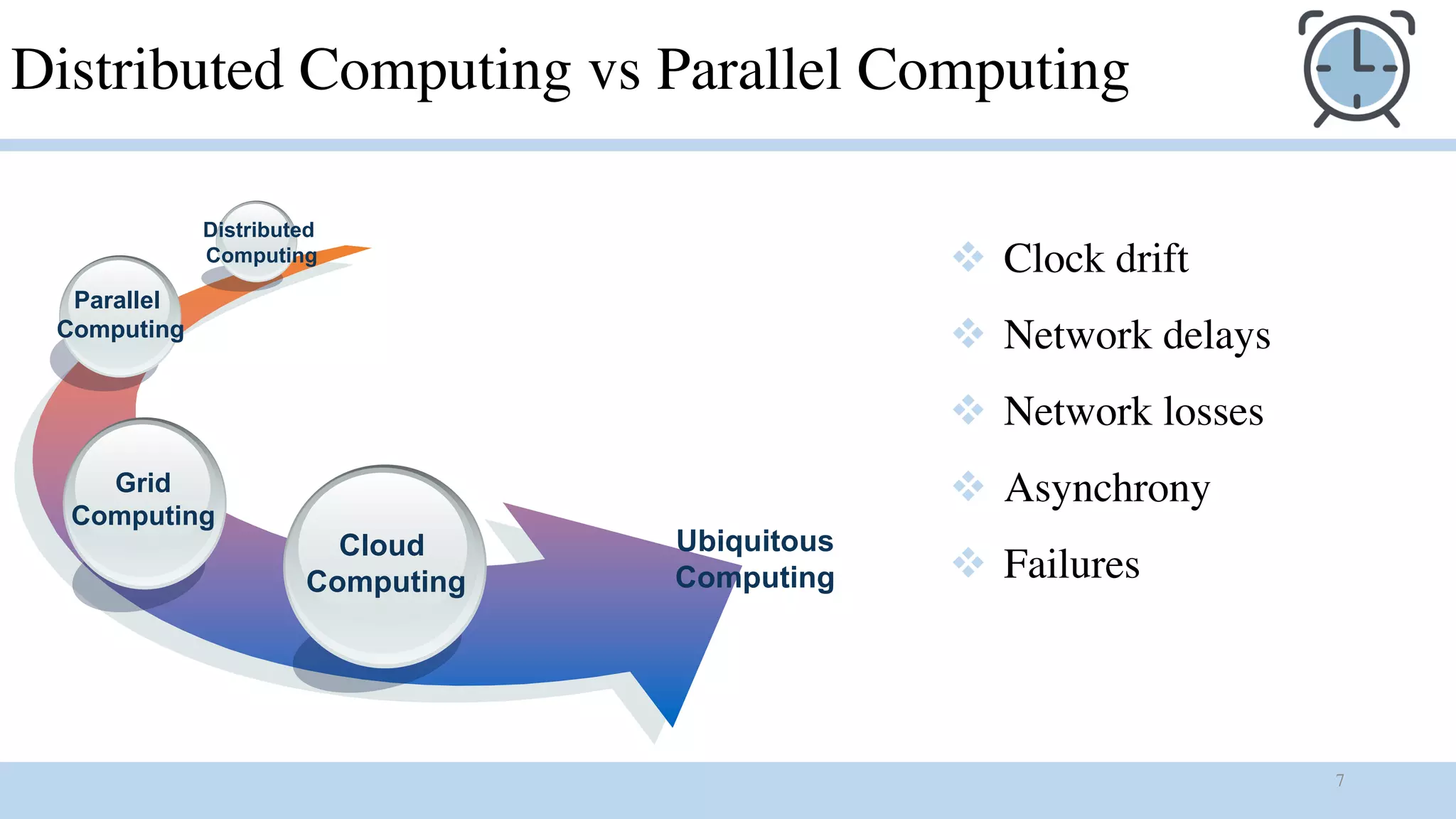
Distributed Computing vs Parallel Computing
Cloud
Computing
Grid
Computing
Parallel
Computing
Distributed
Computing
Ubiquitous
Computing
v Clock drift
v Network delays
v Network losses
v Asynchrony
v Failures
8
About Time
v “Time is what keeps everything from happening at once.” Ray cummings
v The concept of time is fundamental to our way of thinking. It is derived
from the more basic concept of the order in which events occur.
v Time in a computer:
v How do computers keep track of wall clock time?
RTC and NTP
v How do operating systems know when to switch processes and otherwise schedule events?
clock interrupt
v How do applications measure the passage of time?
system calls
9
Synchronization is important
v Bus caching example
v Cloud airline reservation system example
v Ordering events
10
Why is it challenging?
v Physical clocks are inaccurate and we have uncertainty in network
v It is impossible to maintain a single global notion of time
v Clocks cannot be synchronized perfectly across a distributed system
v Unlike processors (CPUs) within one server which can share a system
clock
11
Synchronous vs asynchronous
v Process execution speed
v Message transmission delays
v Clock drift rate
v A protocol for an asynchronous system will also work for a synchronous
system (though not vice-versa)
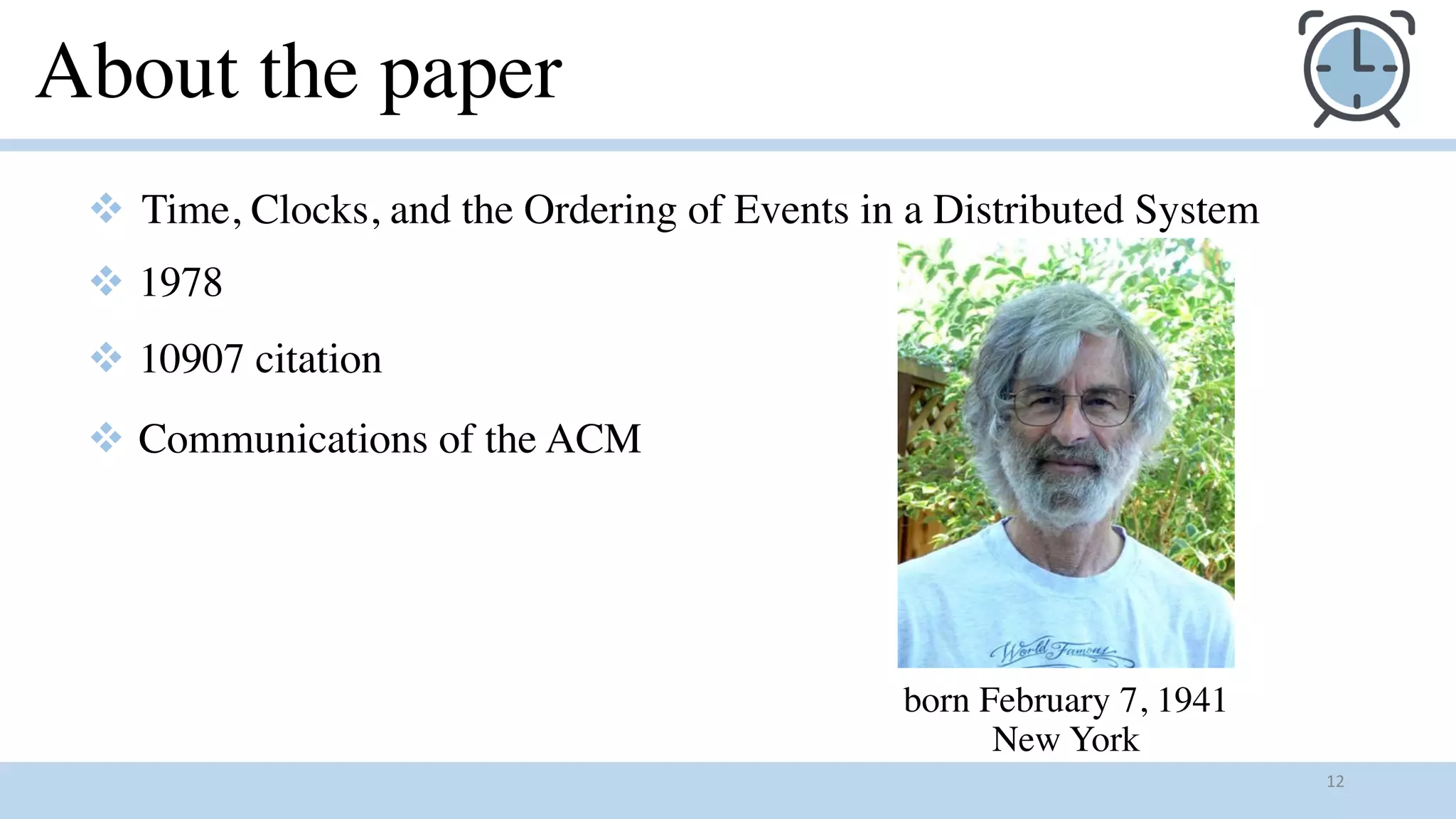
born February 7, 1941
New York
12
v Time, Clocks, and the Ordering of Events in a Distributed System
v 1978
v 10907 citation
v Communications of the ACM
About the paper
13
We begin by defining our system more precisely
v An Asynchronous Distributed System consists of a number of processes
v Each process has a state (values of variables).
v State of a may change as a result of a computation step or communication
step
v An event is an abstraction to represent steps performed by a process
v Each process has a local clock, which may drift
14
We begin by defining our system more precisely
v Each process has a local clock – events within a process can be assigned
timestamps, and thus ordered linearly.
v But – in a distributed system, we also need to know the time order of
events across different processes.
v Event types in a message passing system:
v Compute event
v Send event
v Receive event
15
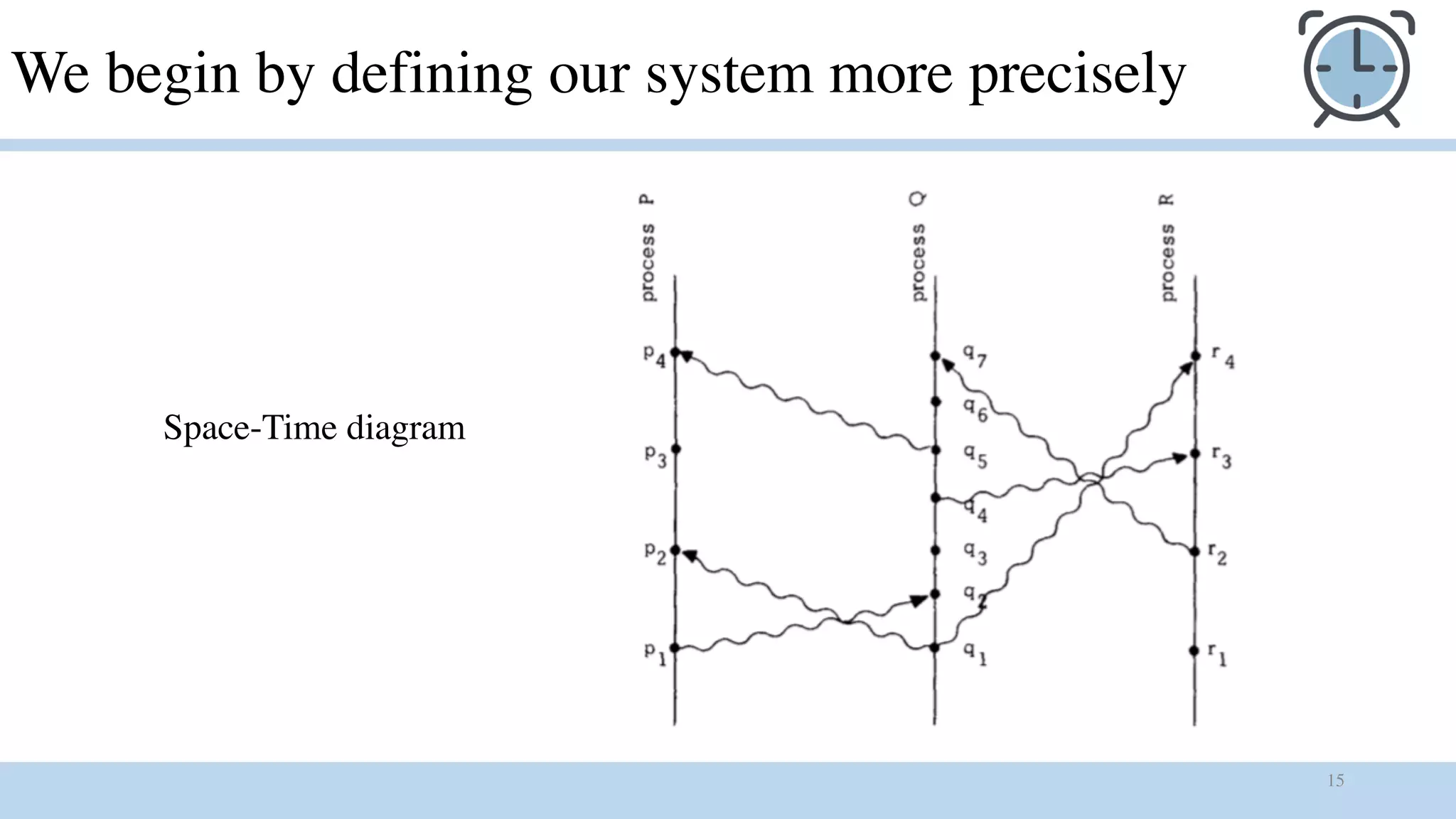
We begin by defining our system more precisely
Space-Time diagram
16
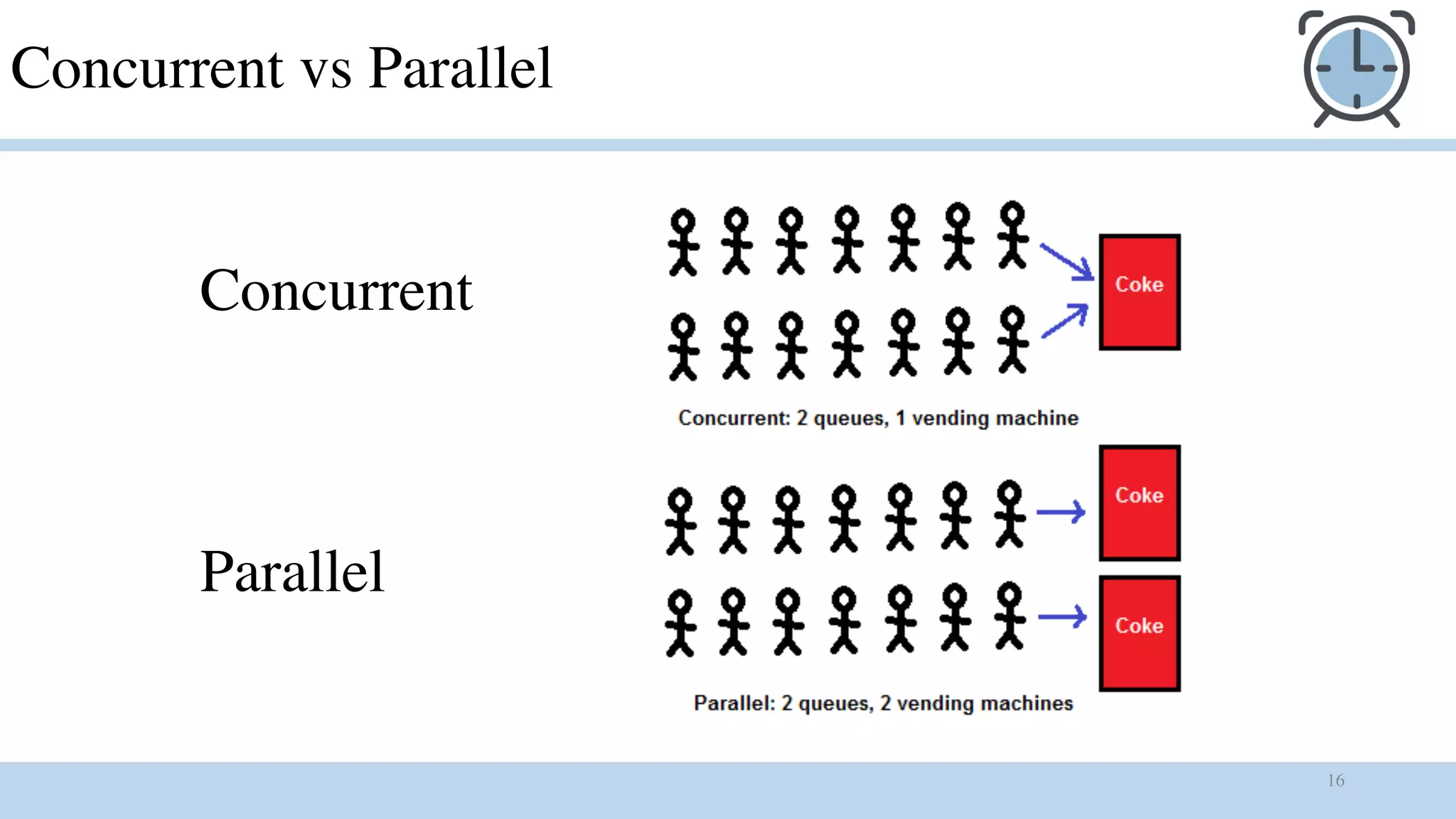
Concurrent vs Parallel
Parallel
Concurrent
17
Ordering of events
v We have no global clock
v Physical clocks are inaccurate
v And we need to ordering the events
Partial ordering
19
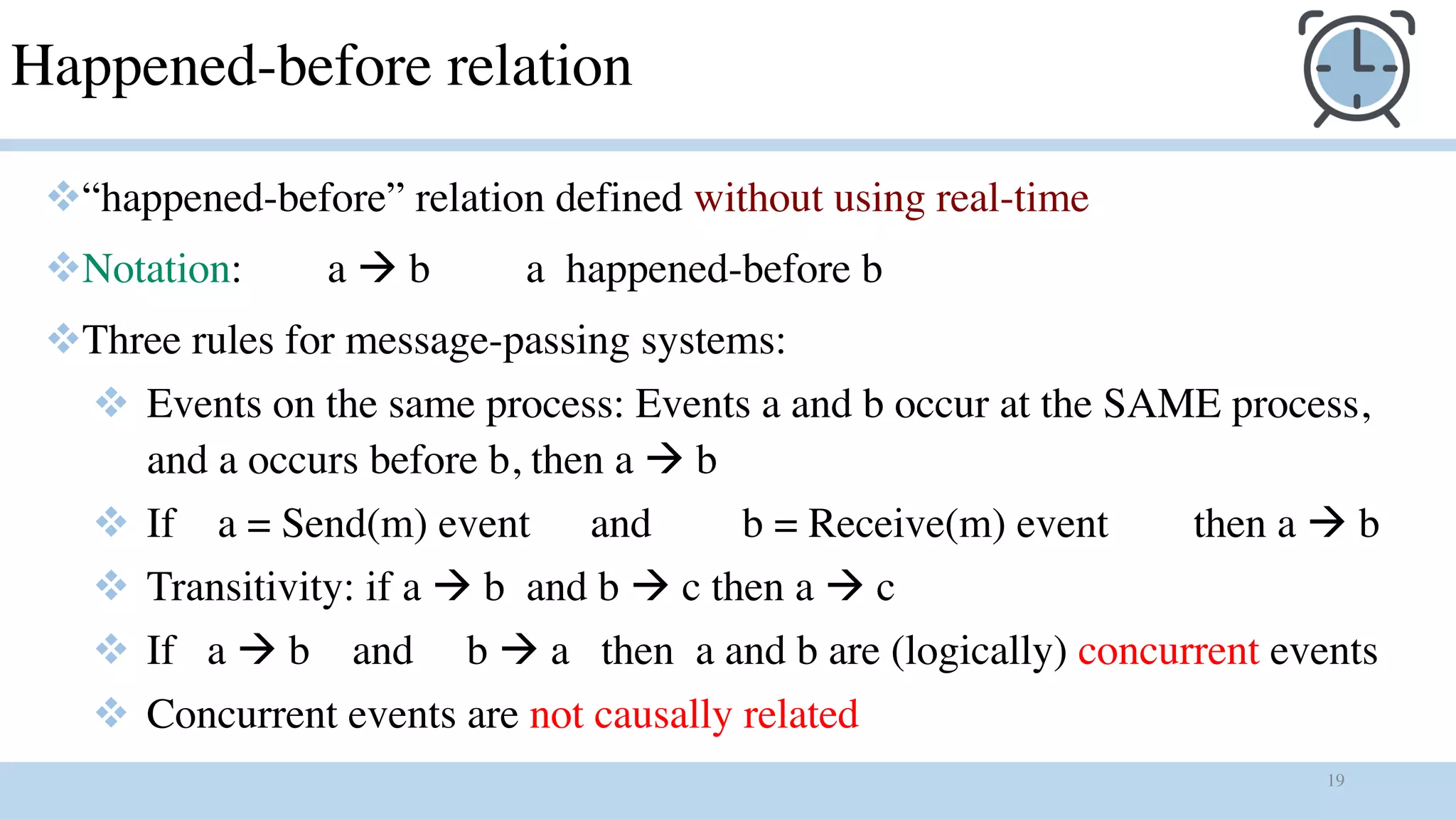
Happened-before relation
v“happened-before” relation defined without using real-time
vNotation: a à b a happened-before b
vThree rules for message-passing systems:
v Events on the same process: Events a and b occur at the SAME process,
and a occurs before b, then a à b
v If a = Send(m) event and b = Receive(m) event then a à b
v Transitivity: if a à b and b à c then a à c
v If a à b and b à a then a and b are (logically) concurrent events
v Concurrent events are not causally related
20
Happened-before relation
p1
p2
p3
a b
c d
e f
m1
m2
Physical
time
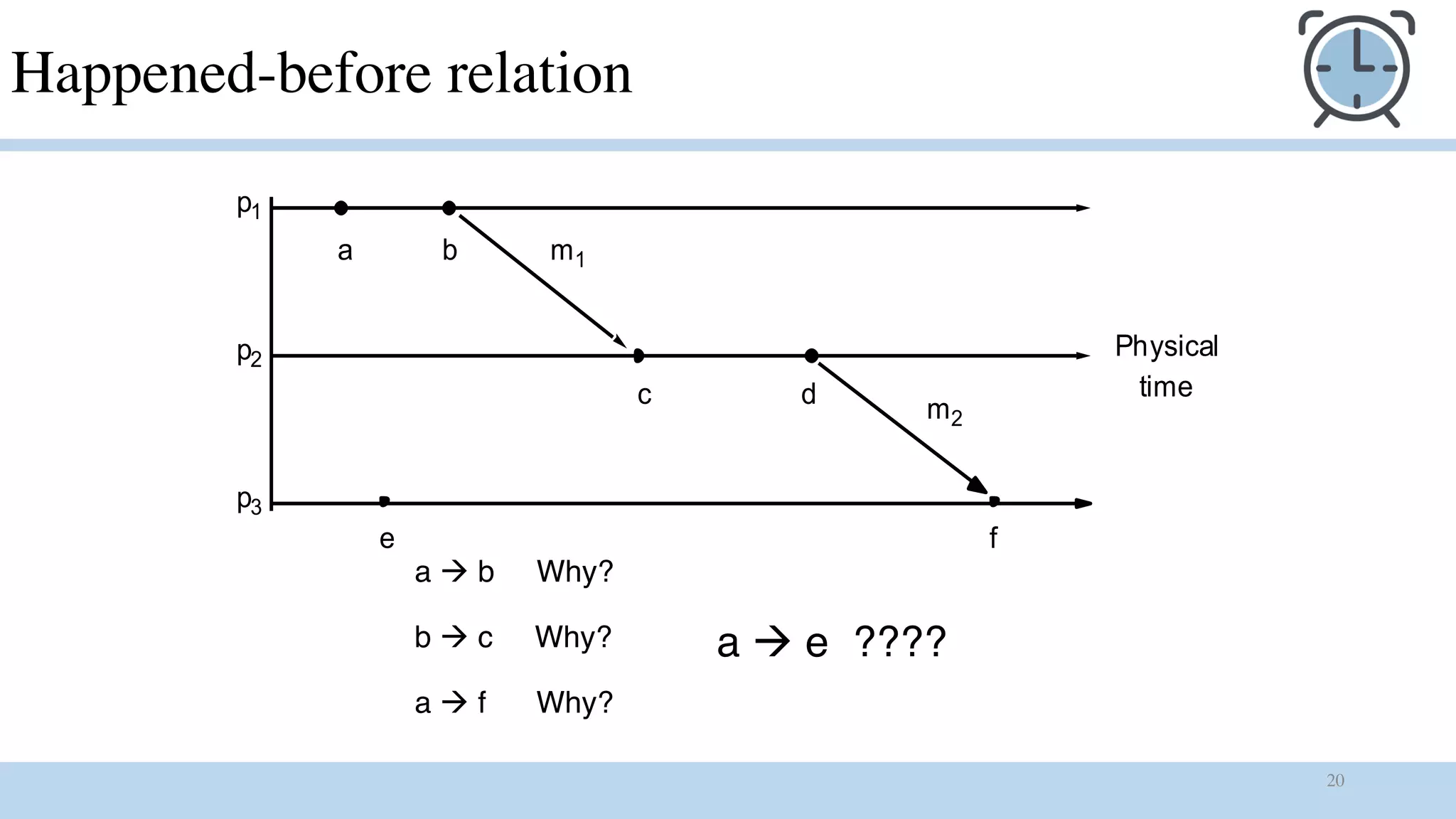
a à b Why?
b à c Why?
a à f Why?
a à e ????
Total ordering
22
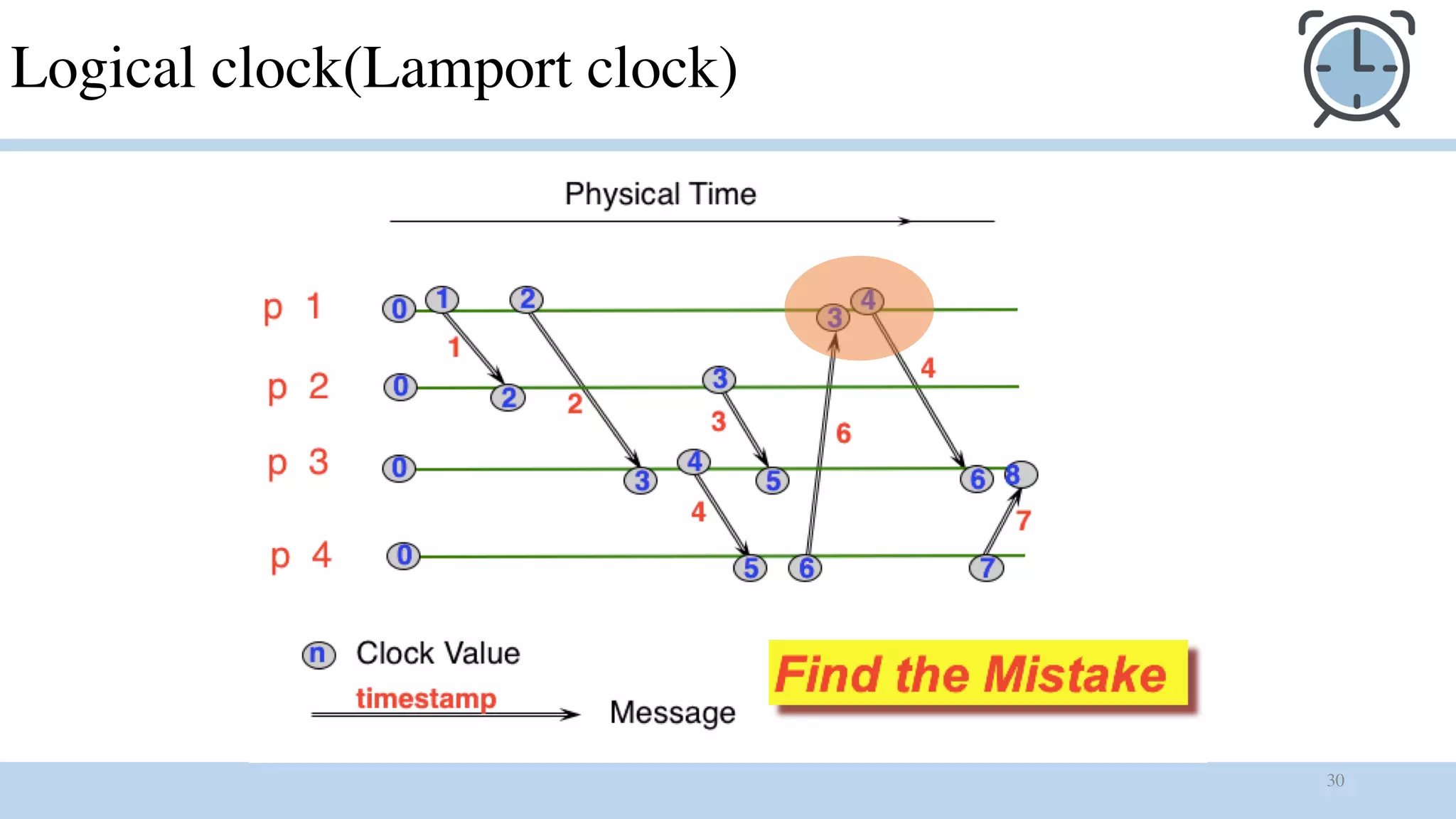
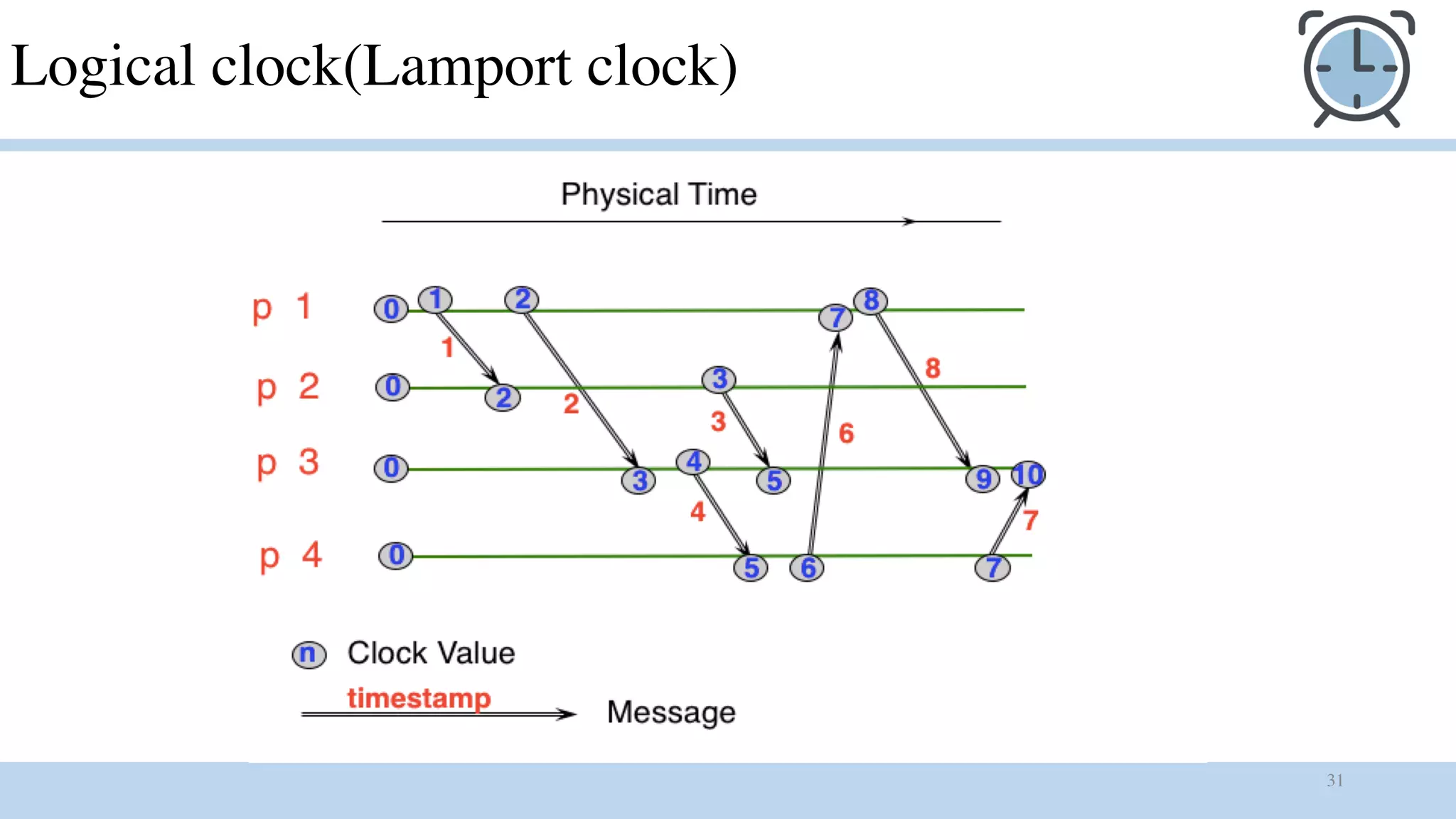
Logical clock(Lamport clock)
v Relation before Creates a partial order among events
v Used in almost all distributed systems since then
v Almost all cloud computing systems use some form of logical ordering of
events
v Goal: Assign logical (Lamport) timestamp to each event (ordering the
events totally)
23
Logical clock(Lamport clock)
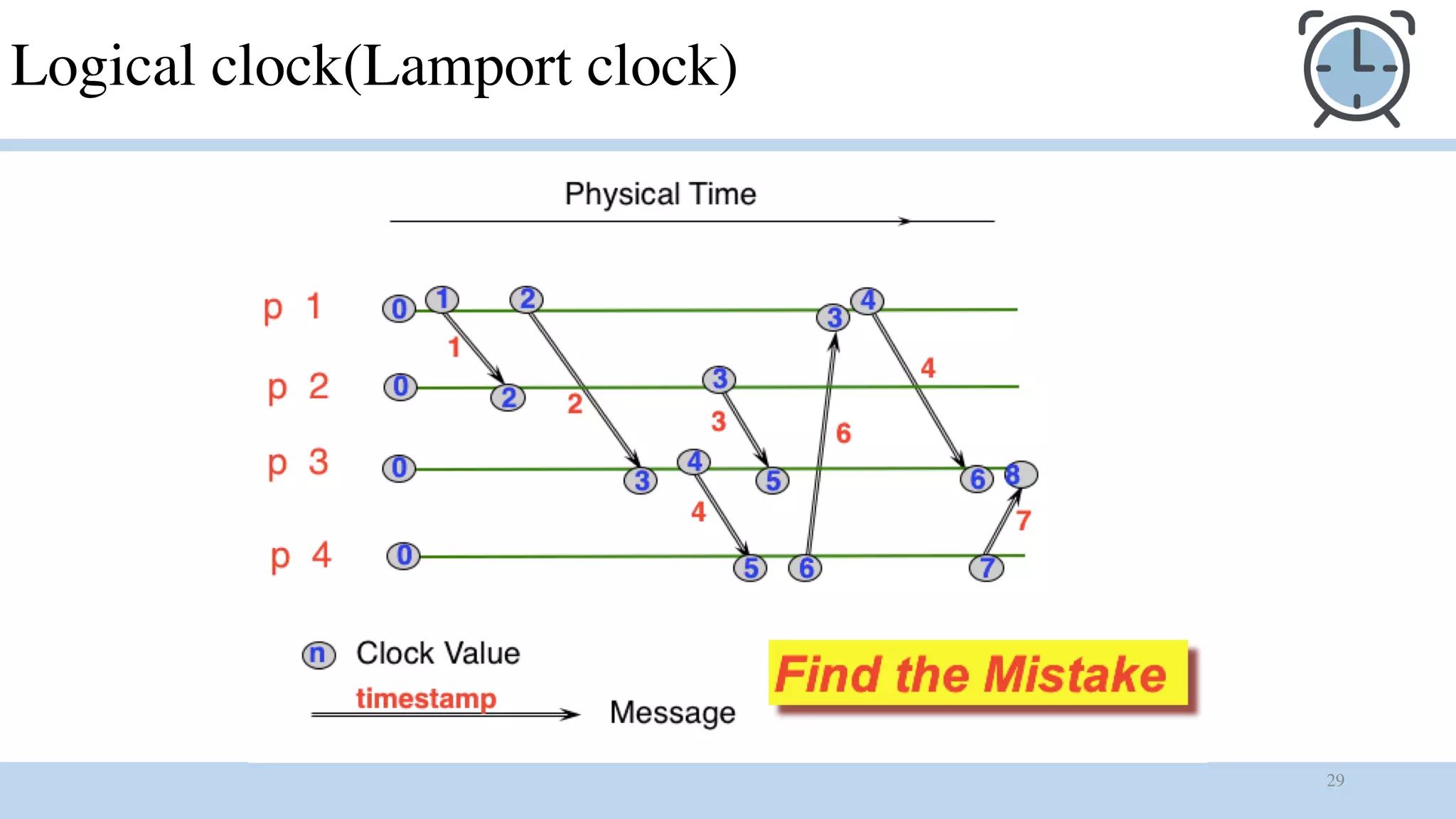
vEach process Pi maintains a logical clock Li(a local counter which is an
integer)
vIntialialize Li = 0 at the start of the process
vWe will describe how timestamps are updated for each type of event
separately
24
Logical clock(Lamport clock)
vEach process Pi maintains a logical clock Li(a local counter which is an
integer)
vIntialialize Li = 0 at the start of the process
vWe will describe how timestamps are updated for each type of event
separately
25
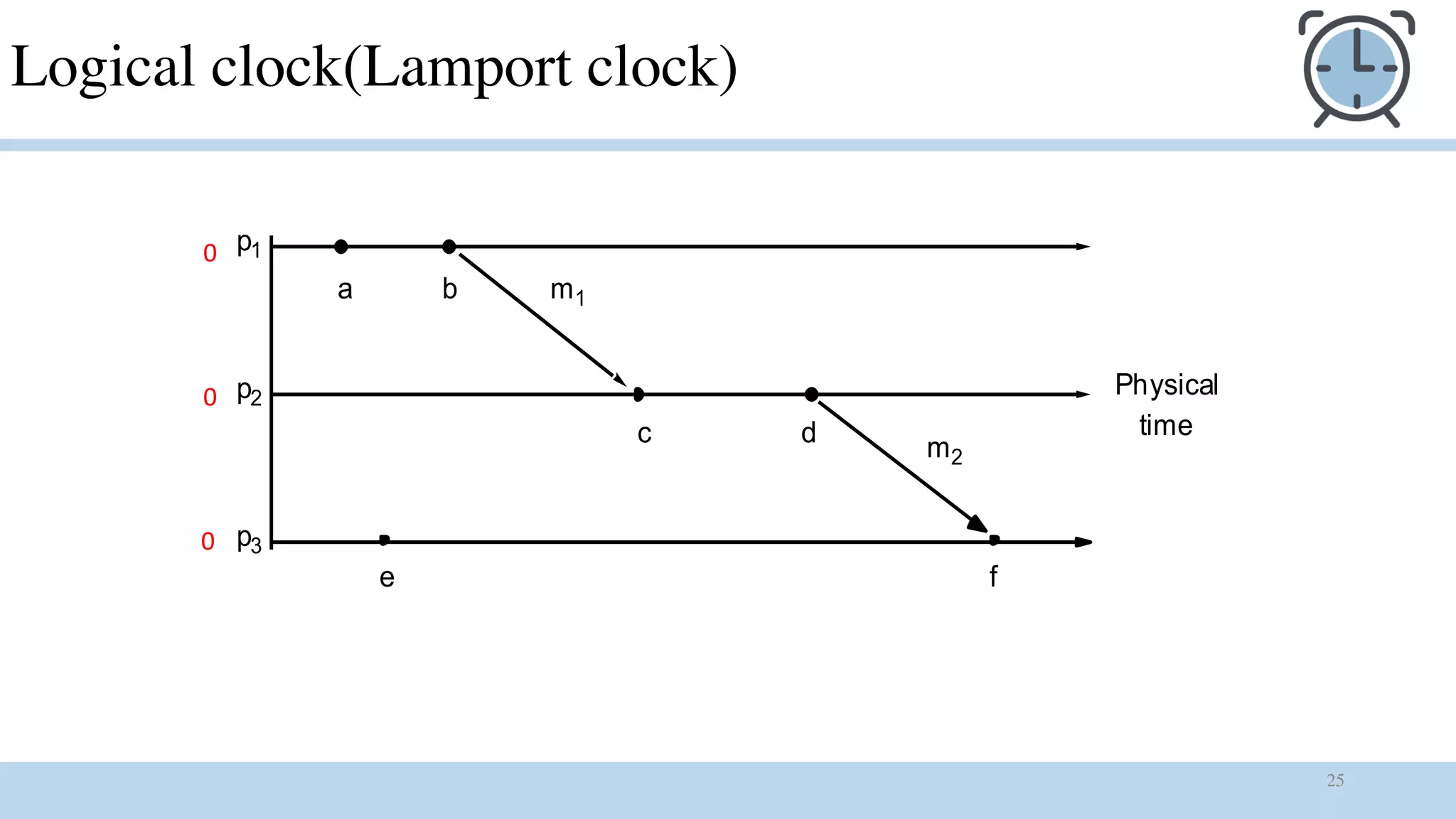
Logical clock(Lamport clock)
p1
p2
p3
a b
c d
e f
m1
m2
Physical
time
0
0
0
26
Logical clock(Lamport clock)
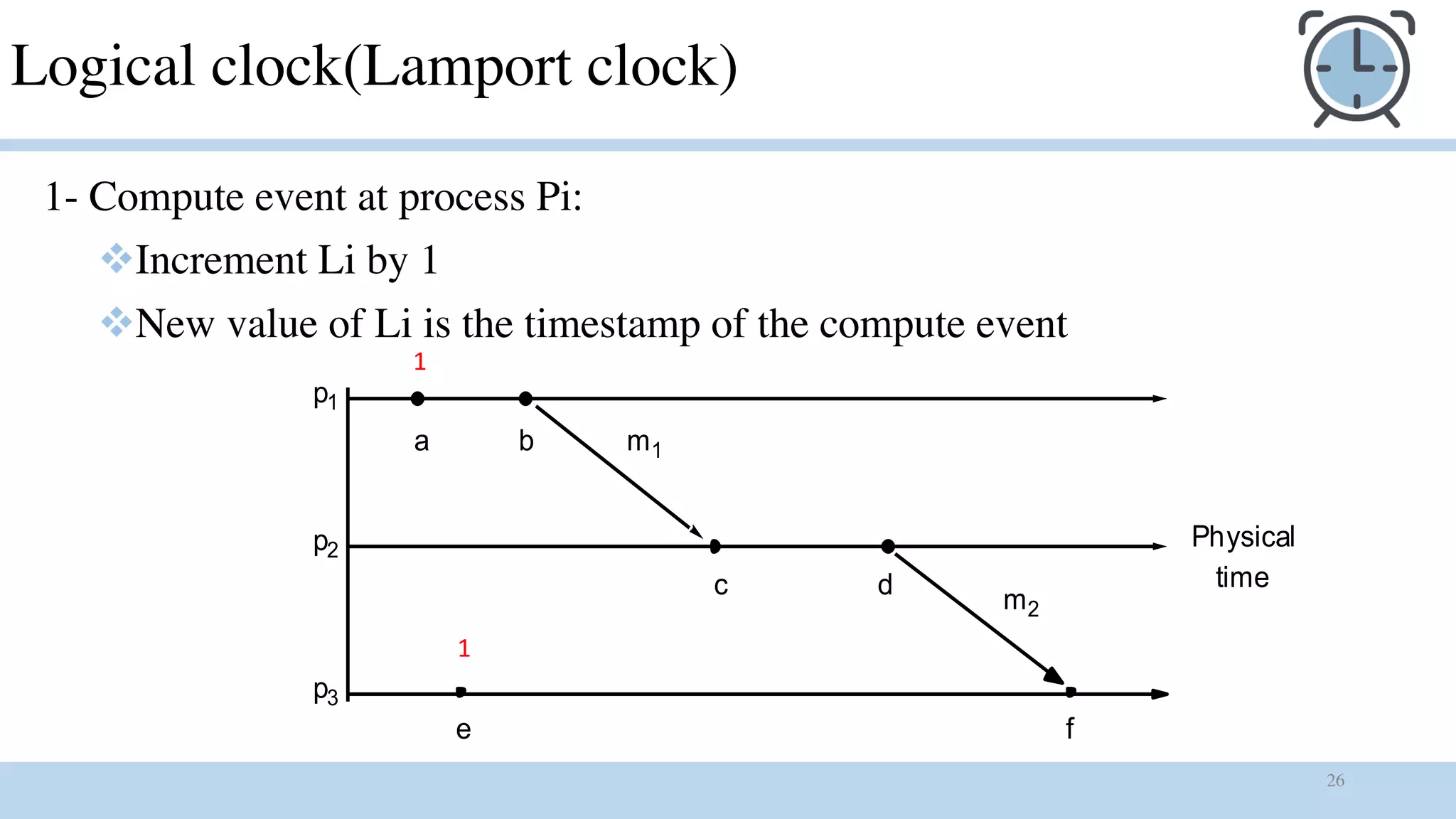
1- Compute event at process Pi:
vIncrement Li by 1
vNew value of Li is the timestamp of the compute event
p1
p2
p3
a b
c d
e f
m1
m2
Physical
time
1
1
27
Logical clock(Lamport clock)
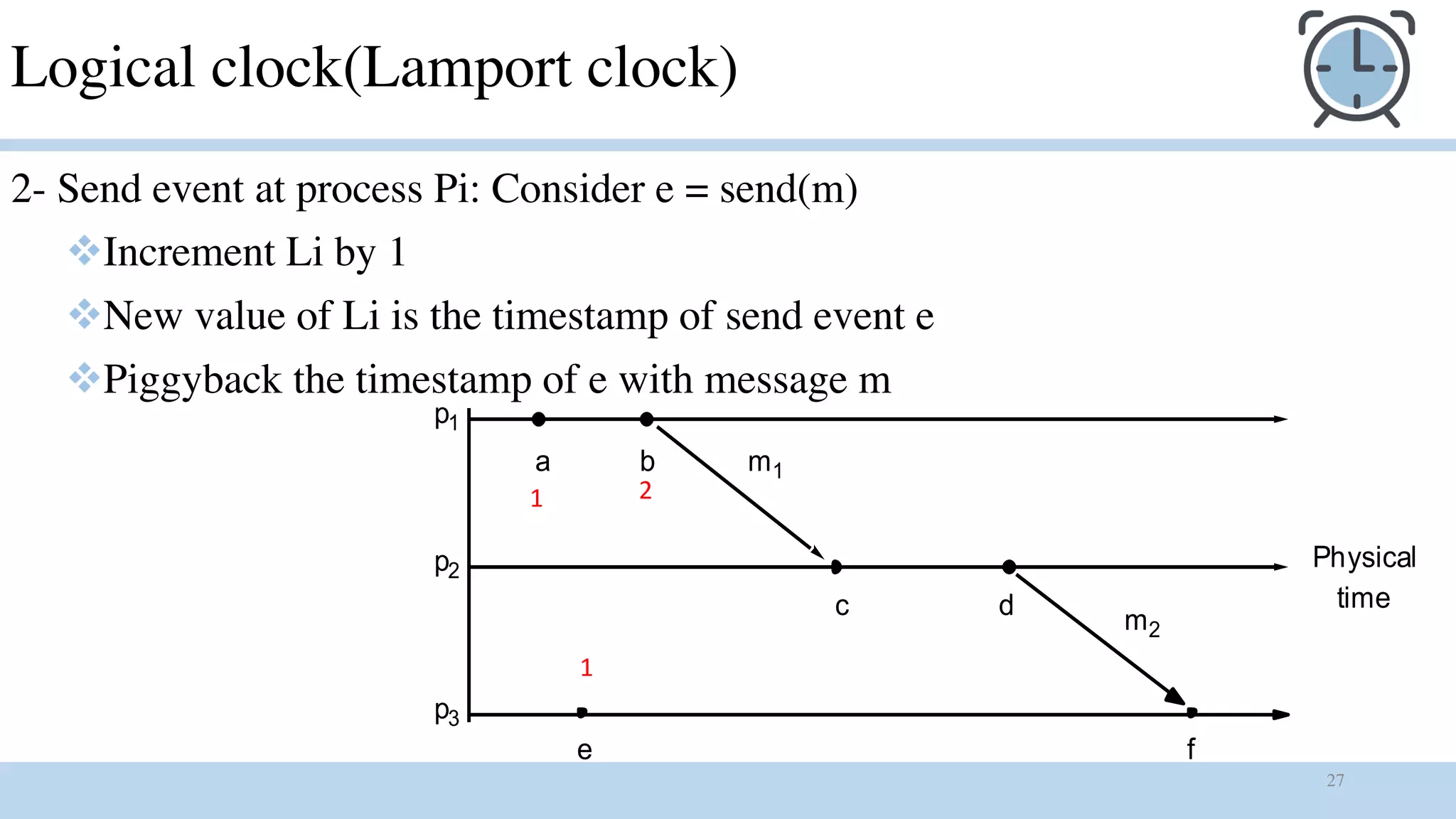
2- Send event at process Pi: Consider e = send(m)
vIncrement Li by 1
vNew value of Li is the timestamp of send event e
vPiggyback the timestamp of e with message m
p1
p2
p3
a b
c d
e f
m1
m2
Physical
time
21
1
28
Logical clock(Lamport clock)
p1
p2
p3
a b
c d
e f
m1
m2
Physical
time
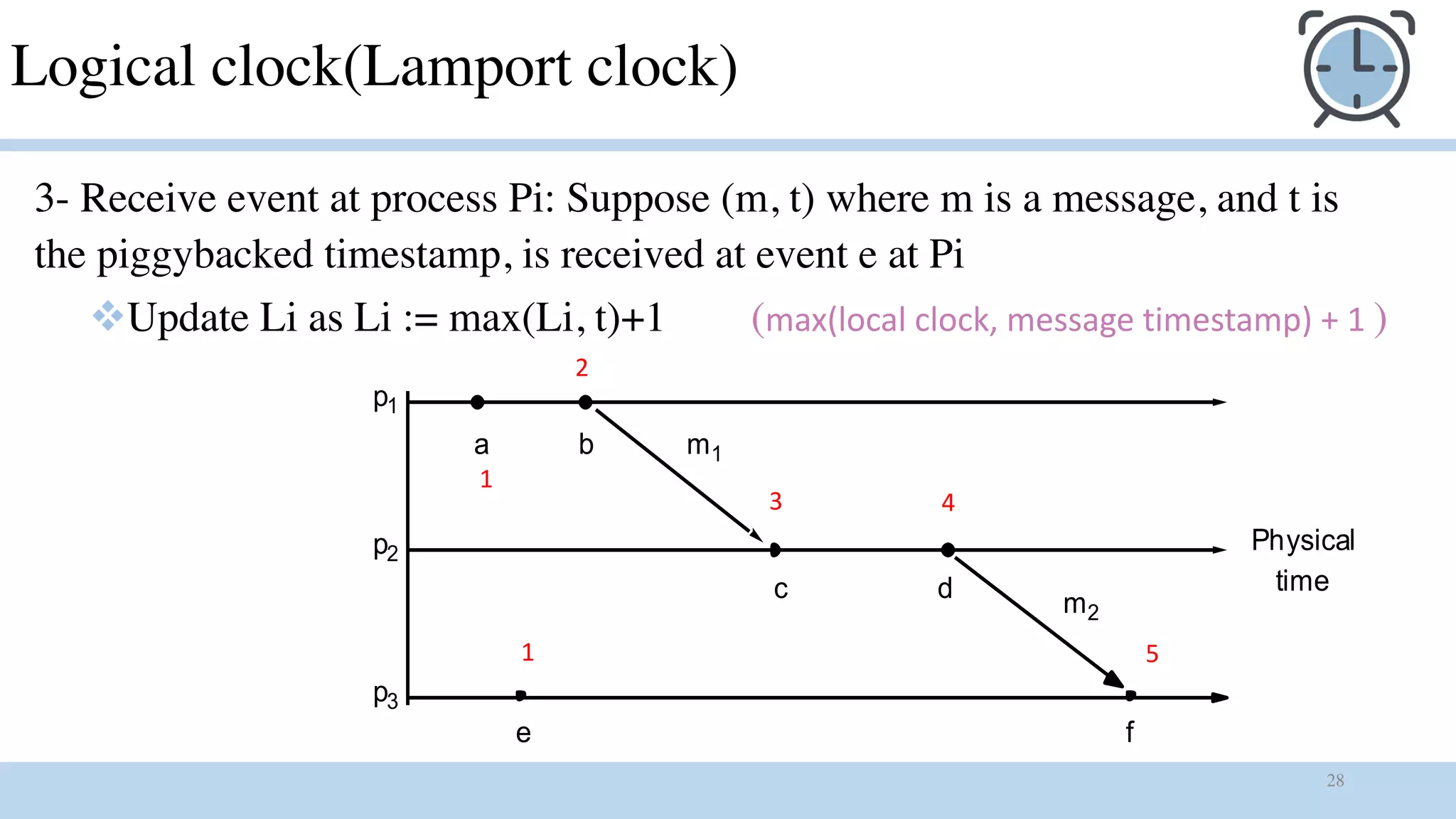
3- Receive event at process Pi: Suppose (m, t) where m is a message, and t is
the piggybacked timestamp, is received at event e at Pi
vUpdate Li as Li := max(Li, t)+1 (max(local clock, message timestamp) + 1 )
1
1
2
3 4
5
29
Logical clock(Lamport clock)
30
Logical clock(Lamport clock)
31
Logical clock(Lamport clock)
32
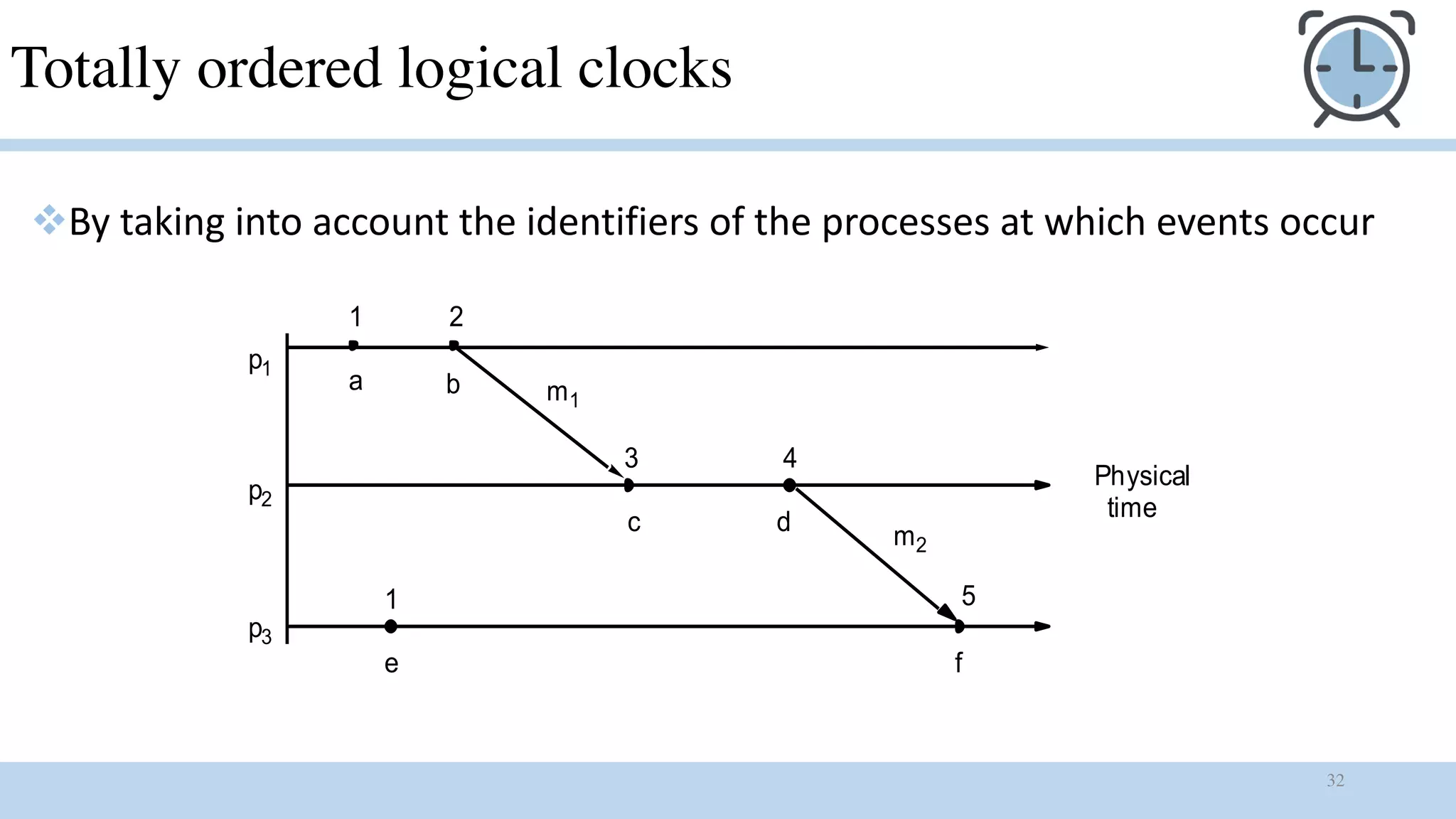
Totally ordered logical clocks
a b
c d
e f
m1
m2
21
3 4
51
p1
p2
p3
Physical
time
vBy taking into account the identifiers of the processes at which events occur
33
Totally ordered logical clocks
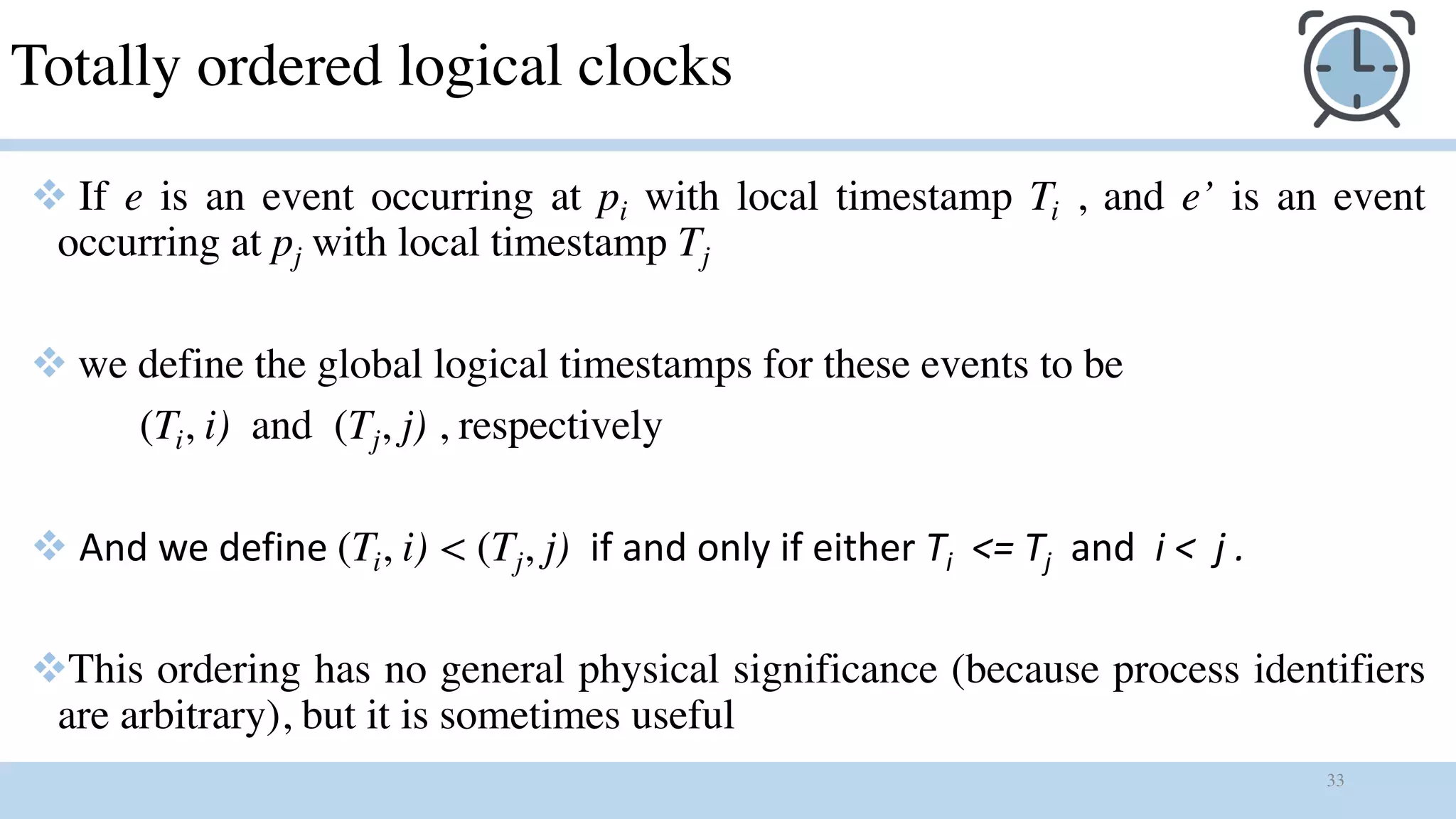
v If e is an event occurring at pi with local timestamp Ti , and e’ is an event
occurring at pj with local timestamp Tj
v we define the global logical timestamps for these events to be
(Ti, i) and (Tj, j) , respectively
v And we define (Ti, i) < (Tj, j) if and only if either Ti <= Tj and i < j .
vThis ordering has no general physical significance (because process identifiers
are arbitrary), but it is sometimes useful
34
Totally ordered logical clocks
v Lamport used it, for example, to order the entry of processes to a critical
section.
Conclusion
36
Conclusion
v We have seen that the concept of "happening before" defines an invariant
partial ordering of the events in a distributed multi process system.
v We described an algorithm for extending that partial ordering to a somewhat
arbitrary total ordering.
v A future paper will show how this approach can be extended to solve any
synchronization problem.
37
Conclusion
v The total ordering defined by the algorithm is some- what arbitrary. It can
produce anomalous behavior if it disagrees with the ordering perceived by the
system's users. This can be prevented by the use of properly synchronized
physical clocks. Our theorem showed how closely the clocks can be
synchronized.
v In a distributed system, it is important to realize that the order in which events
occur is only a partial ordering. We believe that this idea is useful in
understanding any multiprocess system.
Future works
39
Problem of Lamport clock
v L(a) denotes Lamport or Logical timestamp of event a
vIf a à b then L(a) < L(b)
vHowever, L(b) > L(a) does not imply that a à b
v As long as these timestamps obey causality, that would work
vA pair of concurrent events doesn’t have a causal path from one event to
another
v Mattern [1989] and Fidge [1991] developed vector clocks to overcome the
shortcoming of Lamport’s clocks
40
vhttps://dl.acm.org/citation.cfm?id=359563
vIndranil Gupta’s distributed systems slides
vNitin Vaidya’s distributed systems slides
vdistributed systems concepts and design by george coulouris jean
dollimore and tim kindberg ‘s book
Resources
41
Thanks for your attention

Time in distributed systmes

  • 1.
    In the nameof God 1
  • 2.
    2 Institute for AdvancedStudies in Basic Sciences Time in distributed systems Mohammad Amid Abbasi - Asieh Hajtaghi Teacher: Dr Z.Narimani Spring 2018
  • 3.
  • 4.
  • 5.
    5 What is aDistributed System? A distributed system is a collection of independent computers that appear to the users of the system as a single computer. [Andrew Tanenbaum] A distributed system is several computers doing something together. Thus, a distributed system has three primary characteristics: multiple computers, interconnections, and shared state. [Michael Schroeder]
  • 6.
    6 Why do thesedefinitions look inadequate to us? Because we are interested in the insides of a distributed system v design and implementation v Maintenance v Algorithmics (“protocols” or “distributed algorithms”)
  • 7.
    7 Distributed Computing vsParallel Computing Cloud Computing Grid Computing Parallel Computing Distributed Computing Ubiquitous Computing v Clock drift v Network delays v Network losses v Asynchrony v Failures
  • 8.
    8 About Time v “Timeis what keeps everything from happening at once.” Ray cummings v The concept of time is fundamental to our way of thinking. It is derived from the more basic concept of the order in which events occur. v Time in a computer: v How do computers keep track of wall clock time? RTC and NTP v How do operating systems know when to switch processes and otherwise schedule events? clock interrupt v How do applications measure the passage of time? system calls
  • 9.
    9 Synchronization is important vBus caching example v Cloud airline reservation system example v Ordering events
  • 10.
    10 Why is itchallenging? v Physical clocks are inaccurate and we have uncertainty in network v It is impossible to maintain a single global notion of time v Clocks cannot be synchronized perfectly across a distributed system v Unlike processors (CPUs) within one server which can share a system clock
  • 11.
    11 Synchronous vs asynchronous vProcess execution speed v Message transmission delays v Clock drift rate v A protocol for an asynchronous system will also work for a synchronous system (though not vice-versa)
  • 12.
    born February 7,1941 New York 12 v Time, Clocks, and the Ordering of Events in a Distributed System v 1978 v 10907 citation v Communications of the ACM About the paper
  • 13.
    13 We begin bydefining our system more precisely v An Asynchronous Distributed System consists of a number of processes v Each process has a state (values of variables). v State of a may change as a result of a computation step or communication step v An event is an abstraction to represent steps performed by a process v Each process has a local clock, which may drift
  • 14.
    14 We begin bydefining our system more precisely v Each process has a local clock – events within a process can be assigned timestamps, and thus ordered linearly. v But – in a distributed system, we also need to know the time order of events across different processes. v Event types in a message passing system: v Compute event v Send event v Receive event
  • 15.
    15 We begin bydefining our system more precisely Space-Time diagram
  • 16.
  • 17.
    17 Ordering of events vWe have no global clock v Physical clocks are inaccurate v And we need to ordering the events
  • 18.
  • 19.
    19 Happened-before relation v“happened-before” relationdefined without using real-time vNotation: a à b a happened-before b vThree rules for message-passing systems: v Events on the same process: Events a and b occur at the SAME process, and a occurs before b, then a à b v If a = Send(m) event and b = Receive(m) event then a à b v Transitivity: if a à b and b à c then a à c v If a à b and b à a then a and b are (logically) concurrent events v Concurrent events are not causally related
  • 20.
    20 Happened-before relation p1 p2 p3 a b cd e f m1 m2 Physical time a à b Why? b à c Why? a à f Why? a à e ????
  • 21.
  • 22.
    22 Logical clock(Lamport clock) vRelation before Creates a partial order among events v Used in almost all distributed systems since then v Almost all cloud computing systems use some form of logical ordering of events v Goal: Assign logical (Lamport) timestamp to each event (ordering the events totally)
  • 23.
    23 Logical clock(Lamport clock) vEachprocess Pi maintains a logical clock Li(a local counter which is an integer) vIntialialize Li = 0 at the start of the process vWe will describe how timestamps are updated for each type of event separately
  • 24.
    24 Logical clock(Lamport clock) vEachprocess Pi maintains a logical clock Li(a local counter which is an integer) vIntialialize Li = 0 at the start of the process vWe will describe how timestamps are updated for each type of event separately
  • 25.
    25 Logical clock(Lamport clock) p1 p2 p3 ab c d e f m1 m2 Physical time 0 0 0
  • 26.
    26 Logical clock(Lamport clock) 1-Compute event at process Pi: vIncrement Li by 1 vNew value of Li is the timestamp of the compute event p1 p2 p3 a b c d e f m1 m2 Physical time 1 1
  • 27.
    27 Logical clock(Lamport clock) 2-Send event at process Pi: Consider e = send(m) vIncrement Li by 1 vNew value of Li is the timestamp of send event e vPiggyback the timestamp of e with message m p1 p2 p3 a b c d e f m1 m2 Physical time 21 1
  • 28.
    28 Logical clock(Lamport clock) p1 p2 p3 ab c d e f m1 m2 Physical time 3- Receive event at process Pi: Suppose (m, t) where m is a message, and t is the piggybacked timestamp, is received at event e at Pi vUpdate Li as Li := max(Li, t)+1 (max(local clock, message timestamp) + 1 ) 1 1 2 3 4 5
  • 29.
  • 30.
  • 31.
  • 32.
    32 Totally ordered logicalclocks a b c d e f m1 m2 21 3 4 51 p1 p2 p3 Physical time vBy taking into account the identifiers of the processes at which events occur
  • 33.
    33 Totally ordered logicalclocks v If e is an event occurring at pi with local timestamp Ti , and e’ is an event occurring at pj with local timestamp Tj v we define the global logical timestamps for these events to be (Ti, i) and (Tj, j) , respectively v And we define (Ti, i) < (Tj, j) if and only if either Ti <= Tj and i < j . vThis ordering has no general physical significance (because process identifiers are arbitrary), but it is sometimes useful
  • 34.
    34 Totally ordered logicalclocks v Lamport used it, for example, to order the entry of processes to a critical section.
  • 35.
  • 36.
    36 Conclusion v We haveseen that the concept of "happening before" defines an invariant partial ordering of the events in a distributed multi process system. v We described an algorithm for extending that partial ordering to a somewhat arbitrary total ordering. v A future paper will show how this approach can be extended to solve any synchronization problem.
  • 37.
    37 Conclusion v The totalordering defined by the algorithm is some- what arbitrary. It can produce anomalous behavior if it disagrees with the ordering perceived by the system's users. This can be prevented by the use of properly synchronized physical clocks. Our theorem showed how closely the clocks can be synchronized. v In a distributed system, it is important to realize that the order in which events occur is only a partial ordering. We believe that this idea is useful in understanding any multiprocess system.
  • 38.
  • 39.
    39 Problem of Lamportclock v L(a) denotes Lamport or Logical timestamp of event a vIf a à b then L(a) < L(b) vHowever, L(b) > L(a) does not imply that a à b v As long as these timestamps obey causality, that would work vA pair of concurrent events doesn’t have a causal path from one event to another v Mattern [1989] and Fidge [1991] developed vector clocks to overcome the shortcoming of Lamport’s clocks
  • 40.
    40 vhttps://dl.acm.org/citation.cfm?id=359563 vIndranil Gupta’s distributedsystems slides vNitin Vaidya’s distributed systems slides vdistributed systems concepts and design by george coulouris jean dollimore and tim kindberg ‘s book Resources
  • 41.