Why did the cold War thaw in the 1970s? LO:  Explain how the Cold War progressed after Vietnam
Study source A.  What reasons does it give to suggest that people should vote for the liberals? [8]
Study source A.  What reasons does it give to suggest that people should vote for the liberals? [8 marks] Level 1 – Simple assertions based on surface reading of the source. [1-2] Level 2 – Reasons  based on reading of the source but with supporting evidence from either the source or back ground knowledge.[3-4] Level 3 – Reasons  based on reading of the source but with supporting evidence from both the source and back ground knowledge. [5—7] Level 4 – As per level 3 but with a developed conclusion.  [8]
Starter Quiz – the Vietnam War. In what year did America start to send ‘advisors’ to help the South Vietnamese government? What was the leader of the North Vietnamese Communist forces called? Vietnam, before WW2 had been a colony of which European nation? Which president was in power when Americans first started their involvement in Vietnam? What type of tactics did the North Vietnamese Army employ? What was the shortened term frequently used to describe the North Vietnamese Army? What trail was extensively bombed by the Americans because they felt it supplied weapons to the North Vietnamese Army? Which president followed LBJ? What was the name given to the heavy bombing of vast areas of Vietnam? Which other nations provided troops to fight along side the Americans in the conflict? In what year did the Americans massively reduce the number of their soldiers fighting in Vietnam? What year was the Tet Offensive? Give me one environmental impact of the war. Give me one effect on Us soldiers that fought in Vietnam. In what year did Saigon fall to communist forces?
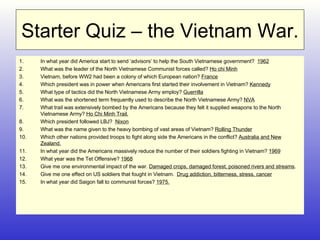
Starter Quiz – the Vietnam War. In what year did America start to send ‘advisors’ to help the South Vietnamese government?  1962 What was the leader of the North Vietnamese Communist forces called?  Ho chi Minh Vietnam, before WW2 had been a colony of which European nation?  France Which president was in power when Americans first started their involvement in Vietnam?  Kennedy What type of tactics did the North Vietnamese Army employ?  Guerrilla What was the shortened term frequently used to describe the North Vietnamese Army?  NVA What trail was extensively bombed by the Americans because they felt it supplied weapons to the North Vietnamese Army?  Ho Chi Minh Trail. Which president followed LBJ?  Nixon What was the name given to the heavy bombing of vast areas of Vietnam?  Rolling Thunder Which other nations provided troops to fight along side the Americans in the conflict?  Australia and New Zealand. In what year did the Americans massively reduce the number of their soldiers fighting in Vietnam?  1969 What year was the Tet Offensive?  1968 Give me one environmental impact of the war.  Damaged crops, damaged forest, poisoned rivers and streams . Give me one effect on US soldiers that fought in Vietnam.  Drug addiction, bitterness, stress, cancer In what year did Saigon fall to communist forces?  1975.
End of Vietnam 1973 = US troops leave Vietnam 1976 = Ho Chi Minh had made Vietnam a single Communist country
In pairs, think of 3 reasons why both superpowers would welcome detente To reduce the risk of a  nuclear war To reduce the  cost  of the arms race Learnt lesson from  Vietnam  war (wanted better relations with USSR and China)
Nixon was a strong anti-Communist but wanted friendly relations with the USSR and China in 1970s. I want to… limit the arms race Discourage Soviet and Chinese expansion
The USA and China were still distrustful of the USSR but were prepared to  ‘hold their noses’  and improve relations with each other.
1971 – USA agreed that communist China should join the  United Nations
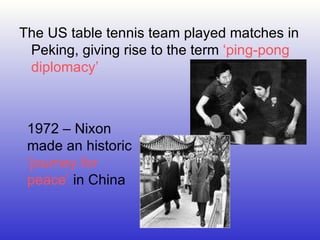
The US table tennis team played matches in Peking, giving rise to the term  ‘ping-pong diplomacy’ 1972 – Nixon made an historic  ‘journey for peace’  in China
Détente with the USSR 1972 – Nixon flew to Moscow (the first president to do so since FDR in 1944)
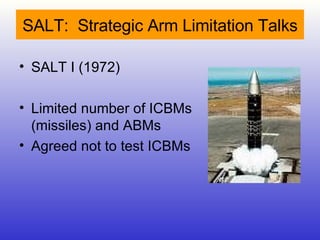
SALT:  Strategic Arm Limitation Talks SALT I (1972)  Limited number of ICBMs (missiles) and ABMs Agreed not to test ICBMs
 
Positive mood task 2 The mood between Russia and the US was improving fast. As you know, Nixon, had flown to Moscow to speak to the Soviet leader, Leonid Brezhnev.  Whilst on Air Force one Nixon is briefed by yourself on potential discussions surrounding SALT 1 which is major political issue. Read info on SALT.  One person will take on the role of the advisor, the other person will be Nixon. Plan a dialogue between the characters.  It may involve Nixon asking various questions so that he understands exactly what he should and should not say to the Soviet leader. The advisor should have lots of relevant advice. (work together to produce this) Remember the feeling of this meeting is positive but both sides are still distrustful of one another.  Consider carefully the advice you will give to your president.
SALT I  is the common name for the  Strategic Arms Limitation Treaty Agreement , but also known as  Strategic Arms Limitation Treaty . SALT I froze the number of strategic ballistic missiles at existing levels.  Leonid Brezhnev and Nixon met in 1972 to discuss such limits on nuclear weapons as well as to consider other issues between the two world super powers.  The U.S.'s total number of missiles had been the same since 1967 at 1054 ICBMs and 656 SLBMs. One part of the treaty was designed to prevent this, and the numbers of missiles  that the Russians had, from increasing.  Negotiations had started  in 1969 and reached a climax in May 1972 after a series of meetings beginning in Helsinki, with the U.S. delegation headed by Gerard Smith, director of the  Arms Control and Disarmament Agency . After a long deadlock, the first results of SALT I came  when an agreement was reached over ABM systems. Further discussion brought the negotiations to an end on  May 26 ,  1972  in  Moscow  when  Richard Nixon  and  Leonid Brezhnev  signed the  Anti-Ballistic Missile Treaty . Relations between America and Russia were improving but they still had a long way to go.  Although the two sides had agreed to limit the amount of missiles they would produce, neither side had actually agreed to get rid of any of their existing missile stocks.  A far greater level of trust between the two nations still had  to be built up.
The Cold War starts to Freeze once more as relations break down.
SALT:  Strategic Arm Limitation Talks SALT II (1979)  President Carter of USA tried to get further deals on arms limitations Slow progress 1979 – Soviet Union invaded Afghanistan Diplomatic links broken Carter withdrew US Olympic team from 1980 Olympic Games in Moscow.
Reagan – The 80s Aggressive anti-Soviet policy Both sides developing new weapons USA developed  neutron bomb  – could kill many people without much damage to property
Reagan – The 80s
Reagan – The 80s
Star Wars 1983 – US scientists began working on the Strategic Defence Initiative or  “ Star Wars” . This was a kind of giant shield in space which would shoot down enemy missiles.  One reason for this was to bring down communism in the USSR by forcing the USSR to spend huge sums of money on arms rather than other investments.
Despite this, talks on reducing arms continued. START:   (Strategic Arms Reduction Talks) aimed to reduce nuclear weapons but little progress was made and the treaty was never signed.
Your task  - turn to page 411 in the Ben Walsh Books. Look at the range of events that took place between 1979 and 1981. You have a summary of each event on the photocopy. Cut out the various events and place/stick them on the graph to show how the relationship deteriorated over the 3 year period.
Super power relations. Time. 1980 1979 1981 0 = at war 10 = close friends
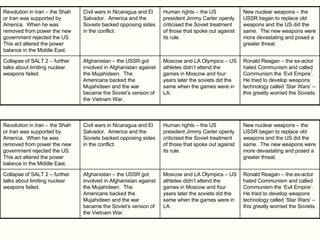
Ronald Reagan – the ex-actor hated Communism and called Communism the ‘Evil Empire’.  He tried to develop weapons technology called ‘Star Wars’ – this greatly worried the Soviets. Moscow and LA Olympics – US athletes didn’t attend the games in Moscow and four years later the soviets did the same when the games were in LA. Afghanistan – the USSR got involved in Afghanistan against the Mujahideen.  The Americans backed the Mujahideen and the war became the Soviet’s version of the Vietnam War. Collapse of SALT 2 – further talks about limiting nuclear weapons failed. New nuclear weapons – the USSR began to replace old weapons and the US did the same.  The new weapons were more devastating and posed a greater threat. Human rights – the US president Jimmy Carter openly criticised the Soviet treatment of those that spoke out against its rule. Civil wars in Nicaragua and El Salvador.  America and the Soviets backed opposing sides in the conflict. Revolution in Iran – the Shah or Iran was supported by America.  When he was removed from power the new government rejected the US.  This act altered the power balance in the Middle East. Ronald Reagan – the ex-actor hated Communism and called Communism the ‘Evil Empire’.  He tried to develop weapons technology called ‘Star Wars’ – this greatly worried the Soviets. Moscow and LA Olympics – US athletes didn’t attend the games in Moscow and four years later the soviets did the same when the games were in LA. Afghanistan – the USSR got involved in Afghanistan against the Mujahideen.  The Americans backed the Mujahideen and the war became the Soviet’s version of the Vietnam War. Collapse of SALT 2 – further talks about limiting nuclear weapons failed. New nuclear weapons – the USSR began to replace old weapons and the US did the same.  The new weapons were more devastating and posed a greater threat. Human rights – the US president Jimmy Carter openly criticised the Soviet treatment of those that spoke out against its rule. Civil wars in Nicaragua and El Salvador.  America and the Soviets backed opposing sides in the conflict. Revolution in Iran – the Shah or Iran was supported by America.  When he was removed from power the new government rejected the US.  This act altered the power balance in the Middle East.
Task 3 - Match the Key Words to their meanings Giant shield in space that could shoot down enemy missiles Reagan US President in the 1980s “ Star Wars” Strategic Arms Reduction Talks START Relaxation Helsinki Accords Agreement signed by 37 countries to recognise Soviet frontiers and agree on basic human rights SALT Strategic Arms Limitations Talks ICBM Type of missile Detente
Breakthrough - Gorbachev In 1985, President Gorbachev of the USSR called for a reduction in hostilities. He began talks with Reagan. Click here to find out what he wanted and decide what Reagan should do
The End of the Cold War 1987 – Both USA and USSR agrees to destroy all medium- and short-range weapons in Europe within three years 1989 – Soviet troops left Afghanistan
1989 – Gorbachev tells leaders of communist-controlled Eastern Europe We will no longer be able to defend you In other words, the Soviet Union was removing its control from Eastern Europe What might happen  to  communist-controlled  countries In Europe?
During the next 12 months, communist governments throughout Eastern Europe were overthrown. The Cold War had ended. Communist control of Eastern Europe had collapsed.
Chronology – Put the events in order in your books. Nixon flies To Moscow SALT I Soviets leave of Afghanistan SALT II 1979 Soviet invasion  of Afghanistan 1980 USA boycott Moscow Olympics Star Wars Gorbachev  wants detente Berlin Wall falls End of Cold War

Changes In Cold War Relationships[1]

  • 1.
    Why did thecold War thaw in the 1970s? LO: Explain how the Cold War progressed after Vietnam
  • 2.
    Study source A. What reasons does it give to suggest that people should vote for the liberals? [8]
  • 3.
    Study source A. What reasons does it give to suggest that people should vote for the liberals? [8 marks] Level 1 – Simple assertions based on surface reading of the source. [1-2] Level 2 – Reasons based on reading of the source but with supporting evidence from either the source or back ground knowledge.[3-4] Level 3 – Reasons based on reading of the source but with supporting evidence from both the source and back ground knowledge. [5—7] Level 4 – As per level 3 but with a developed conclusion. [8]
  • 4.
    Starter Quiz –the Vietnam War. In what year did America start to send ‘advisors’ to help the South Vietnamese government? What was the leader of the North Vietnamese Communist forces called? Vietnam, before WW2 had been a colony of which European nation? Which president was in power when Americans first started their involvement in Vietnam? What type of tactics did the North Vietnamese Army employ? What was the shortened term frequently used to describe the North Vietnamese Army? What trail was extensively bombed by the Americans because they felt it supplied weapons to the North Vietnamese Army? Which president followed LBJ? What was the name given to the heavy bombing of vast areas of Vietnam? Which other nations provided troops to fight along side the Americans in the conflict? In what year did the Americans massively reduce the number of their soldiers fighting in Vietnam? What year was the Tet Offensive? Give me one environmental impact of the war. Give me one effect on Us soldiers that fought in Vietnam. In what year did Saigon fall to communist forces?
  • 5.
    Starter Quiz –the Vietnam War. In what year did America start to send ‘advisors’ to help the South Vietnamese government? 1962 What was the leader of the North Vietnamese Communist forces called? Ho chi Minh Vietnam, before WW2 had been a colony of which European nation? France Which president was in power when Americans first started their involvement in Vietnam? Kennedy What type of tactics did the North Vietnamese Army employ? Guerrilla What was the shortened term frequently used to describe the North Vietnamese Army? NVA What trail was extensively bombed by the Americans because they felt it supplied weapons to the North Vietnamese Army? Ho Chi Minh Trail. Which president followed LBJ? Nixon What was the name given to the heavy bombing of vast areas of Vietnam? Rolling Thunder Which other nations provided troops to fight along side the Americans in the conflict? Australia and New Zealand. In what year did the Americans massively reduce the number of their soldiers fighting in Vietnam? 1969 What year was the Tet Offensive? 1968 Give me one environmental impact of the war. Damaged crops, damaged forest, poisoned rivers and streams . Give me one effect on US soldiers that fought in Vietnam. Drug addiction, bitterness, stress, cancer In what year did Saigon fall to communist forces? 1975.
  • 6.
    End of Vietnam1973 = US troops leave Vietnam 1976 = Ho Chi Minh had made Vietnam a single Communist country
  • 7.
    In pairs, thinkof 3 reasons why both superpowers would welcome detente To reduce the risk of a nuclear war To reduce the cost of the arms race Learnt lesson from Vietnam war (wanted better relations with USSR and China)
  • 8.
    Nixon was astrong anti-Communist but wanted friendly relations with the USSR and China in 1970s. I want to… limit the arms race Discourage Soviet and Chinese expansion
  • 9.
    The USA andChina were still distrustful of the USSR but were prepared to ‘hold their noses’ and improve relations with each other.
  • 10.
    1971 – USAagreed that communist China should join the United Nations
  • 11.
    The US tabletennis team played matches in Peking, giving rise to the term ‘ping-pong diplomacy’ 1972 – Nixon made an historic ‘journey for peace’ in China
  • 12.
    Détente with theUSSR 1972 – Nixon flew to Moscow (the first president to do so since FDR in 1944)
  • 13.
    SALT: StrategicArm Limitation Talks SALT I (1972) Limited number of ICBMs (missiles) and ABMs Agreed not to test ICBMs
  • 14.
  • 15.
    Positive mood task2 The mood between Russia and the US was improving fast. As you know, Nixon, had flown to Moscow to speak to the Soviet leader, Leonid Brezhnev. Whilst on Air Force one Nixon is briefed by yourself on potential discussions surrounding SALT 1 which is major political issue. Read info on SALT. One person will take on the role of the advisor, the other person will be Nixon. Plan a dialogue between the characters. It may involve Nixon asking various questions so that he understands exactly what he should and should not say to the Soviet leader. The advisor should have lots of relevant advice. (work together to produce this) Remember the feeling of this meeting is positive but both sides are still distrustful of one another. Consider carefully the advice you will give to your president.
  • 16.
    SALT I is the common name for the Strategic Arms Limitation Treaty Agreement , but also known as Strategic Arms Limitation Treaty . SALT I froze the number of strategic ballistic missiles at existing levels. Leonid Brezhnev and Nixon met in 1972 to discuss such limits on nuclear weapons as well as to consider other issues between the two world super powers. The U.S.'s total number of missiles had been the same since 1967 at 1054 ICBMs and 656 SLBMs. One part of the treaty was designed to prevent this, and the numbers of missiles that the Russians had, from increasing. Negotiations had started in 1969 and reached a climax in May 1972 after a series of meetings beginning in Helsinki, with the U.S. delegation headed by Gerard Smith, director of the Arms Control and Disarmament Agency . After a long deadlock, the first results of SALT I came when an agreement was reached over ABM systems. Further discussion brought the negotiations to an end on May 26 , 1972 in Moscow when Richard Nixon and Leonid Brezhnev signed the Anti-Ballistic Missile Treaty . Relations between America and Russia were improving but they still had a long way to go. Although the two sides had agreed to limit the amount of missiles they would produce, neither side had actually agreed to get rid of any of their existing missile stocks. A far greater level of trust between the two nations still had to be built up.
  • 17.
    The Cold Warstarts to Freeze once more as relations break down.
  • 18.
    SALT: StrategicArm Limitation Talks SALT II (1979) President Carter of USA tried to get further deals on arms limitations Slow progress 1979 – Soviet Union invaded Afghanistan Diplomatic links broken Carter withdrew US Olympic team from 1980 Olympic Games in Moscow.
  • 19.
    Reagan – The80s Aggressive anti-Soviet policy Both sides developing new weapons USA developed neutron bomb – could kill many people without much damage to property
  • 20.
  • 21.
  • 22.
    Star Wars 1983– US scientists began working on the Strategic Defence Initiative or “ Star Wars” . This was a kind of giant shield in space which would shoot down enemy missiles. One reason for this was to bring down communism in the USSR by forcing the USSR to spend huge sums of money on arms rather than other investments.
  • 23.
    Despite this, talkson reducing arms continued. START: (Strategic Arms Reduction Talks) aimed to reduce nuclear weapons but little progress was made and the treaty was never signed.
  • 24.
    Your task - turn to page 411 in the Ben Walsh Books. Look at the range of events that took place between 1979 and 1981. You have a summary of each event on the photocopy. Cut out the various events and place/stick them on the graph to show how the relationship deteriorated over the 3 year period.
  • 25.
    Super power relations.Time. 1980 1979 1981 0 = at war 10 = close friends
  • 26.
    Ronald Reagan –the ex-actor hated Communism and called Communism the ‘Evil Empire’. He tried to develop weapons technology called ‘Star Wars’ – this greatly worried the Soviets. Moscow and LA Olympics – US athletes didn’t attend the games in Moscow and four years later the soviets did the same when the games were in LA. Afghanistan – the USSR got involved in Afghanistan against the Mujahideen. The Americans backed the Mujahideen and the war became the Soviet’s version of the Vietnam War. Collapse of SALT 2 – further talks about limiting nuclear weapons failed. New nuclear weapons – the USSR began to replace old weapons and the US did the same. The new weapons were more devastating and posed a greater threat. Human rights – the US president Jimmy Carter openly criticised the Soviet treatment of those that spoke out against its rule. Civil wars in Nicaragua and El Salvador. America and the Soviets backed opposing sides in the conflict. Revolution in Iran – the Shah or Iran was supported by America. When he was removed from power the new government rejected the US. This act altered the power balance in the Middle East. Ronald Reagan – the ex-actor hated Communism and called Communism the ‘Evil Empire’. He tried to develop weapons technology called ‘Star Wars’ – this greatly worried the Soviets. Moscow and LA Olympics – US athletes didn’t attend the games in Moscow and four years later the soviets did the same when the games were in LA. Afghanistan – the USSR got involved in Afghanistan against the Mujahideen. The Americans backed the Mujahideen and the war became the Soviet’s version of the Vietnam War. Collapse of SALT 2 – further talks about limiting nuclear weapons failed. New nuclear weapons – the USSR began to replace old weapons and the US did the same. The new weapons were more devastating and posed a greater threat. Human rights – the US president Jimmy Carter openly criticised the Soviet treatment of those that spoke out against its rule. Civil wars in Nicaragua and El Salvador. America and the Soviets backed opposing sides in the conflict. Revolution in Iran – the Shah or Iran was supported by America. When he was removed from power the new government rejected the US. This act altered the power balance in the Middle East.
  • 27.
    Task 3 -Match the Key Words to their meanings Giant shield in space that could shoot down enemy missiles Reagan US President in the 1980s “ Star Wars” Strategic Arms Reduction Talks START Relaxation Helsinki Accords Agreement signed by 37 countries to recognise Soviet frontiers and agree on basic human rights SALT Strategic Arms Limitations Talks ICBM Type of missile Detente
  • 28.
    Breakthrough - GorbachevIn 1985, President Gorbachev of the USSR called for a reduction in hostilities. He began talks with Reagan. Click here to find out what he wanted and decide what Reagan should do
  • 29.
    Breakthrough - GorbachevIn 1985, President Gorbachev of the USSR called for a reduction in hostilities. He began talks with Reagan. Click here to find out what he wanted and decide what Reagan should do
  • 30.
    The End ofthe Cold War 1987 – Both USA and USSR agrees to destroy all medium- and short-range weapons in Europe within three years 1989 – Soviet troops left Afghanistan
  • 31.
    1989 – Gorbachevtells leaders of communist-controlled Eastern Europe We will no longer be able to defend you In other words, the Soviet Union was removing its control from Eastern Europe What might happen to communist-controlled countries In Europe?
  • 32.
    During the next12 months, communist governments throughout Eastern Europe were overthrown. The Cold War had ended. Communist control of Eastern Europe had collapsed.
  • 33.
    Chronology – Putthe events in order in your books. Nixon flies To Moscow SALT I Soviets leave of Afghanistan SALT II 1979 Soviet invasion of Afghanistan 1980 USA boycott Moscow Olympics Star Wars Gorbachev wants detente Berlin Wall falls End of Cold War