J417 OCR Modern World History B Paper I – A971 – International Relations 1919-39 & German Depth Study 1918-45 http://gcsehistory.wetpaint.com
J417 Paper I – International Relations: The inter-war years 1919-39 Versailles (1919) [BRAT] June 28 th  1919 at Versailles, just outside Paris Germany had to accept  B lame for WWI Germany had to pay £6,600 million in  R eparations Germany forbidden to have an airforce, submarines, a navy of only 6 ships and an  A rmy of 100,000 men. Conscription was banned Germany lost  T erritory – Rhineland, Alsace-Lorraine, Saar, Colonies to UK/FRA David Lloyd-George (UK) Wanted:- Compromise between FRA &  USA Expand British Empire Justice but not revenge Make GER pay, but not at expense of trade Got:- GER colonies and smaller GER Navy Said Treaty too harsh and would cause War in 25 years time KEY QUESTIONS:- - What were the motives and aims of the Big Three at Versailles? - Why did the victors not get everything they wanted? - What were the immediate reactions to the peace settlements? - Could the Treaties be justified at the time? AUSTRIA - St Germain 10 th  Sept 1919 Reparations agreed, never set Restricted size of AUS army Dismantled AUS-HUG Empire HUNGARY – Trianon 4 th  June 1920 Reparations but not paid Dismantled AUS-HUG Empire BULGARIA – Neuilly – 27 Nov 1920  Reparations and land TURKEY – Sevres – 10 Aug 1920  Limited army Lausanne 24 th  July 1923  imposed on the Ottoman Empire George Clemenceau [FRA] Wanted:- Revenge on GER Punish GER for death and destruction Make GER pay reparations  Weaken GER militarily so FRA never under threat again Got:- Terms of Treaty – BRAT But wanted Treaty to be harsher and GER to be split into smaller countries Immediate reactions to the Treaties Germany felt humiliated Angry about tiny army Loss of territory was unfair Angry at Clause 231 re-blame French people thought not harsh enough British people thought differently to Lloyd George who was concerned US Senate refused to sign Treaty Woodrow Wilson [USA] Wanted:- 14 points End to disputes – peace and LON Self Determination Got:- LON Self-determination for E.Europe Some of 14 points did not make it Senate refused to join LON so USA stayed out Big Question:- Were the Peace Treaties of 1919-23 fair?
J417 Paper I – International Relations: The inter-war years 1919-39 Versailles (1919)  David Lloyd-George (UK) Wanted:- Got:- KEY QUESTIONS:- - What were the motives and aims of the Big Three at Versailles? - Why did the victors not get everything they wanted? - What were the immediate reactions to the peace settlements? - Could the Treaties be justified at the time? AUSTRIA - St Germain 10 th  Sept 1919 HUNGARY – Trianon 4 th  June 1920 BULGARIA – Neuilly – 27 Nov 1920   TURKEY – George Clemenceau [FRA] Wanted:- Got:- Immediate reactions to the Treaties Woodrow Wilson [USA] Wanted:- Got:- Big Question:- Were the Peace Treaties of 1919-23 fair?
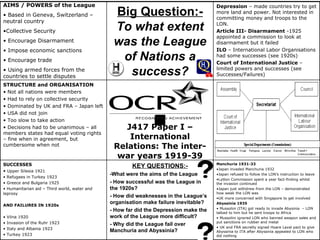
J417 Paper I – International Relations: The inter-war years 1919-39 AIMS / POWERS of the League Based in Geneva, Switzerland – neutral country  Collective Security Encourage Disarmament Impose economic sanctions Encourage trade Using armed forces from the countries to settle disputes Manchuria 1931-33 Japan invaded Manchuria 1932 Japan refused to follow the LON’s instruction to leave Lytton Commission spent a year fact-finding whilst the invasion continued Japan just withdrew from the LON – demonstrated how weak the LON was UK more concerned with Singapore to get involved Abyssinia 1935 Mussolini (ITA) got ready to invade Abysinia  – LON talked to him but he sent troops to Africa Mussolini ignored LON who banned weapon sales and put sanctions on rubber and metal UK and FRA secretly signed Hoare Laval pact to give Abyssinia to ITA after Abyssinia appealed to LON who did nothing KEY QUESTIONS:- -What were the aims of the League? - How successful was the League in the 1920s? - How did weaknesses in the League’s organisation make failure inevitable? - How far did the Depression make the work of the League more difficult? - Why did the League fail over Manchuria and Abyssinia? SUCCESSES  Upper Silesia 1921 Refugees in Turkey 1923 Greece and Bulgaria 1925  Humanitarian aid – Third world, water and leprosy AND FAILURES IN 1920s Vilna 1920 Invasion of the Ruhr 1923 Italy and Albania 1923 Turkey 1923 STRUCTURE and ORGANISATION Not all nations were members Had to rely on collective security Dominated by UK and FRA – Japan left USA did not join Too slow to take action Decisions had to be unanimous – all members states had equal voting rights – fine when in agreement, but cumbersome when not Depression  – made countries try to get more land and power. Not interested in committing money and troops to the LON. Article III- Disarmament  -1925 appointed a commission to look at disarmament but it failed  ILO  – International Labor Organisations had some successes (see 1920s) Court of International Justice  – limited powers and successes (see Successes/Failures) Big Question:- To what extent was the League of Nations a success?
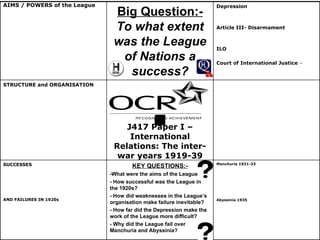
J417 Paper I – International Relations: The inter-war years 1919-39 AIMS / POWERS of the League Manchuria 1931-33 Abyssinia 1935 KEY QUESTIONS:- -What were the aims of the League? - How successful was the League in the 1920s? - How did weaknesses in the League’s organisation make failure inevitable? - How far did the Depression make the work of the League more difficult? - Why did the League fail over Manchuria and Abyssinia? SUCCESSES  AND FAILURES IN 1920s STRUCTURE and ORGANISATION Depression   Article III- Disarmament ILO Court of International Justice  –  Big Question:- To what extent was the League of Nations a success?
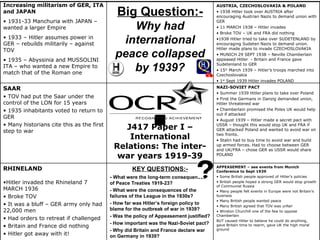
J417 Paper I – International Relations: The inter-war years 1919-39 Increasing militarism of GER, ITA and JAPAN 1931-33 Manchuria with JAPAN – wanted a larger Empire 1933 – Hitler assumes power in GER – rebuilds militarily – against TOV 1935 – Abyssinia and MUSSOLINI ITA – who wanted a new Empire to match that of the Roman one APPEASEMENT – see events from Munich Conference to Sept 1939 Some British people approved of Hitler’s policies British people hoped a strong GER would stop growth of Communist Russia Many people felt events in Europe were not Britain’s business Many British people wanted peace Many British agreed that TOV was unfair Winston Churchill one of the few to oppose Chamberlain BUT caused Hitler to believe he could do anything, gave Britain time to rearm, gave UK the high moral ground KEY QUESTIONS:- -  What were the long-term consequences of Peace Treaties 1919-23? - What were the consequences of the failures of the League in the 1930s? - How far was Hitler’s foreign policy to blame for the outbreak of war in 1939? - Was the policy of Appeasement justified? - How important was the Nazi-Soviet pact?  - Why did Britain and France declare war on Germany in 1939? RHINELAND Hitler invaded the Rhineland 7 MARCH 1936 Broke TOV It was a bluff – GER army only had 22,000 men Had orders to retreat if challenged Britain and France did nothing Hitler got away with it! NAZI-SOVIET PACT Summer 1939 Hitler plans to take over Poland First the Germans in Danzig demanded union, Hitler threatened war Chamberlain promised the Poles UK would help out if attacked August 1939 – Hitler made a secret pact with USSR – thought this would stop UK and FRA if GER attacked Poland and wanted to avoid war on two fronts. Stalin had to buy time to avoid war and build up armed forces. Had to choose between GER and UK/FRA – chose GER as USSR would share POLAND SAAR TOV had put the Saar under the control of the LON for 15 years 1935 inhabitants voted to return to GER Many historians cite this as the first step to war AUSTRIA, CZECHOSLOVAKIA & POLAND 1938 Hitler took over AUSTRIA after encouraging Austrian Nazis to demand union with GER 11 MARCH 1938 – Hitler invades Broke TOV – UK and FRA did nothing 1938 Hitler tried to take over SUDETENLAND by encouraging Sudeten Nazis to demand union. Hitler made plans to invade CZECHOSLOVAKIA MUNICH 29 SEPT 1938 – Neville Chamberlain appeased Hitler  - Britain and France gave Sudetenland to GER 15 th  March 1939 – Hitler’s troops marched into Czechoslovakia 1 st  Sept 1939 Hitler invades POLAND Big Question:- Why had international peace collapsed by 1939?
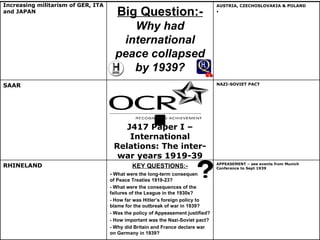
J417 Paper I – International Relations: The inter-war years 1919-39 Increasing militarism of GER, ITA and JAPAN APPEASEMENT – see events from Munich Conference to Sept 1939 KEY QUESTIONS:- -  What were the long-term consequences of Peace Treaties 1919-23? - What were the consequences of the failures of the League in the 1930s? - How far was Hitler’s foreign policy to blame for the outbreak of war in 1939? - Was the policy of Appeasement justified? - How important was the Nazi-Soviet pact?  - Why did Britain and France declare war on Germany in 1939? RHINELAND NAZI-SOVIET PACT SAAR AUSTRIA, CZECHOSLOVAKIA & POLAND Big Question:- Why had international peace collapsed by 1939?
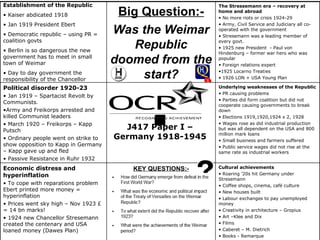
J417 Paper I – Germany 1918-1945 Establishment of the Republic Kaiser abdicated 1918 Jan 1919 President Ebert Democratic republic – using PR = coalition govts Berlin is so dangerous the new government has to meet in small town of Weimar Day to day government the responsibility of the Chancellor Cultural achievements  Roaring ’20s hit Germany under Stresemann Coffee shops, cinema, café culture New houses built Labour exchanges to pay unemployed money Creativity in architecture – Gropius Art –Klee and Dix Films  Caberet – M. Dietrich Books - Remarque KEY QUESTIONS:- Economic distress and hyperinflation To cope with reparations problem Ebert printed more money = hyperinflation Prices went sky high – Nov 1923 £ = 14 bn marks! 1924 new Chancellor Stresemann created the centenary and USA loaned money (Dawes Plan) Underlying weaknesses of the Republic PR causing problems Parties did form coalition but did not cooperate causing governments to break down Elections 1919,1920,1924 x 2, 1928 Wages rose as did industrial production but was all dependent on the USA and 800 million mark loans Small business and farmers suffered Public service wages did not rise at the same rate as industrial workers  Political disorder 1920-23 Jan 1919 – Spartacist Revolt by Communists. Army and Freikorps arrested and killed Communist leaders  March 1920 – Freikorps – Kapp Putsch Ordinary people went on strike to show opposition to Kapp in Germany – Kapp gave up and fled Passive Resistance in Ruhr 1932 The Stressemann era – recovery at home and abroad No more riots or crisis 1924-29 Army, Civil Service and Judiciary all co-operated with the government Stresemann was a leading member of every govt. 1925 new President  - Paul von Hindenburg – former war hero who was popular Foreign relations expert 1925 Locarno Treaties 1926 LON + USA Young Plan Big Question:- Was the Weimar Republic doomed from the start?
J417 Paper I – Germany 1918-1945 Establishment of the Republic Cultural achievements  KEY QUESTIONS:- Economic distress and hyperinflation Underlying weaknesses of the Republic Political disorder 1920-23 The Stressemann era – recovery at home and abroad No more riots or crisis 1924-29 Big Question:- Was the Weimar Republic doomed from the start?
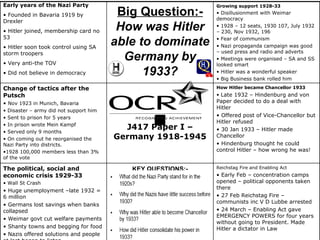
J417 Paper I – Germany 1918-1945 Early years of the Nazi Party Founded in Bavaria 1919 by Drexler Hitler joined, membership card no 53 Hitler soon took control using SA  storm troopers Very anti-the TOV Did not believe in democracy Reichstag Fire and Enabling Act   Early Feb – concentration camps opened – political opponents taken there 27 Feb Reichstag Fire – communists inc V D Lubbe arrested 24 March – Enabling Act gave EMERGENCY POWERS for four years without going to President. Made Hitler a dictator in Law KEY QUESTIONS:- The political, social and economic crisis 1929-33 Wall St Crash Huge unemployment –late 1932 = 6 million Germans lost savings when banks collapsed Weimar govt cut welfare payments Shanty towns and begging for food Nazis offered solutions and people at last began to listen How Hitler became Chancellor 1933 Late 1932 – Hindenburg and von Paper decided to do a deal with Hitler Offered post of Vice-Chancellor but Hitler refused 30 Jan 1933 – Hitler made Chancellor  Hindenburg thought he could control Hitler – how wrong he was! Change of tactics after the Putsch Nov 1923 in Munich, Bavaria Disaster – army did not support him Sent to prison for 5 years In prison wrote Mein Kampf Served only 9 months On coming out he reorganised the Nazi Party into districts. 1928 100,000 members less than 3% of the vote Growing support 1928-33 Disillusionment with Weimar democracy 1928 – 12 seats, 1930 107, July 1932 – 230, Nov 1932, 196  Fear of communism  Nazi propaganda campaign was good – used press and radio and adverts Meetings were organised – SA and SS looked smart Hitler was a wonderful speaker Big Business bank rolled him Big Question:- How was Hitler able to dominate Germany by 1933?
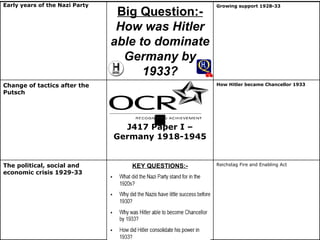
J417 Paper I – Germany 1918-1945 Early years of the Nazi Party Reichstag Fire and Enabling Act   KEY QUESTIONS:- The political, social and economic crisis 1929-33 How Hitler became Chancellor 1933 Change of tactics after the Putsch Growing support 1928-33 Big Question:- How was Hitler able to dominate Germany by 1933?
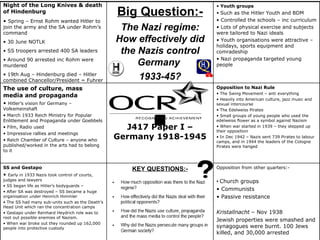
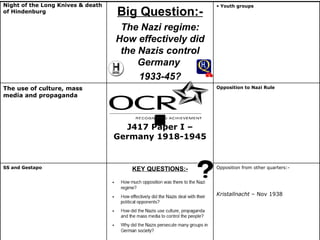
J417 Paper I – Germany 1918-1945 Night of the Long Knives & death of Hindenburg Spring – Ernst Rohm wanted Hitler to join the army and the SA under Rohm’s command 30 June NOTLK SS troopers arrested 400 SA leaders Around 90 arrested inc Rohm were murdered 19th Aug – Hindenburg died – Hitler combined Chancellor/President = Fuhrer Opposition from other quarters:- Church groups Communists Passive resistance Kristallnacht  – Nov 1938 Jewish properties were smashed and synagogues were burnt. 100 Jews killed, and 30,000 arrested KEY QUESTIONS:- SS and Gestapo Early in 1933 Nazis took control of courts, judges and lawyers SS began life as Hitler’s bodyguards –  After SA was destroyed – SS became a huge organisation under Heinrich Himmler The SS had many sub-units such as the Death’s Head Unit which ran the concentration camps Gestapo under Reinhard Heydrich role was to root out possible enemies of Nazism.  When war broke out they rounded up 162,000 people into protective custody Opposition to Nazi Rule The Swing Movement – anti everything Heavily into American culture, jazz music and sexual intercourse The Edelweiss Pirates Small groups of young people who used the edelweiss flower as a symbol against Nazism When war started in 1939 – they stepped up their opposition  In Dec 1942 – Nazis sent 739 Pirates to labour camps, and in 1944 the leaders of the Cologne Pirates were hanged The use of culture, mass media and propaganda Hitler’s vision for Germany – Volkemeinshaft March 1933 Reich Ministry for Popular Enlitlement and Propaganda under Goebbels Film, Radio used Impressive rallies and meetings Reich Chamber of Culture – anyone who published/worked in the arts had to belong to it Youth groups  Such as the Hitler Youth and BDM Controlled the schools – inc curriculum Lots of physical exercise and subjects were tailored to Nazi ideals Youth organisations were attractive – holidays, sports equipment and comradeship Nazi propaganda targeted young people Big Question:- The Nazi regime: How effectively did the Nazis control Germany  1933-45?
J417 Paper I – Germany 1918-1945 Night of the Long Knives & death of Hindenburg Opposition from other quarters:- Kristallnacht  – Nov 1938 KEY QUESTIONS:- SS and Gestapo Opposition to Nazi Rule The use of culture, mass media and propaganda Youth groups  Big Question:- The Nazi regime: How effectively did the Nazis control Germany  1933-45?
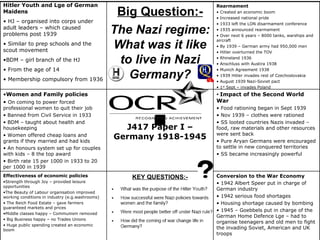
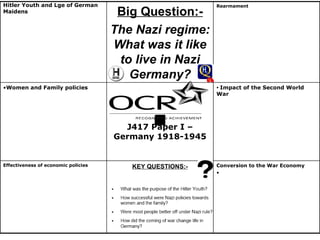
J417 Paper I – Germany 1918-1945 Hitler Youth and Lge of German Maidens HJ – organised into corps under adult leaders – which caused problems post 1939 Similar to prep schools and the scout movement BDM – girl branch of the HJ From the age of 14 Membership compulsory from 1936 Conversion to the War Economy  1942 Albert Speer put in charge of German industry 1942 serious food shortages  Housing shortage caused by bombing 1945 – Goebbels put in charge of the German Home Defence Lge – had to organise teenagers and old men to fight the invading Soviet, American and UK troops KEY QUESTIONS:- Effectiveness of economic policies Strength through Joy – provided leisure opportunities The Beauty of Labour organisation improved working conditions in industry (e.g.washrooms) The Reich Food Estate – gave farmers guaranteed markets and prices Middle classes happy – Communism removed  Big Business happy – no Trades Unions  Huge public spending created an economic boom Impact of the Second World War Food rationing began in Sept 1939 Nov 1939 – clothes were rationed SS looted countries Nazis invaded – food, raw materials and other resources were sent back Pure Aryan Germans were encouraged to settle in new conquered territories SS became increasingly powerful Women and Family policies   On coming to power forced professional women to quit their job Banned from Civil Service in 1933 BDM – taught about health and housekeeping Women offered cheap loans and grants if they married and had kids  An honours system set up for couples with kids – 8 the top award Birth rate 15 per 1000 in 1933 to 20 per 1000 in 1939 Rearmament Created an economic boom Increased national pride 1933 left the LON disarmament conference 1935 announced rearmament Over next 6 years – 8000 tanks, warships and aircraft By 1939 – German army had 950,000 men  Hitler overturned the TOV Rhineland 1936 Anschluss with Austira 1938 Munich Agreement 1938 1939 Hitler invades rest of Czechoslovakia August 1939 Nazi-Soviet pact 1 st  Sept – invades Poland Big Question:- The Nazi regime: What was it like to live in Nazi Germany?
J417 Paper I – Germany 1918-1945 Hitler Youth and Lge of German Maidens Conversion to the War Economy  KEY QUESTIONS:- Effectiveness of economic policies Impact of the Second World War Women and Family policies   Rearmament Big Question:- The Nazi regime: What was it like to live in Nazi Germany?

J417 ck grids_paper_i_with_blanks

  • 1.
    J417 OCR ModernWorld History B Paper I – A971 – International Relations 1919-39 & German Depth Study 1918-45 http://gcsehistory.wetpaint.com
  • 2.
    J417 Paper I– International Relations: The inter-war years 1919-39 Versailles (1919) [BRAT] June 28 th 1919 at Versailles, just outside Paris Germany had to accept B lame for WWI Germany had to pay £6,600 million in R eparations Germany forbidden to have an airforce, submarines, a navy of only 6 ships and an A rmy of 100,000 men. Conscription was banned Germany lost T erritory – Rhineland, Alsace-Lorraine, Saar, Colonies to UK/FRA David Lloyd-George (UK) Wanted:- Compromise between FRA & USA Expand British Empire Justice but not revenge Make GER pay, but not at expense of trade Got:- GER colonies and smaller GER Navy Said Treaty too harsh and would cause War in 25 years time KEY QUESTIONS:- - What were the motives and aims of the Big Three at Versailles? - Why did the victors not get everything they wanted? - What were the immediate reactions to the peace settlements? - Could the Treaties be justified at the time? AUSTRIA - St Germain 10 th Sept 1919 Reparations agreed, never set Restricted size of AUS army Dismantled AUS-HUG Empire HUNGARY – Trianon 4 th June 1920 Reparations but not paid Dismantled AUS-HUG Empire BULGARIA – Neuilly – 27 Nov 1920 Reparations and land TURKEY – Sevres – 10 Aug 1920 Limited army Lausanne 24 th July 1923 imposed on the Ottoman Empire George Clemenceau [FRA] Wanted:- Revenge on GER Punish GER for death and destruction Make GER pay reparations Weaken GER militarily so FRA never under threat again Got:- Terms of Treaty – BRAT But wanted Treaty to be harsher and GER to be split into smaller countries Immediate reactions to the Treaties Germany felt humiliated Angry about tiny army Loss of territory was unfair Angry at Clause 231 re-blame French people thought not harsh enough British people thought differently to Lloyd George who was concerned US Senate refused to sign Treaty Woodrow Wilson [USA] Wanted:- 14 points End to disputes – peace and LON Self Determination Got:- LON Self-determination for E.Europe Some of 14 points did not make it Senate refused to join LON so USA stayed out Big Question:- Were the Peace Treaties of 1919-23 fair?
  • 3.
    J417 Paper I– International Relations: The inter-war years 1919-39 Versailles (1919) David Lloyd-George (UK) Wanted:- Got:- KEY QUESTIONS:- - What were the motives and aims of the Big Three at Versailles? - Why did the victors not get everything they wanted? - What were the immediate reactions to the peace settlements? - Could the Treaties be justified at the time? AUSTRIA - St Germain 10 th Sept 1919 HUNGARY – Trianon 4 th June 1920 BULGARIA – Neuilly – 27 Nov 1920 TURKEY – George Clemenceau [FRA] Wanted:- Got:- Immediate reactions to the Treaties Woodrow Wilson [USA] Wanted:- Got:- Big Question:- Were the Peace Treaties of 1919-23 fair?
  • 4.
    J417 Paper I– International Relations: The inter-war years 1919-39 AIMS / POWERS of the League Based in Geneva, Switzerland – neutral country Collective Security Encourage Disarmament Impose economic sanctions Encourage trade Using armed forces from the countries to settle disputes Manchuria 1931-33 Japan invaded Manchuria 1932 Japan refused to follow the LON’s instruction to leave Lytton Commission spent a year fact-finding whilst the invasion continued Japan just withdrew from the LON – demonstrated how weak the LON was UK more concerned with Singapore to get involved Abyssinia 1935 Mussolini (ITA) got ready to invade Abysinia – LON talked to him but he sent troops to Africa Mussolini ignored LON who banned weapon sales and put sanctions on rubber and metal UK and FRA secretly signed Hoare Laval pact to give Abyssinia to ITA after Abyssinia appealed to LON who did nothing KEY QUESTIONS:- -What were the aims of the League? - How successful was the League in the 1920s? - How did weaknesses in the League’s organisation make failure inevitable? - How far did the Depression make the work of the League more difficult? - Why did the League fail over Manchuria and Abyssinia? SUCCESSES Upper Silesia 1921 Refugees in Turkey 1923 Greece and Bulgaria 1925 Humanitarian aid – Third world, water and leprosy AND FAILURES IN 1920s Vilna 1920 Invasion of the Ruhr 1923 Italy and Albania 1923 Turkey 1923 STRUCTURE and ORGANISATION Not all nations were members Had to rely on collective security Dominated by UK and FRA – Japan left USA did not join Too slow to take action Decisions had to be unanimous – all members states had equal voting rights – fine when in agreement, but cumbersome when not Depression – made countries try to get more land and power. Not interested in committing money and troops to the LON. Article III- Disarmament -1925 appointed a commission to look at disarmament but it failed ILO – International Labor Organisations had some successes (see 1920s) Court of International Justice – limited powers and successes (see Successes/Failures) Big Question:- To what extent was the League of Nations a success?
  • 5.
    J417 Paper I– International Relations: The inter-war years 1919-39 AIMS / POWERS of the League Manchuria 1931-33 Abyssinia 1935 KEY QUESTIONS:- -What were the aims of the League? - How successful was the League in the 1920s? - How did weaknesses in the League’s organisation make failure inevitable? - How far did the Depression make the work of the League more difficult? - Why did the League fail over Manchuria and Abyssinia? SUCCESSES AND FAILURES IN 1920s STRUCTURE and ORGANISATION Depression Article III- Disarmament ILO Court of International Justice – Big Question:- To what extent was the League of Nations a success?
  • 6.
    J417 Paper I– International Relations: The inter-war years 1919-39 Increasing militarism of GER, ITA and JAPAN 1931-33 Manchuria with JAPAN – wanted a larger Empire 1933 – Hitler assumes power in GER – rebuilds militarily – against TOV 1935 – Abyssinia and MUSSOLINI ITA – who wanted a new Empire to match that of the Roman one APPEASEMENT – see events from Munich Conference to Sept 1939 Some British people approved of Hitler’s policies British people hoped a strong GER would stop growth of Communist Russia Many people felt events in Europe were not Britain’s business Many British people wanted peace Many British agreed that TOV was unfair Winston Churchill one of the few to oppose Chamberlain BUT caused Hitler to believe he could do anything, gave Britain time to rearm, gave UK the high moral ground KEY QUESTIONS:- - What were the long-term consequences of Peace Treaties 1919-23? - What were the consequences of the failures of the League in the 1930s? - How far was Hitler’s foreign policy to blame for the outbreak of war in 1939? - Was the policy of Appeasement justified? - How important was the Nazi-Soviet pact? - Why did Britain and France declare war on Germany in 1939? RHINELAND Hitler invaded the Rhineland 7 MARCH 1936 Broke TOV It was a bluff – GER army only had 22,000 men Had orders to retreat if challenged Britain and France did nothing Hitler got away with it! NAZI-SOVIET PACT Summer 1939 Hitler plans to take over Poland First the Germans in Danzig demanded union, Hitler threatened war Chamberlain promised the Poles UK would help out if attacked August 1939 – Hitler made a secret pact with USSR – thought this would stop UK and FRA if GER attacked Poland and wanted to avoid war on two fronts. Stalin had to buy time to avoid war and build up armed forces. Had to choose between GER and UK/FRA – chose GER as USSR would share POLAND SAAR TOV had put the Saar under the control of the LON for 15 years 1935 inhabitants voted to return to GER Many historians cite this as the first step to war AUSTRIA, CZECHOSLOVAKIA & POLAND 1938 Hitler took over AUSTRIA after encouraging Austrian Nazis to demand union with GER 11 MARCH 1938 – Hitler invades Broke TOV – UK and FRA did nothing 1938 Hitler tried to take over SUDETENLAND by encouraging Sudeten Nazis to demand union. Hitler made plans to invade CZECHOSLOVAKIA MUNICH 29 SEPT 1938 – Neville Chamberlain appeased Hitler - Britain and France gave Sudetenland to GER 15 th March 1939 – Hitler’s troops marched into Czechoslovakia 1 st Sept 1939 Hitler invades POLAND Big Question:- Why had international peace collapsed by 1939?
  • 7.
    J417 Paper I– International Relations: The inter-war years 1919-39 Increasing militarism of GER, ITA and JAPAN APPEASEMENT – see events from Munich Conference to Sept 1939 KEY QUESTIONS:- - What were the long-term consequences of Peace Treaties 1919-23? - What were the consequences of the failures of the League in the 1930s? - How far was Hitler’s foreign policy to blame for the outbreak of war in 1939? - Was the policy of Appeasement justified? - How important was the Nazi-Soviet pact? - Why did Britain and France declare war on Germany in 1939? RHINELAND NAZI-SOVIET PACT SAAR AUSTRIA, CZECHOSLOVAKIA & POLAND Big Question:- Why had international peace collapsed by 1939?
  • 8.
    J417 Paper I– Germany 1918-1945 Establishment of the Republic Kaiser abdicated 1918 Jan 1919 President Ebert Democratic republic – using PR = coalition govts Berlin is so dangerous the new government has to meet in small town of Weimar Day to day government the responsibility of the Chancellor Cultural achievements Roaring ’20s hit Germany under Stresemann Coffee shops, cinema, café culture New houses built Labour exchanges to pay unemployed money Creativity in architecture – Gropius Art –Klee and Dix Films Caberet – M. Dietrich Books - Remarque KEY QUESTIONS:- Economic distress and hyperinflation To cope with reparations problem Ebert printed more money = hyperinflation Prices went sky high – Nov 1923 £ = 14 bn marks! 1924 new Chancellor Stresemann created the centenary and USA loaned money (Dawes Plan) Underlying weaknesses of the Republic PR causing problems Parties did form coalition but did not cooperate causing governments to break down Elections 1919,1920,1924 x 2, 1928 Wages rose as did industrial production but was all dependent on the USA and 800 million mark loans Small business and farmers suffered Public service wages did not rise at the same rate as industrial workers Political disorder 1920-23 Jan 1919 – Spartacist Revolt by Communists. Army and Freikorps arrested and killed Communist leaders March 1920 – Freikorps – Kapp Putsch Ordinary people went on strike to show opposition to Kapp in Germany – Kapp gave up and fled Passive Resistance in Ruhr 1932 The Stressemann era – recovery at home and abroad No more riots or crisis 1924-29 Army, Civil Service and Judiciary all co-operated with the government Stresemann was a leading member of every govt. 1925 new President - Paul von Hindenburg – former war hero who was popular Foreign relations expert 1925 Locarno Treaties 1926 LON + USA Young Plan Big Question:- Was the Weimar Republic doomed from the start?
  • 9.
    J417 Paper I– Germany 1918-1945 Establishment of the Republic Cultural achievements KEY QUESTIONS:- Economic distress and hyperinflation Underlying weaknesses of the Republic Political disorder 1920-23 The Stressemann era – recovery at home and abroad No more riots or crisis 1924-29 Big Question:- Was the Weimar Republic doomed from the start?
  • 10.
    J417 Paper I– Germany 1918-1945 Early years of the Nazi Party Founded in Bavaria 1919 by Drexler Hitler joined, membership card no 53 Hitler soon took control using SA storm troopers Very anti-the TOV Did not believe in democracy Reichstag Fire and Enabling Act Early Feb – concentration camps opened – political opponents taken there 27 Feb Reichstag Fire – communists inc V D Lubbe arrested 24 March – Enabling Act gave EMERGENCY POWERS for four years without going to President. Made Hitler a dictator in Law KEY QUESTIONS:- The political, social and economic crisis 1929-33 Wall St Crash Huge unemployment –late 1932 = 6 million Germans lost savings when banks collapsed Weimar govt cut welfare payments Shanty towns and begging for food Nazis offered solutions and people at last began to listen How Hitler became Chancellor 1933 Late 1932 – Hindenburg and von Paper decided to do a deal with Hitler Offered post of Vice-Chancellor but Hitler refused 30 Jan 1933 – Hitler made Chancellor Hindenburg thought he could control Hitler – how wrong he was! Change of tactics after the Putsch Nov 1923 in Munich, Bavaria Disaster – army did not support him Sent to prison for 5 years In prison wrote Mein Kampf Served only 9 months On coming out he reorganised the Nazi Party into districts. 1928 100,000 members less than 3% of the vote Growing support 1928-33 Disillusionment with Weimar democracy 1928 – 12 seats, 1930 107, July 1932 – 230, Nov 1932, 196 Fear of communism Nazi propaganda campaign was good – used press and radio and adverts Meetings were organised – SA and SS looked smart Hitler was a wonderful speaker Big Business bank rolled him Big Question:- How was Hitler able to dominate Germany by 1933?
  • 11.
    J417 Paper I– Germany 1918-1945 Early years of the Nazi Party Reichstag Fire and Enabling Act KEY QUESTIONS:- The political, social and economic crisis 1929-33 How Hitler became Chancellor 1933 Change of tactics after the Putsch Growing support 1928-33 Big Question:- How was Hitler able to dominate Germany by 1933?
  • 12.
    J417 Paper I– Germany 1918-1945 Night of the Long Knives & death of Hindenburg Spring – Ernst Rohm wanted Hitler to join the army and the SA under Rohm’s command 30 June NOTLK SS troopers arrested 400 SA leaders Around 90 arrested inc Rohm were murdered 19th Aug – Hindenburg died – Hitler combined Chancellor/President = Fuhrer Opposition from other quarters:- Church groups Communists Passive resistance Kristallnacht – Nov 1938 Jewish properties were smashed and synagogues were burnt. 100 Jews killed, and 30,000 arrested KEY QUESTIONS:- SS and Gestapo Early in 1933 Nazis took control of courts, judges and lawyers SS began life as Hitler’s bodyguards – After SA was destroyed – SS became a huge organisation under Heinrich Himmler The SS had many sub-units such as the Death’s Head Unit which ran the concentration camps Gestapo under Reinhard Heydrich role was to root out possible enemies of Nazism. When war broke out they rounded up 162,000 people into protective custody Opposition to Nazi Rule The Swing Movement – anti everything Heavily into American culture, jazz music and sexual intercourse The Edelweiss Pirates Small groups of young people who used the edelweiss flower as a symbol against Nazism When war started in 1939 – they stepped up their opposition In Dec 1942 – Nazis sent 739 Pirates to labour camps, and in 1944 the leaders of the Cologne Pirates were hanged The use of culture, mass media and propaganda Hitler’s vision for Germany – Volkemeinshaft March 1933 Reich Ministry for Popular Enlitlement and Propaganda under Goebbels Film, Radio used Impressive rallies and meetings Reich Chamber of Culture – anyone who published/worked in the arts had to belong to it Youth groups Such as the Hitler Youth and BDM Controlled the schools – inc curriculum Lots of physical exercise and subjects were tailored to Nazi ideals Youth organisations were attractive – holidays, sports equipment and comradeship Nazi propaganda targeted young people Big Question:- The Nazi regime: How effectively did the Nazis control Germany 1933-45?
  • 13.
    J417 Paper I– Germany 1918-1945 Night of the Long Knives & death of Hindenburg Opposition from other quarters:- Kristallnacht – Nov 1938 KEY QUESTIONS:- SS and Gestapo Opposition to Nazi Rule The use of culture, mass media and propaganda Youth groups Big Question:- The Nazi regime: How effectively did the Nazis control Germany 1933-45?
  • 14.
    J417 Paper I– Germany 1918-1945 Hitler Youth and Lge of German Maidens HJ – organised into corps under adult leaders – which caused problems post 1939 Similar to prep schools and the scout movement BDM – girl branch of the HJ From the age of 14 Membership compulsory from 1936 Conversion to the War Economy 1942 Albert Speer put in charge of German industry 1942 serious food shortages Housing shortage caused by bombing 1945 – Goebbels put in charge of the German Home Defence Lge – had to organise teenagers and old men to fight the invading Soviet, American and UK troops KEY QUESTIONS:- Effectiveness of economic policies Strength through Joy – provided leisure opportunities The Beauty of Labour organisation improved working conditions in industry (e.g.washrooms) The Reich Food Estate – gave farmers guaranteed markets and prices Middle classes happy – Communism removed Big Business happy – no Trades Unions Huge public spending created an economic boom Impact of the Second World War Food rationing began in Sept 1939 Nov 1939 – clothes were rationed SS looted countries Nazis invaded – food, raw materials and other resources were sent back Pure Aryan Germans were encouraged to settle in new conquered territories SS became increasingly powerful Women and Family policies On coming to power forced professional women to quit their job Banned from Civil Service in 1933 BDM – taught about health and housekeeping Women offered cheap loans and grants if they married and had kids An honours system set up for couples with kids – 8 the top award Birth rate 15 per 1000 in 1933 to 20 per 1000 in 1939 Rearmament Created an economic boom Increased national pride 1933 left the LON disarmament conference 1935 announced rearmament Over next 6 years – 8000 tanks, warships and aircraft By 1939 – German army had 950,000 men Hitler overturned the TOV Rhineland 1936 Anschluss with Austira 1938 Munich Agreement 1938 1939 Hitler invades rest of Czechoslovakia August 1939 Nazi-Soviet pact 1 st Sept – invades Poland Big Question:- The Nazi regime: What was it like to live in Nazi Germany?
  • 15.
    J417 Paper I– Germany 1918-1945 Hitler Youth and Lge of German Maidens Conversion to the War Economy KEY QUESTIONS:- Effectiveness of economic policies Impact of the Second World War Women and Family policies Rearmament Big Question:- The Nazi regime: What was it like to live in Nazi Germany?