Managing Change   A Guide For Managers & Supervisors
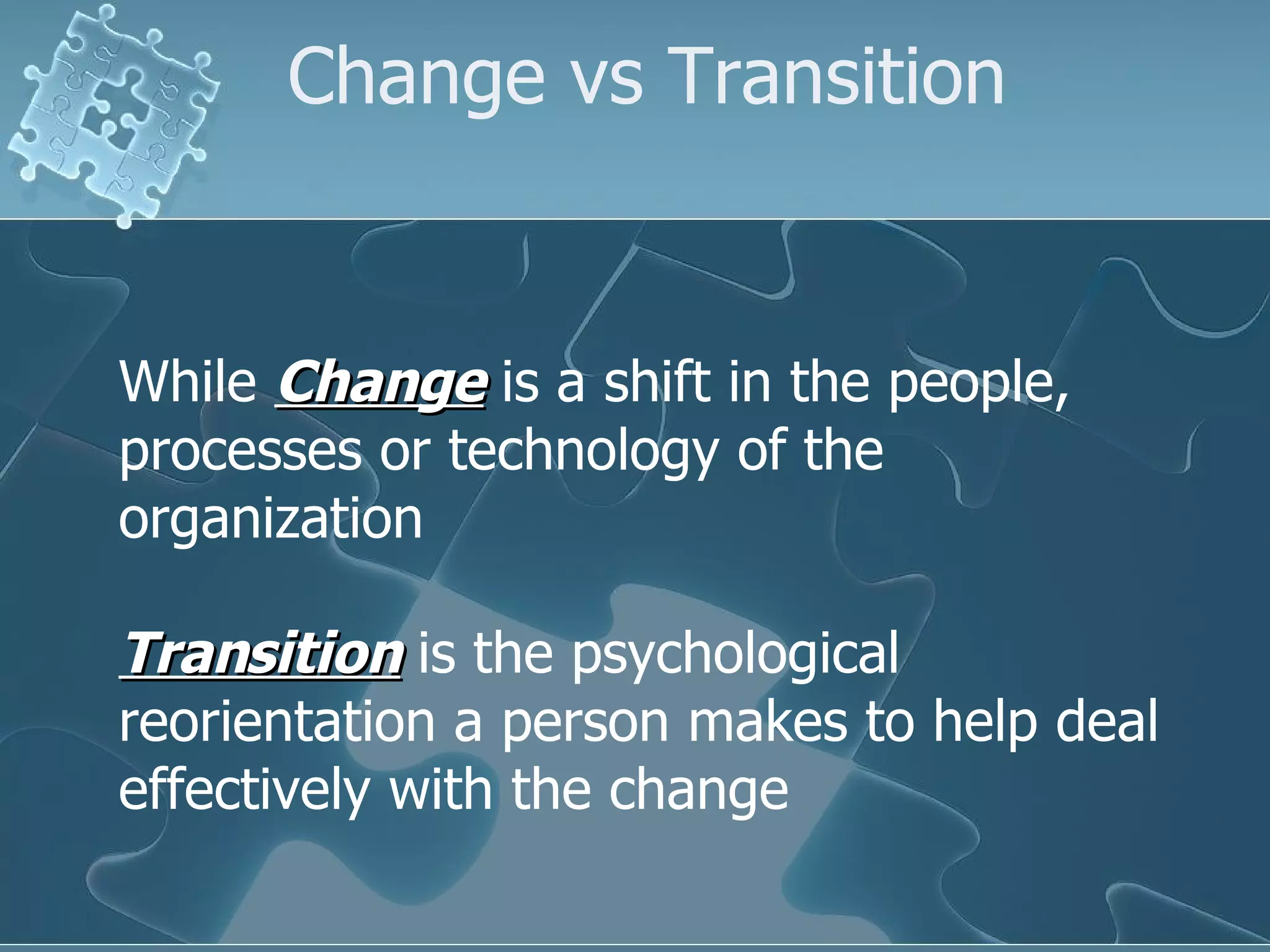
Change vs Transition While  Change  is a shift in the people, processes or technology of the organization Transition  is the psychological reorientation a person makes to help deal effectively with the change
Phases of Transition change. Denial Resistance Exploration Commitment
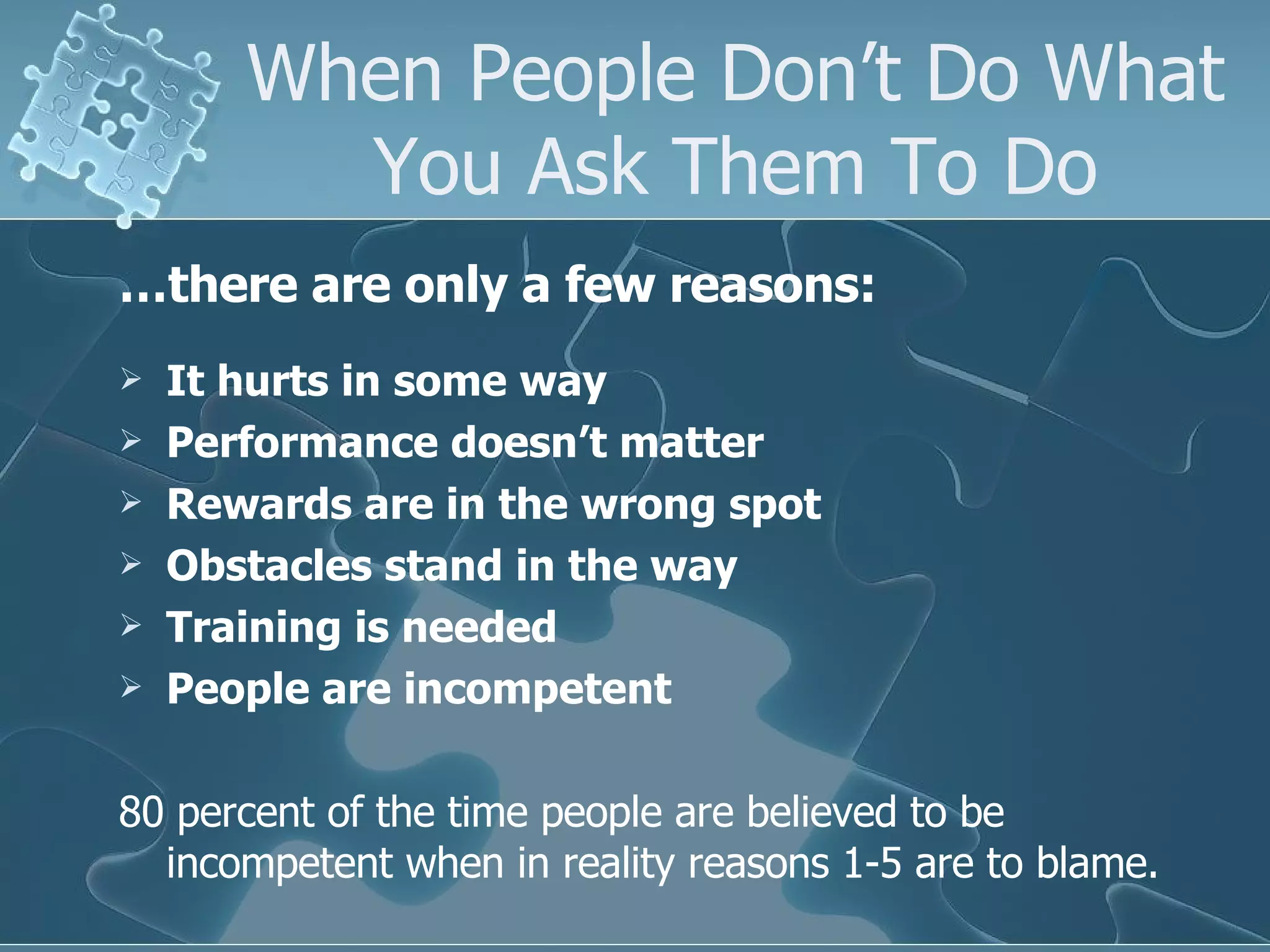
When People Don’t Do What You Ask Them To Do … there are only a few reasons: It hurts in some way Performance doesn’t matter Rewards are in the wrong spot Obstacles stand in the way Training is needed People are incompetent 80 percent of the time people are believed to be incompetent when in reality reasons 1-5 are to blame.
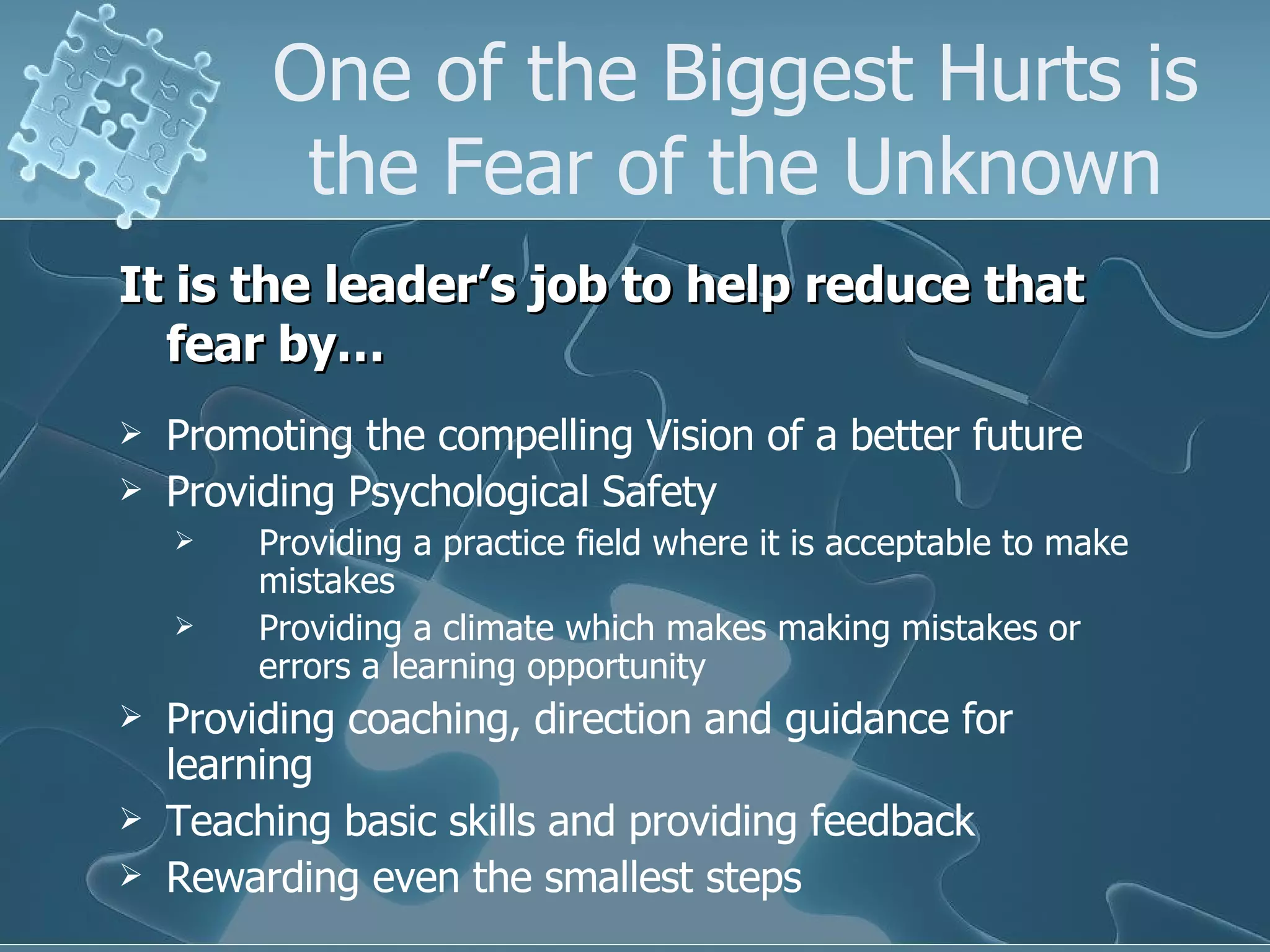
One of the Biggest Hurts is the Fear of the Unknown It is the leader’s job to help reduce that fear by… Promoting the compelling Vision of a better future Providing Psychological Safety Providing a practice field where it is acceptable to make mistakes Providing a climate which makes making mistakes or errors a learning opportunity Providing coaching, direction and guidance for learning Teaching basic skills and providing feedback Rewarding even the smallest steps
Reactions to Change and Managerial Interventions REACTION EXPRESSION MANAGERIAL INTERVENTION Disengagement Withdrawal Confront, identify Disidentification Sadness, worry Explore, transfer Disenchantment Anger Neutralize, acknowledge Disorientation Confusion Explain, plan
Disengagement Disengagement is psychological withdrawal from change.  Employees may appear to lose initiative and interest in the job, they are physically present, but mentally absent. They lack drive and commitment. How to Recognize it:  Employees who are disengaged may be hard to find or doing only the basics to get the job done. Management Strategy to deal with it: Confront employees with their reaction, draw them out and help them air their feelings.  Use open communication and empathy.
Disidentification Disidentification is when employees feel that their identity has been threatened by the change, they feel very vulnerable. How to Recognize it:  They may appear to be sulking and dwelling on the past by reminiscing about the old ways of doing things. Management Strategy to deal with it: Encourage employees to explore their feelings, show them how it is possible to have positive experiences in the new situation.  They need to see that work itself and emotion are separable .
Disenchantment Disenchantment is usually expressed as negativity or anger.  Employees realize the past is gone and they are mad about it. How to Recognize it:  Employees may try to garner support with other employees or result to destructive behaviors like sabotage and backstabbing, bad-mouthing and starting rumors. Management Strategy to deal with it: Allow employees to let off steam to bring them to a more neutral state.  Acknowledge their feelings.
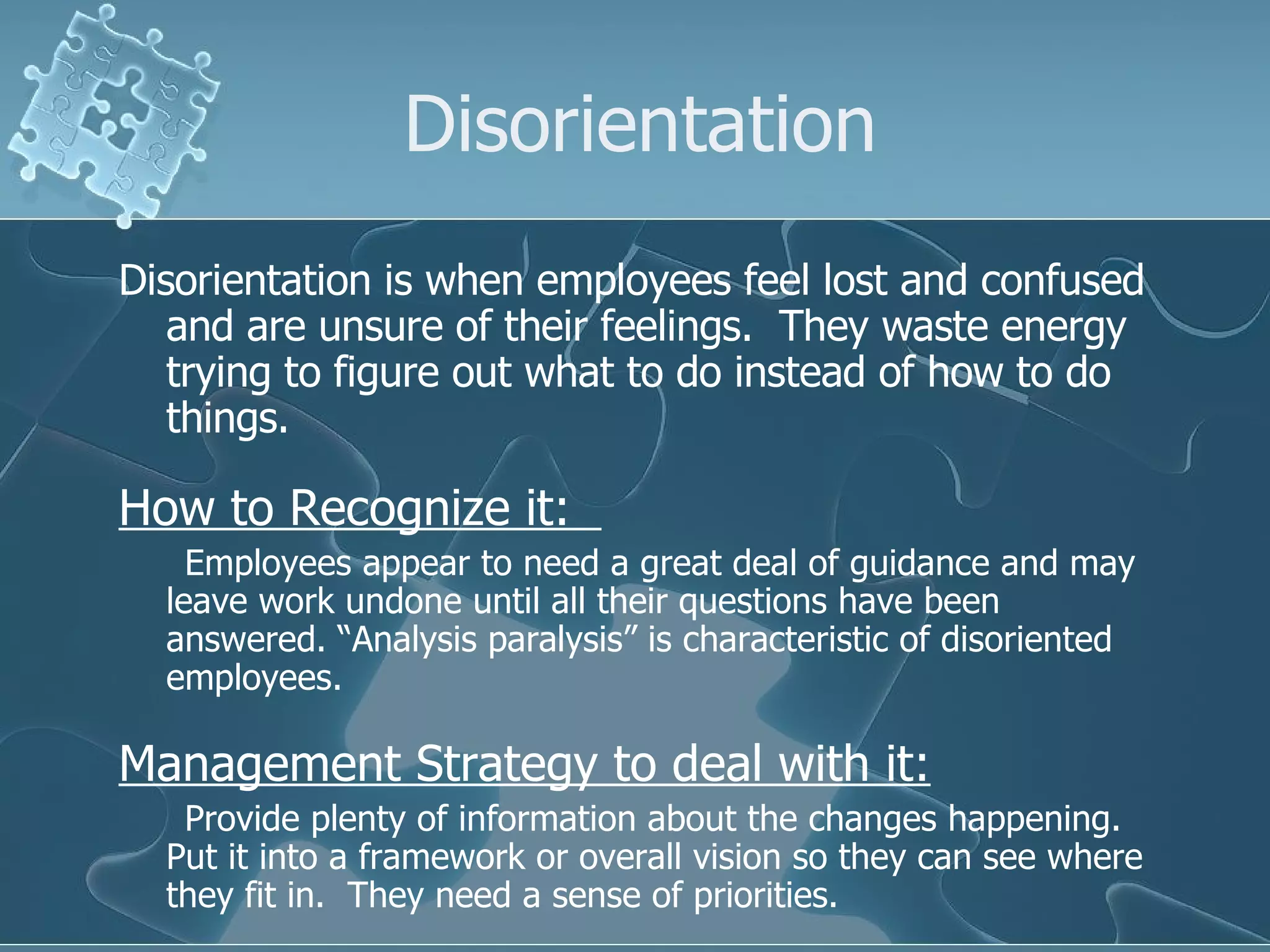
Disorientation Disorientation is when employees feel lost and confused and are unsure of their feelings.  They waste energy trying to figure out what to do instead of how to do things. How to Recognize it:  Employees appear to need a great deal of guidance and may leave work undone until all their questions have been answered. “Analysis paralysis” is characteristic of disoriented employees. Management Strategy to deal with it: Provide plenty of information about the changes happening.  Put it into a framework or overall vision so they can see where they fit in.  They need a sense of priorities.
Tips for Managers and Supervisors Be available to talk during times of change or crisis Be open-minded Be flexible Give praise openly and frequently Be a leader Encourage employees to communicate about how they are feeling Our employees are our most valuable asset, let them know that.
The End

Change Management

  • 1.
    Managing Change A Guide For Managers & Supervisors
  • 2.
    Change vs TransitionWhile Change is a shift in the people, processes or technology of the organization Transition is the psychological reorientation a person makes to help deal effectively with the change
  • 3.
    Phases of Transitionchange. Denial Resistance Exploration Commitment
  • 4.
    When People Don’tDo What You Ask Them To Do … there are only a few reasons: It hurts in some way Performance doesn’t matter Rewards are in the wrong spot Obstacles stand in the way Training is needed People are incompetent 80 percent of the time people are believed to be incompetent when in reality reasons 1-5 are to blame.
  • 5.
    One of theBiggest Hurts is the Fear of the Unknown It is the leader’s job to help reduce that fear by… Promoting the compelling Vision of a better future Providing Psychological Safety Providing a practice field where it is acceptable to make mistakes Providing a climate which makes making mistakes or errors a learning opportunity Providing coaching, direction and guidance for learning Teaching basic skills and providing feedback Rewarding even the smallest steps
  • 6.
    Reactions to Changeand Managerial Interventions REACTION EXPRESSION MANAGERIAL INTERVENTION Disengagement Withdrawal Confront, identify Disidentification Sadness, worry Explore, transfer Disenchantment Anger Neutralize, acknowledge Disorientation Confusion Explain, plan
  • 7.
    Disengagement Disengagement ispsychological withdrawal from change. Employees may appear to lose initiative and interest in the job, they are physically present, but mentally absent. They lack drive and commitment. How to Recognize it: Employees who are disengaged may be hard to find or doing only the basics to get the job done. Management Strategy to deal with it: Confront employees with their reaction, draw them out and help them air their feelings. Use open communication and empathy.
  • 8.
    Disidentification Disidentification iswhen employees feel that their identity has been threatened by the change, they feel very vulnerable. How to Recognize it: They may appear to be sulking and dwelling on the past by reminiscing about the old ways of doing things. Management Strategy to deal with it: Encourage employees to explore their feelings, show them how it is possible to have positive experiences in the new situation. They need to see that work itself and emotion are separable .
  • 9.
    Disenchantment Disenchantment isusually expressed as negativity or anger. Employees realize the past is gone and they are mad about it. How to Recognize it: Employees may try to garner support with other employees or result to destructive behaviors like sabotage and backstabbing, bad-mouthing and starting rumors. Management Strategy to deal with it: Allow employees to let off steam to bring them to a more neutral state. Acknowledge their feelings.
  • 10.
    Disorientation Disorientation iswhen employees feel lost and confused and are unsure of their feelings. They waste energy trying to figure out what to do instead of how to do things. How to Recognize it: Employees appear to need a great deal of guidance and may leave work undone until all their questions have been answered. “Analysis paralysis” is characteristic of disoriented employees. Management Strategy to deal with it: Provide plenty of information about the changes happening. Put it into a framework or overall vision so they can see where they fit in. They need a sense of priorities.
  • 11.
    Tips for Managersand Supervisors Be available to talk during times of change or crisis Be open-minded Be flexible Give praise openly and frequently Be a leader Encourage employees to communicate about how they are feeling Our employees are our most valuable asset, let them know that.
  • 12.