PERSONNEL MANAGEMENT Personnel are a major factor in determining the quality of experience a visitor receives  “ You can dream, create, design and build the most wonderful place in the world… but it takes people to make the dream a reality” Walt Disney
Personnel Training should accomplish the following Train the employees to be friendly and courteous Give employees basic knowledge of facility features and programmes Introduce the employees to the visitor and his problems and needs Train the employees to be alert to situations where they can help visitors Make employees aware of the image projected both by themselves and the facility
Human Resource functions Traditional Hiring  Recruiting Selecting Training Supervising Modern Leadership Instructional strategies Crisis confrontation and intervention
The goal of hiring The goal of filling the vacant position is not to fill the position, it is to fill the position with the right person
JOB DESCRIPTION Thorough and accurate job description must be prepared for each position in your organization from the frontline personnel  to middle level managers to top level managers
What is included in job description ? Title Listing responsibilities and functions Required knowledge and skills Minimum acceptable educational level  and previous experience Physical or medical standards
RULES AND CONDUCT Dress and appearance Employee cooperation Reporting for duty
Relations between employee-department-community Employee –administration relation Employee community relation Solicitation of funds Management of funds Publicity releases
EMPLOYEE MANUALS A  good employee manual will not just include personnel policies but will also serve as a reference with details  of more complicated or less frequently performed tasks It will present a numbered sequence of operations ,in order for each of these tasks
SUPERVISION Role as a coach:  Pass along your experience and knowledge Role as a counselor  : Employing encouragement, criticism and a range or techniques to deal with possible problems in the work environment, interpersonal difficulties or other emotional or social problems that may occur
Guidelines for effective counseling Listen patiently – without interrupting  Refrain from criticizing or offering hasty advice Never argue with employees while counseling them  Give them your undivided attention while they are talking Look beyond the mere words of what they are talking If the problem is minor, simply helping the employees burden himself/herself  may lead to a solution If the problem is more severe recommend a counselor-  trained professional in that subject
EMPLOYEE MOTIVATION Reinforcement techniques -  positive reinforcers ..add something good to employee’s life - negative reinforcers .. Remove something unpleasant, such as distasteful task or schedule, from the employee’s life
EMPLOYEE MOTIVATION -  Punishers or deterrents.. add something unpleasant or removes something good Reinforcement techniques  are considered to be far superior in  producing lasting behavioral change
EVALUATION It is essential that supervision regularly rate employees on criteria such as personality traits, degree of responsibility, enthusiasm, initiative, human relations skills, appearance, specific job related skills and overall level of performance
Behavioural competencies  are those critical to success in the role Leadership People Management Initiative Commitment Teamwork Judgment Flexibility Interpersonal Skills Creativity Problem Solving Examples Key Success Factors
Training & Development In today’s world, if training and development opportunities are not made available to your employees, you will lose them.  Access to training and development has  become a fundamental expectation of today’s workforce.
Employee participation in management ""  Paricipation in management has three important stages viz- . 1. Information sharing.. Notice boards, House bullettins etc.
2. Joint consultations .. Where Unions and Management sit together, and views exchanged .
Participation becomes possible when both Union and mamagement are matured in their relationships and the level of TRUST is at the optimum .
3. Participation.. when both, the union and management sit together and take consensus decision
Managing Conflict
Conflict Conflict is derived from the Latin word Confligere, i.e., to strike together.
Defining Conflict Conflict is the sharp disagreement and opposition of ideas. Conflict is the general word we use for a contest, a struggle, a quarrel. Conflict is the emotional disturbance resulting from a clash of interests. Conflict can be a storm in the workplace.
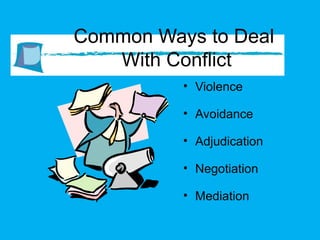
Common Ways to Deal  With Conflict Violence Avoidance Adjudication Negotiation Mediation
The Truth About  Workplace Conflict You can’t avoid it You can’t eliminate it You can’t wish it away You can only understand it and manage it
Don’t Be Afraid of Conflict Conflicts are like office gifts: Conflicts can open lines of communication. Conflicts can be viewed as symptoms of larger workplace problems. Conflicts can let you address issues before they become problems.
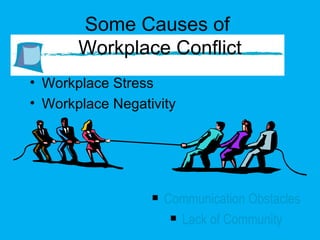
Some Causes of  Workplace Conflict Workplace Stress Workplace Negativity Communication Obstacles Lack of Community
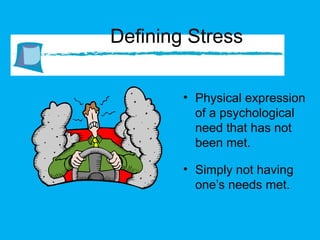
Defining Stress Stress is a force exerted upon a body that tends to strain or deform its shape. Stress manifests itself as mental or physical tension or strain.
Defining Stress Physical expression of a psychological need that has not been met. Simply not having one’s needs met.
Workplace Stress Relievers Take a short break Go on vacation Take a stress class Do exercises at work Eat lunch with a friend Get active in work committees Volunteer for team assignments Talk to your EAP Counselor
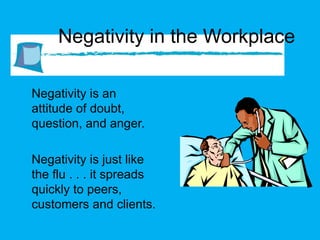
Negativity in the Workplace Negativity is an attitude of doubt, question, and anger.  Negativity is just like the flu . . . it spreads quickly to peers, customers and clients.
The Garden of Negativity Negativity: Like weeds in a garden- it will not go away by itself. Change and stress help to fertilize the negativity in your workplace.
Some Causes of Negativity Experiencing increased change Feeling a lack of control Hearing rumors Having work helplessness Experiencing jealousy,  self-doubt and fear  Feelings of isolation Having no work focus or agency mission
Tips for Dealing With the Chronic Complainer Listen and acknowledge Don’t get caught in the “never” or  “always” cycle Don’t agree with the complaint Avoid the blame and justify State facts without apology Ask for solutions  Show the list of complaints
Tips for Dealing With the Chronic Worrier Listen to concerns Address the easy issues Suggest a mentor Enroll in stress reduction classes Push teamwork Refer to EAP
Tips for Dealing With  Angry Employees Don’t get angry Diffuse the anger Don’t agree Let the person talk Move toward problem-solving Refer to EAP
Tips for Dealing With  Difficult Managers Avoid negative attitude  transference to boss Expect rough days Don’t nurse a small gripe  into a huge issue Select the right time to approach the boss Don’t go over the boss’ head without communicating first Don’t let the boss intimidate
Tips for Dealing With  Difficult Managers Your boss is not your buddy If you make a mistake,  clear the air quickly Not all bosses enjoy  being the boss If possible, make the boss your mentor Maintain open and honest communication with your boss Don’t be negative with others about the boss
Coping With  Difficult Situations Assess the situation – am I dealing with a difficult person or a difficult situation? What am I willing to accept about this person or situation? Should I put some distance between me and the person or situation?
Deal With  Workplace Negativity Negativity: Wastes time Damages relationships Destroys productivity Negativity also: Damages creativity and innovation Diminishes workplace morale Defeats empowerment-”that is not my job”
How to Channel  Negative Energy Suggestion boxes Team group awards Quality groups Websites Management feedback Employee concerns  program Community improvement awards
“ Positivity” in the Workplace “ Positivity” is as contagious as negativity Better communication decreases negativity and increases “positivity” in your workforce Work toward creating a positive attitude among your peers, employees, customers and clients
“ Positivity” in the Workplace Be likeable Be respectful Don’t aggravate the situation Don’t force people to be  defensive Don’t always try to find fault Be willing to lose a battle to win a war Be patient Smile
Tips For Building a Positive Work Attitude Build a positive attitude in another environment Talk about positive things Look for good things in the  people you work with Look for good things in your  organization Avoid financial problems Avoid negative attitude traps of fellow workers Make frequent self-assessments
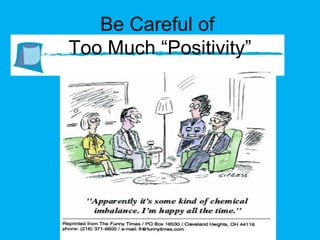
Be Careful of  Too Much “Positivity”
Why Care About Work Conflicts Decreased Performance Increased Turnover Decreased Ability to Recruit Increased Grievances and Complaints Decreased Ability to Manage Leave Programs  Increased Violence in the Workplace
Chinese Philosopher Lao Tzu Said Always we hope someone else has the answer. Some other place will be better. Some other time it will all turn out.. No one else has the answer. No other place will be better, and it has already turned out. At the center of your being you have the answer… Search your heart and see the way to do is to be.
Positive Work Environment A Happy and Productive Workforce doesn’t happen by itself . . . It takes a lot of hard work and a great deal of effort by everyone. The reward is worth the effort.
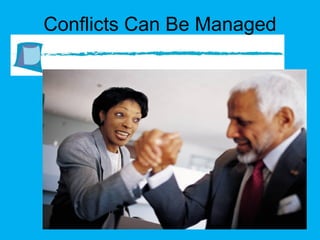
Conflicts Can Be Managed
BOSS To LEADER BOSS Drives the team Instills fear Say “Do” Makes work drudgery Relies upon authority Says “I” LEADER Guides the team Inspires confidence Say “Let’s Do” Makes work interesting Relies upon cooperation Says “WE”
Who is a Team Leader Contact point for communication between team and management Full-fledged team member Assists the team by immediately implementing changes that are within the bounds of the team
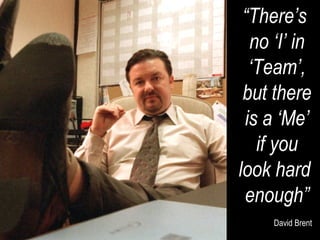
“ There’s  no ‘I’ in ‘ Team’, but there is a ‘Me’ if you look hard  enough” David Brent
give your people a  damn good listening to
“ The best  engineers  sometimes come in  bodies that can’t  talk .” nolan bushnell, founder of atari
take  action, not notes
“ Vision without  action is  hallucination” Andy Law, St.Lukes
“ take the first  step in faith. You  do not have to  see the whole  staircase. Just take  the first  step.” Martin Luther King
don’t just stand there….. do something! dick dastardly
Ten Commandments To Feel Good Every Day
BE A KID AGAIN
EXPAND YOUR HORIZONS
LIST FIVE OF YOUR STRENGTHS
HELP SOME ONE WITHOUT TELLING THEM
CHANGE SOMETHING ABOUT YOURSELF
ACCOMPLISH SOMETHING SMALL THAT YOU HAVE BEEN  AVOIDING
TALK WITH A GOOD FRIEND
GET SOME REGULAR EXERCISES
GET IN TOUCH WITH YOUR SPIRITUAL SIDE
“ RELAX VEV
THANK YOU THANK YOU
Dr.R.PRAKASH MSc(Ag), MBA, PhD Professor&Project cordinator Agricultural Extension and Development studies Kerala Agricultural University College of Agriculture,Vellayani P O Thiruvananthapuram – 695522 [email_address]   9446331825 (M)

Personnel Management Rttc

  • 1.
    PERSONNEL MANAGEMENT Personnelare a major factor in determining the quality of experience a visitor receives “ You can dream, create, design and build the most wonderful place in the world… but it takes people to make the dream a reality” Walt Disney
  • 2.
    Personnel Training shouldaccomplish the following Train the employees to be friendly and courteous Give employees basic knowledge of facility features and programmes Introduce the employees to the visitor and his problems and needs Train the employees to be alert to situations where they can help visitors Make employees aware of the image projected both by themselves and the facility
  • 3.
    Human Resource functionsTraditional Hiring Recruiting Selecting Training Supervising Modern Leadership Instructional strategies Crisis confrontation and intervention
  • 4.
    The goal ofhiring The goal of filling the vacant position is not to fill the position, it is to fill the position with the right person
  • 5.
    JOB DESCRIPTION Thoroughand accurate job description must be prepared for each position in your organization from the frontline personnel to middle level managers to top level managers
  • 6.
    What is includedin job description ? Title Listing responsibilities and functions Required knowledge and skills Minimum acceptable educational level and previous experience Physical or medical standards
  • 7.
    RULES AND CONDUCTDress and appearance Employee cooperation Reporting for duty
  • 8.
    Relations between employee-department-communityEmployee –administration relation Employee community relation Solicitation of funds Management of funds Publicity releases
  • 9.
    EMPLOYEE MANUALS A good employee manual will not just include personnel policies but will also serve as a reference with details of more complicated or less frequently performed tasks It will present a numbered sequence of operations ,in order for each of these tasks
  • 10.
    SUPERVISION Role asa coach: Pass along your experience and knowledge Role as a counselor : Employing encouragement, criticism and a range or techniques to deal with possible problems in the work environment, interpersonal difficulties or other emotional or social problems that may occur
  • 11.
    Guidelines for effectivecounseling Listen patiently – without interrupting Refrain from criticizing or offering hasty advice Never argue with employees while counseling them Give them your undivided attention while they are talking Look beyond the mere words of what they are talking If the problem is minor, simply helping the employees burden himself/herself may lead to a solution If the problem is more severe recommend a counselor- trained professional in that subject
  • 12.
    EMPLOYEE MOTIVATION Reinforcementtechniques - positive reinforcers ..add something good to employee’s life - negative reinforcers .. Remove something unpleasant, such as distasteful task or schedule, from the employee’s life
  • 13.
    EMPLOYEE MOTIVATION - Punishers or deterrents.. add something unpleasant or removes something good Reinforcement techniques are considered to be far superior in producing lasting behavioral change
  • 14.
    EVALUATION It isessential that supervision regularly rate employees on criteria such as personality traits, degree of responsibility, enthusiasm, initiative, human relations skills, appearance, specific job related skills and overall level of performance
  • 15.
    Behavioural competencies are those critical to success in the role Leadership People Management Initiative Commitment Teamwork Judgment Flexibility Interpersonal Skills Creativity Problem Solving Examples Key Success Factors
  • 16.
    Training & DevelopmentIn today’s world, if training and development opportunities are not made available to your employees, you will lose them. Access to training and development has become a fundamental expectation of today’s workforce.
  • 17.
    Employee participation inmanagement "" Paricipation in management has three important stages viz- . 1. Information sharing.. Notice boards, House bullettins etc.
  • 18.
    2. Joint consultations.. Where Unions and Management sit together, and views exchanged .
  • 19.
    Participation becomes possiblewhen both Union and mamagement are matured in their relationships and the level of TRUST is at the optimum .
  • 20.
    3. Participation.. whenboth, the union and management sit together and take consensus decision
  • 21.
  • 22.
    Conflict Conflict isderived from the Latin word Confligere, i.e., to strike together.
  • 23.
    Defining Conflict Conflictis the sharp disagreement and opposition of ideas. Conflict is the general word we use for a contest, a struggle, a quarrel. Conflict is the emotional disturbance resulting from a clash of interests. Conflict can be a storm in the workplace.
  • 24.
    Common Ways toDeal With Conflict Violence Avoidance Adjudication Negotiation Mediation
  • 25.
    The Truth About Workplace Conflict You can’t avoid it You can’t eliminate it You can’t wish it away You can only understand it and manage it
  • 26.
    Don’t Be Afraidof Conflict Conflicts are like office gifts: Conflicts can open lines of communication. Conflicts can be viewed as symptoms of larger workplace problems. Conflicts can let you address issues before they become problems.
  • 27.
    Some Causes of Workplace Conflict Workplace Stress Workplace Negativity Communication Obstacles Lack of Community
  • 28.
    Defining Stress Stressis a force exerted upon a body that tends to strain or deform its shape. Stress manifests itself as mental or physical tension or strain.
  • 29.
    Defining Stress Physicalexpression of a psychological need that has not been met. Simply not having one’s needs met.
  • 30.
    Workplace Stress RelieversTake a short break Go on vacation Take a stress class Do exercises at work Eat lunch with a friend Get active in work committees Volunteer for team assignments Talk to your EAP Counselor
  • 31.
    Negativity in theWorkplace Negativity is an attitude of doubt, question, and anger. Negativity is just like the flu . . . it spreads quickly to peers, customers and clients.
  • 32.
    The Garden ofNegativity Negativity: Like weeds in a garden- it will not go away by itself. Change and stress help to fertilize the negativity in your workplace.
  • 33.
    Some Causes ofNegativity Experiencing increased change Feeling a lack of control Hearing rumors Having work helplessness Experiencing jealousy, self-doubt and fear Feelings of isolation Having no work focus or agency mission
  • 34.
    Tips for DealingWith the Chronic Complainer Listen and acknowledge Don’t get caught in the “never” or “always” cycle Don’t agree with the complaint Avoid the blame and justify State facts without apology Ask for solutions Show the list of complaints
  • 35.
    Tips for DealingWith the Chronic Worrier Listen to concerns Address the easy issues Suggest a mentor Enroll in stress reduction classes Push teamwork Refer to EAP
  • 36.
    Tips for DealingWith Angry Employees Don’t get angry Diffuse the anger Don’t agree Let the person talk Move toward problem-solving Refer to EAP
  • 37.
    Tips for DealingWith Difficult Managers Avoid negative attitude transference to boss Expect rough days Don’t nurse a small gripe into a huge issue Select the right time to approach the boss Don’t go over the boss’ head without communicating first Don’t let the boss intimidate
  • 38.
    Tips for DealingWith Difficult Managers Your boss is not your buddy If you make a mistake, clear the air quickly Not all bosses enjoy being the boss If possible, make the boss your mentor Maintain open and honest communication with your boss Don’t be negative with others about the boss
  • 39.
    Coping With Difficult Situations Assess the situation – am I dealing with a difficult person or a difficult situation? What am I willing to accept about this person or situation? Should I put some distance between me and the person or situation?
  • 40.
    Deal With Workplace Negativity Negativity: Wastes time Damages relationships Destroys productivity Negativity also: Damages creativity and innovation Diminishes workplace morale Defeats empowerment-”that is not my job”
  • 41.
    How to Channel Negative Energy Suggestion boxes Team group awards Quality groups Websites Management feedback Employee concerns program Community improvement awards
  • 42.
    “ Positivity” inthe Workplace “ Positivity” is as contagious as negativity Better communication decreases negativity and increases “positivity” in your workforce Work toward creating a positive attitude among your peers, employees, customers and clients
  • 43.
    “ Positivity” inthe Workplace Be likeable Be respectful Don’t aggravate the situation Don’t force people to be defensive Don’t always try to find fault Be willing to lose a battle to win a war Be patient Smile
  • 44.
    Tips For Buildinga Positive Work Attitude Build a positive attitude in another environment Talk about positive things Look for good things in the people you work with Look for good things in your organization Avoid financial problems Avoid negative attitude traps of fellow workers Make frequent self-assessments
  • 45.
    Be Careful of Too Much “Positivity”
  • 46.
    Why Care AboutWork Conflicts Decreased Performance Increased Turnover Decreased Ability to Recruit Increased Grievances and Complaints Decreased Ability to Manage Leave Programs Increased Violence in the Workplace
  • 47.
    Chinese Philosopher LaoTzu Said Always we hope someone else has the answer. Some other place will be better. Some other time it will all turn out.. No one else has the answer. No other place will be better, and it has already turned out. At the center of your being you have the answer… Search your heart and see the way to do is to be.
  • 48.
    Positive Work EnvironmentA Happy and Productive Workforce doesn’t happen by itself . . . It takes a lot of hard work and a great deal of effort by everyone. The reward is worth the effort.
  • 49.
  • 50.
    BOSS To LEADERBOSS Drives the team Instills fear Say “Do” Makes work drudgery Relies upon authority Says “I” LEADER Guides the team Inspires confidence Say “Let’s Do” Makes work interesting Relies upon cooperation Says “WE”
  • 51.
    Who is aTeam Leader Contact point for communication between team and management Full-fledged team member Assists the team by immediately implementing changes that are within the bounds of the team
  • 52.
    “ There’s no ‘I’ in ‘ Team’, but there is a ‘Me’ if you look hard enough” David Brent
  • 53.
    give your peoplea damn good listening to
  • 54.
    “ The best engineers sometimes come in bodies that can’t talk .” nolan bushnell, founder of atari
  • 55.
    take action,not notes
  • 56.
    “ Vision without action is hallucination” Andy Law, St.Lukes
  • 57.
    “ take thefirst step in faith. You do not have to see the whole staircase. Just take the first step.” Martin Luther King
  • 58.
    don’t just standthere….. do something! dick dastardly
  • 59.
    Ten Commandments ToFeel Good Every Day
  • 60.
    BE A KIDAGAIN
  • 61.
  • 62.
    LIST FIVE OFYOUR STRENGTHS
  • 63.
    HELP SOME ONEWITHOUT TELLING THEM
  • 64.
  • 65.
    ACCOMPLISH SOMETHING SMALLTHAT YOU HAVE BEEN AVOIDING
  • 66.
    TALK WITH AGOOD FRIEND
  • 67.
  • 68.
    GET IN TOUCHWITH YOUR SPIRITUAL SIDE
  • 69.
  • 70.
  • 71.
    Dr.R.PRAKASH MSc(Ag), MBA,PhD Professor&Project cordinator Agricultural Extension and Development studies Kerala Agricultural University College of Agriculture,Vellayani P O Thiruvananthapuram – 695522 [email_address] 9446331825 (M)

Editor's Notes

  • #35 Notes on Dealing with Complainer Listen attentively and acknowledge what the complainer has said by paraphrasing the information. Get to the bottom of the use of words like “always” and “never”. Few things are always and never. Don’t agree with the complainer-it justifies the feelings Avoid blame and justify- Move quickly into problem solving to get the focus off the complaint. Complaints tend to be attention getting devices. Justify the attention. Make statements of fact-no apologies Ask for solutions Most people don’t realize the amount of complaining they do. Show the complainer a list of their complaints and how frequently they complain.
  • #52 If participants vision is different from what is in the slide. ! Do you’ll agree with the points stated