Managing Transition Workshop
Cardmember Core
Process Group
October 16, 2003
“Change is the law of life. And, those
who look only to the past or present
are certain to miss the future.”
- John Fitzgerald Kennedy
The Change Epidemic
 Wal-mart, an upstart leaves K-mart, Sears
and Penny in the dust
 Fox, CNN and cable end the dynasty of ABC,
NBC and CBS
 A computer on every desk, a cellular in every
car, a beeper on every belt …
Change versus Transition
Change is SITUATIONAL
Transition is PSYCHOLOGICAL
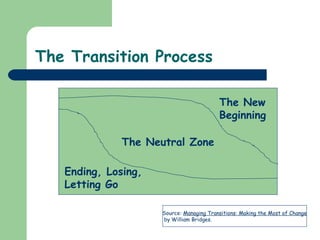
The Transition Process
Source: Managing Transitions: Making the Most of Change
by William Bridges.
The Neutral Zone
Ending, Losing,
Letting Go
The New
Beginning
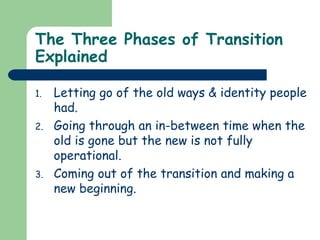
The Three Phases of Transition
Explained
1. Letting go of the old ways & identity people
had.
2. Going through an in-between time when the
old is gone but the new is not fully
operational.
3. Coming out of the transition and making a
new beginning.
Transition – A Way to View It
Transition starts with an ENDING
and finishes with a BEGINNING.
Reactions to Transition
 Complete this worksheet
Almost anything is easier to get
Into than out of.
- Agnes Allen, American Writer
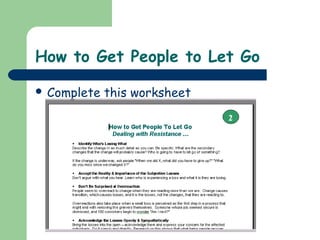
How to Get People to Let Go
 Complete this worksheet
Managing Endings: A Checklist
 Complete this worksheet
Questions to Ask Yourself in
Endings:
 What actions can you take to help people
deal more successfully with the endings that
are taking place in your organization?
 What can you do today to get started on
this aspect of transition management?
The NEUTRAL ZONE
1. If you don’t understand it you will rush through it.
2. Frightened in no-man’s-land and try to escape it
(increased turnover during org. change efforts).
3. If you escape it, you loose the opportunity to be
creative, develop what you need to become and
renew yourself.
The neutral zone is a dangerous and opportune place;
it is the very core of the transition process.
Neutral Zone Dangers
 Anxiety rises and motivation falls
 Miss more work – productivity suffers (rise
in medical & disability claims)
 Old weaknesses reemerge
 People are in overload – mixed signals and
unreliable
 Teamwork & loyalty are undermined
 Company is vulnerable to attack
Possibility Thinking – Look Beyond
the Flaws
 Take a moment and think of a time when you
were encouraged to be innovative and
suggest new ideas. Describe the
environment. If you have never worked in
that type of environment, try to imagine it …
 What can a leader do to foster such an
environment?
The CRITIC versus THE COACH
The Critic
 Focus on defects &
problems
 Identifies barriers
 Shoots holes in ideas
 Listens in order to criticize
and judge
 Interrupts, nitpicks
 Judges the presenter
harshly
 Punishes wild ideas and
failures
The Coach
 Focuses on desired results
 Finds ways to make it work
 Finds Golden Nuggets in
ideas
 Listens in order to
understand and discuss
 Is considerate of others
and their points of view
 Encourages new ideas and
risk taking
Which one are you?
Blessing in Disguise?
 Think of an example in your life that was a
blessing in disguise. What was the blessing
in disguise?
Questions
 Most managers find it easy to fall into the
role of a Critic. Why?
 How would practicing the behaviors
associated with the Coach make you more
effective?
 What could you do to be more of a Coach?
Managing the Neutral Zone: A
Checklist
 Complete this worksheet
Question to Ask Yourself in the
Neutral Zone …
 How can I make this interim between the old
and the new not only a bearable time but
also a time during which the organization and
everyone’s place in it are enhanced?
 How can we come out of this waiting time
better than we were before the transition
started?
Reinforcing the New Beginnings
1. Be Consistent
2. Ensure Quick Successes
3. Symbolize the New Identity
4. Celebrate the Success
New Beginnings 2
 If transition is mishandled we often say “the
change did not work” or “fell short.”
 We should really say …
 “WE GOT THE PEOPLE OUT OF EGYPT,
BUT THEY ARE STILL WANDERING
SOMEWHERE IN THE WILDERNESS!”
Managing New Beginnings: A
Checklist
 Complete this worksheet
Questions to Ask Yourself in New
Beginnings
 What actions could you take to help people
deal more successfully with the new
beginnings they must make if your change
effort is to succeed?
 What could you do today to get started on
this aspect of transition management?
More Questions
 What are your strengths in implementing
change as a change agent?
 What areas of improvement could make you
a better change agent?
 Think about a specific change you are
thinking about implementing. What could
you do to ensure its successful
implementation?
“The change is going to be rapid that as business
leaders, we have to find out how to make change a
satisfier rather than a dis-satisfier. And, I believe
that’s one of the major challenges we face. The
future leaders of all institutions who figure out how to
encourage their people to change – have them feel
good about change – are the ones who are going to
come out ahead.”
-David T. Kearnes
Former Chairman & CEO of
Xerox Corporation
Reflections …
1. What will I do different after attending
this workshop?
2. What will I do going forward to manage
resistance to change?
3. How will I measure success?
References
 William Bridges, Managing Transitions: Making the Most of
Change (Cambridge, MA: Perseus Publishing, 2003)
 The stages of the grieving process were first described by
Elisabeth Kubler-Ross, M.D. in her now-classic book On Death
and Dying (New York: Macmillan, 1969)

Managing Transition Workshop

  • 1.
    Managing Transition Workshop CardmemberCore Process Group October 16, 2003
  • 2.
    “Change is thelaw of life. And, those who look only to the past or present are certain to miss the future.” - John Fitzgerald Kennedy
  • 3.
    The Change Epidemic Wal-mart, an upstart leaves K-mart, Sears and Penny in the dust  Fox, CNN and cable end the dynasty of ABC, NBC and CBS  A computer on every desk, a cellular in every car, a beeper on every belt …
  • 4.
    Change versus Transition Changeis SITUATIONAL Transition is PSYCHOLOGICAL
  • 5.
    The Transition Process Source:Managing Transitions: Making the Most of Change by William Bridges. The Neutral Zone Ending, Losing, Letting Go The New Beginning
  • 6.
    The Three Phasesof Transition Explained 1. Letting go of the old ways & identity people had. 2. Going through an in-between time when the old is gone but the new is not fully operational. 3. Coming out of the transition and making a new beginning.
  • 7.
    Transition – AWay to View It Transition starts with an ENDING and finishes with a BEGINNING.
  • 8.
    Reactions to Transition Complete this worksheet Almost anything is easier to get Into than out of. - Agnes Allen, American Writer
  • 9.
    How to GetPeople to Let Go  Complete this worksheet
  • 10.
    Managing Endings: AChecklist  Complete this worksheet
  • 11.
    Questions to AskYourself in Endings:  What actions can you take to help people deal more successfully with the endings that are taking place in your organization?  What can you do today to get started on this aspect of transition management?
  • 12.
    The NEUTRAL ZONE 1.If you don’t understand it you will rush through it. 2. Frightened in no-man’s-land and try to escape it (increased turnover during org. change efforts). 3. If you escape it, you loose the opportunity to be creative, develop what you need to become and renew yourself. The neutral zone is a dangerous and opportune place; it is the very core of the transition process.
  • 13.
    Neutral Zone Dangers Anxiety rises and motivation falls  Miss more work – productivity suffers (rise in medical & disability claims)  Old weaknesses reemerge  People are in overload – mixed signals and unreliable  Teamwork & loyalty are undermined  Company is vulnerable to attack
  • 14.
    Possibility Thinking –Look Beyond the Flaws  Take a moment and think of a time when you were encouraged to be innovative and suggest new ideas. Describe the environment. If you have never worked in that type of environment, try to imagine it …  What can a leader do to foster such an environment?
  • 15.
    The CRITIC versusTHE COACH The Critic  Focus on defects & problems  Identifies barriers  Shoots holes in ideas  Listens in order to criticize and judge  Interrupts, nitpicks  Judges the presenter harshly  Punishes wild ideas and failures The Coach  Focuses on desired results  Finds ways to make it work  Finds Golden Nuggets in ideas  Listens in order to understand and discuss  Is considerate of others and their points of view  Encourages new ideas and risk taking Which one are you?
  • 16.
    Blessing in Disguise? Think of an example in your life that was a blessing in disguise. What was the blessing in disguise?
  • 17.
    Questions  Most managersfind it easy to fall into the role of a Critic. Why?  How would practicing the behaviors associated with the Coach make you more effective?  What could you do to be more of a Coach?
  • 18.
    Managing the NeutralZone: A Checklist  Complete this worksheet
  • 19.
    Question to AskYourself in the Neutral Zone …  How can I make this interim between the old and the new not only a bearable time but also a time during which the organization and everyone’s place in it are enhanced?  How can we come out of this waiting time better than we were before the transition started?
  • 20.
    Reinforcing the NewBeginnings 1. Be Consistent 2. Ensure Quick Successes 3. Symbolize the New Identity 4. Celebrate the Success
  • 21.
    New Beginnings 2 If transition is mishandled we often say “the change did not work” or “fell short.”  We should really say …  “WE GOT THE PEOPLE OUT OF EGYPT, BUT THEY ARE STILL WANDERING SOMEWHERE IN THE WILDERNESS!”
  • 22.
    Managing New Beginnings:A Checklist  Complete this worksheet
  • 23.
    Questions to AskYourself in New Beginnings  What actions could you take to help people deal more successfully with the new beginnings they must make if your change effort is to succeed?  What could you do today to get started on this aspect of transition management?
  • 24.
    More Questions  Whatare your strengths in implementing change as a change agent?  What areas of improvement could make you a better change agent?  Think about a specific change you are thinking about implementing. What could you do to ensure its successful implementation?
  • 25.
    “The change isgoing to be rapid that as business leaders, we have to find out how to make change a satisfier rather than a dis-satisfier. And, I believe that’s one of the major challenges we face. The future leaders of all institutions who figure out how to encourage their people to change – have them feel good about change – are the ones who are going to come out ahead.” -David T. Kearnes Former Chairman & CEO of Xerox Corporation
  • 26.
    Reflections … 1. Whatwill I do different after attending this workshop? 2. What will I do going forward to manage resistance to change? 3. How will I measure success?
  • 27.
    References  William Bridges,Managing Transitions: Making the Most of Change (Cambridge, MA: Perseus Publishing, 2003)  The stages of the grieving process were first described by Elisabeth Kubler-Ross, M.D. in her now-classic book On Death and Dying (New York: Macmillan, 1969)

Editor's Notes

  • #2 Our session to day is on managing change. In order for you to manage change in the workplace, you need to first understand the change yourself have an idea how you feel about the change and how you will manage the change with your direct reports.
  • #4 Change is happening at an unprecedented pace, leaving people uncertain of the rules, confused about the procedures and anxious about personal security and well-being. Small Change happens everyday. WHAT ARE EXAMPLES OF CHANGE AT DISCOVER? (E.G., REORGS, RIVERWOODS 2, NEW CAFETERIA, NEW SOFTWARE, HARDWARE, NEW STANDARDS) WHO HAS GONE THROUGH A LOT OF CHANGE THIS YEAR? WILL THERE BE MORE CHANGE NEXT YEAR? Managing change is a vital leadership skill Leading change is a tremendous challenge since a natural response to change is resistance! Many leaders / managers underestimate the level of resistance that will meet all change plans.
  • #5 Let’s talk about the difference between Change and Transition. There are times these are used interchangeably, but I will show you that there is a difference between the two words. It is not the change that does you it – it is the transition! Change examples: Moving to a new site, retirement of an individual, reorganization of the roles on the team, revision to a pension plan Transition examples: 3-step process that people go through as they internalize and come to terms with the details of the new situation that change brings about. Getting people through the change is essential if the change is actually to work as planned. When change happens without going through the transition, it is just a rearrangement of the chairs. It is what people mean when they say, “just because everything has changed, don’t think that anything is different around here.” Ask for an example. What is the change that happened? What is the psychological transition you have had to adjust to?
  • #7 1. This first phase of transition is an ending, and the time when you NEED to HELP people deal with their losses. This is called the NEUTRAL ZONE. It is the critical psychological alignments & re-patternings take place. 3. This is when people develop the new identity, experience the new energy, and discover the new sense of purpose that make the change begin to work.
  • #8 Change of any sort – even though it may justified in economic or technological terms – finally succeed or fail on the basis of whether people affected do things differently. Examples are moving into a new house, having a baby, etc. The change happened fast, but, inwardly, the psychological transition happened much more slowly. It is very important to understand the NEUTRAL ZONE.
  • #9 Okay, let’s spend some time talking about our experiences. How did you react to the change? Was it an opportunity or a threat? How did others react to the change around you? What helped you see the positive of the change? What kept people stuck on the negative possiblities? Now let’s describe a change situation affecting all of us here at Discover? Change is an emotional issue as people face uncertainty, self-doubts and fears. Change is uncomfortable. People develop comfort zones and change forces them into the unknown.There is a natural desire to return to the old way. Implementing a change is as much about understanding the emotional basis of resistance as it is planning the actual change. Better to say: It is not the change itself that people tend to resist. It is the losses and endings that they have experienced and the transition that they are resisting. That is why it does little good to talk how healthy the outcome of the change will be. Instead, you have to deal directly with the losses and ending. How do you do this?
  • #10 Anytime a change occurs, people are going to resist – THE NATURAL RESPONSE TO CHANGE IS RESISTANCE. Here are methods to help to get people to let go. You need these to occur for you to understand the change and feel less anxious or fearful of the change or view the change as a threat. Your direct reports also need to have these methods in place to help them alleviate their resistance. QUESTION: Are you currently seeing resistance from your direct reports based on the proposed changes in the organization? Are you practicing any of the methods?
  • #13 If you bypass it or rush through it, you may be discouraged that it does not work. You may mistakingly conclude that the confusion you feel there is a sign that something is wrong with you. This is called the NEUTRAL ZONE. It is the critical psychological alignments & re-patternings take place.
  • #15 Possibility thinking does not mean we ignore what is wrong with an idea, it means we look beyond the flaws to see if it has possibilities. We look for the golden nuggets buried beneath the obvious. Almost all new ideas are a mixture of positives and negatives and many look strange at first. However, if we throw out an idea as soon as we see a negative, we will be throwing out lots of possibilities that might contain even bigger positives. Organizations that encourage a positive outlook nourish new ideas and innovations.
  • #16 Today’s rapid world of change makes doing nothing just as dangerous as making a mistake. It is not longer possible to maintain the status quo, and change requires a continuous stream of new ideas. To stimulate that flow, leaders need to develop the skills of the coach, stimulating ideas and possibility thinking.
  • #17 Our imagination get very creative when we are faced with change, usually with pictures in our minds how terrible things might be. And yet, we have all had experiences of being faced with change, not wanting to do it, resisting it wholeheartedly, and then afterwards being happy about it – feeling it was a blessing in disguise. Ask the group …
  • #21 Beginnings take place only after they have come through the wilderness and are ready to make the emotional commitment to do things the new way and see themselves as new people. Beginning follow the timing of the mind and heart. Reinforce the consistency of the message. Don’t send conflicting messages (if you preach risk-taking and then reward “no mistakes”). Practice what you preach. Self confidence is low here – quick successes can come from small tasks. Humans are not only logical they are also full of feeling. We are not only literal, we are also symbolic. In a time of change, everything means something! Take some time to celebrate arriving in the promised land! If transition is mishandled or if it is overlooked we often say the change did not work or fell short. We should really say that WE GOT THE PEOPLE OUT OF EGYPT, BUT THEY ARE STILL WANDERING SOMEWHERE IN THE WILDERNESS!