





Managing for successby Toronto Training and HR February 2011
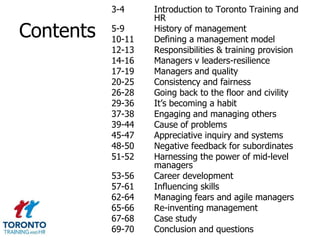
Contents	3-4 Introduction to Toronto Training and 		HR	5-9	History of management	10-11	Defining a management model12-13	Responsibilities & training provision	14-16	Managers v leaders-resilience	17-19	Managers and quality20-25	Consistency and fairness26-28	Going back to the floor and civility29-36	It’s becoming a habit37-38	Engaging and managing others39-44	Cause of problems45-47	Appreciative inquiry and systems48-50	Negative feedback for subordinates51-52	Harnessing the power of mid-level 		managers53-56	Career development57-61	Influencing skills62-64	Managing fears and agile managers65-66	Re-inventing management67-68	Case study69-70	Conclusion and questions
Page 3Introduction
Page 4Introduction to Toronto Training and HRToronto Training and HRis a specialist training and human resources consultancy headed by Timothy Holden 10 years in banking10 years in training and human resourcesFreelance practitioner since 2006The core services provided by Toronto Training and HR are:Training course design
Training course delivery-  Reducing costsSaving time
Improving employee engagement & morale
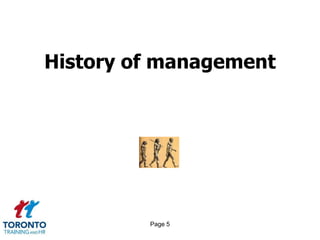
Services for job seekersPage 5History of management
Page 6History of management 1 of 4Scientific managementBureaucratic organizationsAdministrative principles
Page 7History of management 2 of 4SCIENTIFIC MANAGEMENTGeneral approachContributionsCriticisms
Page 8History of management 3 of 4BUREAUCRATIC ORGANIZATIONS-WeberDivision of labour with clear definitions of authority and responsibilityPositions organized in a hierarchy of authorityPersonnel selected and promoted based on their technical qualificationsAdministrative acts and decisions recorded in writingManagement separate from the ownership of the organizationManagers subject to rules and procedures that will ensure reliable and predictable behaviour
Page 9History of management 4 of 4Humanistic perspectiveManagement science perspectiveRecent historical trendsNew management thinking for turbulent times
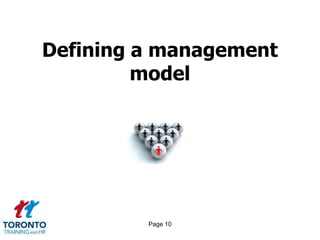
Page 10Defining a management model
Page 11Defining a management modelUnderstandingEvaluatingEnvisioningExperimenting
Page 12Responsibilities & training provision
Page 13Responsibilities & training provisionAppraisal and performance managementRecruitment and selectionEmployee developmentAbsence managementDealing with grievancesDisciplinary proceduresCoaching of direct reportsPay decisions and/or communicating about pay
Page 14Managers v leaders-resilience
Page 15Managers v leaders-resilience 1 of 2Managers spend energy as they fight through tough realities; leaders generate energy by creating new realities. Managers control to avoid crisis; leaders thrive in the game-changing, mind-changing and system-changing potentiality of crisis.Managers become mired in have-to-dos, thereby depleting energy; leaders seek want-to-dos, thereby restoring energy.Managers try to manage time, to get more out of people; leaders seek to foster energy by investing more in people.
Page 16Managers v leaders-resilience 2 of 2Managers hope to find life balance; leaders discover their own resilience formula for generating sustainable energy.Managers control to minimize risk and maximize results; leaders trust to multiply opportunity and optimize long-term sustainability.Managers tend to focus on goals; leaders try to focus on purpose.Managers tend to focus on limited resources (time, money) while leaders tend to focus on investing in unlimitedresources of energy, purpose, engagement, vision and contribution.
Page 17Managers and quality
Page 18Managers and quality 1 of 2In the workplace, who must benefit?Why am I important?How can I positively influence others?Quality in an era of changeApplying management skillsReflections on quality
Page 19Managers and quality 2 of 2Avoiding frustrationsFailure to communicate clearly and clarify messagesInability to understand the concept of qualityLack of or poor training practicesLack of clearly identified and understood objectivesAvoid unrealistic, vague and confusing expectations
Page 20Consistency v fairness
Page 21Consistency v fairness 1 of 5First, think back to a time you were treated unfairly in order to maintain consistency, and then consider the effect it had on your motivation. It'll be the same feeling for those you now manage.Establish clear targets and rewards, and be crystal clear about your expectations.Carefully articulate what constitutes outstandingperformance, and the rewards that await all who achieve it.Those who perform receive the reward, those who don't receive coaching and encouragement to achieve it next time.
Page 22Consistency v fairness 2 of 5Develop a well-thought-out system that allows you the flexibility to give spontaneous "spot rewards" when you see a deserving performance, and keepan element of fun in your reward system. Employees are motivated by the expectation of, but not entitlement to, frequent small rewards for valuable performance.
Page 23Consistency v fairness 3 of 5Account for differences in personal circumstances, especially in the short term, and those beyond the employee's control. If an employee experiences the loss of a close family member, cut them some slack for a reasonable period. Go the extra mile for your employees in these situations, and you'll have their full attention when you talk about going theextra mile for your customers. Offer help if their slump lingers for more than a few weeks.
Page 24Consistency v fairness 4 of 5When an employee complains that you've treated him unfairly, listen because he may have a point.Ask what he would consider fair, and engage in a dialogue that gets both perspectives on the table. Be reasonable, and ask for the same from the other party. Be willing to compromise reach a mutual agreement. Then move on.Develop and maintain an effective Alternative Dispute Resolution (ADR) process in your organization. If the situation rises to such a level, engage the ADR process to resolve the issue without involving lawyers and the courts.
Page 25Consistency v fairness 5 of 5Mediation, and other ADR interventions can beextremely effective in restoring a sense of fairness to all parties, and maintaining productive workingrelationships. Be consistent in yourself. Don't change your tune with every change of mood, and don't maintain different standards for different people, or different groups, without reasons everyone feels good about. Keep your promises, and follow through.
Page 26Going back to the floor and civility
Page 27Going back to the floor and civility 1 of 2GOING BACK TO THE FLOORIt’s not about PRUndercover or not?Arrive without warningRoll up your sleevesGround rulesIt’s just one toolMake it part of your businessBe sure to deliverCome with humility
Page 28Going back to the floor and civility 2 of 2CIVILITYPursue understanding firstListen and respect other opinionsSeek common ground, even if it’s to agree to disagreeTune into what’s happening around you; observe the climateAccept responsibility for your actions and the consequences of those actionsOffer and willingly accept constructive feedback
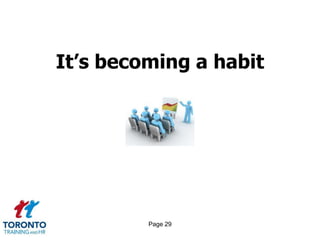
Page 29It’s becoming a habit
Page 30It’s becoming a habit 1 of 7WORK PRODUCTIVITYwork efficiently in getting the job doneset high standards for themselvesdemonstrate proper motivation at workshow initiative and are pro-active in decision-makingare flexible and quick to adapt
Page 31It’s becoming a habit 2 of 7WORK COLLABORATION & PEOPLE RELATIONSdemonstrate civility, courtesy and decencyshow concern for the personal well being of othersdemonstrate a caring attitude toward otherscontribute their "fair share" on collaborative taskswork effectively with other managers and supervisorsseek the input of those affected by decisionslisten to others' views before making any judgments
Page 32It’s becoming a habit 3 of 7ETHICStake a stand where issues of ethics are at stakesafeguard confidential informationrefuse to comply with unethical requestsconsider the rights of others in making decisionsavoid conflicts of interest
Page 33It’s becoming a habit 4 of 7WORK PASSIVITYpassive and unwilling to take needed actionunable to complete work on timerepeatedly late for work or meetingsindecisive and unwilling to take a stand
Page 34It’s becoming a habit 5 of 7COLLABORATIONoverly judgmental of the shortcoming of othersoverly aggressive and intimidating to otherswilling to blame their failures on otherswilling to claim credit for the accomplishmentsof othersdistrustful of the motives of other team membersa source of unnecessary conflict withteam membersunwilling to compromise with others
Page 35It’s becoming a habit 6 of 7IDEAS AND INFORMATIONdefensive and unable to accept criticismclosed to new ways of doing thingsprone to make hasty decisions without duedeliberationunwilling or unable to listen attentively
Page 36It’s becoming a habit 7 of 7SELF-MANAGEMENTperform their job well some days but poorly onother daysunable to keep promisesunable to control his/her temperknowingly make unreasonable demandsdoes not recognize the impact of their feelingson their actions
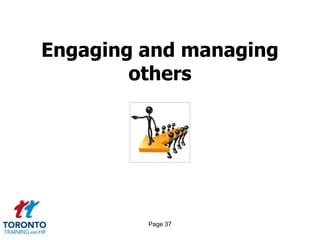
Page 37Engaging and managing others
Page 38Engaging and managing othersThey focus on the individualThey have an empowering managerial styleThey are honest, authentic and competent-which drives high levels of trust
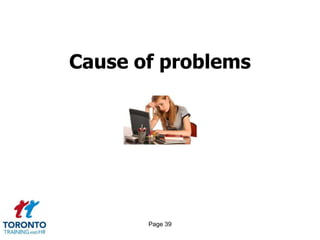
Page 39Cause of problems
Page 40Cause of problems 1 of 5MANAGERS SOMETIMES CREATE ISSUESDoes every member of your management team know the company’s mission, purpose, and vision?Can they describe the values—and give examples of how they’re demonstrated daily?Do they have the skills, resources, and knowledge to lead to the ideal future state?Do you have a succession plan—an approach for developing high-potential candidates?
Page 41Cause of problems 2 of 5MANAGERS SOMETIMES CREATE ISSUESDo people who are promoted to or hired for a management position clearly demonstrate company values?Do you have an effective way to transition new managers into their positions? Do you remove poor and ineffective managers quickly?
Page 42Cause of problems 3 of 5ENSURE SOUND MANAGEMENT FIRSTGet managers to function as an aligned team and to translate the mission, vision and values to subordinates to promote (by example not exhortation) the way business will be doneCarefully select people for management positions Support the transition into management
Page 43Cause of problems 4 of 5ENSURE SOUND MANAGEMENT FIRSTDefine standards of performance for all managersBe responsible for performance managementand for instilling accountability
Page 44Cause of problems 5 of 5PEOPLE-CENTRIC MANAGEMENTInternal service quality is a key driver Internal service quality leads to employee satisfaction, resulting in employee retention and productivityEmployee satisfaction leads to customer satisfactionCustomer satisfaction leads to customer loyalty, which results in retention, repeat business, and referralsCustomer loyalty leads to revenue growth and profitability
Page 45Appreciative inquiry and systems
Page 46Appreciative inquiry and systems 1 of 2APPRECIATIVE INQUIRYKnow your audienceCustomize your solutionTransfer theory into practiceChecklist
Page 47Appreciative inquiry and systems 2 of 2SYSTEMSSystems can’t provide satisfaction in domains that require a unique and personal human solutionA strength of systems and institutions is the ability to suppress the personal and commodify throughreplication Automated human functions affect relationships and our capacity to associate closely with others Systems are designed to make relationships instrumentalSystems do make an effort to compensate for their utilitarian nature
Page 48Negative feedback for subordinates
Page 49Negative feedback for subordinates 1 of 2WHY NOT?The manager wants the protégé he is grooming to be his successor to thrive, and fears that a rebuke will derail him. The manager operates from the perspectivethat you catch more flies with honey than with vinegar. The manager believes that in a PC culture, being known as hostile or aggressive has negative long-term consequences, such as not being invited to sit on boards.
Page 50Negative feedback for subordinates 2 of 2GUIDELINES TO FOLLOWBefore being angry with an employee, map out the issue you wish to discuss to rule-out extraneous influences.When possible, condemn behaviours—not the person. Honesty is the best policy.
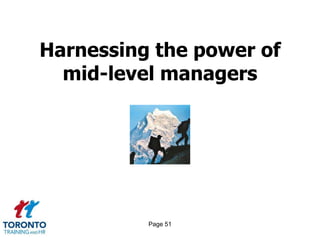
Page 51Harnessing the power of mid-level managers
Page 52Harnessing the power of mid-level managersStart with the end in mindSpecify talent qualities that ensure quality resultsDevelop the right skills in the right waySupport the transition into, up, through and onto new levels of management with a sound succession planEngage mid-level managers and inspire them to meet business needs
Page 53Career development
Page 54Career development 1 of 3ENGAGEMENT/SATISFACTIONThe manager’s role is to manage for career developmentBEYOND DISENGAGEMENTWhat’s the cost of disengagement?What’s the solution?
Page 55Career development 2 of 3FROZEN CAREER PIPELINESSlower career advancement/promotions for people below the blockage producing “stuck” disgruntled workersLess hiring at a time when we most need open positions to reverse the downturn in the job marketPressure from older workers for special accommodations like changes in assignments or less working hoursOrganizations will be forced to confront under-performing, older workers who are coasting to retirementIncreased health care costsMore law suits from older workers who feel they were unfairly pushed out or not promoted
Page 56Career development 3 of 3WHAT SHOULD MANAGERS DO?Audit the retirement plans of people at or near retirement ageMaximize the contribution of those who will stay onMake accommodations, where possible, for the special physical needs of older workersConfront older people whose performance is marginal or poorTrain and develop people whose promotional opportunities are put on hold
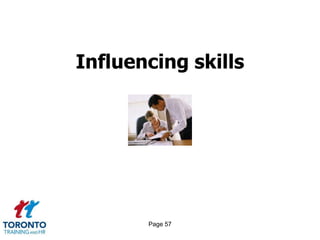
Page 57Influencing skills
Page 58Influencing skills 1 of 4Environment scanningResource allocation and interventionDiplomacy and conflict resolution
Page 59Influencing skills 2 of 4BUILDING INFLUENCE AND INCLUSIONFundamental techniques for strengthening relationshipsHow to win people to your way of thinkingHow to change people without giving offense orarousing resentment
Page 60Influencing skills 3 of 4GLOBAL PERSPECTIVES ON INFLUENCE AND INCLUSIONTeam leaders’ involvementTeam members’ involvementTeam members’ responses
Page 61Influencing skills 4 of 4SEVEN PRINCIPLES FOR EFFECTIVE INFLUENCE1.Remember that a person’s name is to that person the sweetest and most important sound in any language2.Make the other person feel important—and do it sincerely.3.The only way to get the best of an argument is to avoid it4.Begin in a friendly way5.Let the other person feel that the idea is his or hers6.Ask questions instead of giving direct orders7.Make the other person happy about doing the thing you suggest
Page 62Managing fears and agile managers
Page 63Managing fears and agile managers 1 of 2Acknowledge and examine the fearsFace you fear; prepare yourself to take actionCome from love-establish a purpose that is greater than the fearStay in the present moment
Page 64Managing fears and agile managers 2 of 2Managing employeesRewarding employeesPlanningTechnological agilityPolitical skillsProblem-solvingDoing more with less
Page 65Re-inventing management
Page 66Re-inventing managementFIVE FUNDAMENTAL SHIFTSGoal shiftRole shiftMode shiftValue shiftMeans shift
Page 67Case study
Page 68Case study

Managing for success February 2011

  • 1.
    Managing for successbyToronto Training and HR February 2011
  • 2.
    Contents 3-4 Introduction toToronto Training and HR 5-9 History of management 10-11 Defining a management model12-13 Responsibilities & training provision 14-16 Managers v leaders-resilience 17-19 Managers and quality20-25 Consistency and fairness26-28 Going back to the floor and civility29-36 It’s becoming a habit37-38 Engaging and managing others39-44 Cause of problems45-47 Appreciative inquiry and systems48-50 Negative feedback for subordinates51-52 Harnessing the power of mid-level managers53-56 Career development57-61 Influencing skills62-64 Managing fears and agile managers65-66 Re-inventing management67-68 Case study69-70 Conclusion and questions
  • 3.
  • 4.
    Page 4Introduction toToronto Training and HRToronto Training and HRis a specialist training and human resources consultancy headed by Timothy Holden 10 years in banking10 years in training and human resourcesFreelance practitioner since 2006The core services provided by Toronto Training and HR are:Training course design
  • 5.
    Training course delivery- Reducing costsSaving time
  • 6.
  • 7.
    Services for jobseekersPage 5History of management
  • 8.
    Page 6History ofmanagement 1 of 4Scientific managementBureaucratic organizationsAdministrative principles
  • 9.
    Page 7History ofmanagement 2 of 4SCIENTIFIC MANAGEMENTGeneral approachContributionsCriticisms
  • 10.
    Page 8History ofmanagement 3 of 4BUREAUCRATIC ORGANIZATIONS-WeberDivision of labour with clear definitions of authority and responsibilityPositions organized in a hierarchy of authorityPersonnel selected and promoted based on their technical qualificationsAdministrative acts and decisions recorded in writingManagement separate from the ownership of the organizationManagers subject to rules and procedures that will ensure reliable and predictable behaviour
  • 11.
    Page 9History ofmanagement 4 of 4Humanistic perspectiveManagement science perspectiveRecent historical trendsNew management thinking for turbulent times
  • 12.
    Page 10Defining amanagement model
  • 13.
    Page 11Defining amanagement modelUnderstandingEvaluatingEnvisioningExperimenting
  • 14.
    Page 12Responsibilities &training provision
  • 15.
    Page 13Responsibilities &training provisionAppraisal and performance managementRecruitment and selectionEmployee developmentAbsence managementDealing with grievancesDisciplinary proceduresCoaching of direct reportsPay decisions and/or communicating about pay
  • 16.
    Page 14Managers vleaders-resilience
  • 17.
    Page 15Managers vleaders-resilience 1 of 2Managers spend energy as they fight through tough realities; leaders generate energy by creating new realities. Managers control to avoid crisis; leaders thrive in the game-changing, mind-changing and system-changing potentiality of crisis.Managers become mired in have-to-dos, thereby depleting energy; leaders seek want-to-dos, thereby restoring energy.Managers try to manage time, to get more out of people; leaders seek to foster energy by investing more in people.
  • 18.
    Page 16Managers vleaders-resilience 2 of 2Managers hope to find life balance; leaders discover their own resilience formula for generating sustainable energy.Managers control to minimize risk and maximize results; leaders trust to multiply opportunity and optimize long-term sustainability.Managers tend to focus on goals; leaders try to focus on purpose.Managers tend to focus on limited resources (time, money) while leaders tend to focus on investing in unlimitedresources of energy, purpose, engagement, vision and contribution.
  • 19.
  • 20.
    Page 18Managers andquality 1 of 2In the workplace, who must benefit?Why am I important?How can I positively influence others?Quality in an era of changeApplying management skillsReflections on quality
  • 21.
    Page 19Managers andquality 2 of 2Avoiding frustrationsFailure to communicate clearly and clarify messagesInability to understand the concept of qualityLack of or poor training practicesLack of clearly identified and understood objectivesAvoid unrealistic, vague and confusing expectations
  • 22.
  • 23.
    Page 21Consistency vfairness 1 of 5First, think back to a time you were treated unfairly in order to maintain consistency, and then consider the effect it had on your motivation. It'll be the same feeling for those you now manage.Establish clear targets and rewards, and be crystal clear about your expectations.Carefully articulate what constitutes outstandingperformance, and the rewards that await all who achieve it.Those who perform receive the reward, those who don't receive coaching and encouragement to achieve it next time.
  • 24.
    Page 22Consistency vfairness 2 of 5Develop a well-thought-out system that allows you the flexibility to give spontaneous "spot rewards" when you see a deserving performance, and keepan element of fun in your reward system. Employees are motivated by the expectation of, but not entitlement to, frequent small rewards for valuable performance.
  • 25.
    Page 23Consistency vfairness 3 of 5Account for differences in personal circumstances, especially in the short term, and those beyond the employee's control. If an employee experiences the loss of a close family member, cut them some slack for a reasonable period. Go the extra mile for your employees in these situations, and you'll have their full attention when you talk about going theextra mile for your customers. Offer help if their slump lingers for more than a few weeks.
  • 26.
    Page 24Consistency vfairness 4 of 5When an employee complains that you've treated him unfairly, listen because he may have a point.Ask what he would consider fair, and engage in a dialogue that gets both perspectives on the table. Be reasonable, and ask for the same from the other party. Be willing to compromise reach a mutual agreement. Then move on.Develop and maintain an effective Alternative Dispute Resolution (ADR) process in your organization. If the situation rises to such a level, engage the ADR process to resolve the issue without involving lawyers and the courts.
  • 27.
    Page 25Consistency vfairness 5 of 5Mediation, and other ADR interventions can beextremely effective in restoring a sense of fairness to all parties, and maintaining productive workingrelationships. Be consistent in yourself. Don't change your tune with every change of mood, and don't maintain different standards for different people, or different groups, without reasons everyone feels good about. Keep your promises, and follow through.
  • 28.
    Page 26Going backto the floor and civility
  • 29.
    Page 27Going backto the floor and civility 1 of 2GOING BACK TO THE FLOORIt’s not about PRUndercover or not?Arrive without warningRoll up your sleevesGround rulesIt’s just one toolMake it part of your businessBe sure to deliverCome with humility
  • 30.
    Page 28Going backto the floor and civility 2 of 2CIVILITYPursue understanding firstListen and respect other opinionsSeek common ground, even if it’s to agree to disagreeTune into what’s happening around you; observe the climateAccept responsibility for your actions and the consequences of those actionsOffer and willingly accept constructive feedback
  • 31.
  • 32.
    Page 30It’s becominga habit 1 of 7WORK PRODUCTIVITYwork efficiently in getting the job doneset high standards for themselvesdemonstrate proper motivation at workshow initiative and are pro-active in decision-makingare flexible and quick to adapt
  • 33.
    Page 31It’s becominga habit 2 of 7WORK COLLABORATION & PEOPLE RELATIONSdemonstrate civility, courtesy and decencyshow concern for the personal well being of othersdemonstrate a caring attitude toward otherscontribute their "fair share" on collaborative taskswork effectively with other managers and supervisorsseek the input of those affected by decisionslisten to others' views before making any judgments
  • 34.
    Page 32It’s becominga habit 3 of 7ETHICStake a stand where issues of ethics are at stakesafeguard confidential informationrefuse to comply with unethical requestsconsider the rights of others in making decisionsavoid conflicts of interest
  • 35.
    Page 33It’s becominga habit 4 of 7WORK PASSIVITYpassive and unwilling to take needed actionunable to complete work on timerepeatedly late for work or meetingsindecisive and unwilling to take a stand
  • 36.
    Page 34It’s becominga habit 5 of 7COLLABORATIONoverly judgmental of the shortcoming of othersoverly aggressive and intimidating to otherswilling to blame their failures on otherswilling to claim credit for the accomplishmentsof othersdistrustful of the motives of other team membersa source of unnecessary conflict withteam membersunwilling to compromise with others
  • 37.
    Page 35It’s becominga habit 6 of 7IDEAS AND INFORMATIONdefensive and unable to accept criticismclosed to new ways of doing thingsprone to make hasty decisions without duedeliberationunwilling or unable to listen attentively
  • 38.
    Page 36It’s becominga habit 7 of 7SELF-MANAGEMENTperform their job well some days but poorly onother daysunable to keep promisesunable to control his/her temperknowingly make unreasonable demandsdoes not recognize the impact of their feelingson their actions
  • 39.
    Page 37Engaging andmanaging others
  • 40.
    Page 38Engaging andmanaging othersThey focus on the individualThey have an empowering managerial styleThey are honest, authentic and competent-which drives high levels of trust
  • 41.
  • 42.
    Page 40Cause ofproblems 1 of 5MANAGERS SOMETIMES CREATE ISSUESDoes every member of your management team know the company’s mission, purpose, and vision?Can they describe the values—and give examples of how they’re demonstrated daily?Do they have the skills, resources, and knowledge to lead to the ideal future state?Do you have a succession plan—an approach for developing high-potential candidates?
  • 43.
    Page 41Cause ofproblems 2 of 5MANAGERS SOMETIMES CREATE ISSUESDo people who are promoted to or hired for a management position clearly demonstrate company values?Do you have an effective way to transition new managers into their positions? Do you remove poor and ineffective managers quickly?
  • 44.
    Page 42Cause ofproblems 3 of 5ENSURE SOUND MANAGEMENT FIRSTGet managers to function as an aligned team and to translate the mission, vision and values to subordinates to promote (by example not exhortation) the way business will be doneCarefully select people for management positions Support the transition into management
  • 45.
    Page 43Cause ofproblems 4 of 5ENSURE SOUND MANAGEMENT FIRSTDefine standards of performance for all managersBe responsible for performance managementand for instilling accountability
  • 46.
    Page 44Cause ofproblems 5 of 5PEOPLE-CENTRIC MANAGEMENTInternal service quality is a key driver Internal service quality leads to employee satisfaction, resulting in employee retention and productivityEmployee satisfaction leads to customer satisfactionCustomer satisfaction leads to customer loyalty, which results in retention, repeat business, and referralsCustomer loyalty leads to revenue growth and profitability
  • 47.
  • 48.
    Page 46Appreciative inquiryand systems 1 of 2APPRECIATIVE INQUIRYKnow your audienceCustomize your solutionTransfer theory into practiceChecklist
  • 49.
    Page 47Appreciative inquiryand systems 2 of 2SYSTEMSSystems can’t provide satisfaction in domains that require a unique and personal human solutionA strength of systems and institutions is the ability to suppress the personal and commodify throughreplication Automated human functions affect relationships and our capacity to associate closely with others Systems are designed to make relationships instrumentalSystems do make an effort to compensate for their utilitarian nature
  • 50.
    Page 48Negative feedbackfor subordinates
  • 51.
    Page 49Negative feedbackfor subordinates 1 of 2WHY NOT?The manager wants the protégé he is grooming to be his successor to thrive, and fears that a rebuke will derail him. The manager operates from the perspectivethat you catch more flies with honey than with vinegar. The manager believes that in a PC culture, being known as hostile or aggressive has negative long-term consequences, such as not being invited to sit on boards.
  • 52.
    Page 50Negative feedbackfor subordinates 2 of 2GUIDELINES TO FOLLOWBefore being angry with an employee, map out the issue you wish to discuss to rule-out extraneous influences.When possible, condemn behaviours—not the person. Honesty is the best policy.
  • 53.
    Page 51Harnessing thepower of mid-level managers
  • 54.
    Page 52Harnessing thepower of mid-level managersStart with the end in mindSpecify talent qualities that ensure quality resultsDevelop the right skills in the right waySupport the transition into, up, through and onto new levels of management with a sound succession planEngage mid-level managers and inspire them to meet business needs
  • 55.
  • 56.
    Page 54Career development1 of 3ENGAGEMENT/SATISFACTIONThe manager’s role is to manage for career developmentBEYOND DISENGAGEMENTWhat’s the cost of disengagement?What’s the solution?
  • 57.
    Page 55Career development2 of 3FROZEN CAREER PIPELINESSlower career advancement/promotions for people below the blockage producing “stuck” disgruntled workersLess hiring at a time when we most need open positions to reverse the downturn in the job marketPressure from older workers for special accommodations like changes in assignments or less working hoursOrganizations will be forced to confront under-performing, older workers who are coasting to retirementIncreased health care costsMore law suits from older workers who feel they were unfairly pushed out or not promoted
  • 58.
    Page 56Career development3 of 3WHAT SHOULD MANAGERS DO?Audit the retirement plans of people at or near retirement ageMaximize the contribution of those who will stay onMake accommodations, where possible, for the special physical needs of older workersConfront older people whose performance is marginal or poorTrain and develop people whose promotional opportunities are put on hold
  • 59.
  • 60.
    Page 58Influencing skills1 of 4Environment scanningResource allocation and interventionDiplomacy and conflict resolution
  • 61.
    Page 59Influencing skills2 of 4BUILDING INFLUENCE AND INCLUSIONFundamental techniques for strengthening relationshipsHow to win people to your way of thinkingHow to change people without giving offense orarousing resentment
  • 62.
    Page 60Influencing skills3 of 4GLOBAL PERSPECTIVES ON INFLUENCE AND INCLUSIONTeam leaders’ involvementTeam members’ involvementTeam members’ responses
  • 63.
    Page 61Influencing skills4 of 4SEVEN PRINCIPLES FOR EFFECTIVE INFLUENCE1.Remember that a person’s name is to that person the sweetest and most important sound in any language2.Make the other person feel important—and do it sincerely.3.The only way to get the best of an argument is to avoid it4.Begin in a friendly way5.Let the other person feel that the idea is his or hers6.Ask questions instead of giving direct orders7.Make the other person happy about doing the thing you suggest
  • 64.
    Page 62Managing fearsand agile managers
  • 65.
    Page 63Managing fearsand agile managers 1 of 2Acknowledge and examine the fearsFace you fear; prepare yourself to take actionCome from love-establish a purpose that is greater than the fearStay in the present moment
  • 66.
    Page 64Managing fearsand agile managers 2 of 2Managing employeesRewarding employeesPlanningTechnological agilityPolitical skillsProblem-solvingDoing more with less
  • 67.
  • 68.
    Page 66Re-inventing managementFIVEFUNDAMENTAL SHIFTSGoal shiftRole shiftMode shiftValue shiftMeans shift
  • 69.
  • 70.