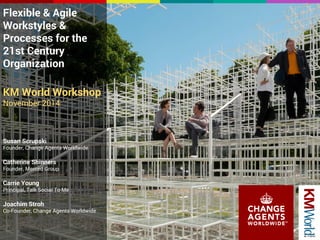
Flexible & Agile 
Workstyles & 
Processes for the 
21st Century 
Organization 
KM World Workshop 
November 2014 
Susan Scrupski 
Founder, Change Agents Worldwide 
Catherine Shinners 
Founder, Merced Group 
Carrie Young 
Principal, Talk Social To Me 
Joachim Stroh 
Co-Founder, Change Agents Worldwide
Joachim Stroh, Speaker 
Co-Founder, CAWW 
about.me/joachim 
Joachim Stroh has been on 
the traditional information and 
knowledge management track 
for more than 15 years before 
shifting gears and moving on 
to the people side of things, 
always bridging the gap 
between business and 
technology (he is an architect 
at heart). A master with 
visualizations, he finds the 
best metaphors to seek a 
better understanding and to 
get more people involved. 
In our networked world we’re 
more connected to our 
organizations, society, 
environment - and each other. 
Catherine brings her 
background as a management 
consultant marketer and 
technologist, to help 
organizations and people 
build new agilities and 
adaptations to the way they 
network, learn, lead and 
create value. 
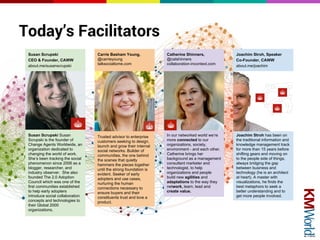
Today’s Facilitators 
Susan Scrupski 
CEO & Founder, CAWW 
about.me/susanscrupski 
Susan Scrupski Susan 
Scrupski is the founder of 
Change Agents Worldwide, an 
organization dedicated to 
changing the world of work. 
She’s been tracking the social 
phenomenon since 2006 as a 
blogger, researcher, and 
industry observer. She also 
founded The 2.0 Adoption 
Council which was one of the 
first communities established 
to help early adopters 
introduce social collaboration 
concepts and technologies to 
their Global 2000 
organizations. 
Catherine Shinners, 
@catshinners 
collaboration-incontext.com 
Carrie Basham Young, 
@carrieyoung 
talksocialtome.com 
Trusted advisor to enterprise 
customers seeking to design, 
launch and grow their internal 
social networks. Builder of 
communities, the one behind 
the scenes that quietly 
hammers the pieces together 
until the strong foundation is 
evident. Seeker of early 
adopters and use cases, 
nurturing the human 
connections necessary to 
ensure buyers and their 
constituents trust and love a 
product.
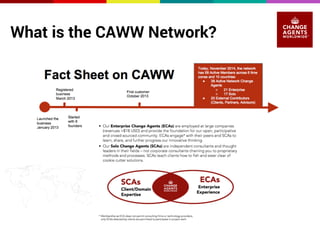
What is the CAWW Network?
Today’s Agenda 
Our conversation today 
â—Ź Introduction to Change Agents 
â—Ź New workplace dynamics 
Worldwide (Susan) 
9:00 - 9:30 am 
More complex, interdependent, changing 
and digital 
â—Ź Accelerating Social Collaboration 
through Stories, Pods, Swarms and 
Enabling Social Processes in 
Cookie Jars and Green Rooms, 
based on Agile and Self-organizing 
Principles (Carrie and Catherine) 
9:30 - 10:15 am 
â—Ź Real stories 
Social capabilities benefitting companies 
â—Ź Where you begin 
Solving strategic problems with 
collaboration 
â—Ź Break 10:15 - 10:30 am 
â—Ź Interactive session (All) 
10:30 - 11:30 am 
â—Ź Organizational Transformation 
Through an Open Framework 
(Joachim) 
11:30 - 12:00 pm
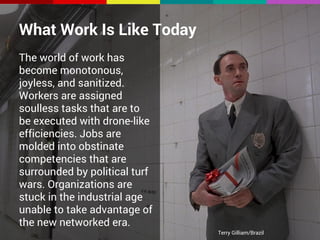
What Work Is Like Today 
The world of work has 
become monotonous, 
joyless, and sanitized. 
Workers are assigned 
soulless tasks that are to 
be executed with drone-like 
efficiencies. Jobs are 
molded into obstinate 
competencies that are 
surrounded by political turf 
wars. Organizations are 
stuck in the industrial age 
unable to take advantage of 
the new networked era. 
Terry Gilliam/Brazil
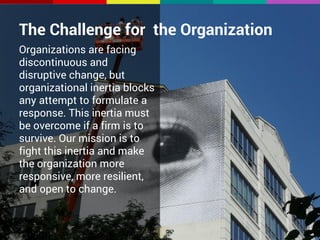
The Challenge for the Organization 
Organizations are facing 
discontinuous and 
disruptive change, but 
organizational inertia blocks 
any attempt to formulate a 
response. This inertia must 
be overcome if a firm is to 
survive. Our mission is to 
fight this inertia and make 
the organization more 
responsive, more resilient, 
and open to change.
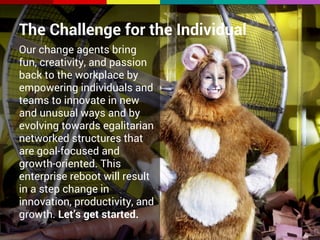
The Challenge for the Individual 
Our change agents bring 
fun, creativity, and passion 
back to the workplace by 
empowering individuals and 
teams to innovate in new 
and unusual ways and by 
evolving towards egalitarian 
networked structures that 
are goal-focused and 
growth-oriented. This 
enterprise reboot will result 
in a step change in 
innovation, productivity, and 
growth. Let’s get started.
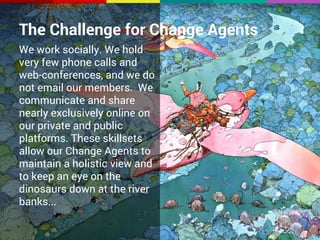
The Challenge for Change Agents 
We work socially. We hold 
very few phone calls and 
web-conferences, and we do 
not email our members. We 
communicate and share 
nearly exclusively online on 
our private and public 
platforms. These skillsets 
allow our Change Agents to 
maintain a holistic view and 
to keep an eye on the 
dinosaurs down at the river 
banks...
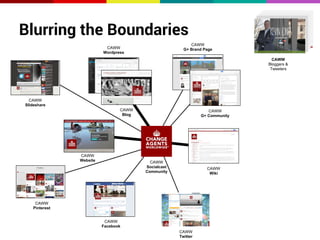
Blurring the Boundaries 
CAWW 
Socialcast 
Community 
CAWW 
Website 
CAWW 
Blog 
CAWW 
G+ Community 
CAWW 
Wiki 
CAWW 
Wordpress 
CAWW 
G+ Brand Page 
CAWW 
Facebook 
CAWW 
Twitter 
CAWW 
Slideshare 
CAWW 
Pinterest 
CAWW 
Bloggers & 
Tweeters
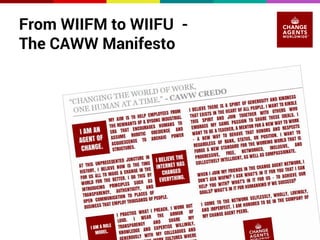
From WIIFM to WIIFU - 
The CAWW Manifesto
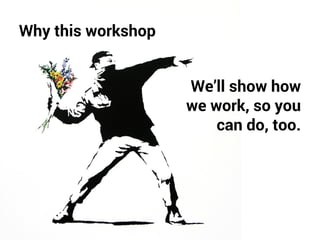
Why this workshop 
We’ll show how 
we work, so you 
can do, too.
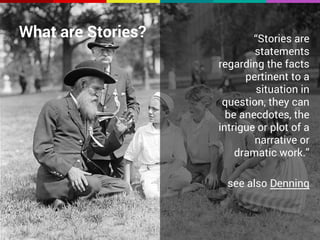
What are Stories? “Stories are 
statements 
regarding the facts 
pertinent to a 
situation in 
question, they can 
be anecdotes, the 
intrigue or plot of a 
narrative or 
dramatic work.” 
see also Denning
Why Stories 
â—Ź stories have a beginning, 
middle & end 
â—Ź stories act as an attractor 
(img) 
â—Ź stories are easy to relate to 
â—Ź stories often continue for 
weeks or months 
â—Ź everyone feels energized, 
even for stories with a bad 
ending
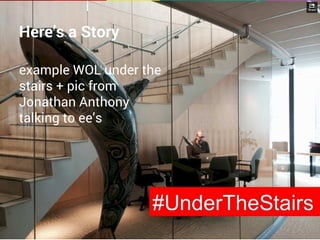
Here’s a Story 
example WOL under the 
stairs + pic from 
Jonathan Anthony 
talking to ee’s
Stories: 
The CA Incubator Celine Schillinger, 
launched a revolution at 
Sanofi-Pasteur. 
She brought passion, 
courage, conviction to 
changing the culture. 
â—Ź Internal Social Campaign for 
Gender Balance 
â—Ź External Social Campaign for 
Break Dengue
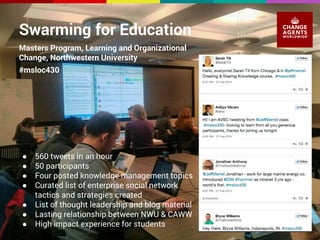
Swarming for Education 
Masters Program, Learning and Organizational 
Change, Northwestern University 
#msloc430 
â—Ź 560 tweets in an hour 
â—Ź 50 participants 
â—Ź Four posted knowledge management topics 
â—Ź Curated list of enterprise social network 
tactics and strategies created 
â—Ź List of thought leadership and blog material 
â—Ź Lasting relationship between NWU & CAWW 
â—Ź High impact experience for students
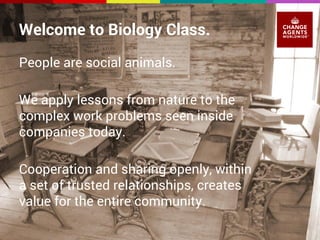
Welcome to Biology Class. 
People are social animals. 
We apply lessons from nature to the 
complex work problems seen inside 
companies today. 
Cooperation and sharing openly, within 
a set of trusted relationships, creates 
value for the entire community.
What are Swarms? 
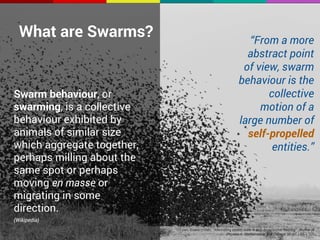
Swarm behaviour, or 
swarming, is a collective 
behaviour exhibited by 
animals of similar size 
which aggregate together, 
perhaps milling about the 
same spot or perhaps 
moving en masse or 
migrating in some 
direction. 
(Wikipedia) 
“From a more 
abstract point 
of view, swarm 
behaviour is the 
collective 
motion of a 
large number of 
self-propelled 
entities.” 
O'Loan; Evans (1998). "Alternating steady state in one-dimensional flocking". Journal of 
Physics A: Mathematical and General 32 (8): L99–L105
Swarms at CAWW 
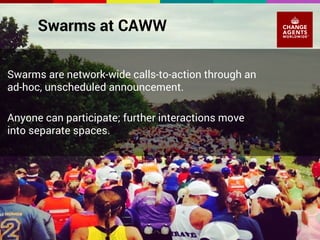
Swarms are network-wide calls-to-action through an 
ad-hoc, unscheduled announcement. 
Anyone can participate; further interactions move 
into separate spaces.
Why Swarms 
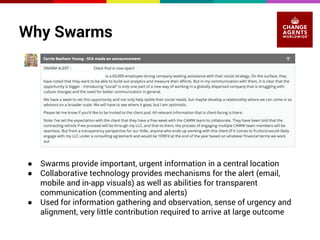
â—Ź Swarms provide important, urgent information in a central location 
â—Ź Collaborative technology provides mechanisms for the alert (email, 
mobile and in-app visuals) as well as abilities for transparent 
communication (commenting and alerts) 
â—Ź Used for information gathering and observation, sense of urgency and 
alignment, very little contribution required to arrive at large outcome
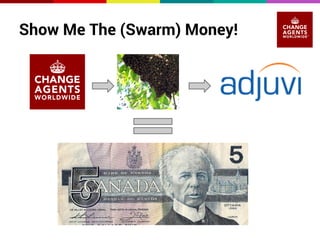
Show Me The (Swarm) Money!
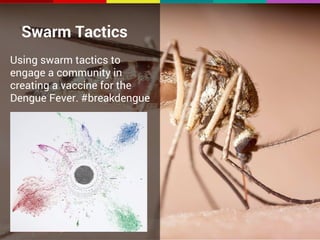
Here’s Swarm a Tactics 
Swarm 
Using swarm tactics to 
engage a community in 
creating a vaccine for the 
Dengue Fever. #breakdengue 
example: arrival of a new client, call-for-papers, 
etc. 
Carrie
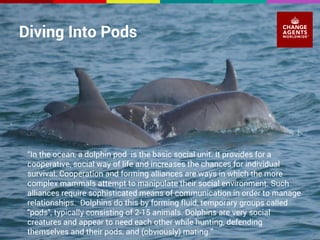
Diving Into Pods 
“In the ocean, a dolphin pod is the basic social unit. It provides for a 
cooperative, social way of life and increases the chances for individual 
survival. Cooperation and forming alliances are ways in which the more 
complex mammals attempt to manipulate their social environment. Such 
alliances require sophisticated means of communication in order to manage 
relationships. Dolphins do this by forming fluid, temporary groups called 
"pods", typically consisting of 2-15 animals. Dolphins are very social 
creatures and appear to need each other while hunting, defending 
themselves and their pods, and (obviously) mating.”
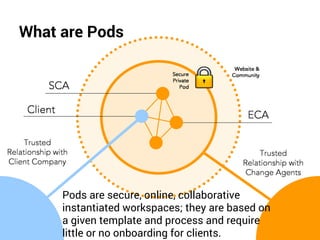
What are Pods 
Pods are secure, online, collaborative 
instantiated workspaces; they are based on 
a given template and process and require 
little or no onboarding for clients.
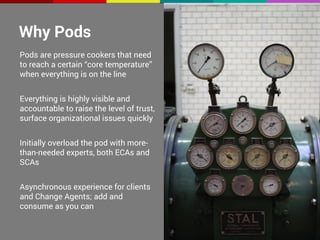
Why Pods 
Pods are pressure cookers that need 
to reach a certain “core temperature” 
when everything is on the line 
Everything is highly visible and 
accountable to raise the level of trust, 
surface organizational issues quickly 
Initially overload the pod with more-than- 
needed experts, both ECAs and 
SCAs 
Asynchronous experience for clients 
and Change Agents; add and 
consume as you can
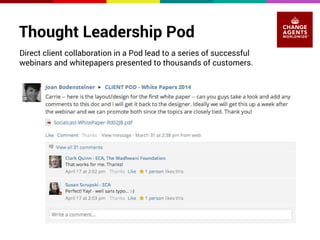
Thought Leadership Pod 
Direct client collaboration in a Pod lead to a series of successful 
webinars and whitepapers presented to thousands of customers.
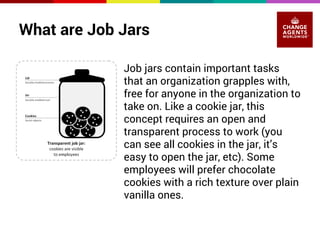
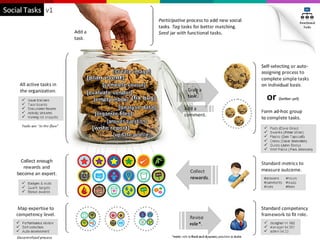
What are Job Jars 
Job jars contain important tasks 
that an organization grapples with, 
free for anyone in the organization to 
take on. Like a cookie jar, this 
concept requires an open and 
transparent process to work (you 
can see all cookies in the jar, it’s 
easy to open the jar, etc). Some 
employees will prefer chocolate 
cookies with a rich texture over plain 
vanilla ones.
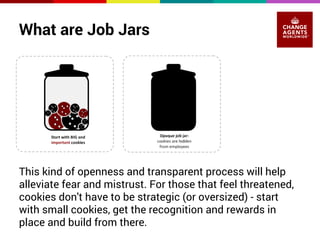
What are Job Jars 
This kind of openness and transparent process will help 
alleviate fear and mistrust. For those that feel threatened, 
cookies don't have to be strategic (or oversized) - start 
with small cookies, get the recognition and rewards in 
place and build from there.
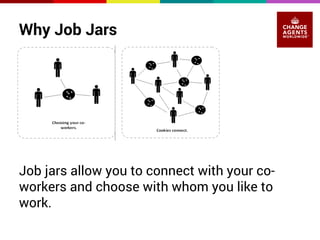
Why Job Jars 
Job jars allow you to connect with your co-workers 
and choose with whom you like to 
work.
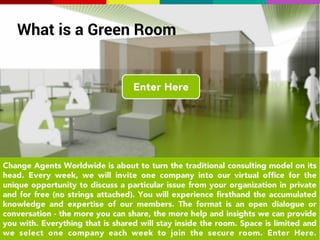
What is a Green Room 
What/Green Rooms 
The best way to understand the value of the expertise and 
strength of a network, is to have a conversation. On 
occasion, we will invite a company into our virtual office 
for the unique opportunity to discuss one particular issue 
from your organization in private and for free. You will 
experience firsthand the accumulated knowledge and 
wisdom of our members. The format is an open 
conversation - the more you can share, the more help and 
insights we can provide. Everything that is shared will stay 
inside the room. Come sit down with our world class team. 
We'd love to talk to you about your greatest change 
challenges. Catherine
Why a Green Room 
A unique opportunity to get to know the 
client, the issues etc. without the 
performance pressure; a pull, not a push 
mechanism to draw in select people 
without the competence pressure; a way 
to sort through things before an actual 
project is started and resources are 
assigned
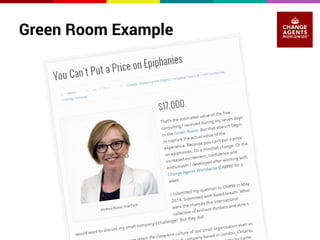
Green Room Example
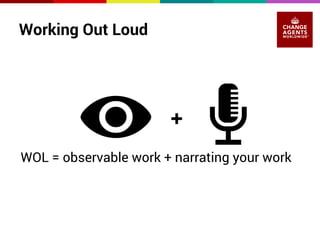
Working Out Loud 
+ 
WOL = observable work + narrating your work
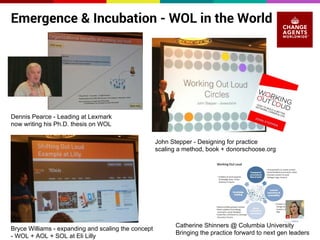
Emergence & Incubation - WOL in the World 
Dennis Pearce - Leading at Lexmark 
now writing his Ph.D. thesis on WOL 
John Stepper - Designing for practice 
scaling a method, book + donorschoose.org 
Catherine Shinners @ Columbia University 
Bringing the practice forward to next gen leaders 
Bryce Williams - expanding and scaling the concept 
- WOL + AOL + SOL at Eli Lilly
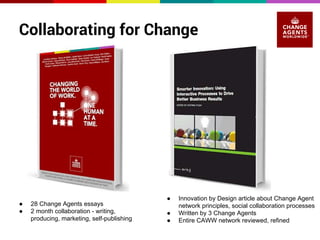
Collaborating for Change 
â—Ź 28 Change Agents essays 
â—Ź 2 month collaboration - writing, 
producing, marketing, self-publishing 
â—Ź Innovation by Design article about Change Agent 
network principles, social collaboration processes 
â—Ź Written by 3 Change Agents 
â—Ź Entire CAWW network reviewed, refined
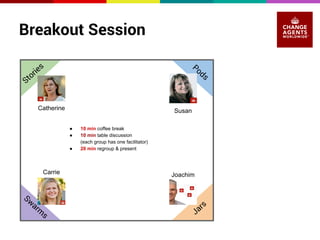
Breakout Session 
Swarms 
Jars 
Stories 
Pods 
Catherine Susan 
â—Ź 10 min coffee break 
â—Ź 10 min table discussion 
(each group has one facilitator) 
â—Ź 20 min regroup & present 
Carrie Joachim
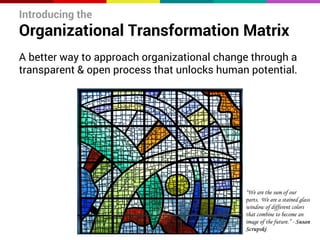
Introducing the 
Organizational Transformation Matrix 
A better way to approach organizational change through a 
transparent & open process that unlocks human potential. 
“We are the sum of our 
parts. We are a stained glass 
window of different colors 
that combine to become an 
image of the future.” - Susan 
Scrupski
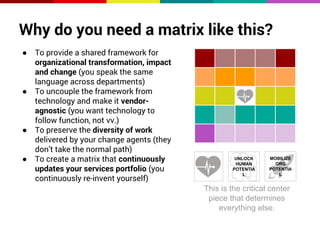
Why do you need a matrix like this? 
â—Ź To provide a shared framework for 
organizational transformation, impact 
and change (you speak the same 
language across departments) 
â—Ź To uncouple the framework from 
technology and make it vendor-agnostic 
(you want technology to 
follow function, not vv.) 
â—Ź To preserve the diversity of work 
delivered by your change agents (they 
don’t take the normal path) 
â—Ź To create a matrix that continuously 
updates your services portfolio (you 
continuously re-invent yourself) 
MOBILIZE 
ORG 
POTENTIA 
L 
UNLOCK 
HUMAN 
POTENTIA 
L 
This is the critical center 
piece that determines 
everything else.
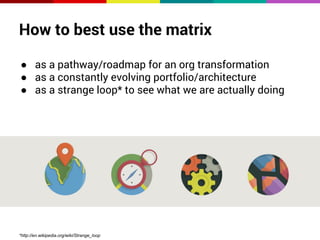
How to best use the matrix 
â—Ź as a pathway/roadmap for an org transformation 
â—Ź as a constantly evolving portfolio/architecture 
â—Ź as a strange loop* to see what we are actually doing 
*http://en.wikipedia.org/wiki/Strange_loop
How to best use the matrix 
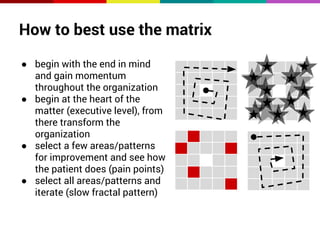
â—Ź begin with the end in mind 
and gain momentum 
throughout the organization 
â—Ź begin at the heart of the 
matter (executive level), from 
there transform the 
organization 
â—Ź select a few areas/patterns 
for improvement and see how 
the patient does (pain points) 
â—Ź select all areas/patterns and 
iterate (slow fractal pattern)
Five kinds of change 
â—Ź Individual change is change that we can enable on a 
personal level through simple introductions, guidelines, or 
initiatives. 
â—Ź Systemic change is change that deeply pervades all parts 
of a system, taking into account the interrelationships and 
interdependencies among those parts. 
â—Ź Structural change is change that alters the way authority, 
capital, information, and responsibility flows in an 
organization. 
â—Ź Culture change is change that alters group norms of 
behavior, practices, attitudes and assumptions and the 
underlying shared values that help keep those norms in 
place. Denning Kotter 
â—Ź Behavior Change applies a method or technique for 
changing one or several psychological determinants of 
behavior such as a person's attitude or self-efficacy.
Five drivers of change 
It is important to note that you are using existing language and refrain from 
using new terminology (i.e. the complex side effects that emerge) 
â—Ź Organizational Communications & Collaboration - Communicating & collaborating 
around a common objective 
â—Ź Organizational Alignment & Capacity - Consistently clear understanding of the 
organization’s purpose throughout the business organization’s entire value chain. 
â—Ź Organizational Capability & Intelligence - Capability of an organization to 
comprehend and conclude knowledge relevant to its business purpose and to drive 
meaningful business results. 
â—Ź Organizational Design & Governance - Process of reshaping and realigning 
organization structure, process, rewards, metrics and talent in order to achieve the 
outcomes the organization intends to produce. 
â—Ź Organizational Performance & Effectiveness - Carrying out or accomplishing an 
action, task, or function.
In the beginning the canvas is blank 
Org 
Design & 
Governance 
Org 
Comms & 
Collaboration 
Org 
Performance & 
Effectiveness 
Org 
Alignment 
& Capacity 
Org 
Capability & 
Intelligence 
Individual 
Change 
Systemic 
Change 
Structural 
Change 
Culture 
Change 
Behavior 
Change 
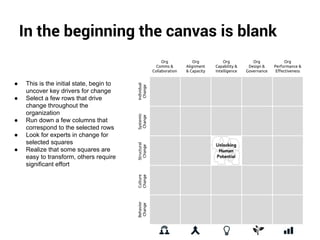
â—Ź This is the initial state, begin to 
uncover key drivers for change 
â—Ź Select a few rows that drive 
change throughout the 
organization 
â—Ź Run down a few columns that 
correspond to the selected rows 
â—Ź Look for experts in change for 
selected squares 
â—Ź Realize that some squares are 
easy to transform, others require 
significant effort
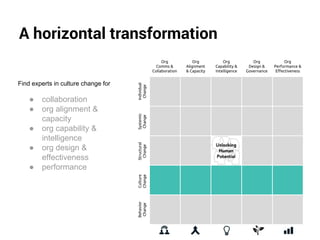
A horizontal transformation 
Individual 
Change 
Systemic 
Change 
Structural 
Change 
Culture 
Change 
Behavior 
Change 
Find experts in culture change for 
â—Ź collaboration 
â—Ź org alignment & 
capacity 
â—Ź org capability & 
intelligence 
â—Ź org design & 
effectiveness 
â—Ź performance 
Org 
Design & 
Governance 
Org 
Comms & 
Collaboration 
Org 
Performance & 
Effectiveness 
Org 
Alignment 
& Capacity 
Org 
Capability & 
Intelligence
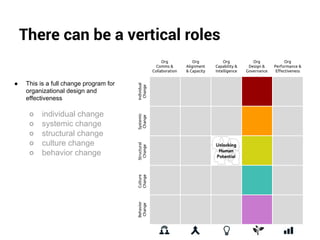
There can be a vertical roles 
Individual 
Change 
Systemic 
Change 
Structural 
Change 
Culture 
Change 
Behavior 
Change 
â—Ź This is a full change program for 
organizational design and 
effectiveness 
â—‹ individual change 
â—‹ systemic change 
â—‹ structural change 
â—‹ culture change 
â—‹ behavior change 
Org 
Design & 
Governance 
Org 
Comms & 
Collaboration 
Org 
Performance & 
Effectiveness 
Org 
Alignment 
& Capacity 
Org 
Capability & 
Intelligence
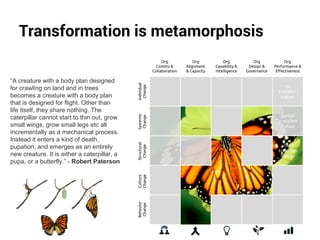
Transformation is metamorphosis 
no 
transfor-mation 
partial 
transfor-mation 
Individual 
Change 
Systemic 
Change 
Structural 
Change 
Culture 
Change 
Behavior 
Change 
“A creature with a body plan designed 
for crawling on land and in trees 
becomes a creature with a body plan 
that is designed for flight. Other than 
life itself, they share nothing. The 
caterpillar cannot start to thin out, grow 
small wings, grow small legs etc all 
incrementally as a mechanical process. 
Instead it enters a kind of death, 
pupation, and emerges as an entirely 
new creature. It is either a caterpillar, a 
pupa, or a butterfly.” - Robert Paterson 
Org 
Design & 
Governance 
Org 
Comms & 
Collaboration 
Org 
Performance & 
Effectiveness 
Org 
Alignment 
& Capacity 
Org 
Capability & 
Intelligence 
full 
transfor-mation
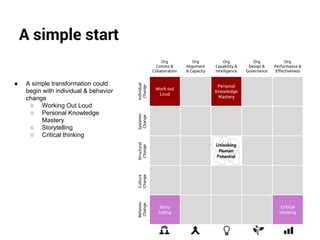
A simple start 
Individual 
Change 
Systemic 
Change 
Structural 
Change 
Culture 
Change 
Behavior 
Change 
â—Ź A simple transformation could 
begin with individual & behavior 
change 
â—‹ Working Out Loud 
â—‹ Personal Knowledge 
Mastery 
â—‹ Storytelling 
â—‹ Critical thinking 
Work out 
Loud 
Personal 
Knowledge 
Mastery 
Story 
telling 
Critical 
thinking 
Org 
Design & 
Governance 
Org 
Comms & 
Collaboration 
Org 
Performance & 
Effectiveness 
Org 
Alignment 
& Capacity 
Org 
Capability & 
Intelligence
A Trend: Culture Evolution 
Individual 
Change 
Systemic 
Change 
Structural 
Change 
Culture 
Change 
Behavior 
Change 
â—Ź Consultancies cashing in on 
culture change caused by social 
â—Ź Example: PwC 2013 Culture and 
Change Management Survey 
â—Ź This is how you would address 
culture change and org 
effectiveness 
Org 
Design & 
Governance 
Org 
Comms & 
Collaboration 
Org 
Performance & 
Effectiveness 
Org 
Alignment 
& Capacity 
Org 
Capability & 
Intelligence 
Trust 
Culture 
Maps 
Leadership 
& Talent 
Coaching 
Employee 
Empower-ment 
Tools & 
Techniques 
#lawwe 
Self-Mgt 
Self-Org 
Jobs>Roles 
Gainsharing 
Network 
Maps 
Critical 
Thinking 
Skills
Sample Client Case 
Individual 
Change 
Systemic 
Change 
Structural 
Change 
Culture 
Change 
Behavior 
Change 
Heighten 
awareness and 
engagement 
for IT security. 
Increase 
information 
flows across 
the 
organization. 
Deepen 
commitment & 
engagement 
around good 
security 
practices. 
Instill a sense 
of continuous 
and informal 
learning. 
Heighten 
critical 
thinking & 
questioning 
around 
security. 
Align IT 
security with 
organizational 
purpose. 
Org 
Design & 
Governance 
Org 
Comms & 
Collaboration 
Org 
Performance & 
Effectiveness 
Org 
Alignment 
& Capacity 
Org 
Capability & 
Intelligence 
A critical business need is to enable 
employees need to deepen their 
understanding, commitment and engagement 
around good practice with security and have it 
be more than a compliance check mark. The 
focus of this engagement is on the internal 
workforce. They are seeking assistance from 
members of Change Agents Worldwide to 
implement two project areas: 
â—Ź Develop a program for the [client] 
global network of employees and 
researchers to increase their 
awareness and engagement in IT 
Security and related compliance 
training and activities 
â—Ź Launch of an organization-wide 
Enterprise Social Network that will 
engage key stakeholder units and 
become an essential fabric to all 
employees to stay informed, and 
connected to one another and the 
company culture.
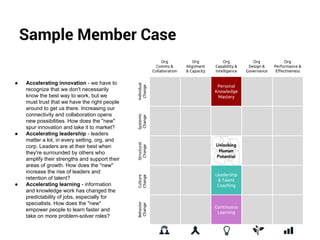
Sample Member Case 
Individual 
Change 
Systemic 
Change 
Structural 
Change 
Culture 
Change 
Behavior 
Change 
â—Ź Accelerating innovation - we have to 
recognize that we don't necessarily 
know the best way to work, but we 
must trust that we have the right people 
around to get us there. Increasing our 
connectivity and collaboration opens 
new possibilities. How does the "new" 
spur innovation and take it to market? 
â—Ź Accelerating leadership - leaders 
matter a lot, in every setting, org, and 
corp. Leaders are at their best when 
they're surrounded by others who 
amplify their strengths and support their 
areas of growth. How does the "new" 
increase the rise of leaders and 
retention of talent? 
â—Ź Accelerating learning - information 
and knowledge work has changed the 
predictability of jobs, especially for 
specialists. How does the "new" 
empower people to learn faster and 
take on more problem-solver roles? 
Personal 
Knowledge 
Mastery 
Leadership 
& Talent 
Coaching 
Continuous 
Learning 
Org 
Design & 
Governance 
Org 
Comms & 
Collaboration 
Org 
Performance & 
Effectiveness 
Org 
Alignment 
& Capacity 
Org 
Capability & 
Intelligence
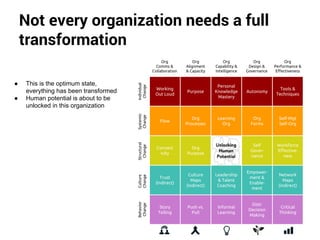
Not every organization needs a full 
transformation 
Individual 
Change 
Systemic 
Change 
Structural 
Change 
Culture 
Change 
Behavior 
Change 
â—Ź This is the optimum state, 
everything has been transformed 
â—Ź Human potential is about to be 
unlocked in this organization 
Working 
Out Loud 
Purpose 
Personal 
Knowledge 
Mastery 
Autonomy 
Tools & 
Techniques 
Flow 
Org 
Processes 
Learning 
Org 
Org 
Forms 
Self-Mgt 
Self-Org 
Trust 
(indirect) 
Culture 
Maps 
(indirect) 
Leadership 
& Talent 
Coaching 
Empower-ment 
& 
Enable-ment 
Network 
Maps 
(indirect) 
Story 
Telling 
Push vs. 
Pull 
Informal 
Learning 
Distr 
Decision 
Making 
Critical 
Thinking 
Connect 
ivity 
Org 
Purpose 
Self 
Gover-nance 
Workforce 
Effective-ness 
Org 
Design & 
Governance 
Org 
Comms & 
Collaboration 
Org 
Performance & 
Effectiveness 
Org 
Alignment 
& Capacity 
Org 
Capability & 
Intelligence
Get your free chapter of the ARK book 
http://www.changeagentsworldwide.com/books
Image Credits 
Image Credits 
â—Ź Terry Gilliam/Brazil 
â—Ź Moebius 
â—Ź Street art by Banksy 
â—Ź James Bareham 
â—Ź Serpentine Gallery Pavilion by Sou Fujimoto 
â—Ź Street art by JR Mural in Brooklyn, NY 
â—Ź Leslie Jones/Boston Public Library 
â—Ź Ali Jafargholi 
â—Ź Jonathan Anthony/This Much We Know 
â—Ź Celine Schillinger/TED Bedminster 
â—Ź Northwestern University 
â—Ź Evans O'Loan 
â—Ź Lukas Felzmann/Wired.com 
â—Ź understanddolphins.com 
All CAWW slides are licensed under share-friendly 
Creative Commons BY 4.0 (i.e., "use at will"). 
www.changeagentsworldwide.com 
Presenters 
â—Ź Susan Scrupski 
â—Ź Carrie Basham Young 
â—Ź Catherine Shinners 
â—Ź Joachim Stroh

Change Agents Worldwide Workshop KMWorld 2014

  • 1.
    Flexible & Agile Workstyles & Processes for the 21st Century Organization KM World Workshop November 2014 Susan Scrupski Founder, Change Agents Worldwide Catherine Shinners Founder, Merced Group Carrie Young Principal, Talk Social To Me Joachim Stroh Co-Founder, Change Agents Worldwide
  • 2.
    Joachim Stroh, Speaker Co-Founder, CAWW about.me/joachim Joachim Stroh has been on the traditional information and knowledge management track for more than 15 years before shifting gears and moving on to the people side of things, always bridging the gap between business and technology (he is an architect at heart). A master with visualizations, he finds the best metaphors to seek a better understanding and to get more people involved. In our networked world we’re more connected to our organizations, society, environment - and each other. Catherine brings her background as a management consultant marketer and technologist, to help organizations and people build new agilities and adaptations to the way they network, learn, lead and create value. Today’s Facilitators Susan Scrupski CEO & Founder, CAWW about.me/susanscrupski Susan Scrupski Susan Scrupski is the founder of Change Agents Worldwide, an organization dedicated to changing the world of work. She’s been tracking the social phenomenon since 2006 as a blogger, researcher, and industry observer. She also founded The 2.0 Adoption Council which was one of the first communities established to help early adopters introduce social collaboration concepts and technologies to their Global 2000 organizations. Catherine Shinners, @catshinners collaboration-incontext.com Carrie Basham Young, @carrieyoung talksocialtome.com Trusted advisor to enterprise customers seeking to design, launch and grow their internal social networks. Builder of communities, the one behind the scenes that quietly hammers the pieces together until the strong foundation is evident. Seeker of early adopters and use cases, nurturing the human connections necessary to ensure buyers and their constituents trust and love a product.
  • 3.
    What is theCAWW Network?
  • 4.
    Today’s Agenda Ourconversation today ● Introduction to Change Agents ● New workplace dynamics Worldwide (Susan) 9:00 - 9:30 am More complex, interdependent, changing and digital ● Accelerating Social Collaboration through Stories, Pods, Swarms and Enabling Social Processes in Cookie Jars and Green Rooms, based on Agile and Self-organizing Principles (Carrie and Catherine) 9:30 - 10:15 am ● Real stories Social capabilities benefitting companies ● Where you begin Solving strategic problems with collaboration ● Break 10:15 - 10:30 am ● Interactive session (All) 10:30 - 11:30 am ● Organizational Transformation Through an Open Framework (Joachim) 11:30 - 12:00 pm
  • 5.
    What Work IsLike Today The world of work has become monotonous, joyless, and sanitized. Workers are assigned soulless tasks that are to be executed with drone-like efficiencies. Jobs are molded into obstinate competencies that are surrounded by political turf wars. Organizations are stuck in the industrial age unable to take advantage of the new networked era. Terry Gilliam/Brazil
  • 6.
    The Challenge forthe Organization Organizations are facing discontinuous and disruptive change, but organizational inertia blocks any attempt to formulate a response. This inertia must be overcome if a firm is to survive. Our mission is to fight this inertia and make the organization more responsive, more resilient, and open to change.
  • 7.
    The Challenge forthe Individual Our change agents bring fun, creativity, and passion back to the workplace by empowering individuals and teams to innovate in new and unusual ways and by evolving towards egalitarian networked structures that are goal-focused and growth-oriented. This enterprise reboot will result in a step change in innovation, productivity, and growth. Let’s get started.
  • 8.
    The Challenge forChange Agents We work socially. We hold very few phone calls and web-conferences, and we do not email our members. We communicate and share nearly exclusively online on our private and public platforms. These skillsets allow our Change Agents to maintain a holistic view and to keep an eye on the dinosaurs down at the river banks...
  • 9.
    Blurring the Boundaries CAWW Socialcast Community CAWW Website CAWW Blog CAWW G+ Community CAWW Wiki CAWW Wordpress CAWW G+ Brand Page CAWW Facebook CAWW Twitter CAWW Slideshare CAWW Pinterest CAWW Bloggers & Tweeters
  • 10.
    From WIIFM toWIIFU - The CAWW Manifesto
  • 11.
    Why this workshop We’ll show how we work, so you can do, too.
  • 12.
    What are Stories?“Stories are statements regarding the facts pertinent to a situation in question, they can be anecdotes, the intrigue or plot of a narrative or dramatic work.” see also Denning
  • 13.
    Why Stories â—Źstories have a beginning, middle & end â—Ź stories act as an attractor (img) â—Ź stories are easy to relate to â—Ź stories often continue for weeks or months â—Ź everyone feels energized, even for stories with a bad ending
  • 14.
    Here’s a Story example WOL under the stairs + pic from Jonathan Anthony talking to ee’s
  • 15.
    Stories: The CAIncubator Celine Schillinger, launched a revolution at Sanofi-Pasteur. She brought passion, courage, conviction to changing the culture. â—Ź Internal Social Campaign for Gender Balance â—Ź External Social Campaign for Break Dengue
  • 16.
    Swarming for Education Masters Program, Learning and Organizational Change, Northwestern University #msloc430 â—Ź 560 tweets in an hour â—Ź 50 participants â—Ź Four posted knowledge management topics â—Ź Curated list of enterprise social network tactics and strategies created â—Ź List of thought leadership and blog material â—Ź Lasting relationship between NWU & CAWW â—Ź High impact experience for students
  • 17.
    Welcome to BiologyClass. People are social animals. We apply lessons from nature to the complex work problems seen inside companies today. Cooperation and sharing openly, within a set of trusted relationships, creates value for the entire community.
  • 18.
    What are Swarms? Swarm behaviour, or swarming, is a collective behaviour exhibited by animals of similar size which aggregate together, perhaps milling about the same spot or perhaps moving en masse or migrating in some direction. (Wikipedia) “From a more abstract point of view, swarm behaviour is the collective motion of a large number of self-propelled entities.” O'Loan; Evans (1998). "Alternating steady state in one-dimensional flocking". Journal of Physics A: Mathematical and General 32 (8): L99–L105
  • 19.
    Swarms at CAWW Swarms are network-wide calls-to-action through an ad-hoc, unscheduled announcement. Anyone can participate; further interactions move into separate spaces.
  • 20.
    Why Swarms â—ŹSwarms provide important, urgent information in a central location â—Ź Collaborative technology provides mechanisms for the alert (email, mobile and in-app visuals) as well as abilities for transparent communication (commenting and alerts) â—Ź Used for information gathering and observation, sense of urgency and alignment, very little contribution required to arrive at large outcome
  • 21.
    Show Me The(Swarm) Money!
  • 22.
    Here’s Swarm aTactics Swarm Using swarm tactics to engage a community in creating a vaccine for the Dengue Fever. #breakdengue example: arrival of a new client, call-for-papers, etc. Carrie
  • 23.
    Diving Into Pods “In the ocean, a dolphin pod is the basic social unit. It provides for a cooperative, social way of life and increases the chances for individual survival. Cooperation and forming alliances are ways in which the more complex mammals attempt to manipulate their social environment. Such alliances require sophisticated means of communication in order to manage relationships. Dolphins do this by forming fluid, temporary groups called "pods", typically consisting of 2-15 animals. Dolphins are very social creatures and appear to need each other while hunting, defending themselves and their pods, and (obviously) mating.”
  • 24.
    What are Pods Pods are secure, online, collaborative instantiated workspaces; they are based on a given template and process and require little or no onboarding for clients.
  • 25.
    Why Pods Podsare pressure cookers that need to reach a certain “core temperature” when everything is on the line Everything is highly visible and accountable to raise the level of trust, surface organizational issues quickly Initially overload the pod with more-than- needed experts, both ECAs and SCAs Asynchronous experience for clients and Change Agents; add and consume as you can
  • 26.
    Thought Leadership Pod Direct client collaboration in a Pod lead to a series of successful webinars and whitepapers presented to thousands of customers.
  • 27.
    What are JobJars Job jars contain important tasks that an organization grapples with, free for anyone in the organization to take on. Like a cookie jar, this concept requires an open and transparent process to work (you can see all cookies in the jar, it’s easy to open the jar, etc). Some employees will prefer chocolate cookies with a rich texture over plain vanilla ones.
  • 28.
    What are JobJars This kind of openness and transparent process will help alleviate fear and mistrust. For those that feel threatened, cookies don't have to be strategic (or oversized) - start with small cookies, get the recognition and rewards in place and build from there.
  • 29.
    Why Job Jars Job jars allow you to connect with your co-workers and choose with whom you like to work.
  • 31.
    What is aGreen Room What/Green Rooms The best way to understand the value of the expertise and strength of a network, is to have a conversation. On occasion, we will invite a company into our virtual office for the unique opportunity to discuss one particular issue from your organization in private and for free. You will experience firsthand the accumulated knowledge and wisdom of our members. The format is an open conversation - the more you can share, the more help and insights we can provide. Everything that is shared will stay inside the room. Come sit down with our world class team. We'd love to talk to you about your greatest change challenges. Catherine
  • 32.
    Why a GreenRoom A unique opportunity to get to know the client, the issues etc. without the performance pressure; a pull, not a push mechanism to draw in select people without the competence pressure; a way to sort through things before an actual project is started and resources are assigned
  • 33.
  • 34.
    Working Out Loud + WOL = observable work + narrating your work
  • 35.
    Emergence & Incubation- WOL in the World Dennis Pearce - Leading at Lexmark now writing his Ph.D. thesis on WOL John Stepper - Designing for practice scaling a method, book + donorschoose.org Catherine Shinners @ Columbia University Bringing the practice forward to next gen leaders Bryce Williams - expanding and scaling the concept - WOL + AOL + SOL at Eli Lilly
  • 37.
    Collaborating for Change â—Ź 28 Change Agents essays â—Ź 2 month collaboration - writing, producing, marketing, self-publishing â—Ź Innovation by Design article about Change Agent network principles, social collaboration processes â—Ź Written by 3 Change Agents â—Ź Entire CAWW network reviewed, refined
  • 38.
    Breakout Session Swarms Jars Stories Pods Catherine Susan â—Ź 10 min coffee break â—Ź 10 min table discussion (each group has one facilitator) â—Ź 20 min regroup & present Carrie Joachim
  • 39.
    Introducing the OrganizationalTransformation Matrix A better way to approach organizational change through a transparent & open process that unlocks human potential. “We are the sum of our parts. We are a stained glass window of different colors that combine to become an image of the future.” - Susan Scrupski
  • 40.
    Why do youneed a matrix like this? ● To provide a shared framework for organizational transformation, impact and change (you speak the same language across departments) ● To uncouple the framework from technology and make it vendor-agnostic (you want technology to follow function, not vv.) ● To preserve the diversity of work delivered by your change agents (they don’t take the normal path) ● To create a matrix that continuously updates your services portfolio (you continuously re-invent yourself) MOBILIZE ORG POTENTIA L UNLOCK HUMAN POTENTIA L This is the critical center piece that determines everything else.
  • 41.
    How to bestuse the matrix â—Ź as a pathway/roadmap for an org transformation â—Ź as a constantly evolving portfolio/architecture â—Ź as a strange loop* to see what we are actually doing *http://en.wikipedia.org/wiki/Strange_loop
  • 42.
    How to bestuse the matrix â—Ź begin with the end in mind and gain momentum throughout the organization â—Ź begin at the heart of the matter (executive level), from there transform the organization â—Ź select a few areas/patterns for improvement and see how the patient does (pain points) â—Ź select all areas/patterns and iterate (slow fractal pattern)
  • 43.
    Five kinds ofchange â—Ź Individual change is change that we can enable on a personal level through simple introductions, guidelines, or initiatives. â—Ź Systemic change is change that deeply pervades all parts of a system, taking into account the interrelationships and interdependencies among those parts. â—Ź Structural change is change that alters the way authority, capital, information, and responsibility flows in an organization. â—Ź Culture change is change that alters group norms of behavior, practices, attitudes and assumptions and the underlying shared values that help keep those norms in place. Denning Kotter â—Ź Behavior Change applies a method or technique for changing one or several psychological determinants of behavior such as a person's attitude or self-efficacy.
  • 44.
    Five drivers ofchange It is important to note that you are using existing language and refrain from using new terminology (i.e. the complex side effects that emerge) ● Organizational Communications & Collaboration - Communicating & collaborating around a common objective ● Organizational Alignment & Capacity - Consistently clear understanding of the organization’s purpose throughout the business organization’s entire value chain. ● Organizational Capability & Intelligence - Capability of an organization to comprehend and conclude knowledge relevant to its business purpose and to drive meaningful business results. ● Organizational Design & Governance - Process of reshaping and realigning organization structure, process, rewards, metrics and talent in order to achieve the outcomes the organization intends to produce. ● Organizational Performance & Effectiveness - Carrying out or accomplishing an action, task, or function.
  • 45.
    In the beginningthe canvas is blank Org Design & Governance Org Comms & Collaboration Org Performance & Effectiveness Org Alignment & Capacity Org Capability & Intelligence Individual Change Systemic Change Structural Change Culture Change Behavior Change â—Ź This is the initial state, begin to uncover key drivers for change â—Ź Select a few rows that drive change throughout the organization â—Ź Run down a few columns that correspond to the selected rows â—Ź Look for experts in change for selected squares â—Ź Realize that some squares are easy to transform, others require significant effort
  • 46.
    A horizontal transformation Individual Change Systemic Change Structural Change Culture Change Behavior Change Find experts in culture change for â—Ź collaboration â—Ź org alignment & capacity â—Ź org capability & intelligence â—Ź org design & effectiveness â—Ź performance Org Design & Governance Org Comms & Collaboration Org Performance & Effectiveness Org Alignment & Capacity Org Capability & Intelligence
  • 47.
    There can bea vertical roles Individual Change Systemic Change Structural Change Culture Change Behavior Change â—Ź This is a full change program for organizational design and effectiveness â—‹ individual change â—‹ systemic change â—‹ structural change â—‹ culture change â—‹ behavior change Org Design & Governance Org Comms & Collaboration Org Performance & Effectiveness Org Alignment & Capacity Org Capability & Intelligence
  • 48.
    Transformation is metamorphosis no transfor-mation partial transfor-mation Individual Change Systemic Change Structural Change Culture Change Behavior Change “A creature with a body plan designed for crawling on land and in trees becomes a creature with a body plan that is designed for flight. Other than life itself, they share nothing. The caterpillar cannot start to thin out, grow small wings, grow small legs etc all incrementally as a mechanical process. Instead it enters a kind of death, pupation, and emerges as an entirely new creature. It is either a caterpillar, a pupa, or a butterfly.” - Robert Paterson Org Design & Governance Org Comms & Collaboration Org Performance & Effectiveness Org Alignment & Capacity Org Capability & Intelligence full transfor-mation
  • 49.
    A simple start Individual Change Systemic Change Structural Change Culture Change Behavior Change â—Ź A simple transformation could begin with individual & behavior change â—‹ Working Out Loud â—‹ Personal Knowledge Mastery â—‹ Storytelling â—‹ Critical thinking Work out Loud Personal Knowledge Mastery Story telling Critical thinking Org Design & Governance Org Comms & Collaboration Org Performance & Effectiveness Org Alignment & Capacity Org Capability & Intelligence
  • 50.
    A Trend: CultureEvolution Individual Change Systemic Change Structural Change Culture Change Behavior Change â—Ź Consultancies cashing in on culture change caused by social â—Ź Example: PwC 2013 Culture and Change Management Survey â—Ź This is how you would address culture change and org effectiveness Org Design & Governance Org Comms & Collaboration Org Performance & Effectiveness Org Alignment & Capacity Org Capability & Intelligence Trust Culture Maps Leadership & Talent Coaching Employee Empower-ment Tools & Techniques #lawwe Self-Mgt Self-Org Jobs>Roles Gainsharing Network Maps Critical Thinking Skills
  • 51.
    Sample Client Case Individual Change Systemic Change Structural Change Culture Change Behavior Change Heighten awareness and engagement for IT security. Increase information flows across the organization. Deepen commitment & engagement around good security practices. Instill a sense of continuous and informal learning. Heighten critical thinking & questioning around security. Align IT security with organizational purpose. Org Design & Governance Org Comms & Collaboration Org Performance & Effectiveness Org Alignment & Capacity Org Capability & Intelligence A critical business need is to enable employees need to deepen their understanding, commitment and engagement around good practice with security and have it be more than a compliance check mark. The focus of this engagement is on the internal workforce. They are seeking assistance from members of Change Agents Worldwide to implement two project areas: â—Ź Develop a program for the [client] global network of employees and researchers to increase their awareness and engagement in IT Security and related compliance training and activities â—Ź Launch of an organization-wide Enterprise Social Network that will engage key stakeholder units and become an essential fabric to all employees to stay informed, and connected to one another and the company culture.
  • 52.
    Sample Member Case Individual Change Systemic Change Structural Change Culture Change Behavior Change â—Ź Accelerating innovation - we have to recognize that we don't necessarily know the best way to work, but we must trust that we have the right people around to get us there. Increasing our connectivity and collaboration opens new possibilities. How does the "new" spur innovation and take it to market? â—Ź Accelerating leadership - leaders matter a lot, in every setting, org, and corp. Leaders are at their best when they're surrounded by others who amplify their strengths and support their areas of growth. How does the "new" increase the rise of leaders and retention of talent? â—Ź Accelerating learning - information and knowledge work has changed the predictability of jobs, especially for specialists. How does the "new" empower people to learn faster and take on more problem-solver roles? Personal Knowledge Mastery Leadership & Talent Coaching Continuous Learning Org Design & Governance Org Comms & Collaboration Org Performance & Effectiveness Org Alignment & Capacity Org Capability & Intelligence
  • 53.
    Not every organizationneeds a full transformation Individual Change Systemic Change Structural Change Culture Change Behavior Change â—Ź This is the optimum state, everything has been transformed â—Ź Human potential is about to be unlocked in this organization Working Out Loud Purpose Personal Knowledge Mastery Autonomy Tools & Techniques Flow Org Processes Learning Org Org Forms Self-Mgt Self-Org Trust (indirect) Culture Maps (indirect) Leadership & Talent Coaching Empower-ment & Enable-ment Network Maps (indirect) Story Telling Push vs. Pull Informal Learning Distr Decision Making Critical Thinking Connect ivity Org Purpose Self Gover-nance Workforce Effective-ness Org Design & Governance Org Comms & Collaboration Org Performance & Effectiveness Org Alignment & Capacity Org Capability & Intelligence
  • 54.
    Get your freechapter of the ARK book http://www.changeagentsworldwide.com/books
  • 55.
    Image Credits ImageCredits â—Ź Terry Gilliam/Brazil â—Ź Moebius â—Ź Street art by Banksy â—Ź James Bareham â—Ź Serpentine Gallery Pavilion by Sou Fujimoto â—Ź Street art by JR Mural in Brooklyn, NY â—Ź Leslie Jones/Boston Public Library â—Ź Ali Jafargholi â—Ź Jonathan Anthony/This Much We Know â—Ź Celine Schillinger/TED Bedminster â—Ź Northwestern University â—Ź Evans O'Loan â—Ź Lukas Felzmann/Wired.com â—Ź understanddolphins.com All CAWW slides are licensed under share-friendly Creative Commons BY 4.0 (i.e., "use at will"). www.changeagentsworldwide.com Presenters â—Ź Susan Scrupski â—Ź Carrie Basham Young â—Ź Catherine Shinners â—Ź Joachim Stroh