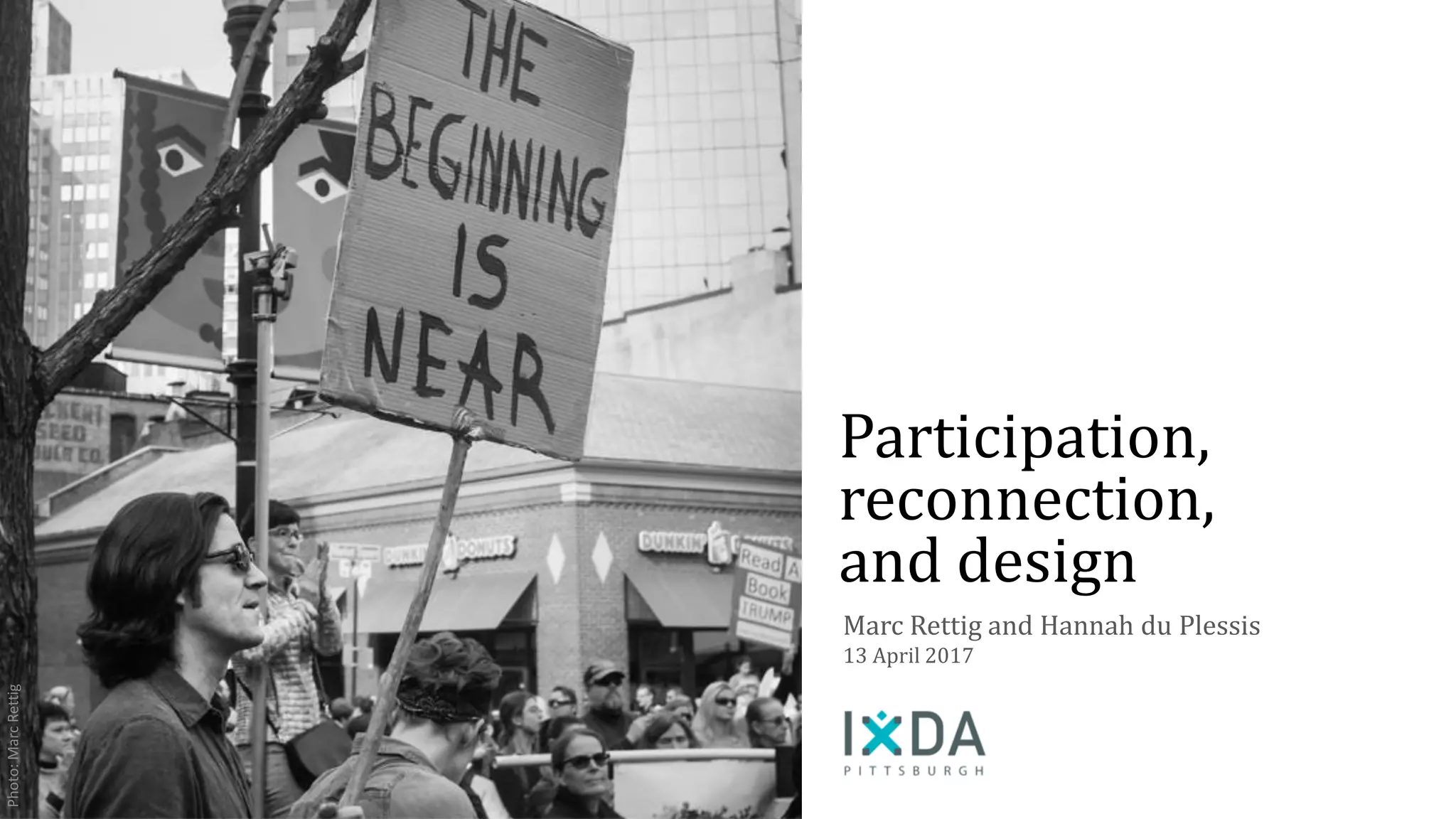
Participation,
reconnection,
and design
Marc Rettig and Hannah du Plessis
13 April 2017
Participation, reconnection, and design
Marc Rettig & Hannah du Plessis | Fit Associates, LLC
www.fitassociates.com
marc@fitassociates.com | @mrettig
hannah@fitassociates.com | @hannahdup
This workshop was presented on April 13, 2017, at a meeting of the Pittsburgh chapter of the Interaction Design Association. For more information, see
ixda.org and www.facebook.com/IxdaPittsburgh.
© 2017, Fit Associates LLC
This work is licensed under a Creative Commons Attribution-NonCommercial-Sharealike 4.0 License. You can copy and redistribute it, and you can remix, transform, and build
upon this material, so long as you attribute credit to its authors, and share under the same license. To view a copy of this license, visit creativecommons.org/licenses/by-nc-
sa/4.0 or send a letter to Creative Commons, 444 Castro Street, Suite 900, Mountain View, California, 94041, USA.
Marc Rettig
marc@fitassociates.com
@mrettig
Hannah du Plessis
hannah@fitassociates.com
@hannahdup
fitassociates.com dsi.sva.edu design.cmu.edu
Three parts
Interaction 17 Reflection sessions report
A version of our keynote talk
Group reflection and discussion
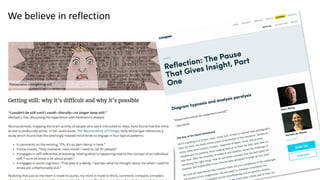
We believe in reflection
fitassociates.com/getting-still
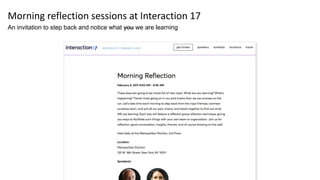
Morning reflection sessions at Interaction 17
An invitation to step back and notice what you we are learning
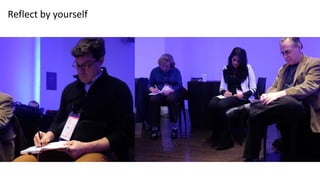
Reflect by yourself
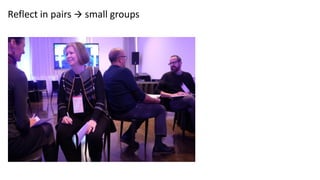
Reflect in pairs  small groups
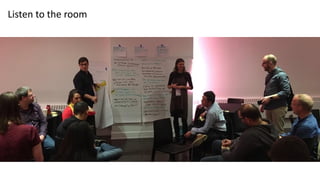
Listen to the room
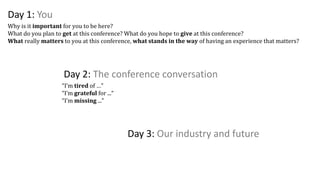
Day 1: You
Why is it important for you to be here?
What do you plan to get at this conference? What do you hope to give at this conference?
What really matters to you at this conference, what stands in the way of having an experience that matters?
Day 2: The conference conversation
“I’m tired of …”
“I’m grateful for ...“
“I’m missing ...”
Day 3: Our industry and future
We stand in a difficult moment in history. We have
inherited a world that works for some at the
expense of others. We are disconnected from the
consequences of our actions. It is alluring to participate
unconsciously and believe that “everything is ok.”
It is therefore important to step outside the comfort of
our industry and our time, and ask critical questions.
What might future generations ask of us?
What might those outside of, but affected
by our industry, ask of us?
So we asked…
Do we consider the unintended consequences of designing only for ourselves?
Why don’t we take the opportunity to change consumption habits rather than
feed technological addiction?
Why don’t we take leadership to shift the moral and ethical compass of
our design community?
Why don’t we refuse to do work that is against our moral commitments?
Why aren’t we talking about designing jobs away?
Why so many fucking photo apps?
Some of the answers we heard
“Business as usual” ain’t working,
it’s hurting.
“Hope locates itself in the premises that we don’t know what will happen
and that in the spaciousness of uncertainty is room to act. When you
recognize uncertainty, you recognize that you may be able to influence
the outcomes–you alone or you in concert with a few dozen or several
million others. Hope is an embrace of the unknown and knowable, a
alternative to the certainty of both optimists and pessimists. Optimists
think it will all be fine without our involvement; pessimists take the
opposite position; both excuse themselves from acting. It’s the belief
that what we do matters even though how and when it may matter, who
and what is may impact, are not things we can know….”
Rebecca Solnit
Possibilities everywhere
Two points about that…
“Business as usual” ain’t working, it’s hurting.
1. At the same time, a lot of good things are happening,
and they add up to something big.
2. We’re finding methods, strategies and approaches that
help us all participate in those things.
1. At the same time, a lot of good things are happening,
and they add up to something big.
(My job for the next four minutes is to overwhelm you with
just how many good things are going on.)
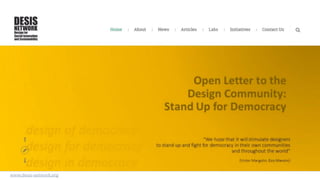
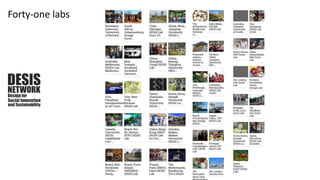
www.desis-network.org
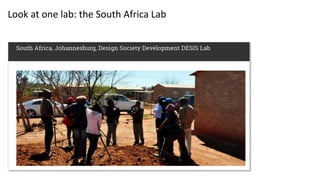
Look at one lab: the South Africa Lab
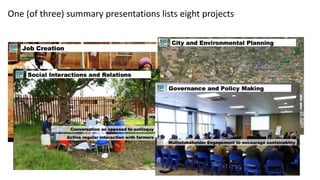
One (of three) summary presentations lists eight projects
Forty-one labs
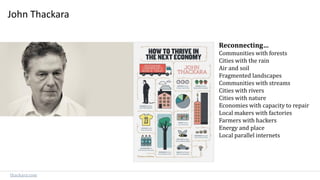
John Thackara
Reconnecting…
Communities with forests
Cities with the rain
Air and soil
Fragmented landscapes
Communities with streams
Cities with rivers
Cities with nature
Economies with capacity to repair
Local makers with factories
Farmers with hackers
Energy and place
Local parallel internets
thackara.com
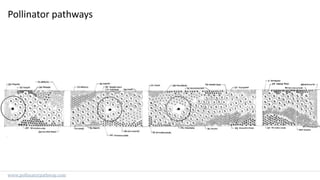
Pollinator pathways
www.pollinatorpathway.com
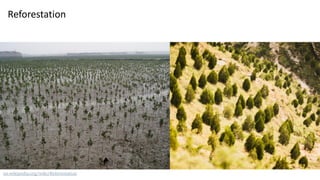
Reforestation
en.wikipedia.org/wiki/Reforestation
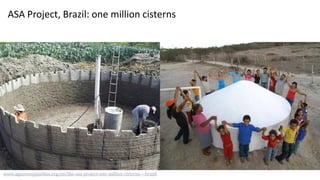
ASA Project, Brazil: one million cisterns
www.aguariosypueblos.org/en/the-asa-project-one-million-cisterns-–-brazil
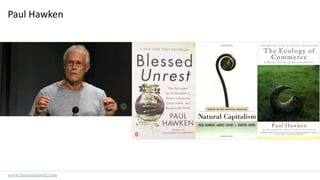
Paul Hawken
www.blessedunrest.com
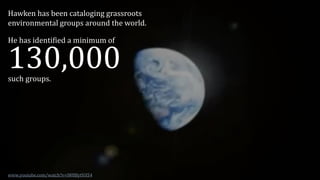
Hawken has been cataloging grassroots
environmental groups around the world.
He has identified a minimum of
130,000such groups.
www.youtube.com/watch?v=iW8BytViI54
“These aren’t the last guttering candles before we
slip into total darkness. These are the symptoms,
flowers, and seedlings of the future. This is
exactly what you would expect for the early stage
of an ecological transformation.”
John Thackara
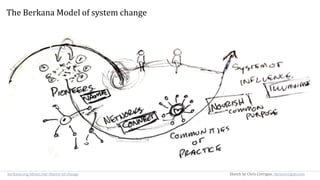
The Berkana Model of system change
berkana.org/about/our-theory-of-change Sketch by Chris Corrigan, chriscorrigan.com
We affect the grand shift by shifting the
way we participate in our own contexts,
and by creating contexts that afford
shifts in others’ participation.
Mechanisms:
participation and (re)connection
medium.com/@EskoKilpi/networks-and-leadership-d8400046eae6 | www.peterblock.com/_assets/downloads/Civic.pdf
2. We’re finding methods, strategies and approaches
that help us all participate in those things.
Methods: room-of-people scale
Strategies: wisely connecting room-scale activities in sequence
1. A lot of good things are happening,
and they add up to something big.
We see an exciting
blossoming of methods
for doing this work at
roomful-of-people scale.
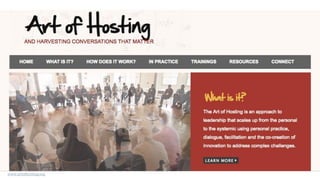
www.artofhosting.org
appliedimprovisation.network
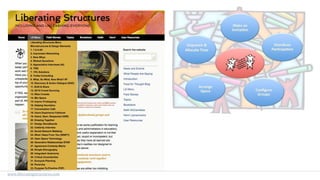
www.liberatingstructures.com
Methods in practice:
The “treat-animals-well society”
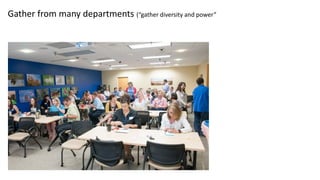
Gather from many departments (“gather diversity and power”
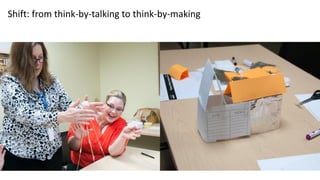
Shift: from think-by-talking to think-by-making
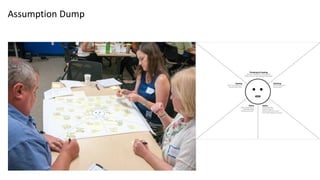
Assumption Dump
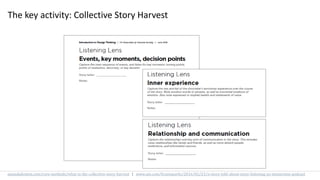
The key activity: Collective Story Harvest
amandafenton.com/core-methods/what-is-the-collective-story-harvest | www.uie.com/brainsparks/2016/02/23/a-story-told-about-story-listening-ux-immersion-podcast
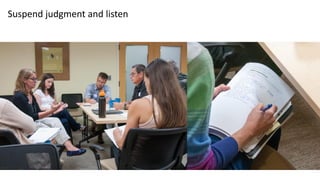
Suspend judgment and listen
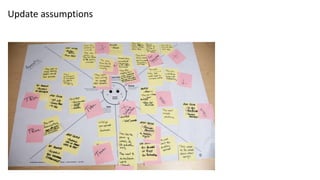
Update assumptions
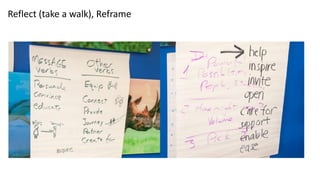
Reflect (take a walk), Reframe
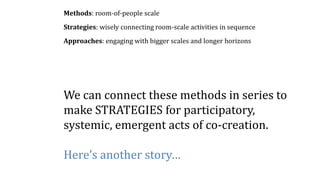
We can connect these methods in series to
make STRATEGIES for participatory,
systemic, emergent acts of co-creation.
Here’s another story…
Methods: room-of-people scale
Strategies: wisely connecting room-scale activities in sequence
Approaches: engaging with bigger scales and longer horizons
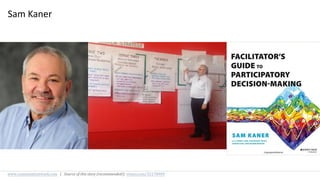
Sam Kaner
www.communityatwork.com | Source of this story (recommended!): vimeo.com/32178909
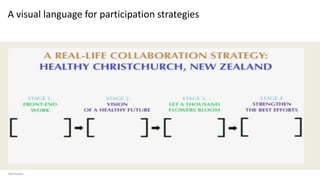
A visual language for participation strategies
Sam Kaner
Sam Kaner
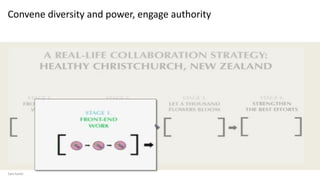
Convene diversity and power, engage authority
Sam Kaner
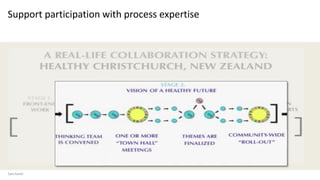
Support participation with process expertise
Sam Kaner
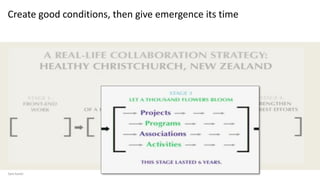
Create good conditions, then give emergence its time
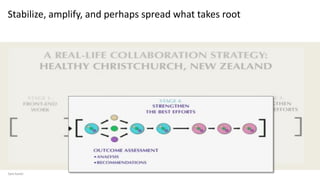
Sam Kaner
Stabilize, amplify, and perhaps spread what takes root
The people who curated this process are
fluent in the work of social emergence:
convening and hosting conversations,
participatory decision-making, the dance
between acting or intervening and
stepping back to trust the creative forces of
community. We can also gain that fluency.
1. At the same time as all the bad things, a lot of good
things are happening, and they add up to something big.
2. We’re finding methods, strategies and approaches that
help us all participate in those things. We can know
how to do this stuff!
And that’s my two points.
Shifting the way we participate in our
own contexts (and working with the
conditions for others’ participation)
requires awareness, courage, support
and practice.
A third point
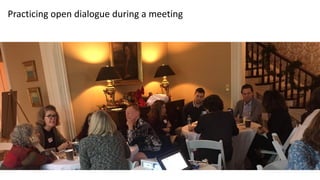
Practicing open dialogue during a meeting
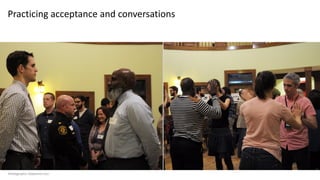
Practicing acceptance and conversations
Photographs: Stephanie Sun
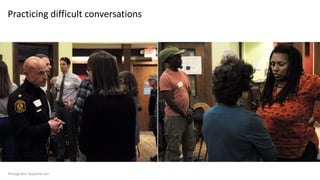
Practicing difficult conversations
Photographs: Stephanie Sun
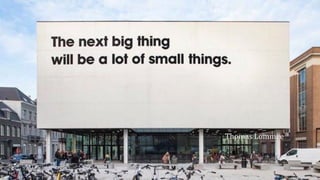
Thomas Lommee
Never before have the possibilities for action been so abundant.
Never before has the potential to interconnect all these actions been so great.
Therefore the time for putting the blame to those in power lies behind us
and the time for kick-starting small but massive action lies in front.
In a networked society the transition to a more sustainable living environment
will not only be realized by a handful of large-scale projects that are orchestrated by a few.
It will mostly be shaped by a billion tiny interrelated actions that are initiated by all of us.
In a networked society we, as citizens, have power.
We can influence decision making by posting, forwarding, grouping, choosing and approving.
We can reshape our living environment by initiating, exchanging, sharing, improving
and building upon what was developed by those who came before us.
It’s now simply up to us to be aware of these new opportunities in order to exploit them to the fullest.
Thomas Lommee
www.intrastructures.net/Intrastructures/Actions_-_The_next_big_thing_2.html
Reflection and discussion
It’s a method!
1-2-4-All
www.liberatingstructures.com/1-1-2-4-all/
Thank you.
Marc Rettig
marc@fitassociates.com
@mrettig
Hannah du Plessis
hannah@fitassociates.com
@hannahdup

Rettig+du plessis ixda_pgh_participation+design_apr2017

  • 1.
    Participation, reconnection, and design Marc Rettigand Hannah du Plessis 13 April 2017
  • 2.
    Participation, reconnection, anddesign Marc Rettig & Hannah du Plessis | Fit Associates, LLC www.fitassociates.com marc@fitassociates.com | @mrettig hannah@fitassociates.com | @hannahdup This workshop was presented on April 13, 2017, at a meeting of the Pittsburgh chapter of the Interaction Design Association. For more information, see ixda.org and www.facebook.com/IxdaPittsburgh. © 2017, Fit Associates LLC This work is licensed under a Creative Commons Attribution-NonCommercial-Sharealike 4.0 License. You can copy and redistribute it, and you can remix, transform, and build upon this material, so long as you attribute credit to its authors, and share under the same license. To view a copy of this license, visit creativecommons.org/licenses/by-nc- sa/4.0 or send a letter to Creative Commons, 444 Castro Street, Suite 900, Mountain View, California, 94041, USA.
  • 3.
    Marc Rettig marc@fitassociates.com @mrettig Hannah duPlessis hannah@fitassociates.com @hannahdup fitassociates.com dsi.sva.edu design.cmu.edu
  • 4.
    Three parts Interaction 17Reflection sessions report A version of our keynote talk Group reflection and discussion
  • 5.
    We believe inreflection fitassociates.com/getting-still
  • 6.
    Morning reflection sessionsat Interaction 17 An invitation to step back and notice what you we are learning
  • 7.
  • 8.
    Reflect in pairs small groups
  • 9.
  • 10.
    Day 1: You Whyis it important for you to be here? What do you plan to get at this conference? What do you hope to give at this conference? What really matters to you at this conference, what stands in the way of having an experience that matters? Day 2: The conference conversation “I’m tired of …” “I’m grateful for ...“ “I’m missing ...” Day 3: Our industry and future
  • 11.
    We stand ina difficult moment in history. We have inherited a world that works for some at the expense of others. We are disconnected from the consequences of our actions. It is alluring to participate unconsciously and believe that “everything is ok.” It is therefore important to step outside the comfort of our industry and our time, and ask critical questions.
  • 12.
    What might futuregenerations ask of us? What might those outside of, but affected by our industry, ask of us? So we asked…
  • 13.
    Do we considerthe unintended consequences of designing only for ourselves? Why don’t we take the opportunity to change consumption habits rather than feed technological addiction? Why don’t we take leadership to shift the moral and ethical compass of our design community? Why don’t we refuse to do work that is against our moral commitments? Why aren’t we talking about designing jobs away? Why so many fucking photo apps? Some of the answers we heard
  • 14.
    “Business as usual”ain’t working, it’s hurting.
  • 15.
    “Hope locates itselfin the premises that we don’t know what will happen and that in the spaciousness of uncertainty is room to act. When you recognize uncertainty, you recognize that you may be able to influence the outcomes–you alone or you in concert with a few dozen or several million others. Hope is an embrace of the unknown and knowable, a alternative to the certainty of both optimists and pessimists. Optimists think it will all be fine without our involvement; pessimists take the opposite position; both excuse themselves from acting. It’s the belief that what we do matters even though how and when it may matter, who and what is may impact, are not things we can know….” Rebecca Solnit Possibilities everywhere
  • 16.
    Two points aboutthat… “Business as usual” ain’t working, it’s hurting. 1. At the same time, a lot of good things are happening, and they add up to something big. 2. We’re finding methods, strategies and approaches that help us all participate in those things.
  • 17.
    1. At thesame time, a lot of good things are happening, and they add up to something big. (My job for the next four minutes is to overwhelm you with just how many good things are going on.)
  • 18.
  • 19.
    Look at onelab: the South Africa Lab
  • 20.
    One (of three)summary presentations lists eight projects
  • 21.
  • 22.
    John Thackara Reconnecting… Communities withforests Cities with the rain Air and soil Fragmented landscapes Communities with streams Cities with rivers Cities with nature Economies with capacity to repair Local makers with factories Farmers with hackers Energy and place Local parallel internets thackara.com
  • 23.
  • 24.
  • 25.
    ASA Project, Brazil:one million cisterns www.aguariosypueblos.org/en/the-asa-project-one-million-cisterns-–-brazil
  • 26.
  • 27.
    Hawken has beencataloging grassroots environmental groups around the world. He has identified a minimum of 130,000such groups. www.youtube.com/watch?v=iW8BytViI54
  • 28.
    “These aren’t thelast guttering candles before we slip into total darkness. These are the symptoms, flowers, and seedlings of the future. This is exactly what you would expect for the early stage of an ecological transformation.” John Thackara
  • 29.
    The Berkana Modelof system change berkana.org/about/our-theory-of-change Sketch by Chris Corrigan, chriscorrigan.com
  • 30.
    We affect thegrand shift by shifting the way we participate in our own contexts, and by creating contexts that afford shifts in others’ participation. Mechanisms: participation and (re)connection medium.com/@EskoKilpi/networks-and-leadership-d8400046eae6 | www.peterblock.com/_assets/downloads/Civic.pdf
  • 31.
    2. We’re findingmethods, strategies and approaches that help us all participate in those things. Methods: room-of-people scale Strategies: wisely connecting room-scale activities in sequence 1. A lot of good things are happening, and they add up to something big.
  • 32.
    We see anexciting blossoming of methods for doing this work at roomful-of-people scale.
  • 33.
  • 34.
  • 35.
  • 36.
    Methods in practice: The“treat-animals-well society”
  • 37.
    Gather from manydepartments (“gather diversity and power”
  • 38.
    Shift: from think-by-talkingto think-by-making
  • 39.
  • 40.
    The key activity:Collective Story Harvest amandafenton.com/core-methods/what-is-the-collective-story-harvest | www.uie.com/brainsparks/2016/02/23/a-story-told-about-story-listening-ux-immersion-podcast
  • 41.
  • 42.
  • 43.
    Reflect (take awalk), Reframe
  • 44.
    We can connectthese methods in series to make STRATEGIES for participatory, systemic, emergent acts of co-creation. Here’s another story… Methods: room-of-people scale Strategies: wisely connecting room-scale activities in sequence Approaches: engaging with bigger scales and longer horizons
  • 45.
    Sam Kaner www.communityatwork.com |Source of this story (recommended!): vimeo.com/32178909
  • 46.
    A visual languagefor participation strategies Sam Kaner
  • 47.
    Sam Kaner Convene diversityand power, engage authority
  • 48.
    Sam Kaner Support participationwith process expertise
  • 49.
    Sam Kaner Create goodconditions, then give emergence its time
  • 50.
    Sam Kaner Stabilize, amplify,and perhaps spread what takes root
  • 51.
    The people whocurated this process are fluent in the work of social emergence: convening and hosting conversations, participatory decision-making, the dance between acting or intervening and stepping back to trust the creative forces of community. We can also gain that fluency.
  • 52.
    1. At thesame time as all the bad things, a lot of good things are happening, and they add up to something big. 2. We’re finding methods, strategies and approaches that help us all participate in those things. We can know how to do this stuff! And that’s my two points.
  • 53.
    Shifting the waywe participate in our own contexts (and working with the conditions for others’ participation) requires awareness, courage, support and practice. A third point
  • 54.
    Practicing open dialogueduring a meeting
  • 55.
    Practicing acceptance andconversations Photographs: Stephanie Sun
  • 56.
  • 57.
  • 58.
    Never before havethe possibilities for action been so abundant. Never before has the potential to interconnect all these actions been so great. Therefore the time for putting the blame to those in power lies behind us and the time for kick-starting small but massive action lies in front. In a networked society the transition to a more sustainable living environment will not only be realized by a handful of large-scale projects that are orchestrated by a few. It will mostly be shaped by a billion tiny interrelated actions that are initiated by all of us. In a networked society we, as citizens, have power. We can influence decision making by posting, forwarding, grouping, choosing and approving. We can reshape our living environment by initiating, exchanging, sharing, improving and building upon what was developed by those who came before us. It’s now simply up to us to be aware of these new opportunities in order to exploit them to the fullest. Thomas Lommee www.intrastructures.net/Intrastructures/Actions_-_The_next_big_thing_2.html
  • 59.
    Reflection and discussion It’sa method! 1-2-4-All www.liberatingstructures.com/1-1-2-4-all/
  • 60.
    Thank you. Marc Rettig marc@fitassociates.com @mrettig Hannahdu Plessis hannah@fitassociates.com @hannahdup