CHAMPS:
PBIS in the
Classroom
Ratio of Interactions
Research suggests that teachers
should plan to use a 4:1 ratio so
that for every 1 corrective or
attention to inappropriate
behavior, the teacher provides 4
interactions in response to
appropriate behavior.
CHAMPS Ch. 7, Task 3, Pg. 293
DSC, Ch 8, Task 4, Pg. 266
Increasing the ratio of times you
interact with students when they
are engaged in desirable
behaviors compared to attending
to undesirable behavior is one of
the most essential & effective
behavior management strategies
teachers can implement to
improve the climate & culture
within the classroom.
Ratio of Interactions
Rating Interactions
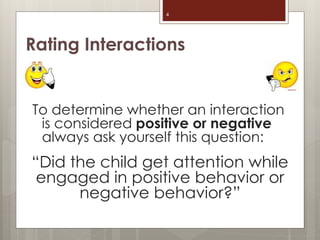
To determine whether an interaction
is considered positive or negative
always ask yourself this question:
“Did the child get attention while
engaged in positive behavior or
negative behavior?”
4
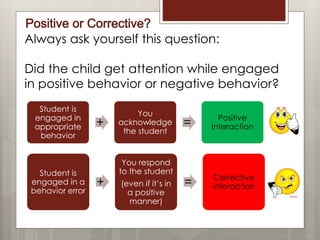
Always ask yourself this question:
Did the child get attention while engaged
in positive behavior or negative behavior?
Student is
engaged in
appropriate
behavior
+
You
acknowledge
the student
= Positive
Interaction
Student is
engaged in a
behavior error
+
You respond
to the student
(even if it’s in
a positive
manner)
= Corrective
Interaction
Ratio of Interaction
Our students are very demanding of attention
and will go to many lengths to get it.
The form of attention may
not matter…….
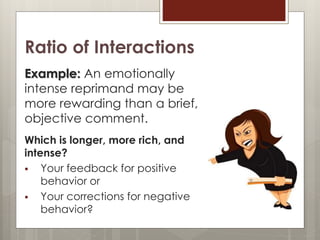
Ratio of Interactions
Example: An emotionally
intense reprimand may be
more rewarding than a brief,
objective comment.
Which is longer, more rich, and
intense?
 Your feedback for positive
behavior or
 Your corrections for negative
behavior?
Ratio of Interactions
The single most important thing that
a teacher can do to improve the
overall behaviors of students in
their classroom is…
increase the number of positive
interactions they have with each
student.
Ratio of Interaction
The behavior you attend to the
most will be the one that you will
see more of in the future.
Ratio of Interactions Formula
This strategy means making the effort to
interact with EVERY student
more frequently
(at least 4 times more)
when the student is behaving
responsibly
than when he or she is behaving
inappropriately.
Ratios of Interactions
What is your best guess as to what
the research says actually occurs in
the typical classroom?
11
Ratios of Interactions
When observers have collected data in
classrooms, they find that teachers
interact with students much more often
when students are engaged in negative
behaviors.
12
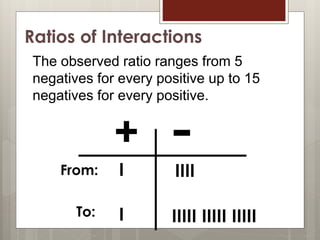
Ratios of Interactions
+ -
The observed ratio ranges from 5
negatives for every positive up to 15
negatives for every positive.
I IIII
I IIIII IIIII IIIII
From:
To:
13

Champs Module 9: Ratio of Interactions

  • 1.
  • 2.
    Ratio of Interactions Researchsuggests that teachers should plan to use a 4:1 ratio so that for every 1 corrective or attention to inappropriate behavior, the teacher provides 4 interactions in response to appropriate behavior. CHAMPS Ch. 7, Task 3, Pg. 293 DSC, Ch 8, Task 4, Pg. 266
  • 3.
    Increasing the ratioof times you interact with students when they are engaged in desirable behaviors compared to attending to undesirable behavior is one of the most essential & effective behavior management strategies teachers can implement to improve the climate & culture within the classroom. Ratio of Interactions
  • 4.
    Rating Interactions To determinewhether an interaction is considered positive or negative always ask yourself this question: “Did the child get attention while engaged in positive behavior or negative behavior?” 4
  • 5.
    Always ask yourselfthis question: Did the child get attention while engaged in positive behavior or negative behavior? Student is engaged in appropriate behavior + You acknowledge the student = Positive Interaction Student is engaged in a behavior error + You respond to the student (even if it’s in a positive manner) = Corrective Interaction
  • 6.
    Ratio of Interaction Ourstudents are very demanding of attention and will go to many lengths to get it. The form of attention may not matter…….
  • 7.
    Ratio of Interactions Example:An emotionally intense reprimand may be more rewarding than a brief, objective comment. Which is longer, more rich, and intense?  Your feedback for positive behavior or  Your corrections for negative behavior?
  • 8.
    Ratio of Interactions Thesingle most important thing that a teacher can do to improve the overall behaviors of students in their classroom is… increase the number of positive interactions they have with each student.
  • 9.
    Ratio of Interaction Thebehavior you attend to the most will be the one that you will see more of in the future.
  • 10.
    Ratio of InteractionsFormula This strategy means making the effort to interact with EVERY student more frequently (at least 4 times more) when the student is behaving responsibly than when he or she is behaving inappropriately.
  • 11.
    Ratios of Interactions Whatis your best guess as to what the research says actually occurs in the typical classroom? 11
  • 12.
    Ratios of Interactions Whenobservers have collected data in classrooms, they find that teachers interact with students much more often when students are engaged in negative behaviors. 12
  • 13.
    Ratios of Interactions +- The observed ratio ranges from 5 negatives for every positive up to 15 negatives for every positive. I IIII I IIIII IIIII IIIII From: To: 13

Editor's Notes

  • #2 Handout packet p 9
  • #3 The next 9 slides are an overview/review of the important ideas from this task in CHAMPS and DSC. This is one of the most important strategies for improving student engagement and behavior in the classroom. Even though Randy Sprick will cover these ideas in the video, it might be worthwhile for staff to hear it again. The research on ratio of interactions varies up to 12 positives for every negative interaction. Randy is at the very bottom of the range of recommendations. Randy suggests 3:1.
  • #5  Interactions are considered positive if student behavior was positive at the time of your interaction. Interactions are considered negative if student behavior was negative at the time of the interaction—regardless of your tone or what you say.
  • #6 Students receive attention and reinforcement in both instances. Interactions are considered positive if student behavior was positive at the time of your interaction. Interactions are considered negative if student behavior was negative at the time of the interaction—regardless of your tone or what you say. **important to note that corrective interactions are often necessary, but the goal is to have 4 times as many positive interactions
  • #8 Think of some examples you can share with participants, e.g., a teacher who reprimands students in the hall. That student is getting a lot of one on one time with the teacher.
  • #10 This comes from behavioral research based on Skinner’s work, and holds true in the classroom. We will look at a brief summary of research supporting this idea.
  • #11 Contingent & Non-Contingent A relatively easy way to increase positive interactions is to use non-contingent attention: greeting students at the door, commenting on non-academic or non-behavior issues, such as ask what he/she did last evening, sporting events, etc.
  • #12 Trainers: This slide is animated. When observers have collected data in classrooms, they find that teachers interact with students much more often when students are engaged in negative behaviors. The observed ratio ranges from 5 negatives for every positive up to 15 negatives for every positive.
  • #13 Trainers: This slide is animated. When observers have collected data in classrooms, they find that teachers interact with students much more often when students are engaged in negative behaviors. The observed ratio ranges from 5 negatives for every positive up to 15 negatives for every positive.