Classroom Management:
Systems & Practices
Johannes-de-la-Salle-Schule
Aschaffenburg
Erasmus+ project task
„Do Not Exclude Me“
2017 - 2019
Purpose
Review critical features &
essential practices of
behavior management in
classroom settings
Goal: Review of basics & context
for self-assessment
Classroom Management
Challenges
• Informal &
untaught
• Reactive &
ineffective
• Disconnected
from SW
• Lack of staff
fluency
• Lack of
durability
• Lack of
instructional
fluency
Why formalize classroom
management?
Arrange environment to
maximize opportunities for
–Academic achievement
–Social success
–Effective & efficient teaching
Guiding Principles
• Remember that good teaching
one of our best behavior
management tools
–Active engagement
–Positive reinforcement
• Apply three tiered prevention
logic to classroom setting
–Primary for all
–Secondary for some
–Tertiary for a few
Primary Prevention:
School-/Classroom-
Wide Systems for
All Students,
Staff, & Settings
Secondary Prevention:
Specialized Group
Systems for Students
with At-Risk Behavior
Tertiary Prevention:
Specialized
Individualized
Systems for Students
with High-Risk Behavior
~80% of Students
~15%
~5%
CONTINUUM OF
SCHOOL-WIDE
INSTRUCTIONAL &
POSITIVE BEHAVIOR
SUPPORT
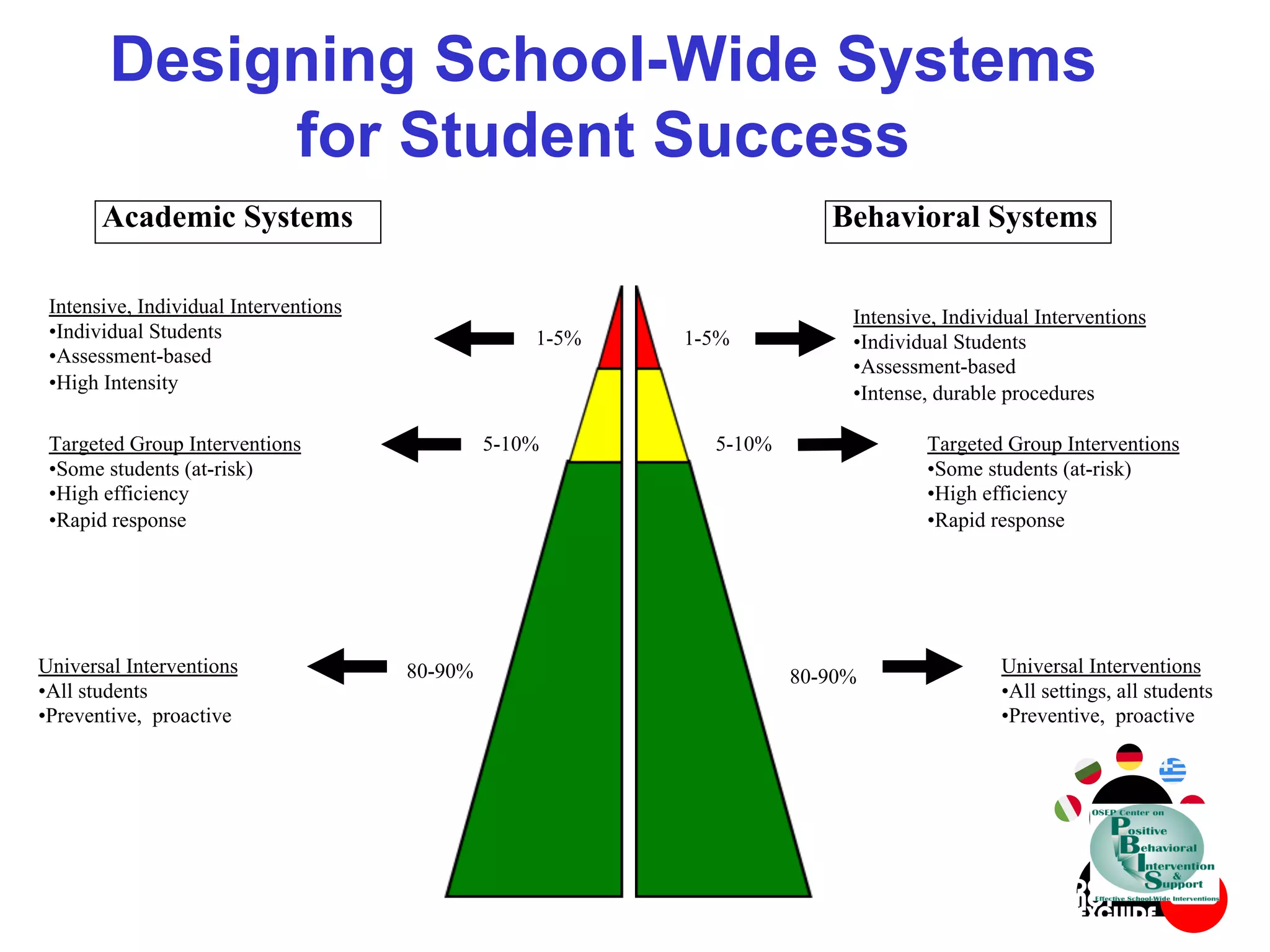
Academic Systems Behavioral Systems
1-5% 1-5%
5-10% 5-10%
80-90% 80-90%
Intensive, Individual Interventions
•Individual Students
•Assessment-based
•High Intensity
Intensive, Individual Interventions
•Individual Students
•Assessment-based
•Intense, durable procedures
Targeted Group Interventions
•Some students (at-risk)
•High efficiency
•Rapid response
Targeted Group Interventions
•Some students (at-risk)
•High efficiency
•Rapid response
Universal Interventions
•All students
•Preventive, proactive
Universal Interventions
•All settings, all students
•Preventive, proactive
Designing School-Wide Systems
for Student Success
Organizational Features
Common
Vision
Common
Language
Common
Experience
ORGANIZATION
MEMBERS
• Link classroom to school-wide
–School-wide expectations
–Classroom v. office managed rule
violations
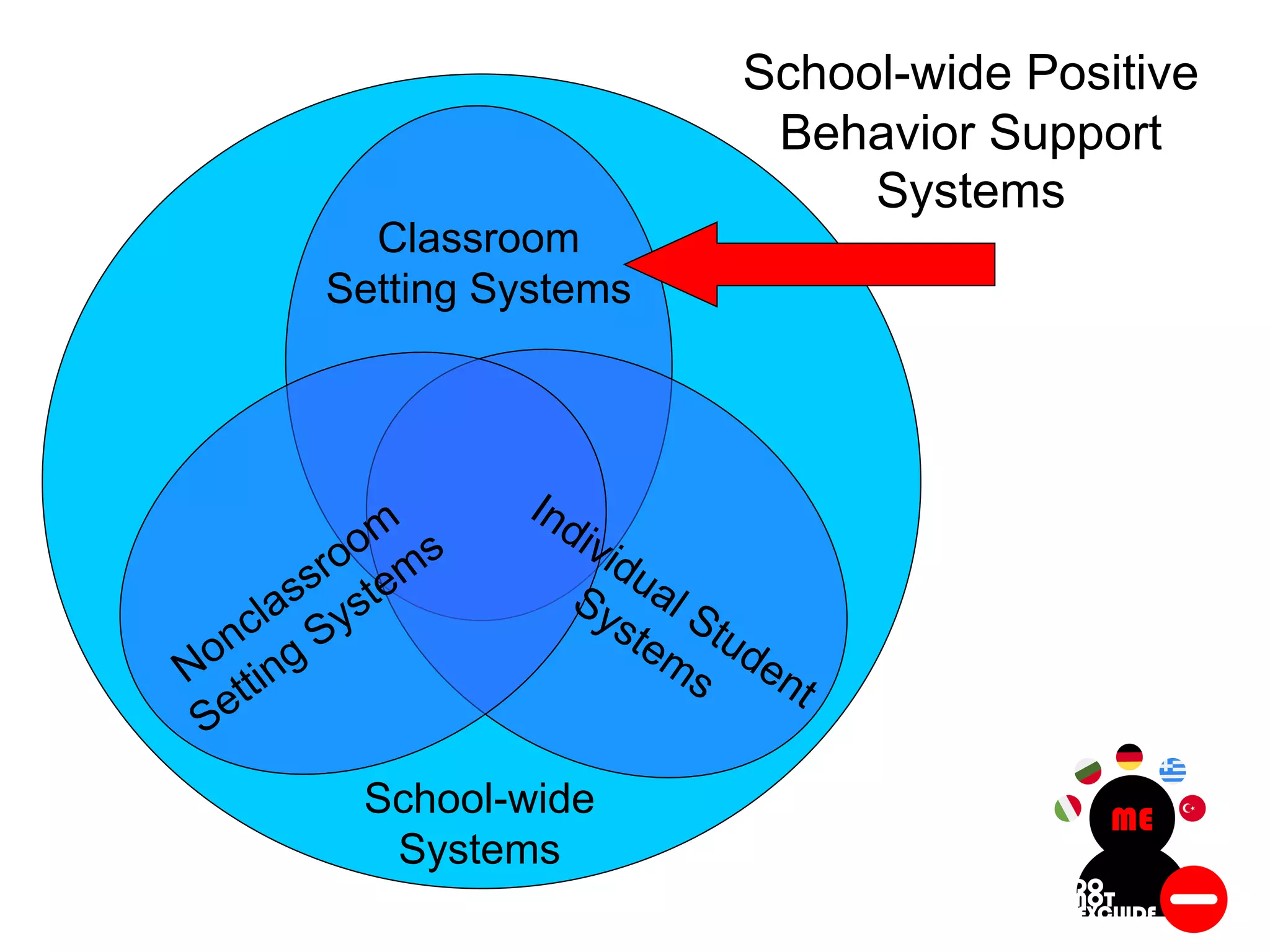
Nonclassroom
Setting
System
s
Classroom
Setting Systems
Individual Student
Systems
School-wide
Systems
School-wide Positive
Behavior Support
Systems
• Teach academic like social skills
–Tell/model/explain
–Guide practice
–Monitor & assess
–Give positive feedback
–Adjust & enhance
• Build systems to support
sustained use of effective
practices
–SW leadership team
–Regular data review
–Regular individual & school action
planning
SYSTEMS
PRACTICES
DATA
Supporting
Staff Behavior
Supporting
Decision
Making
Supporting
Student Behavior
Positive
Behavior
Support OUTCOMES
Social Competence &
Academic Achievement
Enhanced PBS
Implementation
Logic
Effective classroom
managers
• 7 minutes (pick recorder &
spokesperson)
• What do effective classroom
managers do daily?
– 2-3 formal & 2-3 informal strategies
• Report 2-3 “big ideas” from your
team discussion (1 min. reports)
Three Basic CM
Elements
1. Instructional/Curricular
Management
2. Environmental Management
3. Proactive Behavior
Management
Essential Behavior &
Classroom Management
Practices
See Classroom Management
Self-Checklist (6/17)
1. Increase ratio of positive to
negative teacher to student
interactions
1.Maintain at least 4 to 1
2.Interact positively once every 5 minutes
3.Follow correction for rule violation with
positive reinforcer for rule following
Positive
acknowledgements
1.Take 5 minutes
2.Identify 2-3 formal & 2-3 informal
strategies to positively acknowledge
student behavior in classroom
3.Report sample from your team
discussion (1 min. reports)
• Strategies, e.g.,
–Tear card
–Self-record
–Video taping
–Peer observation
–
2. Actively supervise at all times
– Move continuously
– Scan continuously & overtly
– Interact frequently & positively
– Positively reinforce rule following
behaviors
3. Positively interact with most
students during lesson
– Vary type of contact
• Physical, verbal, visual contact
– Vary by individual & group
– Mix instructional & social
interactions
4. Manage minor (low
intensity/frequency) problem
behaviors positively & quickly
3. Signal occurrence
4. State correct response
5. Ask student to restate/show
6. Disengage quickly & early
5. Follow school procedures for
chronic problem behaviors
3. Be consistent & business-like
4. Precorrect for next occurrence
5. Follow SW procedures for major
behavioral incidents
6. Develop individualized plan for
repeated incidents
6. Conduct smooth & efficient
transitions between activities
– Teach routine
– Limit to time required for student to
be ready
– Engage students immediately
7. Be prepared for activity
6. Have filler activities
7. Know desired outcome
8. Have materials
9. Shift phases of learning
6.Acquisition, fluency, maintenance, generalization
10. Practice presentation fluency
8. Begin with clear explanations
of outcome/objective
– Provide advance organizer
– Create focus or point of reference
for assessment
9. Allocate most time to
instruction
– Fill day with instructional activities
– Maximize teacher-led engagement
10.Engage students in active
responding
– Establish & expect behavioral
indicator
• Write, verbalize, manipulate materials
– Enable immediate assessment of
learning & instructional impact
11.Give each student multiple
ways to actively respond
– Vary response type
• Individual v. choral responses
• Written v. gestures
– Use peer-based assistance
12.Regularly check for student
understanding
– Vary assessment type
• Immediate v. delayed
• Individual v. group
– Review previously mastered content
– Check for existing knowledge
13.End activity with specific
feedback
– Review performance on expected
outcomes
• Scheduled activities
• Academic v. social
• Individual v. group
14.Provide specific information
about what happens next
– Describe follow-up activities
• Homework, review, new activity, choices
• Immediate v. delayed
• Following lesson
– Describe features of next lesson
15.Know how many students met
learning objective/outcome
– Administer probe
• Oral, written, gesture
– Immediately graph/display
performance
16. Provide extra time/assistance for
unsuccessful students
– Determine phase of learning
• Acquisition -> re-teach
• Fluency -> more practice
• Maintenance -> reinforcement/feedback
– Schedule time during/before next lesson
17. Plan activity for next time activity
– Consider phase of learning
• New outcome
• Reteaching
• Practice
• Maintenance/generalization
– Modify/select materials
How did I do?
14-17 “yes” = Super
10-13 “yes” = So So
<9 “yes” = Improvement needed
Non-example Action Plan Strategies
- Purchase & distribute classroom management
curriculum/book
- Discuss at faculty meeting
- Bring in CM expert for next month’s ½ day in-
service
- Observe in effective classroom
- Observe & give feedback
What is likelihood of change in teacher
practice?
Example Action Plan Strategies
+ Build on SW System
+ Use school-wide leadership team
+ Use data to justify
+ Adopt evidence based practice
+ Teach/practice to fluency/automaticity
+ Ensure accurate implementation 1st time
+ Regular review & active practice
+ Monitor implementation continuously
+ Acknowledge improvements
Classroom Management
• 15 minutes
• Review “Classroom Management
Self-Assessment” & discuss
possible practices/systems
applications
• Report 2-3 “big ideas” from your
team discussion (1 min. reports)
References
• Colvin, G., & Lazar, M. (1997). The effective elementary classroom: Managing for
success. Longmont, CO: Sopris West.
• Colvin, G., Sugai, G., & Patching, W. (1993). Pre-correction: An instructional
strategy for managing predictable behavior problems. Intervention in School and
Clinic, 28, 143-150.
• Darch, C. B., & Kameenui, E. J. (2003). Instructional classroom management: A
proactive approach to behavior management. (2nd ed.). White Plains, NY:
Longman.
• Jones, V. F. & Jones, L. S. (2001). Comprehensive classroom management:
Creating communities of support and solving problems (6th ed.). Boston: Allyn &
Bacon.
• Kameenui, E. J., & Carnine, D. W. (2002). Effective teaching strategies that
accommodate diverse learners (2nd ed.). Upper Saddle River, NJ: Merrill.
• Latham, G. I. (1997). Behind the schoolhouse door: Eight skills every teacher
should have. Utah State University.
• Latham, G. (1992). Interacting with at-risk children: The positive position.
Principal, 72(1), 26-30.
• Martella, R. C., Nelson, J. R., & Marchand-Martella, N. E. (2003). Managing
disruptive behaviors in the schools: A schoolwide, classroom, and individualized
social learning approach. Boston, MA: Allyn & Bacon.
• Paine, S. C., Radicchi, J., Rosellini, L. C., Deutchman, L., & Darch, C. B. (1983).
Structuring your classroom for academic success. Champaign, IL: Research
Press.

Generic classroom management training final (1)

  • 1.
    Classroom Management: Systems &Practices Johannes-de-la-Salle-Schule Aschaffenburg Erasmus+ project task „Do Not Exclude Me“ 2017 - 2019
  • 3.
    Purpose Review critical features& essential practices of behavior management in classroom settings Goal: Review of basics & context for self-assessment
  • 4.
    Classroom Management Challenges • Informal& untaught • Reactive & ineffective • Disconnected from SW • Lack of staff fluency • Lack of durability • Lack of instructional fluency
  • 5.
    Why formalize classroom management? Arrangeenvironment to maximize opportunities for –Academic achievement –Social success –Effective & efficient teaching
  • 6.
    Guiding Principles • Rememberthat good teaching one of our best behavior management tools –Active engagement –Positive reinforcement
  • 7.
    • Apply threetiered prevention logic to classroom setting –Primary for all –Secondary for some –Tertiary for a few
  • 8.
    Primary Prevention: School-/Classroom- Wide Systemsfor All Students, Staff, & Settings Secondary Prevention: Specialized Group Systems for Students with At-Risk Behavior Tertiary Prevention: Specialized Individualized Systems for Students with High-Risk Behavior ~80% of Students ~15% ~5% CONTINUUM OF SCHOOL-WIDE INSTRUCTIONAL & POSITIVE BEHAVIOR SUPPORT
  • 9.
    Academic Systems BehavioralSystems 1-5% 1-5% 5-10% 5-10% 80-90% 80-90% Intensive, Individual Interventions •Individual Students •Assessment-based •High Intensity Intensive, Individual Interventions •Individual Students •Assessment-based •Intense, durable procedures Targeted Group Interventions •Some students (at-risk) •High efficiency •Rapid response Targeted Group Interventions •Some students (at-risk) •High efficiency •Rapid response Universal Interventions •All students •Preventive, proactive Universal Interventions •All settings, all students •Preventive, proactive Designing School-Wide Systems for Student Success
  • 10.
  • 11.
    • Link classroomto school-wide –School-wide expectations –Classroom v. office managed rule violations
  • 12.
  • 13.
    • Teach academiclike social skills –Tell/model/explain –Guide practice –Monitor & assess –Give positive feedback –Adjust & enhance
  • 14.
    • Build systemsto support sustained use of effective practices –SW leadership team –Regular data review –Regular individual & school action planning
  • 15.
  • 16.
  • 17.
    Effective classroom managers • 7minutes (pick recorder & spokesperson) • What do effective classroom managers do daily? – 2-3 formal & 2-3 informal strategies • Report 2-3 “big ideas” from your team discussion (1 min. reports)
  • 18.
    Three Basic CM Elements 1.Instructional/Curricular Management 2. Environmental Management 3. Proactive Behavior Management
  • 19.
    Essential Behavior & ClassroomManagement Practices See Classroom Management Self-Checklist (6/17)
  • 20.
    1. Increase ratioof positive to negative teacher to student interactions 1.Maintain at least 4 to 1 2.Interact positively once every 5 minutes 3.Follow correction for rule violation with positive reinforcer for rule following
  • 21.
    Positive acknowledgements 1.Take 5 minutes 2.Identify2-3 formal & 2-3 informal strategies to positively acknowledge student behavior in classroom 3.Report sample from your team discussion (1 min. reports)
  • 22.
    • Strategies, e.g., –Tearcard –Self-record –Video taping –Peer observation –
  • 23.
    2. Actively superviseat all times – Move continuously – Scan continuously & overtly – Interact frequently & positively – Positively reinforce rule following behaviors
  • 24.
    3. Positively interactwith most students during lesson – Vary type of contact • Physical, verbal, visual contact – Vary by individual & group – Mix instructional & social interactions
  • 25.
    4. Manage minor(low intensity/frequency) problem behaviors positively & quickly 3. Signal occurrence 4. State correct response 5. Ask student to restate/show 6. Disengage quickly & early
  • 26.
    5. Follow schoolprocedures for chronic problem behaviors 3. Be consistent & business-like 4. Precorrect for next occurrence 5. Follow SW procedures for major behavioral incidents 6. Develop individualized plan for repeated incidents
  • 27.
    6. Conduct smooth& efficient transitions between activities – Teach routine – Limit to time required for student to be ready – Engage students immediately
  • 28.
    7. Be preparedfor activity 6. Have filler activities 7. Know desired outcome 8. Have materials 9. Shift phases of learning 6.Acquisition, fluency, maintenance, generalization 10. Practice presentation fluency
  • 29.
    8. Begin withclear explanations of outcome/objective – Provide advance organizer – Create focus or point of reference for assessment
  • 30.
    9. Allocate mosttime to instruction – Fill day with instructional activities – Maximize teacher-led engagement
  • 31.
    10.Engage students inactive responding – Establish & expect behavioral indicator • Write, verbalize, manipulate materials – Enable immediate assessment of learning & instructional impact
  • 32.
    11.Give each studentmultiple ways to actively respond – Vary response type • Individual v. choral responses • Written v. gestures – Use peer-based assistance
  • 33.
    12.Regularly check forstudent understanding – Vary assessment type • Immediate v. delayed • Individual v. group – Review previously mastered content – Check for existing knowledge
  • 34.
    13.End activity withspecific feedback – Review performance on expected outcomes • Scheduled activities • Academic v. social • Individual v. group
  • 35.
    14.Provide specific information aboutwhat happens next – Describe follow-up activities • Homework, review, new activity, choices • Immediate v. delayed • Following lesson – Describe features of next lesson
  • 36.
    15.Know how manystudents met learning objective/outcome – Administer probe • Oral, written, gesture – Immediately graph/display performance
  • 37.
    16. Provide extratime/assistance for unsuccessful students – Determine phase of learning • Acquisition -> re-teach • Fluency -> more practice • Maintenance -> reinforcement/feedback – Schedule time during/before next lesson
  • 38.
    17. Plan activityfor next time activity – Consider phase of learning • New outcome • Reteaching • Practice • Maintenance/generalization – Modify/select materials
  • 39.
    How did Ido? 14-17 “yes” = Super 10-13 “yes” = So So <9 “yes” = Improvement needed
  • 40.
    Non-example Action PlanStrategies - Purchase & distribute classroom management curriculum/book - Discuss at faculty meeting - Bring in CM expert for next month’s ½ day in- service - Observe in effective classroom - Observe & give feedback What is likelihood of change in teacher practice?
  • 41.
    Example Action PlanStrategies + Build on SW System + Use school-wide leadership team + Use data to justify + Adopt evidence based practice + Teach/practice to fluency/automaticity + Ensure accurate implementation 1st time + Regular review & active practice + Monitor implementation continuously + Acknowledge improvements
  • 42.
    Classroom Management • 15minutes • Review “Classroom Management Self-Assessment” & discuss possible practices/systems applications • Report 2-3 “big ideas” from your team discussion (1 min. reports)
  • 43.
    References • Colvin, G.,& Lazar, M. (1997). The effective elementary classroom: Managing for success. Longmont, CO: Sopris West. • Colvin, G., Sugai, G., & Patching, W. (1993). Pre-correction: An instructional strategy for managing predictable behavior problems. Intervention in School and Clinic, 28, 143-150. • Darch, C. B., & Kameenui, E. J. (2003). Instructional classroom management: A proactive approach to behavior management. (2nd ed.). White Plains, NY: Longman. • Jones, V. F. & Jones, L. S. (2001). Comprehensive classroom management: Creating communities of support and solving problems (6th ed.). Boston: Allyn & Bacon. • Kameenui, E. J., & Carnine, D. W. (2002). Effective teaching strategies that accommodate diverse learners (2nd ed.). Upper Saddle River, NJ: Merrill. • Latham, G. I. (1997). Behind the schoolhouse door: Eight skills every teacher should have. Utah State University. • Latham, G. (1992). Interacting with at-risk children: The positive position. Principal, 72(1), 26-30. • Martella, R. C., Nelson, J. R., & Marchand-Martella, N. E. (2003). Managing disruptive behaviors in the schools: A schoolwide, classroom, and individualized social learning approach. Boston, MA: Allyn & Bacon. • Paine, S. C., Radicchi, J., Rosellini, L. C., Deutchman, L., & Darch, C. B. (1983). Structuring your classroom for academic success. Champaign, IL: Research Press.