Chapter 5
Writing
Business Messages
Chapter 5 - 1
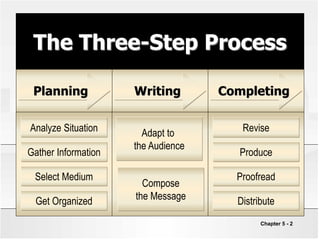
Chapter 5 - 2
The Three-Step Process
Analyze Situation
Gather Information
Select Medium
Get Organized
Revise
Produce
Proofread
Distribute
Adapt to
the Audience
Compose
the Message
Planning Completing
Writing
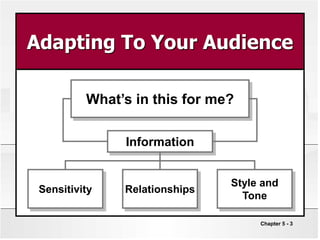
Chapter 5 - 3
Adapting To Your Audience
What’s in this for me?
Style and
Tone
Relationships
Sensitivity
Information
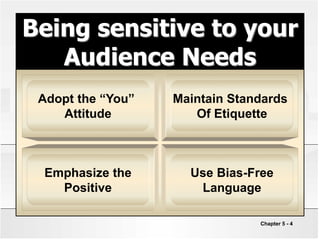
Chapter 5 - 4
Being sensitive to your
Audience Needs
Use Bias-Free
Language
Emphasize the
Positive
Maintain Standards
Of Etiquette
Adopt the “You”
Attitude
Chapter 5 - 5
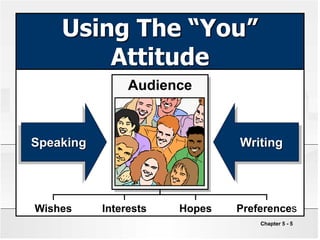
Using The “You”
Attitude
Preferences
Hopes
Interests
Wishes
Speaking Writing
Audience
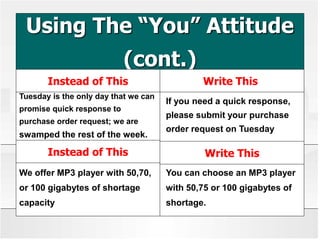
Using The “You” Attitude
(cont.)
Instead of This Write This
Tuesday is the only day that we can
promise quick response to
purchase order request; we are
swamped the rest of the week.
If you need a quick response,
please submit your purchase
order request on Tuesday
We offer MP3 player with 50,70,
or 100 gigabytes of shortage
capacity
You can choose an MP3 player
with 50,75 or 100 gigabytes of
shortage.
Instead of This Write This
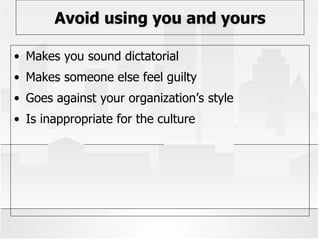
Avoid using you and yours
• Makes you sound dictatorial
• Makes someone else feel guilty
• Goes against your organization’s style
• Is inappropriate for the culture
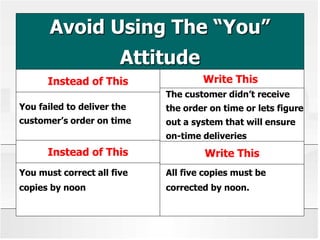
Avoid Using The “You”
Attitude
Instead of This Write This
You failed to deliver the
customer’s order on time
The customer didn’t receive
the order on time or lets figure
out a system that will ensure
on-time deliveries
You must correct all five
copies by noon
All five copies must be
corrected by noon.
Instead of This Write This
Chapter 5 - 9
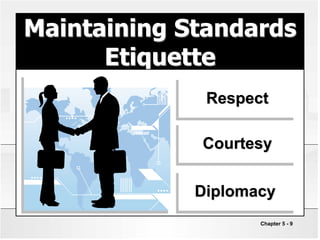
Maintaining Standards
Etiquette
Courtesy
Respect
Diplomacy
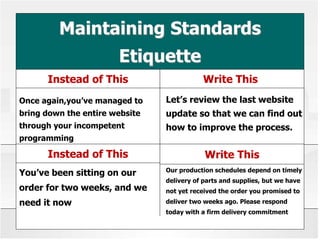
Maintaining Standards
Etiquette
Instead of This Write This
Once again,you’ve managed to
bring down the entire website
through your incompetent
programming
Let’s review the last website
update so that we can find out
how to improve the process.
You’ve been sitting on our
order for two weeks, and we
need it now
Our production schedules depend on timely
delivery of parts and supplies, but we have
not yet received the order you promised to
deliver two weeks ago. Please respond
today with a firm delivery commitment
Instead of This Write This
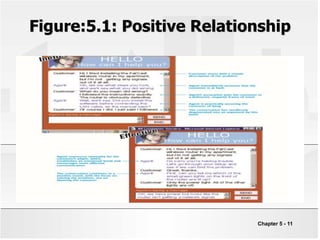
Figure:5.1: Positive Relationship
Chapter 5 - 11
Chapter 5 - 12
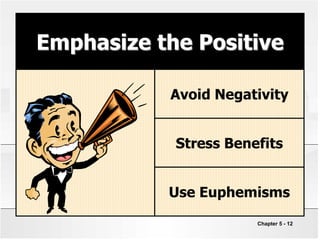
Emphasize the Positive
Avoid Negativity
Stress Benefits
Use Euphemisms
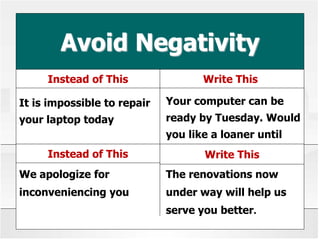
Avoid Negativity
Instead of This Write This
It is impossible to repair
your laptop today
Your computer can be
ready by Tuesday. Would
you like a loaner until
then?
We apologize for
inconveniencing you
The renovations now
under way will help us
serve you better.
Instead of This Write This
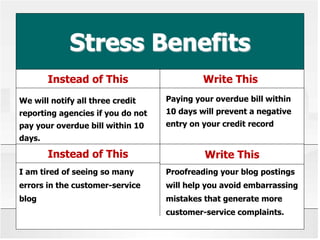
Stress Benefits
Instead of This Write This
We will notify all three credit
reporting agencies if you do not
pay your overdue bill within 10
days.
Paying your overdue bill within
10 days will prevent a negative
entry on your credit record
I am tired of seeing so many
errors in the customer-service
blog
Proofreading your blog postings
will help you avoid embarrassing
mistakes that generate more
customer-service complaints.
Instead of This Write This
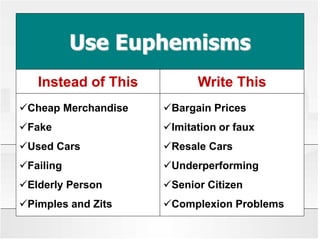
Use Euphemisms
Instead of This Write This
Cheap Merchandise
Fake
Used Cars
Failing
Elderly Person
Pimples and Zits
Bargain Prices
Imitation or faux
Resale Cars
Underperforming
Senior Citizen
Complexion Problems
Chapter
4
-
16
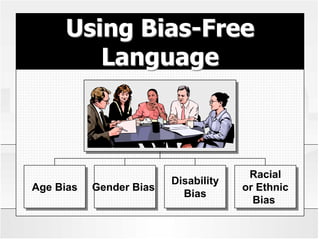
Using Bias-Free
Language
Age Bias Gender Bias
Disability
Bias
Racial
or Ethnic
Bias
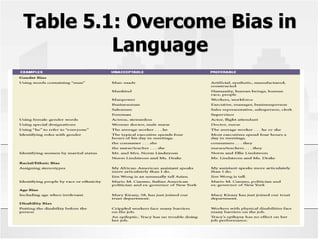
Table 5.1: Overcome Bias in
Language
Chapter 5 - 17
Chapter 5 - 18
Building Strong Relationships
with your Audience
Establish
Your Credibility
Project the
Company’s Image
Chapter 5 - 19
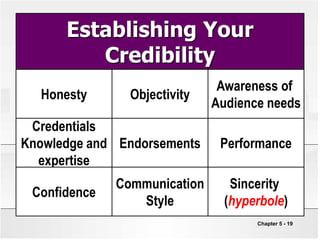
Establishing Your
Credibility
Honesty Objectivity
Awareness of
Audience needs
Credentials
Knowledge and
expertise
Endorsements Performance
Confidence
Communication
Style
Sincerity
(hyperbole)
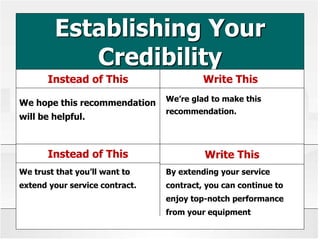
Establishing Your
Credibility
Instead of This Write This
We hope this recommendation
will be helpful.
We’re glad to make this
recommendation.
We trust that you’ll want to
extend your service contract.
By extending your service
contract, you can continue to
enjoy top-notch performance
from your equipment
Instead of This Write This
Chapter 5 - 21
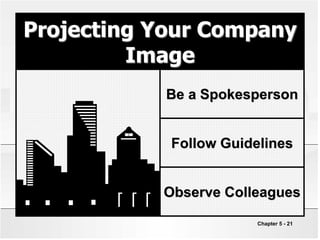
Projecting Your Company
Image
Be a Spokesperson
Follow Guidelines
Observe Colleagues
Chapter 5 - 22
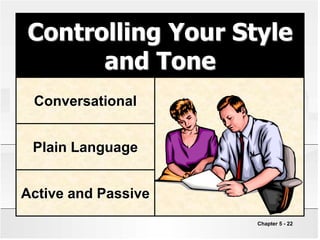
Controlling Your Style
and Tone
Conversational
Plain Language
Active and Passive
Chapter 5 - 23
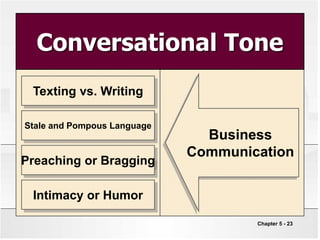
Business
Communication
Texting vs. Writing
Stale and Pompous Language
Preaching or Bragging
Intimacy or Humor
Conversational Tone
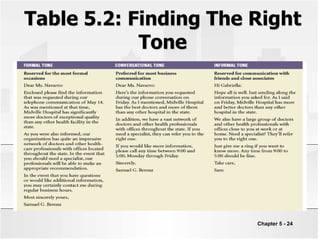
Table 5.2: Finding The Right
Tone
Chapter 5 - 24
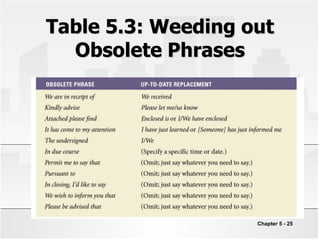
Table 5.3: Weeding out
Obsolete Phrases
Chapter 5 - 25
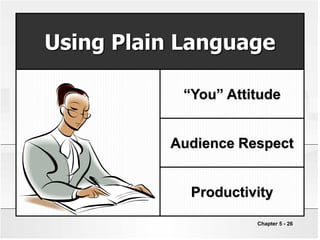
Chapter 5 - 26
Using Plain Language
“You” Attitude
Audience Respect
Productivity
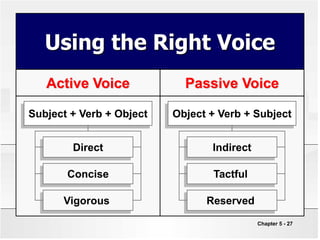
Chapter 5 - 27
Using the Right Voice
Active Voice Passive Voice
Vigorous
Concise
Direct
Subject + Verb + Object
Reserved
Tactful
Indirect
Object + Verb + Subject
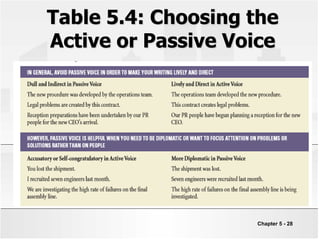
Table 5.4: Choosing the
Active or Passive Voice
Chapter 5 - 28
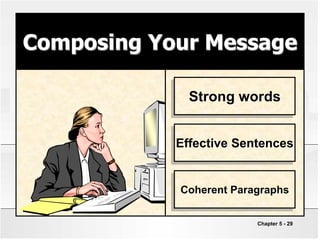
Chapter 5 - 29
Composing Your Message
Strong words
Effective Sentences
Coherent Paragraphs
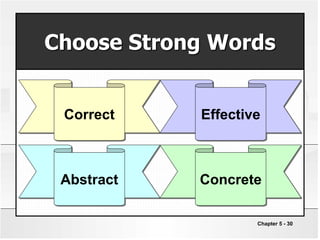
Chapter 5 - 30
Choose Strong Words
Correct
Abstract
Effective
Concrete
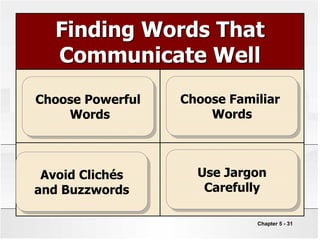
Chapter 5 - 31
Choose Powerful
Words
Choose Familiar
Words
Avoid Clichés
and Buzzwords
Use Jargon
Carefully
Finding Words That
Communicate Well
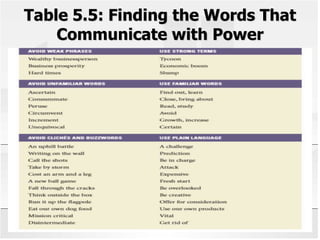
Table 5.5: Finding the Words That
Communicate with Power
Chapter 5 - 32
Chapter 5 - 33
Creating Effective
Sentences
Choose the
Type of Sentence
Emphasize
Key Thoughts
Choosing From The Four Types of
Sentences
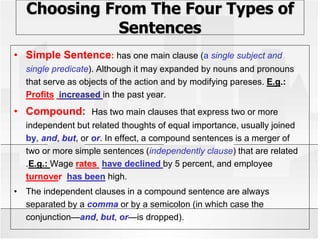
• Simple Sentence: has one main clause (a single subject and
single predicate). Although it may expanded by nouns and pronouns
that serve as objects of the action and by modifying pareses. E.g.:
Profits increased in the past year.
• Compound: Has two main clauses that express two or more
independent but related thoughts of equal importance, usually joined
by, and, but, or or. In effect, a compound sentences is a merger of
two or more simple sentences (independently clause) that are related
.E.g.: Wage rates have declined by 5 percent, and employee
turnover has been high.
• The independent clauses in a compound sentence are always
separated by a comma or by a semicolon (in which case the
conjunction—and, but, or—is dropped).
Choosing From The Four Types of
Sentences (cont.)
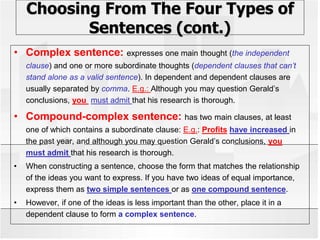
• Complex sentence: expresses one main thought (the independent
clause) and one or more subordinate thoughts (dependent clauses that can’t
stand alone as a valid sentence). In dependent and dependent clauses are
usually separated by comma. E.g.: Although you may question Gerald’s
conclusions, you must admit that his research is thorough.
• Compound-complex sentence: has two main clauses, at least
one of which contains a subordinate clause: E.g.: Profits have increased in
the past year, and although you may question Gerald’s conclusions, you
must admit that his research is thorough.
• When constructing a sentence, choose the form that matches the relationship
of the ideas you want to express. If you have two ideas of equal importance,
express them as two simple sentences or as one compound sentence.
• However, if one of the ideas is less important than the other, place it in a
dependent clause to form a complex sentence.
Choosing From The Four
Types of Sentences (cont.)
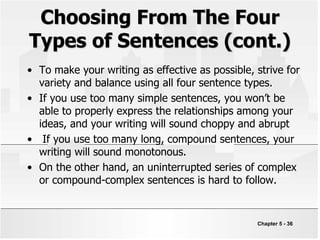
• To make your writing as effective as possible, strive for
variety and balance using all four sentence types.
• If you use too many simple sentences, you won’t be
able to properly express the relationships among your
ideas, and your writing will sound choppy and abrupt
• If you use too many long, compound sentences, your
writing will sound monotonous.
• On the other hand, an uninterrupted series of complex
or compound-complex sentences is hard to follow.
Chapter 5 - 36
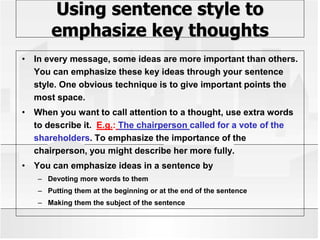
Using sentence style to
emphasize key thoughts
• In every message, some ideas are more important than others.
You can emphasize these key ideas through your sentence
style. One obvious technique is to give important points the
most space.
• When you want to call attention to a thought, use extra words
to describe it. E.g.: The chairperson called for a vote of the
shareholders. To emphasize the importance of the
chairperson, you might describe her more fully.
• You can emphasize ideas in a sentence by
– Devoting more words to them
– Putting them at the beginning or at the end of the sentence
– Making them the subject of the sentence
Chapter 5 - 38
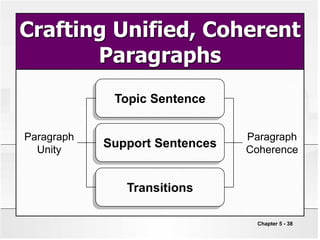
Crafting Unified, Coherent
Paragraphs
Transitions
Support Sentences
Topic Sentence
Paragraph
Unity
Paragraph
Coherence
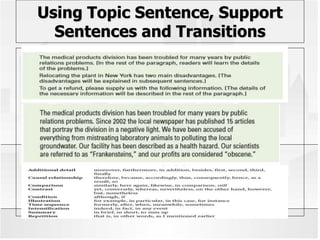
Using Topic Sentence, Support
Sentences and Transitions
Chapter 5 - 40
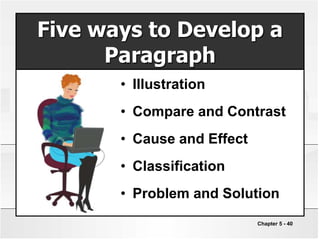
• Illustration
• Compare and Contrast
• Cause and Effect
• Classification
• Problem and Solution
Five ways to Develop a
Paragraph
Chapter 5 - 41
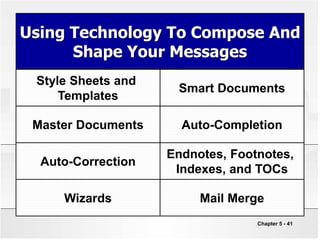
Using Technology To Compose And
Shape Your Messages
Style Sheets and
Templates
Smart Documents
Master Documents Auto-Completion
Auto-Correction
Endnotes, Footnotes,
Indexes, and TOCs
Wizards Mail Merge
Thanks
Q&A

CH5-Writing Business Messages-BCI 2.pptx

  • 1.
  • 2.
    Chapter 5 -2 The Three-Step Process Analyze Situation Gather Information Select Medium Get Organized Revise Produce Proofread Distribute Adapt to the Audience Compose the Message Planning Completing Writing
  • 3.
    Chapter 5 -3 Adapting To Your Audience What’s in this for me? Style and Tone Relationships Sensitivity Information
  • 4.
    Chapter 5 -4 Being sensitive to your Audience Needs Use Bias-Free Language Emphasize the Positive Maintain Standards Of Etiquette Adopt the “You” Attitude
  • 5.
    Chapter 5 -5 Using The “You” Attitude Preferences Hopes Interests Wishes Speaking Writing Audience
  • 6.
    Using The “You”Attitude (cont.) Instead of This Write This Tuesday is the only day that we can promise quick response to purchase order request; we are swamped the rest of the week. If you need a quick response, please submit your purchase order request on Tuesday We offer MP3 player with 50,70, or 100 gigabytes of shortage capacity You can choose an MP3 player with 50,75 or 100 gigabytes of shortage. Instead of This Write This
  • 7.
    Avoid using youand yours • Makes you sound dictatorial • Makes someone else feel guilty • Goes against your organization’s style • Is inappropriate for the culture
  • 8.
    Avoid Using The“You” Attitude Instead of This Write This You failed to deliver the customer’s order on time The customer didn’t receive the order on time or lets figure out a system that will ensure on-time deliveries You must correct all five copies by noon All five copies must be corrected by noon. Instead of This Write This
  • 9.
    Chapter 5 -9 Maintaining Standards Etiquette Courtesy Respect Diplomacy
  • 10.
    Maintaining Standards Etiquette Instead ofThis Write This Once again,you’ve managed to bring down the entire website through your incompetent programming Let’s review the last website update so that we can find out how to improve the process. You’ve been sitting on our order for two weeks, and we need it now Our production schedules depend on timely delivery of parts and supplies, but we have not yet received the order you promised to deliver two weeks ago. Please respond today with a firm delivery commitment Instead of This Write This
  • 11.
  • 12.
    Chapter 5 -12 Emphasize the Positive Avoid Negativity Stress Benefits Use Euphemisms
  • 13.
    Avoid Negativity Instead ofThis Write This It is impossible to repair your laptop today Your computer can be ready by Tuesday. Would you like a loaner until then? We apologize for inconveniencing you The renovations now under way will help us serve you better. Instead of This Write This
  • 14.
    Stress Benefits Instead ofThis Write This We will notify all three credit reporting agencies if you do not pay your overdue bill within 10 days. Paying your overdue bill within 10 days will prevent a negative entry on your credit record I am tired of seeing so many errors in the customer-service blog Proofreading your blog postings will help you avoid embarrassing mistakes that generate more customer-service complaints. Instead of This Write This
  • 15.
    Use Euphemisms Instead ofThis Write This Cheap Merchandise Fake Used Cars Failing Elderly Person Pimples and Zits Bargain Prices Imitation or faux Resale Cars Underperforming Senior Citizen Complexion Problems
  • 16.
    Chapter 4 - 16 Using Bias-Free Language Age BiasGender Bias Disability Bias Racial or Ethnic Bias
  • 17.
    Table 5.1: OvercomeBias in Language Chapter 5 - 17
  • 18.
    Chapter 5 -18 Building Strong Relationships with your Audience Establish Your Credibility Project the Company’s Image
  • 19.
    Chapter 5 -19 Establishing Your Credibility Honesty Objectivity Awareness of Audience needs Credentials Knowledge and expertise Endorsements Performance Confidence Communication Style Sincerity (hyperbole)
  • 20.
    Establishing Your Credibility Instead ofThis Write This We hope this recommendation will be helpful. We’re glad to make this recommendation. We trust that you’ll want to extend your service contract. By extending your service contract, you can continue to enjoy top-notch performance from your equipment Instead of This Write This
  • 21.
    Chapter 5 -21 Projecting Your Company Image Be a Spokesperson Follow Guidelines Observe Colleagues
  • 22.
    Chapter 5 -22 Controlling Your Style and Tone Conversational Plain Language Active and Passive
  • 23.
    Chapter 5 -23 Business Communication Texting vs. Writing Stale and Pompous Language Preaching or Bragging Intimacy or Humor Conversational Tone
  • 24.
    Table 5.2: FindingThe Right Tone Chapter 5 - 24
  • 25.
    Table 5.3: Weedingout Obsolete Phrases Chapter 5 - 25
  • 26.
    Chapter 5 -26 Using Plain Language “You” Attitude Audience Respect Productivity
  • 27.
    Chapter 5 -27 Using the Right Voice Active Voice Passive Voice Vigorous Concise Direct Subject + Verb + Object Reserved Tactful Indirect Object + Verb + Subject
  • 28.
    Table 5.4: Choosingthe Active or Passive Voice Chapter 5 - 28
  • 29.
    Chapter 5 -29 Composing Your Message Strong words Effective Sentences Coherent Paragraphs
  • 30.
    Chapter 5 -30 Choose Strong Words Correct Abstract Effective Concrete
  • 31.
    Chapter 5 -31 Choose Powerful Words Choose Familiar Words Avoid Clichés and Buzzwords Use Jargon Carefully Finding Words That Communicate Well
  • 32.
    Table 5.5: Findingthe Words That Communicate with Power Chapter 5 - 32
  • 33.
    Chapter 5 -33 Creating Effective Sentences Choose the Type of Sentence Emphasize Key Thoughts
  • 34.
    Choosing From TheFour Types of Sentences • Simple Sentence: has one main clause (a single subject and single predicate). Although it may expanded by nouns and pronouns that serve as objects of the action and by modifying pareses. E.g.: Profits increased in the past year. • Compound: Has two main clauses that express two or more independent but related thoughts of equal importance, usually joined by, and, but, or or. In effect, a compound sentences is a merger of two or more simple sentences (independently clause) that are related .E.g.: Wage rates have declined by 5 percent, and employee turnover has been high. • The independent clauses in a compound sentence are always separated by a comma or by a semicolon (in which case the conjunction—and, but, or—is dropped).
  • 35.
    Choosing From TheFour Types of Sentences (cont.) • Complex sentence: expresses one main thought (the independent clause) and one or more subordinate thoughts (dependent clauses that can’t stand alone as a valid sentence). In dependent and dependent clauses are usually separated by comma. E.g.: Although you may question Gerald’s conclusions, you must admit that his research is thorough. • Compound-complex sentence: has two main clauses, at least one of which contains a subordinate clause: E.g.: Profits have increased in the past year, and although you may question Gerald’s conclusions, you must admit that his research is thorough. • When constructing a sentence, choose the form that matches the relationship of the ideas you want to express. If you have two ideas of equal importance, express them as two simple sentences or as one compound sentence. • However, if one of the ideas is less important than the other, place it in a dependent clause to form a complex sentence.
  • 36.
    Choosing From TheFour Types of Sentences (cont.) • To make your writing as effective as possible, strive for variety and balance using all four sentence types. • If you use too many simple sentences, you won’t be able to properly express the relationships among your ideas, and your writing will sound choppy and abrupt • If you use too many long, compound sentences, your writing will sound monotonous. • On the other hand, an uninterrupted series of complex or compound-complex sentences is hard to follow. Chapter 5 - 36
  • 37.
    Using sentence styleto emphasize key thoughts • In every message, some ideas are more important than others. You can emphasize these key ideas through your sentence style. One obvious technique is to give important points the most space. • When you want to call attention to a thought, use extra words to describe it. E.g.: The chairperson called for a vote of the shareholders. To emphasize the importance of the chairperson, you might describe her more fully. • You can emphasize ideas in a sentence by – Devoting more words to them – Putting them at the beginning or at the end of the sentence – Making them the subject of the sentence
  • 38.
    Chapter 5 -38 Crafting Unified, Coherent Paragraphs Transitions Support Sentences Topic Sentence Paragraph Unity Paragraph Coherence
  • 39.
    Using Topic Sentence,Support Sentences and Transitions
  • 40.
    Chapter 5 -40 • Illustration • Compare and Contrast • Cause and Effect • Classification • Problem and Solution Five ways to Develop a Paragraph
  • 41.
    Chapter 5 -41 Using Technology To Compose And Shape Your Messages Style Sheets and Templates Smart Documents Master Documents Auto-Completion Auto-Correction Endnotes, Footnotes, Indexes, and TOCs Wizards Mail Merge
  • 42.