QUANTITATIVE RESEARCH
APPROACH
Surely We have created
everything according to a
precise measure.” Quran,
Chapter: 54, Verse: 49
1.Use of Theories
2. Research Questions
3. Strategies (Design Categories)
4. Data Collection Methods
5. Data Analysis Methods
. Use of Theories
Theories are hypotheses which specify or
explain the relationship among variables
Variable: Attribute of an individual/thing
that can be measured or observed and
that varies among the people/things
being studied
Theory: A bridge between independent
(cause or predictor) and dependent
(outcome or effect) variables.
Types of Variables
Independent: cause or predictor variable
Dependent: outcome or effect variable
Mediating (intervening): Stand between the
independent and dependent variables
Example:
Does the case-based method (variable
type?) enhance student learning of social
work (variable type?) by increasing student
motivation (variable type?)?
Moderating: Independent variables that
affect the direction and/or the strength of
the relationship between independent and
dependent variables
Example:
Does age times critical thinking score
(variable type?) impact student
achievement in the Research
Methodology course (variable type?) ?
Control: Type of independent
variables that potentially influence
the dependent variable (often
demographic or personal variables)
Example:
Student’s prior years of schooling
before admission (variable type?)
affect success in the foundation
program (variable type?)
Quantitative research designs typically
begin with a theory, and work to disprove
or support it
The researcher:
1. Selects a theory
2. Defines and operationalizes variables
derived from the theory
3. Measures or observes variables using
instruments with verified validity and
reliability
Theories can be micro/meso/macro level
Research Questions
Three approaches to Research Questions:
1. Describe responses to the independent,
mediating, or dependent variables
(descriptive study)
What is the frequency and variation of
scores on grades for the SW students in
the study?
How do the CE students rate on critical
thinking skills?
2. Relate one or more
independent variables to one or
more dependent variables (a
survey that correlates variables)
How does critical thinking ability relate to
student achievement? (An inferential question);
(type of variables?)
How does self-esteem influence the formation of
friendships among adolescents? (type of
variables?)
Compare groups on an
independent variable to see its
impact on a dependent variable
(experiment )
Is the case-based method of instruction more
effective than the lecture-discussion in terms of
enhancing students’ overall multicultural social
work competence? (types of questions?)
. Research Strategies
4. Research Strategies
A carefully constructed plan
of action that is rationally
designed and likely to offer the
best prospects of success
1. Surveys
Definition: The collection of
information from a sample of
individuals through their responses
to questions
Types of surveys
 Surveys differ in terms of the technology they
use:
Face to face: more expensive, immediate
validation, better response rate
Telephone: less costly, less time-consuming
Internet: emails, web-based, on-line groups
Social media: less costly, quick response
Selection of survey type:
Choice of type of survey is based on:
Study objectives, geographical area, methods
of data collection, the speed of responses, the
response rate, the need for face to face
contact, the need for indirect contact, the
validity of answers
2. Experiments
Five conditions for use of experiments:
1. The research is explanatory
2. Well-established knowledge about the topic
exists
3. Formation of hypothesis is possible
4. Measurements produce quantitative data
5. Controlling factors studied is possible
Components of experiments:
1. Participants:
Specify the number/amount
Describe selection and assignment processes
Is there random assignment (true
experiments)?
2. Variables:
Independent: The treatment, controls,
mediating
Dependent: The outcome
. Materials and Instruments:
 Materials: Used for the treatment; characteristics?
Instruments: To measure pretest & post-test
4. Procedures:
Type of experiment used: pre-experiment,
quasi-experiment, true experiment
Illustrate the experimental design:
figure, diagram, etc
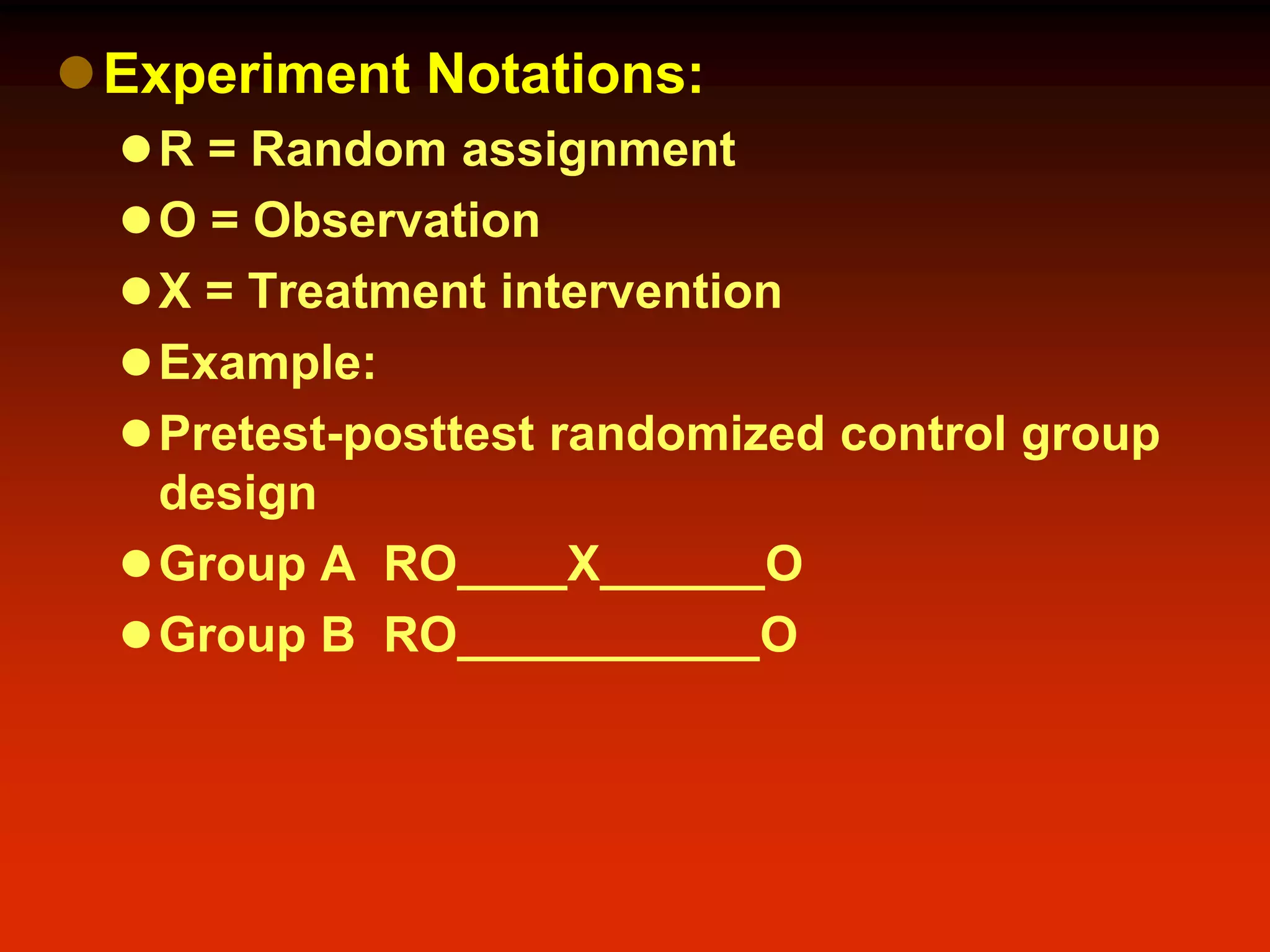
Experiment Notations:
R = Random assignment
O = Observation
X = Treatment intervention
Example:
Pretest-posttest randomized control group
design
Group A RO____X______O
Group B RO___________O
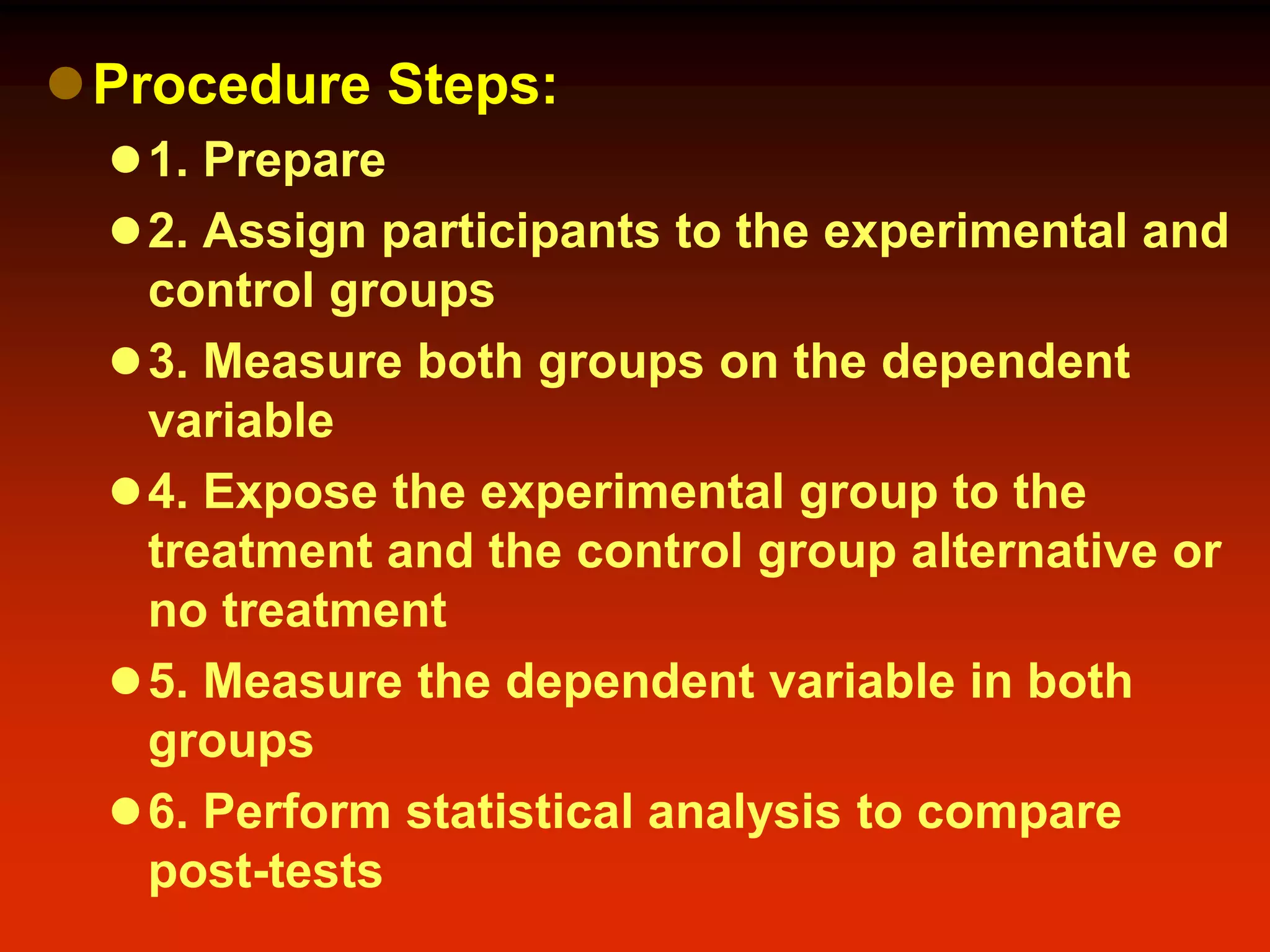
Procedure Steps:
1. Prepare
2. Assign participants to the experimental and
control groups
3. Measure both groups on the dependent
variable
4. Expose the experimental group to the
treatment and the control group alternative or
no treatment
5. Measure the dependent variable in both
groups
6. Perform statistical analysis to compare
post-tests
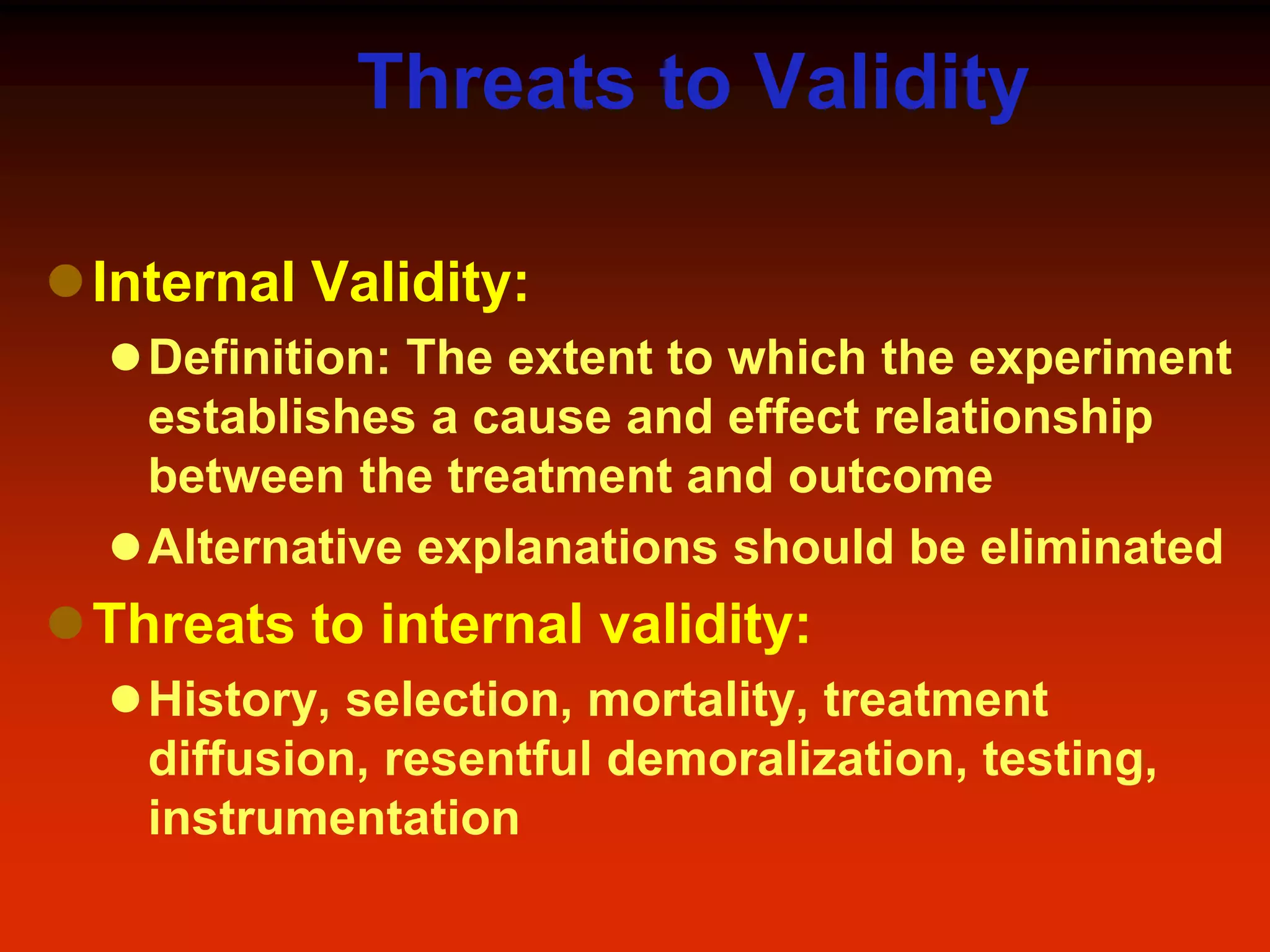
Threats to Validity
Internal Validity:
Definition: The extent to which the experiment
establishes a cause and effect relationship
between the treatment and outcome
Alternative explanations should be eliminated
Threats to internal validity:
History, selection, mortality, treatment
diffusion, resentful demoralization, testing,
instrumentation
External Validity:
Definition: The validity of applying
experiment findings outside of the
context of that study
Threats to external validity:
Pre and posttest: Do tests influence the
outcome?
Sample features: Do some sample features
affect outcome?
Selection bias: Do differences b/w groups
affect?
Situational factors: time, location, lighting,
etc.
. Data Collection Methods
How to collect, analyze, and interpret
data:
Data collection methods are the
equivalent of a microscope or a
thermometer:
Instruments (Natural Sciences)
Questionnaire
Structured Observation
Interviews
Documents
1. Questionnaires
 Questionnaires meet the following Criteria:
 Collect information that can be used as data for
analysis
 Consist of a written list of questions
 Collect information by asking people directly
 Success of questionnaires depends on:
 Response rate
 Completion rate
 Validity of responses (honesty and accuracy)
 Questionnaires meet the following Criteria:
 Collect information that can be used as data for
analysis
 Consist of a written list of questions
 Collect information by asking people directly
 Success of questionnaires depends on:
 Response rate
 Completion rate
 Validity of responses (honesty and accuracy)
For better Questionnaires take into account:
 Capabilities of respondents
 Respondent motivation
 Sensitivity of the topic
 Questionnaire deign
Observations
Systematic Observations:
A method that introduces a system to the
process of observation
It uses observation schedule to produce data
that are consistent between observers
Observation Schedule:
It contains items (e.g. checklist) that all
observers must use
It specifies what to be observed and how
Systematic Observations:
Data based on the counts, amounts, and
frequencies of the observed are collected
Frequency and duration of events are
recorded
Observer effect:
To minimize disruption:
1. Unobtrusive position;
2. Avoid interaction
THANK YOU

statistics 02.ppt

  • 2.
    QUANTITATIVE RESEARCH APPROACH Surely Wehave created everything according to a precise measure.” Quran, Chapter: 54, Verse: 49
  • 3.
    1.Use of Theories 2.Research Questions 3. Strategies (Design Categories) 4. Data Collection Methods 5. Data Analysis Methods
  • 4.
    . Use ofTheories Theories are hypotheses which specify or explain the relationship among variables Variable: Attribute of an individual/thing that can be measured or observed and that varies among the people/things being studied Theory: A bridge between independent (cause or predictor) and dependent (outcome or effect) variables.
  • 5.
    Types of Variables Independent:cause or predictor variable Dependent: outcome or effect variable Mediating (intervening): Stand between the independent and dependent variables Example: Does the case-based method (variable type?) enhance student learning of social work (variable type?) by increasing student motivation (variable type?)?
  • 6.
    Moderating: Independent variablesthat affect the direction and/or the strength of the relationship between independent and dependent variables Example: Does age times critical thinking score (variable type?) impact student achievement in the Research Methodology course (variable type?) ?
  • 7.
    Control: Type ofindependent variables that potentially influence the dependent variable (often demographic or personal variables) Example: Student’s prior years of schooling before admission (variable type?) affect success in the foundation program (variable type?)
  • 8.
    Quantitative research designstypically begin with a theory, and work to disprove or support it The researcher: 1. Selects a theory 2. Defines and operationalizes variables derived from the theory 3. Measures or observes variables using instruments with verified validity and reliability Theories can be micro/meso/macro level
  • 9.
    Research Questions Three approachesto Research Questions: 1. Describe responses to the independent, mediating, or dependent variables (descriptive study) What is the frequency and variation of scores on grades for the SW students in the study? How do the CE students rate on critical thinking skills?
  • 10.
    2. Relate oneor more independent variables to one or more dependent variables (a survey that correlates variables) How does critical thinking ability relate to student achievement? (An inferential question); (type of variables?) How does self-esteem influence the formation of friendships among adolescents? (type of variables?)
  • 11.
    Compare groups onan independent variable to see its impact on a dependent variable (experiment ) Is the case-based method of instruction more effective than the lecture-discussion in terms of enhancing students’ overall multicultural social work competence? (types of questions?)
  • 12.
    . Research Strategies 4.Research Strategies A carefully constructed plan of action that is rationally designed and likely to offer the best prospects of success
  • 13.
    1. Surveys Definition: Thecollection of information from a sample of individuals through their responses to questions
  • 14.
    Types of surveys Surveys differ in terms of the technology they use: Face to face: more expensive, immediate validation, better response rate Telephone: less costly, less time-consuming Internet: emails, web-based, on-line groups Social media: less costly, quick response
  • 15.
    Selection of surveytype: Choice of type of survey is based on: Study objectives, geographical area, methods of data collection, the speed of responses, the response rate, the need for face to face contact, the need for indirect contact, the validity of answers
  • 16.
    2. Experiments Five conditionsfor use of experiments: 1. The research is explanatory 2. Well-established knowledge about the topic exists 3. Formation of hypothesis is possible 4. Measurements produce quantitative data 5. Controlling factors studied is possible
  • 17.
    Components of experiments: 1.Participants: Specify the number/amount Describe selection and assignment processes Is there random assignment (true experiments)? 2. Variables: Independent: The treatment, controls, mediating Dependent: The outcome
  • 18.
    . Materials andInstruments:  Materials: Used for the treatment; characteristics? Instruments: To measure pretest & post-test 4. Procedures: Type of experiment used: pre-experiment, quasi-experiment, true experiment Illustrate the experimental design: figure, diagram, etc
  • 19.
    Experiment Notations: R =Random assignment O = Observation X = Treatment intervention Example: Pretest-posttest randomized control group design Group A RO____X______O Group B RO___________O
  • 20.
    Procedure Steps: 1. Prepare 2.Assign participants to the experimental and control groups 3. Measure both groups on the dependent variable 4. Expose the experimental group to the treatment and the control group alternative or no treatment 5. Measure the dependent variable in both groups 6. Perform statistical analysis to compare post-tests
  • 21.
    Threats to Validity InternalValidity: Definition: The extent to which the experiment establishes a cause and effect relationship between the treatment and outcome Alternative explanations should be eliminated Threats to internal validity: History, selection, mortality, treatment diffusion, resentful demoralization, testing, instrumentation
  • 22.
    External Validity: Definition: Thevalidity of applying experiment findings outside of the context of that study Threats to external validity: Pre and posttest: Do tests influence the outcome? Sample features: Do some sample features affect outcome? Selection bias: Do differences b/w groups affect? Situational factors: time, location, lighting, etc.
  • 23.
    . Data CollectionMethods How to collect, analyze, and interpret data:
  • 24.
    Data collection methodsare the equivalent of a microscope or a thermometer: Instruments (Natural Sciences) Questionnaire Structured Observation Interviews Documents
  • 25.
    1. Questionnaires  Questionnairesmeet the following Criteria:  Collect information that can be used as data for analysis  Consist of a written list of questions  Collect information by asking people directly  Success of questionnaires depends on:  Response rate  Completion rate  Validity of responses (honesty and accuracy)
  • 26.
     Questionnaires meetthe following Criteria:  Collect information that can be used as data for analysis  Consist of a written list of questions  Collect information by asking people directly  Success of questionnaires depends on:  Response rate  Completion rate  Validity of responses (honesty and accuracy)
  • 27.
    For better Questionnairestake into account:  Capabilities of respondents  Respondent motivation  Sensitivity of the topic  Questionnaire deign
  • 28.
    Observations Systematic Observations: A methodthat introduces a system to the process of observation It uses observation schedule to produce data that are consistent between observers Observation Schedule: It contains items (e.g. checklist) that all observers must use It specifies what to be observed and how
  • 29.
    Systematic Observations: Data basedon the counts, amounts, and frequencies of the observed are collected Frequency and duration of events are recorded Observer effect: To minimize disruption: 1. Unobtrusive position; 2. Avoid interaction
  • 30.

Editor's Notes

  • #7 Moderating=Dhexdhexaadinta
  • #9 2. Wuxuu qeexayaa oo hawlgeliyaa doorsoomayaasha laga soo qaatay aragtida 3. Wuxuu cabbiraa ama fiiriyaa doorsoomayaasha isagoo isticmaalaya qalab la xaqiijiyay ansax iyo isku haleyn
  • #15 1.Validation=ansaxinta 2.consuming=waqti cunaya
  • #17 1explanator =sharaxid 2. Aqoon si fiican loo aasaasay oo ku saabsan mawduuca ayaa jira
  • #18 Specify the number/amount=Sheeg lambarka/caddaadka 2. Describe selection and assignment processes=Sharaxaad ka bixi habka xulashada iyo shaqada 3, Is there random assignment =Ma jirtaa shaqo aan kala sooc lahayn 4. treatment= Daawaynta
  • #19  Instruments: Qalabka 2. measure pretest= cabbir iska yeelyeel 3. Illustrate the experimental design=Muuji qaabka tijaabada ah
  • #29 1.Systematic Observations:Kormeero Habaysan 2. A method that introduces a system to the process of observation=Habka soo bandhigaya nidaamka habka kormeerka 3. It uses observation schedule to produce data that are consist ent between observers=Waxay adeegsataa jadwalka indho-indheynta si ay u soo saarto xog is waafaqaysa oo u dhaxaysa goobjoogayaasha .
  • #30 1. To minimize disruption= Si loo yareeyo carqaladaynta 2 Unobtrusive position = Booska aan qarsoonayn 3. Avoid interaction=Iska ilaali isdhexgalka