Preparing to Write Business Messages
Business writing is . . . Purposeful.   It solves problems and conveys information. Economical .   It is concise.  Reader-oriented.   It focuses on the receiver, not the sender.
The 3-x-3 Writing Process Phase 1: Prewriting Analyzing, anticipating, adapting Phase 2: Writing Researching, organizing, composing Phase 3: Revising Revising, proofreading, evaluating
Analyzing and Anticipating Analyze the task Identify the purpose Anticipate the audience Primary receivers? Secondary receivers? Select the best channel Importance of the message? Feedback required? Permanent record required? Cost of the channel? Degree of formality?
Adapting to Task and Audience Spotlight receiver benefits  (the warranty starts working for you immediately) . Cultivate the “you” view  (you will receive your order) . Use sensitive language avoiding gender, race, age, and disability biases  (office workers,  not  office girls) .
Adapting to Task and Audience Express thoughts positively  (you will be happy to,  not  you won't be sorry that) . Use familiar words  (salary,  not  remuneration). Use precise, vigorous words  (fax me,  not  contact me) .
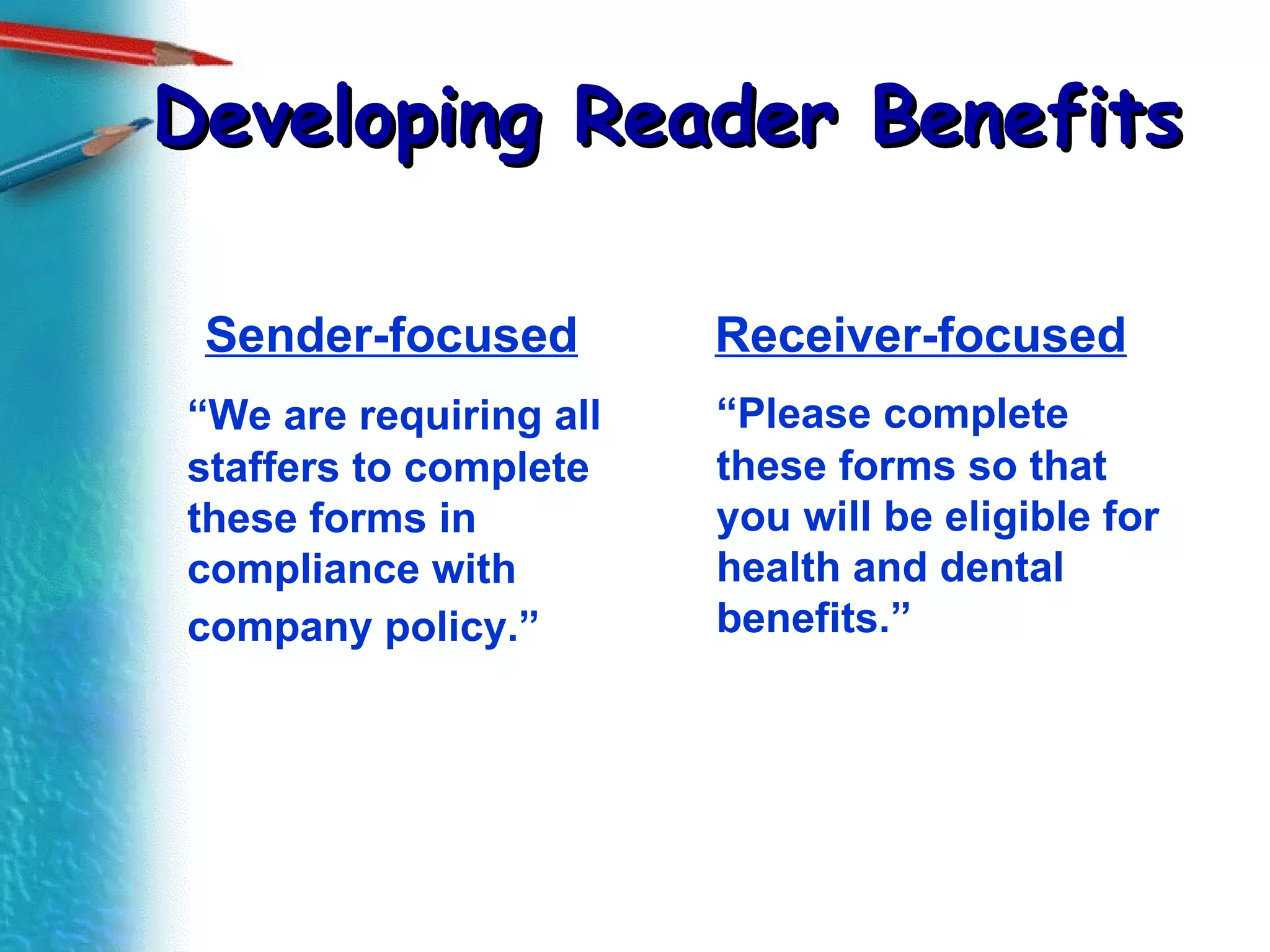
Developing Reader Benefits Sender-focused “ We are requiring all staffers to complete these forms in compliance with company policy.”   Receiver-focused “ Please complete these forms so that you will be eligible for health and dental benefits.”
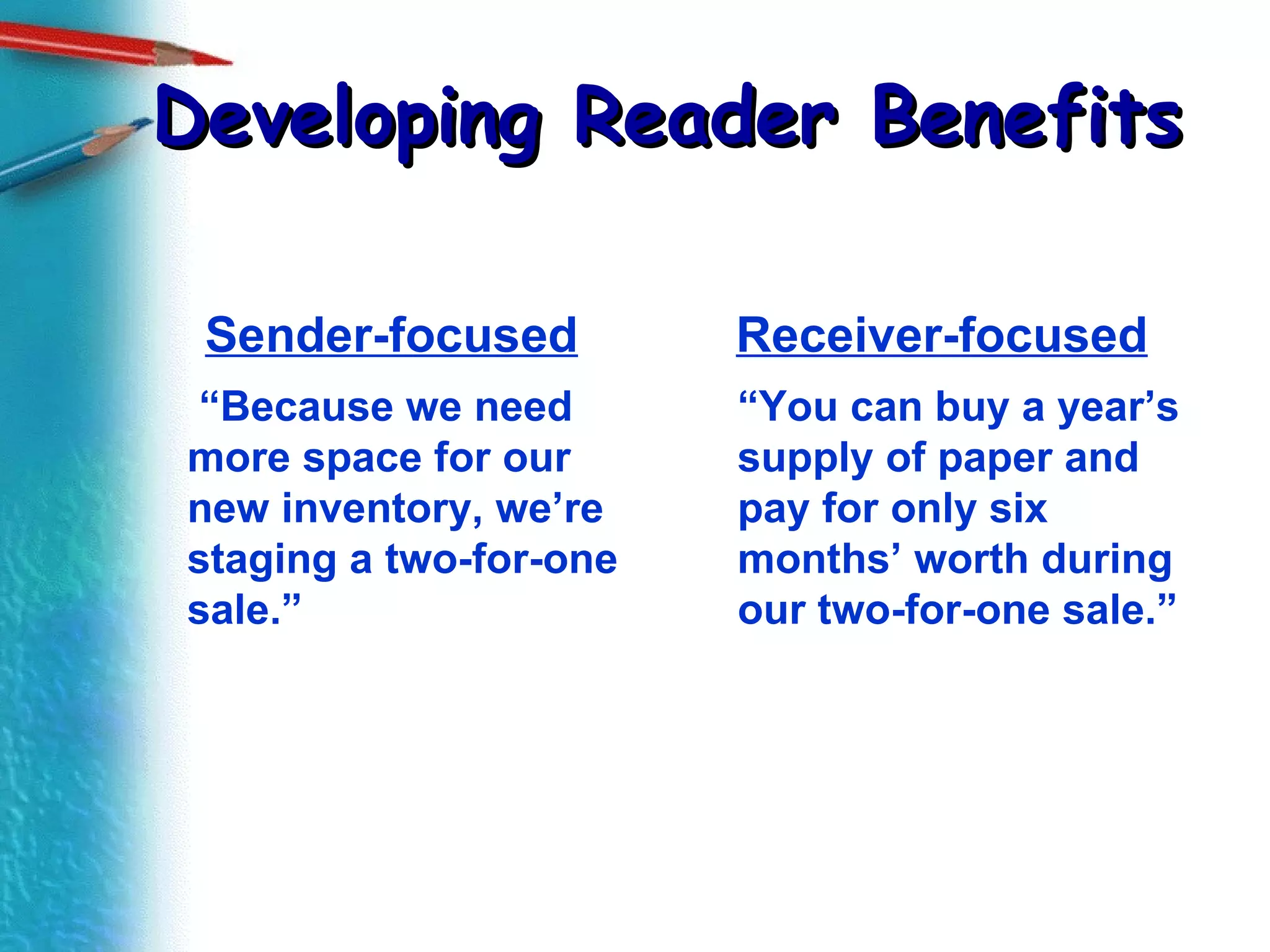
Developing Reader Benefits Sender-focused  “ Because we need more space for our new inventory, we’re staging a two-for-one sale.” Receiver-focused “ You can buy a year’s supply of paper and pay for only six months’ worth during our two-for-one sale.”
Hidden Negative Meanings Writers are sometimes unaware of the hidden messages conveyed by their words.
Hidden Negative Meanings You overlooked . . . . (You are careless.) You failed to . . . . (You are careless.) You state that . . . . (But I don’t believe you.) You claim that . . . . (It’s probably untrue.)
Hidden Negative Meanings You are wrong . . . . (I am right.) You do not understand . . . . (You are not very bright.) Your delay . . . . (You are at fault.) You forgot to . . . . (You are not only inefficient but also stupid and careless.)
Creating Effective Sentences Recognize phrases and clauses. Use short sentences. Emphasize important ideas. Use the active voice for most sentences. Use the passive voice to be tactful.
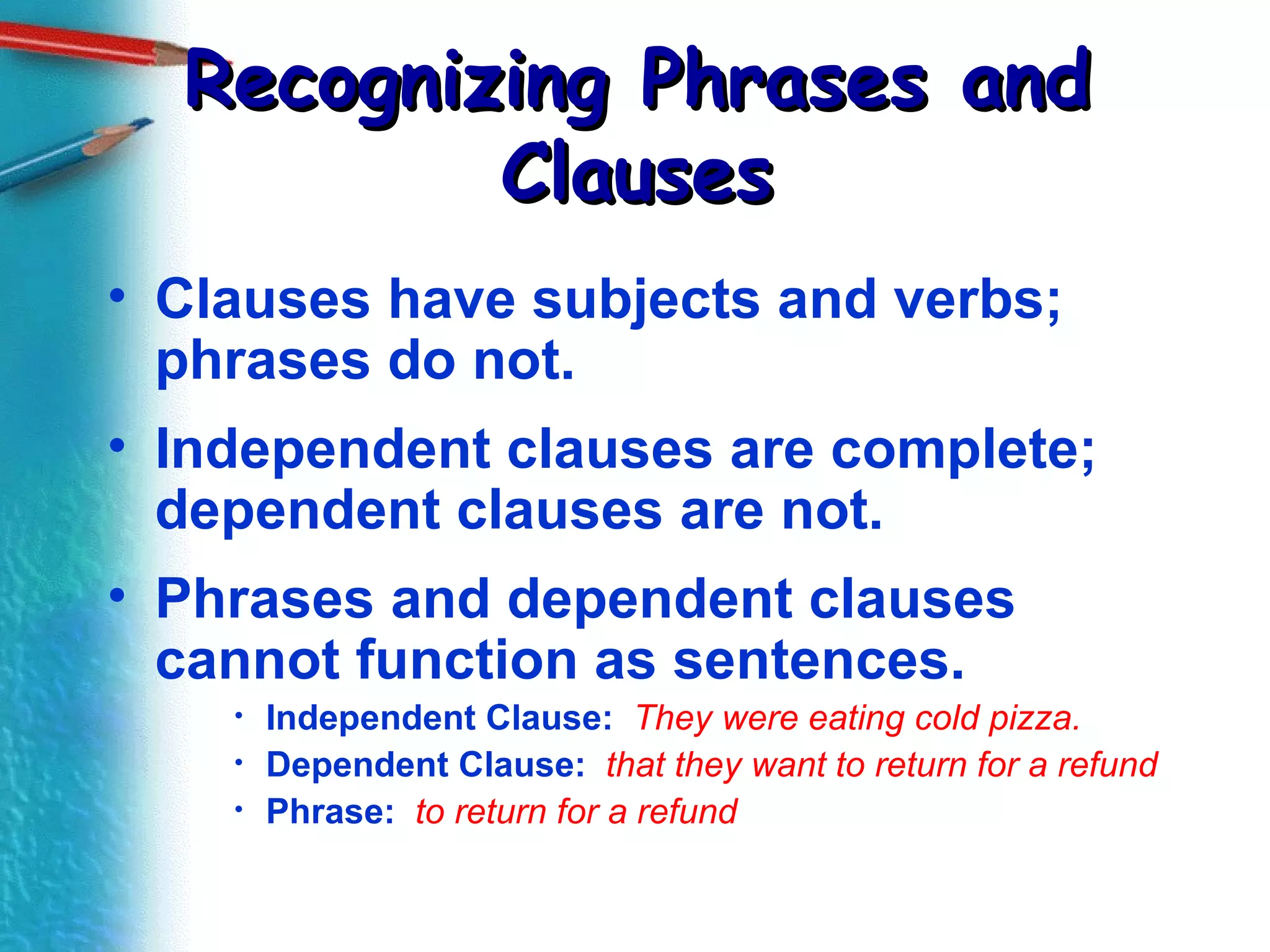
Recognizing Phrases and Clauses Clauses have subjects and verbs; phrases do not. Independent clauses are complete; dependent clauses are not. Phrases and dependent clauses cannot function as sentences. Independent Clause:  They were eating cold pizza. Dependent Clause:   that they want to return for a refund Phrase:   to return for a refund
Using Short Sentences Sentence Length 8 words 15 words 19 words 28 words Comprehension Rate 100% 90% 80% 50% Source: American Press Institute
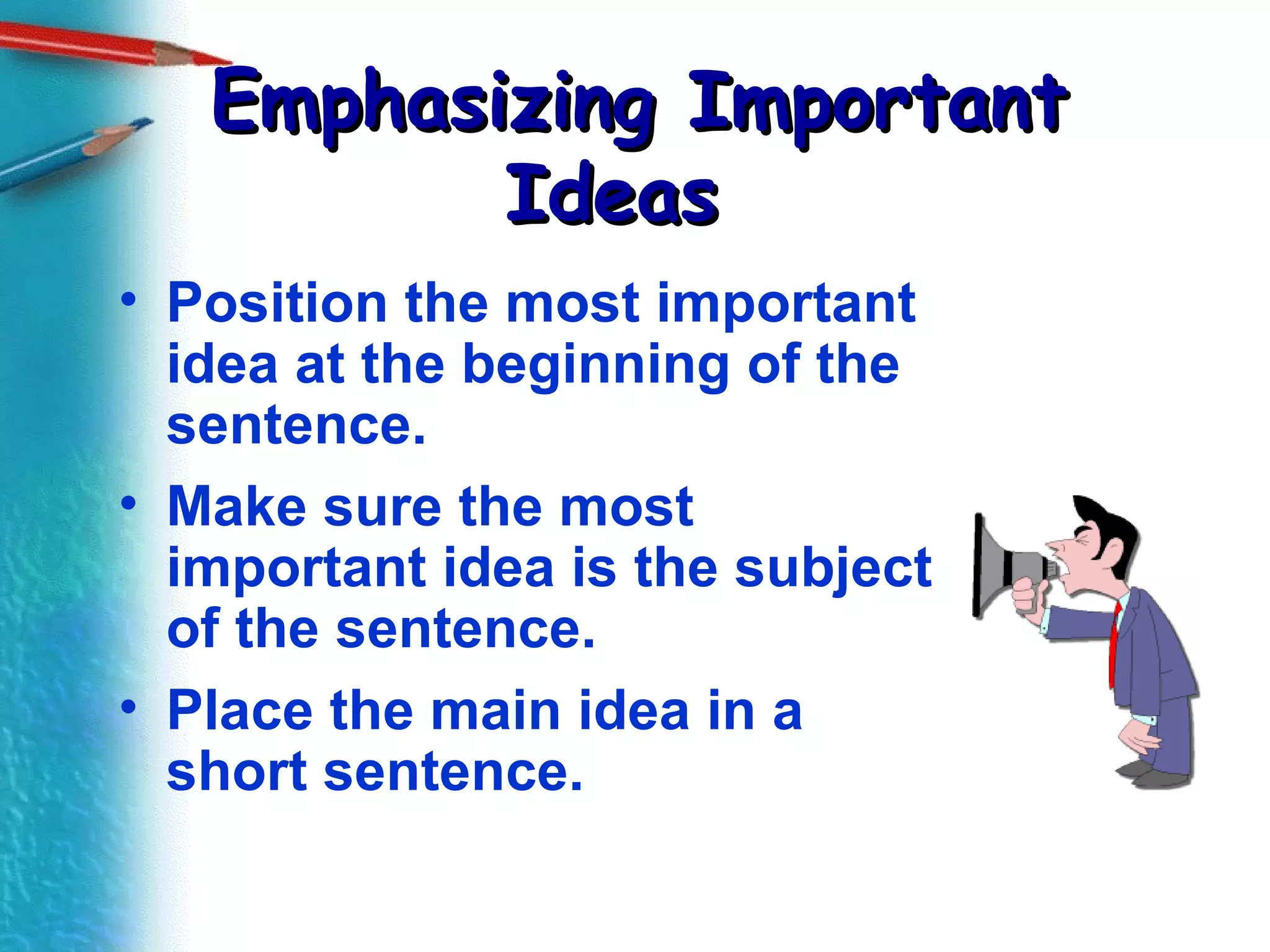
Emphasizing Important Ideas   Position the most important idea at the beginning of the sentence. Make sure the most important idea is the subject of the sentence. Place the main idea in a short sentence.
Use the Active Voice for Most Sentences Active voice:  We lost money . Active voice:  I sent the e-mail message yesterday. (The subject is the performer.)
Use the Passive Voice To Deemphasize the Performer and/or To Be Tactful Passive voice:  Money was lost (by us). Passive voice:  The e-mail message was sent yesterday (by me). (Passive voice test: Ask “By whom?” If you can fill in the performer, the verb is probably in the passive voice.)
Drafting effective paragraphs Discuss only one topic in each paragraph. Arrange sentences in a strategic plan. Link ideas to build coherence. Use transitional expressions for coherence. Compose short paragraphs for effective business messages. Discussing only one topic in each paragraph Group similar ideas together. Start a new paragraph for each new topic. Effective Paragraphs
Using transitional expressions for coherence Recommended expressions: additionally also as a result for example in other words therefore Effective Paragraphs
Writing Letters
The Direct Pattern Frontload in the opening.  Explain in the body. Be specific and courteous in the closing.
Frontloading in the Opening Begin with the main idea. Tell immediately why you are writing.
Explaining in the Body Present details that explain the request or response. Group similar ideas together. Consider using graphic highlighting techniques.
Being Specific and Courteous in the Closing For requests, specifically indicate the action you want taken and provide an end date (deadline), if appropriate. For other direct letters, provide a courteous concluding thought.
Set side margins for 1 to 1½ inches. Place the date 2 inches from the top or 1 blank line below the letterhead. Leave 2 to 7 blank lines between the date and inside address. Single-space within paragraphs and double-space between. Don’t justify right margin. Formatting Business Letters
Decide whether to use full block (all lines starting at the left margin) or modified block (date and closing lines starting at the center) letter style. Allow 3 blank lines between the complimentary close and the writer’s name. Formatting Business Letters
Formatting Business Letters   WEB: cypress@grid.com 5090 Katella Avenue  PHONE:  (310) 329-4330 Anaheim, CA 92642  FAX:  (310) 329-4259 May 18, 2001 Ms. LaTonja Williams Health Care Specialists 2608 Fairview Road Costa Mesa, CA 92627 Dear Ms. Williams: SUBJECT:  FORMATTING BUSINESS LETTERS Cypress Associates, Inc.  Letterhead Dateline Inside  Address  Salutation Subject  Line  2 inches from top of page 2 to 7 blank lines 1 blank line 1 blank line 1 blank line
Formatting Business Letters At your request, this letter illustrates and explains business  letter formatting in a nutshell. The most important points to remember are these: 1. Set margins between 1 and 1½ inches; most word  processing programs automatically set margins at 1 inch. 2. Start the date 2 inches from the top edge of the paper or 1  blank line below the letterhead, whichever position is  lower. 3. Allow about 5 lines after the date—more lines for shorter  letters and fewer lines for longer ones. The two most popular letter styles are block and modified block. Block style, with all lines beginning at the left, causes
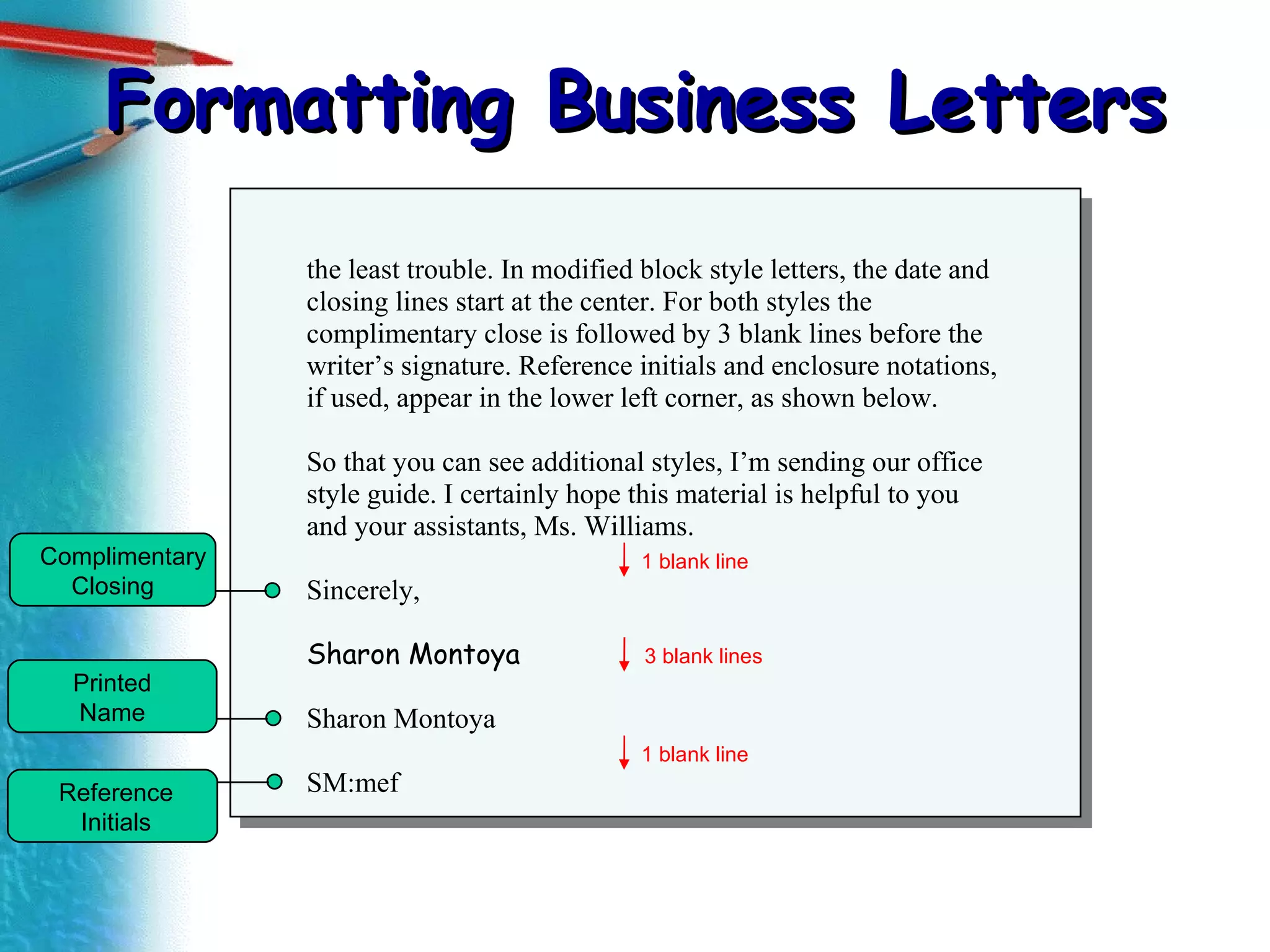
Formatting Business Letters the least trouble. In modified block style letters, the date and closing lines start at the center. For both styles the complimentary close is followed by 3 blank lines before the writer’s signature. Reference initials and enclosure notations, if used, appear in the lower left corner, as shown below. So that you can see additional styles, I’m sending our office style guide. I certainly hope this material is helpful to you and your assistants, Ms. Williams. Sincerely, Sharon Montoya Sharon Montoya SM:mef Complimentary Closing  Printed  Name  Reference  Initials  3 blank lines 1 blank line 1 blank line
The Five Ss of Goodwill Messages In expressing thanks, recognition, or sympathy: Be  s elfless. Emphasize the receiver,   not the sender. Be  s pecific. Focus on specifics rather   than generalities. Be  s incere. Show your honest feelings   by using unpretentious language.
The Five Ss of Goodwill Messages Be  s pontaneous. Make the message sound natural, fresh, and direct. Avoid canned phrases. Keep the message  s hort. Although goodwill messages may be as long as needed, they generally are fairly short.

Writing

  • 1.
    Preparing to WriteBusiness Messages
  • 2.
    Business writing is. . . Purposeful. It solves problems and conveys information. Economical . It is concise. Reader-oriented. It focuses on the receiver, not the sender.
  • 3.
    The 3-x-3 WritingProcess Phase 1: Prewriting Analyzing, anticipating, adapting Phase 2: Writing Researching, organizing, composing Phase 3: Revising Revising, proofreading, evaluating
  • 4.
    Analyzing and AnticipatingAnalyze the task Identify the purpose Anticipate the audience Primary receivers? Secondary receivers? Select the best channel Importance of the message? Feedback required? Permanent record required? Cost of the channel? Degree of formality?
  • 5.
    Adapting to Taskand Audience Spotlight receiver benefits (the warranty starts working for you immediately) . Cultivate the “you” view (you will receive your order) . Use sensitive language avoiding gender, race, age, and disability biases (office workers, not office girls) .
  • 6.
    Adapting to Taskand Audience Express thoughts positively (you will be happy to, not you won't be sorry that) . Use familiar words (salary, not remuneration). Use precise, vigorous words (fax me, not contact me) .
  • 7.
    Developing Reader BenefitsSender-focused “ We are requiring all staffers to complete these forms in compliance with company policy.” Receiver-focused “ Please complete these forms so that you will be eligible for health and dental benefits.”
  • 8.
    Developing Reader BenefitsSender-focused “ Because we need more space for our new inventory, we’re staging a two-for-one sale.” Receiver-focused “ You can buy a year’s supply of paper and pay for only six months’ worth during our two-for-one sale.”
  • 9.
    Hidden Negative MeaningsWriters are sometimes unaware of the hidden messages conveyed by their words.
  • 10.
    Hidden Negative MeaningsYou overlooked . . . . (You are careless.) You failed to . . . . (You are careless.) You state that . . . . (But I don’t believe you.) You claim that . . . . (It’s probably untrue.)
  • 11.
    Hidden Negative MeaningsYou are wrong . . . . (I am right.) You do not understand . . . . (You are not very bright.) Your delay . . . . (You are at fault.) You forgot to . . . . (You are not only inefficient but also stupid and careless.)
  • 12.
    Creating Effective SentencesRecognize phrases and clauses. Use short sentences. Emphasize important ideas. Use the active voice for most sentences. Use the passive voice to be tactful.
  • 13.
    Recognizing Phrases andClauses Clauses have subjects and verbs; phrases do not. Independent clauses are complete; dependent clauses are not. Phrases and dependent clauses cannot function as sentences. Independent Clause: They were eating cold pizza. Dependent Clause: that they want to return for a refund Phrase: to return for a refund
  • 14.
    Using Short SentencesSentence Length 8 words 15 words 19 words 28 words Comprehension Rate 100% 90% 80% 50% Source: American Press Institute
  • 15.
    Emphasizing Important Ideas Position the most important idea at the beginning of the sentence. Make sure the most important idea is the subject of the sentence. Place the main idea in a short sentence.
  • 16.
    Use the ActiveVoice for Most Sentences Active voice: We lost money . Active voice: I sent the e-mail message yesterday. (The subject is the performer.)
  • 17.
    Use the PassiveVoice To Deemphasize the Performer and/or To Be Tactful Passive voice: Money was lost (by us). Passive voice: The e-mail message was sent yesterday (by me). (Passive voice test: Ask “By whom?” If you can fill in the performer, the verb is probably in the passive voice.)
  • 18.
    Drafting effective paragraphsDiscuss only one topic in each paragraph. Arrange sentences in a strategic plan. Link ideas to build coherence. Use transitional expressions for coherence. Compose short paragraphs for effective business messages. Discussing only one topic in each paragraph Group similar ideas together. Start a new paragraph for each new topic. Effective Paragraphs
  • 19.
    Using transitional expressionsfor coherence Recommended expressions: additionally also as a result for example in other words therefore Effective Paragraphs
  • 20.
  • 21.
    The Direct PatternFrontload in the opening. Explain in the body. Be specific and courteous in the closing.
  • 22.
    Frontloading in theOpening Begin with the main idea. Tell immediately why you are writing.
  • 23.
    Explaining in theBody Present details that explain the request or response. Group similar ideas together. Consider using graphic highlighting techniques.
  • 24.
    Being Specific andCourteous in the Closing For requests, specifically indicate the action you want taken and provide an end date (deadline), if appropriate. For other direct letters, provide a courteous concluding thought.
  • 25.
    Set side marginsfor 1 to 1½ inches. Place the date 2 inches from the top or 1 blank line below the letterhead. Leave 2 to 7 blank lines between the date and inside address. Single-space within paragraphs and double-space between. Don’t justify right margin. Formatting Business Letters
  • 26.
    Decide whether touse full block (all lines starting at the left margin) or modified block (date and closing lines starting at the center) letter style. Allow 3 blank lines between the complimentary close and the writer’s name. Formatting Business Letters
  • 27.
    Formatting Business Letters WEB: cypress@grid.com 5090 Katella Avenue PHONE: (310) 329-4330 Anaheim, CA 92642 FAX: (310) 329-4259 May 18, 2001 Ms. LaTonja Williams Health Care Specialists 2608 Fairview Road Costa Mesa, CA 92627 Dear Ms. Williams: SUBJECT: FORMATTING BUSINESS LETTERS Cypress Associates, Inc. Letterhead Dateline Inside Address Salutation Subject Line 2 inches from top of page 2 to 7 blank lines 1 blank line 1 blank line 1 blank line
  • 28.
    Formatting Business LettersAt your request, this letter illustrates and explains business letter formatting in a nutshell. The most important points to remember are these: 1. Set margins between 1 and 1½ inches; most word processing programs automatically set margins at 1 inch. 2. Start the date 2 inches from the top edge of the paper or 1 blank line below the letterhead, whichever position is lower. 3. Allow about 5 lines after the date—more lines for shorter letters and fewer lines for longer ones. The two most popular letter styles are block and modified block. Block style, with all lines beginning at the left, causes
  • 29.
    Formatting Business Lettersthe least trouble. In modified block style letters, the date and closing lines start at the center. For both styles the complimentary close is followed by 3 blank lines before the writer’s signature. Reference initials and enclosure notations, if used, appear in the lower left corner, as shown below. So that you can see additional styles, I’m sending our office style guide. I certainly hope this material is helpful to you and your assistants, Ms. Williams. Sincerely, Sharon Montoya Sharon Montoya SM:mef Complimentary Closing Printed Name Reference Initials 3 blank lines 1 blank line 1 blank line
  • 30.
    The Five Ssof Goodwill Messages In expressing thanks, recognition, or sympathy: Be s elfless. Emphasize the receiver, not the sender. Be s pecific. Focus on specifics rather than generalities. Be s incere. Show your honest feelings by using unpretentious language.
  • 31.
    The Five Ssof Goodwill Messages Be s pontaneous. Make the message sound natural, fresh, and direct. Avoid canned phrases. Keep the message s hort. Although goodwill messages may be as long as needed, they generally are fairly short.