CH5 LISTENING AND CRITICAL THINKING 
MARIA SUBERT
HEARING AND LISTENING ARE DIFFERENT 
 Hearing: the act of receiving sounds 
 Listening: the active process of receiving, constructing 
meaning from, and responding to spoken and nonverbal 
messages.
LISTENING IS IMPORTANT: 
 Listening is our most common communication 
activity. 
 It helps us build and maintain relationships 
 It is essential for success in most professional 
situation
ACTIVE AND INACTIVE LISTENING 
 Active listening: listening with purpose. 
 Not active listening: Enjoyment listening. 
We listen in a relaxing, fun, emotionally stimulating 
situation.
FORMS OF ACTIVE LISTENING 
Forms of active listening 
 Emphatic listening: when you are attempting to 
understand another person. 
 Critical listening: requires evaluating the speaker’s 
message for accuracy, meaningfulness, and 
usefulness.
SELECTIVE & AUTOMATIC ATTENTION 
 Selective attention: the sustained focus we give to 
things that are important. 
 Automatic attention: the instinctive focus we give to 
important things in our surroundings.
MEMORY 
 Working memory where we interpret and assign 
meaning to things we hear 
https://www.youtube.com/watch?v=adnOPRkQ9VY 
 Short-term memory: a temporary storage for 
information. 
https://www.youtube.com/watch?v=wl3zvJ2YRss 
 Long-term memory is our permanent storage for 
information including past experiences. 
https://www.youtube.com/watch?v=rJc-0V5ASw0
ORIENTATION 
 Man are more instrumental/task-oriented when 
communicating 
women tend to be more relationally oriented
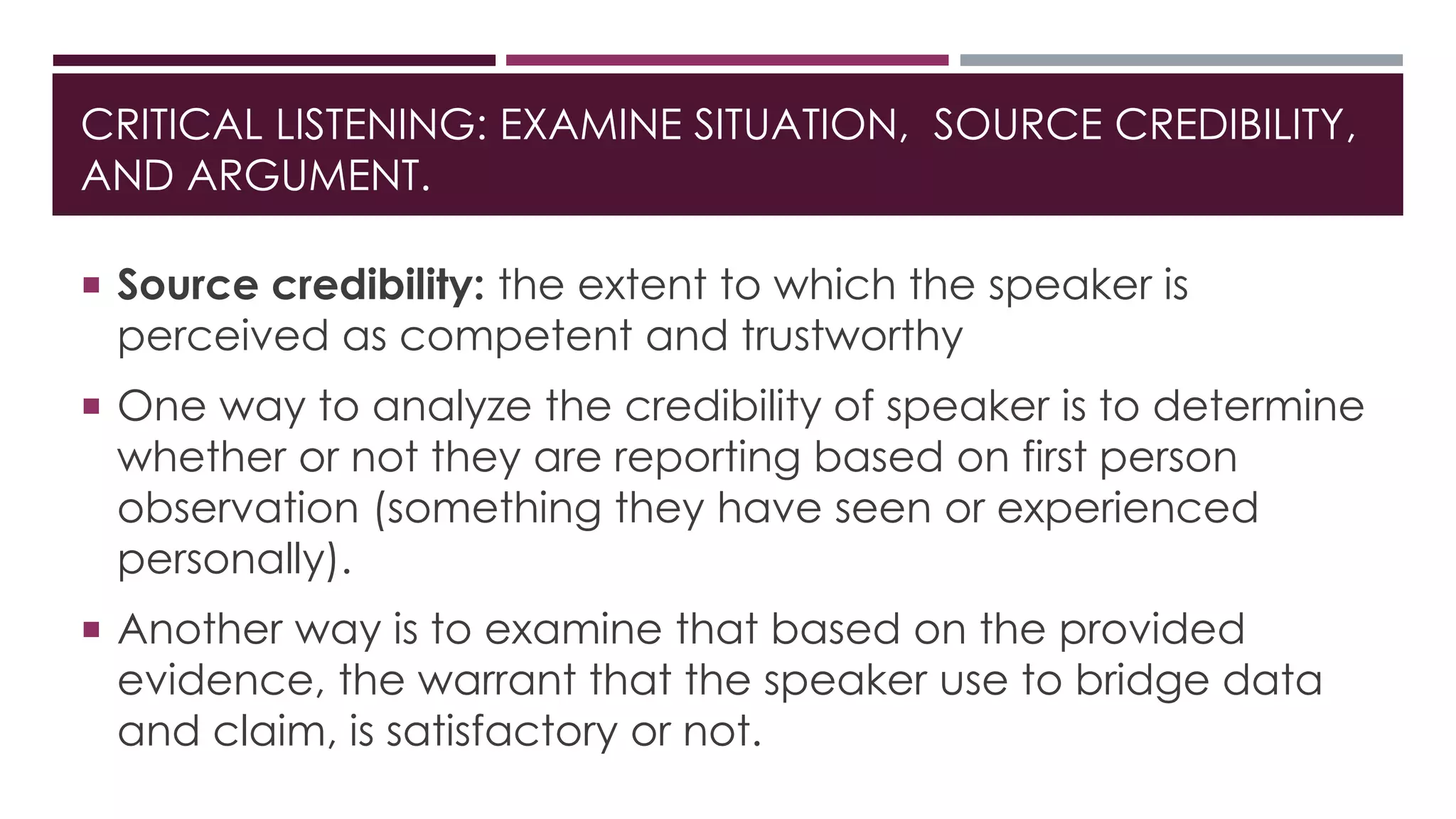
CRITICAL LISTENING: EXAMINE SITUATION, SOURCE CREDIBILITY, 
AND ARGUMENT. 
 Source credibility: the extent to which the speaker is 
perceived as competent and trustworthy 
 One way to analyze the credibility of speaker is to determine 
whether or not they are reporting based on first person 
observation (something they have seen or experienced 
personally). 
 Another way is to examine that based on the provided 
evidence, the warrant that the speaker use to bridge data 
and claim, is satisfactory or not.
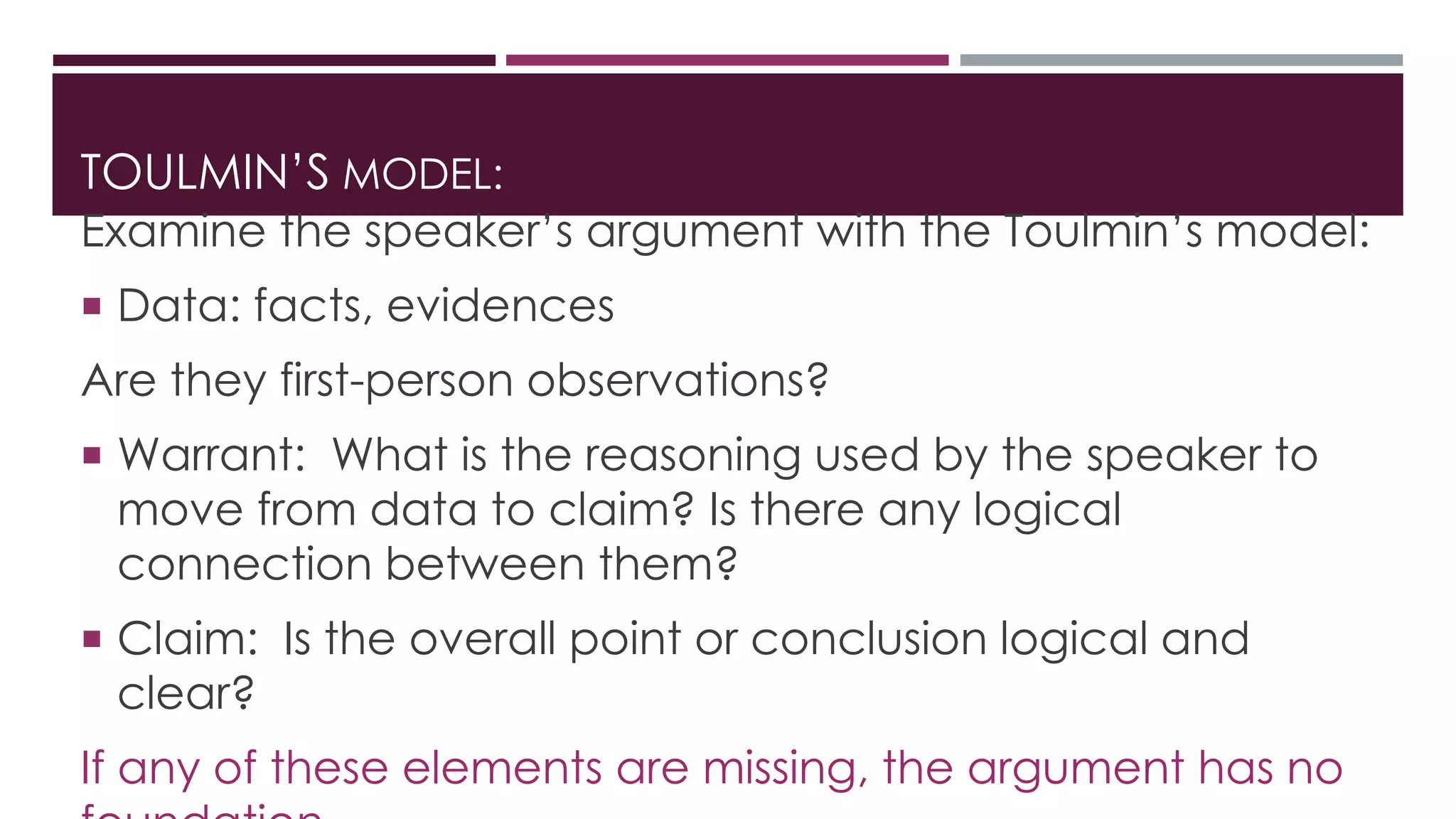
TOULMIN’S MODEL: 
Examine the speaker’s argument with the Toulmin’s model: 
 Data: facts, evidences 
Are they first-person observations? 
 Warrant: What is the reasoning used by the speaker to 
move from data to claim? Is there any logical 
connection between them? 
 Claim: Is the overall point or conclusion logical and 
clear? 
If any of these elements are missing, the argument has no 
foundation.
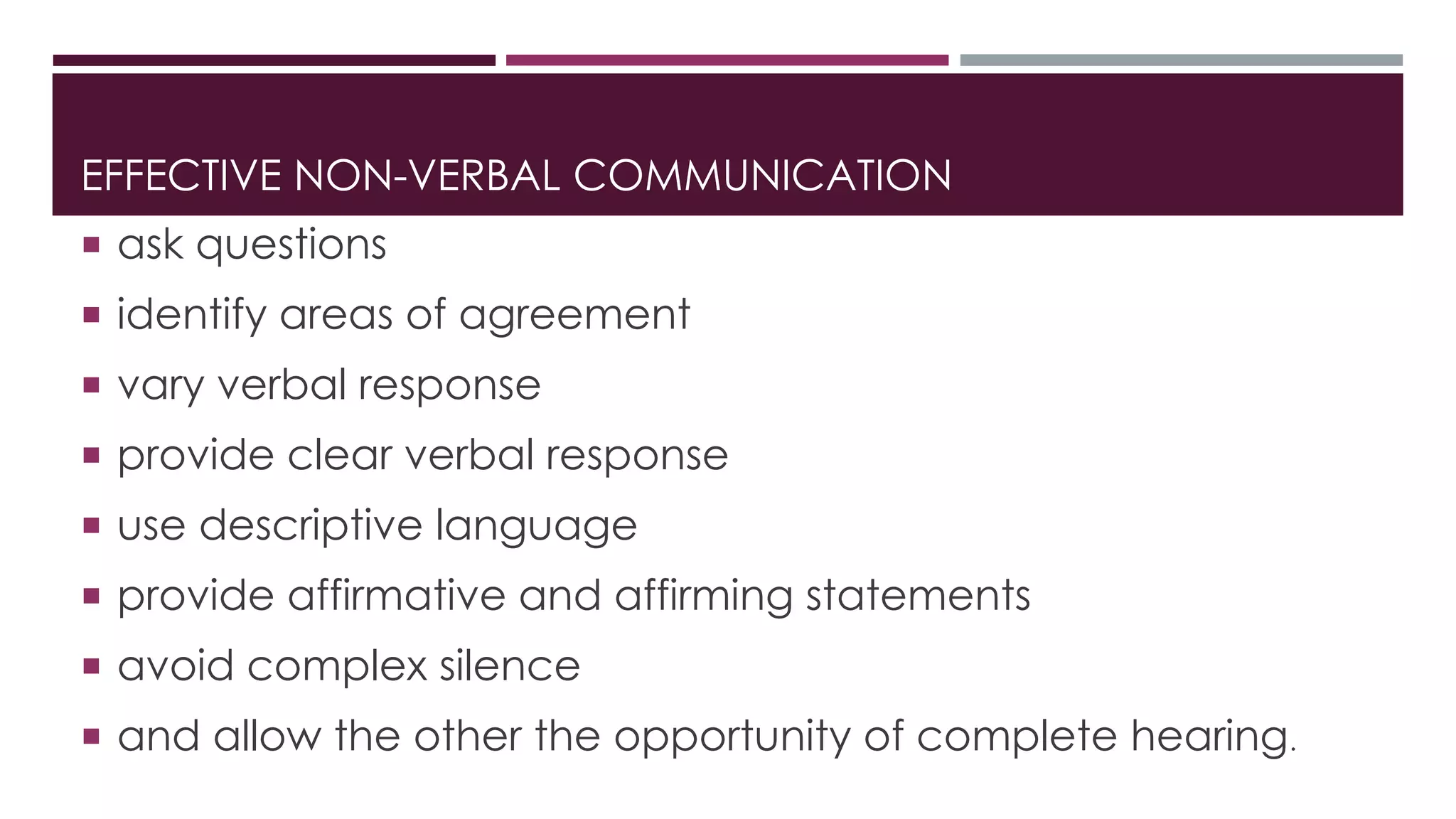
EFFECTIVE NON-VERBAL COMMUNICATION 
 ask questions 
 identify areas of agreement 
 vary verbal response 
 provide clear verbal response 
 use descriptive language 
 provide affirmative and affirming statements 
 avoid complex silence 
 and allow the other the opportunity of complete hearing.
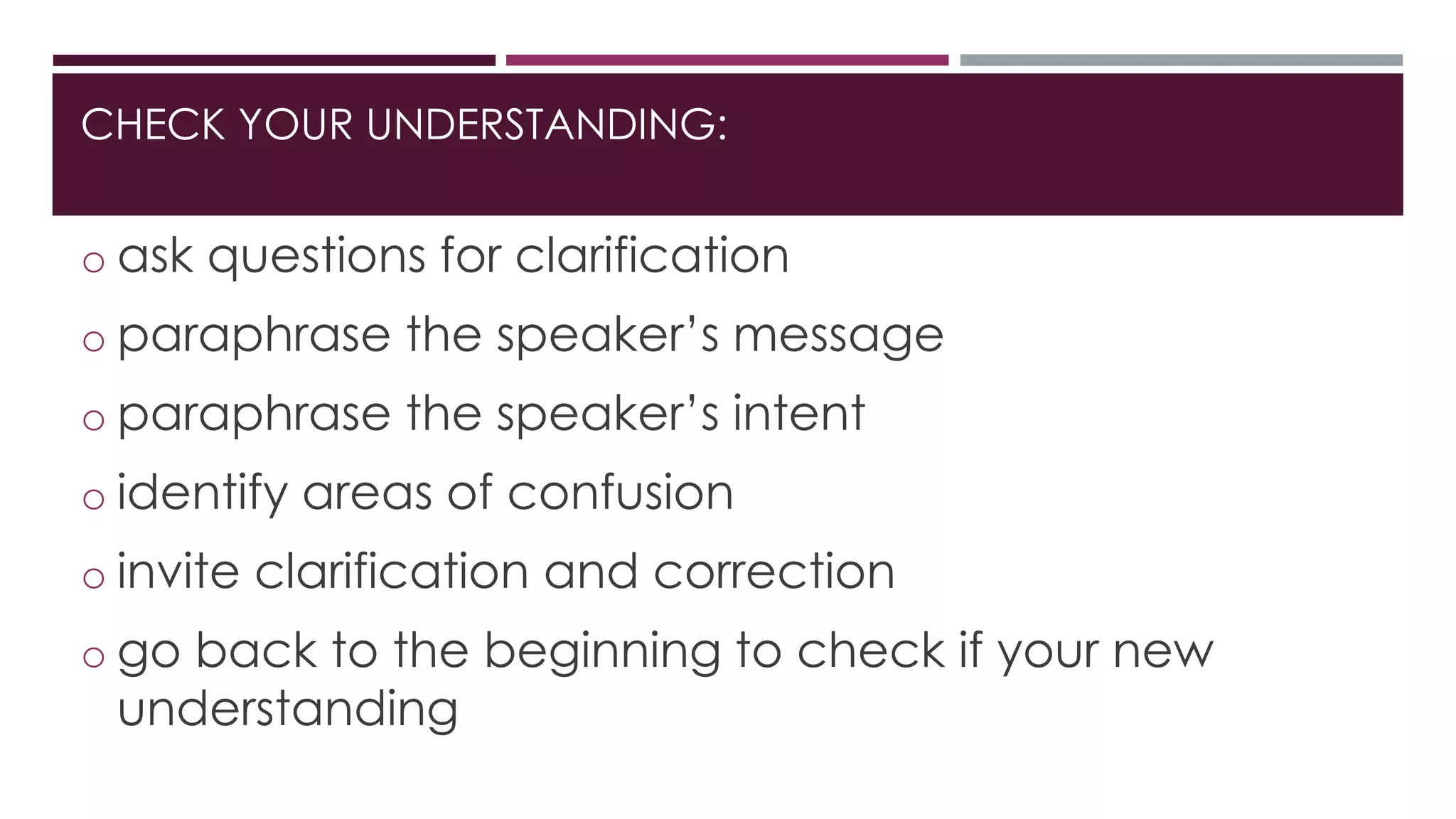
CHECK YOUR UNDERSTANDING: 
o ask questions for clarification 
o paraphrase the speaker’s message 
o paraphrase the speaker’s intent 
o identify areas of confusion 
o invite clarification and correction 
o go back to the beginning to check if your new 
understanding
EFFECTIVE LISTENING STRATEGY IN THE CLASSROOM: 
 involves to take effective notes. 
20% of the college students who took effective notes 
ended up to get A instead of C. 
 Listen for the lesson cues: verbal or nonverbal signs 
that stress points or indicate transitions between 
ideas.
INFORMATION LITERACY: 
 Information literacy: 
recognition when info is needed and 
have ability to locate, evaluate and use the 
needed information.
DIGITAL COMMUNICATION 
 The principal problem with digital communication: 
nonverbal communication, that provides significant 
clues about the other person’s emotions and feelings— 
is difficult.
SECOND LANGUAGE LISTENING 
 Second language listening development requires 
vocabulary comprehension and metacognitive 
awareness. 
 Metacognition is your ability to use mental strategies 
to assist to quickly determining the meaning of the 
words.
THINGS THAT PREVENT YOU FROM BECOMING EFFECTIVE 
LISTENER: 
Noises that prevent from being an effective listener: 
 noise (physical and internal distraction) 
 physical distraction (audible noises in the environment) 
 internal noise (mental, factual, semantic distraction) 
 perception of others and own behavior.
THINGS THAT HELP TO BECOME MORE EFFECTIVE LISTENER 
Developing your critical thinking, nonverbal and verbal skills. 
 Critical thinking: careful analysis of the communication situation 
and the speaker’s message, evaluating the argument and 
supporting material presented, and the speaker’s credibility. 
 Effective non-verbal strategies: be responsive, use positive facial 
expressions, direct eye contact, and positive vocal utterances. 
 Effective verbal strategies: asking questions, inviting additional 
comments, using descriptive responses, providing affirming 
statements.
ETHICAL LISTENING: 
You should recognize and monitor 
your own communication style, apply 
general ethical principles to your 
responses, and adapt your 
communication styles to others.

Ch5 listening and critical thinking

  • 1.
    CH5 LISTENING ANDCRITICAL THINKING MARIA SUBERT
  • 2.
    HEARING AND LISTENINGARE DIFFERENT  Hearing: the act of receiving sounds  Listening: the active process of receiving, constructing meaning from, and responding to spoken and nonverbal messages.
  • 3.
    LISTENING IS IMPORTANT:  Listening is our most common communication activity.  It helps us build and maintain relationships  It is essential for success in most professional situation
  • 4.
    ACTIVE AND INACTIVELISTENING  Active listening: listening with purpose.  Not active listening: Enjoyment listening. We listen in a relaxing, fun, emotionally stimulating situation.
  • 5.
    FORMS OF ACTIVELISTENING Forms of active listening  Emphatic listening: when you are attempting to understand another person.  Critical listening: requires evaluating the speaker’s message for accuracy, meaningfulness, and usefulness.
  • 6.
    SELECTIVE & AUTOMATICATTENTION  Selective attention: the sustained focus we give to things that are important.  Automatic attention: the instinctive focus we give to important things in our surroundings.
  • 7.
    MEMORY  Workingmemory where we interpret and assign meaning to things we hear https://www.youtube.com/watch?v=adnOPRkQ9VY  Short-term memory: a temporary storage for information. https://www.youtube.com/watch?v=wl3zvJ2YRss  Long-term memory is our permanent storage for information including past experiences. https://www.youtube.com/watch?v=rJc-0V5ASw0
  • 8.
    ORIENTATION  Manare more instrumental/task-oriented when communicating women tend to be more relationally oriented
  • 9.
    CRITICAL LISTENING: EXAMINESITUATION, SOURCE CREDIBILITY, AND ARGUMENT.  Source credibility: the extent to which the speaker is perceived as competent and trustworthy  One way to analyze the credibility of speaker is to determine whether or not they are reporting based on first person observation (something they have seen or experienced personally).  Another way is to examine that based on the provided evidence, the warrant that the speaker use to bridge data and claim, is satisfactory or not.
  • 10.
    TOULMIN’S MODEL: Examinethe speaker’s argument with the Toulmin’s model:  Data: facts, evidences Are they first-person observations?  Warrant: What is the reasoning used by the speaker to move from data to claim? Is there any logical connection between them?  Claim: Is the overall point or conclusion logical and clear? If any of these elements are missing, the argument has no foundation.
  • 11.
    EFFECTIVE NON-VERBAL COMMUNICATION  ask questions  identify areas of agreement  vary verbal response  provide clear verbal response  use descriptive language  provide affirmative and affirming statements  avoid complex silence  and allow the other the opportunity of complete hearing.
  • 12.
    CHECK YOUR UNDERSTANDING: o ask questions for clarification o paraphrase the speaker’s message o paraphrase the speaker’s intent o identify areas of confusion o invite clarification and correction o go back to the beginning to check if your new understanding
  • 13.
    EFFECTIVE LISTENING STRATEGYIN THE CLASSROOM:  involves to take effective notes. 20% of the college students who took effective notes ended up to get A instead of C.  Listen for the lesson cues: verbal or nonverbal signs that stress points or indicate transitions between ideas.
  • 14.
    INFORMATION LITERACY: Information literacy: recognition when info is needed and have ability to locate, evaluate and use the needed information.
  • 15.
    DIGITAL COMMUNICATION The principal problem with digital communication: nonverbal communication, that provides significant clues about the other person’s emotions and feelings— is difficult.
  • 16.
    SECOND LANGUAGE LISTENING  Second language listening development requires vocabulary comprehension and metacognitive awareness.  Metacognition is your ability to use mental strategies to assist to quickly determining the meaning of the words.
  • 17.
    THINGS THAT PREVENTYOU FROM BECOMING EFFECTIVE LISTENER: Noises that prevent from being an effective listener:  noise (physical and internal distraction)  physical distraction (audible noises in the environment)  internal noise (mental, factual, semantic distraction)  perception of others and own behavior.
  • 18.
    THINGS THAT HELPTO BECOME MORE EFFECTIVE LISTENER Developing your critical thinking, nonverbal and verbal skills.  Critical thinking: careful analysis of the communication situation and the speaker’s message, evaluating the argument and supporting material presented, and the speaker’s credibility.  Effective non-verbal strategies: be responsive, use positive facial expressions, direct eye contact, and positive vocal utterances.  Effective verbal strategies: asking questions, inviting additional comments, using descriptive responses, providing affirming statements.
  • 19.
    ETHICAL LISTENING: Youshould recognize and monitor your own communication style, apply general ethical principles to your responses, and adapt your communication styles to others.