The Art
of
Listening
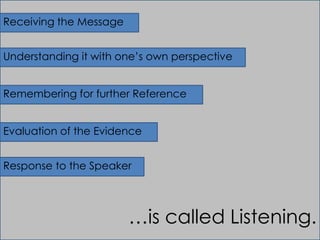
Receiving the Message
Understanding it with one’s own perspective
Remembering for further Reference
Evaluation of the Evidence
Response to the Speaker
…is called Listening.
Importance of Listening
•Nearly all Top notch business executives, successful politicians and brilliant
teachers are excellent listener.
•Effective listeners hold higher positions and are promoted more often than
others.
•When business managers rank-order the communication skills most crucial to
their jobs, they usually rank listening number one.
•In one survey of Fortune 500 companies of America, almost 60 percent of the
respondents said that they provide some kind of listening training for their
employees.
•Close to 90% of class time in colleges and universities is spent listening to
discussions and lectures.
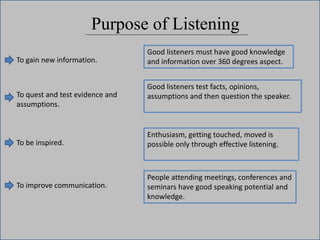
Purpose of Listening
To gain new information.
Good listeners must have good knowledge
and information over 360 degrees aspect.
To quest and test evidence and
assumptions.
Good listeners test facts, opinions,
assumptions and then question the speaker.
To be inspired.
To improve communication.
Enthusiasm, getting touched, moved is
possible only through effective listening.
People attending meetings, conferences and
seminars have good speaking potential and
knowledge.
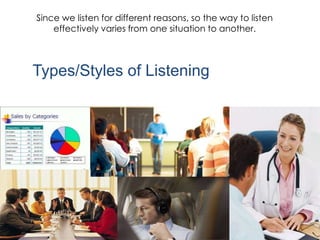
Types/Styles of Listening
Since we listen for different reasons, so the way to listen
effectively varies from one situation to another.
Content Listening
To understand and retain the
message being conveyed.
Information flows from speaker,
no matter you agree or
disagree, approve or
disapprove.
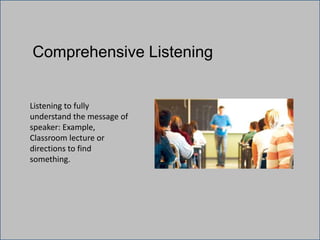
Comprehensive Listening
Listening to fully
understand the message of
speaker: Example,
Classroom lecture or
directions to find
something.
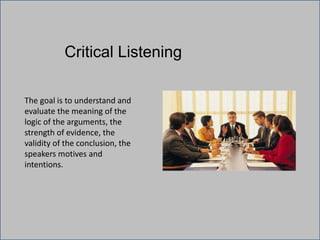
Critical Listening
The goal is to understand and
evaluate the meaning of the
logic of the arguments, the
strength of evidence, the
validity of the conclusion, the
speakers motives and
intentions.
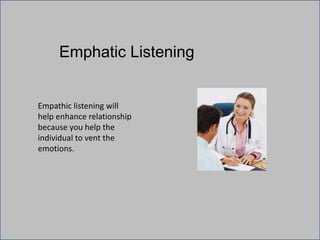
Emphatic Listening
Empathic listening will
help enhance relationship
because you help the
individual to vent the
emotions.
Barriers in Listening
External Distraction: Noisy fans,
dim/glaring light , cold, over
temperature, room furniture etc divert
attention.
Thinking Speed: People can process
800 wpm while speakers speak with
a rate of 80-160 wpm, in the fraction
of time mind gets distracted.
Premature Evaluation: Because of our
thinking speed we process / evaluate
discussion and jump to conclusion
without, sometimes, even paying heed
to what others wish to express.
Semantic Stereotypes: Diction
depends on company, field, attitude,
and exposure. People inadvertently
use different words thus this results in
barrier.
Delivery: Intonation (Rise & Fall)
and stress give color to speech and
keep listeners active. Monotonous
takes them to drowsiness.
Prejudice against the Speaker: If
listeners have any bias against the
speaker, they don’t pay attention
hence do not listen.
To overcome the barriers of
Listening
1. Be prepared --Reach your
class/interview/meeting prepared.
2. Do things with positive approach.
3. Listen to understand not to refute.
4. Respect those with whom you
disagree.
5. Try to understand other point of view.
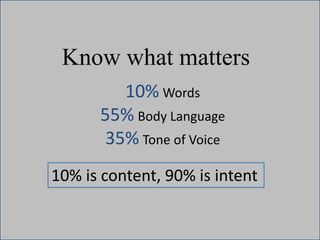
10% Words
55% Body Language
35% Tone of Voice
Know what matters
10% is content, 90% is intent
Thank you for your kind attention.

Listening

  • 1.
  • 2.
    Receiving the Message Understandingit with one’s own perspective Remembering for further Reference Evaluation of the Evidence Response to the Speaker …is called Listening.
  • 3.
    Importance of Listening •Nearlyall Top notch business executives, successful politicians and brilliant teachers are excellent listener. •Effective listeners hold higher positions and are promoted more often than others. •When business managers rank-order the communication skills most crucial to their jobs, they usually rank listening number one. •In one survey of Fortune 500 companies of America, almost 60 percent of the respondents said that they provide some kind of listening training for their employees. •Close to 90% of class time in colleges and universities is spent listening to discussions and lectures.
  • 4.
    Purpose of Listening Togain new information. Good listeners must have good knowledge and information over 360 degrees aspect. To quest and test evidence and assumptions. Good listeners test facts, opinions, assumptions and then question the speaker. To be inspired. To improve communication. Enthusiasm, getting touched, moved is possible only through effective listening. People attending meetings, conferences and seminars have good speaking potential and knowledge.
  • 5.
    Types/Styles of Listening Sincewe listen for different reasons, so the way to listen effectively varies from one situation to another.
  • 6.
    Content Listening To understandand retain the message being conveyed. Information flows from speaker, no matter you agree or disagree, approve or disapprove.
  • 7.
    Comprehensive Listening Listening tofully understand the message of speaker: Example, Classroom lecture or directions to find something.
  • 8.
    Critical Listening The goalis to understand and evaluate the meaning of the logic of the arguments, the strength of evidence, the validity of the conclusion, the speakers motives and intentions.
  • 9.
    Emphatic Listening Empathic listeningwill help enhance relationship because you help the individual to vent the emotions.
  • 10.
    Barriers in Listening ExternalDistraction: Noisy fans, dim/glaring light , cold, over temperature, room furniture etc divert attention. Thinking Speed: People can process 800 wpm while speakers speak with a rate of 80-160 wpm, in the fraction of time mind gets distracted. Premature Evaluation: Because of our thinking speed we process / evaluate discussion and jump to conclusion without, sometimes, even paying heed to what others wish to express. Semantic Stereotypes: Diction depends on company, field, attitude, and exposure. People inadvertently use different words thus this results in barrier. Delivery: Intonation (Rise & Fall) and stress give color to speech and keep listeners active. Monotonous takes them to drowsiness. Prejudice against the Speaker: If listeners have any bias against the speaker, they don’t pay attention hence do not listen.
  • 11.
    To overcome thebarriers of Listening 1. Be prepared --Reach your class/interview/meeting prepared. 2. Do things with positive approach. 3. Listen to understand not to refute. 4. Respect those with whom you disagree. 5. Try to understand other point of view.
  • 12.
    10% Words 55% BodyLanguage 35% Tone of Voice Know what matters 10% is content, 90% is intent
  • 13.
    Thank you foryour kind attention.