6. Stereochemistry
Based on McMurry’s Organic Chemistry, 7th
edition
2
Stereochemistry
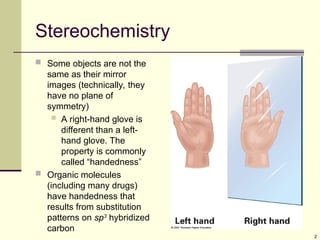
 Some objects are not the
same as their mirror
images (technically, they
have no plane of
symmetry)
 A right-hand glove is
different than a left-
hand glove. The
property is commonly
called “handedness”
 Organic molecules
(including many drugs)
have handedness that
results from substitution
patterns on sp3
hybridized
carbon
3
Why this Chapter?
 Handedness is important in organic and
biochemistry
 Molecular handedness makes possible
specific interactions between enzymes and
substrates
 Stereochemistry looks at 3-D structures of
molecules
4
9.1 Enantiomers and the Tetrahedral
Carbon
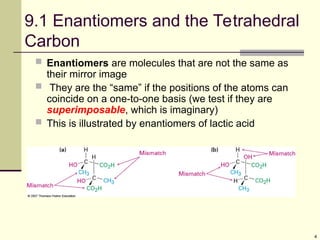
 Enantiomers are molecules that are not the same as
their mirror image
 They are the “same” if the positions of the atoms can
coincide on a one-to-one basis (we test if they are
superimposable, which is imaginary)
 This is illustrated by enantiomers of lactic acid
5
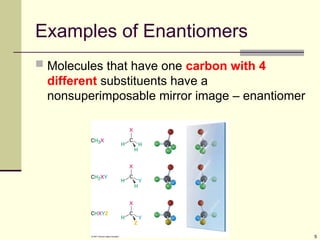
Examples of Enantiomers
 Molecules that have one carbon with 4
different substituents have a
nonsuperimposable mirror image – enantiomer
6
9.2 The Reason for Handedness:
Chirality
 Molecules that are not superimposable with their
mirror images are chiral (have handedness)
 A plane of symmetry divides an entire molecule
into two pieces that are exact mirror images
 A molecule with a plane of symmetry is the same as
its mirror image and is said to be achiral
7
Chirality
 If an object has a plane of symmetry it is necessarily
the same as its mirror image
 The lack of a plane of symmetry is called
“handedness”, chirality
 Hands, gloves are prime examples of chiral object
 They have a “left” and a “right” version
8
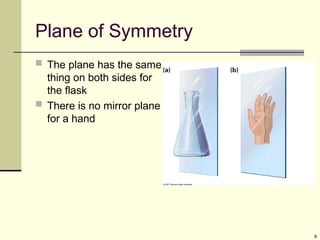
Plane of Symmetry
 The plane has the same
thing on both sides for
the flask
 There is no mirror plane
for a hand
9
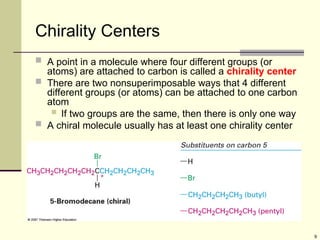
Chirality Centers
 A point in a molecule where four different groups (or
atoms) are attached to carbon is called a chirality center
 There are two nonsuperimposable ways that 4 different
different groups (or atoms) can be attached to one carbon
atom
 If two groups are the same, then there is only one way
 A chiral molecule usually has at least one chirality center
10
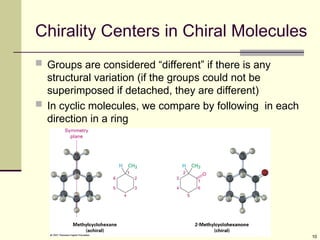
Chirality Centers in Chiral Molecules
 Groups are considered “different” if there is any
structural variation (if the groups could not be
superimposed if detached, they are different)
 In cyclic molecules, we compare by following in each
direction in a ring
11
9.3 Optical Activity
 Light restricted to pass through a plane is plane-
polarized
 Plane-polarized light that passes through solutions of
achiral compounds remains in that plane
 Solutions of chiral compounds rotate plane-polarized
light and the molecules are said to be optically active
 Phenomenon discovered by Jean-Baptiste Biot in the
early 19th
century
12
Optical Activity
 Light passes through a plane polarizer
 Plane polarized light is rotated in solutions of optically
active compounds
 Measured with polarimeter
 Rotation, in degrees, is []
 Clockwise rotation is called dextrorotatory
 Anti-clockwise is levorotatory
13
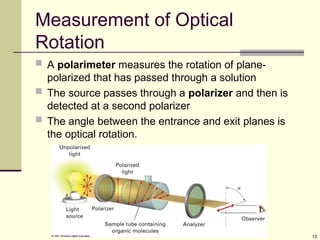
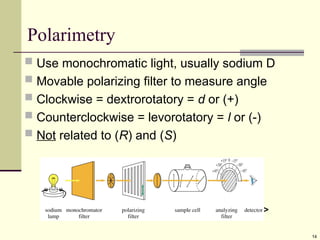
Measurement of Optical
Rotation
 A polarimeter measures the rotation of plane-
polarized that has passed through a solution
 The source passes through a polarizer and then is
detected at a second polarizer
 The angle between the entrance and exit planes is
the optical rotation.
14
Polarimetry
 Use monochromatic light, usually sodium D
 Movable polarizing filter to measure angle
 Clockwise = dextrorotatory = d or (+)
 Counterclockwise = levorotatory = l or (-)
 Not related to (R) and (S)
=>
15
Specific Rotation
 To have a basis for comparison, define specific
rotation, []D for an optically active compound
 []D = observed rotation/(pathlength x concentration)
= /(l x C) = degrees/(dm x g/mL)
 Specific rotation is that observed for 1 g/mL in
solution in cell with a 10 cm path using light from
sodium metal vapor (589 nm)
16
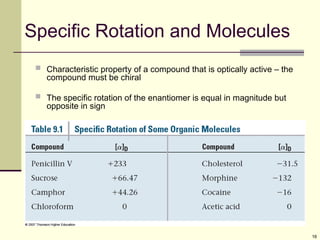
Specific Rotation and Molecules
 Characteristic property of a compound that is optically active – the
compound must be chiral
 The specific rotation of the enantiomer is equal in magnitude but
opposite in sign
17
9.5 Sequence Rules for
Specification of Configuration
 A general method applies to the configuration at each
chirality center (instead of to the whole molecule)
 The configuration is specified by the relative positions
of all the groups with respect to each other at the
chirality center
 The groups are ranked in an established priority
sequence and compared
 The relationship of the groups in priority order in
space determines the label applied to the
configuration, according to a rule
18
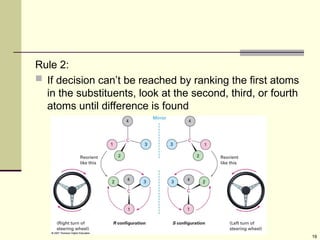
Sequence Rules (IUPAC)
Rule 1:
• Assign each group priority according to the Cahn
Ingold-Prelog scheme
• With the lowest priority group pointing away, look
at remaining 3 groups in a plane
• Clockwise is designated R (from Latin for “right”)
• Counterclockwise is designated S (from Latin word
for “left”)
19
Rule 2:
 If decision can’t be reached by ranking the first atoms
in the substituents, look at the second, third, or fourth
atoms until difference is found
20
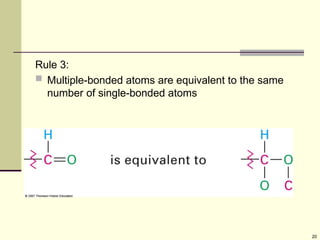
Rule 3:
 Multiple-bonded atoms are equivalent to the same
number of single-bonded atoms
21
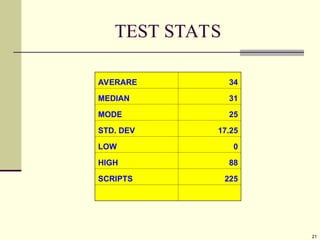
TEST STATS
AVERARE 34
MEDIAN 31
MODE 25
STD. DEV 17.25
LOW 0
HIGH 88
SCRIPTS 225
22
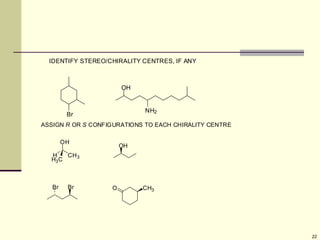
Br
OH
NH2
IDENTIFY STEREO/CHIRALITY CENTRES, IF ANY
OH
CH3
H
H3C
OH
ASSIGN R OR S CONFIGURATIONS TO EACH CHIRALITY CENTRE
Br Br O CH3
23
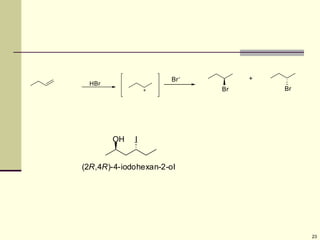
HBr
Br
+
Br
Br-
OH I
(2R,4R)-4-iodohexan-2-ol
24
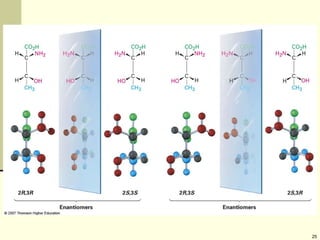
9.6 Diastereomers
 Molecules with more than one chirality center have
mirror image stereoisomers that are enantiomers
 In addition they can have stereoisomeric forms that are
not mirror images, called diastereomers
25
26
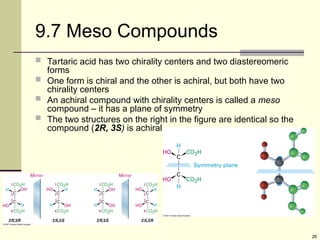
9.7 Meso Compounds
 Tartaric acid has two chirality centers and two diastereomeric
forms
 One form is chiral and the other is achiral, but both have two
chirality centers
 An achiral compound with chirality centers is called a meso
compound – it has a plane of symmetry
 The two structures on the right in the figure are identical so the
compound (2R, 3S) is achiral
27
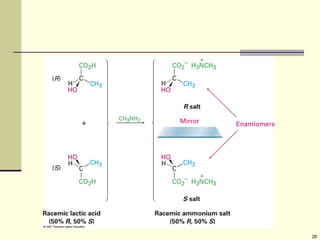
9.8 Racemic Mixtures and The
Resolution of Enantiomers
 A 50:50 mixture of two chiral compounds that are
mirror images does not rotate light – called a
racemic mixture (named for “racemic acid” that was
the double salt of (+) and (-) tartaric acid
 The pure compounds need to be separated or
resolved from the mixture (called a racemate)
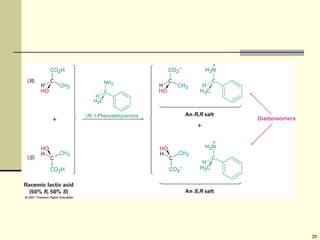
 To separate components of a racemate (reversibly)
we make a derivative of each with a chiral substance
that is free of its enantiomer (resolving agent)
 This gives diastereomers that are separated by their
differing solubility
 The resolving agent is then removed
28
29
30
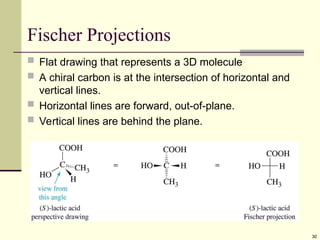
Fischer Projections
 Flat drawing that represents a 3D molecule
 A chiral carbon is at the intersection of horizontal and
vertical lines.
 Horizontal lines are forward, out-of-plane.
 Vertical lines are behind the plane.
31
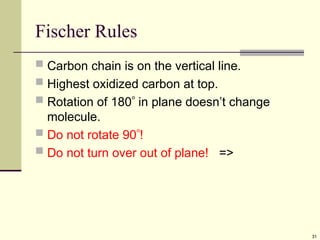
Fischer Rules
 Carbon chain is on the vertical line.
 Highest oxidized carbon at top.
 Rotation of 180 in plane doesn’t change
molecule.
 Do not rotate 90!
 Do not turn over out of plane! =>
32
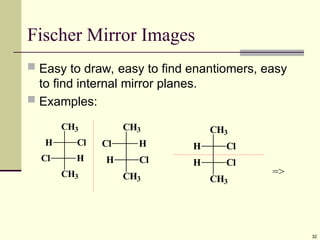
Fischer Mirror Images
 Easy to draw, easy to find enantiomers, easy
to find internal mirror planes.
 Examples:
CH3
H Cl
Cl H
CH3
CH3
Cl H
H Cl
CH3
CH3
H Cl
H Cl
CH3
=>
33
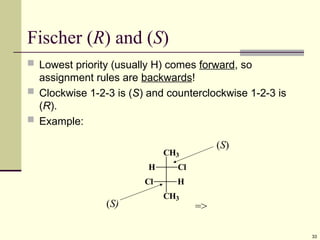
Fischer (R) and (S)
 Lowest priority (usually H) comes forward, so
assignment rules are backwards!
 Clockwise 1-2-3 is (S) and counterclockwise 1-2-3 is
(R).
 Example:
CH3
H Cl
Cl H
CH3
(S)
(S) =>
34
Diastereomers
 Stereoisomers that are not mirror images.
 Geometric isomers (cis-trans)
 Molecules with 2 or more chiral carbons.
=>
35
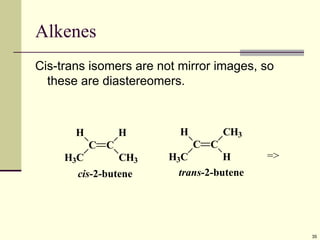
Alkenes
Cis-trans isomers are not mirror images, so
these are diastereomers.
C C
H H
CH3
H3C
cis-2-butene trans-2-butene
C C
H
H3C
CH3
H =>
36
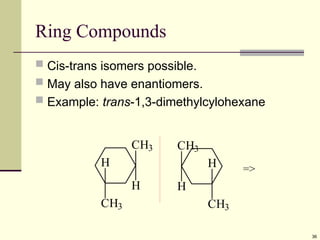
Ring Compounds
 Cis-trans isomers possible.
 May also have enantiomers.
 Example: trans-1,3-dimethylcylohexane
CH3
H
H
CH3
CH3
H
H
CH3
=>
37
Two or More Chiral Carbons
 Enantiomer? Diastereomer? Meso? Assign (R) or
(S) to each chiral carbon.
 Enantiomers have opposite configurations at each
corresponding chiral carbon.
 Diastereomers have some matching, some opposite
configurations.
 Meso compounds have internal mirror plane.
 Maximum number is 2n
, where n = the number of
chiral carbons.
=>
38
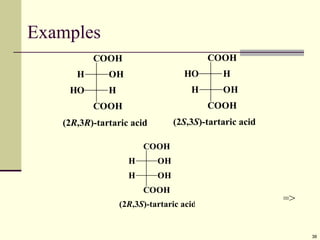
Examples
COOH
H OH
HO H
COOH
(2R,3R)-tartaric acid
COOH
COOH
HO H
H OH
(2S,3S)-tartaric acid
=>
(2R,3S)-tartaric acid
COOH
COOH
H OH
H OH
39
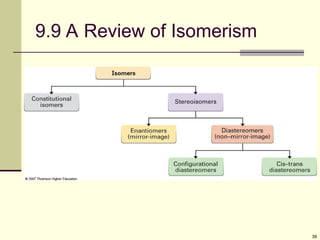
9.9 A Review of Isomerism
 The flowchart summarizes the types of isomers we
have seen
40
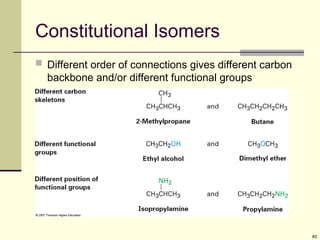
Constitutional Isomers
 Different order of connections gives different carbon
backbone and/or different functional groups
41
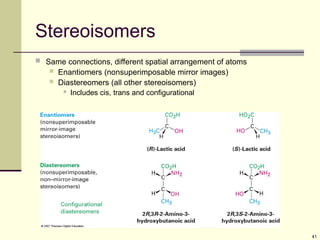
Stereoisomers
 Same connections, different spatial arrangement of atoms
 Enantiomers (nonsuperimposable mirror images)
 Diastereomers (all other stereoisomers)
 Includes cis, trans and configurational

STEREOCHEMISTRY 1 for year 2 stdents.ppt

  • 1.
    6. Stereochemistry Based onMcMurry’s Organic Chemistry, 7th edition
  • 2.
    2 Stereochemistry  Some objectsare not the same as their mirror images (technically, they have no plane of symmetry)  A right-hand glove is different than a left- hand glove. The property is commonly called “handedness”  Organic molecules (including many drugs) have handedness that results from substitution patterns on sp3 hybridized carbon
  • 3.
    3 Why this Chapter? Handedness is important in organic and biochemistry  Molecular handedness makes possible specific interactions between enzymes and substrates  Stereochemistry looks at 3-D structures of molecules
  • 4.
    4 9.1 Enantiomers andthe Tetrahedral Carbon  Enantiomers are molecules that are not the same as their mirror image  They are the “same” if the positions of the atoms can coincide on a one-to-one basis (we test if they are superimposable, which is imaginary)  This is illustrated by enantiomers of lactic acid
  • 5.
    5 Examples of Enantiomers Molecules that have one carbon with 4 different substituents have a nonsuperimposable mirror image – enantiomer
  • 6.
    6 9.2 The Reasonfor Handedness: Chirality  Molecules that are not superimposable with their mirror images are chiral (have handedness)  A plane of symmetry divides an entire molecule into two pieces that are exact mirror images  A molecule with a plane of symmetry is the same as its mirror image and is said to be achiral
  • 7.
    7 Chirality  If anobject has a plane of symmetry it is necessarily the same as its mirror image  The lack of a plane of symmetry is called “handedness”, chirality  Hands, gloves are prime examples of chiral object  They have a “left” and a “right” version
  • 8.
    8 Plane of Symmetry The plane has the same thing on both sides for the flask  There is no mirror plane for a hand
  • 9.
    9 Chirality Centers  Apoint in a molecule where four different groups (or atoms) are attached to carbon is called a chirality center  There are two nonsuperimposable ways that 4 different different groups (or atoms) can be attached to one carbon atom  If two groups are the same, then there is only one way  A chiral molecule usually has at least one chirality center
  • 10.
    10 Chirality Centers inChiral Molecules  Groups are considered “different” if there is any structural variation (if the groups could not be superimposed if detached, they are different)  In cyclic molecules, we compare by following in each direction in a ring
  • 11.
    11 9.3 Optical Activity Light restricted to pass through a plane is plane- polarized  Plane-polarized light that passes through solutions of achiral compounds remains in that plane  Solutions of chiral compounds rotate plane-polarized light and the molecules are said to be optically active  Phenomenon discovered by Jean-Baptiste Biot in the early 19th century
  • 12.
    12 Optical Activity  Lightpasses through a plane polarizer  Plane polarized light is rotated in solutions of optically active compounds  Measured with polarimeter  Rotation, in degrees, is []  Clockwise rotation is called dextrorotatory  Anti-clockwise is levorotatory
  • 13.
    13 Measurement of Optical Rotation A polarimeter measures the rotation of plane- polarized that has passed through a solution  The source passes through a polarizer and then is detected at a second polarizer  The angle between the entrance and exit planes is the optical rotation.
  • 14.
    14 Polarimetry  Use monochromaticlight, usually sodium D  Movable polarizing filter to measure angle  Clockwise = dextrorotatory = d or (+)  Counterclockwise = levorotatory = l or (-)  Not related to (R) and (S) =>
  • 15.
    15 Specific Rotation  Tohave a basis for comparison, define specific rotation, []D for an optically active compound  []D = observed rotation/(pathlength x concentration) = /(l x C) = degrees/(dm x g/mL)  Specific rotation is that observed for 1 g/mL in solution in cell with a 10 cm path using light from sodium metal vapor (589 nm)
  • 16.
    16 Specific Rotation andMolecules  Characteristic property of a compound that is optically active – the compound must be chiral  The specific rotation of the enantiomer is equal in magnitude but opposite in sign
  • 17.
    17 9.5 Sequence Rulesfor Specification of Configuration  A general method applies to the configuration at each chirality center (instead of to the whole molecule)  The configuration is specified by the relative positions of all the groups with respect to each other at the chirality center  The groups are ranked in an established priority sequence and compared  The relationship of the groups in priority order in space determines the label applied to the configuration, according to a rule
  • 18.
    18 Sequence Rules (IUPAC) Rule1: • Assign each group priority according to the Cahn Ingold-Prelog scheme • With the lowest priority group pointing away, look at remaining 3 groups in a plane • Clockwise is designated R (from Latin for “right”) • Counterclockwise is designated S (from Latin word for “left”)
  • 19.
    19 Rule 2:  Ifdecision can’t be reached by ranking the first atoms in the substituents, look at the second, third, or fourth atoms until difference is found
  • 20.
    20 Rule 3:  Multiple-bondedatoms are equivalent to the same number of single-bonded atoms
  • 21.
    21 TEST STATS AVERARE 34 MEDIAN31 MODE 25 STD. DEV 17.25 LOW 0 HIGH 88 SCRIPTS 225
  • 22.
    22 Br OH NH2 IDENTIFY STEREO/CHIRALITY CENTRES,IF ANY OH CH3 H H3C OH ASSIGN R OR S CONFIGURATIONS TO EACH CHIRALITY CENTRE Br Br O CH3
  • 23.
  • 24.
    24 9.6 Diastereomers  Moleculeswith more than one chirality center have mirror image stereoisomers that are enantiomers  In addition they can have stereoisomeric forms that are not mirror images, called diastereomers
  • 25.
  • 26.
    26 9.7 Meso Compounds Tartaric acid has two chirality centers and two diastereomeric forms  One form is chiral and the other is achiral, but both have two chirality centers  An achiral compound with chirality centers is called a meso compound – it has a plane of symmetry  The two structures on the right in the figure are identical so the compound (2R, 3S) is achiral
  • 27.
    27 9.8 Racemic Mixturesand The Resolution of Enantiomers  A 50:50 mixture of two chiral compounds that are mirror images does not rotate light – called a racemic mixture (named for “racemic acid” that was the double salt of (+) and (-) tartaric acid  The pure compounds need to be separated or resolved from the mixture (called a racemate)  To separate components of a racemate (reversibly) we make a derivative of each with a chiral substance that is free of its enantiomer (resolving agent)  This gives diastereomers that are separated by their differing solubility  The resolving agent is then removed
  • 28.
  • 29.
  • 30.
    30 Fischer Projections  Flatdrawing that represents a 3D molecule  A chiral carbon is at the intersection of horizontal and vertical lines.  Horizontal lines are forward, out-of-plane.  Vertical lines are behind the plane.
  • 31.
    31 Fischer Rules  Carbonchain is on the vertical line.  Highest oxidized carbon at top.  Rotation of 180 in plane doesn’t change molecule.  Do not rotate 90!  Do not turn over out of plane! =>
  • 32.
    32 Fischer Mirror Images Easy to draw, easy to find enantiomers, easy to find internal mirror planes.  Examples: CH3 H Cl Cl H CH3 CH3 Cl H H Cl CH3 CH3 H Cl H Cl CH3 =>
  • 33.
    33 Fischer (R) and(S)  Lowest priority (usually H) comes forward, so assignment rules are backwards!  Clockwise 1-2-3 is (S) and counterclockwise 1-2-3 is (R).  Example: CH3 H Cl Cl H CH3 (S) (S) =>
  • 34.
    34 Diastereomers  Stereoisomers thatare not mirror images.  Geometric isomers (cis-trans)  Molecules with 2 or more chiral carbons. =>
  • 35.
    35 Alkenes Cis-trans isomers arenot mirror images, so these are diastereomers. C C H H CH3 H3C cis-2-butene trans-2-butene C C H H3C CH3 H =>
  • 36.
    36 Ring Compounds  Cis-transisomers possible.  May also have enantiomers.  Example: trans-1,3-dimethylcylohexane CH3 H H CH3 CH3 H H CH3 =>
  • 37.
    37 Two or MoreChiral Carbons  Enantiomer? Diastereomer? Meso? Assign (R) or (S) to each chiral carbon.  Enantiomers have opposite configurations at each corresponding chiral carbon.  Diastereomers have some matching, some opposite configurations.  Meso compounds have internal mirror plane.  Maximum number is 2n , where n = the number of chiral carbons. =>
  • 38.
    38 Examples COOH H OH HO H COOH (2R,3R)-tartaricacid COOH COOH HO H H OH (2S,3S)-tartaric acid => (2R,3S)-tartaric acid COOH COOH H OH H OH
  • 39.
    39 9.9 A Reviewof Isomerism  The flowchart summarizes the types of isomers we have seen
  • 40.
    40 Constitutional Isomers  Differentorder of connections gives different carbon backbone and/or different functional groups
  • 41.
    41 Stereoisomers  Same connections,different spatial arrangement of atoms  Enantiomers (nonsuperimposable mirror images)  Diastereomers (all other stereoisomers)  Includes cis, trans and configurational