Healthy Eating
Covers part of Science
Unit 5a: Keeping Healthy


          by Mrs. Chapman, 2005
         Greet School, Birmingham
Introduction
A Healthy Diet and Our Body
Healthy Eating Pyramid
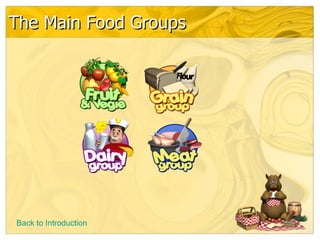
The Main Food Groups
Fruit and Vegetables
Grains and Pulses
Dairy Products
Starches, Sugars and Fats
Vitamins and Minerals
Reading the Labels on Foods
Healthy Eating Myths
Links for further study
A Healthy Diet and Our Body
If our bodies are human machines food is
our fuel. How well we eat, affects how
well our bodies work, and how long we live.

It is especially important that we eat
heathily as children, as we are still growing
and developing; a young plant not given
proper nutrients grows up to be a poor
specimen .                                     Foodie fact
A healthy diet is sometimes called a       C h ild r e n t h a t
balanced diet as it needs to consist of    e a t b re a k fa s t
different types of foods.                     g e t b e tte r
                                               s c o r e s in
Eating properly and regularly is really       te s ts tha n
important; what we eat and drink now,       c h ild r e n t h a t
affects our health in the future.                d o n’ t!
Back to Introduction
Healthy Eating Pyramid


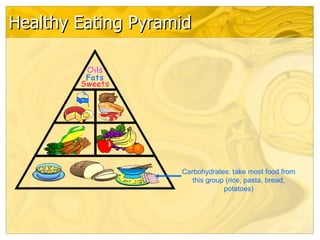
                    Carbohydrates: take most food from
                       this group (rice, pasta, bread,
                                 potatoes)
Healthy Eating Pyramid


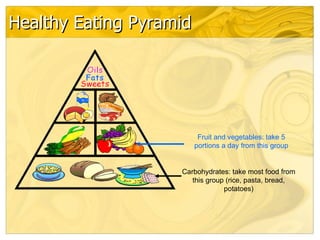
                          Fruit and vegetables: take 5
                         portions a day from this group


                    Carbohydrates: take most food from
                       this group (rice, pasta, bread,
                                 potatoes)
Healthy Eating Pyramid


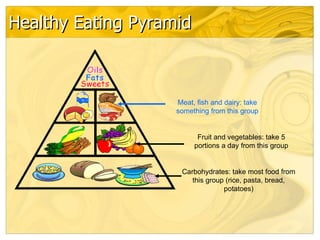
                    Meat, fish and dairy: take
                    something from this group


                          Fruit and vegetables: take 5
                         portions a day from this group


                     Carbohydrates: take most food from
                        this group (rice, pasta, bread,
                                  potatoes)
Healthy Eating Pyramid

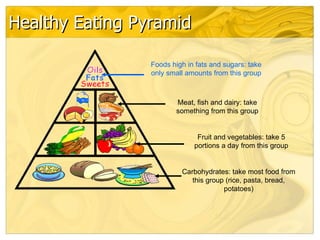
                 Foods high in fats and sugars: take
                 only small amounts from this group


                         Meat, fish and dairy: take
                         something from this group


                               Fruit and vegetables: take 5
                              portions a day from this group


                          Carbohydrates: take most food from
                             this group (rice, pasta, bread,
                                       potatoes)
The Main Food Groups


Back to Introduction
Fruit and Vegetables
Fruits and vegetables grow
on plants: underground, on
the ground or in trees.        Take
Every day we should eat at    5 a day
least 5 portions of fruit
and vegetables. (A portion   everyday!
is about a handful.)
Fruit and vegetables give
us fibre and vitamins and
minerals.


Back to Main Food Groups
Grains and Pulses
This food group includes
wheat, corn, barley, rice,
lentils, beans etc.
                                   What is..?
These are all from plants          R ic e is t h e
and form a staple part of       s t a p le f o o d in
                               C h in a a n d m u c h
the diet for people all over      o f the E a s t.
the world.                     W h a t is it in t h e
                               We s t (UK , US A )?
Grains and pulses give us
carbohydrates and proteins.
Nuts are another source of
protein.
Back to Main Food Groups
Grains and Pulses
This food group includes
wheat, corn, barley, rice,
lentils, beans etc.
                                     Answer
These are all from plants      Wh e a t. We e a t
and form a staple part of          it in b r e a d ,
                               p a s t a , c e r e a ls ,
the diet for people all over   c a k e s , b is c u it s
the world.                     a n d it ’ s a d d e d
                                t o a ll s o r t s o f
Grains and pulses give us              fo o d s .
carbohydrates and proteins.
Nuts are another source of
protein.
Back to Main Food Groups
Dairy Products
Dairy foods are made from milk (usually
cow’s milk, but can be from other animals
like goats or sheep). Dairy foods give us
proteins and fats. They are also a good
source of calcium which is good for bones
and teeth.
These foods include:             Weird fact
•Cheese (hard, soft, cottage);    Our brains
•Yogurt;                         are 80% fat.
•Food high in milk or milk products.

Back to Main Food Groups
Meat, Fish and Eggs
The main nutrients derived from meat are
proteins, but it also gives us fats and some
minerals.
The meat and fish group includes:
                                           Foodie fact
•Chicken and all poultry;
                                  S u s h i ( r a w f is h )
•Fish and shellfish;                is n o w M a r k s
                                  a nd S pe nc e r’ s
•Beef, pork and lamb.                b e s t -s e llin g
                                       lu n c h t im e
•Eggs are included in this group too. s n a c k .
Athletes eat lots of protein; they help to
build muscles.
Back to Main Food Groups
Starches, Sugars and Fats
Sometimes foods are classified into starches, sugars and
fats. Starches includes foods like potatoes and provide
mainly carbohydrates. Carbohydrates give us the energy
to carry on with our day-to-day lives.
Foods high in sugars include those naturally occurring as
in fruit, and those containing refined/processed sugars
such as sweets, chocolates, cakes etc. We need to limit
our intake of refined sugars – these are empty calories
which give an immediate ‘boost’.
A small amount of fat is important for health, but eating
too much fat is unhealthy. It leads to clogged arteries
(restricted blood supply), high cholesterol and becoming
overweight.


Back to Introduction
Vitamins and Minerals
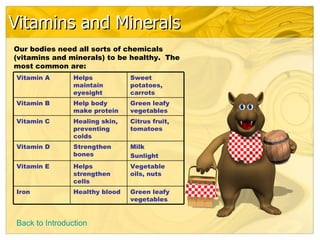
Our bodies need all sorts of chemicals
(vitamins and minerals) to be healthy. The
most common are:
Vitamin A       Helps           Sweet
                maintain        potatoes,
                eyesight        carrots
Vitamin B       Help body       Green leafy
                make protein    vegetables
Vitamin C       Healing skin,   Citrus fruit,
                preventing      tomatoes
                colds
Vitamin D       Strengthen      Milk
                bones           Sunlight
Vitamin E       Helps           Vegetable
                strengthen      oils, nuts
                cells
Iron            Healthy blood   Green leafy
                                vegetables


Back to Introduction
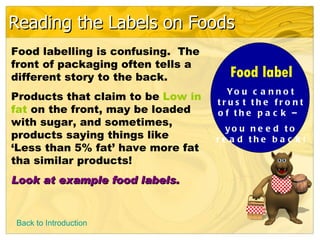
Reading the Labels on Foods
Food labelling is confusing. The
front of packaging often tells a
different story to the back.          Food label
                                     Yo u c a n n o t
Products that claim to be Low in   tru s t th e fro n t
fat on the front, may be loaded    o f the p a c k –
with sugar, and sometimes,
                                     yo u n e e d to
products saying things like        re a d the b a c k !
‘Less than 5% fat’ have more fat
tha similar products!
Look at example food labels.


Back to Introduction
Healthy Eating Myths

            It doesn’t matter
            what I eat as long
              as I do lots of
                exercise.


Back to Introduction
Healthy Eating Myths

            It doesn’t matter
            what I eat as long
              as I do lots of
                exercise.
     Wrong! Exercise is good
     for you, but it still matters
      what you eat. Eating the
     right foods means we can
      learn better and exercise
              better too!
Back to Introduction
Healthy Eating Myths


                       Chocolate is
                       bad for you!


Back to Introduction
Healthy Eating Myths


                       Chocolate is
                       bad for you!
    It’s true that chocolate isn’t the
       healthiest snack – but it isn’t
     innately bad either! So, some
        chocolate can be part of a
        balanced diet. Plain (dark)
        chocolate is better for you
      thank milk; it is higher in iron.
Back to Introduction
Healthy Eating Myths

             Chewing and
          digesting a stick of
         celery uses up more
         energy than you get
            from the food.


Back to Introduction
Healthy Eating Myths

           Chewing and
        digesting a stick of
       celery uses up more
       energy than you get
          from the food.
     This sounds good, but
      unfortunately it isn’t
              true!


Back to Introduction
Links for further study
http://www.bbc.co.uk/northernireland/schools/4_11/uptoyou/
http://www.lifebytes.gov.uk/teachers/lb_teachers-eat.htm
Healthy eating and wired for health sites by the government – links to appropriate ages:

http://www.wiredforhealth.gov.uk/cat.php?catid=886&docid=7219
Food Standards Agency, 5 a day the Bash Street Way aimed at 7-11:

http://www.food.gov.uk/interactivetools/educational/bashstreetdiet/
http://www.eatwell.gov.uk/foodlabels/
http://kidshealth.org/kid/stay_healthy/food/vitamin.html
http://www.dole5aday.com/MusicAndPlay/M_Games.jsp?topmenu=6
Flash game ‘identify the fruit’, interactive, suitable whiteboard, aimed at year 2:

http://www.elllo.org/yeartwo/jan17th/vivian/fruit.htm


 Back to Introduction

Healthy eating sc

  • 1.
    Healthy Eating Covers partof Science Unit 5a: Keeping Healthy by Mrs. Chapman, 2005 Greet School, Birmingham
  • 2.
    Introduction A Healthy Dietand Our Body Healthy Eating Pyramid The Main Food Groups Fruit and Vegetables Grains and Pulses Dairy Products Starches, Sugars and Fats Vitamins and Minerals Reading the Labels on Foods Healthy Eating Myths Links for further study
  • 3.
    A Healthy Dietand Our Body If our bodies are human machines food is our fuel. How well we eat, affects how well our bodies work, and how long we live. It is especially important that we eat heathily as children, as we are still growing and developing; a young plant not given proper nutrients grows up to be a poor specimen . Foodie fact A healthy diet is sometimes called a C h ild r e n t h a t balanced diet as it needs to consist of e a t b re a k fa s t different types of foods. g e t b e tte r s c o r e s in Eating properly and regularly is really te s ts tha n important; what we eat and drink now, c h ild r e n t h a t affects our health in the future. d o n’ t! Back to Introduction
  • 4.
    Healthy Eating Pyramid Carbohydrates: take most food from this group (rice, pasta, bread, potatoes)
  • 5.
    Healthy Eating Pyramid Fruit and vegetables: take 5 portions a day from this group Carbohydrates: take most food from this group (rice, pasta, bread, potatoes)
  • 6.
    Healthy Eating Pyramid Meat, fish and dairy: take something from this group Fruit and vegetables: take 5 portions a day from this group Carbohydrates: take most food from this group (rice, pasta, bread, potatoes)
  • 7.
    Healthy Eating Pyramid Foods high in fats and sugars: take only small amounts from this group Meat, fish and dairy: take something from this group Fruit and vegetables: take 5 portions a day from this group Carbohydrates: take most food from this group (rice, pasta, bread, potatoes)
  • 8.
    The Main FoodGroups Back to Introduction
  • 9.
    Fruit and Vegetables Fruitsand vegetables grow on plants: underground, on the ground or in trees. Take Every day we should eat at 5 a day least 5 portions of fruit and vegetables. (A portion everyday! is about a handful.) Fruit and vegetables give us fibre and vitamins and minerals. Back to Main Food Groups
  • 10.
    Grains and Pulses Thisfood group includes wheat, corn, barley, rice, lentils, beans etc. What is..? These are all from plants R ic e is t h e and form a staple part of s t a p le f o o d in C h in a a n d m u c h the diet for people all over o f the E a s t. the world. W h a t is it in t h e We s t (UK , US A )? Grains and pulses give us carbohydrates and proteins. Nuts are another source of protein. Back to Main Food Groups
  • 11.
    Grains and Pulses Thisfood group includes wheat, corn, barley, rice, lentils, beans etc. Answer These are all from plants Wh e a t. We e a t and form a staple part of it in b r e a d , p a s t a , c e r e a ls , the diet for people all over c a k e s , b is c u it s the world. a n d it ’ s a d d e d t o a ll s o r t s o f Grains and pulses give us fo o d s . carbohydrates and proteins. Nuts are another source of protein. Back to Main Food Groups
  • 12.
    Dairy Products Dairy foodsare made from milk (usually cow’s milk, but can be from other animals like goats or sheep). Dairy foods give us proteins and fats. They are also a good source of calcium which is good for bones and teeth. These foods include: Weird fact •Cheese (hard, soft, cottage); Our brains •Yogurt; are 80% fat. •Food high in milk or milk products. Back to Main Food Groups
  • 13.
    Meat, Fish andEggs The main nutrients derived from meat are proteins, but it also gives us fats and some minerals. The meat and fish group includes: Foodie fact •Chicken and all poultry; S u s h i ( r a w f is h ) •Fish and shellfish; is n o w M a r k s a nd S pe nc e r’ s •Beef, pork and lamb. b e s t -s e llin g lu n c h t im e •Eggs are included in this group too. s n a c k . Athletes eat lots of protein; they help to build muscles. Back to Main Food Groups
  • 14.
    Starches, Sugars andFats Sometimes foods are classified into starches, sugars and fats. Starches includes foods like potatoes and provide mainly carbohydrates. Carbohydrates give us the energy to carry on with our day-to-day lives. Foods high in sugars include those naturally occurring as in fruit, and those containing refined/processed sugars such as sweets, chocolates, cakes etc. We need to limit our intake of refined sugars – these are empty calories which give an immediate ‘boost’. A small amount of fat is important for health, but eating too much fat is unhealthy. It leads to clogged arteries (restricted blood supply), high cholesterol and becoming overweight. Back to Introduction
  • 15.
    Vitamins and Minerals Ourbodies need all sorts of chemicals (vitamins and minerals) to be healthy. The most common are: Vitamin A Helps Sweet maintain potatoes, eyesight carrots Vitamin B Help body Green leafy make protein vegetables Vitamin C Healing skin, Citrus fruit, preventing tomatoes colds Vitamin D Strengthen Milk bones Sunlight Vitamin E Helps Vegetable strengthen oils, nuts cells Iron Healthy blood Green leafy vegetables Back to Introduction
  • 16.
    Reading the Labelson Foods Food labelling is confusing. The front of packaging often tells a different story to the back. Food label Yo u c a n n o t Products that claim to be Low in tru s t th e fro n t fat on the front, may be loaded o f the p a c k – with sugar, and sometimes, yo u n e e d to products saying things like re a d the b a c k ! ‘Less than 5% fat’ have more fat tha similar products! Look at example food labels. Back to Introduction
  • 17.
    Healthy Eating Myths It doesn’t matter what I eat as long as I do lots of exercise. Back to Introduction
  • 18.
    Healthy Eating Myths It doesn’t matter what I eat as long as I do lots of exercise. Wrong! Exercise is good for you, but it still matters what you eat. Eating the right foods means we can learn better and exercise better too! Back to Introduction
  • 19.
    Healthy Eating Myths Chocolate is bad for you! Back to Introduction
  • 20.
    Healthy Eating Myths Chocolate is bad for you! It’s true that chocolate isn’t the healthiest snack – but it isn’t innately bad either! So, some chocolate can be part of a balanced diet. Plain (dark) chocolate is better for you thank milk; it is higher in iron. Back to Introduction
  • 21.
    Healthy Eating Myths Chewing and digesting a stick of celery uses up more energy than you get from the food. Back to Introduction
  • 22.
    Healthy Eating Myths Chewing and digesting a stick of celery uses up more energy than you get from the food. This sounds good, but unfortunately it isn’t true! Back to Introduction
  • 23.
    Links for furtherstudy http://www.bbc.co.uk/northernireland/schools/4_11/uptoyou/ http://www.lifebytes.gov.uk/teachers/lb_teachers-eat.htm Healthy eating and wired for health sites by the government – links to appropriate ages: http://www.wiredforhealth.gov.uk/cat.php?catid=886&docid=7219 Food Standards Agency, 5 a day the Bash Street Way aimed at 7-11: http://www.food.gov.uk/interactivetools/educational/bashstreetdiet/ http://www.eatwell.gov.uk/foodlabels/ http://kidshealth.org/kid/stay_healthy/food/vitamin.html http://www.dole5aday.com/MusicAndPlay/M_Games.jsp?topmenu=6 Flash game ‘identify the fruit’, interactive, suitable whiteboard, aimed at year 2: http://www.elllo.org/yeartwo/jan17th/vivian/fruit.htm Back to Introduction