Management Information
       Systems

       Terry DeGroff
      Burwell, Nebraska


  Books, Records & Controls
Management is…

• Planning, organizing, directing, and
  controlling a business. The most
  important and challenging is control…
  the process of analyzing, evaluating
  and interpreting the production and
  financial performance of a business.
Information…
• Can and does come from many
  sources. Some of the best and
  most needed information can come
  from each business’ own financial
  and production records.
Systems…

• Need to be implemented that allow
  for only necessary record keeping
  and effective use of records.
  Summary information from these
  records should be invaluable in day
  to day business decisions.
Management
• Planning
• Organizing
• Directing
• Controlling
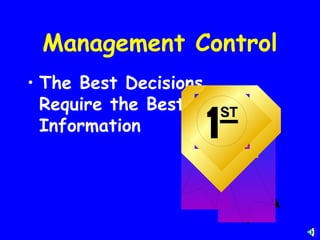
Management Control
• The Best Decisions
  Require the Best
  Information
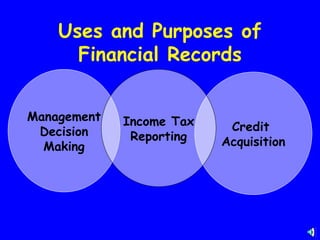
Uses and Purposes of
      Financial Records


Management   Income Tax
 Decision                  Credit
              Reporting   Acquisition
  Making
Keys to Successful
  Record Keeping
Keys to Successful Record
         Keeping
• Simple yet Useful
Keys to Successful Record
         Keeping
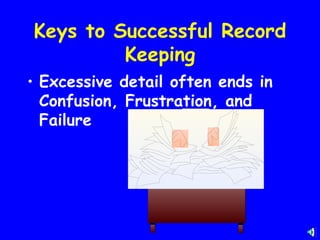
• Excessive detail often ends in
  Confusion, Frustration, and
  Failure
Keys to Successful Record
           Keeping
• Meet your Needs,
  Abilities, &
  Limitations
Keys to Successful Record
         Keeping
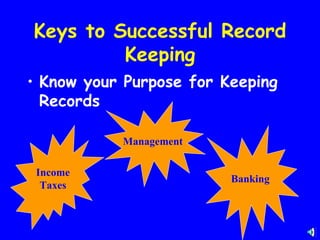
• Know your Purpose for Keeping
  Records

           Management

 Income
                         Banking
  Taxes
Accounting Rules
• Standards of Communication
Accounting Rules
• Generally Accepted Accounting
  Principles
  – (GAAP)
Keys to Successful Record
         Keeping
• Accurately Match Expenses with
  Income
Cash and Accrual
        Accounting
Refers to the timing of entries
 into the accounting system
Cash Based Records
Transactions are recorded when
 cash is received or paid out
Accrual Based Records
Transactions are recorded when
 they take place
Regardless of whether cash is
 involved
Accrual Adjusted
       Statements
Cash based records are kept
 throughout the year
Non-Cash adjustments are
 made to the cash based income
 statement at the end of the
 year
Accrual Adjusted Income
       Statement
 Cash incomes and expenses must be
  adjusted by:
  • Changes in non-cash assets
    • Inventories
    • Pre paid expenses
    • Receivables
  • Changes in non-cash liabilities
    • Payables
    • Accrued interest
Financial Analysis
          Requires
• Basic Set of Financial Statements
Basic Financial Statements

  •   Balance Sheet
  •   Income Statement
  •   Statement of Owner Equity
  •   Statement of Cash Flows
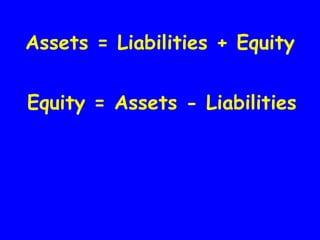
Assets = Liabilities + Equity


Equity = Assets - Liabilities
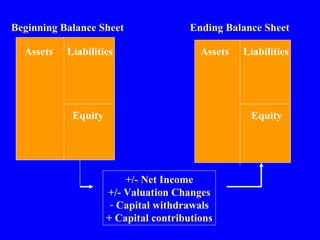
Beginning Balance Sheet                Ending Balance Sheet

  Assets   Liabilities                   Assets   Liabilities


            Equity                                 Equity


                         +/- Net Income
                     +/- Valuation Changes
                      - Capital withdrawals
                     + Capital contributions
Financial Analysis
          Requires
• Basic Set of Financial Statements

• Understanding of how to Analyze
  and Interpret the Financial
  Statements
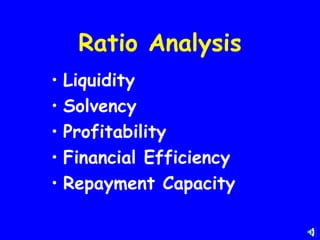
Ratio Analysis
• Liquidity
• Solvency
• Profitability
• Financial Efficiency
• Repayment Capacity
Financial Analysis
• Objectives
 – Measure Financial
   Condition
Financial Analysis
• Objectives
 – Measure Financial Condition
 – Measure Financial Performance
Financial Analysis
All business owners should have
 a basic set of financial
 statements at their disposal
 and they should know how to
 analyze and interpret them.
Profitable Management of the “Extensive”
                  Enterprise

• Forage-based cow/calf production has long represented a
  management paradox. Very high investment requirements per
  dollar of output provides a strong incentive to increase output
  per head (thereby reducing investment per dollar of output).
  Unfortunately, this ever-so-tempting objective has been
  regularly frustrated by the low economic responsiveness to
  performance enhancing technology. In short, it simple has not
  paid to manage beef cows or perennial grass with the same
  “intensity” as we do with more intensive enterprises like dairy
  cows, hogs, and row crops.
Profitable Management of the “Extensive”
                   Enterprise

•   In extensive enterprises (such as the commercial cow/calf business),
    we seldom find it profitable to maximize yield per acre or
    performance per animal. Rather than “pouring on the technology”, we
    must recognize the nature of the brute, live harmoniously with
    nature, and make a very discriminating use of yield or performance-
    enhancing technology. In brief---we generally have to finesse a
    profit.
Profitable Management of the “Extensive”
                   Enterprise

•   Output maximization may approximate optimal management for
    intensive enterprises. However, optimal management of the extensive
    enterprise comes closer to input minimization.


                                    V.E. Jacobs, 1984
A Paradox
• Farmers believe they benefit from
  agricultural technology…but they don’t
• Consumers don’t believe they benefit…but
  they do
Technology is….
• Productivity enhancing
• Management intensive
• Capital intensive
• Not scale neutral
The End

Accounting 1

  • 1.
    Management Information Systems Terry DeGroff Burwell, Nebraska Books, Records & Controls
  • 2.
    Management is… • Planning,organizing, directing, and controlling a business. The most important and challenging is control… the process of analyzing, evaluating and interpreting the production and financial performance of a business.
  • 3.
    Information… • Can anddoes come from many sources. Some of the best and most needed information can come from each business’ own financial and production records.
  • 4.
    Systems… • Need tobe implemented that allow for only necessary record keeping and effective use of records. Summary information from these records should be invaluable in day to day business decisions.
  • 5.
  • 6.
    Management Control • TheBest Decisions Require the Best Information
  • 7.
    Uses and Purposesof Financial Records Management Income Tax Decision Credit Reporting Acquisition Making
  • 8.
    Keys to Successful Record Keeping
  • 9.
    Keys to SuccessfulRecord Keeping • Simple yet Useful
  • 10.
    Keys to SuccessfulRecord Keeping • Excessive detail often ends in Confusion, Frustration, and Failure
  • 11.
    Keys to SuccessfulRecord Keeping • Meet your Needs, Abilities, & Limitations
  • 12.
    Keys to SuccessfulRecord Keeping • Know your Purpose for Keeping Records Management Income Banking Taxes
  • 13.
  • 14.
    Accounting Rules • GenerallyAccepted Accounting Principles – (GAAP)
  • 15.
    Keys to SuccessfulRecord Keeping • Accurately Match Expenses with Income
  • 16.
    Cash and Accrual Accounting Refers to the timing of entries into the accounting system
  • 17.
    Cash Based Records Transactionsare recorded when cash is received or paid out
  • 18.
    Accrual Based Records Transactionsare recorded when they take place Regardless of whether cash is involved
  • 19.
    Accrual Adjusted Statements Cash based records are kept throughout the year Non-Cash adjustments are made to the cash based income statement at the end of the year
  • 20.
    Accrual Adjusted Income Statement  Cash incomes and expenses must be adjusted by: • Changes in non-cash assets • Inventories • Pre paid expenses • Receivables • Changes in non-cash liabilities • Payables • Accrued interest
  • 21.
    Financial Analysis Requires • Basic Set of Financial Statements
  • 22.
    Basic Financial Statements • Balance Sheet • Income Statement • Statement of Owner Equity • Statement of Cash Flows
  • 23.
    Assets = Liabilities+ Equity Equity = Assets - Liabilities
  • 24.
    Beginning Balance Sheet Ending Balance Sheet Assets Liabilities Assets Liabilities Equity Equity +/- Net Income +/- Valuation Changes - Capital withdrawals + Capital contributions
  • 25.
    Financial Analysis Requires • Basic Set of Financial Statements • Understanding of how to Analyze and Interpret the Financial Statements
  • 26.
    Ratio Analysis • Liquidity •Solvency • Profitability • Financial Efficiency • Repayment Capacity
  • 27.
    Financial Analysis • Objectives – Measure Financial Condition
  • 28.
    Financial Analysis • Objectives – Measure Financial Condition – Measure Financial Performance
  • 29.
    Financial Analysis All businessowners should have a basic set of financial statements at their disposal and they should know how to analyze and interpret them.
  • 30.
    Profitable Management ofthe “Extensive” Enterprise • Forage-based cow/calf production has long represented a management paradox. Very high investment requirements per dollar of output provides a strong incentive to increase output per head (thereby reducing investment per dollar of output). Unfortunately, this ever-so-tempting objective has been regularly frustrated by the low economic responsiveness to performance enhancing technology. In short, it simple has not paid to manage beef cows or perennial grass with the same “intensity” as we do with more intensive enterprises like dairy cows, hogs, and row crops.
  • 31.
    Profitable Management ofthe “Extensive” Enterprise • In extensive enterprises (such as the commercial cow/calf business), we seldom find it profitable to maximize yield per acre or performance per animal. Rather than “pouring on the technology”, we must recognize the nature of the brute, live harmoniously with nature, and make a very discriminating use of yield or performance- enhancing technology. In brief---we generally have to finesse a profit.
  • 32.
    Profitable Management ofthe “Extensive” Enterprise • Output maximization may approximate optimal management for intensive enterprises. However, optimal management of the extensive enterprise comes closer to input minimization. V.E. Jacobs, 1984
  • 33.
    A Paradox • Farmersbelieve they benefit from agricultural technology…but they don’t • Consumers don’t believe they benefit…but they do
  • 34.
    Technology is…. • Productivityenhancing • Management intensive • Capital intensive • Not scale neutral
  • 35.