Managing the Multibusiness Corporation Structure of the Multidivisional Company Theory of the M- f orm The divisionalized firm in practice The Role of Corporate Management Managing the Corporate Portfolio Portfolio planning techniques Value- creation through  corporate restructuring Managing Individual Businesses Managing Internal Linkages Recent Trends OUTLINE
The Multidivisional Structure:  Theory of the M-Form Efficiency advantages of the multidivisional firm: Recognizes  bounded rationality— top management has limited decision-making capacity Divides decision-making according to frequency: — high-frequency operating decisions at divisional level — low-frequency strategic decisions at corporate level Reduces costs of communication and coordination: business level decisions confined to divisional level (reduces decision making at the top) Global, rather than local optimization:- functional organizations encourage functional goals. M-form structure encourages focus on profitability. Efficient allocation of resources through internal capital and labor markets Resolves agency problem-- corporate management an interface between shareholders and business-level managers.
The Divisionalized Firm in Practice Constraints upon decentralization .  Difficult to  achieve clear division of decision making between corporate and  divisional levels.  On-going dialogue and conflict between corporate and divisional managers over both strategic and operational issues. Standardization of divisional management Despite potential for divisions to  develop distinctive  strategies  and  structures — corporate systems may impose uniformity. Managing divisional inter-relationships Requires  more complex structures ,  e.g. matrix structures where functional and/or geographical structure is imposed on top of a product/market structure. Added complexity undermines the efficiency advantages of the M-form
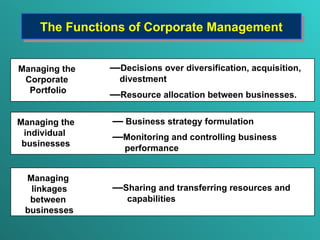
The Functions of Corporate Management — Decisions over diversification , acquisition,   divestment  — R esource allocati o n between businesses.   —   B usiness strategy formulation   — Monitoring and controlling  business   performance   — Sharing and transferring resources and   capabilities Managing  linkages between  businesses Managing the individual  businesses Managing the  Corporate  Portfolio
The Development of Strategic Planning Techniques: General Electric in the 1970’s L ate 19 6 0’s: GE encounter s  problems of direction ,  coordination, control ,  and profitability Corporate planning responses: Portfolio Planning Models   — matrix-based frameworks for  evaluating business  unit performance, formulating business strategies, and allocating resources Strategic Business Units   — GE reorganized around SBUs ( business comprising a strategically-distinct group of closely-related products  PIMS   — a database which quantifies the impact of strategy on performance. Used to appraise SBU  performance and guide business strategy formulation
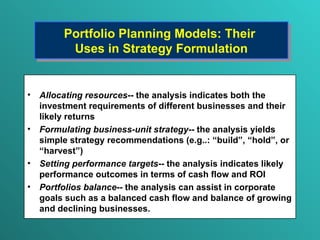
Portfolio Planning Models: Their  Uses in Strategy Formulation Allocating resources -- the analysis indicates both the investment requirements of different businesses and their likely returns Formulating business-unit strategy -- the analysis yields simple strategy recommendations (e.g..: “build”, “hold”, or “harvest”) Setting performance targets -- the analysis indicates likely performance outcomes in terms of cash flow and ROI Portfolios balance -- the analysis can assist in corporate  goals such as a balanced cash flow and balance of growing and declining businesses.
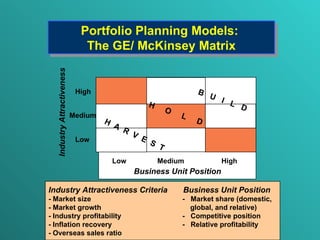
Portfolio Planning Models:  The GE/ McKinsey Matrix H  A   R   V   E   S  T H  O   L   D B   U   I   L   D Low Medium High Low Medium High Industry Attractiveness Industry Attractiveness Criteria  Business Unit Position  - Market size    -  Market share (domestic, - Market growth   global, and relative) - Industry profitability   -  Competitive position - Inflation recovery   -  Relative profitability - Overseas sales ratio Business Unit Position
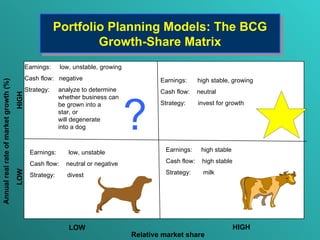
Portfolio Planning Models: The BCG Growth-Share Matrix HIGH LOW LOW Annual real rate of market growth (%) Relative market share Earnings:   high stable Cash flow:  high stable Strategy:  milk Earnings:  low, unstable Cash flow:  neutral or negative Strategy:  divest Earnings:  high stable, growing Cash flow:  neutral Strategy:  invest for growth Earnings:  low, unstable, growing Cash flow:  negative Strategy:  analyze to determine   whether business can   be grown into a     star, or       will degenerate      into a dog HIGH ?
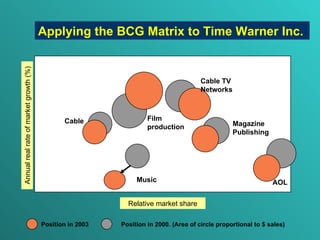
Annual real rate of market growth (%) Relative market share - 8   -4   0   4  8   12 Bakery division P osition  in 2003 Position  in 2000 .  ( Area of circle proportional to $ sales ) Applying the BCG Matrix to  Time Warner  Inc.   AOL Film production Cable Cable TV Networks Music Magazine Publishing
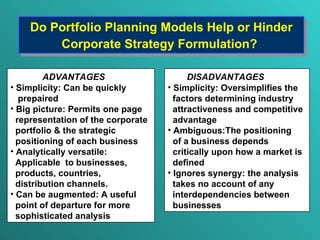
Do Portfolio Planning Models Help or Hinder Corporate Strategy Formulation?   ADVANTAGES Simplicity: Can be quickly prepaired Big picture: Permits one page  representation of the corporate portfolio & the strategic positioning of each business Analytically versatile:  Applicable  to businesses, products, countries,  distribution channels. Can be augmented: A useful point of departure for more sophisticated analysis DISADVANTAGES Simplicity: Oversimplifies the factors determining industry attractiveness and competitive advantage Ambiguous:The positioning  of a business depends  critically upon how a market is  defined Ignores synergy: the analysis  takes no account of any interdependencies between businesses
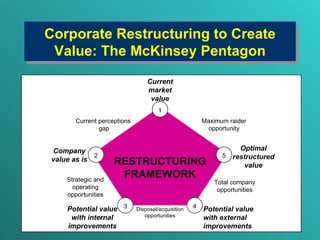
Corporate Restructuring to Create Value: The McKinsey Pentagon Current market value Maximum raider opportunity Current perceptions  gap Company value as is Optimal restructured value Strategic and operating opportunities Potential value with internal improvements Disposal/acquisition opportunities Total company opportunities 1 2 5 RESTRUCTURING FRAMEWORK 3 4 Potential value with external improvements
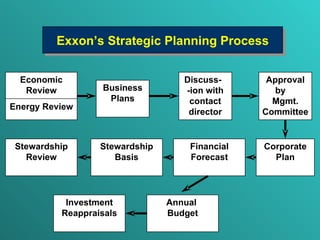
Exxon’s Strategic Planning Process Economic Review Energy Review Business Plans Discuss-  -ion with contact director Approval by  Mgmt. Committee Stewardship Review Stewardship Basis Financial Forecast Corporate Plan Investment Reappraisals Annual  Budget
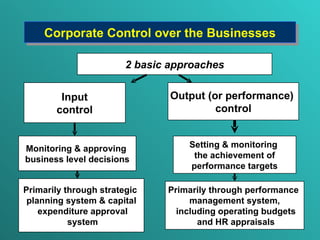
Corporate Control over the  Business es 2  basic approaches Inpu t control Monitoring & approving  business level decisions Output (or performance)  control Setting & monitoring  the achievement of performance targets Primarily through strategic  planning system & capital expenditure approval system Primarily through performance  management system, incl uding   operating  budget s and  HR appraisal s
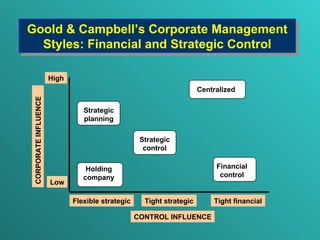
Goold & Campbell’s Corporate Management Styles : Financial and Strategic Control H igh L ow CONTROL INFLUENCE Strategic planning Centralized Strategic control Holding company Financial control CORPORATE   INFLUENCE Flexible strategic Tight strategic Tight financial
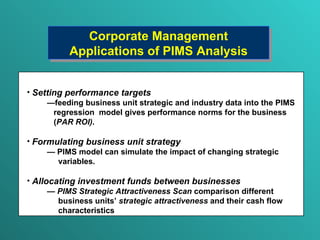
Corporate Management  Application s  of PIMS Analysis Setting performance targets — feeding business unit strategic and industry data into the PIMS regression  model gives  performance norms for the business ( PAR ROI ) . Formulating business unit strategy —   PIMS model  can  simulate the   impact of changing strategic variables. Allocating investment funds between businesses —   PIMS Strategic Attractiveness Scan  comparison different  business units ’   strategic attractiveness  and their  cash flow characteristics
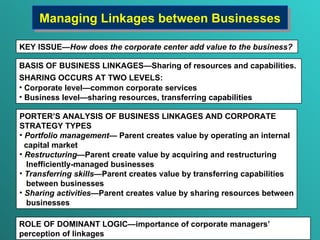
Managing Linkages between Businesses KEY  ISSUE — How does the corporate center add value to the business?  BASIS OF BUSINESS LINKAGES—Sharing of resources and capabilities. SHARING OCCURS AT TWO LEVELS: Corporate level—c ommon corporate services Business level—sharing resources, transferring capabilities PORTER’S  ANALYSIS  OF BUSINESS LINKAGES AND CORPORATE  STRATEGY TYPES Portfolio management —  Parent creates value by operating an internal  capital market Restructuring — Parent create value by acquiring and restructuring  Inefficiently - managed businesses Transferring skills — Parent  creates   value  by transferring   capabilities   between businesses Sharing activities —Parent creates   value  by  sharing resources between businesses ROLE OF DOMINANT LOGIC—importance of corporate managers’ perception of linkages
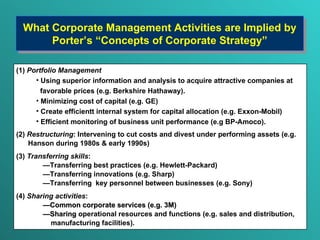
What  Corporate Management  Activities are Implied by  Porter’s “Concepts of Corporate Strategy” (1)  Portfolio Management Using superior information and analysis to a cquir e attractive  companies at  favorable prices  (e.g. Berkshire Hathaway) . Minimizing cost of capital  (e.g. GE) Create  efficient t internal system for  capital allocation  (e.g. Exxon-Mobil) Efficient monitoring of business unit performance  (e.g BP-Amoco) . (2)  Restructuring : Intervening to cut costs and divest  under performing  assets  (e.g. Hanson during 1980s & early 1990s) (3)  Transferring skills :  — Transferring best practices (e.g. Hewlett-Packard) — Transferring innovations (e.g. Sharp) — T ransfer ring  key personnel  between businesses   (e.g. Sony) (4)  Sharing activities : — Common corporate services (e.g. 3M) — Sharing  operat ional resources and  functions (e.g.  sales and distribution,    manufacturing facilities ).
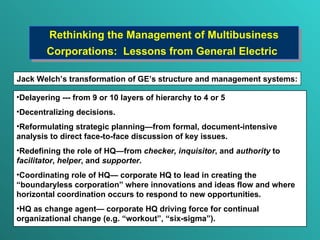
Rethinking the Management of Multibusiness Corporations:  Lessons from  G eneral  E lectric   Delayering --- from 9 or 10 layers of hierarchy to 4 or 5 D ecentralizing decisions. Reformulating strategic planning — from formal, document-intensive analysis to direct face-to-face discussion of key issues. Redefining the role of HQ — from  checker, inquisitor , and  authority  to  facilitator ,  helper , and  supporter . Coordinating role of HQ —  corporate HQ to lead in creating the “boundaryless corporation” where innovations and ideas flow and where horizontal coordination occurs to respond to new opportunities. HQ as change agen t—  corporate HQ driving force for continual organizational change (e.g. “workout” , “six-sigma” ). Jack Welch ’s transformation of GE’s structure and management systems :
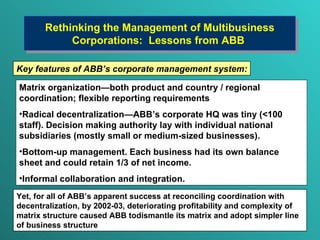
Rethinking the Management of Multibusiness Corporations:  Lessons from  ABB  Matrix organization — both product and country / regional coordination; flexible reporting requirements Radical decentralization — ABB ’s  corporate HQ was tiny (<100 staff). Decision making authority lay with individual  national  subsidiaries  (mostly  small or medium-sized businesses ) . Bottom-up management. Each business had its own balance sheet and could retai n  1/3 of net income. Informal collaboration and integration. Key  f eatures  of ABB’s corporate management system : Yet, for all of ABB’s apparent success at reconciling coordination with  decentralization, by 2002-03, deteriorating profitability and complexity of  matrix structure caused ABB todismantle its matrix and adopt simpler line of business structure
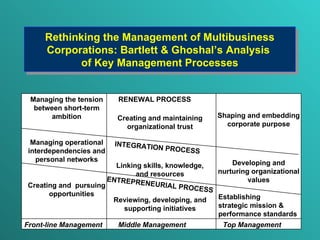
Rethinking the Management of Multibusiness Corporations:  Bartlett & Gh o shal’s  Analysis  of  Key Management Processes Managing the tension between short-term ambition Managing operational interdependencies and personal networks Creating and  pursuing  opportunities Creating and maintaining organizational trust Linking skills, knowledge, and resources Reviewing, developing, and supporting initiatives Shaping and embedding corporate purpose Developing and nurturing organizational values Establishing strategic mission & performance standards Front - line Management   Middle Management   Top Management RENEWAL PROCESS INTEGRATION PROCESS ENTREPRENEURIAL PROCESS

Ch16

  • 1.
    Managing the MultibusinessCorporation Structure of the Multidivisional Company Theory of the M- f orm The divisionalized firm in practice The Role of Corporate Management Managing the Corporate Portfolio Portfolio planning techniques Value- creation through corporate restructuring Managing Individual Businesses Managing Internal Linkages Recent Trends OUTLINE
  • 2.
    The Multidivisional Structure: Theory of the M-Form Efficiency advantages of the multidivisional firm: Recognizes bounded rationality— top management has limited decision-making capacity Divides decision-making according to frequency: — high-frequency operating decisions at divisional level — low-frequency strategic decisions at corporate level Reduces costs of communication and coordination: business level decisions confined to divisional level (reduces decision making at the top) Global, rather than local optimization:- functional organizations encourage functional goals. M-form structure encourages focus on profitability. Efficient allocation of resources through internal capital and labor markets Resolves agency problem-- corporate management an interface between shareholders and business-level managers.
  • 3.
    The Divisionalized Firmin Practice Constraints upon decentralization . Difficult to achieve clear division of decision making between corporate and divisional levels. On-going dialogue and conflict between corporate and divisional managers over both strategic and operational issues. Standardization of divisional management Despite potential for divisions to develop distinctive strategies and structures — corporate systems may impose uniformity. Managing divisional inter-relationships Requires more complex structures , e.g. matrix structures where functional and/or geographical structure is imposed on top of a product/market structure. Added complexity undermines the efficiency advantages of the M-form
  • 4.
    The Functions ofCorporate Management — Decisions over diversification , acquisition, divestment — R esource allocati o n between businesses. — B usiness strategy formulation — Monitoring and controlling business performance — Sharing and transferring resources and capabilities Managing linkages between businesses Managing the individual businesses Managing the Corporate Portfolio
  • 5.
    The Development ofStrategic Planning Techniques: General Electric in the 1970’s L ate 19 6 0’s: GE encounter s problems of direction , coordination, control , and profitability Corporate planning responses: Portfolio Planning Models — matrix-based frameworks for evaluating business unit performance, formulating business strategies, and allocating resources Strategic Business Units — GE reorganized around SBUs ( business comprising a strategically-distinct group of closely-related products PIMS — a database which quantifies the impact of strategy on performance. Used to appraise SBU performance and guide business strategy formulation
  • 6.
    Portfolio Planning Models:Their Uses in Strategy Formulation Allocating resources -- the analysis indicates both the investment requirements of different businesses and their likely returns Formulating business-unit strategy -- the analysis yields simple strategy recommendations (e.g..: “build”, “hold”, or “harvest”) Setting performance targets -- the analysis indicates likely performance outcomes in terms of cash flow and ROI Portfolios balance -- the analysis can assist in corporate goals such as a balanced cash flow and balance of growing and declining businesses.
  • 7.
    Portfolio Planning Models: The GE/ McKinsey Matrix H A R V E S T H O L D B U I L D Low Medium High Low Medium High Industry Attractiveness Industry Attractiveness Criteria Business Unit Position - Market size - Market share (domestic, - Market growth global, and relative) - Industry profitability - Competitive position - Inflation recovery - Relative profitability - Overseas sales ratio Business Unit Position
  • 8.
    Portfolio Planning Models:The BCG Growth-Share Matrix HIGH LOW LOW Annual real rate of market growth (%) Relative market share Earnings: high stable Cash flow: high stable Strategy: milk Earnings: low, unstable Cash flow: neutral or negative Strategy: divest Earnings: high stable, growing Cash flow: neutral Strategy: invest for growth Earnings: low, unstable, growing Cash flow: negative Strategy: analyze to determine whether business can be grown into a star, or will degenerate into a dog HIGH ?
  • 9.
    Annual real rateof market growth (%) Relative market share - 8 -4 0 4 8 12 Bakery division P osition in 2003 Position in 2000 . ( Area of circle proportional to $ sales ) Applying the BCG Matrix to Time Warner Inc. AOL Film production Cable Cable TV Networks Music Magazine Publishing
  • 10.
    Do Portfolio PlanningModels Help or Hinder Corporate Strategy Formulation? ADVANTAGES Simplicity: Can be quickly prepaired Big picture: Permits one page representation of the corporate portfolio & the strategic positioning of each business Analytically versatile: Applicable to businesses, products, countries, distribution channels. Can be augmented: A useful point of departure for more sophisticated analysis DISADVANTAGES Simplicity: Oversimplifies the factors determining industry attractiveness and competitive advantage Ambiguous:The positioning of a business depends critically upon how a market is defined Ignores synergy: the analysis takes no account of any interdependencies between businesses
  • 11.
    Corporate Restructuring toCreate Value: The McKinsey Pentagon Current market value Maximum raider opportunity Current perceptions gap Company value as is Optimal restructured value Strategic and operating opportunities Potential value with internal improvements Disposal/acquisition opportunities Total company opportunities 1 2 5 RESTRUCTURING FRAMEWORK 3 4 Potential value with external improvements
  • 12.
    Exxon’s Strategic PlanningProcess Economic Review Energy Review Business Plans Discuss- -ion with contact director Approval by Mgmt. Committee Stewardship Review Stewardship Basis Financial Forecast Corporate Plan Investment Reappraisals Annual Budget
  • 13.
    Corporate Control overthe Business es 2 basic approaches Inpu t control Monitoring & approving business level decisions Output (or performance) control Setting & monitoring the achievement of performance targets Primarily through strategic planning system & capital expenditure approval system Primarily through performance management system, incl uding operating budget s and HR appraisal s
  • 14.
    Goold & Campbell’sCorporate Management Styles : Financial and Strategic Control H igh L ow CONTROL INFLUENCE Strategic planning Centralized Strategic control Holding company Financial control CORPORATE INFLUENCE Flexible strategic Tight strategic Tight financial
  • 15.
    Corporate Management Application s of PIMS Analysis Setting performance targets — feeding business unit strategic and industry data into the PIMS regression model gives performance norms for the business ( PAR ROI ) . Formulating business unit strategy — PIMS model can simulate the impact of changing strategic variables. Allocating investment funds between businesses — PIMS Strategic Attractiveness Scan comparison different business units ’ strategic attractiveness and their cash flow characteristics
  • 16.
    Managing Linkages betweenBusinesses KEY ISSUE — How does the corporate center add value to the business? BASIS OF BUSINESS LINKAGES—Sharing of resources and capabilities. SHARING OCCURS AT TWO LEVELS: Corporate level—c ommon corporate services Business level—sharing resources, transferring capabilities PORTER’S ANALYSIS OF BUSINESS LINKAGES AND CORPORATE STRATEGY TYPES Portfolio management — Parent creates value by operating an internal capital market Restructuring — Parent create value by acquiring and restructuring Inefficiently - managed businesses Transferring skills — Parent creates value by transferring capabilities between businesses Sharing activities —Parent creates value by sharing resources between businesses ROLE OF DOMINANT LOGIC—importance of corporate managers’ perception of linkages
  • 17.
    What CorporateManagement Activities are Implied by Porter’s “Concepts of Corporate Strategy” (1) Portfolio Management Using superior information and analysis to a cquir e attractive companies at favorable prices (e.g. Berkshire Hathaway) . Minimizing cost of capital (e.g. GE) Create efficient t internal system for capital allocation (e.g. Exxon-Mobil) Efficient monitoring of business unit performance (e.g BP-Amoco) . (2) Restructuring : Intervening to cut costs and divest under performing assets (e.g. Hanson during 1980s & early 1990s) (3) Transferring skills : — Transferring best practices (e.g. Hewlett-Packard) — Transferring innovations (e.g. Sharp) — T ransfer ring key personnel between businesses (e.g. Sony) (4) Sharing activities : — Common corporate services (e.g. 3M) — Sharing operat ional resources and functions (e.g. sales and distribution, manufacturing facilities ).
  • 18.
    Rethinking the Managementof Multibusiness Corporations: Lessons from G eneral E lectric Delayering --- from 9 or 10 layers of hierarchy to 4 or 5 D ecentralizing decisions. Reformulating strategic planning — from formal, document-intensive analysis to direct face-to-face discussion of key issues. Redefining the role of HQ — from checker, inquisitor , and authority to facilitator , helper , and supporter . Coordinating role of HQ — corporate HQ to lead in creating the “boundaryless corporation” where innovations and ideas flow and where horizontal coordination occurs to respond to new opportunities. HQ as change agen t— corporate HQ driving force for continual organizational change (e.g. “workout” , “six-sigma” ). Jack Welch ’s transformation of GE’s structure and management systems :
  • 19.
    Rethinking the Managementof Multibusiness Corporations: Lessons from ABB Matrix organization — both product and country / regional coordination; flexible reporting requirements Radical decentralization — ABB ’s corporate HQ was tiny (<100 staff). Decision making authority lay with individual national subsidiaries (mostly small or medium-sized businesses ) . Bottom-up management. Each business had its own balance sheet and could retai n 1/3 of net income. Informal collaboration and integration. Key f eatures of ABB’s corporate management system : Yet, for all of ABB’s apparent success at reconciling coordination with decentralization, by 2002-03, deteriorating profitability and complexity of matrix structure caused ABB todismantle its matrix and adopt simpler line of business structure
  • 20.
    Rethinking the Managementof Multibusiness Corporations: Bartlett & Gh o shal’s Analysis of Key Management Processes Managing the tension between short-term ambition Managing operational interdependencies and personal networks Creating and pursuing opportunities Creating and maintaining organizational trust Linking skills, knowledge, and resources Reviewing, developing, and supporting initiatives Shaping and embedding corporate purpose Developing and nurturing organizational values Establishing strategic mission & performance standards Front - line Management Middle Management Top Management RENEWAL PROCESS INTEGRATION PROCESS ENTREPRENEURIAL PROCESS

Editor's Notes