PLANNING
– To understand the importance of
planning
– To know what plan and planning mean
– To learn about steps involved in planning
– To learn about different types and levels
of planning
– To understand SWOT analysis as a tool
for business strategies development
– To understand the use of BCG matrix in
categorization of businesses
– To understand concept of MBO and its
relevance to planning
LEARNING
OBJECTIVES
• Planning
– A primary managerial activity that involves:
• Defining the organization’s goals
• Establishing an overall strategy for achieving those goals
• Developing plans for organizational work activities
• Planning refers to a systematic approach towards making
decisions about goals and objectives and the associated activities
that need to be carried out along with various resource
requirements.
• “Planning is deciding in advance what to do, how to do, when to do and
who is to do it. Planning bridges a gap between from where we are to
where we want to go”
-Harold, Koontz and O’Donnel
PLANNING
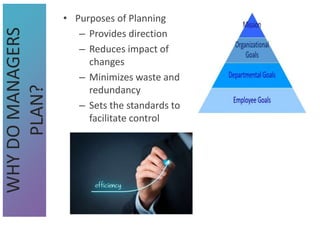
• Purposes of Planning
– Provides direction
– Reduces impact of
changes
– Minimizes waste and
redundancy
– Sets the standards to
facilitate control
WHY
DO
MANAGERS
PLAN?
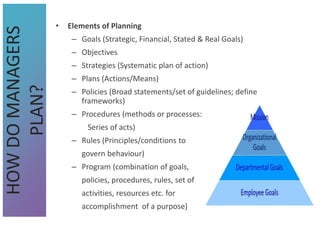
• Elements of Planning
– Goals (Strategic, Financial, Stated & Real Goals)
– Objectives
– Strategies (Systematic plan of action)
– Plans (Actions/Means)
– Policies (Broad statements/set of guidelines; define
frameworks)
– Procedures (methods or processes:
Series of acts)
– Rules (Principles/conditions to
govern behaviour)
– Program (combination of goals,
policies, procedures, rules, set of
activities, resources etc. for
accomplishment of a purpose)
HOW
DO
MANAGERS
PLAN?
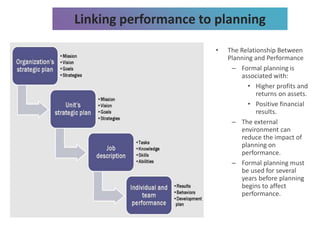
• The Relationship Between
Planning and Performance
– Formal planning is
associated with:
• Higher profits and
returns on assets.
• Positive financial
results.
– The external
environment can
reduce the impact of
planning on
performance.
– Formal planning must
be used for several
years before planning
begins to affect
performance.
Linking performance to planning
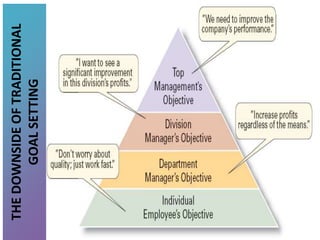
THE
DOWNSIDE
OF
TRADITIONAL
GOAL
SETTING
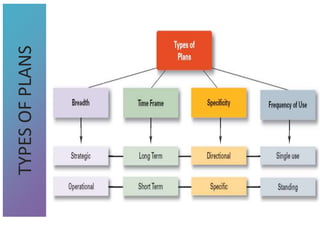
TYPES
OF
PLANS
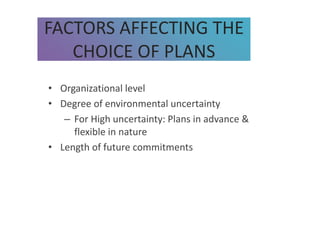
• Organizational level
• Degree of environmental uncertainty
– For High uncertainty: Plans in advance &
flexible in nature
• Length of future commitments
FACTORS AFFECTING THE
CHOICE OF PLANS
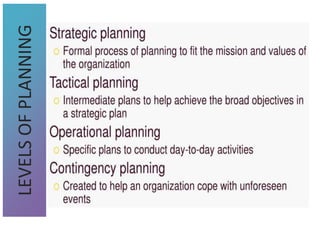
LEVELS
OF
PLANNING
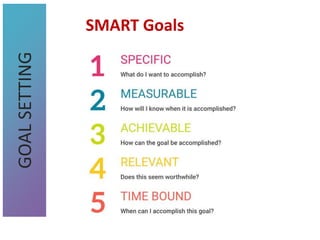
SMART Goals
GOAL
SETTING
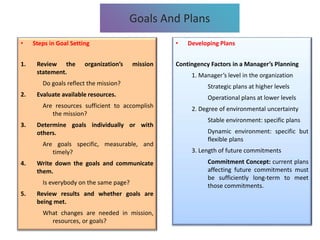
• Steps in Goal Setting
1. Review the organization’s mission
statement.
Do goals reflect the mission?
2. Evaluate available resources.
Are resources sufficient to accomplish
the mission?
3. Determine goals individually or with
others.
Are goals specific, measurable, and
timely?
4. Write down the goals and communicate
them.
Is everybody on the same page?
5. Review results and whether goals are
being met.
What changes are needed in mission,
resources, or goals?
Goals And Plans
• Developing Plans
Contingency Factors in a Manager’s Planning
1. Manager’s level in the organization
Strategic plans at higher levels
Operational plans at lower levels
2. Degree of environmental uncertainty
Stable environment: specific plans
Dynamic environment: specific but
flexible plans
3. Length of future commitments
Commitment Concept: current plans
affecting future commitments must
be sufficiently long-term to meet
those commitments.
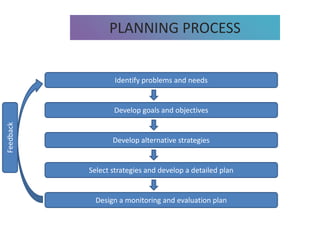
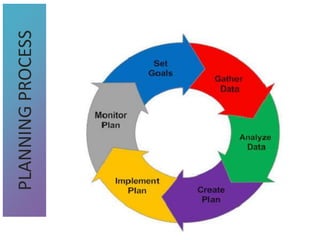
PLANNING PROCESS
Identify problems and needs
Develop goals and objectives
Develop alternative strategies
Select strategies and develop a detailed plan
Design a monitoring and evaluation plan
Feedback
PLANNING
PROCESS
– Planning may create rigidity.
– Plans cannot be developed for dynamic
environments.
– Formal plans cannot replace intuition and
creativity.
– Planning focuses managers’ attention on
today’s competition not tomorrow’s survival.
– Formal planning reinforces today’s success,
which may lead to tomorrow’s failure.
– Just planning isn’t enough.
CRITICISMS
OF
PLANNING
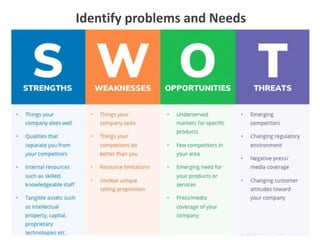
Identify problems and Needs
SWOT analysis helps in identification of possible strategies based on the
following criteria:
• Build and develop on strengths
• Resolve and overcome weaknesses
• Exploit and avail opportunities
• Avoid or minimize the effect of threats
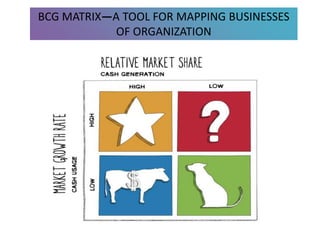
BCG (Boston Consulting Group) has developed a tool that enables the
mapping of all the organization’s businesses based on the criteria of
market growth and relative competitive position vis-à-vis competitors.
DEVELOPING GOALS, OBJECTIVES AND
STRATEGIES
BCG MATRIX—A TOOL FOR MAPPING BUSINESSES
OF ORGANIZATION
BCG
MATRIX
• BCG matrix
• (or growth-share matrix) is a corporate planning tool, which is used to portray firm’s brand
portfolio or SBUs on a quadrant along relative market share axis (horizontal axis) and speed of
market growth (vertical axis) axis to evaluate the potential of business brand portfolio and
suggest further investment strategies. These two dimensions reveal likely profitability of the
business portfolio in terms of cash needed to support that unit and cash generated by it.
• The Brand Portfolio refers to an umbrella under which all the brands or brand lines of a
particular firm functions to serve the needs of different market segments.
• The general purpose of the analysis is to help understand, which brands the firm should invest
in and which ones should be divested.
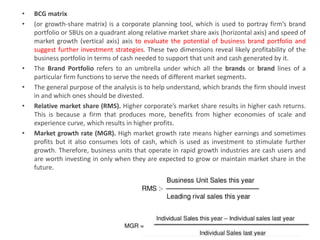
• Relative market share (RMS). Higher corporate’s market share results in higher cash returns.
This is because a firm that produces more, benefits from higher economies of scale and
experience curve, which results in higher profits.
• Market growth rate (MGR). High market growth rate means higher earnings and sometimes
profits but it also consumes lots of cash, which is used as investment to stimulate further
growth. Therefore, business units that operate in rapid growth industries are cash users and
are worth investing in only when they are expected to grow or maintain market share in the
future.
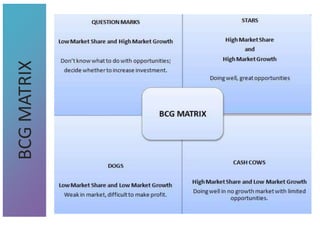
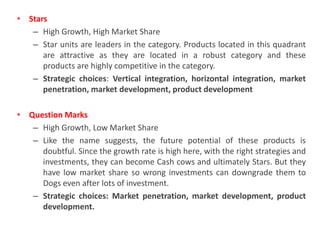
• Stars
– High Growth, High Market Share
– Star units are leaders in the category. Products located in this quadrant
are attractive as they are located in a robust category and these
products are highly competitive in the category.
– Strategic choices: Vertical integration, horizontal integration, market
penetration, market development, product development
• Question Marks
– High Growth, Low Market Share
– Like the name suggests, the future potential of these products is
doubtful. Since the growth rate is high here, with the right strategies and
investments, they can become Cash cows and ultimately Stars. But they
have low market share so wrong investments can downgrade them to
Dogs even after lots of investment.
– Strategic choices: Market penetration, market development, product
development.
• Cash Cows
– Low Growth, High Market Share
– These products or services generate interesting profits and cash but need
to be replaced because the future growth will be lower. If they are
profitable, they can finance other activities in progress (including stars
and question marks).
– Strategic choices: Product development, diversification
• Dogs
– Low Growth, Low Market Share
– Dogs hold low market share compared to competitors. Neither do they
generate cash nor do they require huge cash. In general, they are not
worth investing in because they generate low or negative cash returns
and may require large sums of money to support. Due to low market
share, these products face cost disadvantages.
– Strategic choices: Retrenchment (the reduction of costs or spending in response to
economic difficulty), liquidation (the conversion of assets into cash (i.e. by selling them.)
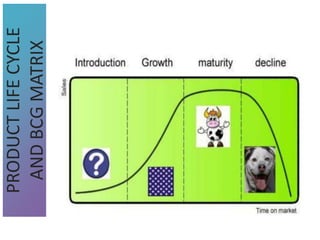
PRODUCT
LIFE
CYCLE
AND
BCG
MATRIX
WHY BCG MATRIX
• To asses
– Profile of product /business
– Cash demands of products
– The development cycle of product
• Resource allocation & divestment decisions
MAIN STEPS OF BCG MATRIX
• Identifying & dividing a company into SBU
• Assessing & comparing the prospects of each SBU
according to two criteria 1) SBU’s relative market share
2) Growth rate of SBU’s industry
• Classifying the SBU’s on the basis of BCG matrix
• Developing strategic objective for each SBU
BCG
MATRIX
• BENEFITS
– BCG matrix is simple & easy to understand
– It helps to quickly & simply screen the opportunity
open to you, & help you think about how you can
make the most of them.
– It is used to identify how corporate cash resources
can best be used to maximize company’s future
growth & profitability.
• LIMITATION
– BCG matrix uses only two dimensions relative
market share & market growth rate.
– Problem of getting data on market share & market
growth
– High market share does not mean profits all time.
– Business with market share can be profitable too.
BCG
MATRIX

This ppt is on management functions. the first function is planning.Planning.ppt

  • 1.
  • 2.
    – To understandthe importance of planning – To know what plan and planning mean – To learn about steps involved in planning – To learn about different types and levels of planning – To understand SWOT analysis as a tool for business strategies development – To understand the use of BCG matrix in categorization of businesses – To understand concept of MBO and its relevance to planning LEARNING OBJECTIVES
  • 3.
    • Planning – Aprimary managerial activity that involves: • Defining the organization’s goals • Establishing an overall strategy for achieving those goals • Developing plans for organizational work activities • Planning refers to a systematic approach towards making decisions about goals and objectives and the associated activities that need to be carried out along with various resource requirements. • “Planning is deciding in advance what to do, how to do, when to do and who is to do it. Planning bridges a gap between from where we are to where we want to go” -Harold, Koontz and O’Donnel PLANNING
  • 4.
    • Purposes ofPlanning – Provides direction – Reduces impact of changes – Minimizes waste and redundancy – Sets the standards to facilitate control WHY DO MANAGERS PLAN?
  • 5.
    • Elements ofPlanning – Goals (Strategic, Financial, Stated & Real Goals) – Objectives – Strategies (Systematic plan of action) – Plans (Actions/Means) – Policies (Broad statements/set of guidelines; define frameworks) – Procedures (methods or processes: Series of acts) – Rules (Principles/conditions to govern behaviour) – Program (combination of goals, policies, procedures, rules, set of activities, resources etc. for accomplishment of a purpose) HOW DO MANAGERS PLAN?
  • 6.
    • The RelationshipBetween Planning and Performance – Formal planning is associated with: • Higher profits and returns on assets. • Positive financial results. – The external environment can reduce the impact of planning on performance. – Formal planning must be used for several years before planning begins to affect performance. Linking performance to planning
  • 7.
  • 8.
  • 9.
    • Organizational level •Degree of environmental uncertainty – For High uncertainty: Plans in advance & flexible in nature • Length of future commitments FACTORS AFFECTING THE CHOICE OF PLANS
  • 10.
  • 11.
  • 12.
    • Steps inGoal Setting 1. Review the organization’s mission statement. Do goals reflect the mission? 2. Evaluate available resources. Are resources sufficient to accomplish the mission? 3. Determine goals individually or with others. Are goals specific, measurable, and timely? 4. Write down the goals and communicate them. Is everybody on the same page? 5. Review results and whether goals are being met. What changes are needed in mission, resources, or goals? Goals And Plans • Developing Plans Contingency Factors in a Manager’s Planning 1. Manager’s level in the organization Strategic plans at higher levels Operational plans at lower levels 2. Degree of environmental uncertainty Stable environment: specific plans Dynamic environment: specific but flexible plans 3. Length of future commitments Commitment Concept: current plans affecting future commitments must be sufficiently long-term to meet those commitments.
  • 13.
    PLANNING PROCESS Identify problemsand needs Develop goals and objectives Develop alternative strategies Select strategies and develop a detailed plan Design a monitoring and evaluation plan Feedback
  • 14.
  • 15.
    – Planning maycreate rigidity. – Plans cannot be developed for dynamic environments. – Formal plans cannot replace intuition and creativity. – Planning focuses managers’ attention on today’s competition not tomorrow’s survival. – Formal planning reinforces today’s success, which may lead to tomorrow’s failure. – Just planning isn’t enough. CRITICISMS OF PLANNING
  • 16.
  • 17.
    SWOT analysis helpsin identification of possible strategies based on the following criteria: • Build and develop on strengths • Resolve and overcome weaknesses • Exploit and avail opportunities • Avoid or minimize the effect of threats BCG (Boston Consulting Group) has developed a tool that enables the mapping of all the organization’s businesses based on the criteria of market growth and relative competitive position vis-à-vis competitors. DEVELOPING GOALS, OBJECTIVES AND STRATEGIES
  • 18.
    BCG MATRIX—A TOOLFOR MAPPING BUSINESSES OF ORGANIZATION
  • 19.
  • 20.
    • BCG matrix •(or growth-share matrix) is a corporate planning tool, which is used to portray firm’s brand portfolio or SBUs on a quadrant along relative market share axis (horizontal axis) and speed of market growth (vertical axis) axis to evaluate the potential of business brand portfolio and suggest further investment strategies. These two dimensions reveal likely profitability of the business portfolio in terms of cash needed to support that unit and cash generated by it. • The Brand Portfolio refers to an umbrella under which all the brands or brand lines of a particular firm functions to serve the needs of different market segments. • The general purpose of the analysis is to help understand, which brands the firm should invest in and which ones should be divested. • Relative market share (RMS). Higher corporate’s market share results in higher cash returns. This is because a firm that produces more, benefits from higher economies of scale and experience curve, which results in higher profits. • Market growth rate (MGR). High market growth rate means higher earnings and sometimes profits but it also consumes lots of cash, which is used as investment to stimulate further growth. Therefore, business units that operate in rapid growth industries are cash users and are worth investing in only when they are expected to grow or maintain market share in the future.
  • 21.
    • Stars – HighGrowth, High Market Share – Star units are leaders in the category. Products located in this quadrant are attractive as they are located in a robust category and these products are highly competitive in the category. – Strategic choices: Vertical integration, horizontal integration, market penetration, market development, product development • Question Marks – High Growth, Low Market Share – Like the name suggests, the future potential of these products is doubtful. Since the growth rate is high here, with the right strategies and investments, they can become Cash cows and ultimately Stars. But they have low market share so wrong investments can downgrade them to Dogs even after lots of investment. – Strategic choices: Market penetration, market development, product development.
  • 22.
    • Cash Cows –Low Growth, High Market Share – These products or services generate interesting profits and cash but need to be replaced because the future growth will be lower. If they are profitable, they can finance other activities in progress (including stars and question marks). – Strategic choices: Product development, diversification • Dogs – Low Growth, Low Market Share – Dogs hold low market share compared to competitors. Neither do they generate cash nor do they require huge cash. In general, they are not worth investing in because they generate low or negative cash returns and may require large sums of money to support. Due to low market share, these products face cost disadvantages. – Strategic choices: Retrenchment (the reduction of costs or spending in response to economic difficulty), liquidation (the conversion of assets into cash (i.e. by selling them.)
  • 23.
  • 24.
    WHY BCG MATRIX •To asses – Profile of product /business – Cash demands of products – The development cycle of product • Resource allocation & divestment decisions MAIN STEPS OF BCG MATRIX • Identifying & dividing a company into SBU • Assessing & comparing the prospects of each SBU according to two criteria 1) SBU’s relative market share 2) Growth rate of SBU’s industry • Classifying the SBU’s on the basis of BCG matrix • Developing strategic objective for each SBU BCG MATRIX
  • 25.
    • BENEFITS – BCGmatrix is simple & easy to understand – It helps to quickly & simply screen the opportunity open to you, & help you think about how you can make the most of them. – It is used to identify how corporate cash resources can best be used to maximize company’s future growth & profitability. • LIMITATION – BCG matrix uses only two dimensions relative market share & market growth rate. – Problem of getting data on market share & market growth – High market share does not mean profits all time. – Business with market share can be profitable too. BCG MATRIX