Strategic Human Resource
      Management
Strategic Human Resource
             Management
• SHRM is part of strategic planning
• Strategic Plan : The Company’s plan for how it
  will match its internal strengths and
  weaknesses with its external opportunities
  and threats to maintain a competitive
  advantage
• Essence is to ask “ Where are we now as a
  business, where we want to be, and how
  should we get there”
• Then formulates specific strategies (Human
  resources and other) to take the company
  from where it is now to where he or she wants
  it to be
• Strategy : The company’s long term plan for
  how it will balance its internal strengths and
  weaknesses with its external opportunities
  and threats to maintain a competitive
  advantage
• SHRM means formulating and executing
  human resource policies and practices that
  produce the employee competencies and
  behaviors the company needs to achieve its
  strategic aims
• E.g. Ford
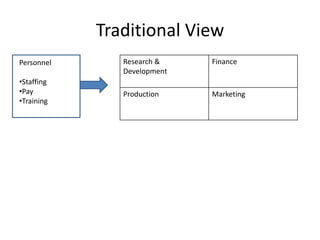
Traditional View
Personnel      Research &    Finance
               Development
•Staffing
•Pay           Production    Marketing
•Training
Need and Importance
• Changing demand from customers or the
  market place
• New technology and increasing pressure from
  competitors (Philip Mirvis)
• Changes in the basic business environment
  (Randall Schuler)
• High levels of uncertainty about basic business
  conditions
• Rising costs
• Rapid technological change
• Changing demographics
• More limited supplies of highly trained labor
• Rapidly changing government legislation and
  regulations
• Increased globalization of industries
Strategic Management Process
• Strategy : The company’s long term plan for how
  it will balance its internal strengths and
  weaknesses with its external opportunities and
  threats to maintain a competitive advantage

• Strategic Management : The process of
  identifying and executing the organization’s
  mission by matching its capabilities with the
  demands of its environment
• Essence of strategic planning - “ Where are
  we now as a business, where we want to be,
  and how should we get there”

• Steps in Strategic Management
• SM entails both strategic planning and
  implementation

• The process of identifying and executing the
  organization’s strategic plan, by matching the
  company’s capabilities with the demands of
  its environment
•   SM process consist of 7 steps
•   1-5, strategic planning
•   6-7, implementation
•   Step1 - define the current Business
•   Choose the terrain on which it will compete –
    what product it will sell, where it will sell
    them, how to differentiate products from its
    competitors
• E.g Rolex and Seiko
• Managers use statements like
• Vision – A general statement of its intended
  direction that evokes emotional feelings in
  organization members
• Broad terms – “what we want to become”
• Gives the direction
• What the business should be
• Mission – What our main task are now
• Spells out who the company is, what it does,
  and where it’s headed
• Step 2 – Perform external and internal audits
• Analyzing external and internal situations
• SWOTs
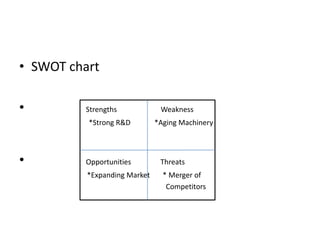
• SWOT analysis
• SWOT chart

•        Strengths             Weakness
          *Strong R&D         *Aging Machinery


•        Opportunities         Threats
          *Expanding Market     * Merger of
                                 Competitors
• Step 3 : Formulate new Business and mission
  statements
• Based on situation analysis
• What should our business be
• What products
• Where it will sell
• How to differentiate from competitors
• New vision and mission
• Step 4 : Translate the mission into strategic
  goals
• Operationalizing the mission for managers –
  strategic goals
• For each department
• Step 5 : Formulate strategies to achieve the
  strategic goals
• Strategies, Course of action – how to move
  from the current business to what it wants to
• Strategies act as bridge between these two
• Step 6 : Implement the strategies
• Translating strategies into action
• Hiring, firing people, building plants, adding
  products, product lines
• This include managerial functions like
  Planning, organizing, staffing, leading, and
  controlling
• Step 7 : Evaluate performance
• Management Monitors the extend to which
  the firm meeting its strategic goals
• Strategic Control – keep strategy up to date
• According to the environmental changes
• Competitors action
Types of Strategies
Three types of strategic planning
A)Corporate strategy
• Company wide level (corporate level)
• Pepsico runs pepsi, fritto lay, and pizza hut, so
  needs a corporate level strategy
• Diversification- expand by adding new product
  lines
• Vertical integration – expands by producing its
  own raw material
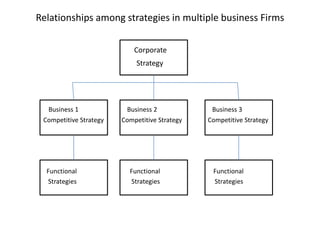
Relationships among strategies in multiple business Firms

                            Corporate
                            Strategy


  Business 1             Business 2             Business 3
 Competitive Strategy   Competitive Strategy   Competitive Strategy


  Functional              Functional            Functional
  Strategies              Strategies            Strategies
• Consolidation – reducing the company’s size
• Geographic expansion – taking business
  abroad
B)Competitive Strategy (Business level )
E.g., Pizza hut
• Next level down, each of the business need
• How to build and strengthen the business’s
  long term competitive position in the market
  place
• How pizza hut will compete with Papa John’s
• Strategies like
• Cost leadership, low cost leader, dell by direct
  selling
• Differentiation, Firm seeks to be unique,
  Toyota by quality, woodland/timberland by
  adventure shoes
• Focusers, Carve out a market niche, like
  ferrari, by providing products and services
  customers can get in no other way
• Functional strategy
• Business composed of departments –
  manufacturing, selling, finance, HRM
• This identify the basic courses of action that
  each department will pursue in order to help
  the business attain its competitive goals

Strategic human resource management

  • 1.
  • 2.
    Strategic Human Resource Management • SHRM is part of strategic planning • Strategic Plan : The Company’s plan for how it will match its internal strengths and weaknesses with its external opportunities and threats to maintain a competitive advantage • Essence is to ask “ Where are we now as a business, where we want to be, and how should we get there”
  • 3.
    • Then formulatesspecific strategies (Human resources and other) to take the company from where it is now to where he or she wants it to be • Strategy : The company’s long term plan for how it will balance its internal strengths and weaknesses with its external opportunities and threats to maintain a competitive advantage
  • 4.
    • SHRM meansformulating and executing human resource policies and practices that produce the employee competencies and behaviors the company needs to achieve its strategic aims • E.g. Ford
  • 5.
    Traditional View Personnel Research & Finance Development •Staffing •Pay Production Marketing •Training
  • 6.
    Need and Importance •Changing demand from customers or the market place • New technology and increasing pressure from competitors (Philip Mirvis) • Changes in the basic business environment (Randall Schuler) • High levels of uncertainty about basic business conditions
  • 7.
    • Rising costs •Rapid technological change • Changing demographics • More limited supplies of highly trained labor • Rapidly changing government legislation and regulations • Increased globalization of industries
  • 8.
    Strategic Management Process •Strategy : The company’s long term plan for how it will balance its internal strengths and weaknesses with its external opportunities and threats to maintain a competitive advantage • Strategic Management : The process of identifying and executing the organization’s mission by matching its capabilities with the demands of its environment
  • 9.
    • Essence ofstrategic planning - “ Where are we now as a business, where we want to be, and how should we get there” • Steps in Strategic Management • SM entails both strategic planning and implementation • The process of identifying and executing the organization’s strategic plan, by matching the company’s capabilities with the demands of its environment
  • 10.
    SM process consist of 7 steps • 1-5, strategic planning • 6-7, implementation • Step1 - define the current Business • Choose the terrain on which it will compete – what product it will sell, where it will sell them, how to differentiate products from its competitors
  • 11.
    • E.g Rolexand Seiko • Managers use statements like • Vision – A general statement of its intended direction that evokes emotional feelings in organization members • Broad terms – “what we want to become” • Gives the direction • What the business should be
  • 12.
    • Mission –What our main task are now • Spells out who the company is, what it does, and where it’s headed • Step 2 – Perform external and internal audits • Analyzing external and internal situations • SWOTs • SWOT analysis
  • 13.
    • SWOT chart • Strengths Weakness *Strong R&D *Aging Machinery • Opportunities Threats *Expanding Market * Merger of Competitors
  • 14.
    • Step 3: Formulate new Business and mission statements • Based on situation analysis • What should our business be • What products • Where it will sell • How to differentiate from competitors • New vision and mission
  • 15.
    • Step 4: Translate the mission into strategic goals • Operationalizing the mission for managers – strategic goals • For each department • Step 5 : Formulate strategies to achieve the strategic goals • Strategies, Course of action – how to move from the current business to what it wants to
  • 16.
    • Strategies actas bridge between these two • Step 6 : Implement the strategies • Translating strategies into action • Hiring, firing people, building plants, adding products, product lines • This include managerial functions like Planning, organizing, staffing, leading, and controlling
  • 17.
    • Step 7: Evaluate performance • Management Monitors the extend to which the firm meeting its strategic goals • Strategic Control – keep strategy up to date • According to the environmental changes • Competitors action
  • 18.
    Types of Strategies Threetypes of strategic planning A)Corporate strategy • Company wide level (corporate level) • Pepsico runs pepsi, fritto lay, and pizza hut, so needs a corporate level strategy • Diversification- expand by adding new product lines • Vertical integration – expands by producing its own raw material
  • 19.
    Relationships among strategiesin multiple business Firms Corporate Strategy Business 1 Business 2 Business 3 Competitive Strategy Competitive Strategy Competitive Strategy Functional Functional Functional Strategies Strategies Strategies
  • 20.
    • Consolidation –reducing the company’s size • Geographic expansion – taking business abroad
  • 21.
    B)Competitive Strategy (Businesslevel ) E.g., Pizza hut • Next level down, each of the business need • How to build and strengthen the business’s long term competitive position in the market place • How pizza hut will compete with Papa John’s
  • 22.
    • Strategies like •Cost leadership, low cost leader, dell by direct selling • Differentiation, Firm seeks to be unique, Toyota by quality, woodland/timberland by adventure shoes • Focusers, Carve out a market niche, like ferrari, by providing products and services customers can get in no other way
  • 23.
    • Functional strategy •Business composed of departments – manufacturing, selling, finance, HRM • This identify the basic courses of action that each department will pursue in order to help the business attain its competitive goals