Technology-based Industries &
the Management of Innovation
Technology-based Industries &
the Management of Innovation
• Competitive advantage in technology-intensive
Industries
– Appropriating the returns to innovation
• Strategies to exploit innovation
– Alternative approaches
– Timing: to lead or to follow?
– Managing risk
• Competing for standards
• Implementing technology strategy
– The conditions for creativity
– From invention to innovation
OUTLINE
The Development of Technology: From
Knowledge Generation to Diffusion
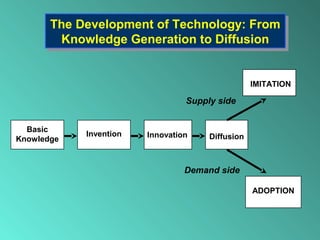
The Development of Technology: From
Knowledge Generation to Diffusion
Basic
Knowledge
Invention Innovation Diffusion
IMITATION
ADOPTION
Supply side
Demand side
The Development of Technology: Lags Between
Knowledge Generation and Commercialization
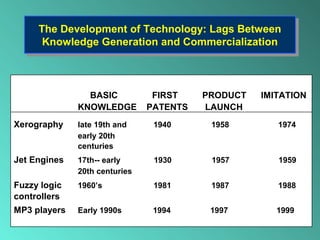
The Development of Technology: Lags Between
Knowledge Generation and Commercialization
BASIC FIRST PRODUCT IMITATION
KNOWLEDGE PATENTS LAUNCH
Xerography late 19th and 1940 1958 1974
early 20th
centuries
Jet Engines 17th-- early 1930 1957 1959
20th centuries
Fuzzy logic 1960’s 1981 1987 1988
controllers
MP3 players Early 1990s 1994 1997 1999
Appropriation of Value:- How are the
Benefits from Innovation Distributed?
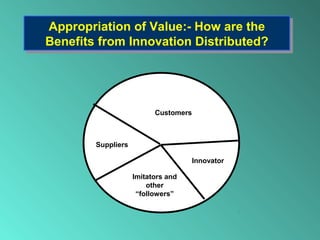
Appropriation of Value:- How are the
Benefits from Innovation Distributed?
Customers
Suppliers
Imitators and
other
“followers”
Innovator
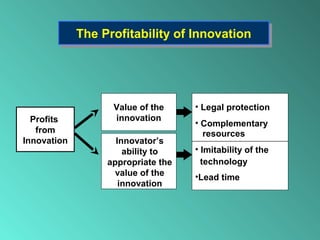
The Profitability of InnovationThe Profitability of Innovation
• Legal protection
• Complementary
resources
• Imitability of the
technology
•Lead time
Profits
from
Innovation
Value of the
innovation
Innovator’s
ability to
appropriate the
value of the
innovation
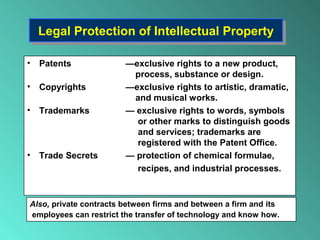
Legal Protection of Intellectual PropertyLegal Protection of Intellectual Property
• Patents —exclusive rights to a new product,
process, substance or design.
• Copyrights —exclusive rights to artistic, dramatic,
and musical works.
• Trademarks — exclusive rights to words, symbols
or other marks to distinguish goods
and services; trademarks are
registered with the Patent Office.
• Trade Secrets — protection of chemical formulae,
recipes, and industrial processes.
Also, private contracts between firms and between a firm and its
employees can restrict the transfer of technology and know how.
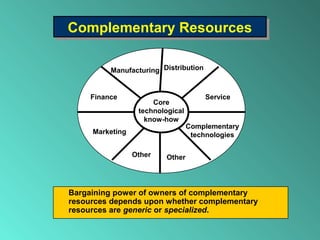
Complementary ResourcesComplementary Resources
Bargaining power of owners of complementary
resources depends upon whether complementary
resources are generic or specialized.
Manufacturing Distribution
Service
Complementary
technologies
OtherOther
Marketing
Finance
Core
technological
know-how
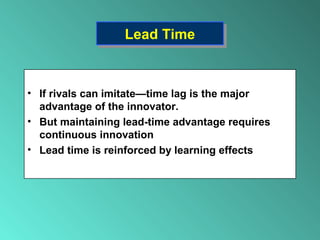
Lead TimeLead Time
• If rivals can imitate—time lag is the major
advantage of the innovator.
• But maintaining lead-time advantage requires
continuous innovation
• Lead time is reinforced by learning effects
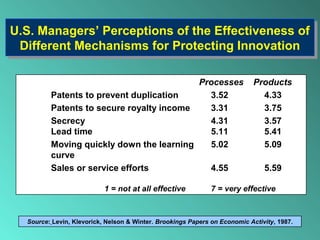
U.S. Managers’ Perceptions of the Effectiveness of
Different Mechanisms for Protecting Innovation
U.S. Managers’ Perceptions of the Effectiveness of
Different Mechanisms for Protecting Innovation
Processes Products
Patents to prevent duplication 3.52 4.33
Patents to secure royalty income 3.31 3.75
Secrecy 4.31 3.57
Lead time 5.11 5.41
Moving quickly down the learning 5.02 5.09
curve
Sales or service efforts 4.55 5.59
1 = not at all effective 7 = very effective
Source: Levin, Klevorick, Nelson & Winter. Brookings Papers on Economic Activity, 1987.
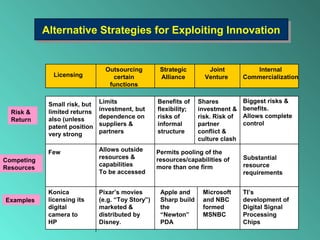
Risk &
Return
Competing
Resources
Examples
Licensing
Outsourcing
certain
functions
Strategic
Alliance
Joint
Venture
Internal
Commercialization
Small risk, but
limited returns
also (unless
patent position
very strong
Limits
investment, but
dependence on
suppliers &
partners
Benefits of
flexibility;
risks of
informal
structure
Shares
investment &
risk. Risk of
partner
conflict &
culture clash
Biggest risks &
benefits.
Allows complete
control
Few Allows outside
resources &
capabilities
To be accessed
Permits pooling of the
resources/capabilities of
more than one firm
Substantial
resource
requirements
Konica
licensing its
digital
camera to
HP
Pixar’s movies
(e.g. “Toy Story”)
marketed &
distributed by
Disney.
Apple and
Sharp build
the
“Newton”
PDA
Microsoft
and NBC
formed
MSNBC
TI’s
development of
Digital Signal
Processing
Chips
Alternative Strategies for Exploiting InnovationAlternative Strategies for Exploiting Innovation
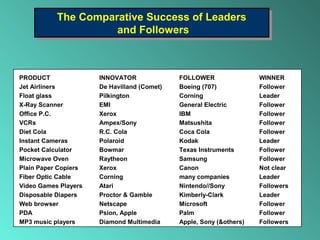
The Comparative Success of Leaders
and Followers
The Comparative Success of Leaders
and Followers
PRODUCT INNOVATOR FOLLOWER WINNER
Jet Airliners De Havilland (Comet) Boeing (707) Follower
Float glass Pilkington Corning Leader
X-Ray Scanner EMI General Electric Follower
Office P.C. Xerox IBM Follower
VCRs Ampex/Sony Matsushita Follower
Diet Cola R.C. Cola Coca Cola Follower
Instant Cameras Polaroid Kodak Leader
Pocket Calculator Bowmar Texas Instruments Follower
Microwave Oven Raytheon Samsung Follower
Plain Paper Copiers Xerox Canon Not clear
Fiber Optic Cable Corning many companies Leader
Video Games Players Atari Nintendo//Sony Followers
Disposable Diapers Proctor & Gamble Kimberly-Clark Leader
Web browser Netscape Microsoft Follower
PDA Psion, Apple Palm Follower
MP3 music players Diamond Multimedia Apple, Sony (&others) Followers
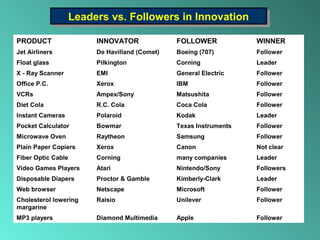
Leaders vs. Followers in InnovationLeaders vs. Followers in Innovation
PRODUCT INNOVATOR FOLLOWER WINNER
Jet Airliners De Havilland (Comet) Boeing (707) Follower
Float glass Pilkington Corning Leader
X - Ray Scanner EMI General Electric Follower
Office P.C. Xerox IBM Follower
VCRs Ampex/Sony Matsushita Follower
Diet Cola R.C. Cola Coca Cola Follower
Instant Cameras Polaroid Kodak Leader
Pocket Calculator Bowmar Texas Instruments Follower
Microwave Oven Raytheon Samsung Follower
Plain Paper Copiers Xerox Canon Not clear
Fiber Optic Cable Corning many companies Leader
Video Games Players Atari Nintendo/Sony Followers
Disposable Diapers Proctor & Gamble Kimberly-Clark Leader
Web browser Netscape Microsoft Follower
Cholesterol lowering Raisio Unilever Follower
margarine
MP3 players Diamond Multimedia Apple Follower
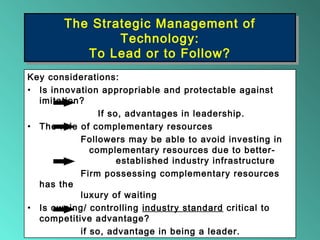
The Strategic Management of
Technology:
To Lead or to Follow?
The Strategic Management of
Technology:
To Lead or to Follow?
Key considerations:
• Is innovation appropriable and protectable against
imitation?
If so, advantages in leadership.
• The role of complementary resources
Followers may be able to avoid investing in
complementary resources due to better-
established industry infrastructure
Firm possessing complementary resources
has the
luxury of waiting
• Is owning/ controlling industry standard critical to
competitive advantage?
if so, advantage in being a leader.
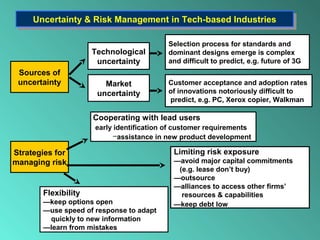
Uncertainty & Risk Management in Tech-based IndustriesUncertainty & Risk Management in Tech-based Industries
Sources of
uncertainty
Technological
uncertainty
Selection process for standards and
dominant designs emerge is complex
and difficult to predict, e.g. future of 3G
Customer acceptance and adoption rates
of innovations notoriously difficult to
predict, e.g. PC, Xerox copier, Walkman
Market
uncertainty
Strategies for
managing risk
Cooperating with lead users
early identification of customer requirements
–assistance in new product development
Flexibility
—keep options open
—use speed of response to adapt
quickly to new information
—learn from mistakes
Limiting risk exposure
—avoid major capital commitments
(e.g. lease don’t buy)
—outsource
—alliances to access other firms’
resources & capabilities
—keep debt low
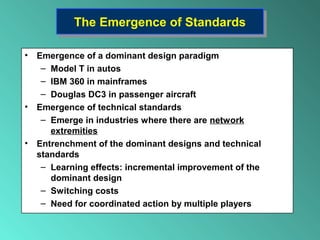
The Emergence of StandardsThe Emergence of Standards
• Emergence of a dominant design paradigm
– Model T in autos
– IBM 360 in mainframes
– Douglas DC3 in passenger aircraft
• Emergence of technical standards
– Emerge in industries where there are network
extremities
• Entrenchment of the dominant designs and technical
standards
– Learning effects: incremental improvement of the
dominant design
– Switching costs
– Need for coordinated action by multiple players
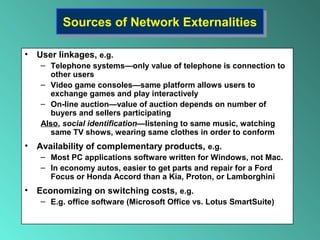
Sources of Network ExternalitiesSources of Network Externalities
• User linkages, e.g.
– Telephone systems—only value of telephone is connection to
other users
– Video game consoles—same platform allows users to
exchange games and play interactively
– On-line auction—value of auction depends on number of
buyers and sellers participating
Also, social identification—listening to same music, watching
same TV shows, wearing same clothes in order to conform
• Availability of complementary products, e.g.
– Most PC applications software written for Windows, not Mac.
– In economy autos, easier to get parts and repair for a Ford
Focus or Honda Accord than a Kia, Proton, or Lamborghini
• Economizing on switching costs, e.g.
– E.g. office software (Microsoft Office vs. Lotus SmartSuite)
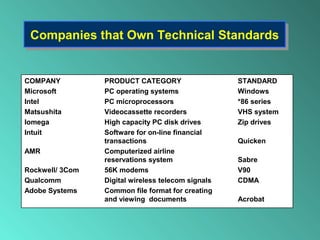
Companies that Own Technical StandardsCompanies that Own Technical Standards
COMPANY PRODUCT CATEGORY STANDARD
Microsoft PC operating systems Windows
Intel PC microprocessors *86 series
Matsushita Videocassette recorders VHS system
Iomega High capacity PC disk drives Zip drives
Intuit Software for on-line financial
transactions Quicken
AMR Computerized airline
reservations system Sabre
Rockwell/ 3Com 56K modems V90
Qualcomm Digital wireless telecom signals CDMA
Adobe Systems Common file format for creating
and viewing documents Acrobat
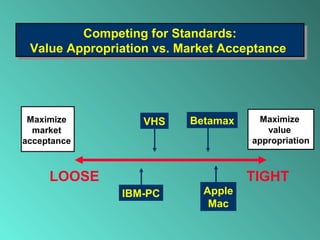
Competing for Standards:
Value Appropriation vs. Market Acceptance
Competing for Standards:
Value Appropriation vs. Market Acceptance
Maximize
value
appropriation
Maximize
market
acceptance
LOOSE TIGHT
VHS
IBM-PC Apple
Mac
Betamax
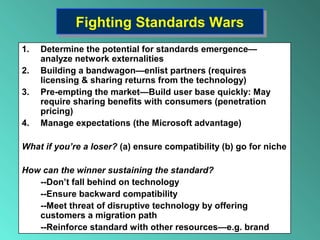
Fighting Standards WarsFighting Standards Wars
1. Determine the potential for standards emergence—
analyze network externalities
2. Building a bandwagon—enlist partners (requires
licensing & sharing returns from the technology)
3. Pre-empting the market—Build user base quickly: May
require sharing benefits with consumers (penetration
pricing)
4. Manage expectations (the Microsoft advantage)
What if you’re a loser? (a) ensure compatibility (b) go for niche
How can the winner sustaining the standard?
--Don’t fall behind on technology
--Ensure backward compatibility
--Meet threat of disruptive technology by offering
customers a migration path
--Reinforce standard with other resources—e.g. brand
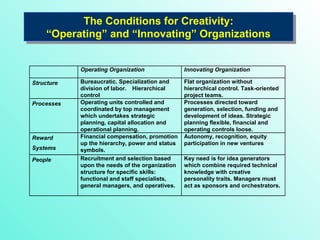
The Conditions for Creativity:
“Operating” and “Innovating” Organizations
The Conditions for Creativity:
“Operating” and “Innovating” Organizations
Operating Organization Innovating Organization
Structure Bureaucratic. Specialization and
division of labor. Hierarchical
control
Flat organization without
hierarchical control. Task-oriented
project teams.
Processes Operating units controlled and
coordinated by top management
which undertakes strategic
planning, capital allocation and
operational planning.
Processes directed toward
generation, selection, funding and
development of ideas. Strategic
planning flexible, financial and
operating controls loose.
Reward
Systems
Financial compensation, promotion
up the hierarchy, power and status
symbols.
Autonomy, recognition, equity
participation in new ventures
People Recruitment and selection based
upon the needs of the organization
structure for specific skills:
functional and staff specialists,
general managers, and operatives.
Key need is for idea generators
which combine required technical
knowledge with creative
personality traits. Managers must
act as sponsors and orchestrators.
Strategy Implementation: Invention to
Innovation
Strategy Implementation: Invention to
Innovation
• While invention depends upon creativity, successful
innovation requires integrating new knowledge with
multiple business functions.
• Need to link R&D departments with other functions (the
problem of Xerox’s PARC)
• The role of cross-functional new product development
teams as vehicles for integration
• The role of product champions--in achieving integration
and counteracting organizational inertia.

Ch11

  • 1.
    Technology-based Industries & theManagement of Innovation Technology-based Industries & the Management of Innovation • Competitive advantage in technology-intensive Industries – Appropriating the returns to innovation • Strategies to exploit innovation – Alternative approaches – Timing: to lead or to follow? – Managing risk • Competing for standards • Implementing technology strategy – The conditions for creativity – From invention to innovation OUTLINE
  • 2.
    The Development ofTechnology: From Knowledge Generation to Diffusion The Development of Technology: From Knowledge Generation to Diffusion Basic Knowledge Invention Innovation Diffusion IMITATION ADOPTION Supply side Demand side
  • 3.
    The Development ofTechnology: Lags Between Knowledge Generation and Commercialization The Development of Technology: Lags Between Knowledge Generation and Commercialization BASIC FIRST PRODUCT IMITATION KNOWLEDGE PATENTS LAUNCH Xerography late 19th and 1940 1958 1974 early 20th centuries Jet Engines 17th-- early 1930 1957 1959 20th centuries Fuzzy logic 1960’s 1981 1987 1988 controllers MP3 players Early 1990s 1994 1997 1999
  • 4.
    Appropriation of Value:-How are the Benefits from Innovation Distributed? Appropriation of Value:- How are the Benefits from Innovation Distributed? Customers Suppliers Imitators and other “followers” Innovator
  • 5.
    The Profitability ofInnovationThe Profitability of Innovation • Legal protection • Complementary resources • Imitability of the technology •Lead time Profits from Innovation Value of the innovation Innovator’s ability to appropriate the value of the innovation
  • 6.
    Legal Protection ofIntellectual PropertyLegal Protection of Intellectual Property • Patents —exclusive rights to a new product, process, substance or design. • Copyrights —exclusive rights to artistic, dramatic, and musical works. • Trademarks — exclusive rights to words, symbols or other marks to distinguish goods and services; trademarks are registered with the Patent Office. • Trade Secrets — protection of chemical formulae, recipes, and industrial processes. Also, private contracts between firms and between a firm and its employees can restrict the transfer of technology and know how.
  • 7.
    Complementary ResourcesComplementary Resources Bargainingpower of owners of complementary resources depends upon whether complementary resources are generic or specialized. Manufacturing Distribution Service Complementary technologies OtherOther Marketing Finance Core technological know-how
  • 8.
    Lead TimeLead Time •If rivals can imitate—time lag is the major advantage of the innovator. • But maintaining lead-time advantage requires continuous innovation • Lead time is reinforced by learning effects
  • 9.
    U.S. Managers’ Perceptionsof the Effectiveness of Different Mechanisms for Protecting Innovation U.S. Managers’ Perceptions of the Effectiveness of Different Mechanisms for Protecting Innovation Processes Products Patents to prevent duplication 3.52 4.33 Patents to secure royalty income 3.31 3.75 Secrecy 4.31 3.57 Lead time 5.11 5.41 Moving quickly down the learning 5.02 5.09 curve Sales or service efforts 4.55 5.59 1 = not at all effective 7 = very effective Source: Levin, Klevorick, Nelson & Winter. Brookings Papers on Economic Activity, 1987.
  • 10.
    Risk & Return Competing Resources Examples Licensing Outsourcing certain functions Strategic Alliance Joint Venture Internal Commercialization Small risk,but limited returns also (unless patent position very strong Limits investment, but dependence on suppliers & partners Benefits of flexibility; risks of informal structure Shares investment & risk. Risk of partner conflict & culture clash Biggest risks & benefits. Allows complete control Few Allows outside resources & capabilities To be accessed Permits pooling of the resources/capabilities of more than one firm Substantial resource requirements Konica licensing its digital camera to HP Pixar’s movies (e.g. “Toy Story”) marketed & distributed by Disney. Apple and Sharp build the “Newton” PDA Microsoft and NBC formed MSNBC TI’s development of Digital Signal Processing Chips Alternative Strategies for Exploiting InnovationAlternative Strategies for Exploiting Innovation
  • 11.
    The Comparative Successof Leaders and Followers The Comparative Success of Leaders and Followers PRODUCT INNOVATOR FOLLOWER WINNER Jet Airliners De Havilland (Comet) Boeing (707) Follower Float glass Pilkington Corning Leader X-Ray Scanner EMI General Electric Follower Office P.C. Xerox IBM Follower VCRs Ampex/Sony Matsushita Follower Diet Cola R.C. Cola Coca Cola Follower Instant Cameras Polaroid Kodak Leader Pocket Calculator Bowmar Texas Instruments Follower Microwave Oven Raytheon Samsung Follower Plain Paper Copiers Xerox Canon Not clear Fiber Optic Cable Corning many companies Leader Video Games Players Atari Nintendo//Sony Followers Disposable Diapers Proctor & Gamble Kimberly-Clark Leader Web browser Netscape Microsoft Follower PDA Psion, Apple Palm Follower MP3 music players Diamond Multimedia Apple, Sony (&others) Followers
  • 12.
    Leaders vs. Followersin InnovationLeaders vs. Followers in Innovation PRODUCT INNOVATOR FOLLOWER WINNER Jet Airliners De Havilland (Comet) Boeing (707) Follower Float glass Pilkington Corning Leader X - Ray Scanner EMI General Electric Follower Office P.C. Xerox IBM Follower VCRs Ampex/Sony Matsushita Follower Diet Cola R.C. Cola Coca Cola Follower Instant Cameras Polaroid Kodak Leader Pocket Calculator Bowmar Texas Instruments Follower Microwave Oven Raytheon Samsung Follower Plain Paper Copiers Xerox Canon Not clear Fiber Optic Cable Corning many companies Leader Video Games Players Atari Nintendo/Sony Followers Disposable Diapers Proctor & Gamble Kimberly-Clark Leader Web browser Netscape Microsoft Follower Cholesterol lowering Raisio Unilever Follower margarine MP3 players Diamond Multimedia Apple Follower
  • 13.
    The Strategic Managementof Technology: To Lead or to Follow? The Strategic Management of Technology: To Lead or to Follow? Key considerations: • Is innovation appropriable and protectable against imitation? If so, advantages in leadership. • The role of complementary resources Followers may be able to avoid investing in complementary resources due to better- established industry infrastructure Firm possessing complementary resources has the luxury of waiting • Is owning/ controlling industry standard critical to competitive advantage? if so, advantage in being a leader.
  • 14.
    Uncertainty & RiskManagement in Tech-based IndustriesUncertainty & Risk Management in Tech-based Industries Sources of uncertainty Technological uncertainty Selection process for standards and dominant designs emerge is complex and difficult to predict, e.g. future of 3G Customer acceptance and adoption rates of innovations notoriously difficult to predict, e.g. PC, Xerox copier, Walkman Market uncertainty Strategies for managing risk Cooperating with lead users early identification of customer requirements –assistance in new product development Flexibility —keep options open —use speed of response to adapt quickly to new information —learn from mistakes Limiting risk exposure —avoid major capital commitments (e.g. lease don’t buy) —outsource —alliances to access other firms’ resources & capabilities —keep debt low
  • 15.
    The Emergence ofStandardsThe Emergence of Standards • Emergence of a dominant design paradigm – Model T in autos – IBM 360 in mainframes – Douglas DC3 in passenger aircraft • Emergence of technical standards – Emerge in industries where there are network extremities • Entrenchment of the dominant designs and technical standards – Learning effects: incremental improvement of the dominant design – Switching costs – Need for coordinated action by multiple players
  • 16.
    Sources of NetworkExternalitiesSources of Network Externalities • User linkages, e.g. – Telephone systems—only value of telephone is connection to other users – Video game consoles—same platform allows users to exchange games and play interactively – On-line auction—value of auction depends on number of buyers and sellers participating Also, social identification—listening to same music, watching same TV shows, wearing same clothes in order to conform • Availability of complementary products, e.g. – Most PC applications software written for Windows, not Mac. – In economy autos, easier to get parts and repair for a Ford Focus or Honda Accord than a Kia, Proton, or Lamborghini • Economizing on switching costs, e.g. – E.g. office software (Microsoft Office vs. Lotus SmartSuite)
  • 17.
    Companies that OwnTechnical StandardsCompanies that Own Technical Standards COMPANY PRODUCT CATEGORY STANDARD Microsoft PC operating systems Windows Intel PC microprocessors *86 series Matsushita Videocassette recorders VHS system Iomega High capacity PC disk drives Zip drives Intuit Software for on-line financial transactions Quicken AMR Computerized airline reservations system Sabre Rockwell/ 3Com 56K modems V90 Qualcomm Digital wireless telecom signals CDMA Adobe Systems Common file format for creating and viewing documents Acrobat
  • 18.
    Competing for Standards: ValueAppropriation vs. Market Acceptance Competing for Standards: Value Appropriation vs. Market Acceptance Maximize value appropriation Maximize market acceptance LOOSE TIGHT VHS IBM-PC Apple Mac Betamax
  • 19.
    Fighting Standards WarsFightingStandards Wars 1. Determine the potential for standards emergence— analyze network externalities 2. Building a bandwagon—enlist partners (requires licensing & sharing returns from the technology) 3. Pre-empting the market—Build user base quickly: May require sharing benefits with consumers (penetration pricing) 4. Manage expectations (the Microsoft advantage) What if you’re a loser? (a) ensure compatibility (b) go for niche How can the winner sustaining the standard? --Don’t fall behind on technology --Ensure backward compatibility --Meet threat of disruptive technology by offering customers a migration path --Reinforce standard with other resources—e.g. brand
  • 20.
    The Conditions forCreativity: “Operating” and “Innovating” Organizations The Conditions for Creativity: “Operating” and “Innovating” Organizations Operating Organization Innovating Organization Structure Bureaucratic. Specialization and division of labor. Hierarchical control Flat organization without hierarchical control. Task-oriented project teams. Processes Operating units controlled and coordinated by top management which undertakes strategic planning, capital allocation and operational planning. Processes directed toward generation, selection, funding and development of ideas. Strategic planning flexible, financial and operating controls loose. Reward Systems Financial compensation, promotion up the hierarchy, power and status symbols. Autonomy, recognition, equity participation in new ventures People Recruitment and selection based upon the needs of the organization structure for specific skills: functional and staff specialists, general managers, and operatives. Key need is for idea generators which combine required technical knowledge with creative personality traits. Managers must act as sponsors and orchestrators.
  • 21.
    Strategy Implementation: Inventionto Innovation Strategy Implementation: Invention to Innovation • While invention depends upon creativity, successful innovation requires integrating new knowledge with multiple business functions. • Need to link R&D departments with other functions (the problem of Xerox’s PARC) • The role of cross-functional new product development teams as vehicles for integration • The role of product champions--in achieving integration and counteracting organizational inertia.