CSAC16 1/13/07 9:27 Page 414


                                                                                                 16
                             Managing the
                             Multibusiness
                             Corporation


             Some have argued that single-product businesses have a focus that gives them
             an advantage over multibusiness companies like our own – and perhaps they
             would have, but only if we neglect our own overriding advantage: the ability
             to share the ideas that are the result of wide and rich input from a multitude
                                            of global sources.

            GE businesses share technology, design, compensation and personnel evaluation
             systems, manufacturing practices, and customer and country knowledge. Gas
             Turbines shares manufacturing technology with Aircraft Engines; Motors and
            Transportation Systems work together on new propulsion systems; Lighting and
             Medical Systems collaborate to improve x-ray tube processes; and GE Capital
             provides innovative financing packages that help all our businesses around the
            globe. Supporting all this is a management system that fosters and rewards this
             sharing and teamwork, and, increasingly, a culture that makes it reflexive and
                           natural at every level and corner of our Company.
                —JACK WELCH, CHAIRMAN, GENERAL ELECTRIC COMPANY, 1981–2001


                                                 OUTLINE

           l Introduction and Objectives                l Managing the Corporate Portfolio
                                                           GE and the Development of Strategic
           l The Structure of the Multibusiness               Planning
              Company                                      Portfolio Planning: The GE/McKinsey
              The Theory of the M-Form                        Matrix
              Problems of Divisionalized Firms             Portfolio Planning: BCG’s
                                                              Growth–Share Matrix
           l The Role of Corporate                         Value Creation Through Corporate
              Management                                      Restructuring

    414
CSAC16 1/13/07 9:27 Page 415


                                                         CHAPTER 16   MANAGING THE MULTIBUSINESS CORPORATION      415


           l Managing Individual Businesses                The Corporate Role in Managing
              The Strategic Planning System                  Linkages
              Performance Control and the Budgeting
                 Process                                l Leading Change in the Multibusiness
              Balancing Strategic Planning and             Corporation
                 Financial Control
              Using PIMS in Strategy Formulation and
                 Performance Appraisal                  l Summary

           l Managing Internal Linkages
                                                        l Self-Study Questions
              Common Corporate Services
              Business Linkages and Porter’s
                Corporate Strategy Types                l Notes


                    Introduction and Objectives
                    In the last chapter, we concluded that the case for diversification rests ultimately on the
                    ability of the diversified corporation to exploit sources of value from operating across
                    multiple businesses more effectively than can specialized firms linked by markets.
                    Chapters 13 and 14 arrived at the same conclusion in relation to vertical integration and
                    multinational operations. Hence, multibusiness companies1 – whether vertically integrated,
                    multinational, or diversified across multiple products – face two critical issues. First,
                    can value be created through the relationships between businesses that span different
                    activities or different markets? Second, how should a company be structured and man-
                    aged to exploit these sources of value? Chapters 13, 14, and 15 addressed the first ques-
                    tion in relation to vertical, multinational, and multiproduct scope. This chapter addresses
                    the second question.
                       To manage multiple activities in multiple markets, multibusiness corporations typically
                    use multidivisional structures comprising several divisions or subsidiaries, coordinated by
                    a corporate headquarters. We shall examine the structures, management systems, and
                    leadership styles through which these – typically large, complex – corporations formulated
                    and implement their strategies. As we will see, corporate strategy is not simply a matter
                    of answering the question: “What businesses should we be in?” Some of the most difficult
                    issues of corporate strategy concern the roles and activities of the corporate head office
                    and the relationships between the businesses and the corporate center. These issues
                    include: managing the business portfolio; resource allocation; strategic planning; con-
                    trolling business unit performance; and coordinating across businesses.
CSAC16 1/13/07 9:27 Page 416


    416   PART V   CORPORATE STRATEGY


                    By the time you have completed this chapter you will be able to:

                    l Recognize the principal organizational feature of the multibusiness corporation.

                    l Apply the techniques of portfolio analysis to corporate strategy decisions.

                    l Analyze the potential for value creation through restructuring a multibusiness
                      corporation.

                    l Understand how corporate headquarters manages its individual businesses
                      through strategic planning and financial control and by managing linkages
                      across businesses.

                    l Analyze the fit between a firm’s corporate strategy organization structure,
                      management systems, and leadership style.


                           The Structure of the Multibusiness Company
                           Chapter 1 introduced the distinction between business strategy and corporate strategy
                           and observed that, within the multibusiness company, corporate management takes
                           primary responsibility for corporate strategy, and divisional management takes
                           primary responsibility for business strategy. This corporate/divisional distinction is
                           the basis feature of the multibusiness corporation. Whether we are referring to a multi-
                           product company (such as Viacom), a multinational company (such as SABMiller),
                           or a vertically integrated corporation (such as Alcoa), almost all multibusiness
                           companies are organized as multidivisional structures where business decisions are
                           located at the business level and the corporate center exercises overall coordination
                           and control. As we noted in Chapter 6, the emergence of the multidivisional structure
                           during the early 20th century was one of the key innovations in the history of man-
                           agement since it facilitated the development of the large diversified, multinational
                           corporations.
                              The allocation of decision making between corporate and divisional levels has
                           shifted over time. The initial rationale for the multidivisional firm was the separation
                           of strategic and operational decision making. During recent decades, more strategic
                           decision making has been devolved to the divisional and business unit levels, while
                           corporate headquarters have taken responsibility for corporate strategy and the man-
                           agement of overall corporate performance. Our primary focus is to analyze and
                           understand the role of the corporate center in managing the multibusiness company.


                           The Theory of the M-form
                           Once Alfred Chandler had documented the origin and diffusion of the multidivisional
                           form, it was left to Oliver Williamson to theorize about its rationale.2 Williamson
CSAC16 1/13/07 9:27 Page 417


                                                         CHAPTER 16   MANAGING THE MULTIBUSINESS CORPORATION   417


           identified four key efficiency advantages of the divisionalized firm (or, in his termi-
           nology, the M-form):

              1 Adaptation to “bounded rationality.” If managers are limited in their
                cognitive, information-processing, and decision-making capabilities, the top
                management team cannot be responsible for all coordination and decision
                making within a complex organization. The M-form permits decision making
                to be dispersed.
              2 Allocation of decision making. Decision-making responsibilities should be
                separated according to the frequency with which different types of decisions
                are made. The M-form allows high frequency decisions (e.g., operating
                decisions) to be made at divisional level and decisions that are made
                infrequently (e.g., strategic decisions) to be made at corporate level.
              3 Minimizing coordination costs. In the functional organization, decisions
                concerning a particular product or business area must pass up to the top of
                the company where all the relevant information and expertise can be brought
                to bear. In the divisionalized firm, so long as close coordination between
                different business areas is not necessary, most decisions concerning a
                particular business can be made at the divisional level. This eases the
                information and decision-making burden on top management.
              4 Avoiding goal conflict. In functional organizations, department heads
                emphasize functional goals over those of the organization as a whole. In
                multidivisional companies, divisional heads, as general managers, are more
                likely to pursue profit goals that are consistent with the goals of the company
                as a whole.

              As a result, the multidivisional firm can help solve two key problems of large, man-
           agerially controlled corporations:

              l Allocation of resources. Resource allocation within any administrative
                structure is a political process in which power, status, and influence can
                triumph over purely commercial considerations.3 To the extent that the
                multidivisional company can create a competitive internal capital market in
                which capital is allocated according to financial and strategic criteria, it can
                avoid much of the politicization inherent in purely hierarchical systems. The
                multidivisional company can achieve this through operating an internal capital
                market where budgets are linked to past and projected divisional profitability,
                and individual projects are subject to a standardized appraisal and approval
                process.
              l Resolution of agency problems. A related shortcoming of the modern
                corporation is that owners (shareholders) wish to maximize the value of the
                firm, while their agents (top managers) are more interested in salaries,
                security, and power. Given the limited power of shareholders to discipline and
                replace managers, and the tendency for top management to dominate the
                board of directors, the multidivisional form may act as a partial remedy to the
                agency problem. The rationale is as follows: by acting as an interface between
                the stockholders and the divisional managers, corporate management can
                enforce adherence to profit goals. With divisions designated as profit centers,
                financial performance can readily be monitored by the head office, and
CSAC16 1/13/07 9:27 Page 418


    418   PART V   CORPORATE STRATEGY


                               divisional managers can be held responsible for performance failures. So long
                               as corporate management is focused on shareholder goals, the multidivisional
                               structure can support a system for enforcing profit maximization at the
                               divisional level. General Electric, Emerson Electric, and BP are prime
                               examples of multidivisional companies where the corporate headquarters has
                               been highly effective in creating profit-oriented systems and cultures.
                             Oliver Williamson explains these merits of the multidivisional corporation as
                          follows:
                            The M-form conglomerate can be thought of as substituting an administrative
                            interface between an operating division and the stockholders where a market
                            interface had existed previously. Subject to the condition that the conglomerate
                            does not diversify to excess, in the sense that it cannot competently evaluate and
                            allocate funds among the diverse activities in which it is engaged, the substitution
                            of internal organization can have beneficial effects in goal pursuit, monitoring,
                            staffing, and resource allocation respects. The goal-pursuit advantage is that
                            which accrues to M-form organizations in general: since the general management
                            of an M-form conglomerate is disengaged from operating matters, a presumption
                            that the general office favors profits over functional goals is warranted. Relatedly,
                            the general office can be regarded as an agent of the stockholders whose purpose is
                            to monitor the operations of the constituent parts. Monitoring benefits are
                            realized in the degree to which internal monitors enjoy advantages over external
                            monitors in access to information – which they arguably do. The differential ease
                            with which the general office can change managers and reassign duties where
                            performance failures or distortions are detected is responsible for the staffing
                            advantage. Resource allocation benefits are realized because cash flows no longer
                            return automatically to their origins but instead revert to the center, thereafter to
                            be allocated among competing uses in accordance with prospective yields.4
                             Can the corporate general office really be relied upon to act as an “agent of the
                          stockholders”? Despite evidence that multidivisional structures are, in general, more
                          effective for diversified firms than alternative structural forms,5 some of the most
                          notorious examples of chief executives operating their companies as personal
                          fiefdoms are found among diversified, divisionalized corporations. Armand Hammer
                          at Occidental Petroleum, Howard Hughes at Hughes Corporation, Ken Lay at Enron,
                          Dennis Kozlowski at Tyco, and Jean-Marie Messier at Vivendi Universal all pursued
                          empire building at the expense of shareholder return.6 Corporate executives of
                          diversified companies may be less emotionally committed to particular businesses, but
                          this does not necessarily mean that they are more predisposed to shareholder return
                          than to Napoleonic personal grandeur.


                          Problems of Divisionalized Firms
                          In principle, the divisionalized corporation reconciles the benefits of decentralization
                          with those of coordination. As Henry Mintzberg points out, in practice, the multi-
                          divisional structure suffers from two important rigidities that limit decentralization
                          and adaptability:7
                            l Constraints on decentralization. Although operational authority in the
                               M-form firm is dispersed to the divisional level, the individual divisions
CSAC16 1/13/07 9:27 Page 419


                                                         CHAPTER 16   MANAGING THE MULTIBUSINESS CORPORATION   419


                often feature highly centralized power that is partly a reflection of the
                divisional president’s personal accountability to the head office. In addition,
                the operational freedom of the divisional management exists only so long as
                the corporate head office is satisfied with divisional performance. Monthly
                financial reviews typically mean that variances in divisional performance
                precipitate speedy corporate intervention.
              l Standardization of divisional management. In principle, the divisional form
                permits divisional management to be differentiated by their business needs.
                In practice, there are powerful forces for standardizing control systems and
                management styles which may inhibit individual divisions from achieving their
                potential. The imposition by Exxon of its standard financial control systems
                and hierarchical culture on its entrepreneurial IT subsidiary, Exxon Office
                Systems, was a key factor in the venture’s eventual failure. The difficulties that
                many large, mature corporations experience with new business development
                often result from applying to new businesses the same management systems
                designed for existing businesses.8


           The Role of Corporate Management
           How does the corporate headquarters create value within the multibusiness corpora-
           tion? If the multibusiness corporation is to be viable, then the additional profits gen-
           erated by bringing several businesses under common ownership and control must
           exceed the costs of the corporate headquarters. To explore the potential for corporate
           management to add value, we must consider the role and functions of corporate
           managers.
              So far we have identified corporate headquarters primarily with corporate strategy:
           determining the scope of the firm and allocating resources between its different parts.
           In fact, the responsibilities of corporate management also include administrative
           and leadership roles with regard to implementing corporate strategy, participating in
           divisional strategy formulation, coordinating the different divisions, and fostering
           overall cohesion, identity, and direction within the company. These functions extend
           beyond what is normally thought of as “corporate strategy.” For this reason, Goold,
           Campbell, and Alexander refer to the role of the corporate headquarters in the multi-
           business company as “corporate parenting.”9
              There are three main activities through which corporate management adds value
           to the multibusiness company:

              l Managing the corporate portfolio, including acquisitions, divestments, and
                resource allocation.
              l Exercising guidance and control over individual businesses, including
                influencing business strategy formulation and managing financial
                performance.
              l Managing linkages among businesses by sharing and transferring resources
                and capabilities.

             Let us consider each of these corporate management activities and establish the
           conditions under which they can create value.
CSAC16 1/13/07 9:27 Page 420


    420   PART V   CORPORATE STRATEGY


                          Managing the Corporate Portfolio
                          The basic question of corporate strategy is: “What business are we in?” Hence,
                          corporate strategy is concerned with the composition and balance of a company’s
                          portfolio of businesses. The key issues are extensions of the portfolio (acquisitions,
                          mergers, new ventures, and market entries), deletions from the portfolio (divest-
                          ments), and changes in the balance of the portfolio through the allocation and re-
                          allocation of capital and other resources. While additions to and deletions from the
                          corporate portfolio are typically major but infrequent strategic decisions, resource
                          allocation among businesses is an ongoing strategic responsibility of corporate man-
                          agement. Portfolio planning models are useful techniques for appraising a firm’s over-
                          all business portfolio and for formulating strategies for the individual businesses.

                          GE and the Development of Strategic Planning
                          Portfolio planning techniques were one outcome of the pioneering work in corpor-
                          ate strategy initiated by General Electric at the end of the 1960s.10 Indeed, General
                          Electric has been a leading source of corporate strategy concepts and innovations
                          for more than half a century. GE has been among the top five members of Fortune
                          magazine’s “America’s Most Admired Corporations” since the listings began.
                             At the end of the 1960s, GE comprised 46 divisions and over 190 businesses. To
                          manage this sprawling industrial empire more effectively, GE launched a series of
                          initiatives together with the Boston Consulting Group, McKinsey & Co., Arthur D.
                          Little, and the Harvard Business School. The result was three innovations that would
                          transform corporate strategy formulation in multibusiness companies:
                            l Portfolio planning models – two-dimensional, matrix-based frameworks to
                              evaluate business unit performance, formulate business unit strategies, and
                              assess the overall balance of the corporate portfolio.
                            l The strategic business unit (SBU) – the basic organizational unit for which it is
                              meaningful to formulate a separate competitive strategy. Typically, an SBU is a
                              business consisting of a number of closely related products and for which
                              most costs are not shared with other businesses. McKinsey recommended the
                              reorganization of GE into SBUs for formulating and monitoring business
                              strategies.
                            l The PIMS database – an internal database that comprises strategic, market,
                              and performance data on each of GE’s businesses for assisting strategy
                              formulation by providing analysis of the impact of market structure and
                              strategy variables on profitability.11

                          Portfolio Planning: The GE/McKinsey Matrix
                          The best-known products of GE’s corporate planning initiatives of 1969–72 are the
                          portfolio planning models developed by McKinsey, BCG, and A. D. Little. The basic
                          idea was to represent the businesses of the diversified company within a simple graph-
                          ical framework that could be used to guide strategy analysis in four areas:
                            1 Allocating resources. Portfolio analysis examines the position of a business unit
                              in relation to the two primary sources of profitability: industry attractiveness
                              and the competitive advantage of the firm. These indicate the attractiveness of
                              the business for future investment.
CSAC16 1/13/07 9:27 Page 421


                                                                            CHAPTER 16    MANAGING THE MULTIBUSINESS CORPORATION   421


              2 Formulating business unit strategy. The current positioning of the business
                in relation to industry attractiveness and potential competitive advantage
                indicates the strategic approach that should be taken with regard to capital
                investment and can point to opportunities for repositioning the business.
              3 Analyzing portfolio balance. The primary usefulness of a single diagrammatic
                representation of the company’s different businesses is the ability of corporate
                management to take an overall view of the company. This permits planning
                the overall balance of:
                – cash flows: by balancing cash-generating businesses against cash-absorbing
                   businesses, the diversified company can achieve independence from
                   external capital markets;
                – growth: by balancing a mix of businesses in different stages of their life
                   cycles, the diversified company can stabilize its growth rate and achieve
                   continuity over time.
              4 Setting performance targets. To the extent that positioning with regard to
                industry attractiveness and competitive position determine profit potential,
                portfolio-planning matrices can assist in setting performance targets for
                individual businesses.
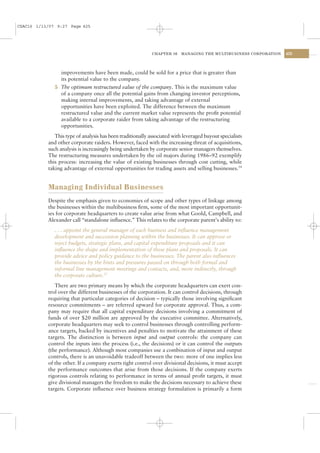
              The two axes of the GE/McKinsey matrix (see Figure 16.1) are the familiar sources
           of superior profitability for a firm: industry attractiveness and competitive advantage.
           Industry attractiveness combines the following factors: market size and growth rate;
           industry profitability (return on sales over three years); cyclicality; inflation recovery
           (ability to cover cost increases by higher productivity and increased prices); and im-
           portance of overseas markets (ratio of international to US sales). Business unit com-
           petitive advantage is computed on the basis of the following variables: market share;
           competitive position with regard to quality, technology, manufacturing, distribution,
           marketing, and cost; and return on sales relative to that of leading competitors.
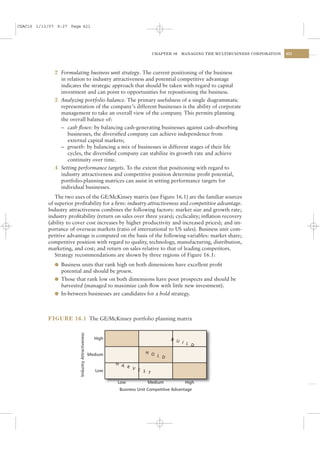
              Strategy recommendations are shown by three regions of Figure 16.1:
              l Business units that rank high on both dimensions have excellent profit
                potential and should be grown.
              l Those that rank low on both dimensions have poor prospects and should be
                harvested (managed to maximize cash flow with little new investment).
              l In-between businesses are candidates for a hold strategy.


           FIGURE 16.1 The GE/McKinsey portfolio planning matrix
                         Industry Attractiveness


                                                     High                            B U
                                                                                         I L
                                                                                             D
                                                                         H O
                                                   Medium                    L D
                                                            H A
                                                                R V
                                                      Low           E S
                                                                        T

                                                            Low           Medium            High
                                                             Business Unit Competitive Advantage
CSAC16 1/13/07 9:27 Page 422


    422   PART V   CORPORATE STRATEGY


                          FIGURE 16.2 The BCG growth–share matrix


                                                                    Earnings:    low, unstable, growing        Earnings:    high, stable, growing
                            Annual Real Rate of Market Growth (%)


                                                                    Cash flow:   negative                      Cash flow:   neutral
                                                                    Strategy:    analyze to determine          Strategy:    invest for growth
                                                        HIGH


                                                                                 whether business can


                                                                                                       ?
                                                                                 be grown into a star
                                                                                 or will degenerate
                                                                                 into a dog

                                                                    Earnings:    low, unstable                 Earnings:    high, stable
                                                                    Cash flow:   neutral or negative           Cash flow:   high, stable
                                                                    Strategy:    divest                        Strategy:    milk
                                LOW


                                                                                      LOW                                       HIGH
                                                                                                   Relative Market Share


                          Portfolio Planning: BCG’s Growth–Share Matrix
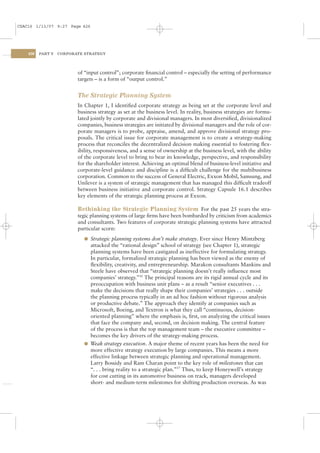
                          The Boston Consulting Group’s matrix is similar: it also uses industry attractiveness
                          and competitive position to compare the strategic positions of different businesses.
                          However, unlike the McKinsey matrix, it uses single variables for each axis: industry
                          attractiveness is measured by rate of market growth, competitive advantage by relative
                          market share (the business unit’s market share relative to that of its largest competitor).
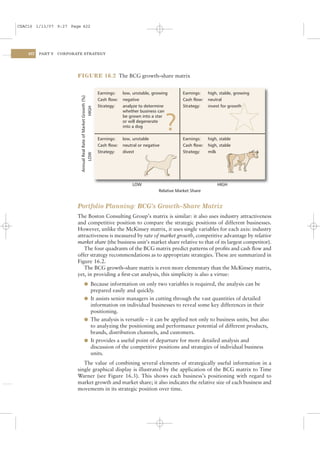
                             The four quadrants of the BCG matrix predict patterns of profits and cash flow and
                          offer strategy recommendations as to appropriate strategies. These are summarized in
                          Figure 16.2.
                             The BCG growth–share matrix is even more elementary than the McKinsey matrix,
                          yet, in providing a first-cut analysis, this simplicity is also a virtue:
                                    l Because information on only two variables is required, the analysis can be
                                      prepared easily and quickly.
                                    l It assists senior managers in cutting through the vast quantities of detailed
                                      information on individual businesses to reveal some key differences in their
                                      positioning.
                                    l The analysis is versatile – it can be applied not only to business units, but also
                                      to analyzing the positioning and performance potential of different products,
                                      brands, distribution channels, and customers.
                                    l It provides a useful point of departure for more detailed analysis and
                                      discussion of the competitive positions and strategies of individual business
                                      units.
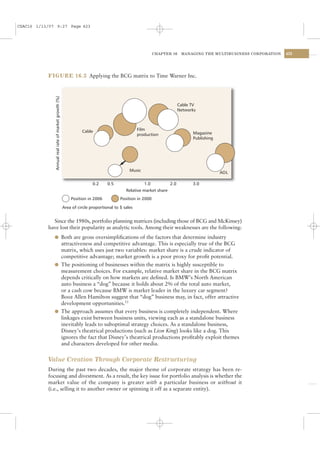
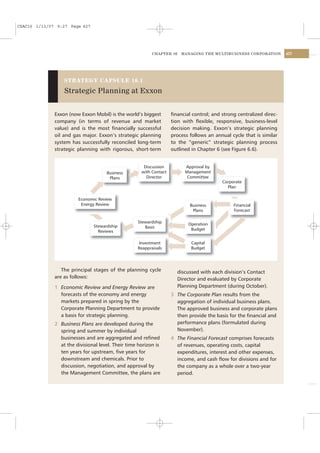
                             The value of combining several elements of strategically useful information in a
                          single graphical display is illustrated by the application of the BCG matrix to Time
                          Warner (see Figure 16.3). This shows each business’s positioning with regard to
                          market growth and market share; it also indicates the relative size of each business and
                          movements in its strategic position over time.
CSAC16 1/13/07 9:27 Page 423


                                                                                                        CHAPTER 16     MANAGING THE MULTIBUSINESS CORPORATION   423


           FIGURE 16.3 Applying the BCG matrix to Time Warner Inc.
              Annual real rate of market growth (%)


                                                                                                                      Cable TV
                                                                                                                      Networks


                                                                Cable                          Film
                                                                                               production                   Magazine
                                                                                                                            Publishing


                                                                                          Music                                          AOL

                                                                      0.2     0.5                 1.0           2.0         3.0
                                                                                        Relative market share
                                                          Position in 2006           Position in 2000

                                                      Area of circle proportional to $ sales


             Since the 1980s, portfolio planning matrices (including those of BCG and McKinsey)
           have lost their popularity as analytic tools. Among their weaknesses are the following:
              l Both are gross oversimplifications of the factors that determine industry
                attractiveness and competitive advantage. This is especially true of the BCG
                matrix, which uses just two variables: market share is a crude indicator of
                competitive advantage; market growth is a poor proxy for profit potential.
              l The positioning of businesses within the matrix is highly susceptible to
                measurement choices. For example, relative market share in the BCG matrix
                depends critically on how markets are defined. Is BMW’s North American
                auto business a “dog” because it holds about 2% of the total auto market,
                or a cash cow because BMW is market leader in the luxury car segment?
                Booz Allen Hamilton suggest that “dog” business may, in fact, offer attractive
                development opportunities.12
              l The approach assumes that every business is completely independent. Where
                linkages exist between business units, viewing each as a standalone business
                inevitably leads to suboptimal strategy choices. As a standalone business,
                Disney’s theatrical productions (such as Lion King) looks like a dog. This
                ignores the fact that Disney’s theatrical productions profitably exploit themes
                and characters developed for other media.


           Value Creation Through Corporate Restructuring
           During the past two decades, the major theme of corporate strategy has been re-
           focusing and divestment. As a result, the key issue for portfolio analysis is whether the
           market value of the company is greater with a particular business or without it
           (i.e., selling it to another owner or spinning it off as a separate entity).
CSAC16 1/13/07 9:27 Page 424


    424   PART V   CORPORATE STRATEGY


                          FIGURE 16.4 The McKinsey restructuring pentagon

                                                                     Current
                                                                   market value


                                                                                                                       SOURCE: T. E. COPELAND, T. KOLLER, AND J. MURRIN, VALUATION (NEW YORK: WILEY, 1990).
                                                                         1
                                                  Current                              Maximum raider
                                              perceptions gap                           opportunity


                                                                                                          Optimal
                                Company                          RESTRUCTURING
                                                2                                                  5    restructured
                                value as is                       FRAMEWORK                                 value

                                    Strategic and
                                                                                                Total company
                                      operating
                                                                                                 opportunities
                                    opportunities

                                        Potential value     3                           4    Potential value
                                         with internal          Disposal/acquisition          with external
                                        improvements               opportunities             improvements


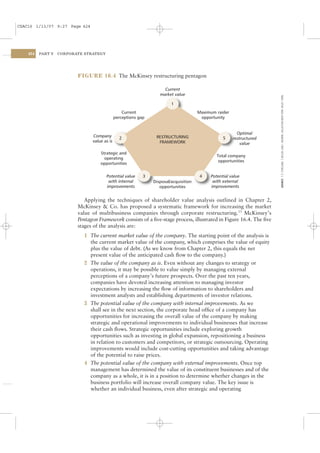
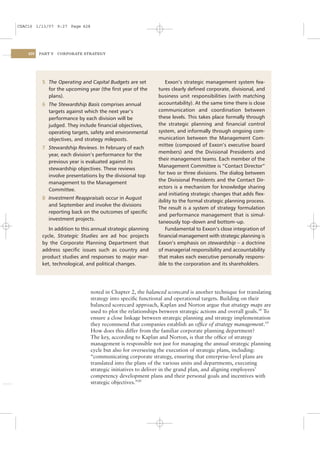
                             Applying the techniques of shareholder value analysis outlined in Chapter 2,
                          McKinsey & Co. has proposed a systematic framework for increasing the market
                          value of multibusiness companies through corporate restructuring.13 McKinsey’s
                          Pentagon Framework consists of a five-stage process, illustrated in Figure 16.4. The five
                          stages of the analysis are:
                            1 The current market value of the company. The starting point of the analysis is
                              the current market value of the company, which comprises the value of equity
                              plus the value of debt. (As we know from Chapter 2, this equals the net
                              present value of the anticipated cash flow to the company.)
                            2 The value of the company as is. Even without any changes to strategy or
                              operations, it may be possible to value simply by managing external
                              perceptions of a company’s future prospects. Over the past ten years,
                              companies have devoted increasing attention to managing investor
                              expectations by increasing the flow of information to shareholders and
                              investment analysts and establishing departments of investor relations.
                            3 The potential value of the company with internal improvements. As we
                              shall see in the next section, the corporate head office of a company has
                              opportunities for increasing the overall value of the company by making
                              strategic and operational improvements to individual businesses that increase
                              their cash flows. Strategic opportunities include exploring growth
                              opportunities such as investing in global expansion, repositioning a business
                              in relation to customers and competitors, or strategic outsourcing. Operating
                              improvements would include cost-cutting opportunities and taking advantage
                              of the potential to raise prices.
                            4 The potential value of the company with external improvements. Once top
                              management has determined the value of its constituent businesses and of the
                              company as a whole, it is in a position to determine whether changes in the
                              business portfolio will increase overall company value. The key issue is
                              whether an individual business, even after strategic and operating
CSAC16 1/13/07 9:27 Page 425


                                                            CHAPTER 16    MANAGING THE MULTIBUSINESS CORPORATION   425


                improvements have been made, could be sold for a price that is greater than
                its potential value to the company.
              5 The optimum restructured value of the company. This is the maximum value
                of a company once all the potential gains from changing investor perceptions,
                making internal improvements, and taking advantage of external
                opportunities have been exploited. The difference between the maximum
                restructured value and the current market value represents the profit potential
                available to a corporate raider from taking advantage of the restructuring
                opportunities.
              This type of analysis has been traditionally associated with leveraged buyout specialists
           and other corporate raiders. However, faced with the increasing threat of acquisitions,
           such analysis is increasingly being undertaken by corporate senior managers themselves.
           The restructuring measures undertaken by the oil majors during 1986–92 exemplify
           this process: increasing the value of existing businesses through cost cutting, while
           taking advantage of external opportunities for trading assets and selling businesses.14


           Managing Individual Businesses
           Despite the emphasis given to economies of scope and other types of linkage among
           the businesses within the multibusiness firm, some of the most important opportunit-
           ies for corporate headquarters to create value arise from what Goold, Campbell, and
           Alexander call “standalone influence.” This relates to the corporate parent’s ability to:
              . . . appoint the general manager of each business and influence management
              development and succession planning within the businesses. It can approve or
              reject budgets, strategic plans, and capital expenditure proposals and it can
              influence the shape and implementation of these plans and proposals. It can
              provide advice and policy guidance to the businesses. The parent also influences
              the businesses by the hints and pressures passed on through both formal and
              informal line management meetings and contacts, and, more indirectly, through
              the corporate culture.15
              There are two primary means by which the corporate headquarters can exert con-
           trol over the different businesses of the corporation. It can control decisions, through
           requiring that particular categories of decision – typically those involving significant
           resource commitments – are referred upward for corporate approval. Thus, a com-
           pany may require that all capital expenditure decisions involving a commitment of
           funds of over $20 million are approved by the executive committee. Alternatively,
           corporate headquarters may seek to control businesses through controlling perform-
           ance targets, backed by incentives and penalties to motivate the attainment of these
           targets. The distinction is between input and output controls: the company can
           control the inputs into the process (i.e., the decisions) or it can control the outputs
           (the performance). Although most companies use a combination of input and output
           controls, there is an unavoidable tradeoff between the two: more of one implies less
           of the other. If a company exerts tight control over divisional decisions, it must accept
           the performance outcomes that arise from those decisions. If the company exerts
           rigorous controls relating to performance in terms of annual profit targets, it must
           give divisional managers the freedom to make the decisions necessary to achieve these
           targets. Corporate influence over business strategy formulation is primarily a form
CSAC16 1/13/07 9:27 Page 426


    426   PART V   CORPORATE STRATEGY


                          of “input control”; corporate financial control – especially the setting of performance
                          targets – is a form of “output control.”


                          The Strategic Planning System
                          In Chapter 1, I identified corporate strategy as being set at the corporate level and
                          business strategy as set at the business level. In reality, business strategies are formu-
                          lated jointly by corporate and divisional managers. In most diversified, divisionalized
                          companies, business strategies are initiated by divisional managers and the role of cor-
                          porate managers is to probe, appraise, amend, and approve divisional strategy pro-
                          posals. The critical issue for corporate management is to create a strategy-making
                          process that reconciles the decentralized decision making essential to fostering flex-
                          ibility, responsiveness, and a sense of ownership at the business level, with the ability
                          of the corporate level to bring to bear its knowledge, perspective, and responsibility
                          for the shareholder interest. Achieving an optimal blend of business-level initiative and
                          corporate-level guidance and discipline is a difficult challenge for the multibusiness
                          corporation. Common to the success of General Electric, Exxon Mobil, Samsung, and
                          Unilever is a system of strategic management that has managed this difficult tradeoff
                          between business initiative and corporate control. Strategy Capsule 16.1 describes
                          key elements of the strategic planning process at Exxon.

                          Rethinking the Strategic Planning System For the past 25 years the stra-
                          tegic planning systems of large firms have been bombarded by criticism from academics
                          and consultants. Two features of corporate strategic planning systems have attracted
                          particular scorn:
                            l Strategic planning systems don’t make strategy. Ever since Henry Mintzberg
                              attacked the “rational design” school of strategy (see Chapter 1), strategic
                              planning systems have been castigated as ineffective for formulating strategy.
                              In particular, formalized strategic planning has been viewed as the enemy of
                              flexibility, creativity, and entrepreneurship. Marakon consultants Mankins and
                              Steele have observed that “strategic planning doesn’t really influence most
                              companies’ strategy.”16 The principal reasons are its rigid annual cycle and its
                              preoccupation with business unit plans – as a result “senior executives . . .
                              make the decisions that really shape their companies’ strategies . . . outside
                              the planning process typically in an ad hoc fashion without rigorous analysis
                              or productive debate.” The approach they identify at companies such as
                              Microsoft, Boeing, and Textron is what they call “continuous, decision-
                              oriented planning” where the emphasis is, first, on analyzing the critical issues
                              that face the company and, second, on decision making. The central feature
                              of the process is that the top management team – the executive committee –
                              becomes the key drivers of the strategy-making process.
                            l Weak strategy execution. A major theme of recent years has been the need for
                              more effective strategy execution by large companies. This means a more
                              effective linkage between strategic planning and operational management.
                              Larry Bossidy and Ram Charan point to the key role of milestones that can
                              “. . . bring reality to a strategic plan.”17 Thus, to keep Honeywell’s strategy
                              for cost cutting in its automotive business on track, managers developed
                              short- and medium-term milestones for shifting production overseas. As was
CSAC16 1/13/07 9:27 Page 427


                                                          CHAPTER 16    MANAGING THE MULTIBUSINESS CORPORATION        427


                  STRATEGY CAPSULE 16.1

                  Strategic Planning at Exxon


              Exxon (now Exxon Mobil) is the world’s biggest        financial control; and strong centralized direc-
              company (in terms of revenue and market               tion with flexible, responsive, business-level
              value) and is the most financially successful          decision making. Exxon’s strategic planning
              oil and gas major. Exxon’s strategic planning         process follows an annual cycle that is similar
              system has successfully reconciled long-term          to the “generic” strategic planning process
              strategic planning with rigorous, short-term          outlined in Chapter 6 (see Figure 6.6).


                                                      Discussion          Approval by
                                     Business        with Contact         Management
                                      Plans            Director            Committee
                                                                                          Corporate
                                                                                            Plan

                        Economic Review
                         Energy Review                                      Business           Financial
                                                                             Plans             Forecast

                                                   Stewardship             Operation
                               Stewardship            Basis
                                 Reviews                                    Budget


                                                    Investment              Capital
                                                   Reappraisals             Budget


                 The principal stages of the planning cycle            discussed with each division’s Contact
              are as follows:                                          Director and evaluated by Corporate
              1 Economic Review and Energy Review are                  Planning Department (during October).
                forecasts of the economy and energy                 3 The Corporate Plan results from the
                markets prepared in spring by the                     aggregation of individual business plans.
                Corporate Planning Department to provide              The approved business and corporate plans
                a basis for strategic planning.                       then provide the basis for the financial and
              2 Business Plans are developed during the               performance plans (formulated during
                spring and summer by individual                       November).
                businesses and are aggregated and refined            4 The Financial Forecast comprises forecasts
                at the divisional level. Their time horizon is        of revenues, operating costs, capital
                ten years for upstream, five years for                 expenditures, interest and other expenses,
                downstream and chemicals. Prior to                    income, and cash flow for divisions and for
                discussion, negotiation, and approval by              the company as a whole over a two-year
                the Management Committee, the plans are               period.
CSAC16 1/13/07 9:27 Page 428


    428   PART V   CORPORATE STRATEGY


           5 The Operating and Capital Budgets are set            Exxon’s strategic management system fea-
             for the upcoming year (the first year of the      tures clearly defined corporate, divisional, and
             plans).                                          business unit responsibilities (with matching
           6 The Stewardship Basis comprises annual           accountability). At the same time there is close
             targets against which the next year’s            communication and coordination between
             performance by each division will be             these levels. This takes place formally through
             judged. They include financial objectives,        the strategic planning and financial control
             operating targets, safety and environmental      system, and informally through ongoing com-
             objectives, and strategy mileposts.              munication between the Management Com-
                                                              mittee (composed of Exxon’s executive board
           7 Stewardship Reviews. In February of each
                                                              members) and the Divisional Presidents and
             year, each division’s performance for the
                                                              their management teams. Each member of the
             previous year is evaluated against its
                                                              Management Committee is “Contact Director”
             stewardship objectives. These reviews
                                                              for two or three divisions. The dialog between
             involve presentations by the divisional top
                                                              the Divisional Presidents and the Contact Dir-
             management to the Management
                                                              ectors is a mechanism for knowledge sharing
             Committee.
                                                              and initiating strategic changes that adds flex-
           8 Investment Reappraisals occur in August
                                                              ibility to the formal strategic planning process.
             and September and involve the divisions
                                                              The result is a system of strategy formulation
             reporting back on the outcomes of specific
                                                              and performance management that is simul-
             investment projects.
                                                              taneously top–down and bottom–up.
              In addition to this annual strategic planning       Fundamental to Exxon’s close integration of
           cycle, Strategic Studies are ad hoc projects       financial management with strategic planning is
           by the Corporate Planning Department that          Exxon’s emphasis on stewardship – a doctrine
           address specific issues such as country and         of managerial responsibility and accountability
           product studies and responses to major mar-        that makes each executive personally respons-
           ket, technological, and political changes.         ible to the corporation and its shareholders.


                                noted in Chapter 2, the balanced scorecard is another technique for translating
                                strategy into specific functional and operational targets. Building on their
                                balanced scorecard approach, Kaplan and Norton argue that strategy maps are
                                used to plot the relationships between strategic actions and overall goals.18 To
                                ensure a close linkage between strategic planning and strategy implementation
                                they recommend that companies establish an office of strategy management.19
                                How does this differ from the familiar corporate planning department?
                                The key, according to Kaplan and Norton, is that the office of strategy
                                management is responsible not just for managing the annual strategic planning
                                cycle but also for overseeing the execution of strategic plans, including:
                                “communicating corporate strategy, ensuring that enterprise-level plans are
                                translated into the plans of the various units and departments, executing
                                strategic initiatives to deliver in the grand plan, and aligning employees’
                                competency development plans and their personal goals and incentives with
                                strategic objectives.”20
CSAC16 1/13/07 9:27 Page 429


                                                         CHAPTER 16   MANAGING THE MULTIBUSINESS CORPORATION   429


           Performance Control and the Budgeting Process
           Most multidivisional companies operate a dual planning process: strategic planning
           concentrates on the medium and long term, financial planning controls short-term
           performance. Typically, the first year of the strategic plan includes the performance
           plan for the upcoming year in terms of an operating budget, a capital expenditure
           budget, and strategy targets relating to market share, output and employment levels,
           and specific strategic milestones. Annual performance plans are agreed between senior
           business-level and corporate-level managers. They are monitored on a monthly or
           quarterly basis, and are reviewed more extensively in meetings between business and
           corporate management after the end of each financial year.
              The corporate head office is responsible for setting and monitoring performance
           targets for the individual divisions. Performance targets may be financial (return on
           invested capital, gross margin, growth of sales revenue), strategic (market share, rate
           of new product introduction, market penetration, quality), or operational (output,
           productivity). Performance targets are primarily annual, with less detailed perfor-
           mance targets set for up to five years ahead. Corporate emphasis is on annual targets
           which are monitored on a monthy and quarterly basis to detect deviations.
              Performance targets are supported by incentives include financial returns (bonuses,
           enhanced authority, recognition) and sanctions. Some companies have combined
           demanding performance goals and powerful incentives to create an intensely motivat-
           ing environment for divisional managers. At ITT, Geneen’s obsession with highly
           detailed performance monitoring, ruthless interrogation of divisional executives, and
           generous rewards for success developed a highly motivated, strongly capable group
           of young, senior executives who were willing to work unremittingly long hours. They
           demanded as high a standard of performance from their subordinates as Geneen
           did of them.21 Creating an intense, performance-driven culture requires unremitting
           focus on a few quantitative performance targets that can be monitored on a short-term
           basis. PepsiCo’s obsession with monthly market share nourishes an intense, marketing-
           oriented culture. As CEO Indra Nooyi noted, “We are a very objective-driven com-
           pany. We spend a lot of time up front setting objectives and our guys rise to the
           challenge of meeting those objectives. When they don’t meet the objectives, we don’t
           have to flog them because they do it themselves.”22 One executive put it more bluntly:
           “The place is full of guys with sparks coming out of their asses.”23 Even in businesses
           where interdependence is high and investment gestation periods are long, as in oil
           and gas, short- or medium-term performance targets can be highly effective. The key
           feature of BP’s performance-oriented culture is a system of performance contracts
           in which each business unit general manager agrees a set of financial, strategic, and
           operational targets with the CEO.24
              Linking individual incentives to company performance goals has proved to be more
           difficult than most advocates of performance management envisaged. Over time, top
           management compensation has become increasingly closely tied to company perform-
           ance through performance-related bonuses the stock options. Moreover, perform-
           ance bonuses and options packages have been extended down corporate hierarchies to
           increasing numbers of employees. In the UK, salary comprised 54% of total executive
           compensation as compared with bonuses 24%, and options and long-term incentive
           plans 22%.25 However, financial incentives for executives seem to be poorly aligned
           with the goals of shareholders. The ability of top managers to design their own com-
           pensation schemes has resulted in massive growth in top management pay and in the
CSAC16 1/13/07 9:27 Page 430


    430    PART V   CORPORATE STRATEGY


                              manipulation of these schemes to the benefit of executives.26 The stock market boom
                              of the late 1990s created perverse incentives for executives to maximize short-term
                              financial performance and even to manipulate financial statements.27

                              Balancing Strategic Planning and Financial Control
                              One implication of the tradeoff between input control (controlling decisions) and
                              output control (controlling performance) is that companies must choose how far to
                              emphasize strategic planning relative to financial planning as their primary control
                              system. A study of British multibusiness companies by Michael Goold and Andrew
                              Campbell found that their corporate management systems emphasized either stra-
                              tegic planning or financial control.28 Strategic planning emphasized the longer term
                              development of the businesses and was associated with substantial involvement by
                              corporate headquarters in business-level planning. Financial control implied limited
                              involvement by corporate management in business strategy formulation, which was
                              the responsibility of divisional and business unit managers. The primary influence of
                              headquarters was through short-term budgetary control and the establishment of
                              ambitious financial targets that were rigorously monitored by headquarters. Table 16.1
                              summarizes key features of the two styles.

          TABLE 16.1 Characteristics of Different Strategic Management Styles

                                 Strategic planning                            Financial control

           Business              Businesses and corporate HQ jointly           Strategy formulated at business unit
           Strategy              formulate strategy. HQ coordinates            level. Corporate HQ largely reactive,
           Formulation           strategies of businesses.                     offering little coordination.

           Controlling           Primarily strategic goals with medium- to     Financial budgets set annual targets for
           Performance           long-term horizon.                            ROI and other financial variables with
                                                                               monthly and quarterly monitoring.

           Advantages            Effective in managing (a) linkages among      Business unit autonomy encourages
                                 businesses, (b) innovation, (c) long-term     initiative responsiveness, and the
                                 competitive positioning.                      development of business leaders.           SOURCE: BASED ON M. GOOLD AND A. CAMPBELL, STRATEGIES AND STYLES (OXFORD: BLACKWELL, 1987).


           Disadvantages         Loss of divisional autonomy and initiative.   Short-term focus discourages innovation
                                 Conducive to unitary strategic view.          and long-term development Limited
                                 Resistance to abandoning failed strategy.     sharing of resources and skills among
                                                                               businesses.

           Style suited to:
           UK Examples           Companies with a small number of closely      Companies with many businesses across
                                 related businesses. In sectors where          a wide range of industries, and with
                                 technology and competition are important      limited linkages between them.
                                 and projects are large and long term.         Approach works best in mature,
                                                                               technologically stable sectors where
                                                                               investment projects are relatively small
                                                                               and short term.

                                 BP, BOC, Cadbury-Schweppes, Lex Group,        Hanson, BTR, General Electric Company,
                                 STC, United Biscuits.                         Ferranti, Tarmac
CSAC16 1/13/07 9:27 Page 431


                                                         CHAPTER 16   MANAGING THE MULTIBUSINESS CORPORATION   431


              Since Goold and Campbell’s original study, it appears that financial control has
           become increasingly important – even in companies, such as BP, that fell into the
           strategic planning category. Thus, among the oil and gas majors, it was observed that
           strategic planning has become less concerned with strategic decision making and more
           focused on managing financial performance.29


           Using PIMS in Strategy Formulation and
           Performance Appraisal
           Some of the most sophisticated techniques for strategy development and perform-
           ance appraisal have been those based on the PIMS (Profit Impact of Market Strategies)
           database. PIMS grew out of General Electric’s internal database and was developed
           by the Strategic Planning Institute. It comprises information on over 5,000 business
           units that is used to estimate the impact of strategy and market structure on business-
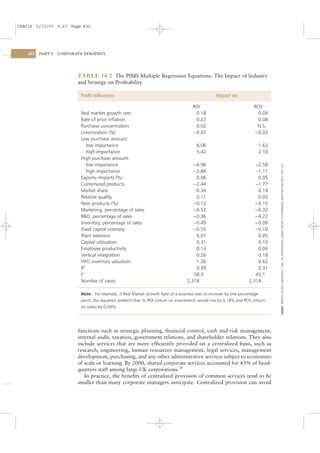
           level profitability. Table 16.2 shows an estimated PIMS equation.
              PIMS is used by multibusiness companies to assist in three areas of corporate
           management:
              l Setting performance targets for business units. Using the regression coefficients
                in the PIMS profitability equations, it is possible to plug into the PIMS
                regression the actual levels of the strategic and industry variables for a
                particular business and thereby calculate its “Par ROI” – the level of ROI that
                would be expected for the business given its profile of strategic and industry
                characteristics if its performance were typical of the sample as a whole. “Par
                ROI” represents a benchmark that can be used to set profitability targets or to
                evaluate actual profitability.
              l Formulating business unit strategy. Because the PIMS regression equations
                show the impact of different strategy variables on ROI, these estimates can
                indicate how a business can adjust its strategy to increase its profit
                performance.
              l Allocating investment funds between businesses. Past profitability of business
                units is a poor indicator of the return on new investment. PIMS’ “Strategic
                Attractiveness Scan” indicates investment attractiveness based on (a) estimated
                future real growth rate of the market, and (b) the “Par ROI” of the business.
                The analysis offers predictions as to the “strategic attractiveness” of
                investment in the business, and the cash flow that can be expected from it.


           Managing Internal Linkages
           As we saw in the previous chapter, the main opportunities for creating value in the
           multibusiness company arise from sharing resources and transferring capabilities
           among the different businesses within the company. This sharing occurs both through
           the centralization of common services at the corporate level and through direct link-
           ages between the businesses.

           Common Corporate Services
           The simplest form of resource sharing in the multidivisional company is the centralized
           provision of common services and functions. These include corporate management
CSAC16 1/13/07 9:27 Page 432


    432   PART V   CORPORATE STRATEGY


                          TABLE 16.2 The PIMS Multiple Regression Equations: The Impact of Industry
                          and Strategy on Profitability

                           Profit Influences                                                          Impact on:

                                                                                       ROI                              ROS
                           Real market growth rate                                      0.18                              0.04
                           Rate of price inflation                                       0.22                              0.08
                           Purchase concentration                                       0.02                              N.S.
                           Unionization (%)                                            −0.07                             −0.03
                           Low purchase amount:
                              low importance                                             6.06                              1.63
                              high importance                                            5.42                              2.10
                           High purchase amount:
                              low importance                                           −6.96                             −2.58


                                                                                                                                  SOURCE: ROBERT D. BUZZELL AND BRADLEY T. GALE, THE PIMS PRINCIPLES: LINKING STRATEGY TO PERFORMANCE (NEW YORK: FREE PRESS, 1987): 274.
                              high importance                                          −3.84                             −1.11
                           Exports–Imports (%)                                          0.06                              0.05
                           Customized products                                         −2.44                             −1.77
                           Market share                                                 0.34                              0.14
                           Relative quality                                             0.11                              0.05
                           New products (%)                                            −0.12                             −0.15
                           Marketing, percentage of sales                              −0.52                             −0.32
                           R&D, percentage of sales                                    −0.36                             −0.22
                           Inventory, percentage of sales                              −0.49                             −0.09
                           Fixed capital intensity                                     −0.55                             −0.10
                           Plant newness                                                0.07                              0.05
                           Capital utilization                                          0.31                              0.10
                           Employee productivity                                        0.13                              0.06
                           Vertical integration                                         0.26                              0.18
                           FIFO inventory valuation                                     1.30                              0.62
                           R2                                                           0.39                              0.31
                           F                                                           58.3                              45.1
                           Number of cases                                          2,314                             2,314

                           Note: For example, if Real Market Growth Rate of a business was to increase by one percentage
                           point, the equation predicts that its ROI (return on investment) would rise by 0.18% and ROS (return
                           on sales) by 0.04%.


                          functions such as strategic planning, financial control, cash and risk management,
                          internal audit, taxation, government relations, and shareholder relations. They also
                          include services that are more efficiently provided on a centralized basis, such as
                          research, engineering, human resources management, legal services, management
                          development, purchasing, and any other administrative services subject to economies
                          of scale or learning. By 2000, shared corporate services accounted for 43% of head-
                          quarters staff among large UK corporations.30
                             In practice, the benefits of centralized provision of common services tend to be
                          smaller than many corporate managers anticipate. Centralized provision can avoid
CSAC16 1/13/07 9:27 Page 433


                                                         CHAPTER 16   MANAGING THE MULTIBUSINESS CORPORATION   433


           costs of duplication, but there is little incentive among headquarters staff and spe-
           cialized corporate units to meet the needs of their business-level customers. The
           experience of many companies is that corporate staffs tend to grow under their own
           momentum with few obvious economies from central provision and few benefits of
           superior services.
              As a result, many companies separated their corporate headquarters into two
           groups: a corporate management unit responsible for supporting the corporate man-
           agement team in core support activities such as strategic planning, finance, and legal,
           and a shared services organization responsible for supplying common services such as
           research, engineering, training, and information technology to the businesses. Market
           incentives have been created for these shared service organizations by requiring them
           to supply services on an arm’s-length basis to internal operating units, sometimes in
           competition with independent suppliers. For example:

              l Amoco split its head office between a Corporate Roles group – comprising the
                Controller, Treasurer, Financial Operations, Corporate Planning, Corporate
                Secretary, and Quality Management – and a Shared Services Organization,
                including Human Resources, IT, Government Relations, Public and
                Government Affairs, Purchasing, Facilities and Services, Business Processing,
                Analytical Services, Environment-Health-Safety, Supply, Engineering and
                Construction, Tax, Auditing, and Legal Services. These 14 service groups
                initially had a three-year “monopoly” on supplying services to the business
                groups, after which the businesses were free to obtain services from inside or
                outside the Amoco group.
              l Alcoa’s Global Business Services was created in 2003. It offers financial
                accounting services; procurement; environment, health and safety services;
                people services; global credit; and information services. Its 1,900 employees
                are based in Pittsburgh, Monterrey (Mexico), Quebec (Canada)
                Szekesfehervar (Hungary), Booragoon (Australia), Sao Paulo (Brazil),
                and Bangalore (India). Its vision is to “deliver valuable services to Alcoa’s
                business and resource units at a cost and quality better than competitive
                alternatives.”31


           Business Linkages and Porter’s Corporate Strategy Types
           Exploiting economies of scope doesn’t necessarily mean centralizing resources at the
           corporate level. Resources and capabilities can also be shared between the businesses.
           Michael Porter has argued that the way in which a company manages these linkages
           determines its potential to create value for shareholders.32 He identifies four corpor-
           ate strategy types.

              l Portfolio management. The most limited form of resource sharing is where the
                parent company simply acquires a portfolio of attractive, soundly managed
                companies, allows them to operate autonomously, and links them through an
                efficient internal capital market. The typical organizational structure for
                portfolio management is the holding company – a parent company that owns
                controlling stakes in a number of (typically unrelated) subsidiaries, but,
                beyond appointing the boards of the subsidiary companies, does not exert
                significant management control. Investor AB of Sweden (controlled by the
CSAC16 1/13/07 9:27 Page 434


    434   PART V   CORPORATE STRATEGY


                              Wallenberg family), Koor Industries of Israel, and Berkshire Hathaway of
                              the US (headed by legendary investor Warren Buffett) are leading examples.
                              Value is created by acquiring companies at favorable prices, closely
                              monitoring their financial performance, and operating an effective internal
                              capital market.
                            l Restructuring. Conglomerates such as Tomkins, Tyco, and Textron create
                              value by restructuring: acquiring poorly managed companies, then
                              intervening to appoint new management, dispose of underperforming
                              businesses, restructure liabilities, and cut costs. Recently, private equity
                              groups such as Carlyle, KKR, Blackstone, and Texas Pacific in the US and
                              Alchemy and Candover in the UK are performing the same restructuring
                              role.33
                            l Transferring skills. Organizational capabilities can be transferred between
                              business units. LVMH transfers brand management and distribution
                              capabilities among its different luxury-brand businesses. Sharp transfers its
                              optoelectronics and miniaturization capabilities across a number of consumer,
                              electronic, and office equipment products. Creating value by sharing skills
                              requires that the same capabilities are applicable to the different businesses,
                              and also that mechanisms are established to transfer these skills through
                              personnel exchange and best practice transfer.
                            l Sharing activities. Porter argues that the most important source of value arises
                              from exploiting economies of scope in common resources and activities.
                              For these economies to be realized, corporate management must play a key
                              coordinating role, including involvement in formulating business unit
                              strategies and intervention in operational matters to ensure that opportunities
                              for sharing R&D, advertising, distribution systems, and service networks are
                              fully exploited. Such sharing is facilitated by:
                              – a strong sense of corporate identity;
                              – a corporate mission that emphasizes the integration of business-level
                                 strategies;
                              – an incentive for cooperation among businesses;
                              – interbusiness task forces and other vehicles for cross-business cooperation.


                          The Corporate Role in Managing Linkages
                          The closer the linkages among businesses, the greater the opportunities for creating
                          value from sharing resources and transferring capabilities, and the greater the need for
                          corporate headquarters to coordinate across businesses. We noted earlier that the
                          “financial control” style of management occurs mainly in conglomerate where the
                          independence of each business limits the coordinating role of the head office to man-
                          aging the budgetary process and establishing “framework conditions” for divisional
                          planning.
                             In more closely related companies such as the vertically integrated oil companies, or
                          companies with close market or technological links (such as IBM, Procter & Gamble,
                          American Express, and Alcoa), corporate management uses a “strategic planning” style,
                          which is likely to involve not only coordination of strategies but also operational
                          coordination to exploit the economies of scope and transferable skills discussed in
                          Chapter 15. Corporate involvement in interdivisional affairs has implications for the
CSAC16 1/13/07 9:27 Page 435


                                                           CHAPTER 16    MANAGING THE MULTIBUSINESS CORPORATION   435


           size of the corporate headquarters. Berkshire Hathaway, which has almost no link-
           ages among its businesses, has a corporate staff of about 50. Hewlett-Packard, with
           about the same sales but much closer linkages between its divisions, has close to 3,000
           employees at its Palo Alto head office. Goold and Campbell note that the companies
           that are closely involved with their businesses through “value-added corporate
           parenting” tend to have significant numbers of headquarters staff involved in devel-
           oping key technical and functional capabilities. Thus, Pfizer and Corning have strong
           corporate R&D groups; Dow has a strong corporate manufacturing function; and
           Virgin’s corporate team plays a key role in managing the Virgin brand.34
              Opportunities for sharing and transferring resources and capabilities may require
           ad hoc organizational arrangements such as cross-divisional task forces. Such task
           forces might be formed for the introduction and dissemination of total quality man-
           agement, to reengineer financial management practices, to promote fast-cycle new
           product development, to coordinate business development in China, and so on.
              CEOs can use their authority to launch corporate-wide initiatives to encourage
           divisional managers to exploit interbusiness linkages and to take account of company-
           wide issues in their strategies and operating decisions. These initiatives provide a key
           mechanism for disseminating strategic changes, best practices, and management
           innovations.35 At General Electric, Jack Welch was an especially effective exponent
           of corporate initiatives as a means of driving organizational change. These were built
           around communicable and compelling slogans such as “GE’s growth engine,” “bound-
           arylessness,” “six-sigma quality,” and “destroy-your-business-dot-com.”
              Exploiting linkages between businesses requires careful management, and this
           imposes costs. Though Porter may be right that the potential for value creation increases
           as a company moves from a loose, “portfolio management” strategy toward the more
           integrated, “shared activity” strategy, it is not apparent that this potential is always
           realized. For example, most attempts at exploiting the potential for cross-selling across
           different businesses have yielded disappointing results, especially in financial services.36
           Lorsch and Allen shed light on the management implications of close linkages
           between businesses. They compared three conglomerates with three vertically integrated
           paper companies.37 The coordination requirements of the paper companies resulted
           in greater involvement of head office staff in divisional operations, larger head office
           staffs, more complex planning and control devices, and lower responsiveness to
           change in the external environment. By contrast, the conglomerates made little
           attempt to exploit linkages even if they were present:
              The conglomerate firms we had studied seemed to be achieving appreciable
              degrees of financial and managerial synergy but little or no operating synergy.
              Some of the firms saw little immediate payoff in this operating synergy; others
              met with little success in attempting to achieve it.38
              The success with which the corporate headquarters manages linkages between busi-
           nesses depends on top management’s understanding of the commonalities among its
           different businesses. As we noted in the last chapter, the underlying rationale of the
           diversified company has been called dominant logic by C. K. Prahalad and Richard
           Bettis.39 They define dominant logic as “the way in which managers conceptualize the
           business and make critical resource allocation decisions.” For a diversified business
           to be successful, they argue, there must be sufficient strategic similarity among the
           different businesses so that top management can administer the corporation with a
           single dominant logic.
CSAC16 1/13/07 9:27 Page 436


    436   PART V   CORPORATE STRATEGY


                          Leading Change in the Multibusiness Corporation
                          Our conception of the role of management in the multibusiness corporation has
                          shifted substantially in recent years. Two decades ago it was about the administration
                          of large business empires. Today the focus is on value creation in an intensely com-
                          petitive, fast-changing world. Corporate headquarters are concerned less with the
                          problem of control and more with the problem of identifying and implementing the
                          means for creating value within and between their individual businesses. The use
                          of the term “parenting” to describe the corporate role, as opposed to the notion of
                          “systems of corporate control,” reflects this shift in thinking.
                              Changes in the management of multibusiness corporations have included decen-
                          tralization of decision making from corporate to divisional levels, a shift from formal
                          to informal coordination, and a more multidimensional role for the corporate head-
                          quarters. From being simply a control center, the corporate HQ acts as a service
                          center, a guide to the future, and a knowledge hub.
                              Managing transition has been a key role for chief executives. The most celebrated
                          of these “change masters” was Jack Welch, Chairman and CEO of General Electric
                          from 1981 to 2001. Welch’s style and the system he created has become a model for
                          other large, multibusiness corporations – not just in North America, but in Europe and
                          Asia too. Strategy Capsule 16.2 outlines Welch’s style and methods.
                              As Welch has shown, managing large-scale organizational change is not simply
                          about top–down decision making. A key component is fostering change processes
                          at lower level of the organization – GE’s “work-out” is a prime example. A critical fea-
                          ture of organizational design is building structures and systems that permit adaptation.


               STRATEGY CAPSULE 16.2

               General Electric: Welch’s Reinvention of Corporate
               Management

           Jack Welch’s 20 years as Chairman and CEO of          sector level of organization so that
           General Electric began with an intensive period       business heads reported directly to him.
           of restructuring, which transformed the com-          He pressured them to flatten their
           position of GE’s business portfolio through           management pyramids. Overall, GE’s layers
           acquisitions and disposals and extended the           of hierarchy were cut from nine or ten to
           conglomerate’s global reach. Toward the mid-          four or five.
           1980s, Welch’s attention shifted from the busi-    2 Changing the Strategic Planning System.
           ness portfolio to the structure, systems, and        During the 1970s, GE had developed a
           style of GE. Among the changes he initiated          systematic and formalized approach to
           were the following.                                  strategy formulation and appraisal. Welch
           1 Delayering. Welch’s fundamental criticism          believed that not only was the system slow
             of GE’s management was that it was slow            and inefficient, it also stifled innovation
             and unresponsive. Welch eliminated GE’s            and opportunism. Welch replaced the
CSAC16 1/13/07 9:27 Page 437


                                                          CHAPTER 16    MANAGING THE MULTIBUSINESS CORPORATION               437


                staff-led, document-driven process with                identifying and exploiting synergies. In
                more personal, less formal, but very                   1990, Welch launched his concept of the
                intensive face-to-face discussions. Instead            “boundaryless company.” This involved
                of data-heavy documents, each business                 blurring internal divisions so that people
                head was asked to produce a slim “play-                could work together across functional and
                book” that summarized key strategic issues             business boundaries. Welch aimed at
                and actions. Concise answers were                      “integrated diversity” – the ability to
                required to questions about market                     transfer the best ideas, most developed
                dynamics, competitive activity, risks, and             knowledge, and most valuable people
                proposed GE business responses. These                  freely and easily between businesses.
                documents became the basis for a half-day                Boundaryless behavior is the soul of
                review session where business heads and                  today’s GE . . . Simply put, people seem
                key executives met with the Office of the                 compelled to build layers and walls
                CEO in an open dialog on strategy and                    between themselves and others, and
                performance.1                                            that human tendency tends to be
              3 Redefining the Role of Headquarters. The                  magnified in large, old institutions like
                changes in the strategic planning system                 ours. These walls cramp people, inhibit
                reflected broader changes in the role of                  creativity, waste time, restrict vision,
                the corporate headquarters. Welch viewed                 smother dreams and, above all, slow
                headquarters as interfering too much,                    things down . . . Boundaryless behavior
                generating too much paper, and failing to                shows up in the actions of a woman
                add value. His objective was to “turn their              from our Appliances business in Hong
                role 180 degrees from checker, inquisitor,               Kong helping NBC with contacts needed
                and authority figure to faciliator, helper,               to develop satellite television service in
                and supporter” so that decisions could                   Asia . . . And finally, boundaryless
                move more quickly:                                       behavior means exploiting one of
                   What we do here at headquarters . . .                 the unmatchable advantages a
                   is to multiply the resources we have,                 multibusiness GE has over almost any
                   the human resources, the financial                     other company in the world.
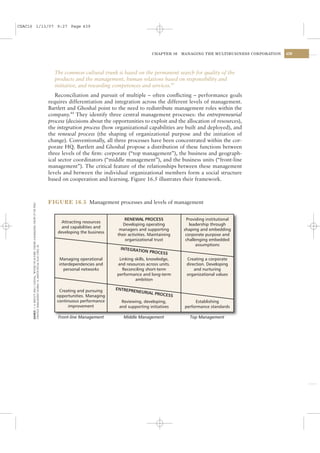
                   resources, and the best practices . . .               Boundaryless behavior combines 12
                   Our job is to help, it’s to assist, it’s to           huge global businesses – each number
                   make these businesses stronger, to help               one or number two in its markets – into
                   them grow and be more powerful.2                      a vast laboratory whose principal
                                                                         product is new ideas, coupled with a
              4 The Coordinating Role of Corporate.
                                                                         common commitment to spread them
                A key role of corporate was facilitating
                                                                         throughout the Company.3
                coordination across GE’s businesses.
                The Corporate Executive Council was
                                                                 Notes:
                reconstituted to include the leaders of GE’s     1 General Electric: Jack Welch’s Second Wave (A), Case
                13 businesses and several key corporate             No. 9-391-248 (Boston: Harvard Business School, 1991).
                                                                 2 Jack Welch, “GE Growth Engine,” speech to employees
                executives. It met two days each quarter to
                                                                    (1988).
                discuss common problems and issues. The          3 “Letter to Share Owners,” General Electric Company
                Council became an important vehicle for             1993 Annual Report (Fairfield, CT, 1994): 2.
CSAC16 1/13/07 9:27 Page 438


    438   PART V   CORPORATE STRATEGY


                          While CEOs cannot be the primary initiators of change, they need to be alert and
                          responsive to signals. Intel’s former CEO, Andy Grove emphasizes the importance of
                          CEOs identifying strategic inflection points – instances where seismic shifts in a firm’s
                          competitive environment require a fundamental redirection of strategy.40 At Intel,
                          such inflection points included the transition from DRAM chips to microprocessors,
                          the decision to focus on its x86 series of microprocessors in favor of RISC architec-
                          ture, and the decision to replace its faulty Pentium chips.41
                             Above all, CEOs need to be adept at managing contradiction and dilemma. For
                          example:

                            l Companies must strive for efficiency, which requires rigorous financial
                              controls; they must also be innovative and entrepreneurial, which requires
                              autonomy and loose, flexible controls.
                            l Maximizing current performance requires strategies that exploiting existing
                              resources and capabilities across different markets; success for the future is
                              dependent on the creation of new resources and capabilities and their
                              deployment in new markets.
                            l Innovation, efficiency, and responsiveness require autonomy for business-level
                              managers; yet the competitive advantage of the multibusiness corporation
                              ultimately depends on integrating resources and capabilities across businesses.
                              Is it possible for companies like Microsoft, Siemens, or Samsung to mesh the
                              resource advantages of the giant corporation with the responsiveness and
                              creativity of small enterprises?

                          Resolving these dilemmas requires that organizations operate in multiple modes
                          simultaneously. In particular, they need to combine both decentralized flexibility and
                          initiative and centralized purpose and integration. The transformation of IBM under
                          Lou Gerstner offers some guidance has to how this can be achieved. Resisting Wall
                          Street pressure to break up IBM, Gerstner was able to combine aggressive cuts in costs
                          and jobs, entrepreneurship and flexibility through decentralized decision making, and
                          integration of technology and know-how by breaking down barriers both within IBM
                          and between IBM and other companies.42
                             Flexible integration – whether it is sharing capabilities, harmonizing market initi-
                          atives in different countries, or collaborating to develop the new products and tech-
                          nologies requires – cannot be hierarchically decreed: headquarters does not posses the
                          necessary knowledge to be in the driver’s seat. It must happen through horizontal
                          collaboration among the businesses units. This requires that business-level general man-
                          gers identify not only with their particular businesses, but also with the corporation
                          as a whole. Fostering the necessary identity and direction within the multibusiness
                          corporation is probably the most important task that the CEO must perform.
                             Creating this sense of identity is much more challenging for a company that spans
                          several businesses than for one whose identity is determined by the products it offers
                          (McDonald’s or De Beers). Its goes beyond “strategic relatedness” and “dominant
                          logic” and embraces notions of vision and mission – concepts which were identified
                          in Chapter 1 as lying at the foundations of companies’ strategy formulation. Thus,
                          LVMH, supplier of Moët & Chandon champagne, Hennessy cognac, Dior and
                          Givenchy perfumes, and Louis Vuitton luggage, has established an identity that not
                          only established its strategic logic but also the “cultural glue” that holds its disparate
                          businesses together:
CSAC16 1/13/07 9:27 Page 439


                                                                                                                                                             CHAPTER 16        MANAGING THE MULTIBUSINESS CORPORATION   439


                                                                                                              The common cultural trunk is based on the permanent search for quality of the
                                                                                                              products and the management, human relations based on responsibility and
                                                                                                              initiative, and rewarding competences and services.43
                                                                                                               Reconciliation and pursuit of multiple – often conflicting – performance goals
                                                                                                            requires differentiation and integration across the different levels of management.
                                                                                                            Bartlett and Ghoshal point to the need to redistribute management roles within the
                                                                                                            company.44 They identify three central management processes: the entrepreneurial
                                                                                                            process (decisions about the opportunities to exploit and the allocation of resources),
                                                                                                            the integration process (how organizational capabilities are built and deployed), and
                                                                                                            the renewal process (the shaping of organizational purpose and the initiation of
                                                                                                            change). Conventionally, all three processes have been concentrated within the cor-
                                                                                                            porate HQ. Bartlett and Ghoshal propose a distribution of these functions between
                                                                                                            three levels of the firm: corporate (“top management”), the business and geograph-
                                                                                                            ical sector coordinators (“middle management”), and the business units (“front-line
                                                                                                            management”). The critical feature of the relationships between these management
                                                                                                            levels and between the individual organizational members form a social structure
                                                                                                            based on cooperation and learning. Figure 16.5 illustrates their framework.


                                                                                                            FIGURE 16.5 Management processes and levels of management
      SOURCE: C. A. BARTLETT AND S. GHOSHAL, “BEYOND THE M-FORM: TOWARD A MANAGERIAL THEORY OF THE FIRM,”


                                                                                                                                               RENEWAL PROCESS                  Providing institutional
                                                                                                                  Attracting resources
                                                                                                                                              Developing operating                leadership through
                                                                                                                  and capabilities and
                                                                                                                                            managers and supporting            shaping and embedding
                                                                                                                developing the business
                                                                                                                                           their activities. Maintaining        corporate purpose and
                                                                                                                                               organizational trust             challenging embedded
                                                                                                                                                                                     assumptions
      STRATEGIC MANAGEMENT JOURNAL 14, WINTER SPECIAL ISSUE (1993): 38.


                                                                                                                                            INTEGRATI
                                                                                                                                                        ON PROCES
                                                                                                                                                                   S
                                                                                                                Managing operational       Linking skills, knowledge,            Creating a corporate
                                                                                                                interdependencies and     and resources across units.            direction. Developing
                                                                                                                  personal networks          Reconciling short-term                  and nurturing
                                                                                                                                          performance and long-term              organizational values
                                                                                                                                                   ambition

                                                                                                                Creating and pursuing     ENTREPR
                                                                                                                                                 ENEURIA
                                                                                                                                                             L PROCES
                                                                                                               opportunities. Managing                                     S
                                                                                                               continuous performance       Reviewing, developing,                   Establishing
                                                                                                                    improvement            and supporting initiatives           performance standards

                                                                                                                Front-line Management         Middle Management                   Top Management
CSAC16 1/13/07 9:27 Page 440


    440   PART V   CORPORATE STRATEGY


            Summary
            Formulating and implementating corporate                 business prospects and company valuation, and
            strategy in the multibusiness company presents           the ability to operate a highly efficient internal
            issues of almost impenetrable complexity. We             capital market. Hence, organization and manage-
            can classify firms in different strategic types but,      ment systems should be oriented toward a clear
            ultimately, it is impossible to offer generic recom-     separation of business levels on corporate deci-
            mendations for how a multibusiness company               sions and a highly effective system for budgetary
            should implement its corporate strategy: each            control and project evaluation. For a technology-
            firm possesses a unique portfolio of products             based diversified corporation, value is created
            and markets; each owns a unique set of resources         through the transfer and integration of know-
            and capabilities; each has developed a distinct          ledge, ideas, and expertise. The company must be
            administrative structure, management style, and          organized in order to facilitate the transfer and
            corporate culture. Given these factors, it is hardly     application of knowledge. Two sets of issues are
            surprising that empirical research offers little clear   critical:
            guidance as to the correlates of superior perform-
            ance – close relationships between businesses            l The characteristics of the resources and
            may or may not lead to higher profitability; shar-           capabilities that are being exploited within
            ing resources and capabilities offers economies             the multibusiness corporation.
            but also imposes management costs; and there             l The characteristics of the businesses.
            are no consistent relationships between a com-
            pany’s performance and the characteristics of its            Ultimately, the structure, systems, and man-
            structure, control system, or leadership style.          agement style must fit with the identity of the
               Designing the appropriate organizational struc-       company. The conglomerates of the 1970s failed
            ture, management systems, and leadership style           either because they did not establish a clear
            of a multibusiness corporation depends critically        identity or because their identity was so closely
            on fit with the corporate strategy of the company.        linked with a single person (e.g., Geneen at ITT). In
            Fundamental to this fit is the rationale for the          other cases, the rationale on which the identity
            firm. Diversification – both across product markets        was based was found to be flawed (e.g., Allegis
            and across geographical markets – can create             Corp.). Conversely, multibusiness companies that
            value in different ways. Each source of gain from        sustain success over time establish clarity of iden-
            diversification is likely to imply a quite different      tity and vision that is reflected in their strategy,
            approach to managing the firm. For a conglom-             structure, management systems, and leadership
            erate firm, value can be created through the              style. Moreover, they periodically revisit that iden-
            strategic judgment of the CEO with regard to             tity and vision as their world changes.
CSAC16 1/13/07 9:27 Page 441


                                                                 CHAPTER 16   MANAGING THE MULTIBUSINESS CORPORATION                441


           Self-Study Questions
           1    Williamson’s “M-form” concept argues that the efficiency of the multidivisional firm is the
                result of (a) the separation of responsibilities between divisional and corporate management
                and (b) overcoming the “agency problem” of managers pursuing their own interests rather
                than those of shareholders. How effective are most multibusiness companies in achieving
                these advantages? Are there other performance advantages associated with multibusiness
                companies?

           2    If you were VP of Strategic Planning for a large, multibusiness company, would you use
                portfolio planning techniques in your work? If so, for what purposes? If not, why not?
                Would your preference be to use the GE/McKinsey matrix or the BCG matrix?

           3    Identify a poorly performing multibusiness company (examples might include Sony, Time
                Warner, Bombardier, Pearson, Matsushita, Fiat Group, or Tyco). Using the McKinsey
                pentagon framework, in which stage do you perceive the greatest opportunities for value
                creation through restructuring? (Use the company’s website or Hoovers.com to access
                information on the company.)

           4    For technology-based companies, building linkages across different business is critical to
                sustaining competitive advantage. Select a technology-based company that you are familiar
                with (possibilities might include Microsoft, HP Apple Computer, Canon, Nortel Networks,
                                                               ,
                or Finmeccanica), then identify how linkages between businesses are currently being
                exploited and identify opportunities for additional exploitation of cross-business linkages.


           Notes
            1 I use the term multibusiness company to refer to a          6 E. J. Epstein, Dossier: The Secret History of Armand
              company that comprises multiple business units. These         Hammer (New York: Carroll & Graf, 1999);
              may comprise different vertical activities, different         B. Burrough, Barbarians at the Gate: The Fall of RJR
              geographical units, or different product sectors.             Nabisco (New York: Harper & Row, 1990); J. Johnson
            2 O. E. Williamson, Markets and Hierarchies: Analysis and       and M. Orange, The Man Who Tried to Buy the World
              Antitrust Implications (New York: Free Press, 1975); and      (Pengain, 2004).
              O. E. Williamson, “The Modern Corporation: Origins,         7 H. Mintzberg, Structure in Fives: Designing Effective
              Evolution, Attributes,” Journal of Economic Literature        Organizations (Englewood Cliffs, NJ: Prentice Hall,
              19 (1981): 1537– 68.                                          1983): Chapter 11.
            3 J. L. Bower, Managing the Resource Allocation Process       8 J. Birkinshaw and A. Campbell, “Know the Limits of
              (Boston: Harvard Business School Press, 1986).                Corporate Venturing,” FT Summer School, Financial
            4 Williamson, “The Modern Corporation,” op. cit.                Times (August 10, 2004).
            5 See, for example, P Steer and J. Cable, “Internal
                                 .                                        9 M. Goold, A. Campbell, and M. Alexander, Corporate-
              Organization and Profit: An Empirical Analysis of Large        Level Strategy: Creating Value in the Multibusiness
              UK Companies,” Journal of Industrial Economics 21             Company (New York: Wiley, 1994).
              (September 1978): 13–30; H. Armour and D. Teece,           10 General Electric: Strategic Position – 1981, Case No.
              “Organizational Structure and Economic Performance:           381–174 (Boston: Harvard Business School, 1981): 1.
              A Test of the Multidivisional Hypothesis,” Bell Journal    11 The PIMS database is referred to in Chapter 3 and is
              of Economics 9 (1978): 106–22; D. Teece, “Internal            discussed later in this chapter.
              Organization and Economic Performance,” Journal of         12 H. Quarls, T. Pernsteiner, and K. Rangan, “Love Your
              Industrial Economics 30 (1981): 173–99.                       Dogs,” Booz Allen Hamilton (March 15, 2005).
CSAC16 1/13/07 9:27 Page 442


    442   PART V   CORPORATE STRATEGY


          13 T. Copeland, T. Koller, and J. Murrin, Valuation:        29 R. M. Grant, “Strategic Planning in a Turbulent
             Measuring and Managing the Value of Companies,              Environment: Evidence from the Oil and Gas Majors,”
             3rd edn (New York: Wiley, 2000).                            Strategic Management Journal 24 (2003): 491–518.
          14 R. Cibin and R. M. Grant, “Restructuring Among the       30 M. Goold, D. Pettifer, and D. Young, “Redesigning the
             World’s Largest Oil Companies,” British Journal of          Corporate Center,” European Mangement Review 19,
             Management 7 (December 1996): 411–28.                       no. 1 (2001): 83–91.
          15 Goold, Campbell, and Alexander, op. cit.: 90.            31 IQPC, “Most Admired Shared Service Organizations,
          16 M. C. Mankins and R. Steele, “Stop Making Plans; Start      2005” (www.iqpc.com).
             Making Decisions,” Harvard Business Review ( January     32 M. E. Porter, “From Competitive Advantage to
             2006): 76–84.                                               Corporate Strategy,” Harvard Business Review
          17 L. Bossidy and R. Charan, Execution: The Discipline of      (May–June 1987): 46.
             Getting Things Done (New York: Crown Business,           33 “Going Private,” Business Week (February 27, 2006).
             2002): 197–201.                                          34 M. Goold, D. Pettifer, and D. Young, op cit.
          18 R. S. Kaplan and D. P Norton, “Having Trouble With
                                   .                                  35 J. Darragh and A. Campbell, “Why Corporate
             Your Strategy? Then Map It,” Harvard Business Review        Initiatives Get Stuck,” Long Range Planning 34
             (September–October 2000): 67–76.                            ( January 2001): 33–52.
          19 R. S. Kaplan and D. P Norton, “The Office of Strategy
                                   .                                  36 “Cross-selling’s Elusive Charms,” Financial Times
             Management,” Harvard Business Review (October               (November 16, 1998): 21.
             2005): 72–80.                                            37 J. W Lorsch and S. A. Allen III, Managing Diversity
                                                                              .
          20 Ibid.: 73.                                                  and Interdependence: An Organizational Study of
          21 Geneen’s style of management is discussed in Chapter 3      Multidivisional Firms (Boston: Harvard Business
             of R. T. Pascale and A. G. Athos, The Art of Japanese       School Press, 1973).
             Management (New York: Warner Books, 1982).               38 Ibid.: 168.
          22 Tuck School of Business, CEO Speaker Series, September   39 C. K. Prahalad and R. Bettis, “The Dominant Logic:
             23, 2002.                                                   A New Linkage Between Diversity and Performance,”
          23 “Those Highflying PepsiCo Managers,” Fortune                 Strategic Management Journal 7 (1986): 485–502.
             (April 10, 1989): 79.                                    40 A. S. Grove, Only the Paranoid Survive: How to Exploit
          24 BP “Performance Contracts” (www.bp.com/
               ,                                                         the Crisis Points that Challenge Every Company
             genericarticle?Id=25&cotentId=2000476).                     (New York: Bantam, 1999).
          25 M. J. Conyon, S. I. Peck, L. E. Read, and G. V Sadler,
                                                            .         41 R. A. Burgelman and A. Grove, “Strategic Dissonance,”
             “The Structure of Executive Compensation Contracts:         California Management Review 38 (Winter 1996): 8–28.
             The UK Evidence,” Long Range Planning 33 (August         42 L. V Gerstner, Who Says Elephants Can’t Dance?
                                                                              .
             2000): 478–503.                                             (New York: Harper Business, 2002).
          26 Option backdating was a particular problem. See          43 LVMH: Building Star Brands, ICFAI Case MKTA016
             “Nuclear Options,” Economist ( June 1, 2006).               (2004); Roland Calori, “How Successful Companies
          27 See for example: P Bolton, J. Scheinkman, and W
                                .                              .         Manage Diverse Businesses,” Long Range Planning 21
             Xiong, “Pay for Short-term Performance: Executive           ( June 1988): 85.
             Compensation in Speculative Markets,” NBER Working       44 C. A. Bartlett and S. Ghoshal, “Beyond the M-Form:
             Paper 12107 (March 2006); M. C. Jensen and                  Toward a Managerial Theory of the Firm,” Strategic
             K. J. Murphy, “Remuneration: Where We’ve Been, How          Management Journal 14, Winter Special Issue (1993):
             We Got Here, What Are the Problems,” ECGI-Finance           23–46; C. A. Bartlett and S. Ghoshal, “The Myth of the
             Working Paper 44 (2004).                                    General Manager: New Personal Competencies for New
          28 M. Goold and A. Campbell, Strategies and Styles             Management Roles,” California Management Review 40
             (Oxford: Blackwell, 1987).                                  (Fall 1997): 92–116; “Beyond Structure to Process,”
                                                                         Harvard Business Review (January–February 1995).

Csac16[1].p

  • 1.
    CSAC16 1/13/07 9:27Page 414 16 Managing the Multibusiness Corporation Some have argued that single-product businesses have a focus that gives them an advantage over multibusiness companies like our own – and perhaps they would have, but only if we neglect our own overriding advantage: the ability to share the ideas that are the result of wide and rich input from a multitude of global sources. GE businesses share technology, design, compensation and personnel evaluation systems, manufacturing practices, and customer and country knowledge. Gas Turbines shares manufacturing technology with Aircraft Engines; Motors and Transportation Systems work together on new propulsion systems; Lighting and Medical Systems collaborate to improve x-ray tube processes; and GE Capital provides innovative financing packages that help all our businesses around the globe. Supporting all this is a management system that fosters and rewards this sharing and teamwork, and, increasingly, a culture that makes it reflexive and natural at every level and corner of our Company. —JACK WELCH, CHAIRMAN, GENERAL ELECTRIC COMPANY, 1981–2001 OUTLINE l Introduction and Objectives l Managing the Corporate Portfolio GE and the Development of Strategic l The Structure of the Multibusiness Planning Company Portfolio Planning: The GE/McKinsey The Theory of the M-Form Matrix Problems of Divisionalized Firms Portfolio Planning: BCG’s Growth–Share Matrix l The Role of Corporate Value Creation Through Corporate Management Restructuring 414
  • 2.
    CSAC16 1/13/07 9:27Page 415 CHAPTER 16 MANAGING THE MULTIBUSINESS CORPORATION 415 l Managing Individual Businesses The Corporate Role in Managing The Strategic Planning System Linkages Performance Control and the Budgeting Process l Leading Change in the Multibusiness Balancing Strategic Planning and Corporation Financial Control Using PIMS in Strategy Formulation and Performance Appraisal l Summary l Managing Internal Linkages l Self-Study Questions Common Corporate Services Business Linkages and Porter’s Corporate Strategy Types l Notes Introduction and Objectives In the last chapter, we concluded that the case for diversification rests ultimately on the ability of the diversified corporation to exploit sources of value from operating across multiple businesses more effectively than can specialized firms linked by markets. Chapters 13 and 14 arrived at the same conclusion in relation to vertical integration and multinational operations. Hence, multibusiness companies1 – whether vertically integrated, multinational, or diversified across multiple products – face two critical issues. First, can value be created through the relationships between businesses that span different activities or different markets? Second, how should a company be structured and man- aged to exploit these sources of value? Chapters 13, 14, and 15 addressed the first ques- tion in relation to vertical, multinational, and multiproduct scope. This chapter addresses the second question. To manage multiple activities in multiple markets, multibusiness corporations typically use multidivisional structures comprising several divisions or subsidiaries, coordinated by a corporate headquarters. We shall examine the structures, management systems, and leadership styles through which these – typically large, complex – corporations formulated and implement their strategies. As we will see, corporate strategy is not simply a matter of answering the question: “What businesses should we be in?” Some of the most difficult issues of corporate strategy concern the roles and activities of the corporate head office and the relationships between the businesses and the corporate center. These issues include: managing the business portfolio; resource allocation; strategic planning; con- trolling business unit performance; and coordinating across businesses.
  • 3.
    CSAC16 1/13/07 9:27Page 416 416 PART V CORPORATE STRATEGY By the time you have completed this chapter you will be able to: l Recognize the principal organizational feature of the multibusiness corporation. l Apply the techniques of portfolio analysis to corporate strategy decisions. l Analyze the potential for value creation through restructuring a multibusiness corporation. l Understand how corporate headquarters manages its individual businesses through strategic planning and financial control and by managing linkages across businesses. l Analyze the fit between a firm’s corporate strategy organization structure, management systems, and leadership style. The Structure of the Multibusiness Company Chapter 1 introduced the distinction between business strategy and corporate strategy and observed that, within the multibusiness company, corporate management takes primary responsibility for corporate strategy, and divisional management takes primary responsibility for business strategy. This corporate/divisional distinction is the basis feature of the multibusiness corporation. Whether we are referring to a multi- product company (such as Viacom), a multinational company (such as SABMiller), or a vertically integrated corporation (such as Alcoa), almost all multibusiness companies are organized as multidivisional structures where business decisions are located at the business level and the corporate center exercises overall coordination and control. As we noted in Chapter 6, the emergence of the multidivisional structure during the early 20th century was one of the key innovations in the history of man- agement since it facilitated the development of the large diversified, multinational corporations. The allocation of decision making between corporate and divisional levels has shifted over time. The initial rationale for the multidivisional firm was the separation of strategic and operational decision making. During recent decades, more strategic decision making has been devolved to the divisional and business unit levels, while corporate headquarters have taken responsibility for corporate strategy and the man- agement of overall corporate performance. Our primary focus is to analyze and understand the role of the corporate center in managing the multibusiness company. The Theory of the M-form Once Alfred Chandler had documented the origin and diffusion of the multidivisional form, it was left to Oliver Williamson to theorize about its rationale.2 Williamson
  • 4.
    CSAC16 1/13/07 9:27Page 417 CHAPTER 16 MANAGING THE MULTIBUSINESS CORPORATION 417 identified four key efficiency advantages of the divisionalized firm (or, in his termi- nology, the M-form): 1 Adaptation to “bounded rationality.” If managers are limited in their cognitive, information-processing, and decision-making capabilities, the top management team cannot be responsible for all coordination and decision making within a complex organization. The M-form permits decision making to be dispersed. 2 Allocation of decision making. Decision-making responsibilities should be separated according to the frequency with which different types of decisions are made. The M-form allows high frequency decisions (e.g., operating decisions) to be made at divisional level and decisions that are made infrequently (e.g., strategic decisions) to be made at corporate level. 3 Minimizing coordination costs. In the functional organization, decisions concerning a particular product or business area must pass up to the top of the company where all the relevant information and expertise can be brought to bear. In the divisionalized firm, so long as close coordination between different business areas is not necessary, most decisions concerning a particular business can be made at the divisional level. This eases the information and decision-making burden on top management. 4 Avoiding goal conflict. In functional organizations, department heads emphasize functional goals over those of the organization as a whole. In multidivisional companies, divisional heads, as general managers, are more likely to pursue profit goals that are consistent with the goals of the company as a whole. As a result, the multidivisional firm can help solve two key problems of large, man- agerially controlled corporations: l Allocation of resources. Resource allocation within any administrative structure is a political process in which power, status, and influence can triumph over purely commercial considerations.3 To the extent that the multidivisional company can create a competitive internal capital market in which capital is allocated according to financial and strategic criteria, it can avoid much of the politicization inherent in purely hierarchical systems. The multidivisional company can achieve this through operating an internal capital market where budgets are linked to past and projected divisional profitability, and individual projects are subject to a standardized appraisal and approval process. l Resolution of agency problems. A related shortcoming of the modern corporation is that owners (shareholders) wish to maximize the value of the firm, while their agents (top managers) are more interested in salaries, security, and power. Given the limited power of shareholders to discipline and replace managers, and the tendency for top management to dominate the board of directors, the multidivisional form may act as a partial remedy to the agency problem. The rationale is as follows: by acting as an interface between the stockholders and the divisional managers, corporate management can enforce adherence to profit goals. With divisions designated as profit centers, financial performance can readily be monitored by the head office, and
  • 5.
    CSAC16 1/13/07 9:27Page 418 418 PART V CORPORATE STRATEGY divisional managers can be held responsible for performance failures. So long as corporate management is focused on shareholder goals, the multidivisional structure can support a system for enforcing profit maximization at the divisional level. General Electric, Emerson Electric, and BP are prime examples of multidivisional companies where the corporate headquarters has been highly effective in creating profit-oriented systems and cultures. Oliver Williamson explains these merits of the multidivisional corporation as follows: The M-form conglomerate can be thought of as substituting an administrative interface between an operating division and the stockholders where a market interface had existed previously. Subject to the condition that the conglomerate does not diversify to excess, in the sense that it cannot competently evaluate and allocate funds among the diverse activities in which it is engaged, the substitution of internal organization can have beneficial effects in goal pursuit, monitoring, staffing, and resource allocation respects. The goal-pursuit advantage is that which accrues to M-form organizations in general: since the general management of an M-form conglomerate is disengaged from operating matters, a presumption that the general office favors profits over functional goals is warranted. Relatedly, the general office can be regarded as an agent of the stockholders whose purpose is to monitor the operations of the constituent parts. Monitoring benefits are realized in the degree to which internal monitors enjoy advantages over external monitors in access to information – which they arguably do. The differential ease with which the general office can change managers and reassign duties where performance failures or distortions are detected is responsible for the staffing advantage. Resource allocation benefits are realized because cash flows no longer return automatically to their origins but instead revert to the center, thereafter to be allocated among competing uses in accordance with prospective yields.4 Can the corporate general office really be relied upon to act as an “agent of the stockholders”? Despite evidence that multidivisional structures are, in general, more effective for diversified firms than alternative structural forms,5 some of the most notorious examples of chief executives operating their companies as personal fiefdoms are found among diversified, divisionalized corporations. Armand Hammer at Occidental Petroleum, Howard Hughes at Hughes Corporation, Ken Lay at Enron, Dennis Kozlowski at Tyco, and Jean-Marie Messier at Vivendi Universal all pursued empire building at the expense of shareholder return.6 Corporate executives of diversified companies may be less emotionally committed to particular businesses, but this does not necessarily mean that they are more predisposed to shareholder return than to Napoleonic personal grandeur. Problems of Divisionalized Firms In principle, the divisionalized corporation reconciles the benefits of decentralization with those of coordination. As Henry Mintzberg points out, in practice, the multi- divisional structure suffers from two important rigidities that limit decentralization and adaptability:7 l Constraints on decentralization. Although operational authority in the M-form firm is dispersed to the divisional level, the individual divisions
  • 6.
    CSAC16 1/13/07 9:27Page 419 CHAPTER 16 MANAGING THE MULTIBUSINESS CORPORATION 419 often feature highly centralized power that is partly a reflection of the divisional president’s personal accountability to the head office. In addition, the operational freedom of the divisional management exists only so long as the corporate head office is satisfied with divisional performance. Monthly financial reviews typically mean that variances in divisional performance precipitate speedy corporate intervention. l Standardization of divisional management. In principle, the divisional form permits divisional management to be differentiated by their business needs. In practice, there are powerful forces for standardizing control systems and management styles which may inhibit individual divisions from achieving their potential. The imposition by Exxon of its standard financial control systems and hierarchical culture on its entrepreneurial IT subsidiary, Exxon Office Systems, was a key factor in the venture’s eventual failure. The difficulties that many large, mature corporations experience with new business development often result from applying to new businesses the same management systems designed for existing businesses.8 The Role of Corporate Management How does the corporate headquarters create value within the multibusiness corpora- tion? If the multibusiness corporation is to be viable, then the additional profits gen- erated by bringing several businesses under common ownership and control must exceed the costs of the corporate headquarters. To explore the potential for corporate management to add value, we must consider the role and functions of corporate managers. So far we have identified corporate headquarters primarily with corporate strategy: determining the scope of the firm and allocating resources between its different parts. In fact, the responsibilities of corporate management also include administrative and leadership roles with regard to implementing corporate strategy, participating in divisional strategy formulation, coordinating the different divisions, and fostering overall cohesion, identity, and direction within the company. These functions extend beyond what is normally thought of as “corporate strategy.” For this reason, Goold, Campbell, and Alexander refer to the role of the corporate headquarters in the multi- business company as “corporate parenting.”9 There are three main activities through which corporate management adds value to the multibusiness company: l Managing the corporate portfolio, including acquisitions, divestments, and resource allocation. l Exercising guidance and control over individual businesses, including influencing business strategy formulation and managing financial performance. l Managing linkages among businesses by sharing and transferring resources and capabilities. Let us consider each of these corporate management activities and establish the conditions under which they can create value.
  • 7.
    CSAC16 1/13/07 9:27Page 420 420 PART V CORPORATE STRATEGY Managing the Corporate Portfolio The basic question of corporate strategy is: “What business are we in?” Hence, corporate strategy is concerned with the composition and balance of a company’s portfolio of businesses. The key issues are extensions of the portfolio (acquisitions, mergers, new ventures, and market entries), deletions from the portfolio (divest- ments), and changes in the balance of the portfolio through the allocation and re- allocation of capital and other resources. While additions to and deletions from the corporate portfolio are typically major but infrequent strategic decisions, resource allocation among businesses is an ongoing strategic responsibility of corporate man- agement. Portfolio planning models are useful techniques for appraising a firm’s over- all business portfolio and for formulating strategies for the individual businesses. GE and the Development of Strategic Planning Portfolio planning techniques were one outcome of the pioneering work in corpor- ate strategy initiated by General Electric at the end of the 1960s.10 Indeed, General Electric has been a leading source of corporate strategy concepts and innovations for more than half a century. GE has been among the top five members of Fortune magazine’s “America’s Most Admired Corporations” since the listings began. At the end of the 1960s, GE comprised 46 divisions and over 190 businesses. To manage this sprawling industrial empire more effectively, GE launched a series of initiatives together with the Boston Consulting Group, McKinsey & Co., Arthur D. Little, and the Harvard Business School. The result was three innovations that would transform corporate strategy formulation in multibusiness companies: l Portfolio planning models – two-dimensional, matrix-based frameworks to evaluate business unit performance, formulate business unit strategies, and assess the overall balance of the corporate portfolio. l The strategic business unit (SBU) – the basic organizational unit for which it is meaningful to formulate a separate competitive strategy. Typically, an SBU is a business consisting of a number of closely related products and for which most costs are not shared with other businesses. McKinsey recommended the reorganization of GE into SBUs for formulating and monitoring business strategies. l The PIMS database – an internal database that comprises strategic, market, and performance data on each of GE’s businesses for assisting strategy formulation by providing analysis of the impact of market structure and strategy variables on profitability.11 Portfolio Planning: The GE/McKinsey Matrix The best-known products of GE’s corporate planning initiatives of 1969–72 are the portfolio planning models developed by McKinsey, BCG, and A. D. Little. The basic idea was to represent the businesses of the diversified company within a simple graph- ical framework that could be used to guide strategy analysis in four areas: 1 Allocating resources. Portfolio analysis examines the position of a business unit in relation to the two primary sources of profitability: industry attractiveness and the competitive advantage of the firm. These indicate the attractiveness of the business for future investment.
  • 8.
    CSAC16 1/13/07 9:27Page 421 CHAPTER 16 MANAGING THE MULTIBUSINESS CORPORATION 421 2 Formulating business unit strategy. The current positioning of the business in relation to industry attractiveness and potential competitive advantage indicates the strategic approach that should be taken with regard to capital investment and can point to opportunities for repositioning the business. 3 Analyzing portfolio balance. The primary usefulness of a single diagrammatic representation of the company’s different businesses is the ability of corporate management to take an overall view of the company. This permits planning the overall balance of: – cash flows: by balancing cash-generating businesses against cash-absorbing businesses, the diversified company can achieve independence from external capital markets; – growth: by balancing a mix of businesses in different stages of their life cycles, the diversified company can stabilize its growth rate and achieve continuity over time. 4 Setting performance targets. To the extent that positioning with regard to industry attractiveness and competitive position determine profit potential, portfolio-planning matrices can assist in setting performance targets for individual businesses. The two axes of the GE/McKinsey matrix (see Figure 16.1) are the familiar sources of superior profitability for a firm: industry attractiveness and competitive advantage. Industry attractiveness combines the following factors: market size and growth rate; industry profitability (return on sales over three years); cyclicality; inflation recovery (ability to cover cost increases by higher productivity and increased prices); and im- portance of overseas markets (ratio of international to US sales). Business unit com- petitive advantage is computed on the basis of the following variables: market share; competitive position with regard to quality, technology, manufacturing, distribution, marketing, and cost; and return on sales relative to that of leading competitors. Strategy recommendations are shown by three regions of Figure 16.1: l Business units that rank high on both dimensions have excellent profit potential and should be grown. l Those that rank low on both dimensions have poor prospects and should be harvested (managed to maximize cash flow with little new investment). l In-between businesses are candidates for a hold strategy. FIGURE 16.1 The GE/McKinsey portfolio planning matrix Industry Attractiveness High B U I L D H O Medium L D H A R V Low E S T Low Medium High Business Unit Competitive Advantage
  • 9.
    CSAC16 1/13/07 9:27Page 422 422 PART V CORPORATE STRATEGY FIGURE 16.2 The BCG growth–share matrix Earnings: low, unstable, growing Earnings: high, stable, growing Annual Real Rate of Market Growth (%) Cash flow: negative Cash flow: neutral Strategy: analyze to determine Strategy: invest for growth HIGH whether business can ? be grown into a star or will degenerate into a dog Earnings: low, unstable Earnings: high, stable Cash flow: neutral or negative Cash flow: high, stable Strategy: divest Strategy: milk LOW LOW HIGH Relative Market Share Portfolio Planning: BCG’s Growth–Share Matrix The Boston Consulting Group’s matrix is similar: it also uses industry attractiveness and competitive position to compare the strategic positions of different businesses. However, unlike the McKinsey matrix, it uses single variables for each axis: industry attractiveness is measured by rate of market growth, competitive advantage by relative market share (the business unit’s market share relative to that of its largest competitor). The four quadrants of the BCG matrix predict patterns of profits and cash flow and offer strategy recommendations as to appropriate strategies. These are summarized in Figure 16.2. The BCG growth–share matrix is even more elementary than the McKinsey matrix, yet, in providing a first-cut analysis, this simplicity is also a virtue: l Because information on only two variables is required, the analysis can be prepared easily and quickly. l It assists senior managers in cutting through the vast quantities of detailed information on individual businesses to reveal some key differences in their positioning. l The analysis is versatile – it can be applied not only to business units, but also to analyzing the positioning and performance potential of different products, brands, distribution channels, and customers. l It provides a useful point of departure for more detailed analysis and discussion of the competitive positions and strategies of individual business units. The value of combining several elements of strategically useful information in a single graphical display is illustrated by the application of the BCG matrix to Time Warner (see Figure 16.3). This shows each business’s positioning with regard to market growth and market share; it also indicates the relative size of each business and movements in its strategic position over time.
  • 10.
    CSAC16 1/13/07 9:27Page 423 CHAPTER 16 MANAGING THE MULTIBUSINESS CORPORATION 423 FIGURE 16.3 Applying the BCG matrix to Time Warner Inc. Annual real rate of market growth (%) Cable TV Networks Cable Film production Magazine Publishing Music AOL 0.2 0.5 1.0 2.0 3.0 Relative market share Position in 2006 Position in 2000 Area of circle proportional to $ sales Since the 1980s, portfolio planning matrices (including those of BCG and McKinsey) have lost their popularity as analytic tools. Among their weaknesses are the following: l Both are gross oversimplifications of the factors that determine industry attractiveness and competitive advantage. This is especially true of the BCG matrix, which uses just two variables: market share is a crude indicator of competitive advantage; market growth is a poor proxy for profit potential. l The positioning of businesses within the matrix is highly susceptible to measurement choices. For example, relative market share in the BCG matrix depends critically on how markets are defined. Is BMW’s North American auto business a “dog” because it holds about 2% of the total auto market, or a cash cow because BMW is market leader in the luxury car segment? Booz Allen Hamilton suggest that “dog” business may, in fact, offer attractive development opportunities.12 l The approach assumes that every business is completely independent. Where linkages exist between business units, viewing each as a standalone business inevitably leads to suboptimal strategy choices. As a standalone business, Disney’s theatrical productions (such as Lion King) looks like a dog. This ignores the fact that Disney’s theatrical productions profitably exploit themes and characters developed for other media. Value Creation Through Corporate Restructuring During the past two decades, the major theme of corporate strategy has been re- focusing and divestment. As a result, the key issue for portfolio analysis is whether the market value of the company is greater with a particular business or without it (i.e., selling it to another owner or spinning it off as a separate entity).
  • 11.
    CSAC16 1/13/07 9:27Page 424 424 PART V CORPORATE STRATEGY FIGURE 16.4 The McKinsey restructuring pentagon Current market value SOURCE: T. E. COPELAND, T. KOLLER, AND J. MURRIN, VALUATION (NEW YORK: WILEY, 1990). 1 Current Maximum raider perceptions gap opportunity Optimal Company RESTRUCTURING 2 5 restructured value as is FRAMEWORK value Strategic and Total company operating opportunities opportunities Potential value 3 4 Potential value with internal Disposal/acquisition with external improvements opportunities improvements Applying the techniques of shareholder value analysis outlined in Chapter 2, McKinsey & Co. has proposed a systematic framework for increasing the market value of multibusiness companies through corporate restructuring.13 McKinsey’s Pentagon Framework consists of a five-stage process, illustrated in Figure 16.4. The five stages of the analysis are: 1 The current market value of the company. The starting point of the analysis is the current market value of the company, which comprises the value of equity plus the value of debt. (As we know from Chapter 2, this equals the net present value of the anticipated cash flow to the company.) 2 The value of the company as is. Even without any changes to strategy or operations, it may be possible to value simply by managing external perceptions of a company’s future prospects. Over the past ten years, companies have devoted increasing attention to managing investor expectations by increasing the flow of information to shareholders and investment analysts and establishing departments of investor relations. 3 The potential value of the company with internal improvements. As we shall see in the next section, the corporate head office of a company has opportunities for increasing the overall value of the company by making strategic and operational improvements to individual businesses that increase their cash flows. Strategic opportunities include exploring growth opportunities such as investing in global expansion, repositioning a business in relation to customers and competitors, or strategic outsourcing. Operating improvements would include cost-cutting opportunities and taking advantage of the potential to raise prices. 4 The potential value of the company with external improvements. Once top management has determined the value of its constituent businesses and of the company as a whole, it is in a position to determine whether changes in the business portfolio will increase overall company value. The key issue is whether an individual business, even after strategic and operating
  • 12.
    CSAC16 1/13/07 9:27Page 425 CHAPTER 16 MANAGING THE MULTIBUSINESS CORPORATION 425 improvements have been made, could be sold for a price that is greater than its potential value to the company. 5 The optimum restructured value of the company. This is the maximum value of a company once all the potential gains from changing investor perceptions, making internal improvements, and taking advantage of external opportunities have been exploited. The difference between the maximum restructured value and the current market value represents the profit potential available to a corporate raider from taking advantage of the restructuring opportunities. This type of analysis has been traditionally associated with leveraged buyout specialists and other corporate raiders. However, faced with the increasing threat of acquisitions, such analysis is increasingly being undertaken by corporate senior managers themselves. The restructuring measures undertaken by the oil majors during 1986–92 exemplify this process: increasing the value of existing businesses through cost cutting, while taking advantage of external opportunities for trading assets and selling businesses.14 Managing Individual Businesses Despite the emphasis given to economies of scope and other types of linkage among the businesses within the multibusiness firm, some of the most important opportunit- ies for corporate headquarters to create value arise from what Goold, Campbell, and Alexander call “standalone influence.” This relates to the corporate parent’s ability to: . . . appoint the general manager of each business and influence management development and succession planning within the businesses. It can approve or reject budgets, strategic plans, and capital expenditure proposals and it can influence the shape and implementation of these plans and proposals. It can provide advice and policy guidance to the businesses. The parent also influences the businesses by the hints and pressures passed on through both formal and informal line management meetings and contacts, and, more indirectly, through the corporate culture.15 There are two primary means by which the corporate headquarters can exert con- trol over the different businesses of the corporation. It can control decisions, through requiring that particular categories of decision – typically those involving significant resource commitments – are referred upward for corporate approval. Thus, a com- pany may require that all capital expenditure decisions involving a commitment of funds of over $20 million are approved by the executive committee. Alternatively, corporate headquarters may seek to control businesses through controlling perform- ance targets, backed by incentives and penalties to motivate the attainment of these targets. The distinction is between input and output controls: the company can control the inputs into the process (i.e., the decisions) or it can control the outputs (the performance). Although most companies use a combination of input and output controls, there is an unavoidable tradeoff between the two: more of one implies less of the other. If a company exerts tight control over divisional decisions, it must accept the performance outcomes that arise from those decisions. If the company exerts rigorous controls relating to performance in terms of annual profit targets, it must give divisional managers the freedom to make the decisions necessary to achieve these targets. Corporate influence over business strategy formulation is primarily a form
  • 13.
    CSAC16 1/13/07 9:27Page 426 426 PART V CORPORATE STRATEGY of “input control”; corporate financial control – especially the setting of performance targets – is a form of “output control.” The Strategic Planning System In Chapter 1, I identified corporate strategy as being set at the corporate level and business strategy as set at the business level. In reality, business strategies are formu- lated jointly by corporate and divisional managers. In most diversified, divisionalized companies, business strategies are initiated by divisional managers and the role of cor- porate managers is to probe, appraise, amend, and approve divisional strategy pro- posals. The critical issue for corporate management is to create a strategy-making process that reconciles the decentralized decision making essential to fostering flex- ibility, responsiveness, and a sense of ownership at the business level, with the ability of the corporate level to bring to bear its knowledge, perspective, and responsibility for the shareholder interest. Achieving an optimal blend of business-level initiative and corporate-level guidance and discipline is a difficult challenge for the multibusiness corporation. Common to the success of General Electric, Exxon Mobil, Samsung, and Unilever is a system of strategic management that has managed this difficult tradeoff between business initiative and corporate control. Strategy Capsule 16.1 describes key elements of the strategic planning process at Exxon. Rethinking the Strategic Planning System For the past 25 years the stra- tegic planning systems of large firms have been bombarded by criticism from academics and consultants. Two features of corporate strategic planning systems have attracted particular scorn: l Strategic planning systems don’t make strategy. Ever since Henry Mintzberg attacked the “rational design” school of strategy (see Chapter 1), strategic planning systems have been castigated as ineffective for formulating strategy. In particular, formalized strategic planning has been viewed as the enemy of flexibility, creativity, and entrepreneurship. Marakon consultants Mankins and Steele have observed that “strategic planning doesn’t really influence most companies’ strategy.”16 The principal reasons are its rigid annual cycle and its preoccupation with business unit plans – as a result “senior executives . . . make the decisions that really shape their companies’ strategies . . . outside the planning process typically in an ad hoc fashion without rigorous analysis or productive debate.” The approach they identify at companies such as Microsoft, Boeing, and Textron is what they call “continuous, decision- oriented planning” where the emphasis is, first, on analyzing the critical issues that face the company and, second, on decision making. The central feature of the process is that the top management team – the executive committee – becomes the key drivers of the strategy-making process. l Weak strategy execution. A major theme of recent years has been the need for more effective strategy execution by large companies. This means a more effective linkage between strategic planning and operational management. Larry Bossidy and Ram Charan point to the key role of milestones that can “. . . bring reality to a strategic plan.”17 Thus, to keep Honeywell’s strategy for cost cutting in its automotive business on track, managers developed short- and medium-term milestones for shifting production overseas. As was
  • 14.
    CSAC16 1/13/07 9:27Page 427 CHAPTER 16 MANAGING THE MULTIBUSINESS CORPORATION 427 STRATEGY CAPSULE 16.1 Strategic Planning at Exxon Exxon (now Exxon Mobil) is the world’s biggest financial control; and strong centralized direc- company (in terms of revenue and market tion with flexible, responsive, business-level value) and is the most financially successful decision making. Exxon’s strategic planning oil and gas major. Exxon’s strategic planning process follows an annual cycle that is similar system has successfully reconciled long-term to the “generic” strategic planning process strategic planning with rigorous, short-term outlined in Chapter 6 (see Figure 6.6). Discussion Approval by Business with Contact Management Plans Director Committee Corporate Plan Economic Review Energy Review Business Financial Plans Forecast Stewardship Operation Stewardship Basis Reviews Budget Investment Capital Reappraisals Budget The principal stages of the planning cycle discussed with each division’s Contact are as follows: Director and evaluated by Corporate 1 Economic Review and Energy Review are Planning Department (during October). forecasts of the economy and energy 3 The Corporate Plan results from the markets prepared in spring by the aggregation of individual business plans. Corporate Planning Department to provide The approved business and corporate plans a basis for strategic planning. then provide the basis for the financial and 2 Business Plans are developed during the performance plans (formulated during spring and summer by individual November). businesses and are aggregated and refined 4 The Financial Forecast comprises forecasts at the divisional level. Their time horizon is of revenues, operating costs, capital ten years for upstream, five years for expenditures, interest and other expenses, downstream and chemicals. Prior to income, and cash flow for divisions and for discussion, negotiation, and approval by the company as a whole over a two-year the Management Committee, the plans are period.
  • 15.
    CSAC16 1/13/07 9:27Page 428 428 PART V CORPORATE STRATEGY 5 The Operating and Capital Budgets are set Exxon’s strategic management system fea- for the upcoming year (the first year of the tures clearly defined corporate, divisional, and plans). business unit responsibilities (with matching 6 The Stewardship Basis comprises annual accountability). At the same time there is close targets against which the next year’s communication and coordination between performance by each division will be these levels. This takes place formally through judged. They include financial objectives, the strategic planning and financial control operating targets, safety and environmental system, and informally through ongoing com- objectives, and strategy mileposts. munication between the Management Com- mittee (composed of Exxon’s executive board 7 Stewardship Reviews. In February of each members) and the Divisional Presidents and year, each division’s performance for the their management teams. Each member of the previous year is evaluated against its Management Committee is “Contact Director” stewardship objectives. These reviews for two or three divisions. The dialog between involve presentations by the divisional top the Divisional Presidents and the Contact Dir- management to the Management ectors is a mechanism for knowledge sharing Committee. and initiating strategic changes that adds flex- 8 Investment Reappraisals occur in August ibility to the formal strategic planning process. and September and involve the divisions The result is a system of strategy formulation reporting back on the outcomes of specific and performance management that is simul- investment projects. taneously top–down and bottom–up. In addition to this annual strategic planning Fundamental to Exxon’s close integration of cycle, Strategic Studies are ad hoc projects financial management with strategic planning is by the Corporate Planning Department that Exxon’s emphasis on stewardship – a doctrine address specific issues such as country and of managerial responsibility and accountability product studies and responses to major mar- that makes each executive personally respons- ket, technological, and political changes. ible to the corporation and its shareholders. noted in Chapter 2, the balanced scorecard is another technique for translating strategy into specific functional and operational targets. Building on their balanced scorecard approach, Kaplan and Norton argue that strategy maps are used to plot the relationships between strategic actions and overall goals.18 To ensure a close linkage between strategic planning and strategy implementation they recommend that companies establish an office of strategy management.19 How does this differ from the familiar corporate planning department? The key, according to Kaplan and Norton, is that the office of strategy management is responsible not just for managing the annual strategic planning cycle but also for overseeing the execution of strategic plans, including: “communicating corporate strategy, ensuring that enterprise-level plans are translated into the plans of the various units and departments, executing strategic initiatives to deliver in the grand plan, and aligning employees’ competency development plans and their personal goals and incentives with strategic objectives.”20
  • 16.
    CSAC16 1/13/07 9:27Page 429 CHAPTER 16 MANAGING THE MULTIBUSINESS CORPORATION 429 Performance Control and the Budgeting Process Most multidivisional companies operate a dual planning process: strategic planning concentrates on the medium and long term, financial planning controls short-term performance. Typically, the first year of the strategic plan includes the performance plan for the upcoming year in terms of an operating budget, a capital expenditure budget, and strategy targets relating to market share, output and employment levels, and specific strategic milestones. Annual performance plans are agreed between senior business-level and corporate-level managers. They are monitored on a monthly or quarterly basis, and are reviewed more extensively in meetings between business and corporate management after the end of each financial year. The corporate head office is responsible for setting and monitoring performance targets for the individual divisions. Performance targets may be financial (return on invested capital, gross margin, growth of sales revenue), strategic (market share, rate of new product introduction, market penetration, quality), or operational (output, productivity). Performance targets are primarily annual, with less detailed perfor- mance targets set for up to five years ahead. Corporate emphasis is on annual targets which are monitored on a monthy and quarterly basis to detect deviations. Performance targets are supported by incentives include financial returns (bonuses, enhanced authority, recognition) and sanctions. Some companies have combined demanding performance goals and powerful incentives to create an intensely motivat- ing environment for divisional managers. At ITT, Geneen’s obsession with highly detailed performance monitoring, ruthless interrogation of divisional executives, and generous rewards for success developed a highly motivated, strongly capable group of young, senior executives who were willing to work unremittingly long hours. They demanded as high a standard of performance from their subordinates as Geneen did of them.21 Creating an intense, performance-driven culture requires unremitting focus on a few quantitative performance targets that can be monitored on a short-term basis. PepsiCo’s obsession with monthly market share nourishes an intense, marketing- oriented culture. As CEO Indra Nooyi noted, “We are a very objective-driven com- pany. We spend a lot of time up front setting objectives and our guys rise to the challenge of meeting those objectives. When they don’t meet the objectives, we don’t have to flog them because they do it themselves.”22 One executive put it more bluntly: “The place is full of guys with sparks coming out of their asses.”23 Even in businesses where interdependence is high and investment gestation periods are long, as in oil and gas, short- or medium-term performance targets can be highly effective. The key feature of BP’s performance-oriented culture is a system of performance contracts in which each business unit general manager agrees a set of financial, strategic, and operational targets with the CEO.24 Linking individual incentives to company performance goals has proved to be more difficult than most advocates of performance management envisaged. Over time, top management compensation has become increasingly closely tied to company perform- ance through performance-related bonuses the stock options. Moreover, perform- ance bonuses and options packages have been extended down corporate hierarchies to increasing numbers of employees. In the UK, salary comprised 54% of total executive compensation as compared with bonuses 24%, and options and long-term incentive plans 22%.25 However, financial incentives for executives seem to be poorly aligned with the goals of shareholders. The ability of top managers to design their own com- pensation schemes has resulted in massive growth in top management pay and in the
  • 17.
    CSAC16 1/13/07 9:27Page 430 430 PART V CORPORATE STRATEGY manipulation of these schemes to the benefit of executives.26 The stock market boom of the late 1990s created perverse incentives for executives to maximize short-term financial performance and even to manipulate financial statements.27 Balancing Strategic Planning and Financial Control One implication of the tradeoff between input control (controlling decisions) and output control (controlling performance) is that companies must choose how far to emphasize strategic planning relative to financial planning as their primary control system. A study of British multibusiness companies by Michael Goold and Andrew Campbell found that their corporate management systems emphasized either stra- tegic planning or financial control.28 Strategic planning emphasized the longer term development of the businesses and was associated with substantial involvement by corporate headquarters in business-level planning. Financial control implied limited involvement by corporate management in business strategy formulation, which was the responsibility of divisional and business unit managers. The primary influence of headquarters was through short-term budgetary control and the establishment of ambitious financial targets that were rigorously monitored by headquarters. Table 16.1 summarizes key features of the two styles. TABLE 16.1 Characteristics of Different Strategic Management Styles Strategic planning Financial control Business Businesses and corporate HQ jointly Strategy formulated at business unit Strategy formulate strategy. HQ coordinates level. Corporate HQ largely reactive, Formulation strategies of businesses. offering little coordination. Controlling Primarily strategic goals with medium- to Financial budgets set annual targets for Performance long-term horizon. ROI and other financial variables with monthly and quarterly monitoring. Advantages Effective in managing (a) linkages among Business unit autonomy encourages businesses, (b) innovation, (c) long-term initiative responsiveness, and the competitive positioning. development of business leaders. SOURCE: BASED ON M. GOOLD AND A. CAMPBELL, STRATEGIES AND STYLES (OXFORD: BLACKWELL, 1987). Disadvantages Loss of divisional autonomy and initiative. Short-term focus discourages innovation Conducive to unitary strategic view. and long-term development Limited Resistance to abandoning failed strategy. sharing of resources and skills among businesses. Style suited to: UK Examples Companies with a small number of closely Companies with many businesses across related businesses. In sectors where a wide range of industries, and with technology and competition are important limited linkages between them. and projects are large and long term. Approach works best in mature, technologically stable sectors where investment projects are relatively small and short term. BP, BOC, Cadbury-Schweppes, Lex Group, Hanson, BTR, General Electric Company, STC, United Biscuits. Ferranti, Tarmac
  • 18.
    CSAC16 1/13/07 9:27Page 431 CHAPTER 16 MANAGING THE MULTIBUSINESS CORPORATION 431 Since Goold and Campbell’s original study, it appears that financial control has become increasingly important – even in companies, such as BP, that fell into the strategic planning category. Thus, among the oil and gas majors, it was observed that strategic planning has become less concerned with strategic decision making and more focused on managing financial performance.29 Using PIMS in Strategy Formulation and Performance Appraisal Some of the most sophisticated techniques for strategy development and perform- ance appraisal have been those based on the PIMS (Profit Impact of Market Strategies) database. PIMS grew out of General Electric’s internal database and was developed by the Strategic Planning Institute. It comprises information on over 5,000 business units that is used to estimate the impact of strategy and market structure on business- level profitability. Table 16.2 shows an estimated PIMS equation. PIMS is used by multibusiness companies to assist in three areas of corporate management: l Setting performance targets for business units. Using the regression coefficients in the PIMS profitability equations, it is possible to plug into the PIMS regression the actual levels of the strategic and industry variables for a particular business and thereby calculate its “Par ROI” – the level of ROI that would be expected for the business given its profile of strategic and industry characteristics if its performance were typical of the sample as a whole. “Par ROI” represents a benchmark that can be used to set profitability targets or to evaluate actual profitability. l Formulating business unit strategy. Because the PIMS regression equations show the impact of different strategy variables on ROI, these estimates can indicate how a business can adjust its strategy to increase its profit performance. l Allocating investment funds between businesses. Past profitability of business units is a poor indicator of the return on new investment. PIMS’ “Strategic Attractiveness Scan” indicates investment attractiveness based on (a) estimated future real growth rate of the market, and (b) the “Par ROI” of the business. The analysis offers predictions as to the “strategic attractiveness” of investment in the business, and the cash flow that can be expected from it. Managing Internal Linkages As we saw in the previous chapter, the main opportunities for creating value in the multibusiness company arise from sharing resources and transferring capabilities among the different businesses within the company. This sharing occurs both through the centralization of common services at the corporate level and through direct link- ages between the businesses. Common Corporate Services The simplest form of resource sharing in the multidivisional company is the centralized provision of common services and functions. These include corporate management
  • 19.
    CSAC16 1/13/07 9:27Page 432 432 PART V CORPORATE STRATEGY TABLE 16.2 The PIMS Multiple Regression Equations: The Impact of Industry and Strategy on Profitability Profit Influences Impact on: ROI ROS Real market growth rate 0.18 0.04 Rate of price inflation 0.22 0.08 Purchase concentration 0.02 N.S. Unionization (%) −0.07 −0.03 Low purchase amount: low importance 6.06 1.63 high importance 5.42 2.10 High purchase amount: low importance −6.96 −2.58 SOURCE: ROBERT D. BUZZELL AND BRADLEY T. GALE, THE PIMS PRINCIPLES: LINKING STRATEGY TO PERFORMANCE (NEW YORK: FREE PRESS, 1987): 274. high importance −3.84 −1.11 Exports–Imports (%) 0.06 0.05 Customized products −2.44 −1.77 Market share 0.34 0.14 Relative quality 0.11 0.05 New products (%) −0.12 −0.15 Marketing, percentage of sales −0.52 −0.32 R&D, percentage of sales −0.36 −0.22 Inventory, percentage of sales −0.49 −0.09 Fixed capital intensity −0.55 −0.10 Plant newness 0.07 0.05 Capital utilization 0.31 0.10 Employee productivity 0.13 0.06 Vertical integration 0.26 0.18 FIFO inventory valuation 1.30 0.62 R2 0.39 0.31 F 58.3 45.1 Number of cases 2,314 2,314 Note: For example, if Real Market Growth Rate of a business was to increase by one percentage point, the equation predicts that its ROI (return on investment) would rise by 0.18% and ROS (return on sales) by 0.04%. functions such as strategic planning, financial control, cash and risk management, internal audit, taxation, government relations, and shareholder relations. They also include services that are more efficiently provided on a centralized basis, such as research, engineering, human resources management, legal services, management development, purchasing, and any other administrative services subject to economies of scale or learning. By 2000, shared corporate services accounted for 43% of head- quarters staff among large UK corporations.30 In practice, the benefits of centralized provision of common services tend to be smaller than many corporate managers anticipate. Centralized provision can avoid
  • 20.
    CSAC16 1/13/07 9:27Page 433 CHAPTER 16 MANAGING THE MULTIBUSINESS CORPORATION 433 costs of duplication, but there is little incentive among headquarters staff and spe- cialized corporate units to meet the needs of their business-level customers. The experience of many companies is that corporate staffs tend to grow under their own momentum with few obvious economies from central provision and few benefits of superior services. As a result, many companies separated their corporate headquarters into two groups: a corporate management unit responsible for supporting the corporate man- agement team in core support activities such as strategic planning, finance, and legal, and a shared services organization responsible for supplying common services such as research, engineering, training, and information technology to the businesses. Market incentives have been created for these shared service organizations by requiring them to supply services on an arm’s-length basis to internal operating units, sometimes in competition with independent suppliers. For example: l Amoco split its head office between a Corporate Roles group – comprising the Controller, Treasurer, Financial Operations, Corporate Planning, Corporate Secretary, and Quality Management – and a Shared Services Organization, including Human Resources, IT, Government Relations, Public and Government Affairs, Purchasing, Facilities and Services, Business Processing, Analytical Services, Environment-Health-Safety, Supply, Engineering and Construction, Tax, Auditing, and Legal Services. These 14 service groups initially had a three-year “monopoly” on supplying services to the business groups, after which the businesses were free to obtain services from inside or outside the Amoco group. l Alcoa’s Global Business Services was created in 2003. It offers financial accounting services; procurement; environment, health and safety services; people services; global credit; and information services. Its 1,900 employees are based in Pittsburgh, Monterrey (Mexico), Quebec (Canada) Szekesfehervar (Hungary), Booragoon (Australia), Sao Paulo (Brazil), and Bangalore (India). Its vision is to “deliver valuable services to Alcoa’s business and resource units at a cost and quality better than competitive alternatives.”31 Business Linkages and Porter’s Corporate Strategy Types Exploiting economies of scope doesn’t necessarily mean centralizing resources at the corporate level. Resources and capabilities can also be shared between the businesses. Michael Porter has argued that the way in which a company manages these linkages determines its potential to create value for shareholders.32 He identifies four corpor- ate strategy types. l Portfolio management. The most limited form of resource sharing is where the parent company simply acquires a portfolio of attractive, soundly managed companies, allows them to operate autonomously, and links them through an efficient internal capital market. The typical organizational structure for portfolio management is the holding company – a parent company that owns controlling stakes in a number of (typically unrelated) subsidiaries, but, beyond appointing the boards of the subsidiary companies, does not exert significant management control. Investor AB of Sweden (controlled by the
  • 21.
    CSAC16 1/13/07 9:27Page 434 434 PART V CORPORATE STRATEGY Wallenberg family), Koor Industries of Israel, and Berkshire Hathaway of the US (headed by legendary investor Warren Buffett) are leading examples. Value is created by acquiring companies at favorable prices, closely monitoring their financial performance, and operating an effective internal capital market. l Restructuring. Conglomerates such as Tomkins, Tyco, and Textron create value by restructuring: acquiring poorly managed companies, then intervening to appoint new management, dispose of underperforming businesses, restructure liabilities, and cut costs. Recently, private equity groups such as Carlyle, KKR, Blackstone, and Texas Pacific in the US and Alchemy and Candover in the UK are performing the same restructuring role.33 l Transferring skills. Organizational capabilities can be transferred between business units. LVMH transfers brand management and distribution capabilities among its different luxury-brand businesses. Sharp transfers its optoelectronics and miniaturization capabilities across a number of consumer, electronic, and office equipment products. Creating value by sharing skills requires that the same capabilities are applicable to the different businesses, and also that mechanisms are established to transfer these skills through personnel exchange and best practice transfer. l Sharing activities. Porter argues that the most important source of value arises from exploiting economies of scope in common resources and activities. For these economies to be realized, corporate management must play a key coordinating role, including involvement in formulating business unit strategies and intervention in operational matters to ensure that opportunities for sharing R&D, advertising, distribution systems, and service networks are fully exploited. Such sharing is facilitated by: – a strong sense of corporate identity; – a corporate mission that emphasizes the integration of business-level strategies; – an incentive for cooperation among businesses; – interbusiness task forces and other vehicles for cross-business cooperation. The Corporate Role in Managing Linkages The closer the linkages among businesses, the greater the opportunities for creating value from sharing resources and transferring capabilities, and the greater the need for corporate headquarters to coordinate across businesses. We noted earlier that the “financial control” style of management occurs mainly in conglomerate where the independence of each business limits the coordinating role of the head office to man- aging the budgetary process and establishing “framework conditions” for divisional planning. In more closely related companies such as the vertically integrated oil companies, or companies with close market or technological links (such as IBM, Procter & Gamble, American Express, and Alcoa), corporate management uses a “strategic planning” style, which is likely to involve not only coordination of strategies but also operational coordination to exploit the economies of scope and transferable skills discussed in Chapter 15. Corporate involvement in interdivisional affairs has implications for the
  • 22.
    CSAC16 1/13/07 9:27Page 435 CHAPTER 16 MANAGING THE MULTIBUSINESS CORPORATION 435 size of the corporate headquarters. Berkshire Hathaway, which has almost no link- ages among its businesses, has a corporate staff of about 50. Hewlett-Packard, with about the same sales but much closer linkages between its divisions, has close to 3,000 employees at its Palo Alto head office. Goold and Campbell note that the companies that are closely involved with their businesses through “value-added corporate parenting” tend to have significant numbers of headquarters staff involved in devel- oping key technical and functional capabilities. Thus, Pfizer and Corning have strong corporate R&D groups; Dow has a strong corporate manufacturing function; and Virgin’s corporate team plays a key role in managing the Virgin brand.34 Opportunities for sharing and transferring resources and capabilities may require ad hoc organizational arrangements such as cross-divisional task forces. Such task forces might be formed for the introduction and dissemination of total quality man- agement, to reengineer financial management practices, to promote fast-cycle new product development, to coordinate business development in China, and so on. CEOs can use their authority to launch corporate-wide initiatives to encourage divisional managers to exploit interbusiness linkages and to take account of company- wide issues in their strategies and operating decisions. These initiatives provide a key mechanism for disseminating strategic changes, best practices, and management innovations.35 At General Electric, Jack Welch was an especially effective exponent of corporate initiatives as a means of driving organizational change. These were built around communicable and compelling slogans such as “GE’s growth engine,” “bound- arylessness,” “six-sigma quality,” and “destroy-your-business-dot-com.” Exploiting linkages between businesses requires careful management, and this imposes costs. Though Porter may be right that the potential for value creation increases as a company moves from a loose, “portfolio management” strategy toward the more integrated, “shared activity” strategy, it is not apparent that this potential is always realized. For example, most attempts at exploiting the potential for cross-selling across different businesses have yielded disappointing results, especially in financial services.36 Lorsch and Allen shed light on the management implications of close linkages between businesses. They compared three conglomerates with three vertically integrated paper companies.37 The coordination requirements of the paper companies resulted in greater involvement of head office staff in divisional operations, larger head office staffs, more complex planning and control devices, and lower responsiveness to change in the external environment. By contrast, the conglomerates made little attempt to exploit linkages even if they were present: The conglomerate firms we had studied seemed to be achieving appreciable degrees of financial and managerial synergy but little or no operating synergy. Some of the firms saw little immediate payoff in this operating synergy; others met with little success in attempting to achieve it.38 The success with which the corporate headquarters manages linkages between busi- nesses depends on top management’s understanding of the commonalities among its different businesses. As we noted in the last chapter, the underlying rationale of the diversified company has been called dominant logic by C. K. Prahalad and Richard Bettis.39 They define dominant logic as “the way in which managers conceptualize the business and make critical resource allocation decisions.” For a diversified business to be successful, they argue, there must be sufficient strategic similarity among the different businesses so that top management can administer the corporation with a single dominant logic.
  • 23.
    CSAC16 1/13/07 9:27Page 436 436 PART V CORPORATE STRATEGY Leading Change in the Multibusiness Corporation Our conception of the role of management in the multibusiness corporation has shifted substantially in recent years. Two decades ago it was about the administration of large business empires. Today the focus is on value creation in an intensely com- petitive, fast-changing world. Corporate headquarters are concerned less with the problem of control and more with the problem of identifying and implementing the means for creating value within and between their individual businesses. The use of the term “parenting” to describe the corporate role, as opposed to the notion of “systems of corporate control,” reflects this shift in thinking. Changes in the management of multibusiness corporations have included decen- tralization of decision making from corporate to divisional levels, a shift from formal to informal coordination, and a more multidimensional role for the corporate head- quarters. From being simply a control center, the corporate HQ acts as a service center, a guide to the future, and a knowledge hub. Managing transition has been a key role for chief executives. The most celebrated of these “change masters” was Jack Welch, Chairman and CEO of General Electric from 1981 to 2001. Welch’s style and the system he created has become a model for other large, multibusiness corporations – not just in North America, but in Europe and Asia too. Strategy Capsule 16.2 outlines Welch’s style and methods. As Welch has shown, managing large-scale organizational change is not simply about top–down decision making. A key component is fostering change processes at lower level of the organization – GE’s “work-out” is a prime example. A critical fea- ture of organizational design is building structures and systems that permit adaptation. STRATEGY CAPSULE 16.2 General Electric: Welch’s Reinvention of Corporate Management Jack Welch’s 20 years as Chairman and CEO of sector level of organization so that General Electric began with an intensive period business heads reported directly to him. of restructuring, which transformed the com- He pressured them to flatten their position of GE’s business portfolio through management pyramids. Overall, GE’s layers acquisitions and disposals and extended the of hierarchy were cut from nine or ten to conglomerate’s global reach. Toward the mid- four or five. 1980s, Welch’s attention shifted from the busi- 2 Changing the Strategic Planning System. ness portfolio to the structure, systems, and During the 1970s, GE had developed a style of GE. Among the changes he initiated systematic and formalized approach to were the following. strategy formulation and appraisal. Welch 1 Delayering. Welch’s fundamental criticism believed that not only was the system slow of GE’s management was that it was slow and inefficient, it also stifled innovation and unresponsive. Welch eliminated GE’s and opportunism. Welch replaced the
  • 24.
    CSAC16 1/13/07 9:27Page 437 CHAPTER 16 MANAGING THE MULTIBUSINESS CORPORATION 437 staff-led, document-driven process with identifying and exploiting synergies. In more personal, less formal, but very 1990, Welch launched his concept of the intensive face-to-face discussions. Instead “boundaryless company.” This involved of data-heavy documents, each business blurring internal divisions so that people head was asked to produce a slim “play- could work together across functional and book” that summarized key strategic issues business boundaries. Welch aimed at and actions. Concise answers were “integrated diversity” – the ability to required to questions about market transfer the best ideas, most developed dynamics, competitive activity, risks, and knowledge, and most valuable people proposed GE business responses. These freely and easily between businesses. documents became the basis for a half-day Boundaryless behavior is the soul of review session where business heads and today’s GE . . . Simply put, people seem key executives met with the Office of the compelled to build layers and walls CEO in an open dialog on strategy and between themselves and others, and performance.1 that human tendency tends to be 3 Redefining the Role of Headquarters. The magnified in large, old institutions like changes in the strategic planning system ours. These walls cramp people, inhibit reflected broader changes in the role of creativity, waste time, restrict vision, the corporate headquarters. Welch viewed smother dreams and, above all, slow headquarters as interfering too much, things down . . . Boundaryless behavior generating too much paper, and failing to shows up in the actions of a woman add value. His objective was to “turn their from our Appliances business in Hong role 180 degrees from checker, inquisitor, Kong helping NBC with contacts needed and authority figure to faciliator, helper, to develop satellite television service in and supporter” so that decisions could Asia . . . And finally, boundaryless move more quickly: behavior means exploiting one of What we do here at headquarters . . . the unmatchable advantages a is to multiply the resources we have, multibusiness GE has over almost any the human resources, the financial other company in the world. resources, and the best practices . . . Boundaryless behavior combines 12 Our job is to help, it’s to assist, it’s to huge global businesses – each number make these businesses stronger, to help one or number two in its markets – into them grow and be more powerful.2 a vast laboratory whose principal product is new ideas, coupled with a 4 The Coordinating Role of Corporate. common commitment to spread them A key role of corporate was facilitating throughout the Company.3 coordination across GE’s businesses. The Corporate Executive Council was Notes: reconstituted to include the leaders of GE’s 1 General Electric: Jack Welch’s Second Wave (A), Case 13 businesses and several key corporate No. 9-391-248 (Boston: Harvard Business School, 1991). 2 Jack Welch, “GE Growth Engine,” speech to employees executives. It met two days each quarter to (1988). discuss common problems and issues. The 3 “Letter to Share Owners,” General Electric Company Council became an important vehicle for 1993 Annual Report (Fairfield, CT, 1994): 2.
  • 25.
    CSAC16 1/13/07 9:27Page 438 438 PART V CORPORATE STRATEGY While CEOs cannot be the primary initiators of change, they need to be alert and responsive to signals. Intel’s former CEO, Andy Grove emphasizes the importance of CEOs identifying strategic inflection points – instances where seismic shifts in a firm’s competitive environment require a fundamental redirection of strategy.40 At Intel, such inflection points included the transition from DRAM chips to microprocessors, the decision to focus on its x86 series of microprocessors in favor of RISC architec- ture, and the decision to replace its faulty Pentium chips.41 Above all, CEOs need to be adept at managing contradiction and dilemma. For example: l Companies must strive for efficiency, which requires rigorous financial controls; they must also be innovative and entrepreneurial, which requires autonomy and loose, flexible controls. l Maximizing current performance requires strategies that exploiting existing resources and capabilities across different markets; success for the future is dependent on the creation of new resources and capabilities and their deployment in new markets. l Innovation, efficiency, and responsiveness require autonomy for business-level managers; yet the competitive advantage of the multibusiness corporation ultimately depends on integrating resources and capabilities across businesses. Is it possible for companies like Microsoft, Siemens, or Samsung to mesh the resource advantages of the giant corporation with the responsiveness and creativity of small enterprises? Resolving these dilemmas requires that organizations operate in multiple modes simultaneously. In particular, they need to combine both decentralized flexibility and initiative and centralized purpose and integration. The transformation of IBM under Lou Gerstner offers some guidance has to how this can be achieved. Resisting Wall Street pressure to break up IBM, Gerstner was able to combine aggressive cuts in costs and jobs, entrepreneurship and flexibility through decentralized decision making, and integration of technology and know-how by breaking down barriers both within IBM and between IBM and other companies.42 Flexible integration – whether it is sharing capabilities, harmonizing market initi- atives in different countries, or collaborating to develop the new products and tech- nologies requires – cannot be hierarchically decreed: headquarters does not posses the necessary knowledge to be in the driver’s seat. It must happen through horizontal collaboration among the businesses units. This requires that business-level general man- gers identify not only with their particular businesses, but also with the corporation as a whole. Fostering the necessary identity and direction within the multibusiness corporation is probably the most important task that the CEO must perform. Creating this sense of identity is much more challenging for a company that spans several businesses than for one whose identity is determined by the products it offers (McDonald’s or De Beers). Its goes beyond “strategic relatedness” and “dominant logic” and embraces notions of vision and mission – concepts which were identified in Chapter 1 as lying at the foundations of companies’ strategy formulation. Thus, LVMH, supplier of Moët & Chandon champagne, Hennessy cognac, Dior and Givenchy perfumes, and Louis Vuitton luggage, has established an identity that not only established its strategic logic but also the “cultural glue” that holds its disparate businesses together:
  • 26.
    CSAC16 1/13/07 9:27Page 439 CHAPTER 16 MANAGING THE MULTIBUSINESS CORPORATION 439 The common cultural trunk is based on the permanent search for quality of the products and the management, human relations based on responsibility and initiative, and rewarding competences and services.43 Reconciliation and pursuit of multiple – often conflicting – performance goals requires differentiation and integration across the different levels of management. Bartlett and Ghoshal point to the need to redistribute management roles within the company.44 They identify three central management processes: the entrepreneurial process (decisions about the opportunities to exploit and the allocation of resources), the integration process (how organizational capabilities are built and deployed), and the renewal process (the shaping of organizational purpose and the initiation of change). Conventionally, all three processes have been concentrated within the cor- porate HQ. Bartlett and Ghoshal propose a distribution of these functions between three levels of the firm: corporate (“top management”), the business and geograph- ical sector coordinators (“middle management”), and the business units (“front-line management”). The critical feature of the relationships between these management levels and between the individual organizational members form a social structure based on cooperation and learning. Figure 16.5 illustrates their framework. FIGURE 16.5 Management processes and levels of management SOURCE: C. A. BARTLETT AND S. GHOSHAL, “BEYOND THE M-FORM: TOWARD A MANAGERIAL THEORY OF THE FIRM,” RENEWAL PROCESS Providing institutional Attracting resources Developing operating leadership through and capabilities and managers and supporting shaping and embedding developing the business their activities. Maintaining corporate purpose and organizational trust challenging embedded assumptions STRATEGIC MANAGEMENT JOURNAL 14, WINTER SPECIAL ISSUE (1993): 38. INTEGRATI ON PROCES S Managing operational Linking skills, knowledge, Creating a corporate interdependencies and and resources across units. direction. Developing personal networks Reconciling short-term and nurturing performance and long-term organizational values ambition Creating and pursuing ENTREPR ENEURIA L PROCES opportunities. Managing S continuous performance Reviewing, developing, Establishing improvement and supporting initiatives performance standards Front-line Management Middle Management Top Management
  • 27.
    CSAC16 1/13/07 9:27Page 440 440 PART V CORPORATE STRATEGY Summary Formulating and implementating corporate business prospects and company valuation, and strategy in the multibusiness company presents the ability to operate a highly efficient internal issues of almost impenetrable complexity. We capital market. Hence, organization and manage- can classify firms in different strategic types but, ment systems should be oriented toward a clear ultimately, it is impossible to offer generic recom- separation of business levels on corporate deci- mendations for how a multibusiness company sions and a highly effective system for budgetary should implement its corporate strategy: each control and project evaluation. For a technology- firm possesses a unique portfolio of products based diversified corporation, value is created and markets; each owns a unique set of resources through the transfer and integration of know- and capabilities; each has developed a distinct ledge, ideas, and expertise. The company must be administrative structure, management style, and organized in order to facilitate the transfer and corporate culture. Given these factors, it is hardly application of knowledge. Two sets of issues are surprising that empirical research offers little clear critical: guidance as to the correlates of superior perform- ance – close relationships between businesses l The characteristics of the resources and may or may not lead to higher profitability; shar- capabilities that are being exploited within ing resources and capabilities offers economies the multibusiness corporation. but also imposes management costs; and there l The characteristics of the businesses. are no consistent relationships between a com- pany’s performance and the characteristics of its Ultimately, the structure, systems, and man- structure, control system, or leadership style. agement style must fit with the identity of the Designing the appropriate organizational struc- company. The conglomerates of the 1970s failed ture, management systems, and leadership style either because they did not establish a clear of a multibusiness corporation depends critically identity or because their identity was so closely on fit with the corporate strategy of the company. linked with a single person (e.g., Geneen at ITT). In Fundamental to this fit is the rationale for the other cases, the rationale on which the identity firm. Diversification – both across product markets was based was found to be flawed (e.g., Allegis and across geographical markets – can create Corp.). Conversely, multibusiness companies that value in different ways. Each source of gain from sustain success over time establish clarity of iden- diversification is likely to imply a quite different tity and vision that is reflected in their strategy, approach to managing the firm. For a conglom- structure, management systems, and leadership erate firm, value can be created through the style. Moreover, they periodically revisit that iden- strategic judgment of the CEO with regard to tity and vision as their world changes.
  • 28.
    CSAC16 1/13/07 9:27Page 441 CHAPTER 16 MANAGING THE MULTIBUSINESS CORPORATION 441 Self-Study Questions 1 Williamson’s “M-form” concept argues that the efficiency of the multidivisional firm is the result of (a) the separation of responsibilities between divisional and corporate management and (b) overcoming the “agency problem” of managers pursuing their own interests rather than those of shareholders. How effective are most multibusiness companies in achieving these advantages? Are there other performance advantages associated with multibusiness companies? 2 If you were VP of Strategic Planning for a large, multibusiness company, would you use portfolio planning techniques in your work? If so, for what purposes? If not, why not? Would your preference be to use the GE/McKinsey matrix or the BCG matrix? 3 Identify a poorly performing multibusiness company (examples might include Sony, Time Warner, Bombardier, Pearson, Matsushita, Fiat Group, or Tyco). Using the McKinsey pentagon framework, in which stage do you perceive the greatest opportunities for value creation through restructuring? (Use the company’s website or Hoovers.com to access information on the company.) 4 For technology-based companies, building linkages across different business is critical to sustaining competitive advantage. Select a technology-based company that you are familiar with (possibilities might include Microsoft, HP Apple Computer, Canon, Nortel Networks, , or Finmeccanica), then identify how linkages between businesses are currently being exploited and identify opportunities for additional exploitation of cross-business linkages. Notes 1 I use the term multibusiness company to refer to a 6 E. J. Epstein, Dossier: The Secret History of Armand company that comprises multiple business units. These Hammer (New York: Carroll & Graf, 1999); may comprise different vertical activities, different B. Burrough, Barbarians at the Gate: The Fall of RJR geographical units, or different product sectors. Nabisco (New York: Harper & Row, 1990); J. Johnson 2 O. E. Williamson, Markets and Hierarchies: Analysis and and M. Orange, The Man Who Tried to Buy the World Antitrust Implications (New York: Free Press, 1975); and (Pengain, 2004). O. E. Williamson, “The Modern Corporation: Origins, 7 H. Mintzberg, Structure in Fives: Designing Effective Evolution, Attributes,” Journal of Economic Literature Organizations (Englewood Cliffs, NJ: Prentice Hall, 19 (1981): 1537– 68. 1983): Chapter 11. 3 J. L. Bower, Managing the Resource Allocation Process 8 J. Birkinshaw and A. Campbell, “Know the Limits of (Boston: Harvard Business School Press, 1986). Corporate Venturing,” FT Summer School, Financial 4 Williamson, “The Modern Corporation,” op. cit. Times (August 10, 2004). 5 See, for example, P Steer and J. Cable, “Internal . 9 M. Goold, A. Campbell, and M. Alexander, Corporate- Organization and Profit: An Empirical Analysis of Large Level Strategy: Creating Value in the Multibusiness UK Companies,” Journal of Industrial Economics 21 Company (New York: Wiley, 1994). (September 1978): 13–30; H. Armour and D. Teece, 10 General Electric: Strategic Position – 1981, Case No. “Organizational Structure and Economic Performance: 381–174 (Boston: Harvard Business School, 1981): 1. A Test of the Multidivisional Hypothesis,” Bell Journal 11 The PIMS database is referred to in Chapter 3 and is of Economics 9 (1978): 106–22; D. Teece, “Internal discussed later in this chapter. Organization and Economic Performance,” Journal of 12 H. Quarls, T. Pernsteiner, and K. Rangan, “Love Your Industrial Economics 30 (1981): 173–99. Dogs,” Booz Allen Hamilton (March 15, 2005).
  • 29.
    CSAC16 1/13/07 9:27Page 442 442 PART V CORPORATE STRATEGY 13 T. Copeland, T. Koller, and J. Murrin, Valuation: 29 R. M. Grant, “Strategic Planning in a Turbulent Measuring and Managing the Value of Companies, Environment: Evidence from the Oil and Gas Majors,” 3rd edn (New York: Wiley, 2000). Strategic Management Journal 24 (2003): 491–518. 14 R. Cibin and R. M. Grant, “Restructuring Among the 30 M. Goold, D. Pettifer, and D. Young, “Redesigning the World’s Largest Oil Companies,” British Journal of Corporate Center,” European Mangement Review 19, Management 7 (December 1996): 411–28. no. 1 (2001): 83–91. 15 Goold, Campbell, and Alexander, op. cit.: 90. 31 IQPC, “Most Admired Shared Service Organizations, 16 M. C. Mankins and R. Steele, “Stop Making Plans; Start 2005” (www.iqpc.com). Making Decisions,” Harvard Business Review ( January 32 M. E. Porter, “From Competitive Advantage to 2006): 76–84. Corporate Strategy,” Harvard Business Review 17 L. Bossidy and R. Charan, Execution: The Discipline of (May–June 1987): 46. Getting Things Done (New York: Crown Business, 33 “Going Private,” Business Week (February 27, 2006). 2002): 197–201. 34 M. Goold, D. Pettifer, and D. Young, op cit. 18 R. S. Kaplan and D. P Norton, “Having Trouble With . 35 J. Darragh and A. Campbell, “Why Corporate Your Strategy? Then Map It,” Harvard Business Review Initiatives Get Stuck,” Long Range Planning 34 (September–October 2000): 67–76. ( January 2001): 33–52. 19 R. S. Kaplan and D. P Norton, “The Office of Strategy . 36 “Cross-selling’s Elusive Charms,” Financial Times Management,” Harvard Business Review (October (November 16, 1998): 21. 2005): 72–80. 37 J. W Lorsch and S. A. Allen III, Managing Diversity . 20 Ibid.: 73. and Interdependence: An Organizational Study of 21 Geneen’s style of management is discussed in Chapter 3 Multidivisional Firms (Boston: Harvard Business of R. T. Pascale and A. G. Athos, The Art of Japanese School Press, 1973). Management (New York: Warner Books, 1982). 38 Ibid.: 168. 22 Tuck School of Business, CEO Speaker Series, September 39 C. K. Prahalad and R. Bettis, “The Dominant Logic: 23, 2002. A New Linkage Between Diversity and Performance,” 23 “Those Highflying PepsiCo Managers,” Fortune Strategic Management Journal 7 (1986): 485–502. (April 10, 1989): 79. 40 A. S. Grove, Only the Paranoid Survive: How to Exploit 24 BP “Performance Contracts” (www.bp.com/ , the Crisis Points that Challenge Every Company genericarticle?Id=25&cotentId=2000476). (New York: Bantam, 1999). 25 M. J. Conyon, S. I. Peck, L. E. Read, and G. V Sadler, . 41 R. A. Burgelman and A. Grove, “Strategic Dissonance,” “The Structure of Executive Compensation Contracts: California Management Review 38 (Winter 1996): 8–28. The UK Evidence,” Long Range Planning 33 (August 42 L. V Gerstner, Who Says Elephants Can’t Dance? . 2000): 478–503. (New York: Harper Business, 2002). 26 Option backdating was a particular problem. See 43 LVMH: Building Star Brands, ICFAI Case MKTA016 “Nuclear Options,” Economist ( June 1, 2006). (2004); Roland Calori, “How Successful Companies 27 See for example: P Bolton, J. Scheinkman, and W . . Manage Diverse Businesses,” Long Range Planning 21 Xiong, “Pay for Short-term Performance: Executive ( June 1988): 85. Compensation in Speculative Markets,” NBER Working 44 C. A. Bartlett and S. Ghoshal, “Beyond the M-Form: Paper 12107 (March 2006); M. C. Jensen and Toward a Managerial Theory of the Firm,” Strategic K. J. Murphy, “Remuneration: Where We’ve Been, How Management Journal 14, Winter Special Issue (1993): We Got Here, What Are the Problems,” ECGI-Finance 23–46; C. A. Bartlett and S. Ghoshal, “The Myth of the Working Paper 44 (2004). General Manager: New Personal Competencies for New 28 M. Goold and A. Campbell, Strategies and Styles Management Roles,” California Management Review 40 (Oxford: Blackwell, 1987). (Fall 1997): 92–116; “Beyond Structure to Process,” Harvard Business Review (January–February 1995).