Chinese AAmmeerriiccaannss aanndd 
JJaappaanneessee AAmmeerriiccaannss 
Chapter 13 
Review Questions
In 1882, Congress enacted legislation prohibiting 
the immigration of: 
A. Japanese 
B. Hawaiians 
C. Chinese 
D. All of these
In 1882 Congress enacted legislation prohibiting the 
immigration of: 
A. Japanese 
B. Hawaiians 
C. Chinese 
D. All of these
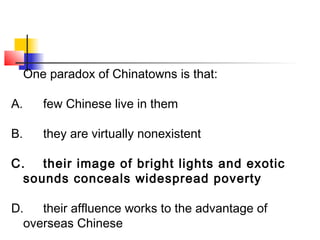
One paradox of Chinatowns is that: 
A. few Chinese live in them 
B. they are virtually nonexistent 
C. their image of bright lights and exotic sounds 
conceals widespread poverty 
D. their affluence works to the advantage of 
overseas Chinese
One paradox of Chinatowns is that: 
A. few Chinese live in them 
B. they are virtually nonexistent 
C. their image of bright lights and exotic 
sounds conceals widespread poverty 
D. their affluence works to the advantage of 
overseas Chinese
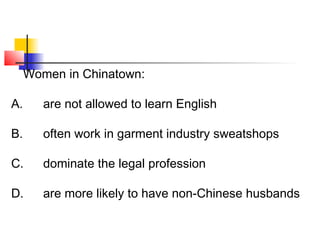
Women in Chinatown: 
A. are not allowed to learn English 
B. often work in garment industry sweatshops 
C. dominate the legal profession 
D. are more likely to have non-Chinese husbands
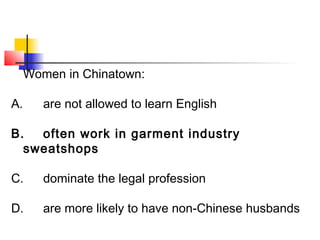
Women in Chinatown: 
A. are not allowed to learn English 
B. often work in garment industry 
sweatshops 
C. dominate the legal profession 
D. are more likely to have non-Chinese husbands
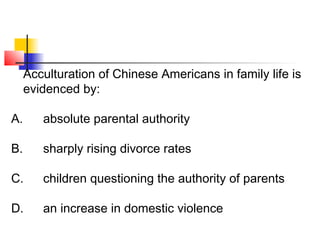
Acculturation of Chinese Americans in family life is 
evidenced by: 
A. absolute parental authority 
B. sharply rising divorce rates 
C. children questioning the authority of parents 
D. an increase in domestic violence
Acculturation of Chinese Americans in family life is 
evidenced by: 
A. absolute parental authority 
B. sharply rising divorce rates 
C. children questioning the authority of 
parents 
D. an increase in domestic violence
First generation Japanese immigrants to the United 
States are known as: 
A. Issei 
B. Samurai 
C. Nisei 
D. Cantonese
First generation Japanese immigrants to the United 
States are known as: 
A. Issei 
B. Samurai 
C. Nisei 
D. Cantonese
California's 1913 Alien Land Act: 
A. provided land grants to Japanese immigrants 
B. drove Japanese farmers into cities 
C. forced Japanese living in cities into rural areas 
D. gave citizenship to Japanese farmers but not to 
city dwellers
California's 1913 Alien Land Act: 
A. provided land grants to Japanese immigrants 
B. drove Japanese farmers into cities 
C. forced Japanese living in cities into rural areas 
D. gave citizenship to Japanese farmers but not to 
city dwellers
Which President is responsible for the order to 
place Japanese Americans in evacuation camps 
during WWII? 
A. Harry S. Truman 
B. Franklin D. Roosevelt 
C. Lyndon Johnson 
D. Woodrow Wilson
Which President is responsible for the order to 
place Japanese Americans in evacuation camps 
during WWII? 
A. Harry S. Truman 
B. Franklin D. Roosevelt 
C. Lyndon Johnson 
D. Woodrow Wilson
Order 9066, which resulted in the forced 
confinement of Japanese Americans in evacuation 
camps, involved which of the following? 
A. Court action against Japanese Americans 
suspected of espionage 
B. trial decisions finding Japanese Americans guilty 
of anti-American activities 
C. proof that Japanese Americans had greater 
loyalty to Japan than to the U.S. 
D. none of these
Order 9066, which resulted in the forced 
confinement of Japanese Americans in evacuation 
camps, involved which of the following? 
A. Court action against Japanese Americans 
suspected of espionage 
B. trial decisions finding Japanese Americans guilty 
of anti-American activities 
C. proof that Japanese Americans had greater 
loyalty to Japan than to the U.S. 
D. none of these
In 1988, President Ronald Reagan signed 
legislation entitled the Civil Liberties Act, in which 
the United States authorized reparations for: 
A. Jewish Americans 
B. Chinese Americans 
C. Japanese Americans 
D. Vietnamese Americans
In 1988, President Ronald Reagan signed 
legislation entitled the Civil Liberties Act, in which 
the United States authorized reparations for: 
A. Jewish Americans 
B. Chinese Americans 
C. Japanese Americans 
D. Vietnamese Americans
Compared to Whites, Japanese Americans as 
a group: 
A. have more education but occupy lower 
status jobs 
B. have better jobs despite overall lower 
educational attainment 
C. have lower levels of educational 
attainment and occupy poorer jobs 
D. have higher wage earnings and more 
education
Compared to Whites, Japanese Americans as 
a group: 
A. have more education but occupy lower 
status jobs 
B. have better jobs despite overall lower 
educational attainment 
C. have lower levels of educational 
attainment and occupy poorer jobs 
D. have higher wage earnings and 
more education

Ch13 prs

  • 1.
    Chinese AAmmeerriiccaannss aanndd JJaappaanneessee AAmmeerriiccaannss Chapter 13 Review Questions
  • 2.
    In 1882, Congressenacted legislation prohibiting the immigration of: A. Japanese B. Hawaiians C. Chinese D. All of these
  • 3.
    In 1882 Congressenacted legislation prohibiting the immigration of: A. Japanese B. Hawaiians C. Chinese D. All of these
  • 4.
    One paradox ofChinatowns is that: A. few Chinese live in them B. they are virtually nonexistent C. their image of bright lights and exotic sounds conceals widespread poverty D. their affluence works to the advantage of overseas Chinese
  • 5.
    One paradox ofChinatowns is that: A. few Chinese live in them B. they are virtually nonexistent C. their image of bright lights and exotic sounds conceals widespread poverty D. their affluence works to the advantage of overseas Chinese
  • 6.
    Women in Chinatown: A. are not allowed to learn English B. often work in garment industry sweatshops C. dominate the legal profession D. are more likely to have non-Chinese husbands
  • 7.
    Women in Chinatown: A. are not allowed to learn English B. often work in garment industry sweatshops C. dominate the legal profession D. are more likely to have non-Chinese husbands
  • 8.
    Acculturation of ChineseAmericans in family life is evidenced by: A. absolute parental authority B. sharply rising divorce rates C. children questioning the authority of parents D. an increase in domestic violence
  • 9.
    Acculturation of ChineseAmericans in family life is evidenced by: A. absolute parental authority B. sharply rising divorce rates C. children questioning the authority of parents D. an increase in domestic violence
  • 10.
    First generation Japaneseimmigrants to the United States are known as: A. Issei B. Samurai C. Nisei D. Cantonese
  • 11.
    First generation Japaneseimmigrants to the United States are known as: A. Issei B. Samurai C. Nisei D. Cantonese
  • 12.
    California's 1913 AlienLand Act: A. provided land grants to Japanese immigrants B. drove Japanese farmers into cities C. forced Japanese living in cities into rural areas D. gave citizenship to Japanese farmers but not to city dwellers
  • 13.
    California's 1913 AlienLand Act: A. provided land grants to Japanese immigrants B. drove Japanese farmers into cities C. forced Japanese living in cities into rural areas D. gave citizenship to Japanese farmers but not to city dwellers
  • 14.
    Which President isresponsible for the order to place Japanese Americans in evacuation camps during WWII? A. Harry S. Truman B. Franklin D. Roosevelt C. Lyndon Johnson D. Woodrow Wilson
  • 15.
    Which President isresponsible for the order to place Japanese Americans in evacuation camps during WWII? A. Harry S. Truman B. Franklin D. Roosevelt C. Lyndon Johnson D. Woodrow Wilson
  • 16.
    Order 9066, whichresulted in the forced confinement of Japanese Americans in evacuation camps, involved which of the following? A. Court action against Japanese Americans suspected of espionage B. trial decisions finding Japanese Americans guilty of anti-American activities C. proof that Japanese Americans had greater loyalty to Japan than to the U.S. D. none of these
  • 17.
    Order 9066, whichresulted in the forced confinement of Japanese Americans in evacuation camps, involved which of the following? A. Court action against Japanese Americans suspected of espionage B. trial decisions finding Japanese Americans guilty of anti-American activities C. proof that Japanese Americans had greater loyalty to Japan than to the U.S. D. none of these
  • 18.
    In 1988, PresidentRonald Reagan signed legislation entitled the Civil Liberties Act, in which the United States authorized reparations for: A. Jewish Americans B. Chinese Americans C. Japanese Americans D. Vietnamese Americans
  • 19.
    In 1988, PresidentRonald Reagan signed legislation entitled the Civil Liberties Act, in which the United States authorized reparations for: A. Jewish Americans B. Chinese Americans C. Japanese Americans D. Vietnamese Americans
  • 20.
    Compared to Whites,Japanese Americans as a group: A. have more education but occupy lower status jobs B. have better jobs despite overall lower educational attainment C. have lower levels of educational attainment and occupy poorer jobs D. have higher wage earnings and more education
  • 21.
    Compared to Whites,Japanese Americans as a group: A. have more education but occupy lower status jobs B. have better jobs despite overall lower educational attainment C. have lower levels of educational attainment and occupy poorer jobs D. have higher wage earnings and more education