Aim: Should the government restrict the rights of a
       group that it believes to be a threat?
                     5/1/2012
DO NOW: Complete DO NOW and copy AIM and
 Date.


Announcements:
HW #5 due Thurs at 11:59
Vocab sheet due 5/8
Mock Regents 5/9
Aim: Should the government restrict the rights of a
           group that it believes to be a threat?
February 27, 2009

An accused enemy combatant, who has been held for more
  than five years at a Navy brig in South Carolina, is expected to
  be sent to Illinois to stand trial in a civilian courtroom. The
  Justice Department has not yet announced charges against Ali
  al-Marri. The Bush administration had claimed terror suspects
  caught in the U.S. could be held indefinitely without charges.

Do you agree with the US government’s treatment of Ali al-
  Marri in order to prevent further terrorist attacks against the
  US?
Aim: Should the government restrict the rights of a
       group that it believes to be a threat?
Japanese in America
• Over 100,000 Japanese immigrated to US from
  1890s
• Mostly resided on the west coast (California,
  Oregon, Hawaii, etc)
• The white Americans saw the Japanese as
  economic competition for land and jobs,
  especially during the Great Depression ->
  “Yellow Flood”
• Anti-Japanese sentiment intensified after the
  bombing of Pearl Harbor
After Pearl Harbor, FDR declares of war on Japan
• Suspicion towards the Japanese grew out of fear that Japanese
  Americans were spying for Japan
• FBI raided over 1,000 Japanese Americans homes suspected of
  espionage
• Rarely any evidence proved Japanese Americans were spies

“Of all the races ineligible to [sic] citizenship, the Japanese are the
  least assailable and the most dangerous to the country. … They
  come … for the purpose of colonizing and establishing here the
  proud Yamato race. They never cease to be Japanese.”
                                         -Valentine S. McClatchy,
      A wealthy California Newspaper owner testifying to Congress


If you were Japanese American, and your neighbor and
   country accused you of being treasonous, what would you
   do?
Executive Order 9066
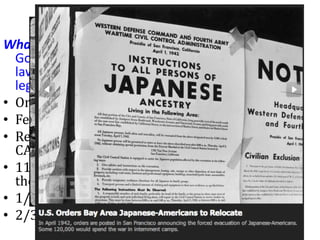
What is an Executive Order: a President's or
  Governor's declaration which has the force of
  law and does not require the consent of the
  legislature.
• Ordered by FDR
• February 19, 1942
• Removal of those of Japanese ancestry from
  CA, WA, OR, & AZ.
• 110,000 Japanese Americans removed from
  their homes
• 1/3- Issei- Immigrated from Japan
• 2/3 – Nisei – 2nd generation (born in America)
How did the United States carry out
         the Executive Order?
Directions: While listening to the clips, take
  down notes on how the lives of Japanese
  Americans changed when FDR issued the
  Executive Order 9066.
FBI Raids        Executing the Order   Life in Camps
Internment Process
• FBI raided many Japanese homes looking for
  evidence against Japanese Americans, were unable
  to find any
• Internment was indefinite
• Internees were given 48 noticed to report to a bus
  terminal, bring all of their belongs, and then sent to
  an undisclosed location
• Most Japanese Americans were forced to sell all of
  their property & their possessions
Life in Internment Camps
• Families were given barracks to live with little to
  no privacy (curtains = walls)
• Weather was harsh and sickness was common
• Forbidden from leaving camps
• Children attended school in the camps
• Japanese were not used to the foods provided by
  the US Military
• Adults were given jobs, mostly producing materials
  for war
• Men were drafted to the military
Loyalty Oath: Check Yes or No
1. "Are you willing to serve in the armed forces of the
    United States on combat duty wherever ordered?"
                    ____YES ____NO
2. "Will you swear unqualified allegiance to the United
    States of America and faithfully defend the United
    States from the Japanese Emperor any or all attack by
    foreign or domestic forces, and forswear any form of
    allegiance or obedience or any other foreign
    government, power, or organization?”
                    ____YES ____NO
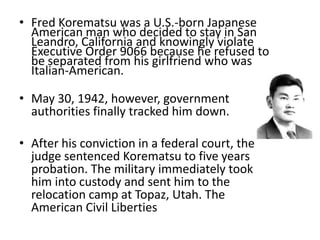
• Fred Korematsu was a U.S.-born Japanese
  American man who decided to stay in San
  Leandro, California and knowingly violate
  Executive Order 9066 because he refused to
  be separated from his girlfriend who was
  Italian-American.

• May 30, 1942, however, government
  authorities finally tracked him down.

• After his conviction in a federal court, the
  judge sentenced Korematsu to five years
  probation. The military immediately took
  him into custody and sent him to the
  relocation camp at Topaz, Utah. The
  American Civil Liberties
Korematsu vs. United States
 Issue
• The Court ruled on whether the President and Congress went
   beyond their war powers by implementing exclusion and
   restricting the rights of Americans of Japanese descent.

 Argument
• Korematsu argued that the Executive Order violated his basic
   civil rights.
• While, the United States Government argued that the
   executive order was issued because it was extremely
   concerned about nation’s security.


               Which side won? Why?
4 Corners Debate
1. Was the U.S. Government justified in interning people of
   Japanese descent?

2. During “times of war” should the government have
   unlimited power if it is aimed to protect America and its
   citizens?

3. In 1988, Ronald Reagan issued a formal apology to the
   Japanese American interned at the Camps. In addition he
   signed the Civil Liberties Act of 1988 (the Japanese American
   Redress Bill) which provided compensation of $20,000 for
   each victim of the internment. Was this sufficient to make
   amends for the internment?

4. Could this is happen again? Why or why not?
Aftermath

Korematsu and internment

  • 1.
    Aim: Should thegovernment restrict the rights of a group that it believes to be a threat? 5/1/2012 DO NOW: Complete DO NOW and copy AIM and Date. Announcements: HW #5 due Thurs at 11:59 Vocab sheet due 5/8 Mock Regents 5/9
  • 2.
    Aim: Should thegovernment restrict the rights of a group that it believes to be a threat? February 27, 2009 An accused enemy combatant, who has been held for more than five years at a Navy brig in South Carolina, is expected to be sent to Illinois to stand trial in a civilian courtroom. The Justice Department has not yet announced charges against Ali al-Marri. The Bush administration had claimed terror suspects caught in the U.S. could be held indefinitely without charges. Do you agree with the US government’s treatment of Ali al- Marri in order to prevent further terrorist attacks against the US?
  • 3.
    Aim: Should thegovernment restrict the rights of a group that it believes to be a threat? Japanese in America • Over 100,000 Japanese immigrated to US from 1890s • Mostly resided on the west coast (California, Oregon, Hawaii, etc) • The white Americans saw the Japanese as economic competition for land and jobs, especially during the Great Depression -> “Yellow Flood” • Anti-Japanese sentiment intensified after the bombing of Pearl Harbor
  • 4.
    After Pearl Harbor,FDR declares of war on Japan • Suspicion towards the Japanese grew out of fear that Japanese Americans were spying for Japan • FBI raided over 1,000 Japanese Americans homes suspected of espionage • Rarely any evidence proved Japanese Americans were spies “Of all the races ineligible to [sic] citizenship, the Japanese are the least assailable and the most dangerous to the country. … They come … for the purpose of colonizing and establishing here the proud Yamato race. They never cease to be Japanese.” -Valentine S. McClatchy, A wealthy California Newspaper owner testifying to Congress If you were Japanese American, and your neighbor and country accused you of being treasonous, what would you do?
  • 5.
    Executive Order 9066 Whatis an Executive Order: a President's or Governor's declaration which has the force of law and does not require the consent of the legislature. • Ordered by FDR • February 19, 1942 • Removal of those of Japanese ancestry from CA, WA, OR, & AZ. • 110,000 Japanese Americans removed from their homes • 1/3- Issei- Immigrated from Japan • 2/3 – Nisei – 2nd generation (born in America)
  • 6.
    How did theUnited States carry out the Executive Order? Directions: While listening to the clips, take down notes on how the lives of Japanese Americans changed when FDR issued the Executive Order 9066. FBI Raids Executing the Order Life in Camps
  • 7.
    Internment Process • FBIraided many Japanese homes looking for evidence against Japanese Americans, were unable to find any • Internment was indefinite • Internees were given 48 noticed to report to a bus terminal, bring all of their belongs, and then sent to an undisclosed location • Most Japanese Americans were forced to sell all of their property & their possessions
  • 9.
    Life in InternmentCamps • Families were given barracks to live with little to no privacy (curtains = walls) • Weather was harsh and sickness was common • Forbidden from leaving camps • Children attended school in the camps • Japanese were not used to the foods provided by the US Military • Adults were given jobs, mostly producing materials for war • Men were drafted to the military
  • 10.
    Loyalty Oath: CheckYes or No 1. "Are you willing to serve in the armed forces of the United States on combat duty wherever ordered?" ____YES ____NO 2. "Will you swear unqualified allegiance to the United States of America and faithfully defend the United States from the Japanese Emperor any or all attack by foreign or domestic forces, and forswear any form of allegiance or obedience or any other foreign government, power, or organization?” ____YES ____NO
  • 11.
    • Fred Korematsuwas a U.S.-born Japanese American man who decided to stay in San Leandro, California and knowingly violate Executive Order 9066 because he refused to be separated from his girlfriend who was Italian-American. • May 30, 1942, however, government authorities finally tracked him down. • After his conviction in a federal court, the judge sentenced Korematsu to five years probation. The military immediately took him into custody and sent him to the relocation camp at Topaz, Utah. The American Civil Liberties
  • 12.
    Korematsu vs. UnitedStates Issue • The Court ruled on whether the President and Congress went beyond their war powers by implementing exclusion and restricting the rights of Americans of Japanese descent. Argument • Korematsu argued that the Executive Order violated his basic civil rights. • While, the United States Government argued that the executive order was issued because it was extremely concerned about nation’s security. Which side won? Why?
  • 13.
    4 Corners Debate 1.Was the U.S. Government justified in interning people of Japanese descent? 2. During “times of war” should the government have unlimited power if it is aimed to protect America and its citizens? 3. In 1988, Ronald Reagan issued a formal apology to the Japanese American interned at the Camps. In addition he signed the Civil Liberties Act of 1988 (the Japanese American Redress Bill) which provided compensation of $20,000 for each victim of the internment. Was this sufficient to make amends for the internment? 4. Could this is happen again? Why or why not?
  • 14.

Editor's Notes

  • #4 What do you think the attitudes were towards Japanese Americans after Pearl Harbor?
  • #5 If you were Japanese American, and your neighbor and country accused you of being treasonous, what would you do?Anti-Asian sentiments were common, many Chinese and Korean Americans had to wear a yellow button to let others know they weren’t Japanese
  • #6 Did the President have the right to order this?Were the rights of Japanese Americans violated? If so, which ones?If the US asked you to follow this order as proof of loyalty to the US, would you comply? Why?
  • #7 Have student take down notes on how the lives of JA changed.
  • #8 What do you think happened, when JA protested?
  • #11 Ask students to take the oath as if they were JA and turn and talk: Do you think JA replied “yes” or “no” No-No responses caused JA to be sent to other camps where they were known as “dangerous.” What could be some reasons behind the way Japanese Americans answered this oath?