Chapter 11 
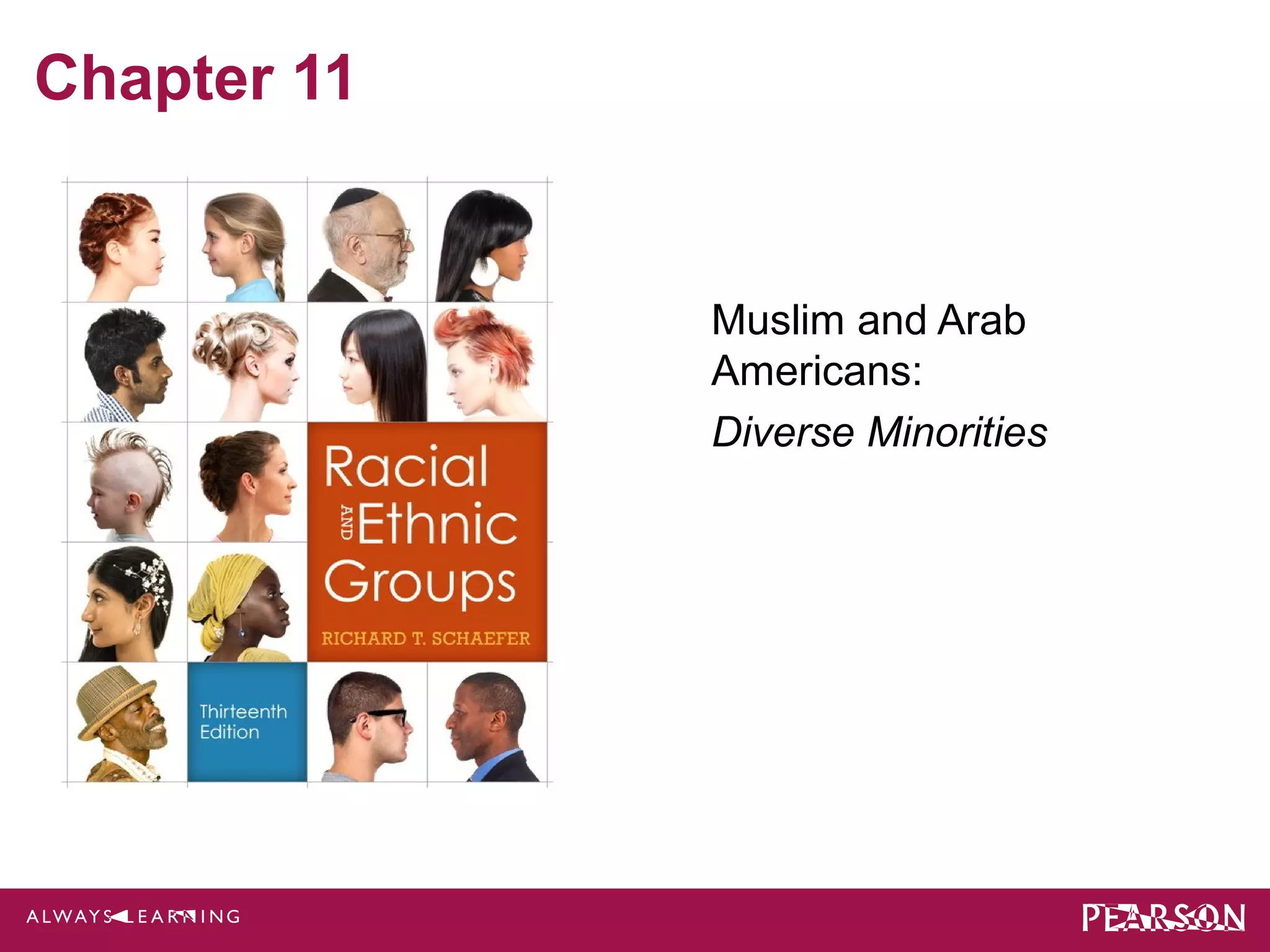
Muslim and Arab 
Americans: 
Diverse Minorities
Muslim and Arab People 
• Muslim and Arab Americans are different 
groups in America, though they overlap 
• Considering Arab & Muslim Americans 
– 1st - clarify the distinction between two groups 
incorrectly referred as the same population 
– Overcome prism of Orientalism through which 
many Americans view Arab and Muslim world 
© 2012 Pearson Education, Inc. All rights reserved.
Muslim and Arab People 
• Arabs are an ethnic group; Muslims are a 
religious group; Islam is the faith 
• Muslim is a believer of that religion 
• One cannot accurately identify the Muslim 
faithful by nationality alone 
• Clearly being Arab does not define one as 
being a follower of Islam 
© 2012 Pearson Education, Inc. All rights reserved.
Arab Americans 
• Arab Americans & “Middle Eastern” 
• The Arabic language is the most single 
unifying force among Arabs 
• Up to 3 million people with Arab ancestry 
in the U.S. 
– Lebanon, Syria, Egypt, and Palestine account 
fro 2/3rd of Arab Americans in 2000 
© 2012 Pearson Education, Inc. All rights reserved.
Arab Americans 
• Diversity of Arabs 
– Variation in time of arrival 
– Variation in the point of origin 
– Variation of religious tradition 
• Deficit Model of Ethnic Identity 
– A factor of subtracting away characteristics 
corresponding to some ideal ethnic type 
© 2012 Pearson Education, Inc. All rights reserved.
Muslim Americans 
• 1.6 billion followers worldwide and second 
to Christianity 
• Islam is guided by the teaching of the 
Koran (Qur’an) 
• Use religious rituals 
• Divided into a variety of faiths and sects 
• Jihad 
© 2012 Pearson Education, Inc. All rights reserved.
Muslim Americans 
• Number of Muslim Americans is difficult to 
estimate 
– 20-42 percent African American 
– 24-33 percent South Asian (Afghan, 
Bangladeshi, Indian and Pakistani) 
– 12-32 percent Arab 
© 2012 Pearson Education, Inc. All rights reserved.
Muslim Americans 
– 15-22 percent “other” (Bosnian, Iranian, Turk, 
and White and Hispanic converts) 
• Total agreement that the population is 
growing rapidly 
– Immigration and conversion 
© 2012 Pearson Education, Inc. All rights reserved.
Muslim Americans 
• Blended Identity 
– Is the self-image and worldview that is a 
combination of: 
• Religious faith, cultural background based in 
nationality, & status of being a resident of the U.S. 
• Many Muslims experience the freedom to 
be Muslim and the pressure to be Muslim 
© 2012 Pearson Education, Inc. All rights reserved.
Black Muslims 
• Estimated to account for 90 percent of all 
converts to Islam in the U.S. 
• Not tightly organized into a single religious 
fellowship 
• Against adultery and drinking alcohol 
© 2012 Pearson Education, Inc. All rights reserved.
Black Muslims 
• The Nation of Islam became a well-known 
and controversial organization 
– Trace roots to W. Fard Muhammad in (1930) 
– Became well-known and controversial under 
Elijah Muhammad 
© 2012 Pearson Education, Inc. All rights reserved.
Malcolm X 
• Originally a member of the Nation of Islam 
• Was the most powerful and brilliant voice 
of Black self-determination in the 1960s 
• Highly critical of the civil rights movement 
in general and of Martin Luther King, Jr. 
© 2012 Pearson Education, Inc. All rights reserved.
Malcolm X 
• Remembered for: 
– His sharp attacks on Black leaders 
– His break with the Nation of Islam 
– His apparent shift to support the formation of 
coalitions with progressive whites 
– Teaching that Black must resist violence “by 
any means necessary.” 
© 2012 Pearson Education, Inc. All rights reserved.
Malcolm X 
• Created the Organization of Afro- 
American Unity 
– Meant to internationalize the Civil Rights 
Movement 
• Assassinated in 1964 
© 2012 Pearson Education, Inc. All rights reserved.
Louis Farrakhan 
• Most visible spokesperson among Muslim 
groups in the African American community 
• Anti-Israel foreign policy 
• Leader of the 1995 Million Man March 
© 2012 Pearson Education, Inc. All rights reserved.
Louis Farrakhan 
• Pro: Self-help, bootstrap capitalism, and 
strict punishment 
• Against: Abortion, drugs, and 
homosexuality 
© 2012 Pearson Education, Inc. All rights reserved.
Immigration to the United States 
• Some slaves were followers of Islam 
• The National Origins System slowed 
immigration to the United States 
• In 1919, the first mosque was established 
– And a variety of service agencies to help the 
immigrant community 
© 2012 Pearson Education, Inc. All rights reserved.
Immigration to the United States 
• Professional-Preference Clauses within 
1965 Immigration and Naturalization Act 
– Increased immigration among Muslims and 
Arabs 
© 2012 Pearson Education, Inc. All rights reserved.
Mosques 
• The mosques in metropolitan Detroit serve 
an estimated 200,000 Muslims 
• This is probably the largest Arab 
community outside of the Arab world 
© 2012 Pearson Education, Inc. All rights reserved.
Contemporary Life in the United 
States 
• Arab Americans tend to immigrate to 
urban areas 
• Fill skilled & professional roles in US 
– And become self-employed merchants or 
entrepreneurs 
© 2012 Pearson Education, Inc. All rights reserved.
Contemporary Life in the United 
States 
• Operate stores in low-income areas of 
central cities major retailers ignore 
– Opportunities for success are great 
• But face challenges of serving low-income 
population with few consumer choices 
• And history of being exploited by outsiders 
© 2012 Pearson Education, Inc. All rights reserved.
Family Life and Gender 
• Traditionally, Islam has permitted men to 
have multiple wives—a maximum of four. 
• Role of women receive much attention 
because outer clothing is a: 
– Conspicuous symbol that to some seem to 
represent repression of women in society 
© 2012 Pearson Education, Inc. All rights reserved.
Family Life and Gender 
• Perception of gender practices in Muslim 
societies receive special attention 
– By Western media 
• Particularly dress codes 
© 2012 Pearson Education, Inc. All rights reserved.
Family Life and Gender 
• Hijab 
– A variety of garments that allow women to 
follow the guidelines of modest dress 
• There are differences in the role of 
women within the faith and the mosque 
• Segregations of the sexes in mosques 
© 2012 Pearson Education, Inc. All rights reserved.
Family Life and Gender 
• Perspectives among Muslim women in US 
and settlements outside Islamic countries 
• Younger, better educated, support hijab but draw 
upon Western ideas of individual rights 
• Older, less-educated support hijab and make 
arguments without reference to Western ideology 
• Third group of all ages & education, oppose hijab 
© 2012 Pearson Education, Inc. All rights reserved.
Education 
• Recognize the importance of education 
and value formal instruction in their faith 
• Schools are specific to particular 
expressions of Islam/specific nationalities 
© 2012 Pearson Education, Inc. All rights reserved.
Education 
• Children attending public schools 
encounter the type of: 
– Adjustment experienced by those of a 
religious faith 
• Different from the dominant one of society 
© 2012 Pearson Education, Inc. All rights reserved.
Politics 
• Muslim and Arab Americans are politically 
aware and often active 
• Most visible Arab American in politics 
– Ralph Nader tried to open presidential politics 
to a true alternative to the two-party system 
© 2012 Pearson Education, Inc. All rights reserved.
Politics 
• Muslims in the U.S. often express the 
view: 
– That their faith encourages political 
participation 
• There is a clear distancing that one can 
observe between the major parties: 
– And Muslims and Arab Americans 
© 2012 Pearson Education, Inc. All rights reserved.
Politics 
• Clear distancing between the major 
parties and Muslim and Arab Americans 
• Contrast to the catering of African 
Americans and Latinos for votes 
© 2012 Pearson Education, Inc. All rights reserved.
Politics 
• News events have fueled anti-Arab and 
anti-Muslim feeling 
• 1972 terrorist raid at the Munich Olympics 
• 1998 bombings of the U.S. embassies, 
Kenya and Tanzania 
• September 11, 2001 engineered by Arab 
Muslim extremists 
© 2012 Pearson Education, Inc. All rights reserved.
Politics 
• Racial Profiling 
– Any arbitrary police-initiated action based on 
race, ethnicity, or national origin 
– Became intense after 9/11 
• The registration process deepened fear 
and disillusionment among: 
– The many law-abiding Muslims in the U.S. 
© 2012 Pearson Education, Inc. All rights reserved.
Issues of Prejudice and 
Discrimination 
• Motion pictures show Arabs and Muslims 
as savages, untrustworthy, and barbaric 
• On television, there is an overemphasis on 
the extreme representations 
• Surveys conducted after 9/11 found a 
growing willingness to view: 
– Arabs/Muslims as generally dangerous 
people 
© 2012 Pearson Education, Inc. All rights reserved.
Issues of Prejudice and 
Discrimination 
• Hate crimes and harassment rose sharply 
after 9/11 
• One in four people believe a number of 
anti-Muslim stereotypes 
• Arab and Muslim Americans have not 
been passive to their treatment 
© 2012 Pearson Education, Inc. All rights reserved.
Islamophobia 
• A range of negative feelings toward 
Muslims and their religion 
– Ranges from generalized intolerance to 
hatred 
© 2012 Pearson Education, Inc. All rights reserved.

Schaefer c11 (1)

  • 1.
    Chapter 11 Muslimand Arab Americans: Diverse Minorities
  • 2.
    Muslim and ArabPeople • Muslim and Arab Americans are different groups in America, though they overlap • Considering Arab & Muslim Americans – 1st - clarify the distinction between two groups incorrectly referred as the same population – Overcome prism of Orientalism through which many Americans view Arab and Muslim world © 2012 Pearson Education, Inc. All rights reserved.
  • 3.
    Muslim and ArabPeople • Arabs are an ethnic group; Muslims are a religious group; Islam is the faith • Muslim is a believer of that religion • One cannot accurately identify the Muslim faithful by nationality alone • Clearly being Arab does not define one as being a follower of Islam © 2012 Pearson Education, Inc. All rights reserved.
  • 4.
    Arab Americans •Arab Americans & “Middle Eastern” • The Arabic language is the most single unifying force among Arabs • Up to 3 million people with Arab ancestry in the U.S. – Lebanon, Syria, Egypt, and Palestine account fro 2/3rd of Arab Americans in 2000 © 2012 Pearson Education, Inc. All rights reserved.
  • 5.
    Arab Americans •Diversity of Arabs – Variation in time of arrival – Variation in the point of origin – Variation of religious tradition • Deficit Model of Ethnic Identity – A factor of subtracting away characteristics corresponding to some ideal ethnic type © 2012 Pearson Education, Inc. All rights reserved.
  • 6.
    Muslim Americans •1.6 billion followers worldwide and second to Christianity • Islam is guided by the teaching of the Koran (Qur’an) • Use religious rituals • Divided into a variety of faiths and sects • Jihad © 2012 Pearson Education, Inc. All rights reserved.
  • 7.
    Muslim Americans •Number of Muslim Americans is difficult to estimate – 20-42 percent African American – 24-33 percent South Asian (Afghan, Bangladeshi, Indian and Pakistani) – 12-32 percent Arab © 2012 Pearson Education, Inc. All rights reserved.
  • 8.
    Muslim Americans –15-22 percent “other” (Bosnian, Iranian, Turk, and White and Hispanic converts) • Total agreement that the population is growing rapidly – Immigration and conversion © 2012 Pearson Education, Inc. All rights reserved.
  • 9.
    Muslim Americans •Blended Identity – Is the self-image and worldview that is a combination of: • Religious faith, cultural background based in nationality, & status of being a resident of the U.S. • Many Muslims experience the freedom to be Muslim and the pressure to be Muslim © 2012 Pearson Education, Inc. All rights reserved.
  • 10.
    Black Muslims •Estimated to account for 90 percent of all converts to Islam in the U.S. • Not tightly organized into a single religious fellowship • Against adultery and drinking alcohol © 2012 Pearson Education, Inc. All rights reserved.
  • 11.
    Black Muslims •The Nation of Islam became a well-known and controversial organization – Trace roots to W. Fard Muhammad in (1930) – Became well-known and controversial under Elijah Muhammad © 2012 Pearson Education, Inc. All rights reserved.
  • 12.
    Malcolm X •Originally a member of the Nation of Islam • Was the most powerful and brilliant voice of Black self-determination in the 1960s • Highly critical of the civil rights movement in general and of Martin Luther King, Jr. © 2012 Pearson Education, Inc. All rights reserved.
  • 13.
    Malcolm X •Remembered for: – His sharp attacks on Black leaders – His break with the Nation of Islam – His apparent shift to support the formation of coalitions with progressive whites – Teaching that Black must resist violence “by any means necessary.” © 2012 Pearson Education, Inc. All rights reserved.
  • 14.
    Malcolm X •Created the Organization of Afro- American Unity – Meant to internationalize the Civil Rights Movement • Assassinated in 1964 © 2012 Pearson Education, Inc. All rights reserved.
  • 15.
    Louis Farrakhan •Most visible spokesperson among Muslim groups in the African American community • Anti-Israel foreign policy • Leader of the 1995 Million Man March © 2012 Pearson Education, Inc. All rights reserved.
  • 16.
    Louis Farrakhan •Pro: Self-help, bootstrap capitalism, and strict punishment • Against: Abortion, drugs, and homosexuality © 2012 Pearson Education, Inc. All rights reserved.
  • 17.
    Immigration to theUnited States • Some slaves were followers of Islam • The National Origins System slowed immigration to the United States • In 1919, the first mosque was established – And a variety of service agencies to help the immigrant community © 2012 Pearson Education, Inc. All rights reserved.
  • 18.
    Immigration to theUnited States • Professional-Preference Clauses within 1965 Immigration and Naturalization Act – Increased immigration among Muslims and Arabs © 2012 Pearson Education, Inc. All rights reserved.
  • 19.
    Mosques • Themosques in metropolitan Detroit serve an estimated 200,000 Muslims • This is probably the largest Arab community outside of the Arab world © 2012 Pearson Education, Inc. All rights reserved.
  • 20.
    Contemporary Life inthe United States • Arab Americans tend to immigrate to urban areas • Fill skilled & professional roles in US – And become self-employed merchants or entrepreneurs © 2012 Pearson Education, Inc. All rights reserved.
  • 21.
    Contemporary Life inthe United States • Operate stores in low-income areas of central cities major retailers ignore – Opportunities for success are great • But face challenges of serving low-income population with few consumer choices • And history of being exploited by outsiders © 2012 Pearson Education, Inc. All rights reserved.
  • 22.
    Family Life andGender • Traditionally, Islam has permitted men to have multiple wives—a maximum of four. • Role of women receive much attention because outer clothing is a: – Conspicuous symbol that to some seem to represent repression of women in society © 2012 Pearson Education, Inc. All rights reserved.
  • 23.
    Family Life andGender • Perception of gender practices in Muslim societies receive special attention – By Western media • Particularly dress codes © 2012 Pearson Education, Inc. All rights reserved.
  • 24.
    Family Life andGender • Hijab – A variety of garments that allow women to follow the guidelines of modest dress • There are differences in the role of women within the faith and the mosque • Segregations of the sexes in mosques © 2012 Pearson Education, Inc. All rights reserved.
  • 25.
    Family Life andGender • Perspectives among Muslim women in US and settlements outside Islamic countries • Younger, better educated, support hijab but draw upon Western ideas of individual rights • Older, less-educated support hijab and make arguments without reference to Western ideology • Third group of all ages & education, oppose hijab © 2012 Pearson Education, Inc. All rights reserved.
  • 26.
    Education • Recognizethe importance of education and value formal instruction in their faith • Schools are specific to particular expressions of Islam/specific nationalities © 2012 Pearson Education, Inc. All rights reserved.
  • 27.
    Education • Childrenattending public schools encounter the type of: – Adjustment experienced by those of a religious faith • Different from the dominant one of society © 2012 Pearson Education, Inc. All rights reserved.
  • 28.
    Politics • Muslimand Arab Americans are politically aware and often active • Most visible Arab American in politics – Ralph Nader tried to open presidential politics to a true alternative to the two-party system © 2012 Pearson Education, Inc. All rights reserved.
  • 29.
    Politics • Muslimsin the U.S. often express the view: – That their faith encourages political participation • There is a clear distancing that one can observe between the major parties: – And Muslims and Arab Americans © 2012 Pearson Education, Inc. All rights reserved.
  • 30.
    Politics • Cleardistancing between the major parties and Muslim and Arab Americans • Contrast to the catering of African Americans and Latinos for votes © 2012 Pearson Education, Inc. All rights reserved.
  • 31.
    Politics • Newsevents have fueled anti-Arab and anti-Muslim feeling • 1972 terrorist raid at the Munich Olympics • 1998 bombings of the U.S. embassies, Kenya and Tanzania • September 11, 2001 engineered by Arab Muslim extremists © 2012 Pearson Education, Inc. All rights reserved.
  • 32.
    Politics • RacialProfiling – Any arbitrary police-initiated action based on race, ethnicity, or national origin – Became intense after 9/11 • The registration process deepened fear and disillusionment among: – The many law-abiding Muslims in the U.S. © 2012 Pearson Education, Inc. All rights reserved.
  • 33.
    Issues of Prejudiceand Discrimination • Motion pictures show Arabs and Muslims as savages, untrustworthy, and barbaric • On television, there is an overemphasis on the extreme representations • Surveys conducted after 9/11 found a growing willingness to view: – Arabs/Muslims as generally dangerous people © 2012 Pearson Education, Inc. All rights reserved.
  • 34.
    Issues of Prejudiceand Discrimination • Hate crimes and harassment rose sharply after 9/11 • One in four people believe a number of anti-Muslim stereotypes • Arab and Muslim Americans have not been passive to their treatment © 2012 Pearson Education, Inc. All rights reserved.
  • 35.
    Islamophobia • Arange of negative feelings toward Muslims and their religion – Ranges from generalized intolerance to hatred © 2012 Pearson Education, Inc. All rights reserved.