The MMaakkiinngg ooff AAffrriiccaann 
AAmmeerriiccaannss iinn WWhhiittee 
AAmmeerriiccaa 
Chapter 7 
Review Questions
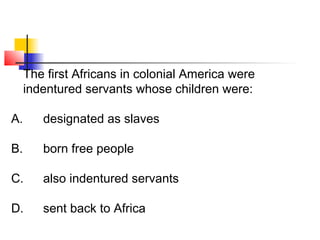
The first Africans in colonial America were 
indentured servants whose children were: 
A. designated as slaves 
B. born free people 
C. also indentured servants 
D. sent back to Africa
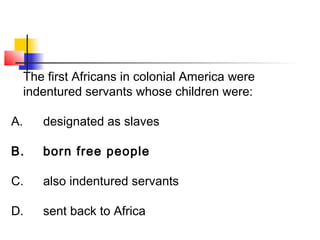
The first Africans in colonial America were 
indentured servants whose children were: 
A. designated as slaves 
B. born free people 
C. also indentured servants 
D. sent back to Africa
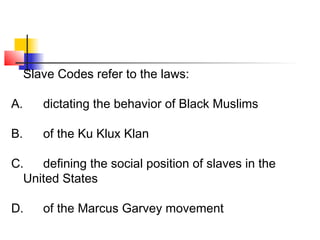
Slave Codes refer to the laws: 
A. dictating the behavior of Black Muslims 
B. of the Ku Klux Klan 
C. defining the social position of slaves in the 
United States 
D. of the Marcus Garvey movement
Slave Codes refer to the laws: 
A. dictating the behavior of Black Muslims 
B. of the Ku Klux Klan 
C. defining the social position of slaves in 
the United States 
D. of the Marcus Garvey movement
For the slave population, Christianity: 
A. stressed obeying their owners 
B. warned that fighting slavery would cause 
everlasting damnation 
C. formed the basis of the struggle for freedom 
D. all of these
For the slave population Christianity: 
A. stressed obeying their owners 
B. warned that fighting slavery would cause 
everlasting damnation 
C. formed the basis of the struggle for freedom 
D. all of these
The survival of African culture can be documented 
in: 
A. folklore 
B. religion and music 
C. language 
D. all of these
The survival of African culture can be documented 
in: 
A. folklore 
B. religion and music 
C. language 
D. all of these
The antislavery movement was referred to as: 
A. Equal Rights 
B. Suffrage 
C. Abolitionism 
D. Ableism
The antislavery movement was referred to as: 
A. Equal Rights 
B. Suffrage 
C. Abolitionism 
D. Ableism
The Emancipation Proclamation: 
A. worsened the state of the slave status 
B. freed the slaves in the Confederacy 
C. freed all slaves 
D. was eradicated by the Supreme Court
The Emancipation Proclamation: 
A. worsened the state of the slave status 
B. freed the slaves in the Confederacy 
C. freed all slaves 
D. was eradicated by the Supreme Court
The policy of "separate but equal" was defined as 
________ by the U.S. Supreme Court in 1896: 
A. reasonable 
B. unacceptable 
C. racist 
D. discriminatory
The policy of "separate but equal" was defined as 
________ by the U.S. Supreme Court in 1896: 
A. reasonable 
B. unacceptable 
C. racist 
D. discriminatory
The Supreme Court approved the use of poll taxes, 
literacy tests, and residency requirements as a 
method of keeping Blacks from voting in the 
decision: 
A. Williams v. Mississippi 
B. Plessy v. Ferguson 
C. California v. Bakke 
D. United States v. Cruikshank
The Supreme Court approved the use of poll taxes, 
literacy tests, and residency requirements as a 
method of keeping Blacks from voting in the 
decision: 
A. Williams v. Mississippi 
B. Plessy v. Ferguson 
C. California v. Bakke 
D. United States v. Cruikshank
Which of the following has the U.S. government 
never issued an official apology for? 
A. Sending Japanese Americans to internment 
camps during WWII 
B. The enslavement of Africans brought to America 
C. Injustices to the American Indians 
D. The U.S. government has never issued an 
apology for any of these.
Which of the following has the U.S. government 
never issued an official apology for? 
A. Sending Japanese Americans to internment 
camps during WWII 
B. The enslavement of Africans brought to 
America 
C. Injustices to the American Indians 
D. The U.S. government has never issued an 
apology for any of these.
The Niagara Movement directly led to the formation 
of the: 
A. Urban League 
B. Black Panther's Party 
C. National Association for the Advancement of 
Colored People 
D. Million Man March
The Niagara Movement directly led to the formation 
of the: 
A. Urban League 
B. Black Panther's Party 
C. National Association for the 
Advancement of Colored People 
D. Million Man March

Ch07 prs0

  • 1.
    The MMaakkiinngg ooffAAffrriiccaann AAmmeerriiccaannss iinn WWhhiittee AAmmeerriiccaa Chapter 7 Review Questions
  • 2.
    The first Africansin colonial America were indentured servants whose children were: A. designated as slaves B. born free people C. also indentured servants D. sent back to Africa
  • 3.
    The first Africansin colonial America were indentured servants whose children were: A. designated as slaves B. born free people C. also indentured servants D. sent back to Africa
  • 4.
    Slave Codes referto the laws: A. dictating the behavior of Black Muslims B. of the Ku Klux Klan C. defining the social position of slaves in the United States D. of the Marcus Garvey movement
  • 5.
    Slave Codes referto the laws: A. dictating the behavior of Black Muslims B. of the Ku Klux Klan C. defining the social position of slaves in the United States D. of the Marcus Garvey movement
  • 6.
    For the slavepopulation, Christianity: A. stressed obeying their owners B. warned that fighting slavery would cause everlasting damnation C. formed the basis of the struggle for freedom D. all of these
  • 7.
    For the slavepopulation Christianity: A. stressed obeying their owners B. warned that fighting slavery would cause everlasting damnation C. formed the basis of the struggle for freedom D. all of these
  • 8.
    The survival ofAfrican culture can be documented in: A. folklore B. religion and music C. language D. all of these
  • 9.
    The survival ofAfrican culture can be documented in: A. folklore B. religion and music C. language D. all of these
  • 10.
    The antislavery movementwas referred to as: A. Equal Rights B. Suffrage C. Abolitionism D. Ableism
  • 11.
    The antislavery movementwas referred to as: A. Equal Rights B. Suffrage C. Abolitionism D. Ableism
  • 12.
    The Emancipation Proclamation: A. worsened the state of the slave status B. freed the slaves in the Confederacy C. freed all slaves D. was eradicated by the Supreme Court
  • 13.
    The Emancipation Proclamation: A. worsened the state of the slave status B. freed the slaves in the Confederacy C. freed all slaves D. was eradicated by the Supreme Court
  • 14.
    The policy of"separate but equal" was defined as ________ by the U.S. Supreme Court in 1896: A. reasonable B. unacceptable C. racist D. discriminatory
  • 15.
    The policy of"separate but equal" was defined as ________ by the U.S. Supreme Court in 1896: A. reasonable B. unacceptable C. racist D. discriminatory
  • 16.
    The Supreme Courtapproved the use of poll taxes, literacy tests, and residency requirements as a method of keeping Blacks from voting in the decision: A. Williams v. Mississippi B. Plessy v. Ferguson C. California v. Bakke D. United States v. Cruikshank
  • 17.
    The Supreme Courtapproved the use of poll taxes, literacy tests, and residency requirements as a method of keeping Blacks from voting in the decision: A. Williams v. Mississippi B. Plessy v. Ferguson C. California v. Bakke D. United States v. Cruikshank
  • 18.
    Which of thefollowing has the U.S. government never issued an official apology for? A. Sending Japanese Americans to internment camps during WWII B. The enslavement of Africans brought to America C. Injustices to the American Indians D. The U.S. government has never issued an apology for any of these.
  • 19.
    Which of thefollowing has the U.S. government never issued an official apology for? A. Sending Japanese Americans to internment camps during WWII B. The enslavement of Africans brought to America C. Injustices to the American Indians D. The U.S. government has never issued an apology for any of these.
  • 20.
    The Niagara Movementdirectly led to the formation of the: A. Urban League B. Black Panther's Party C. National Association for the Advancement of Colored People D. Million Man March
  • 21.
    The Niagara Movementdirectly led to the formation of the: A. Urban League B. Black Panther's Party C. National Association for the Advancement of Colored People D. Million Man March