ISSUES TO ADDRESS...
• Why are dislocations observed primarily in metals
and alloys?
• How are strength and dislocation motion related?
• How do we increase strength?
1
• How can heating change strength and other properties?
CHAPTER 8:
DEFORMATION AND STRENGTHENING
MECHANISMS
3
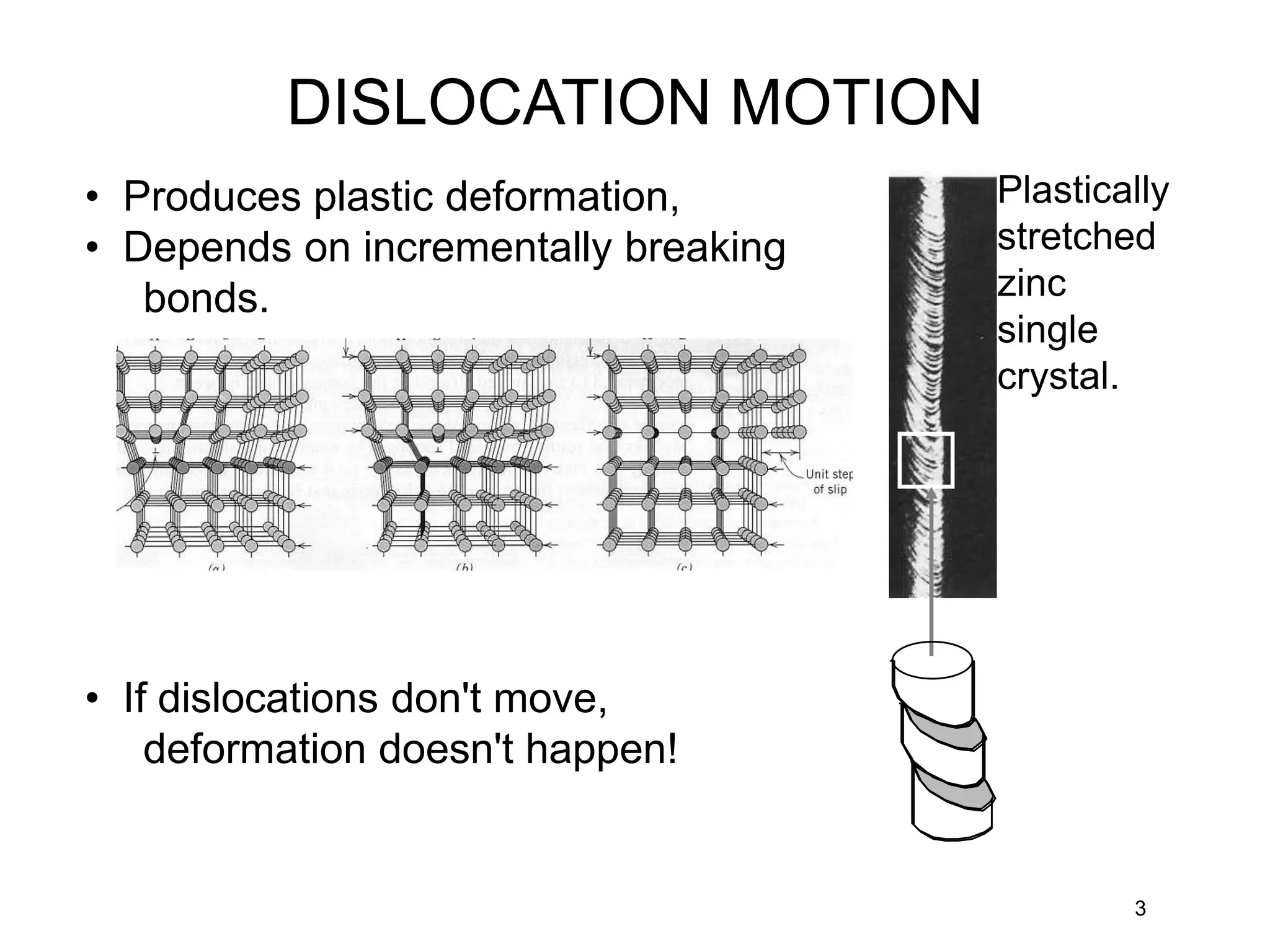
• Produces plastic deformation,
• Depends on incrementally breaking
bonds.
Plastically
stretched
zinc
single
crystal.
• If dislocations don't move,
deformation doesn't happen!
DISLOCATION MOTION
2
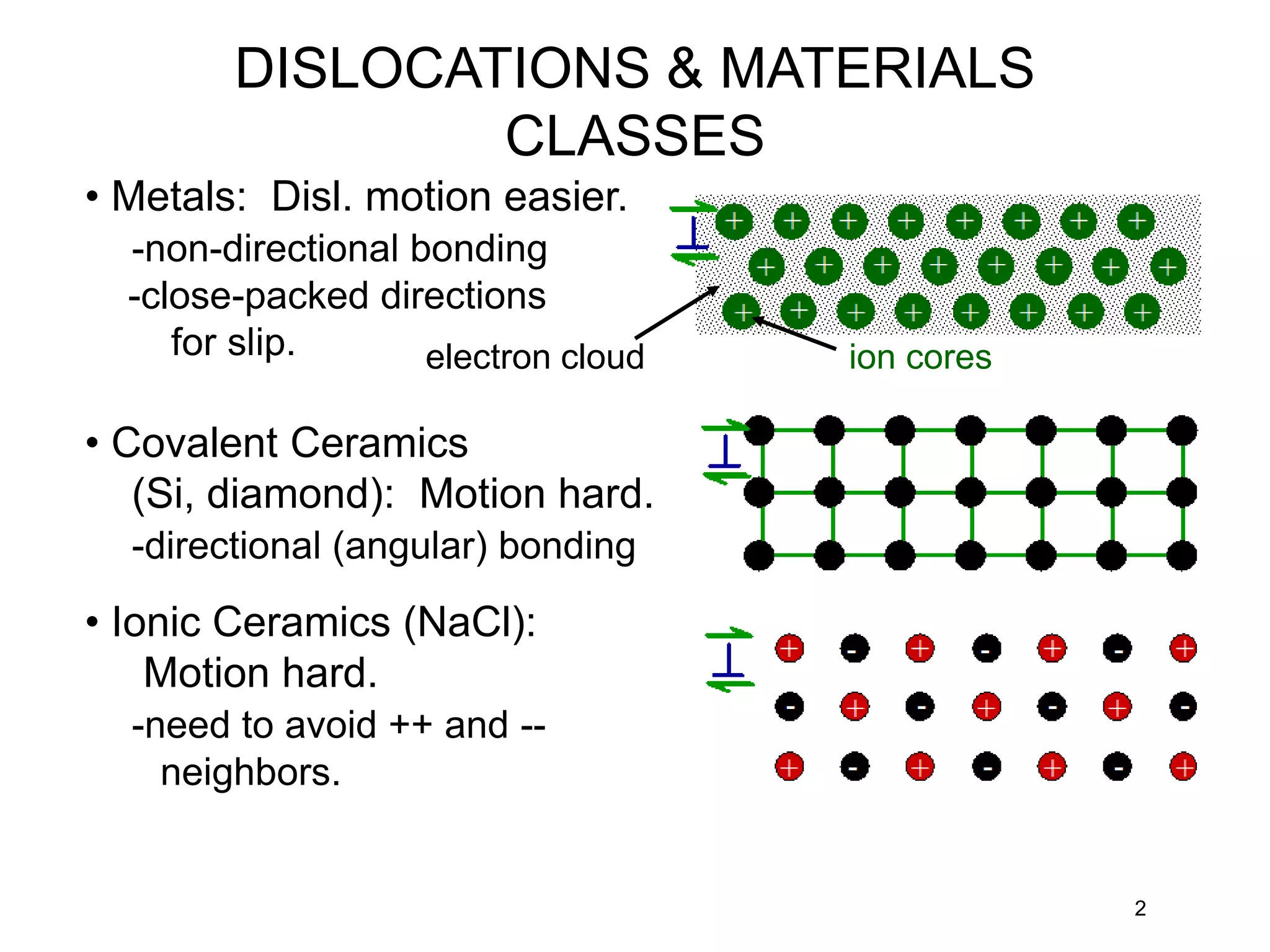
• Metals: Disl. motion easier.
-non-directional bonding
-close-packed directions
for slip. electron cloud ion cores
• Covalent Ceramics
(Si, diamond): Motion hard.
-directional (angular) bonding
• Ionic Ceramics (NaCl):
Motion hard.
-need to avoid ++ and --
neighbors.
DISLOCATIONS & MATERIALS
CLASSES
6
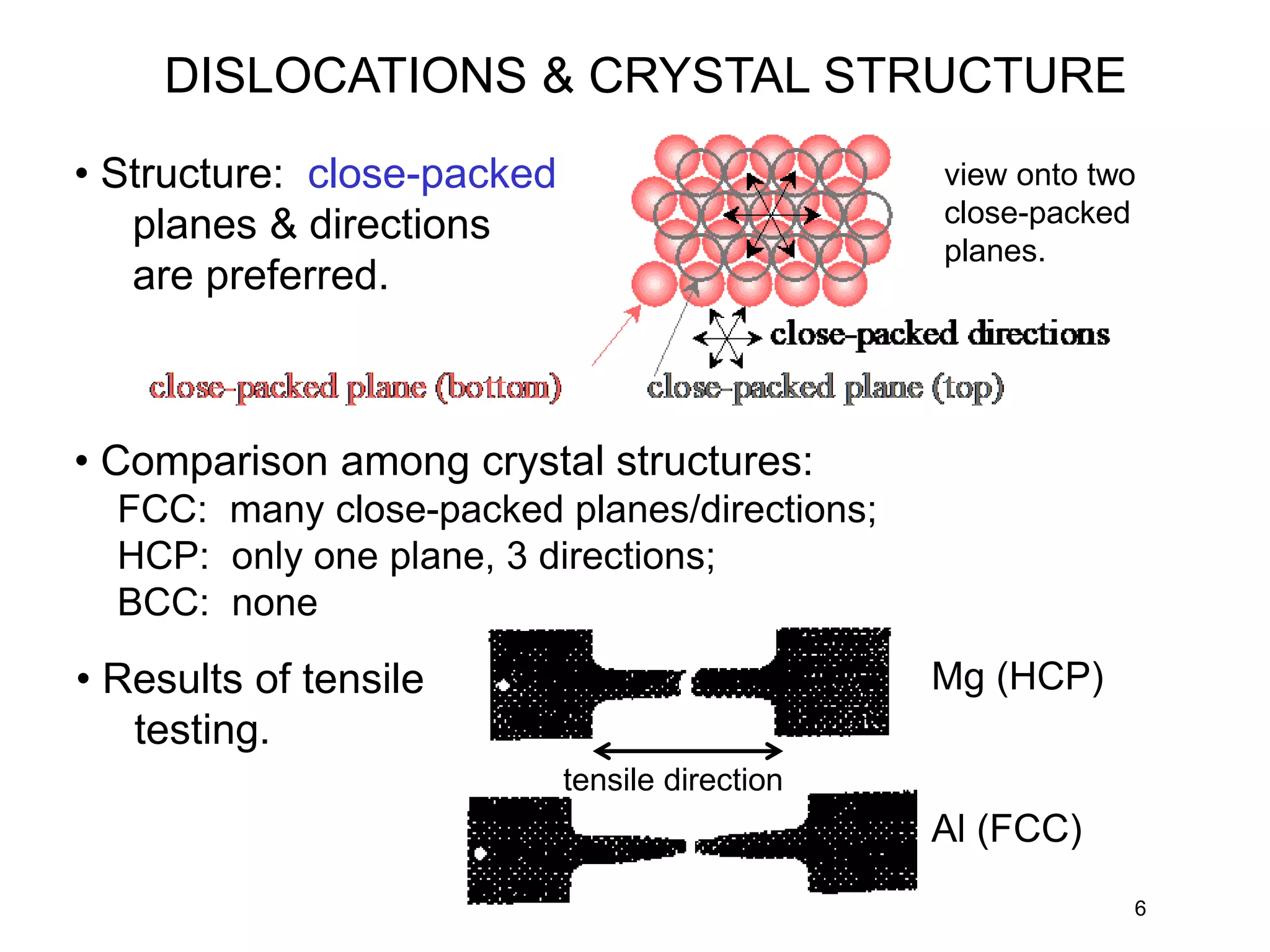
• Structure: close-packed
planes & directions
are preferred.
• Comparison among crystal structures:
FCC: many close-packed planes/directions;
HCP: only one plane, 3 directions;
BCC: none
Mg (HCP)
Al (FCC)
tensile direction
• Results of tensile
testing.
view onto two
close-packed
planes.
DISLOCATIONS & CRYSTAL STRUCTURE
7
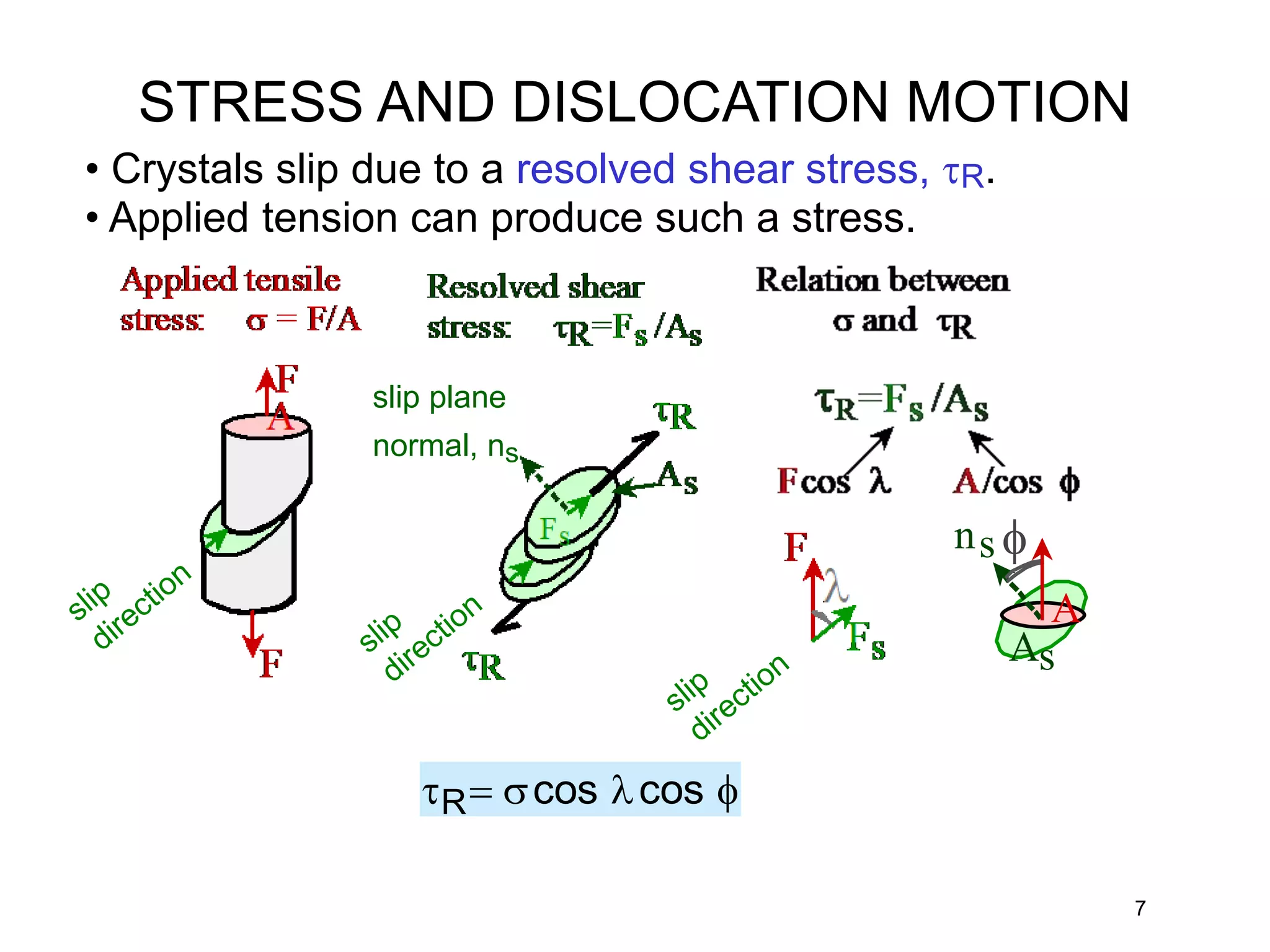
• Crystals slip due to a resolved shear stress, tR.
• Applied tension can produce such a stress.
tR cos cos 

ns
A
As
STRESS AND DISLOCATION MOTION
slip plane
normal, ns
8
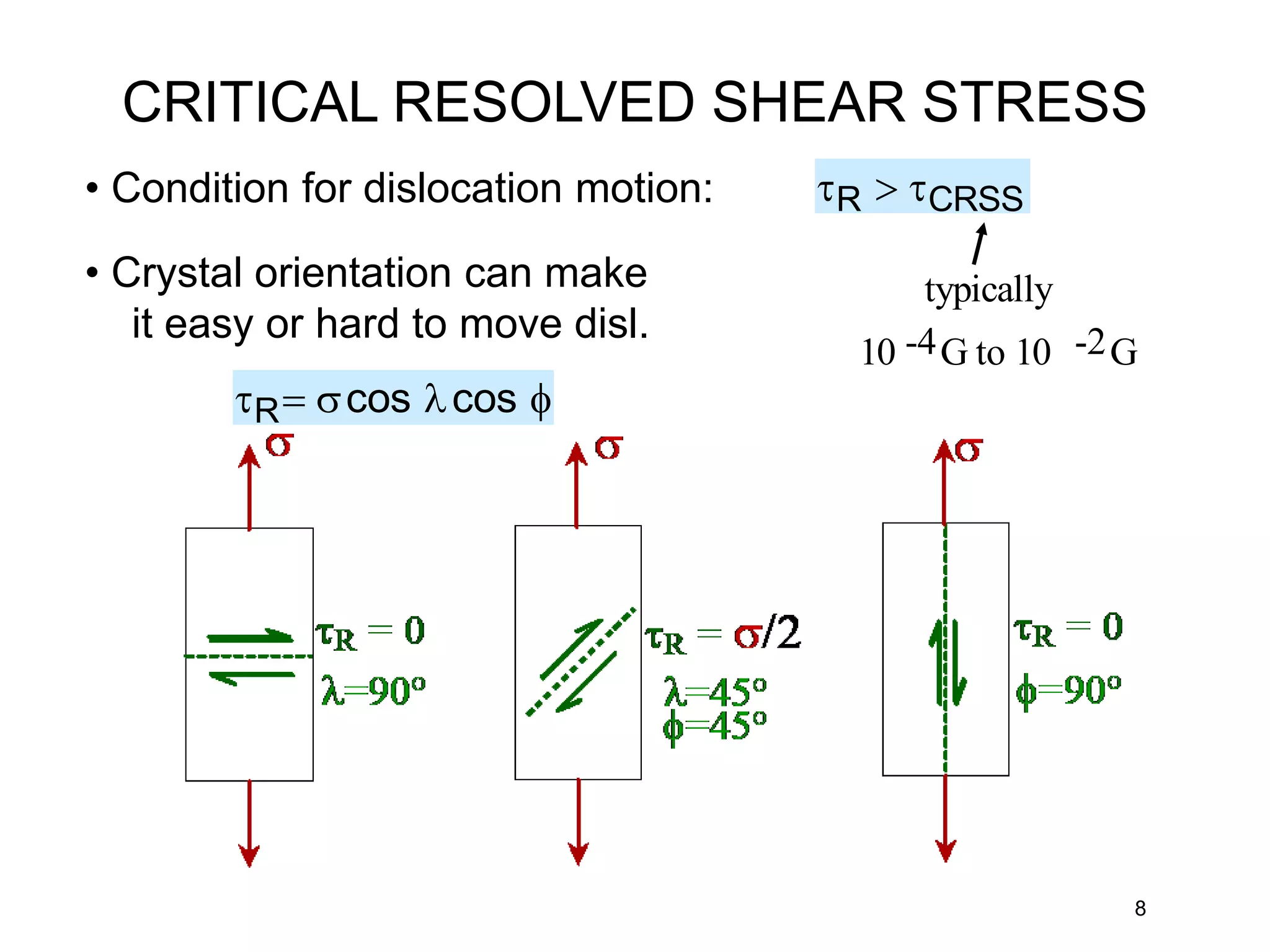
• Condition for dislocation motion: tR  tCRSS
• Crystal orientation can make
it easy or hard to move disl.
10 -4G to 10 -2G
typically
tR cos cos 
CRITICAL RESOLVED SHEAR STRESS
9
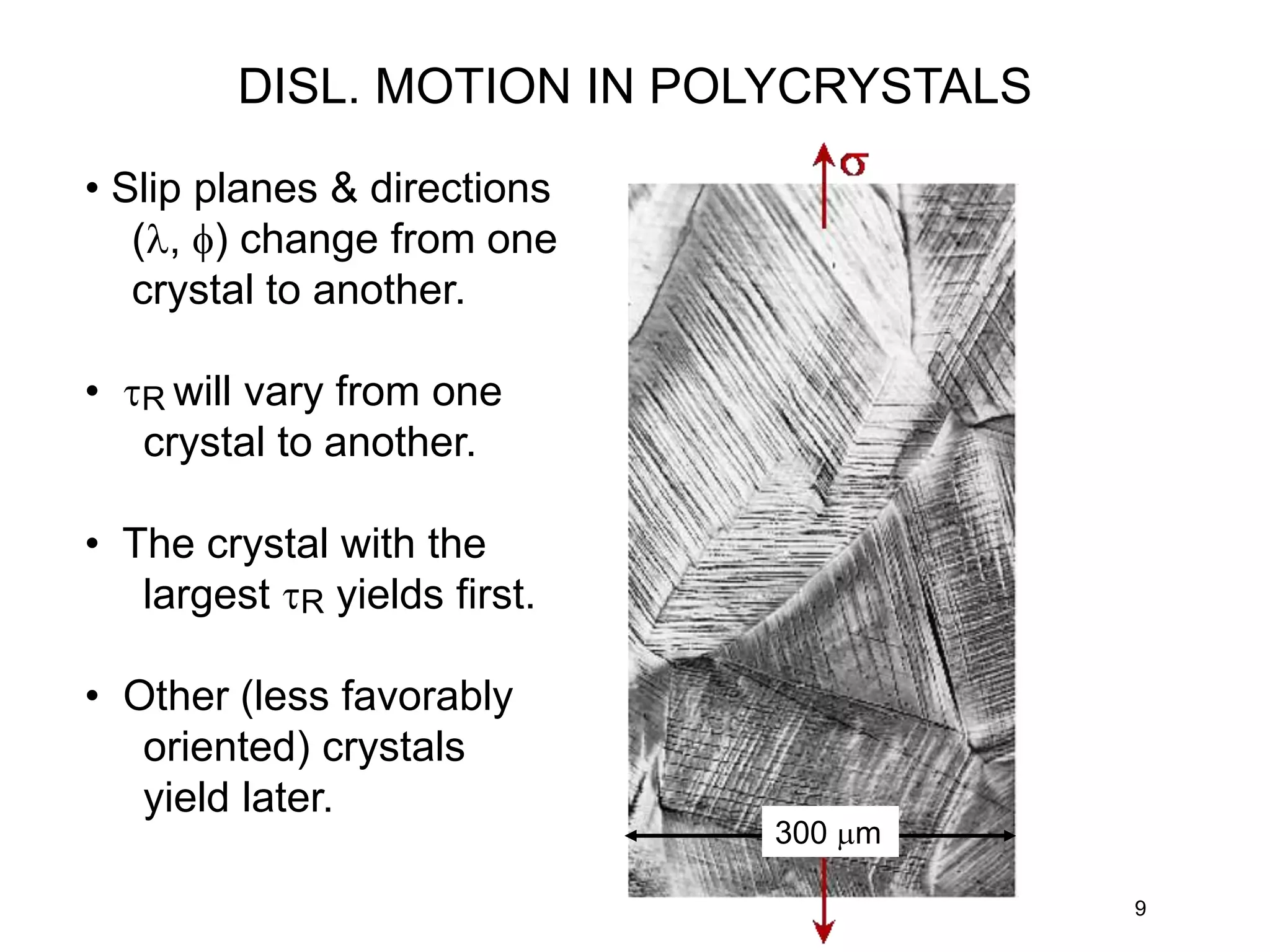
• Slip planes & directions
(, ) change from one
crystal to another.
• tR will vary from one
crystal to another.
• The crystal with the
largest tR yields first.
• Other (less favorably
oriented) crystals
yield later.
300 mm
DISL. MOTION IN POLYCRYSTALS
10
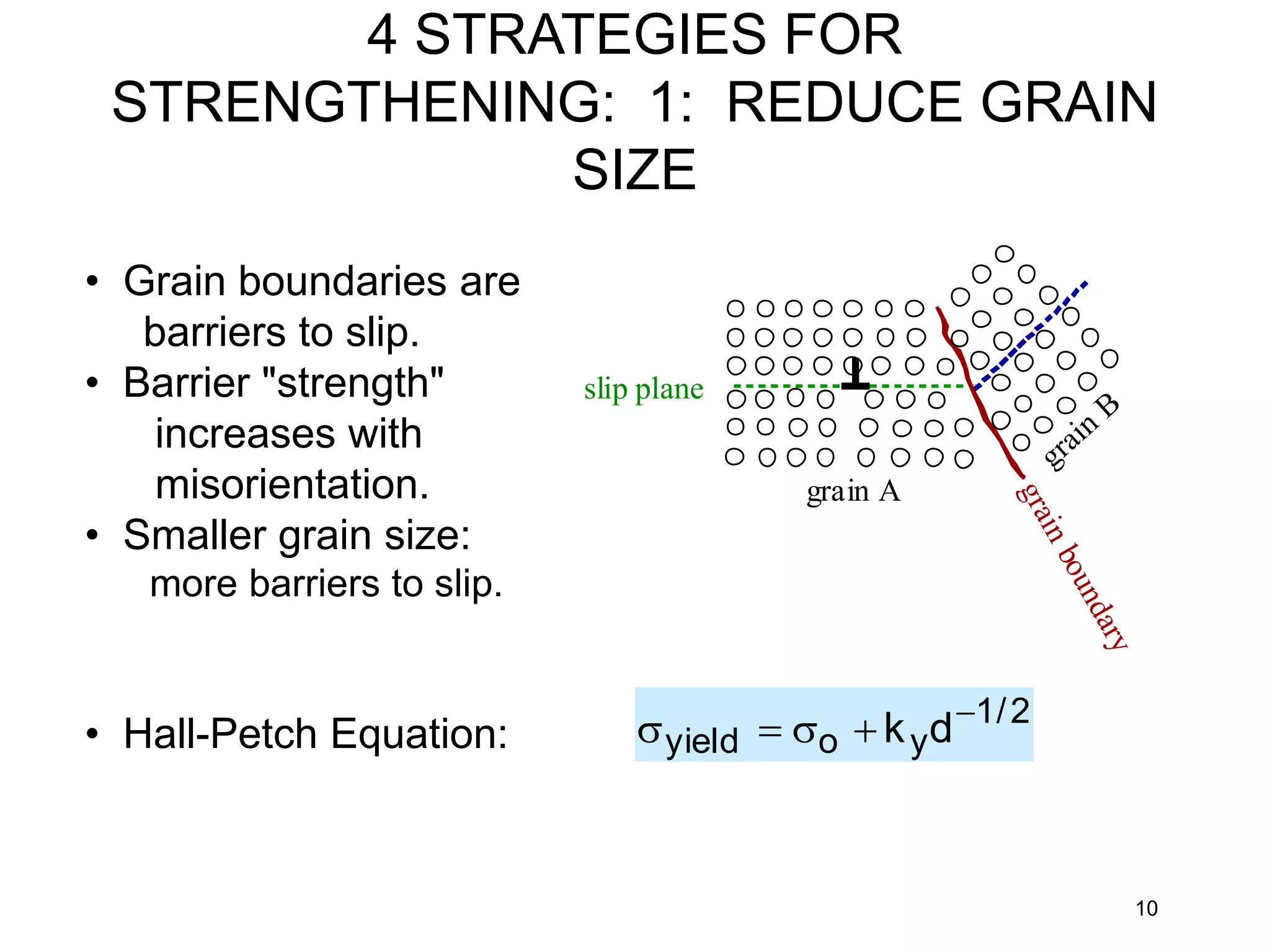
• Grain boundaries are
barriers to slip.
• Barrier "strength"
increases with
misorientation.
• Smaller grain size:
more barriers to slip.
• Hall-Petch Equation:
g
r
a
i
n
b
o
u
n
d
a
r
y
slip plane
grain A
grain
B
yield  o kyd1/2
4 STRATEGIES FOR
STRENGTHENING: 1: REDUCE GRAIN
SIZE
11
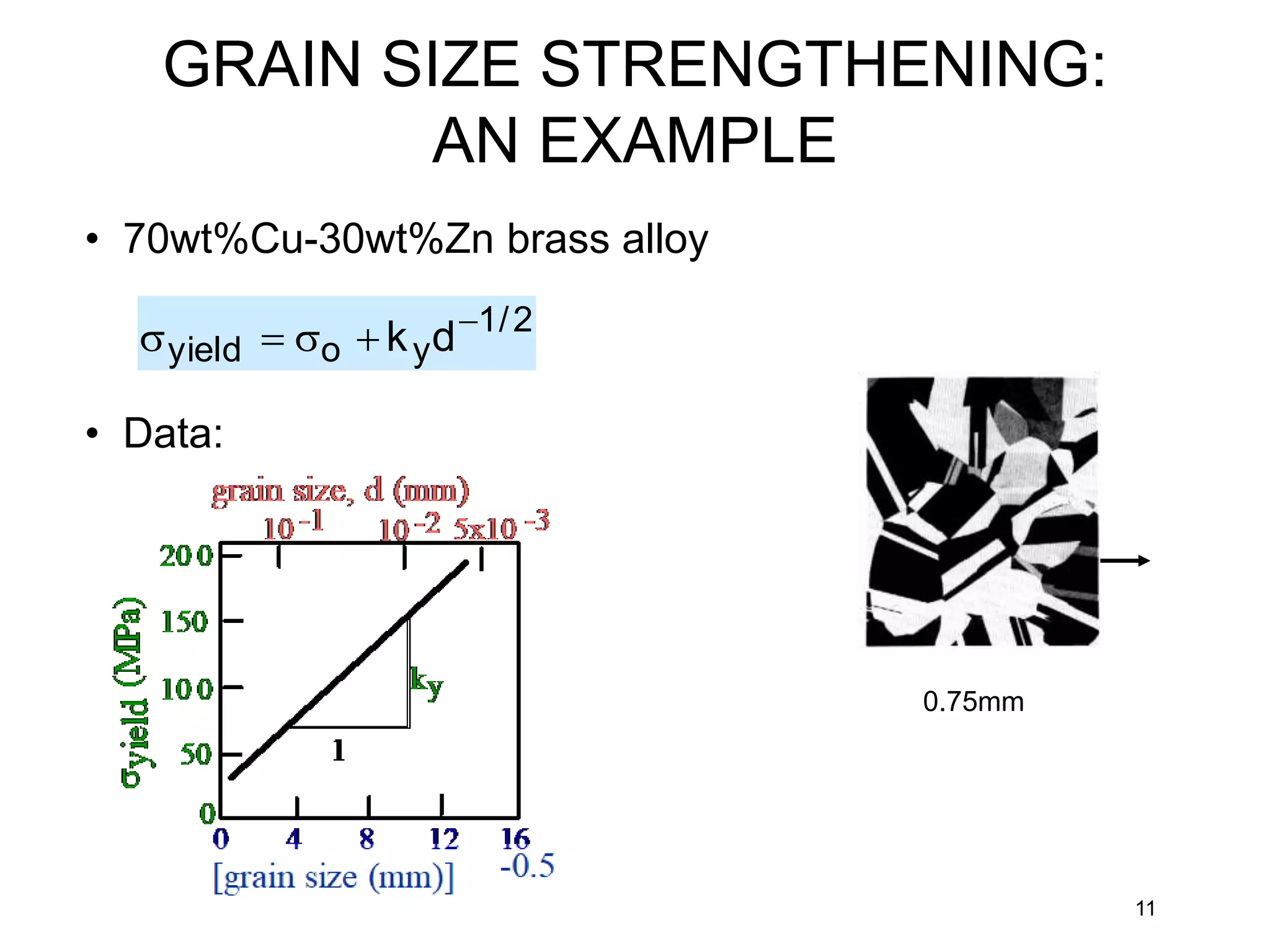
• 70wt%Cu-30wt%Zn brass alloy
yield  o kyd1/2
• Data:
0.75mm
GRAIN SIZE STRENGTHENING:
AN EXAMPLE
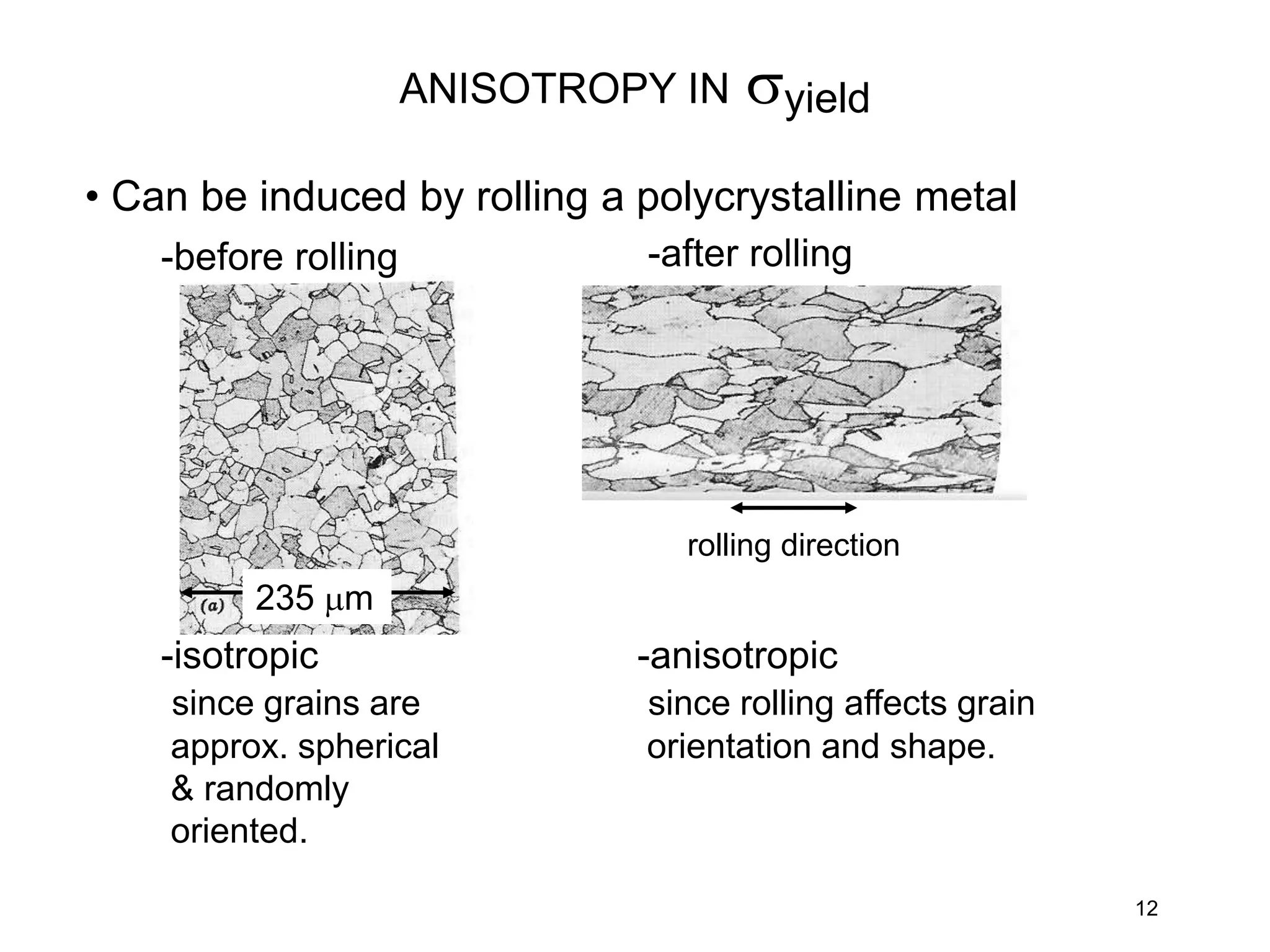
• Can be induced by rolling a polycrystalline metal
12
-before rolling -after rolling
235 mm
-isotropic
since grains are
approx. spherical
& randomly
oriented.
-anisotropic
since rolling affects grain
orientation and shape.
rolling direction
ANISOTROPY IN yield
14
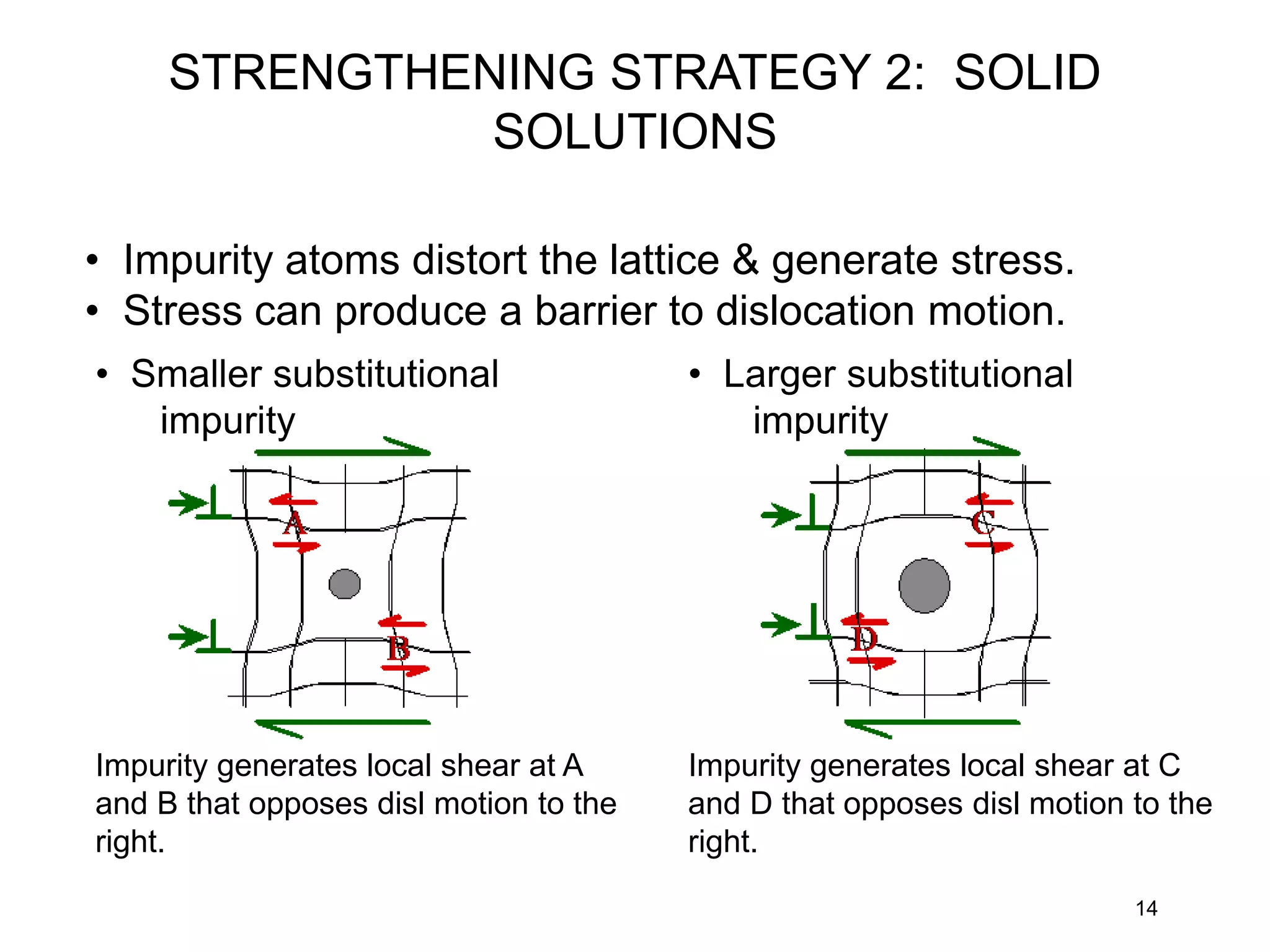
• Impurity atoms distort the lattice & generate stress.
• Stress can produce a barrier to dislocation motion.
• Smaller substitutional
impurity
• Larger substitutional
impurity
Impurity generates local shear at A
and B that opposes disl motion to the
right.
Impurity generates local shear at C
and D that opposes disl motion to the
right.
STRENGTHENING STRATEGY 2: SOLID
SOLUTIONS
15
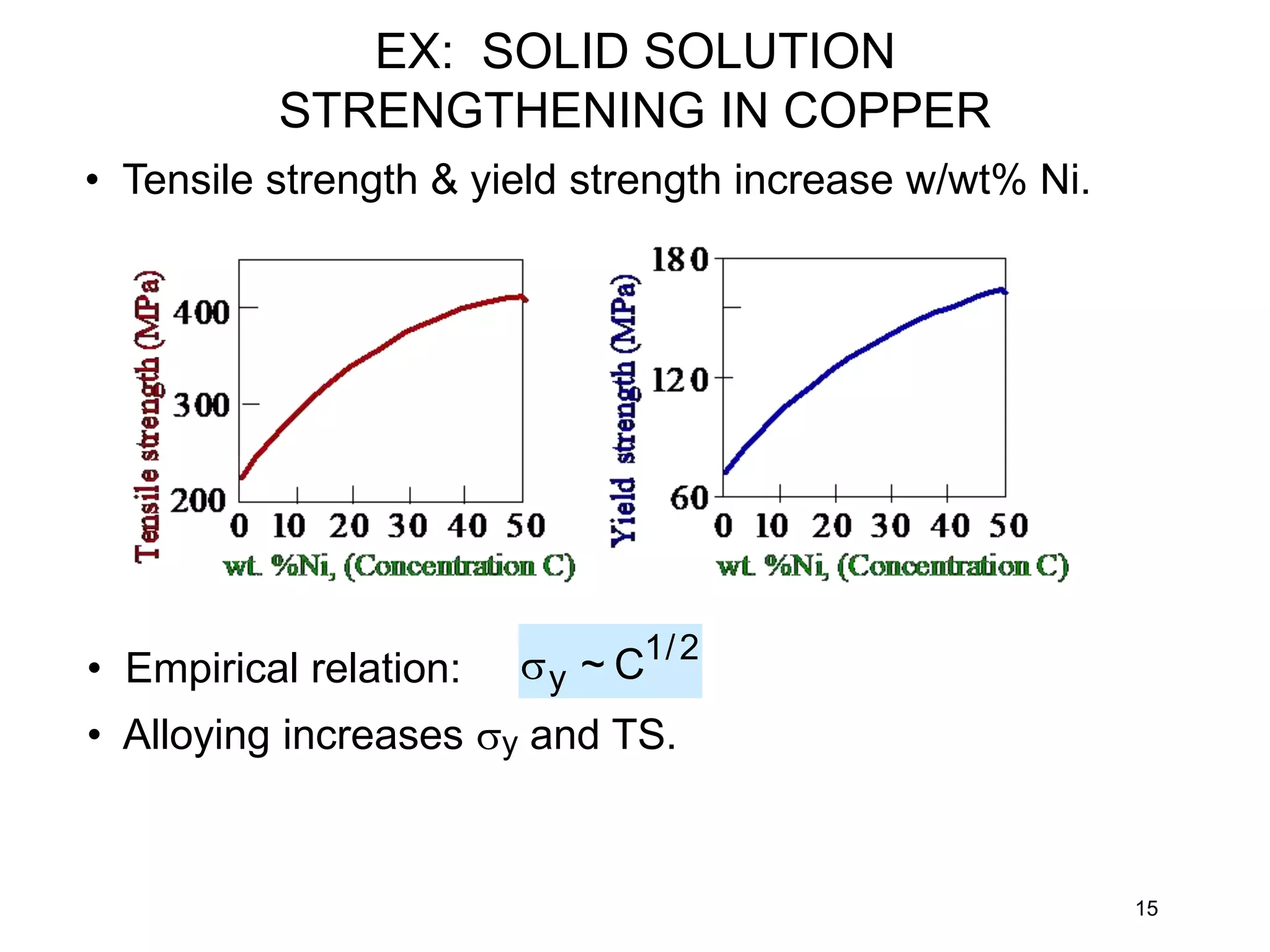
• Tensile strength & yield strength increase w/wt% Ni.
• Empirical relation:
• Alloying increases y and TS.
y ~ C1/2
EX: SOLID SOLUTION
STRENGTHENING IN COPPER
16
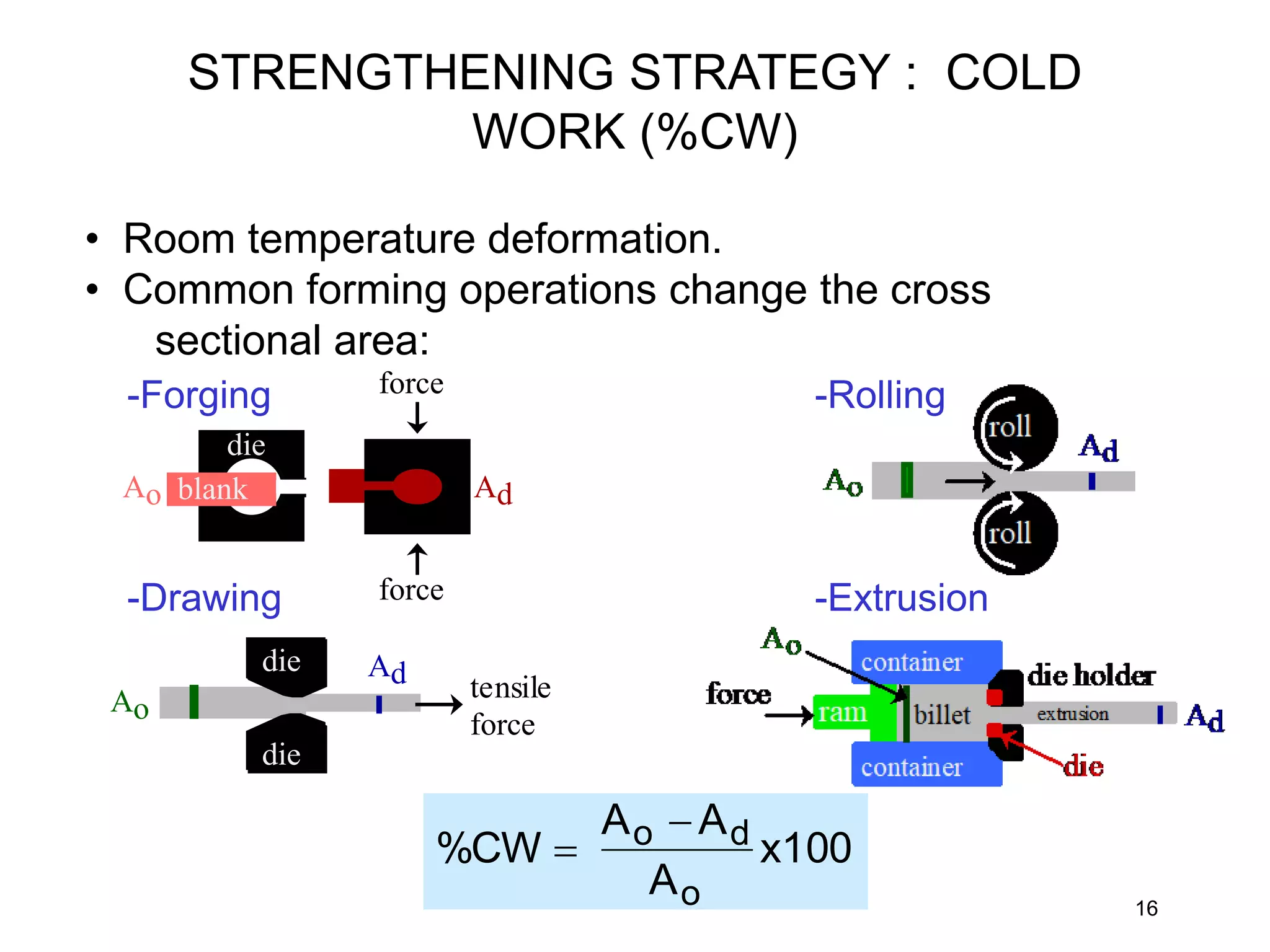
• Room temperature deformation.
• Common forming operations change the cross
sectional area:
%CW 
Ao Ad
Ao
x100
Ao Ad
force
die
blank
force
-Forging -Rolling
-Extrusion
-Drawing
tensile
force
Ao
Ad
die
die
STRENGTHENING STRATEGY : COLD
WORK (%CW)
17
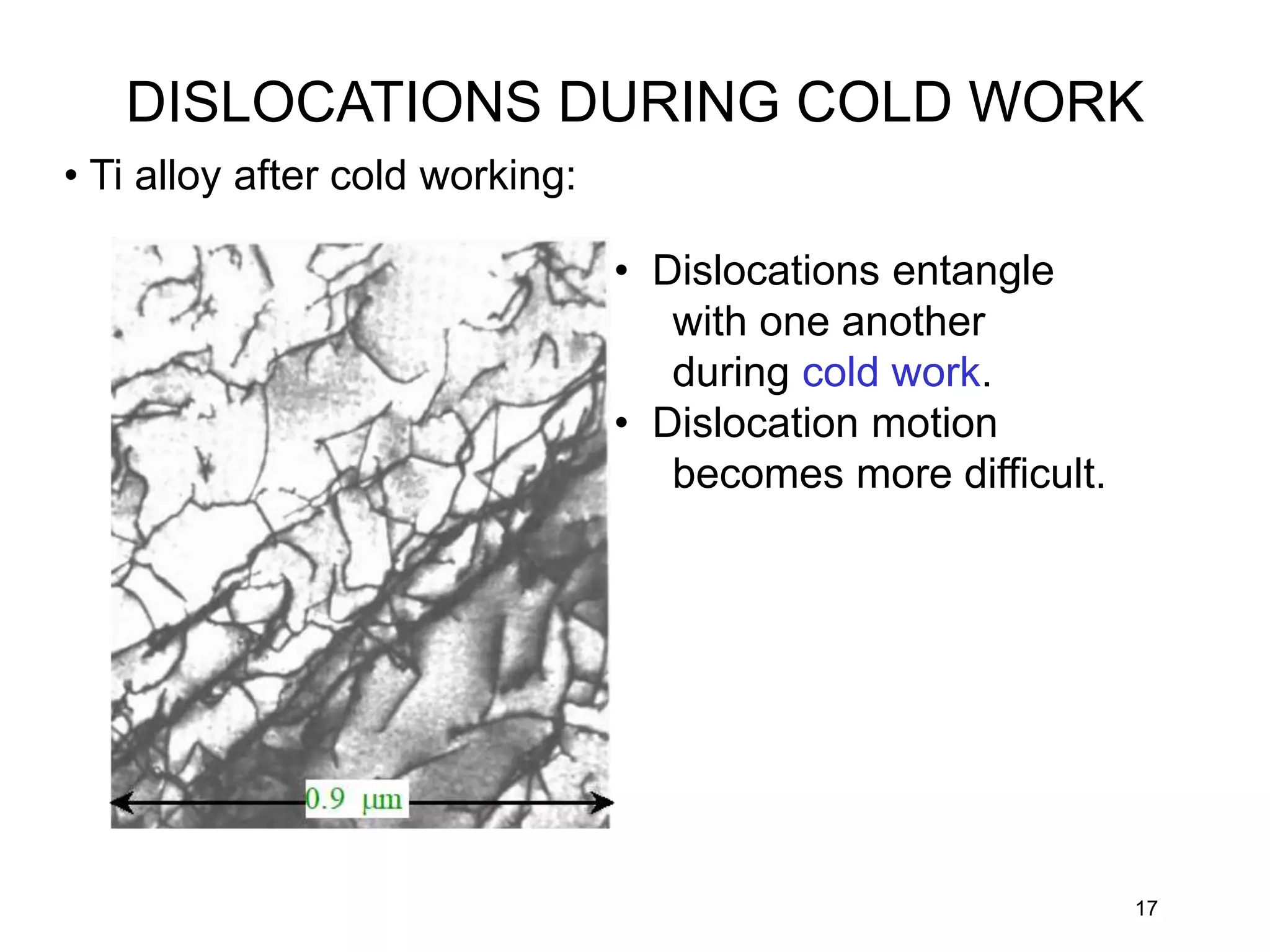
• Ti alloy after cold working:
• Dislocations entangle
with one another
during cold work.
• Dislocation motion
becomes more difficult.
DISLOCATIONS DURING COLD WORK
18
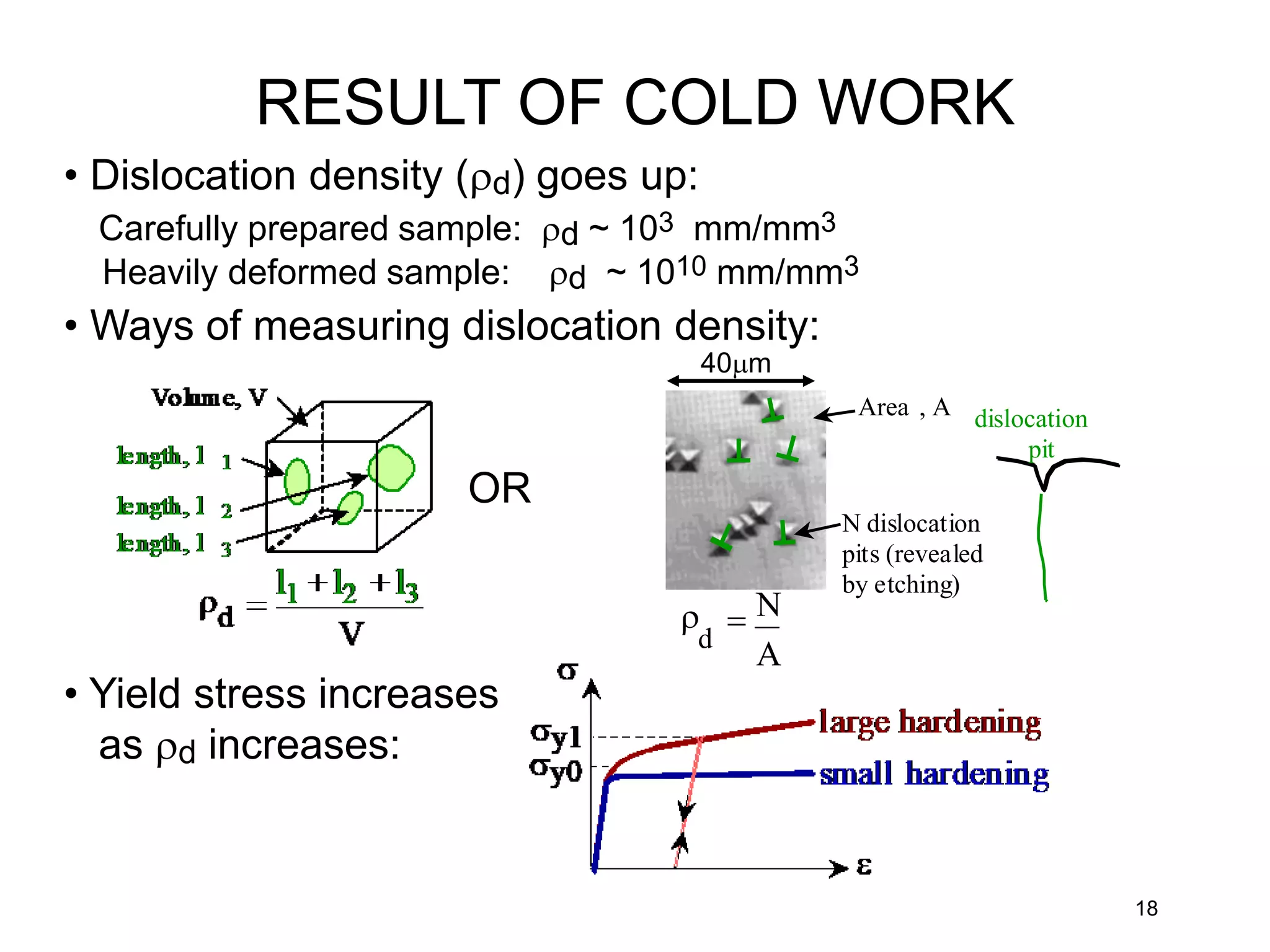
• Dislocation density (rd) goes up:
Carefully prepared sample: rd ~ 103 mm/mm3
Heavily deformed sample: rd ~ 1010 mm/mm3
• Ways of measuring dislocation density:
OR
d
 N
A
Area , A
N dislocation
pits (revealed
by etching)
dislocation
pit
r
• Yield stress increases
as rd increases:
40mm
RESULT OF COLD WORK
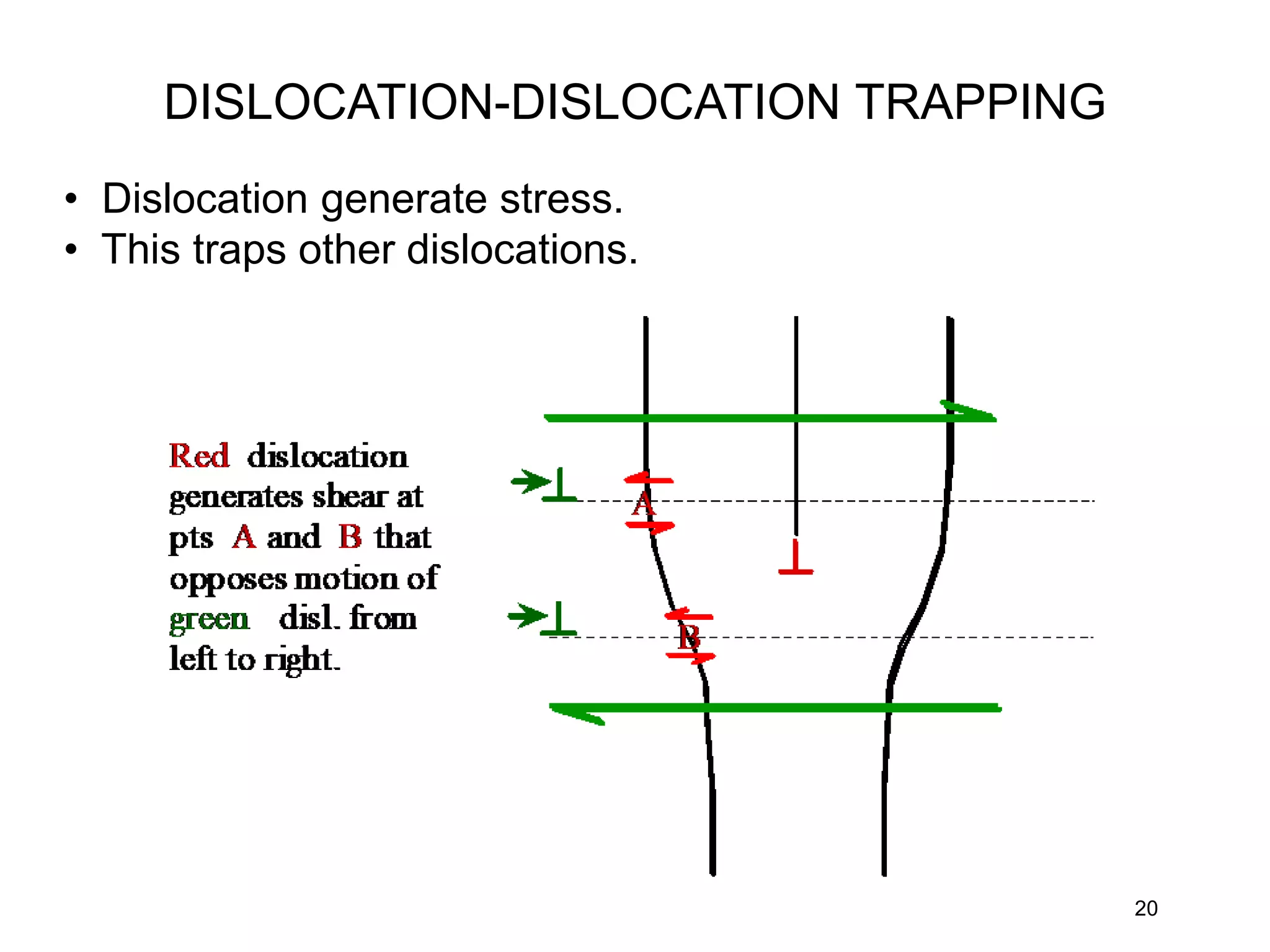
• Dislocation generate stress.
• This traps other dislocations.
20
DISLOCATION-DISLOCATION TRAPPING
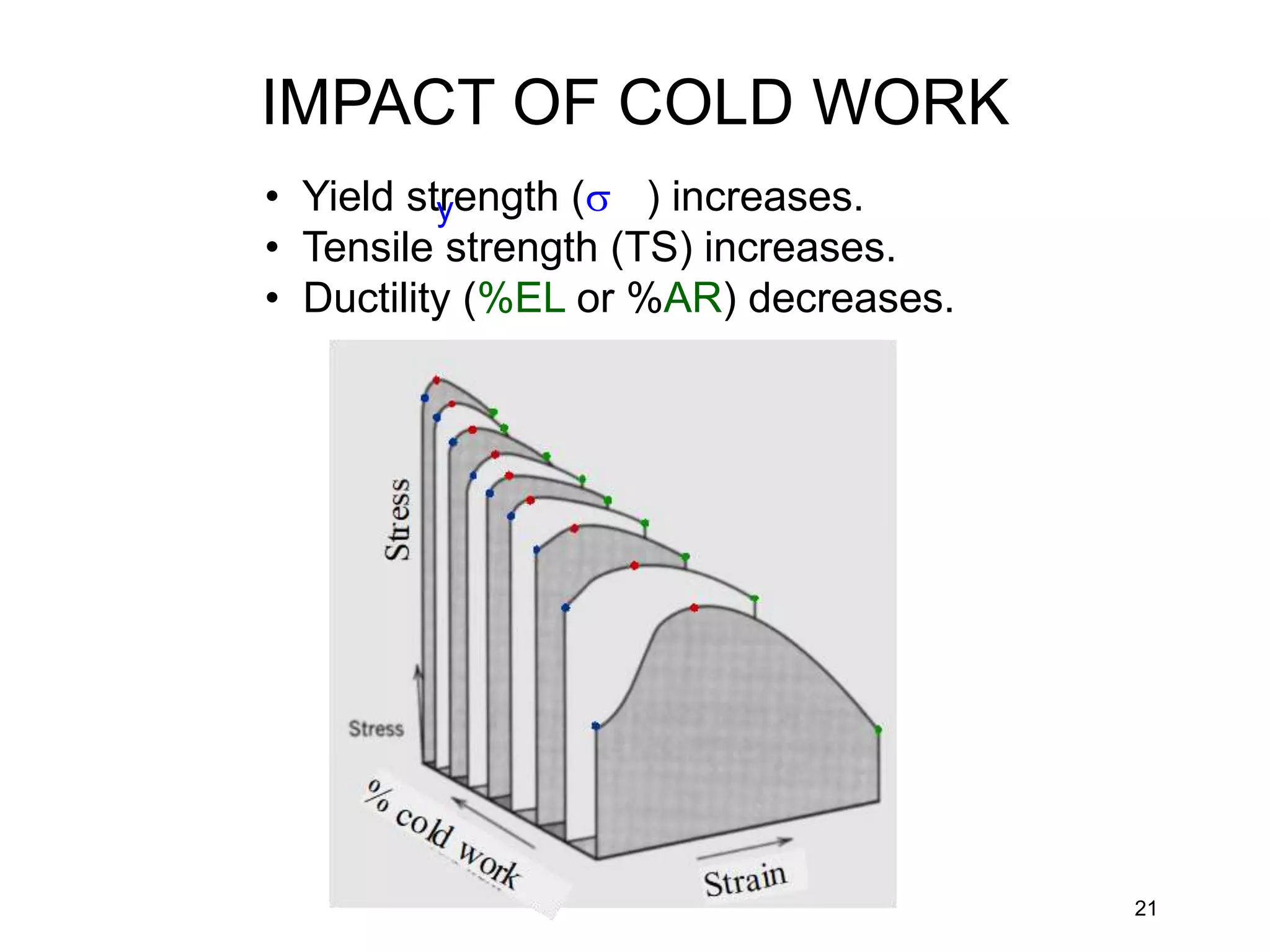
• Yield strength ( ) increases.
• Tensile strength (TS) increases.
• Ductility (%EL or %AR) decreases.
21
y
IMPACT OF COLD WORK
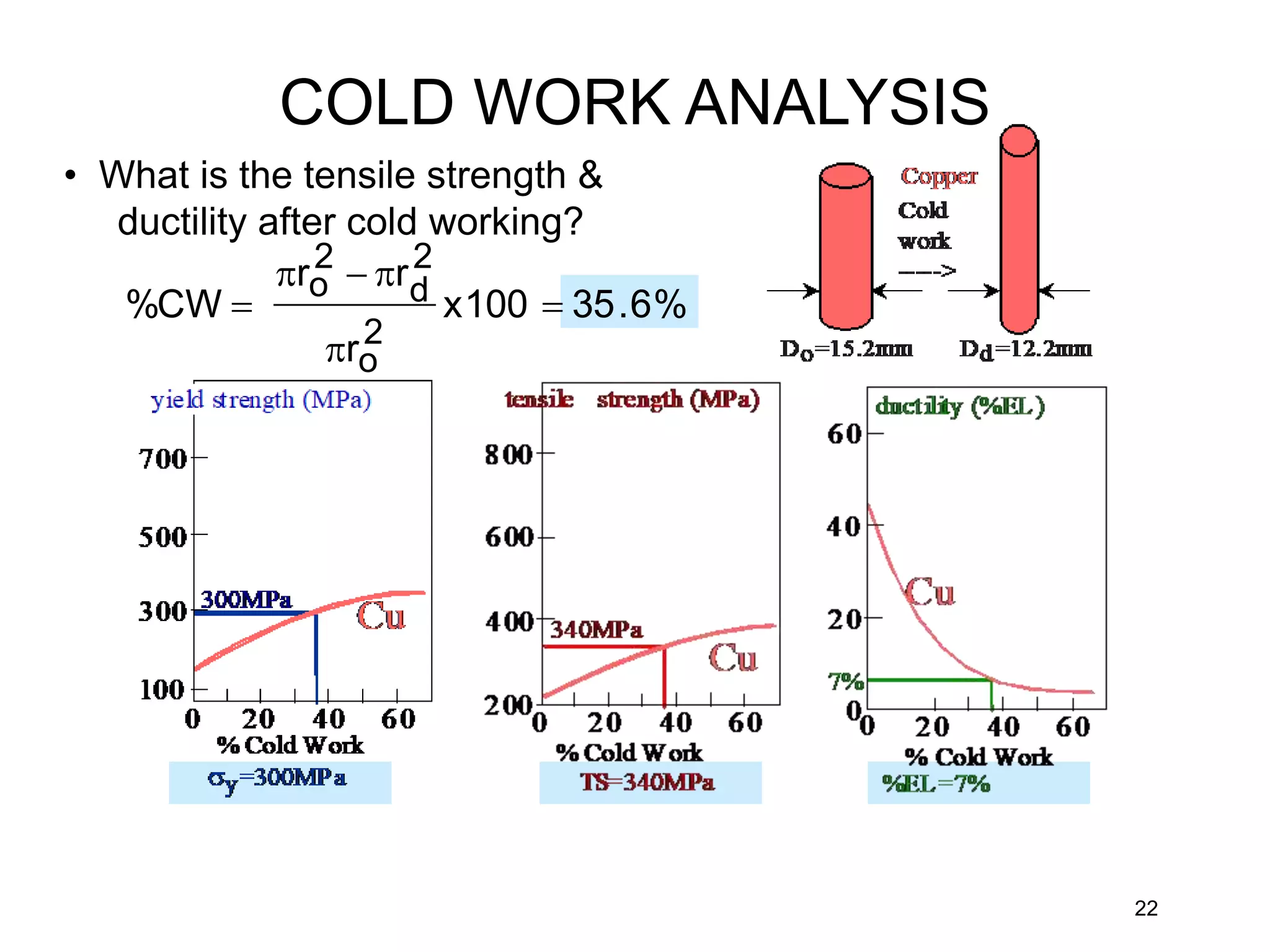
• What is the tensile strength &
ductility after cold working?
22
%CW 
ro
2  rd
2
ro
2
x100  35.6%
COLD WORK ANALYSIS
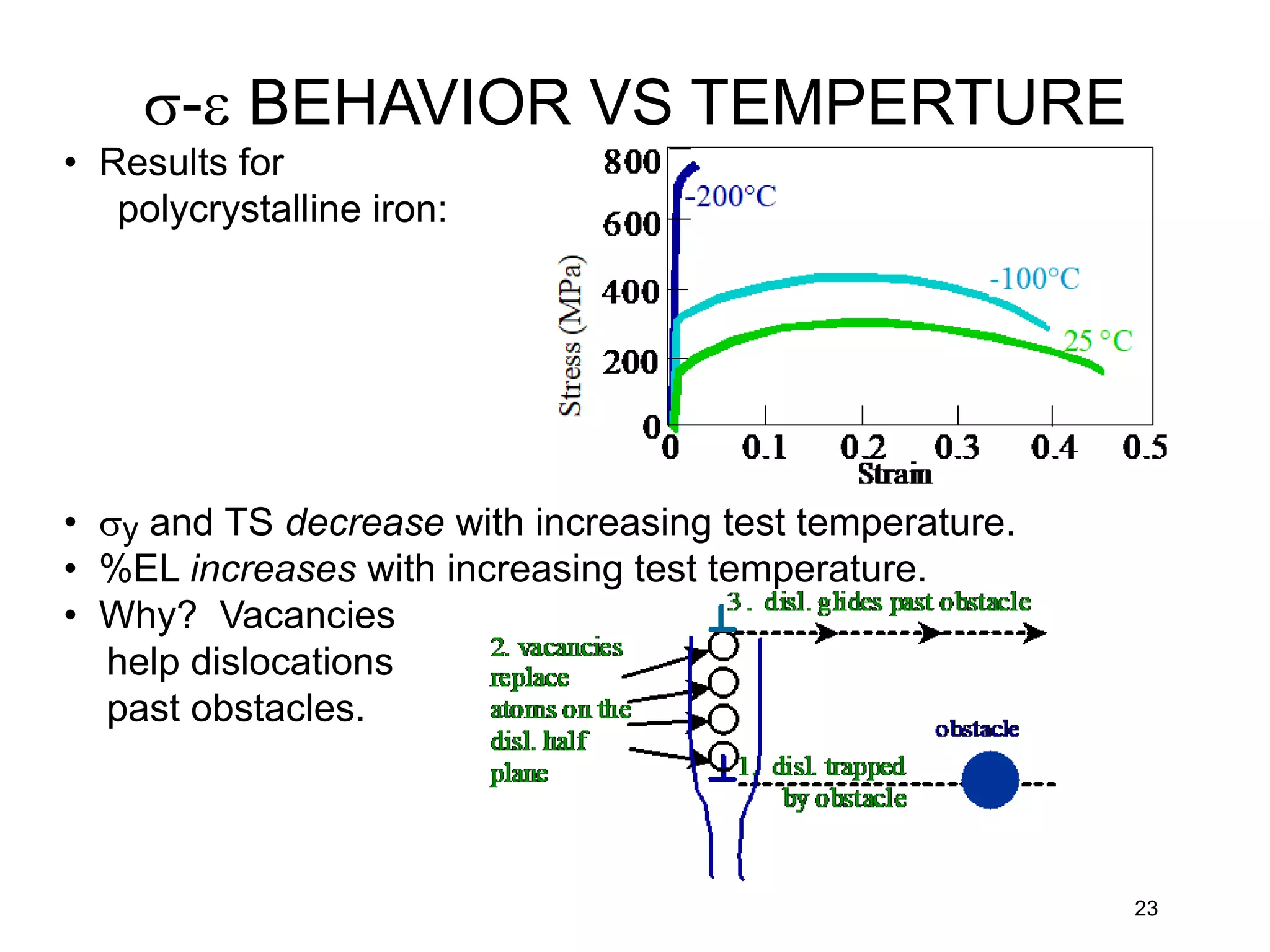
• Results for
polycrystalline iron:
23
• y and TS decrease with increasing test temperature.
• %EL increases with increasing test temperature.
• Why? Vacancies
help dislocations
past obstacles.
-e BEHAVIOR VS TEMPERTURE
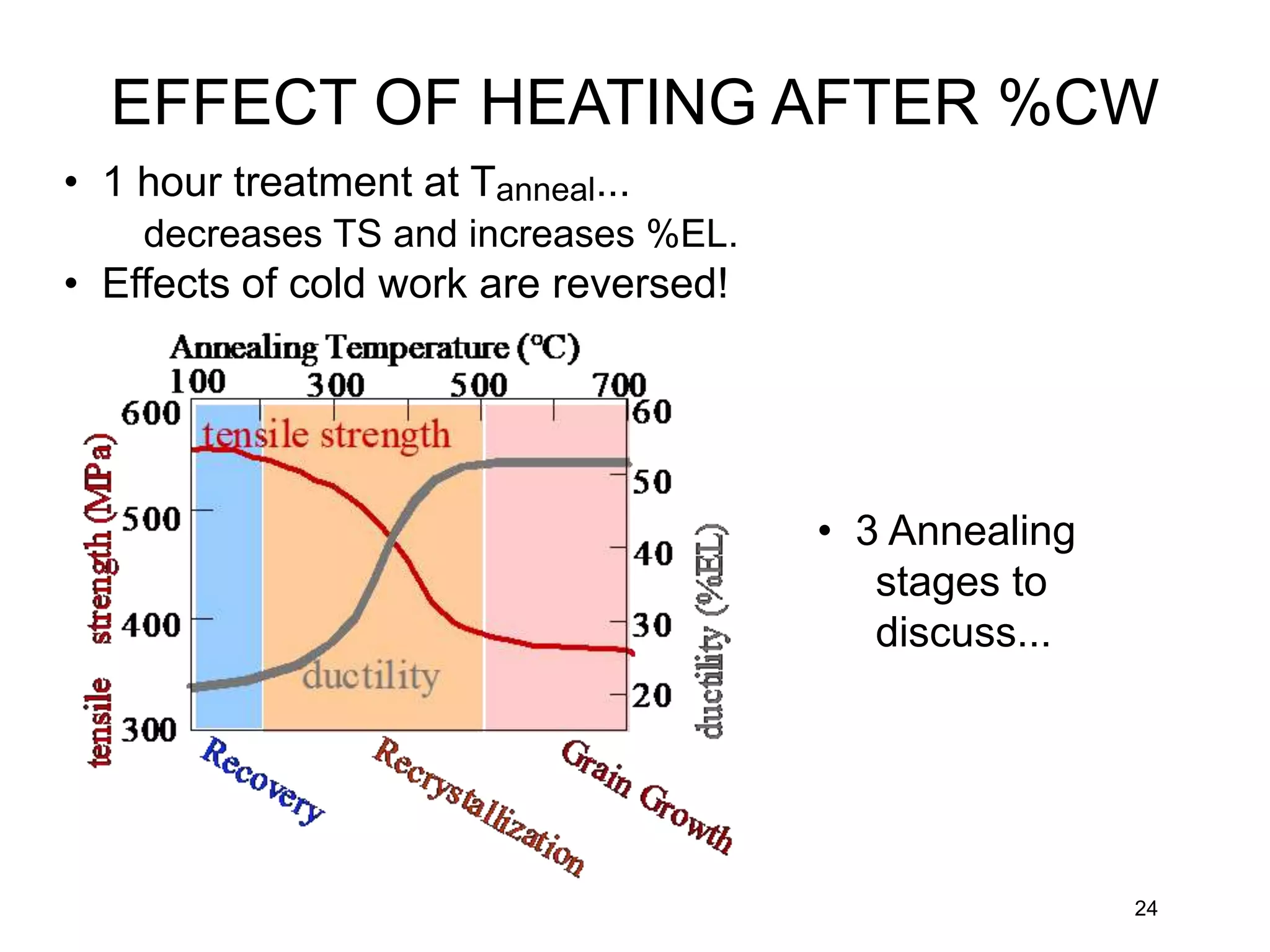
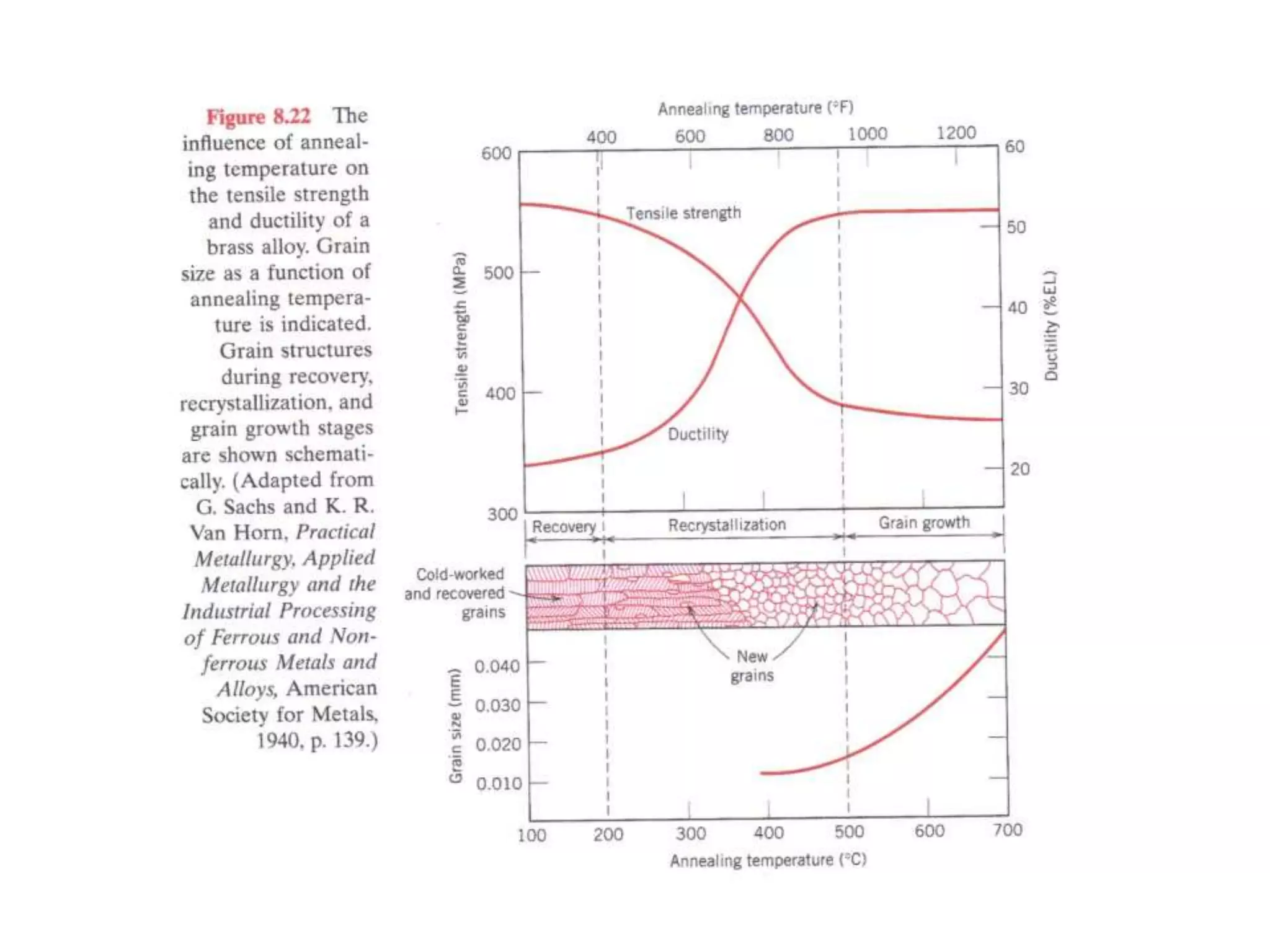
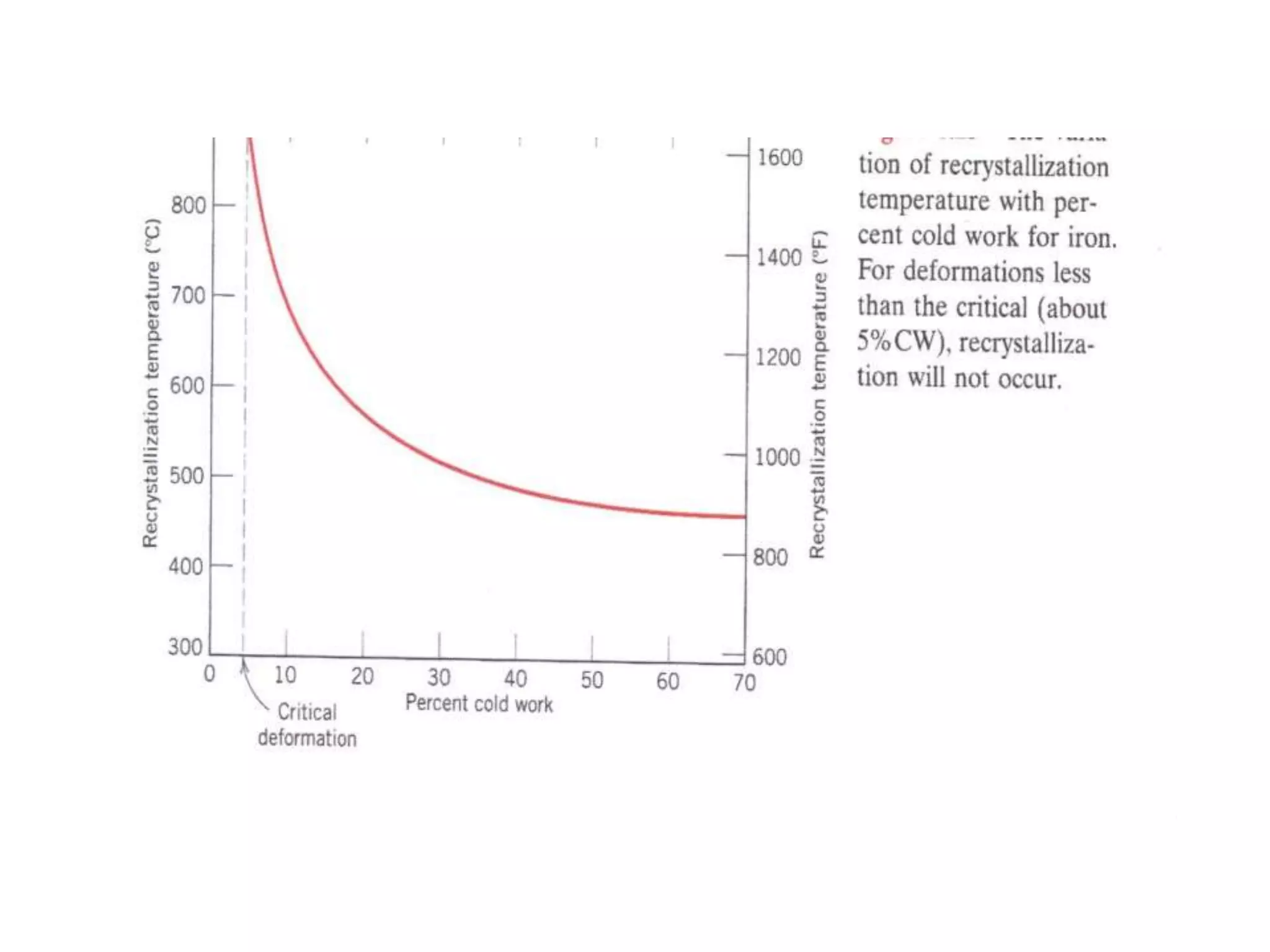
• 1 hour treatment at Tanneal...
decreases TS and increases %EL.
• Effects of cold work are reversed!
24
• 3 Annealing
stages to
discuss...
EFFECT OF HEATING AFTER %CW
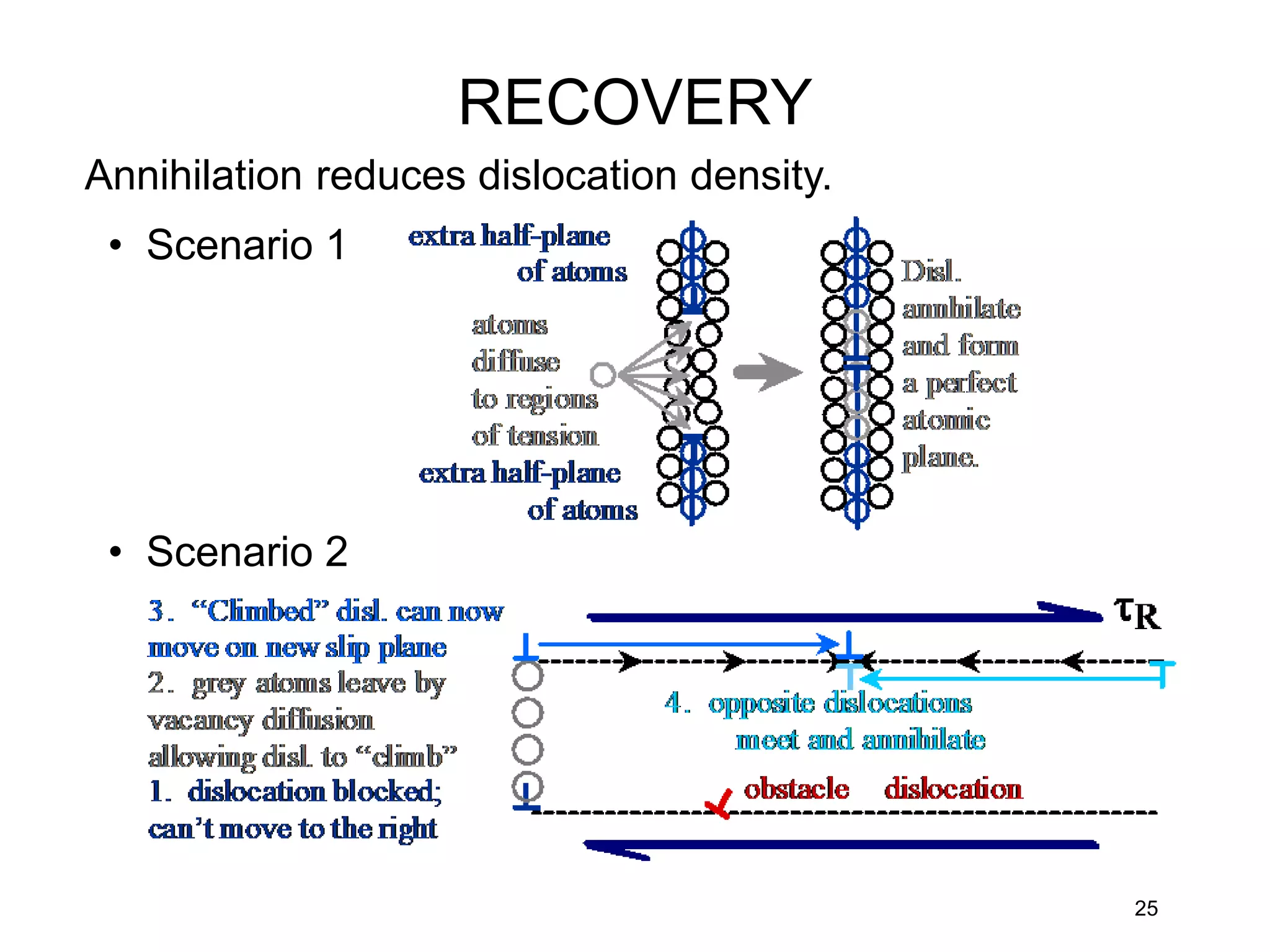
Annihilation reduces dislocation density.
25
• Scenario 1
• Scenario 2
RECOVERY
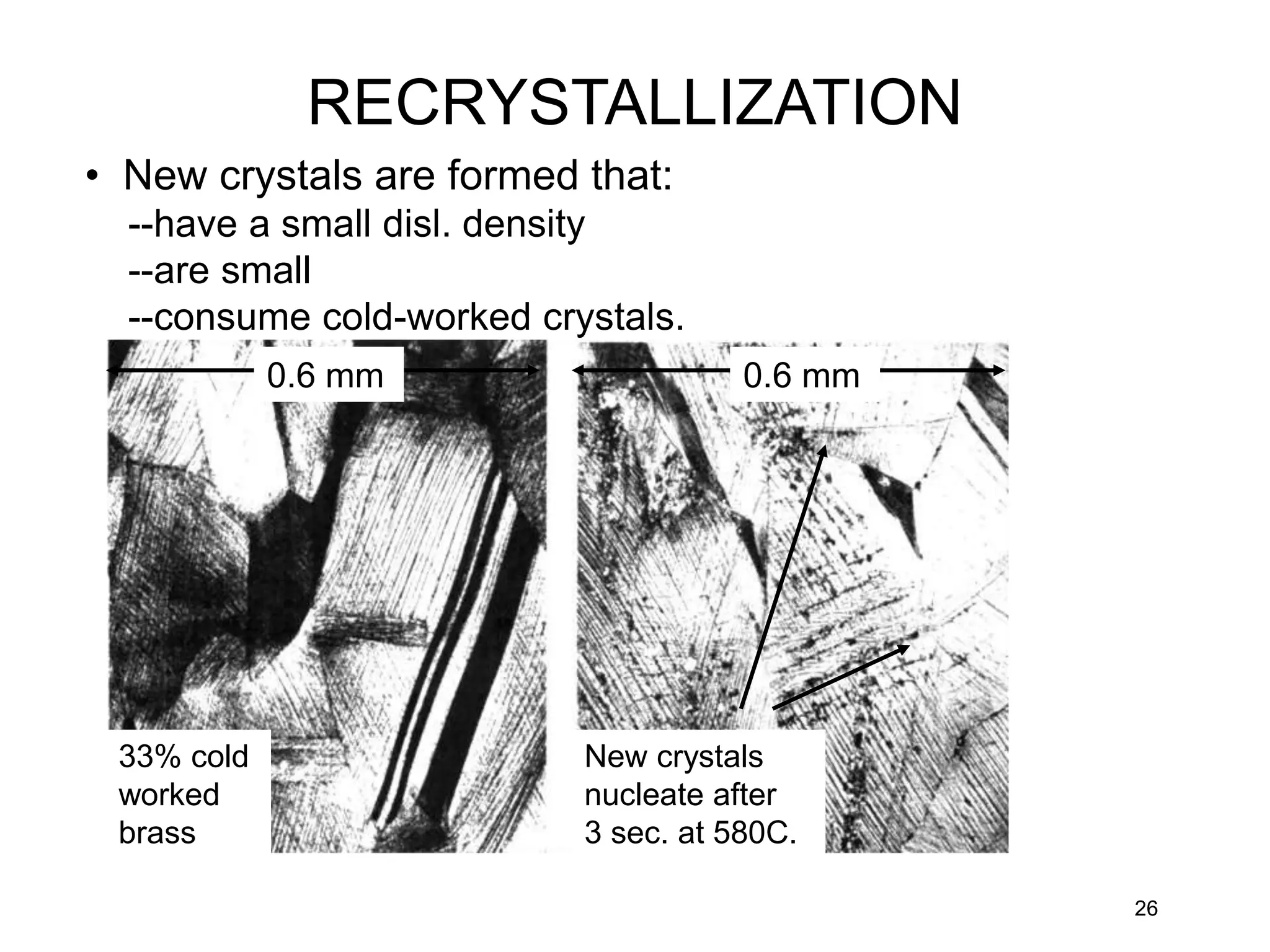
• New crystals are formed that:
--have a small disl. density
--are small
--consume cold-worked crystals.
26
33% cold
worked
brass
New crystals
nucleate after
3 sec. at 580C.
0.6 mm 0.6 mm
RECRYSTALLIZATION
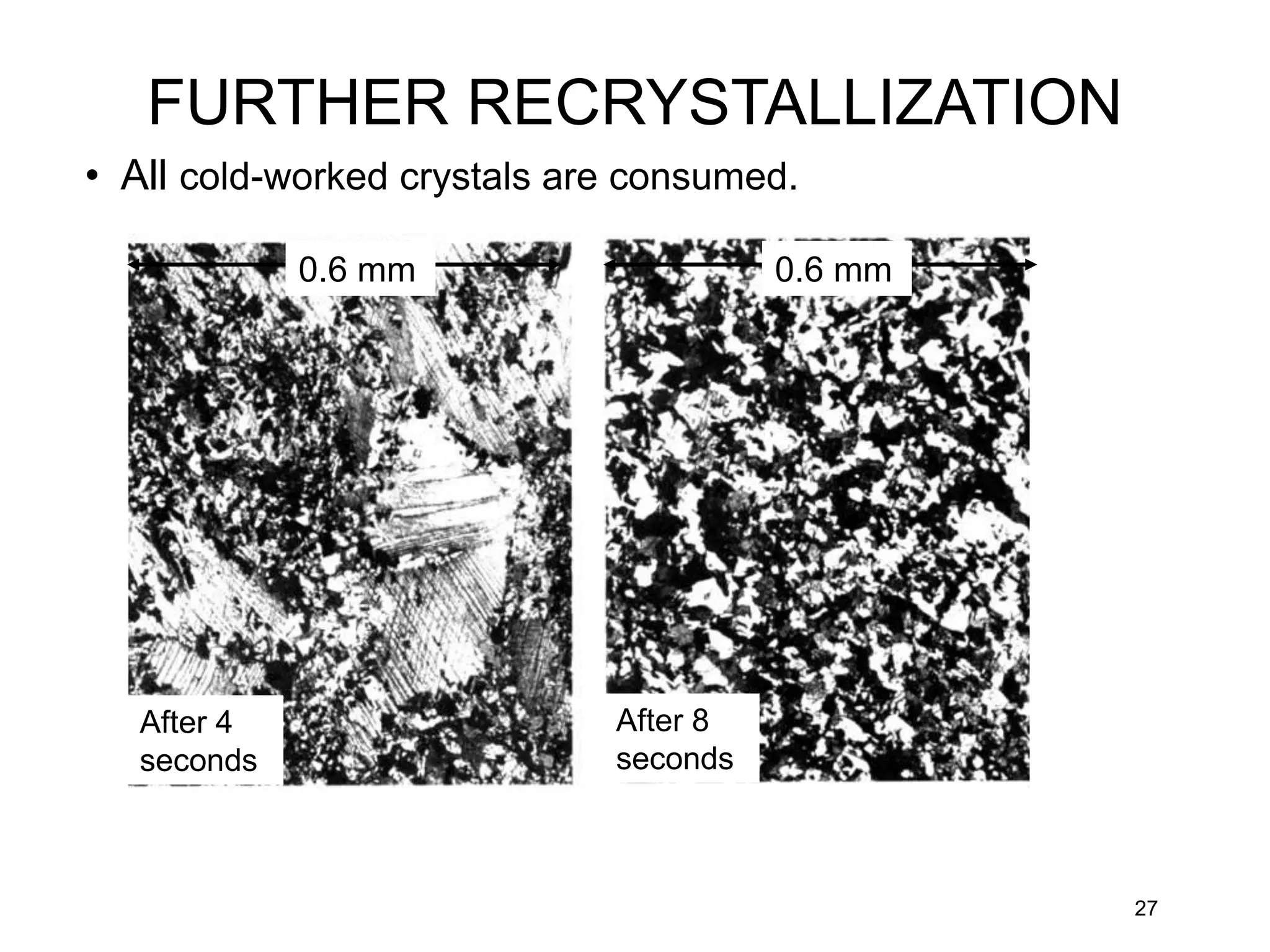
• All cold-worked crystals are consumed.
27
After 4
seconds
After 8
seconds
0.6 mm
0.6 mm
FURTHER RECRYSTALLIZATION
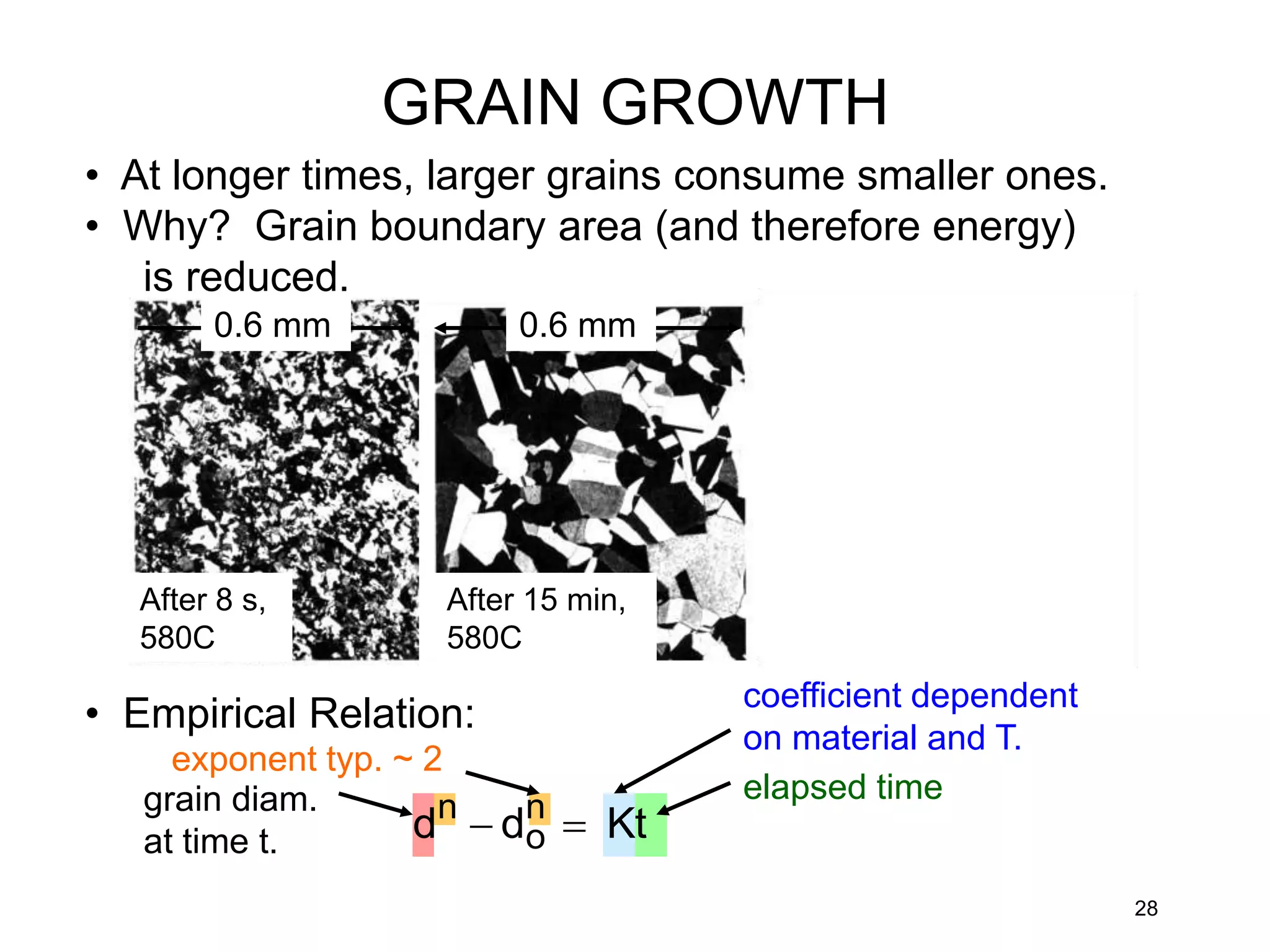
• At longer times, larger grains consume smaller ones.
• Why? Grain boundary area (and therefore energy)
is reduced.
28
• Empirical Relation:
After 8 s,
580C
After 15 min,
580C
dn
 do
n
 Kt
elapsed time
coefficient dependent
on material and T.
grain diam.
at time t.
exponent typ. ~ 2
0.6 mm 0.6 mm
GRAIN GROWTH
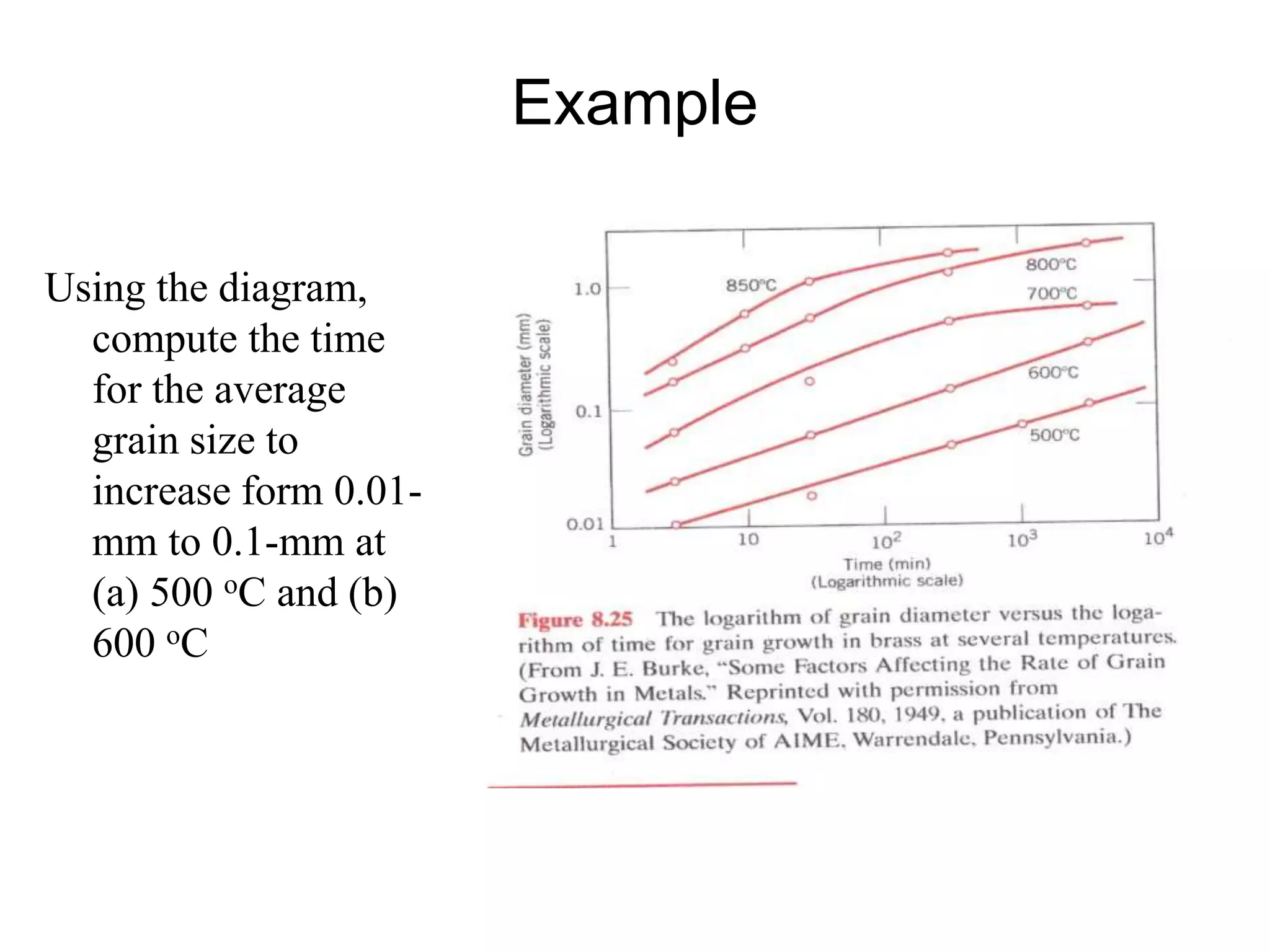
Example
Using the diagram,
compute the time
for the average
grain size to
increase form 0.01-
mm to 0.1-mm at
(a) 500 oC and (b)
600 oC
29
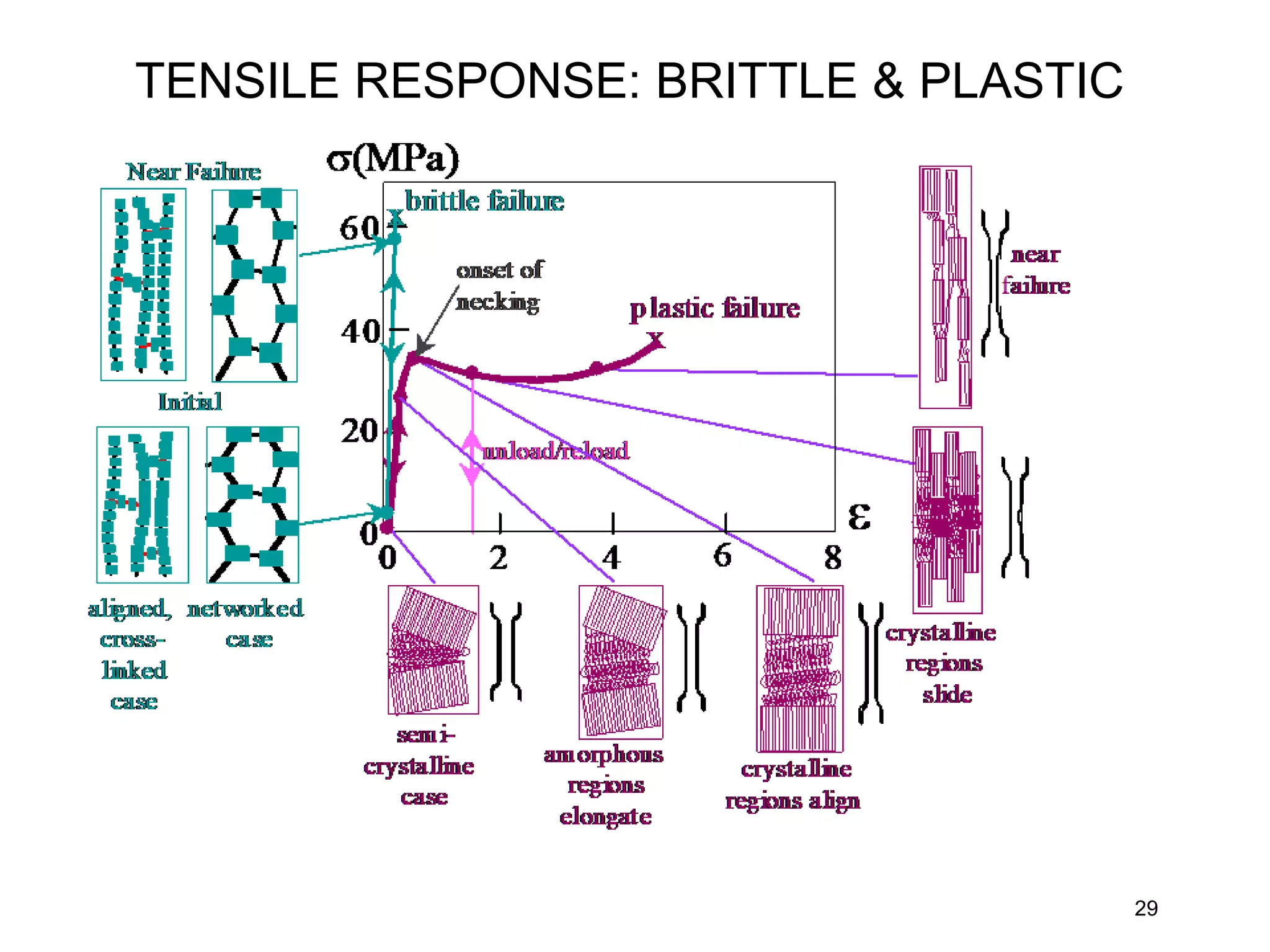
TENSILE RESPONSE: BRITTLE & PLASTIC
30
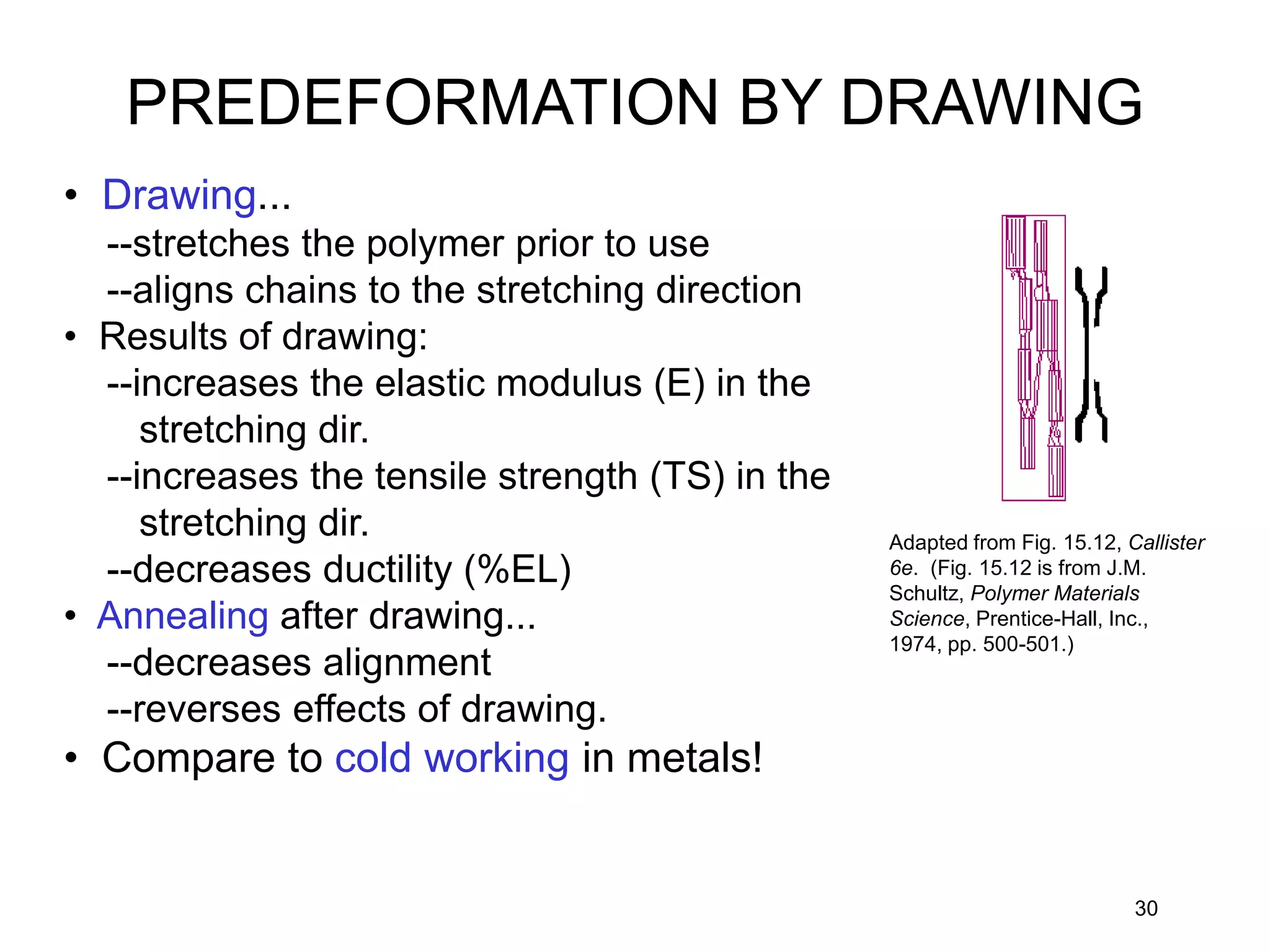
• Drawing...
--stretches the polymer prior to use
--aligns chains to the stretching direction
• Results of drawing:
--increases the elastic modulus (E) in the
stretching dir.
--increases the tensile strength (TS) in the
stretching dir.
--decreases ductility (%EL)
• Annealing after drawing...
--decreases alignment
--reverses effects of drawing.
• Compare to cold working in metals!
Adapted from Fig. 15.12, Callister
6e. (Fig. 15.12 is from J.M.
Schultz, Polymer Materials
Science, Prentice-Hall, Inc.,
1974, pp. 500-501.)
PREDEFORMATION BY DRAWING
31
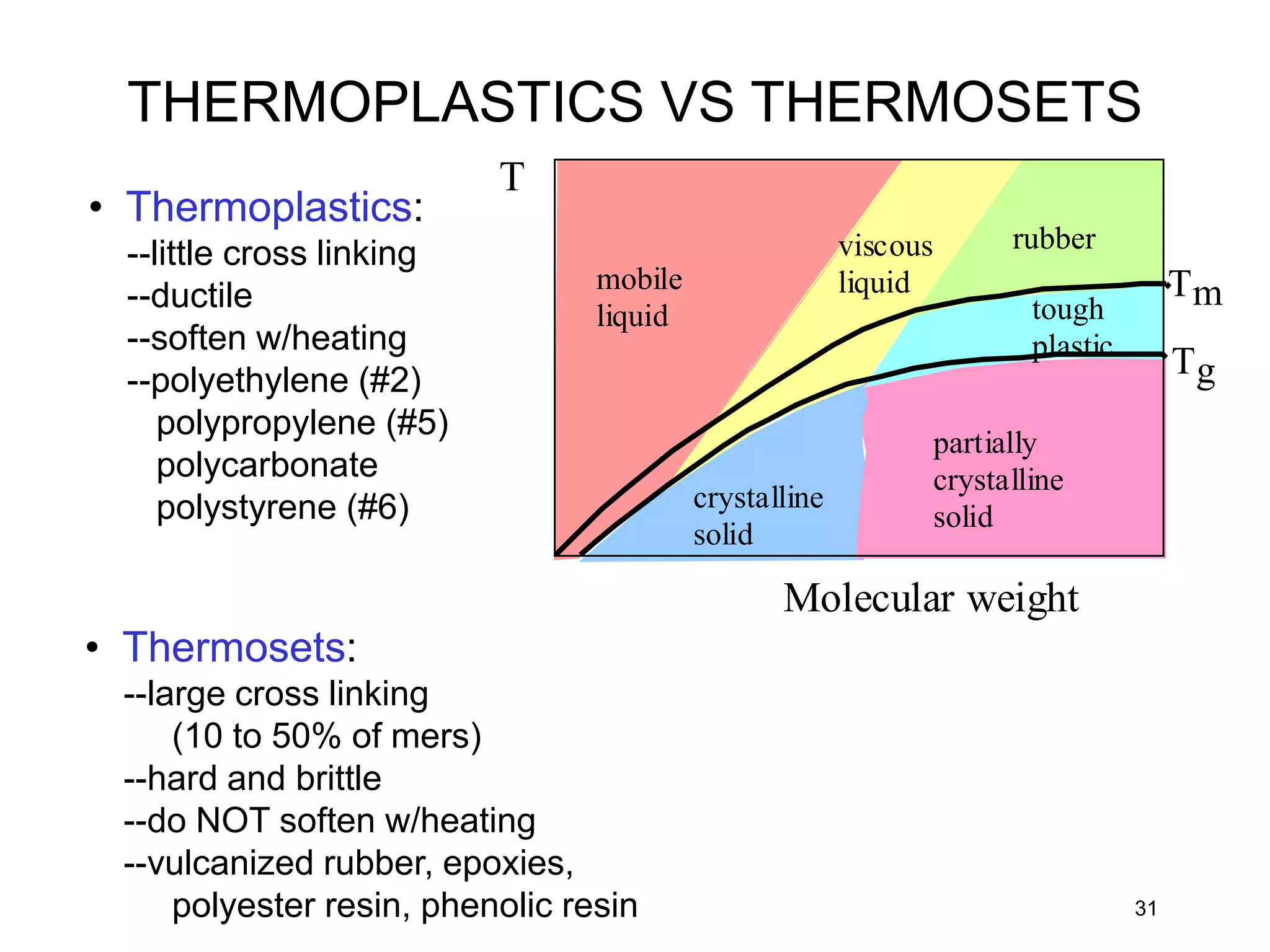
• Thermoplastics:
--little cross linking
--ductile
--soften w/heating
--polyethylene (#2)
polypropylene (#5)
polycarbonate
polystyrene (#6)
• Thermosets:
--large cross linking
(10 to 50% of mers)
--hard and brittle
--do NOT soften w/heating
--vulcanized rubber, epoxies,
polyester resin, phenolic resin
Callister,
Fig. 16.9
T
Molecular weight
Tg
Tm
mobile
liquid
viscous
liquid
rubber
tough
plastic
partially
crystalline
solid
crystalline
solid
THERMOPLASTICS VS THERMOSETS
32
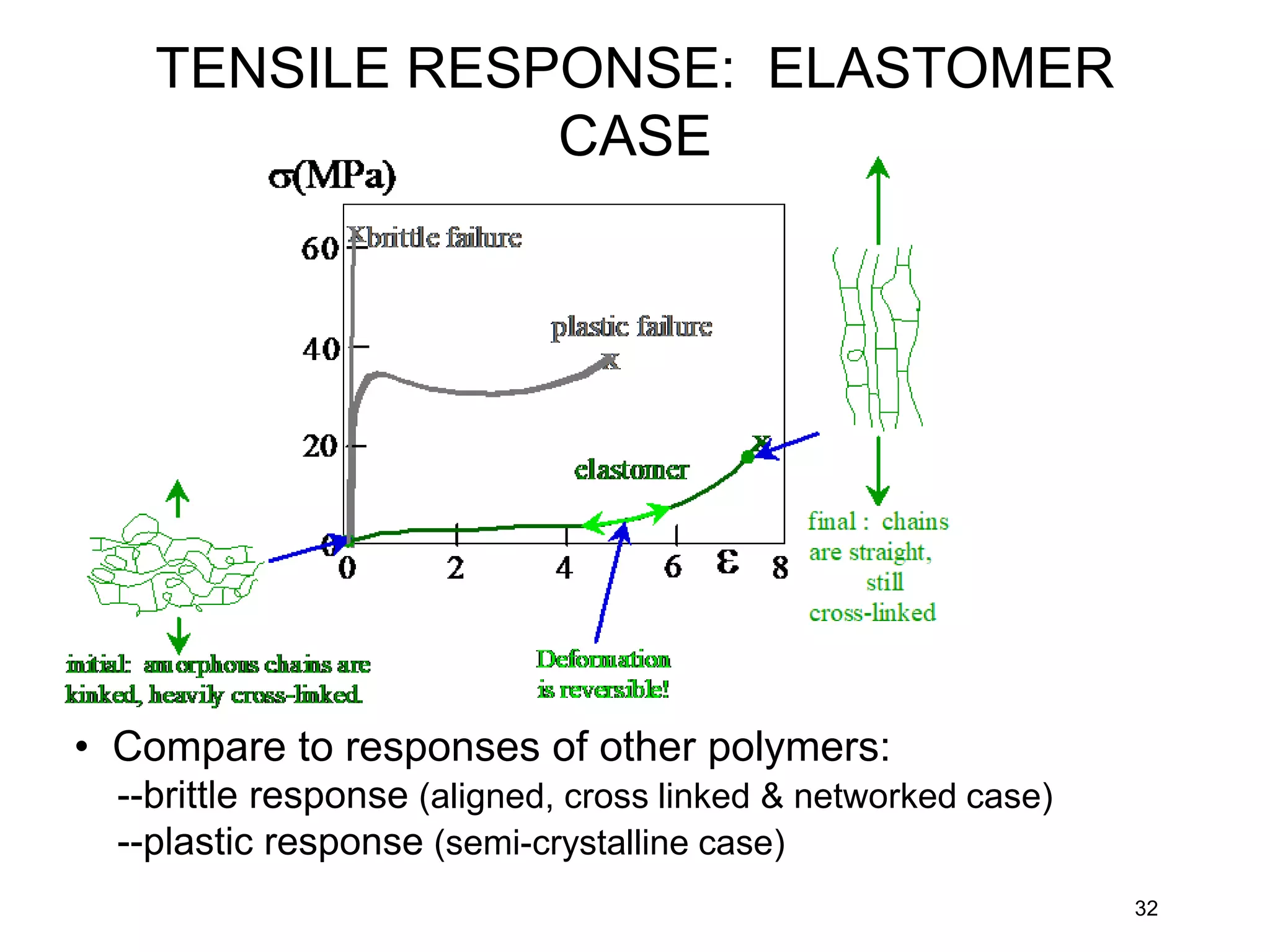
• Compare to responses of other polymers:
--brittle response (aligned, cross linked & networked case)
--plastic response (semi-crystalline case)
TENSILE RESPONSE: ELASTOMER
CASE
33
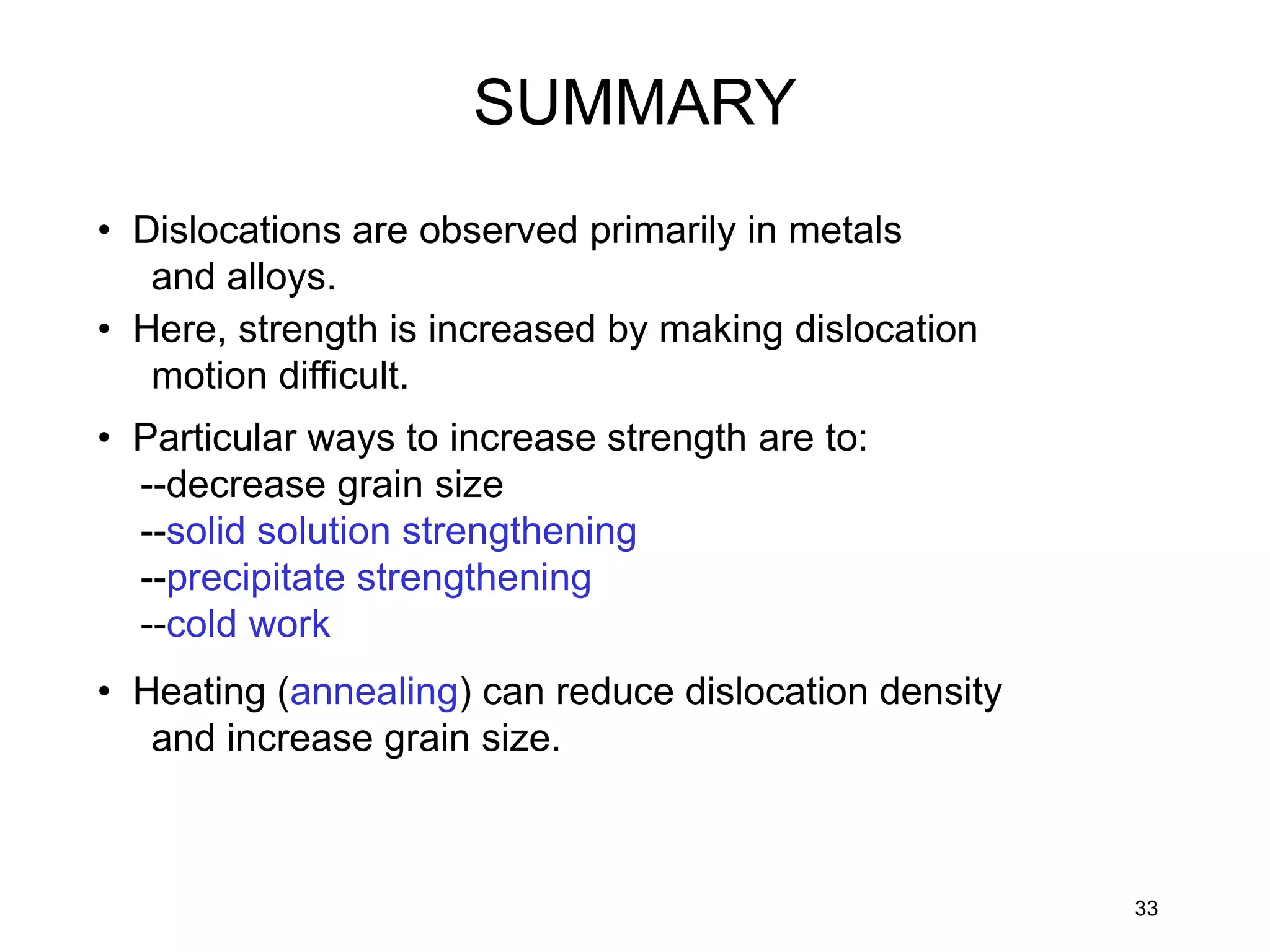
• Dislocations are observed primarily in metals
and alloys.
• Here, strength is increased by making dislocation
motion difficult.
• Particular ways to increase strength are to:
--decrease grain size
--solid solution strengthening
--precipitate strengthening
--cold work
• Heating (annealing) can reduce dislocation density
and increase grain size.
SUMMARY

fdocuments.in_chapter-8-deformation-and-strengthening-mechanisms.ppt

  • 1.
    ISSUES TO ADDRESS... •Why are dislocations observed primarily in metals and alloys? • How are strength and dislocation motion related? • How do we increase strength? 1 • How can heating change strength and other properties? CHAPTER 8: DEFORMATION AND STRENGTHENING MECHANISMS
  • 2.
    3 • Produces plasticdeformation, • Depends on incrementally breaking bonds. Plastically stretched zinc single crystal. • If dislocations don't move, deformation doesn't happen! DISLOCATION MOTION
  • 3.
    2 • Metals: Disl.motion easier. -non-directional bonding -close-packed directions for slip. electron cloud ion cores • Covalent Ceramics (Si, diamond): Motion hard. -directional (angular) bonding • Ionic Ceramics (NaCl): Motion hard. -need to avoid ++ and -- neighbors. DISLOCATIONS & MATERIALS CLASSES
  • 4.
    6 • Structure: close-packed planes& directions are preferred. • Comparison among crystal structures: FCC: many close-packed planes/directions; HCP: only one plane, 3 directions; BCC: none Mg (HCP) Al (FCC) tensile direction • Results of tensile testing. view onto two close-packed planes. DISLOCATIONS & CRYSTAL STRUCTURE
  • 5.
    7 • Crystals slipdue to a resolved shear stress, tR. • Applied tension can produce such a stress. tR cos cos   ns A As STRESS AND DISLOCATION MOTION slip plane normal, ns
  • 6.
    8 • Condition fordislocation motion: tR  tCRSS • Crystal orientation can make it easy or hard to move disl. 10 -4G to 10 -2G typically tR cos cos  CRITICAL RESOLVED SHEAR STRESS
  • 7.
    9 • Slip planes& directions (, ) change from one crystal to another. • tR will vary from one crystal to another. • The crystal with the largest tR yields first. • Other (less favorably oriented) crystals yield later. 300 mm DISL. MOTION IN POLYCRYSTALS
  • 8.
    10 • Grain boundariesare barriers to slip. • Barrier "strength" increases with misorientation. • Smaller grain size: more barriers to slip. • Hall-Petch Equation: g r a i n b o u n d a r y slip plane grain A grain B yield  o kyd1/2 4 STRATEGIES FOR STRENGTHENING: 1: REDUCE GRAIN SIZE
  • 9.
    11 • 70wt%Cu-30wt%Zn brassalloy yield  o kyd1/2 • Data: 0.75mm GRAIN SIZE STRENGTHENING: AN EXAMPLE
  • 10.
    • Can beinduced by rolling a polycrystalline metal 12 -before rolling -after rolling 235 mm -isotropic since grains are approx. spherical & randomly oriented. -anisotropic since rolling affects grain orientation and shape. rolling direction ANISOTROPY IN yield
  • 11.
    14 • Impurity atomsdistort the lattice & generate stress. • Stress can produce a barrier to dislocation motion. • Smaller substitutional impurity • Larger substitutional impurity Impurity generates local shear at A and B that opposes disl motion to the right. Impurity generates local shear at C and D that opposes disl motion to the right. STRENGTHENING STRATEGY 2: SOLID SOLUTIONS
  • 12.
    15 • Tensile strength& yield strength increase w/wt% Ni. • Empirical relation: • Alloying increases y and TS. y ~ C1/2 EX: SOLID SOLUTION STRENGTHENING IN COPPER
  • 13.
    16 • Room temperaturedeformation. • Common forming operations change the cross sectional area: %CW  Ao Ad Ao x100 Ao Ad force die blank force -Forging -Rolling -Extrusion -Drawing tensile force Ao Ad die die STRENGTHENING STRATEGY : COLD WORK (%CW)
  • 14.
    17 • Ti alloyafter cold working: • Dislocations entangle with one another during cold work. • Dislocation motion becomes more difficult. DISLOCATIONS DURING COLD WORK
  • 15.
    18 • Dislocation density(rd) goes up: Carefully prepared sample: rd ~ 103 mm/mm3 Heavily deformed sample: rd ~ 1010 mm/mm3 • Ways of measuring dislocation density: OR d  N A Area , A N dislocation pits (revealed by etching) dislocation pit r • Yield stress increases as rd increases: 40mm RESULT OF COLD WORK
  • 16.
    • Dislocation generatestress. • This traps other dislocations. 20 DISLOCATION-DISLOCATION TRAPPING
  • 17.
    • Yield strength( ) increases. • Tensile strength (TS) increases. • Ductility (%EL or %AR) decreases. 21 y IMPACT OF COLD WORK
  • 18.
    • What isthe tensile strength & ductility after cold working? 22 %CW  ro 2  rd 2 ro 2 x100  35.6% COLD WORK ANALYSIS
  • 19.
    • Results for polycrystallineiron: 23 • y and TS decrease with increasing test temperature. • %EL increases with increasing test temperature. • Why? Vacancies help dislocations past obstacles. -e BEHAVIOR VS TEMPERTURE
  • 20.
    • 1 hourtreatment at Tanneal... decreases TS and increases %EL. • Effects of cold work are reversed! 24 • 3 Annealing stages to discuss... EFFECT OF HEATING AFTER %CW
  • 21.
    Annihilation reduces dislocationdensity. 25 • Scenario 1 • Scenario 2 RECOVERY
  • 22.
    • New crystalsare formed that: --have a small disl. density --are small --consume cold-worked crystals. 26 33% cold worked brass New crystals nucleate after 3 sec. at 580C. 0.6 mm 0.6 mm RECRYSTALLIZATION
  • 23.
    • All cold-workedcrystals are consumed. 27 After 4 seconds After 8 seconds 0.6 mm 0.6 mm FURTHER RECRYSTALLIZATION
  • 24.
    • At longertimes, larger grains consume smaller ones. • Why? Grain boundary area (and therefore energy) is reduced. 28 • Empirical Relation: After 8 s, 580C After 15 min, 580C dn  do n  Kt elapsed time coefficient dependent on material and T. grain diam. at time t. exponent typ. ~ 2 0.6 mm 0.6 mm GRAIN GROWTH
  • 27.
    Example Using the diagram, computethe time for the average grain size to increase form 0.01- mm to 0.1-mm at (a) 500 oC and (b) 600 oC
  • 28.
  • 29.
    30 • Drawing... --stretches thepolymer prior to use --aligns chains to the stretching direction • Results of drawing: --increases the elastic modulus (E) in the stretching dir. --increases the tensile strength (TS) in the stretching dir. --decreases ductility (%EL) • Annealing after drawing... --decreases alignment --reverses effects of drawing. • Compare to cold working in metals! Adapted from Fig. 15.12, Callister 6e. (Fig. 15.12 is from J.M. Schultz, Polymer Materials Science, Prentice-Hall, Inc., 1974, pp. 500-501.) PREDEFORMATION BY DRAWING
  • 30.
    31 • Thermoplastics: --little crosslinking --ductile --soften w/heating --polyethylene (#2) polypropylene (#5) polycarbonate polystyrene (#6) • Thermosets: --large cross linking (10 to 50% of mers) --hard and brittle --do NOT soften w/heating --vulcanized rubber, epoxies, polyester resin, phenolic resin Callister, Fig. 16.9 T Molecular weight Tg Tm mobile liquid viscous liquid rubber tough plastic partially crystalline solid crystalline solid THERMOPLASTICS VS THERMOSETS
  • 31.
    32 • Compare toresponses of other polymers: --brittle response (aligned, cross linked & networked case) --plastic response (semi-crystalline case) TENSILE RESPONSE: ELASTOMER CASE
  • 32.
    33 • Dislocations areobserved primarily in metals and alloys. • Here, strength is increased by making dislocation motion difficult. • Particular ways to increase strength are to: --decrease grain size --solid solution strengthening --precipitate strengthening --cold work • Heating (annealing) can reduce dislocation density and increase grain size. SUMMARY