Chapter 4:
The Business Research Process
 Reduces uncertainty
 Helps focus decision making
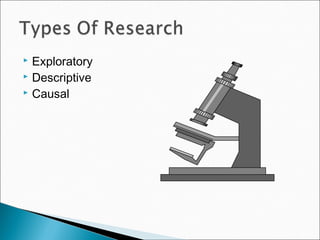
 Exploratory
 Descriptive
 Causal
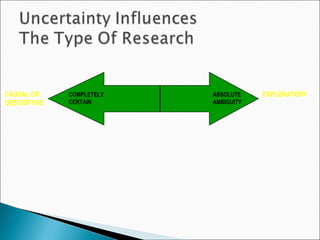
COMPLETELY
CERTAIN
ABSOLUTE
AMBIGUITY
CAUSAL OR
DESCRIPTIVE
EXPLORATORY
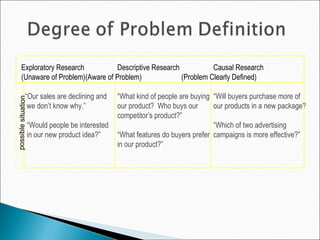
Exploratory Research Descriptive Research Causal Research
(Unaware of Problem)(Aware of Problem) (Problem Clearly Defined)
“Our sales are declining and “What kind of people are buying “Will buyers purchase more of
we don’t know why.” our product? Who buys our our products in a new package?
competitor’s product?”
“Would people be interested “Which of two advertising
in our new product idea?” “What features do buyers prefer campaigns is more effective?”
in our product?”
possiblesituation
6
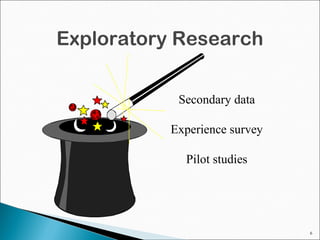
Exploratory Research
Secondary data
Experience survey
Pilot studies
 Initial research conducted to clarify and define the
nature of a problem
 Does not provide conclusive evidence
 Subsequent research expected
 Describes characteristics of a population or
phenomenon
 Some understanding of the nature of the problem
9
I keep six honest serving men, (they
taught me all I knew), their names are
--Rudyard Kipling
what, and why, and when, and how,
and where and who.”
 Weight Watchers average customer
 Woman about 40 years old
 Household income of about $50,000
 At least some college education
 Trying to juggle children and a job
 Men’s fragrance market
 1/3 size of women’s fragrance market
 But growing at a faster pace
 Women buy 80 % of men’s fragrances
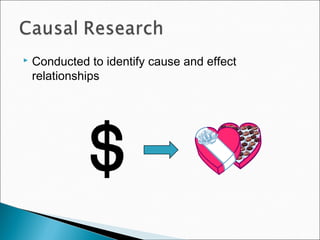
 Conducted to identify cause and effect
relationships
 A causal relationship is impossible to prove.
 Evidence of causality:
◦ 1. The appropriate causal order of events
◦ 2. Concomitant variation--two phenomena vary
together
◦ 3. An absence of alternative plausible explanations
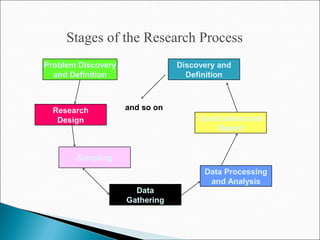
Stages of the Research Process
Problem Discovery
and Definition
Research
Design
Sampling
Data
Gathering
Data Processing
and Analysis
Conclusions and
Report
Discovery and
Definition
and so on
 Cyclical process - conclusions generate new ideas
 Stages can overlap chronologically
 Stages are functionally interrelated
◦ Forward linkages
◦ Backward linkages
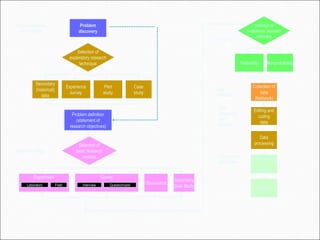
Problem
discovery
Problem definition
(statement of
research objectives)
Secondary
(historical)
data
Experience
survey
Pilot
study
Case
study
Selection of
exploratory research
technique
Selection of
basic research
method
Experiment Survey
Observation
Secondary
Data StudyLaboratory Field Interview Questionnaire
Selection of
exploratory research
technique
Sampling
Probability Nonprobability
Collection of
data
(fieldwork)
Editing and
coding
data
Data
processing
Interpretation
of
findings
Report
Data
Gathering
Data
Processing
and
Analysis
Conclusions
and Report
Research Design
Problem Discovery
and Definition
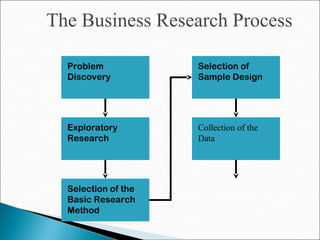
The Business Research Process
Problem
Discovery
Exploratory
Research
Selection of the
Basic Research
Method
Selection of
Sample Design
Collection of the
Data
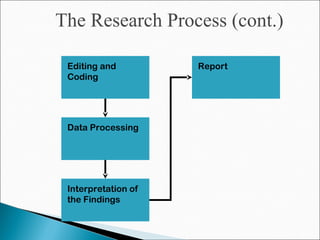
The Research Process (cont.)
Editing and
Coding
Data Processing
Interpretation of
the Findings
Report
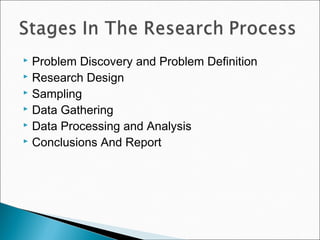
 Problem Discovery and Problem Definition
 Research Design
 Sampling
 Data Gathering
 Data Processing and Analysis
 Conclusions And Report
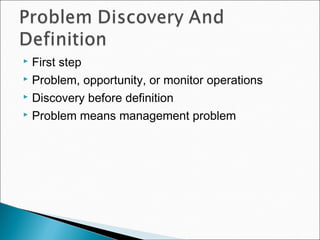
 First step
 Problem, opportunity, or monitor operations
 Discovery before definition
 Problem means management problem
Albert Einstein
22
 A statement
 that can be refuted
 by empirical data
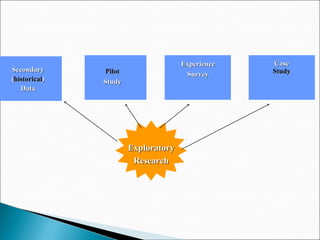
SecondarySecondary
((historicalhistorical))
DataData
PilotPilot
StudyStudy
ExperienceExperience
SurveySurvey
CaseCase
StudyStudy
ExploratoryExploratory
ResearchResearch
 Secondary data (historical data)
◦ Previously collected
◦ Census of population
◦ Literature survey
 Pilot study
◦ A number of diverse techniques
 Master plan
 Framework for action
 Specifies methods and procedures
 Surveys
 Experiments
 Secondary data
 Observation
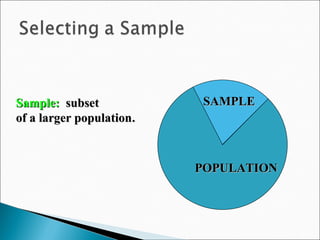
POPULATIONPOPULATION
SAMPLESAMPLESample:Sample: subsetsubset
of a larger populationof a larger population..
 Who is to be sampled?
 How large a sample?
 How will sample units be selected?
 Effective communication of the research findings
 A written statement of the research design that
includes a statement explaining the purpose of the
study.

 Detailed outline of procedures associated with a
particular methodology
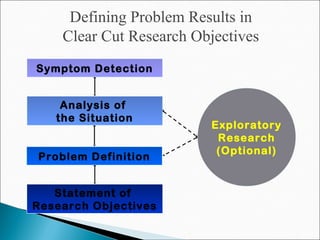
Statement of
Research Objectives
Problem Definition
Defining Problem Results in
Clear Cut Research Objectives
Exploratory
Research
(Optional)
Analysis of
the Situation
Symptom Detection

Ch04