Chapter 2
      Network Models


2.1
2-1 LAYERED TASKS

We use the concept of layers in our daily life. As an
example, let us consider two friends who communicate
through postal mail. The process of sending a letter to a
friend would be complex if there were no services
available from the post office.


  Topics discussed in this section:
 Sender, Receiver, and Carrier
 Hierarchy


2.2
Figure 2.1   Tasks involved in sending a letter


2.3
2-2 THE OSI MODEL
Established in 1947, the International Standards
Organization (ISO) is a multinational body dedicated to
worldwide agreement on international standards. An ISO
standard that covers all aspects of network
communications is the Open Systems Interconnection
(OSI) model. It was first introduced in the late 1970s.


  Topics discussed in this section:
 Layered Architecture
 Peer-to-Peer Processes
 Encapsulation

2.4
ISO is the organization.
         OSI is the model.


2.5
Figure 2.2 Seven layers of the OSI model


2.6
Figure 2.3 The interaction between layers in the OSI model


2.7
Figure 2.4 An exchange using the OSI model


2.8
2-3 LAYERS IN THE OSI MODEL

In this section we briefly describe the functions of each
layer in the OSI model.


  Topics discussed in this section:
 Physical Layer
 Data Link Layer
 Network Layer
 Transport Layer
 Session Layer
 Presentation Layer
 Application Layer


2.9
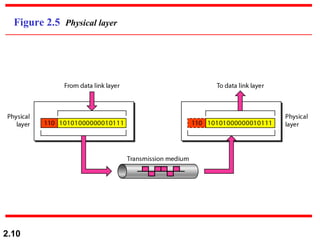
Figure 2.5 Physical layer


2.10
The physical layer is responsible for movements of
        individual bits from one hop (node) to the next.


2.11
Figure 2.6 Data link layer


2.12
The data link layer is responsible for moving
         frames from one hop (node) to the next.


2.13
Figure 2.7 Hop-to-hop delivery


2.14
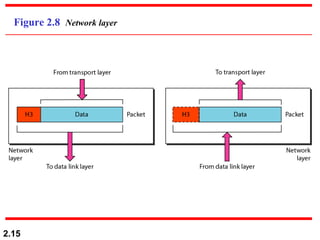
Figure 2.8 Network layer


2.15
The network layer is responsible for the
         delivery of individual packets from
        the source host to the destination host.


2.16
Figure 2.9 Source-to-destination delivery


2.17
Figure 2.10 Transport layer


2.18
The transport layer is responsible for the delivery
           of a message from one process to another.


2.19
Figure 2.11 Reliable process-to-process delivery of a message


2.20
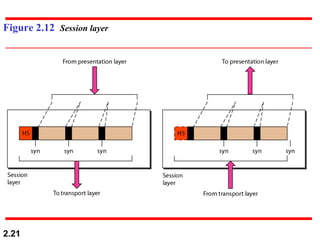
Figure 2.12 Session layer


2.21
The session layer is responsible for dialog
             control and synchronization.


2.22
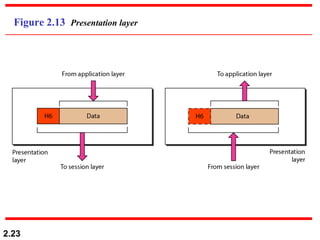
Figure 2.13 Presentation layer


2.23
The presentation layer is responsible for translation,
                 compression, and encryption.


2.24
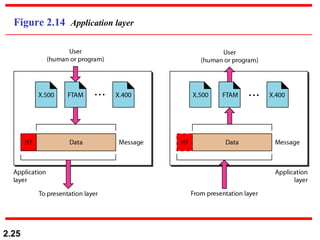
Figure 2.14 Application layer


2.25
The application layer is responsible for
           providing services to the user.


2.26
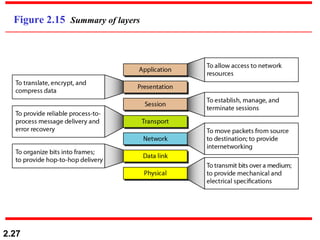
Figure 2.15 Summary of layers


2.27

Ch02

  • 1.
    Chapter 2 Network Models 2.1
  • 2.
    2-1 LAYERED TASKS Weuse the concept of layers in our daily life. As an example, let us consider two friends who communicate through postal mail. The process of sending a letter to a friend would be complex if there were no services available from the post office. Topics discussed in this section: Sender, Receiver, and Carrier Hierarchy 2.2
  • 3.
    Figure 2.1 Tasks involved in sending a letter 2.3
  • 4.
    2-2 THE OSIMODEL Established in 1947, the International Standards Organization (ISO) is a multinational body dedicated to worldwide agreement on international standards. An ISO standard that covers all aspects of network communications is the Open Systems Interconnection (OSI) model. It was first introduced in the late 1970s. Topics discussed in this section: Layered Architecture Peer-to-Peer Processes Encapsulation 2.4
  • 5.
    ISO is theorganization. OSI is the model. 2.5
  • 6.
    Figure 2.2 Sevenlayers of the OSI model 2.6
  • 7.
    Figure 2.3 Theinteraction between layers in the OSI model 2.7
  • 8.
    Figure 2.4 Anexchange using the OSI model 2.8
  • 9.
    2-3 LAYERS INTHE OSI MODEL In this section we briefly describe the functions of each layer in the OSI model. Topics discussed in this section: Physical Layer Data Link Layer Network Layer Transport Layer Session Layer Presentation Layer Application Layer 2.9
  • 10.
  • 11.
    The physical layeris responsible for movements of individual bits from one hop (node) to the next. 2.11
  • 12.
    Figure 2.6 Datalink layer 2.12
  • 13.
    The data linklayer is responsible for moving frames from one hop (node) to the next. 2.13
  • 14.
    Figure 2.7 Hop-to-hopdelivery 2.14
  • 15.
  • 16.
    The network layeris responsible for the delivery of individual packets from the source host to the destination host. 2.16
  • 17.
  • 18.
  • 19.
    The transport layeris responsible for the delivery of a message from one process to another. 2.19
  • 20.
    Figure 2.11 Reliableprocess-to-process delivery of a message 2.20
  • 21.
  • 22.
    The session layeris responsible for dialog control and synchronization. 2.22
  • 23.
  • 24.
    The presentation layeris responsible for translation, compression, and encryption. 2.24
  • 25.
  • 26.
    The application layeris responsible for providing services to the user. 2.26
  • 27.
    Figure 2.15 Summaryof layers 2.27