Data communication and Networks
2.1
Lecture -3
Network Models
Copyright © The McGraw-Hill Companies, Inc. Permission required for reproduction or display.
2.2
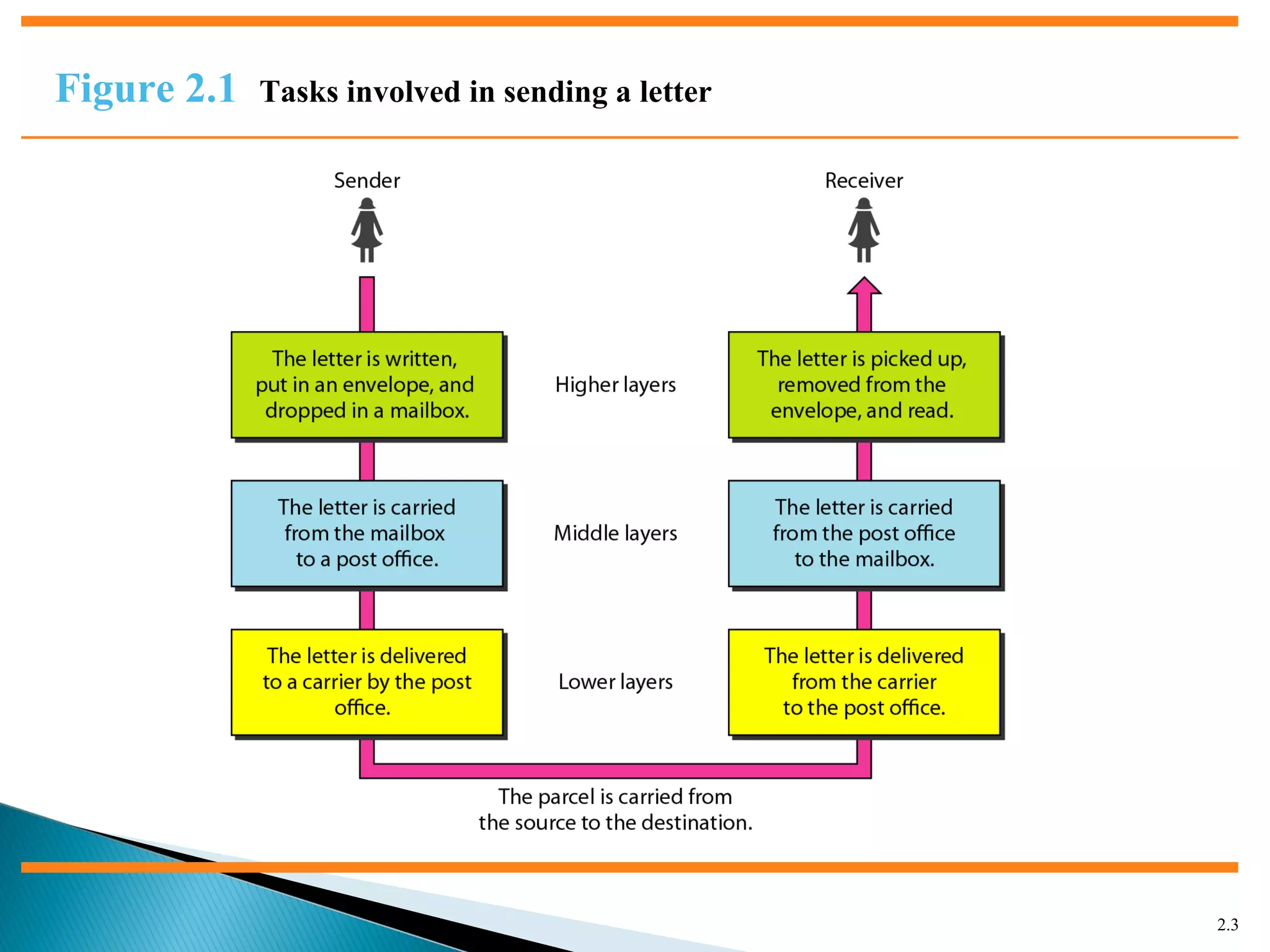
2-1 LAYERED TASKS2-1 LAYERED TASKS
We use the concept ofWe use the concept of layerslayers in our daily life. As anin our daily life. As an
example, let us consider two friends who communicateexample, let us consider two friends who communicate
through postal mail. The process of sending a letter to athrough postal mail. The process of sending a letter to a
friend would be complex if there were no servicesfriend would be complex if there were no services
available from the post office.available from the post office.
Sender, Receiver, and Carrier
Hierarchy
Topics discussed in this section:Topics discussed in this section:
2.3
Figure 2.1 Tasks involved in sending a letter
2.4
2-2 THE OSI MODEL2-2 THE OSI MODEL
Established in 1947, the International StandardsEstablished in 1947, the International Standards
Organization (Organization (ISOISO) is a multinational body dedicated to) is a multinational body dedicated to
worldwide agreement on international standards. An ISOworldwide agreement on international standards. An ISO
standard that covers all aspects of networkstandard that covers all aspects of network
communications is the Open Systems Interconnectioncommunications is the Open Systems Interconnection
((OSIOSI) model. It was first introduced in the late 1970s.) model. It was first introduced in the late 1970s.
Layered Architecture
Peer-to-Peer Processes
Encapsulation
Topics discussed in this section:Topics discussed in this section:
2.5
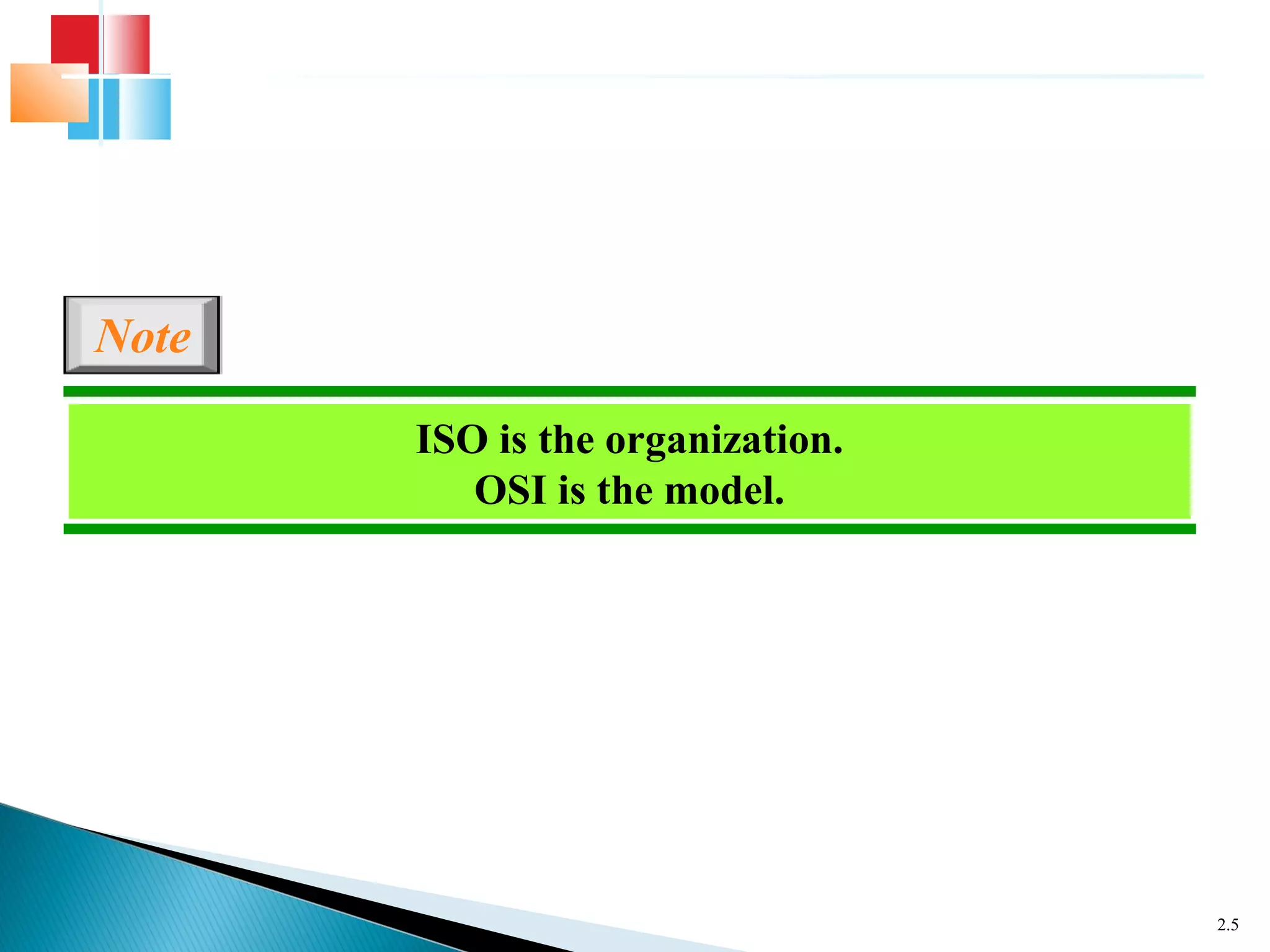
ISO is the organization.
OSI is the model.
Note
2.6
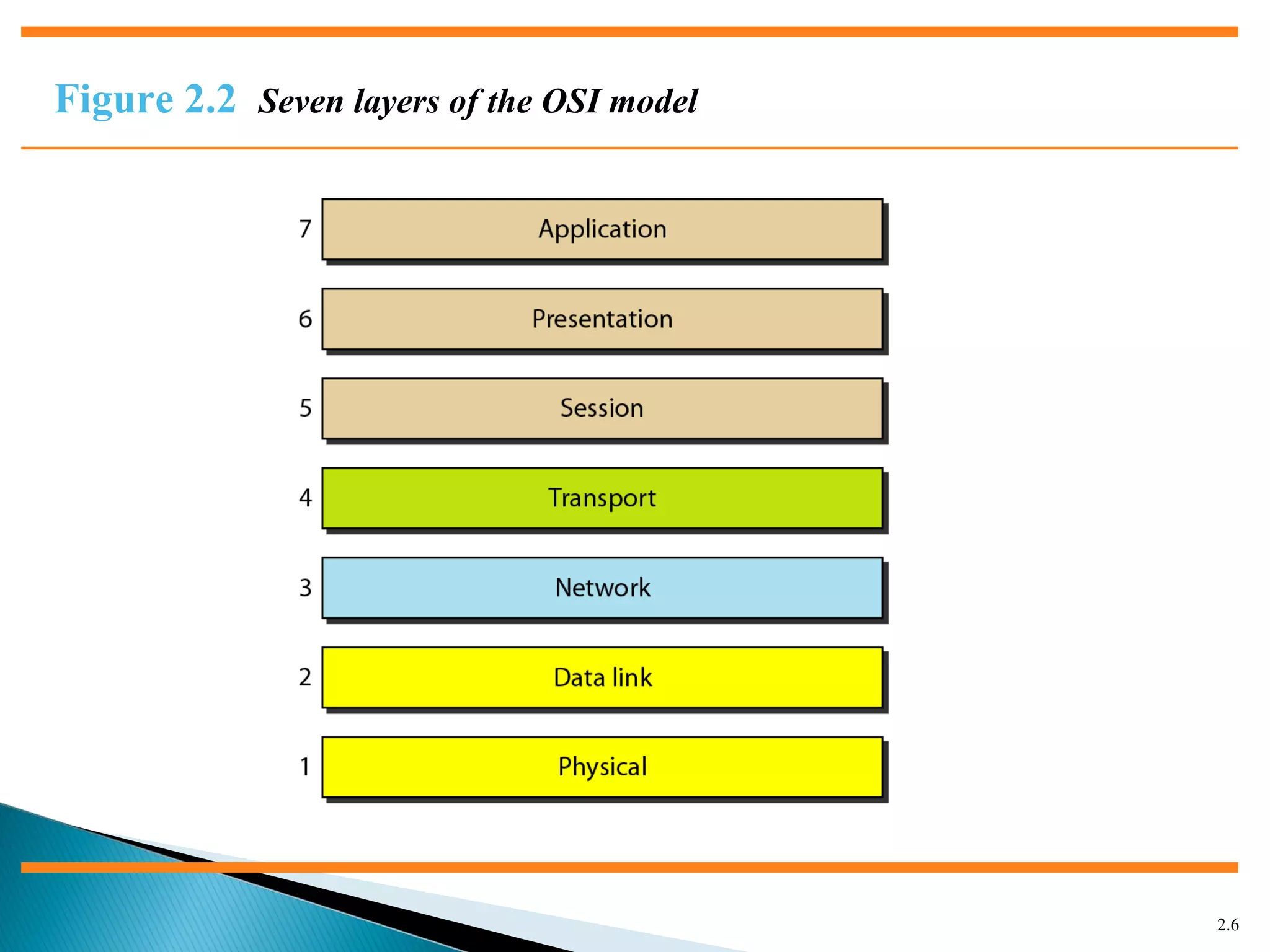
Figure 2.2 Seven layers of the OSI model
2.7
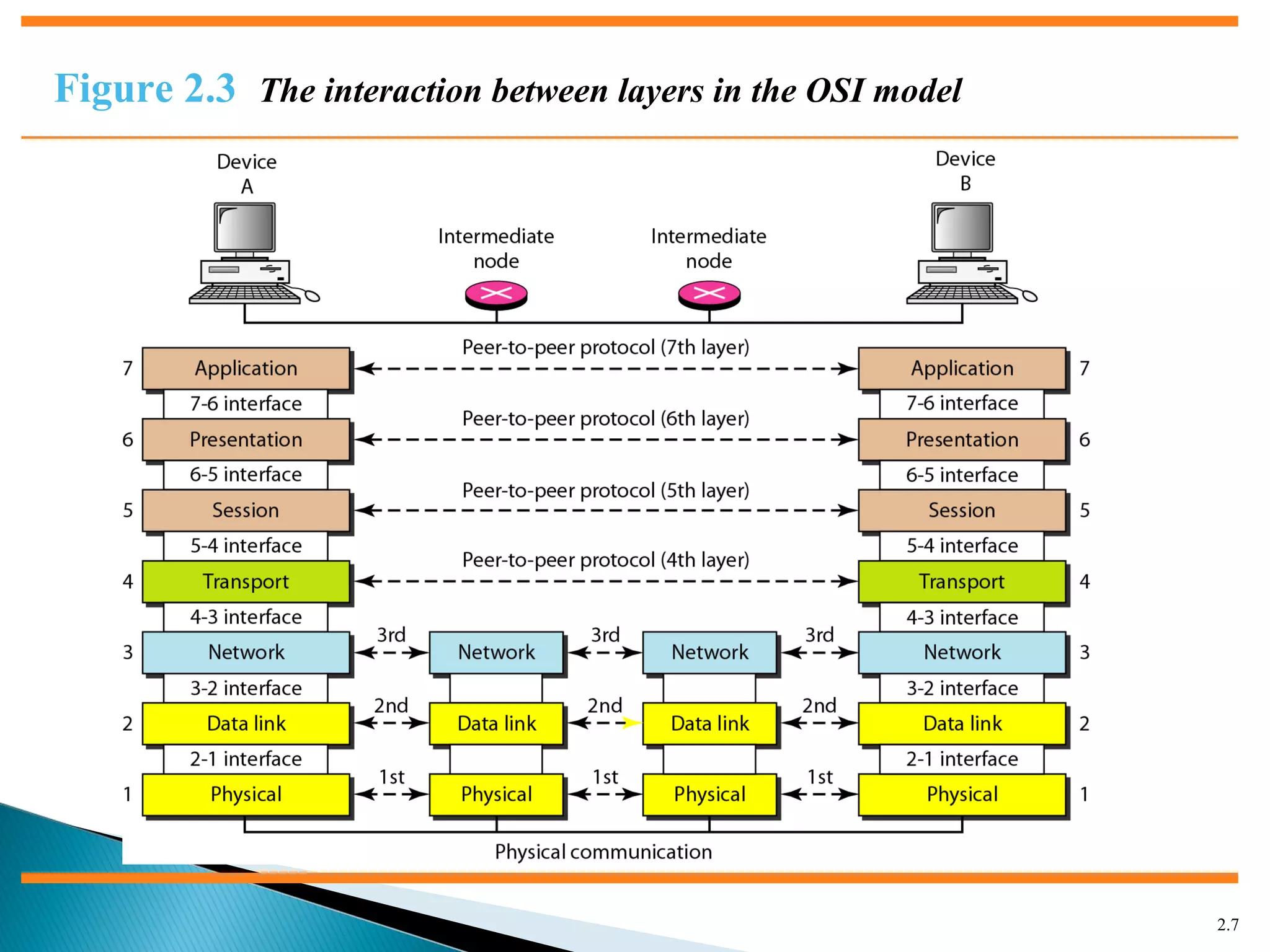
Figure 2.3 The interaction between layers in the OSI model
2.8
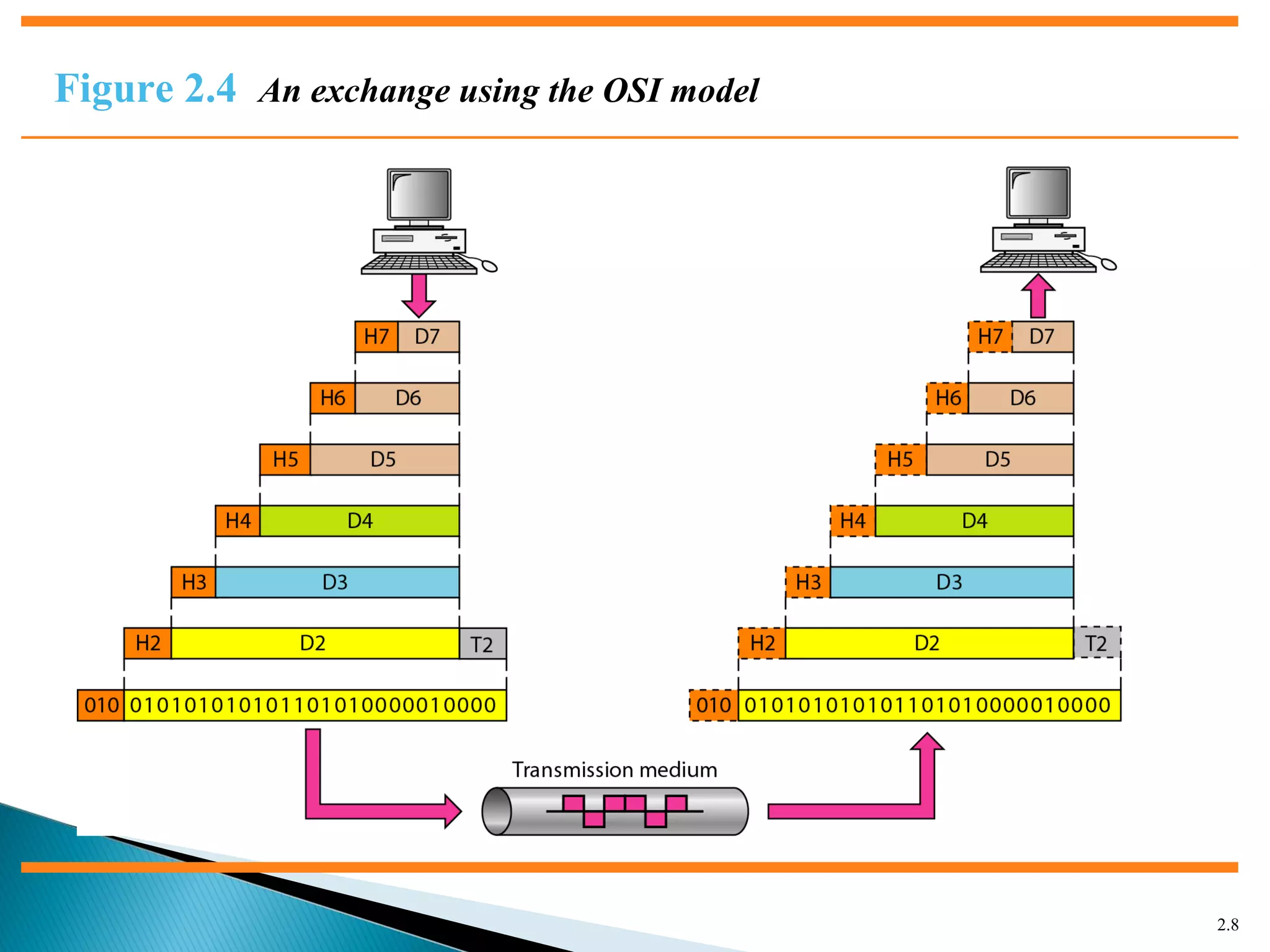
Figure 2.4 An exchange using the OSI model
2.9
2-3 LAYERS IN THE OSI MODEL2-3 LAYERS IN THE OSI MODEL
In this section we briefly describe the functions of eachIn this section we briefly describe the functions of each
layer in the OSI model.layer in the OSI model.
Physical Layer
Data Link Layer
Network Layer
Transport Layer
Session Layer
Presentation Layer
Application Layer
Topics discussed in this section:Topics discussed in this section:
2.
10
Figure 2.5 Physical layer
2.
11
The physical layer is responsible for movements of
individual bits from one hop (node) to the next.
Representation of bits. Represent by (0 s&1 s)
 Data rate :the number of bits sent each second .
Note
2.
12
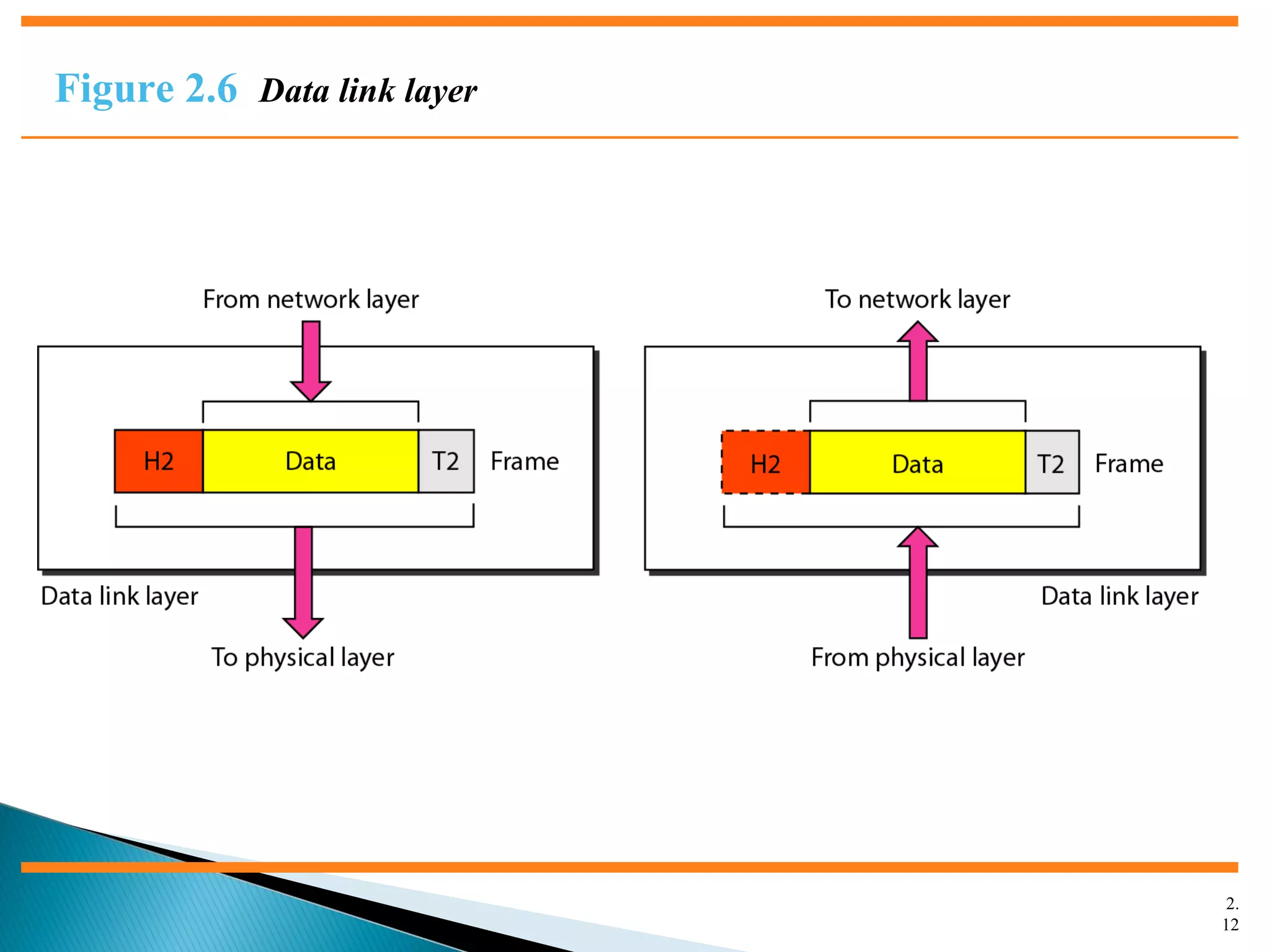
Figure 2.6 Data link layer
2.
13
The data link layer is responsible for moving
frames from one hop (node) to the next.
Framing: divides the stream of bits into manageable data
called frames.
Note
2.
14
Figure 2.7 Hop-to-hop delivery
2.
15
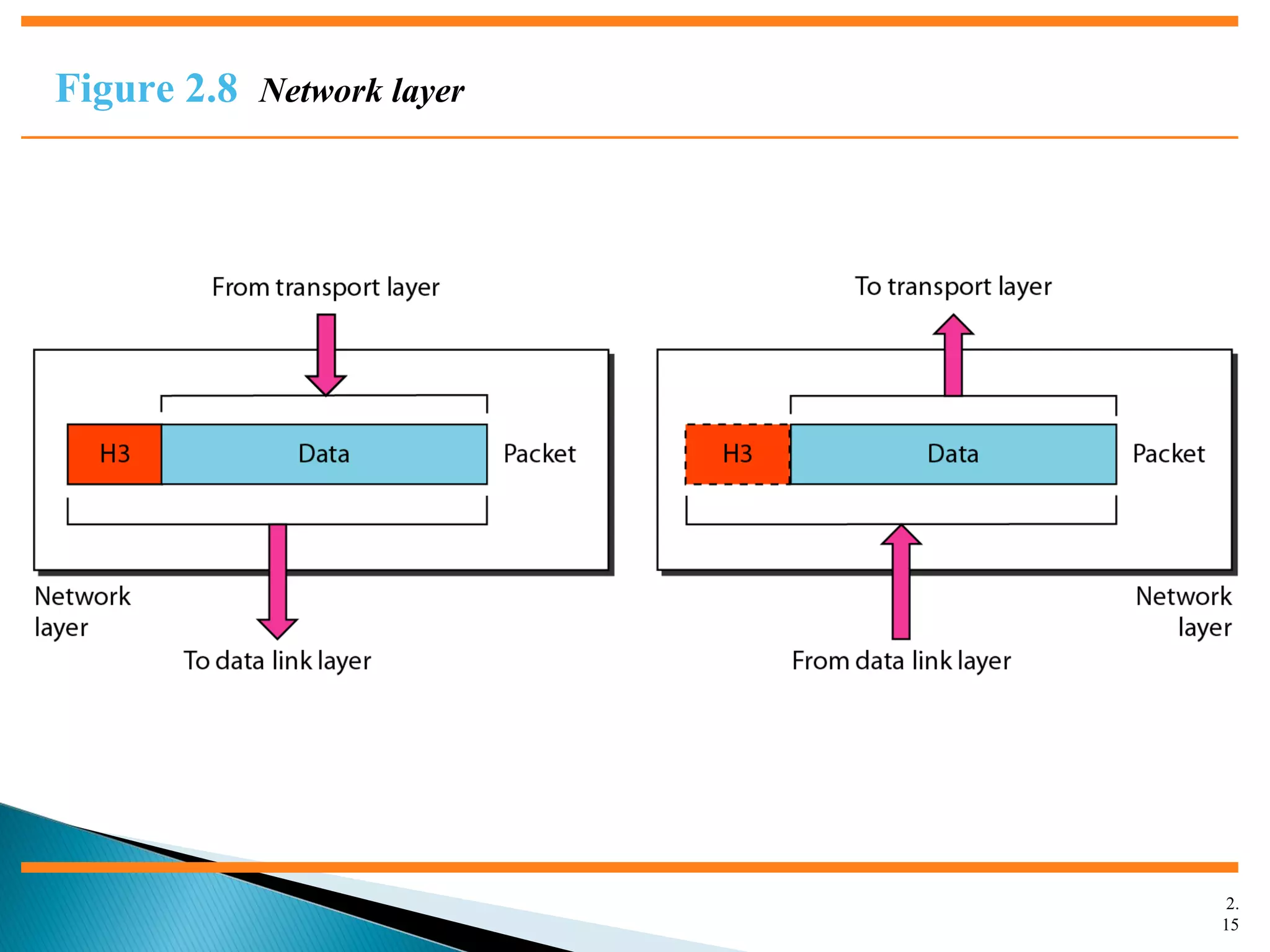
Figure 2.8 Network layer
2.
16
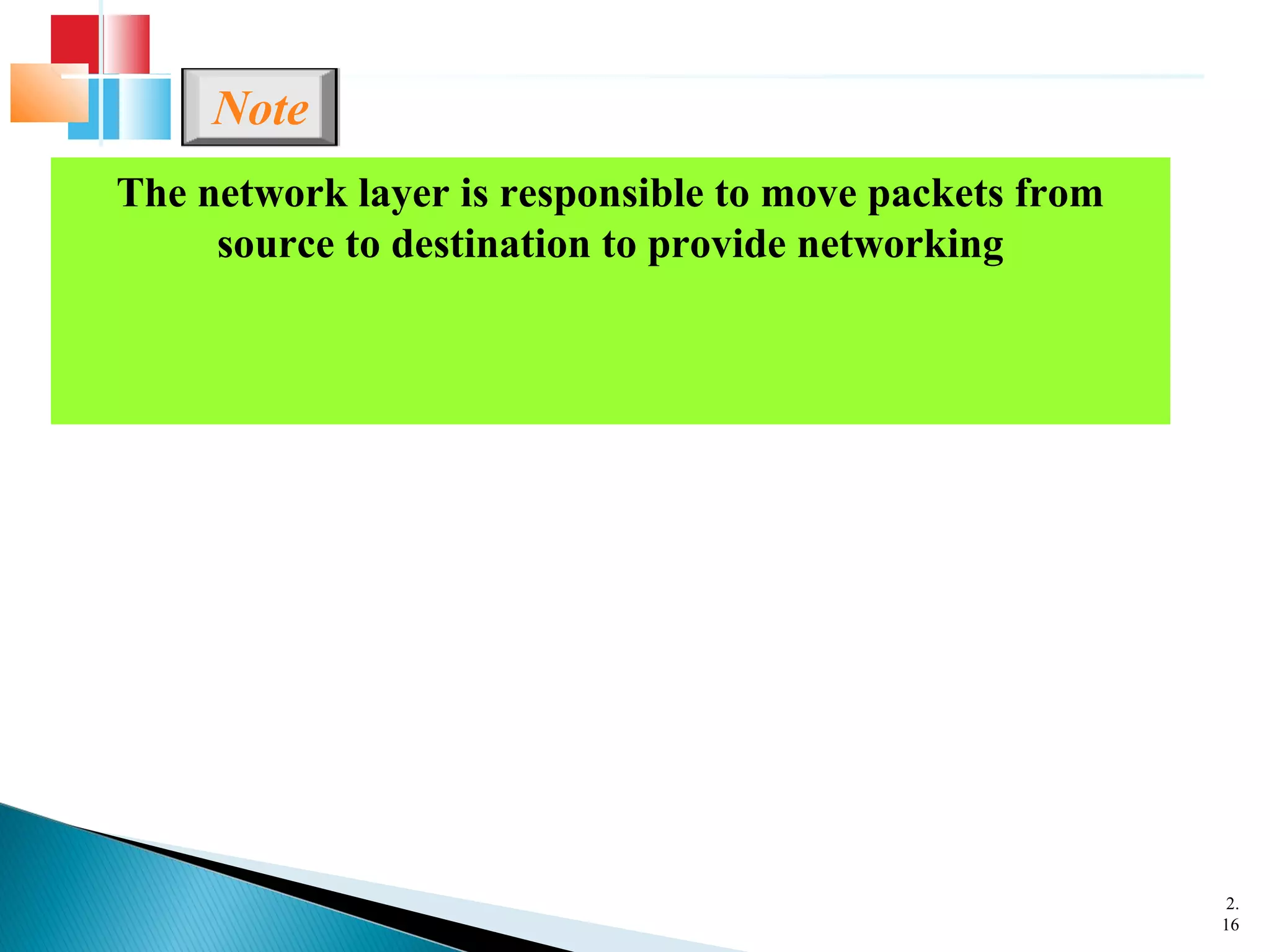
The network layer is responsible to move packets from
source to destination to provide networking
Note
2.
17
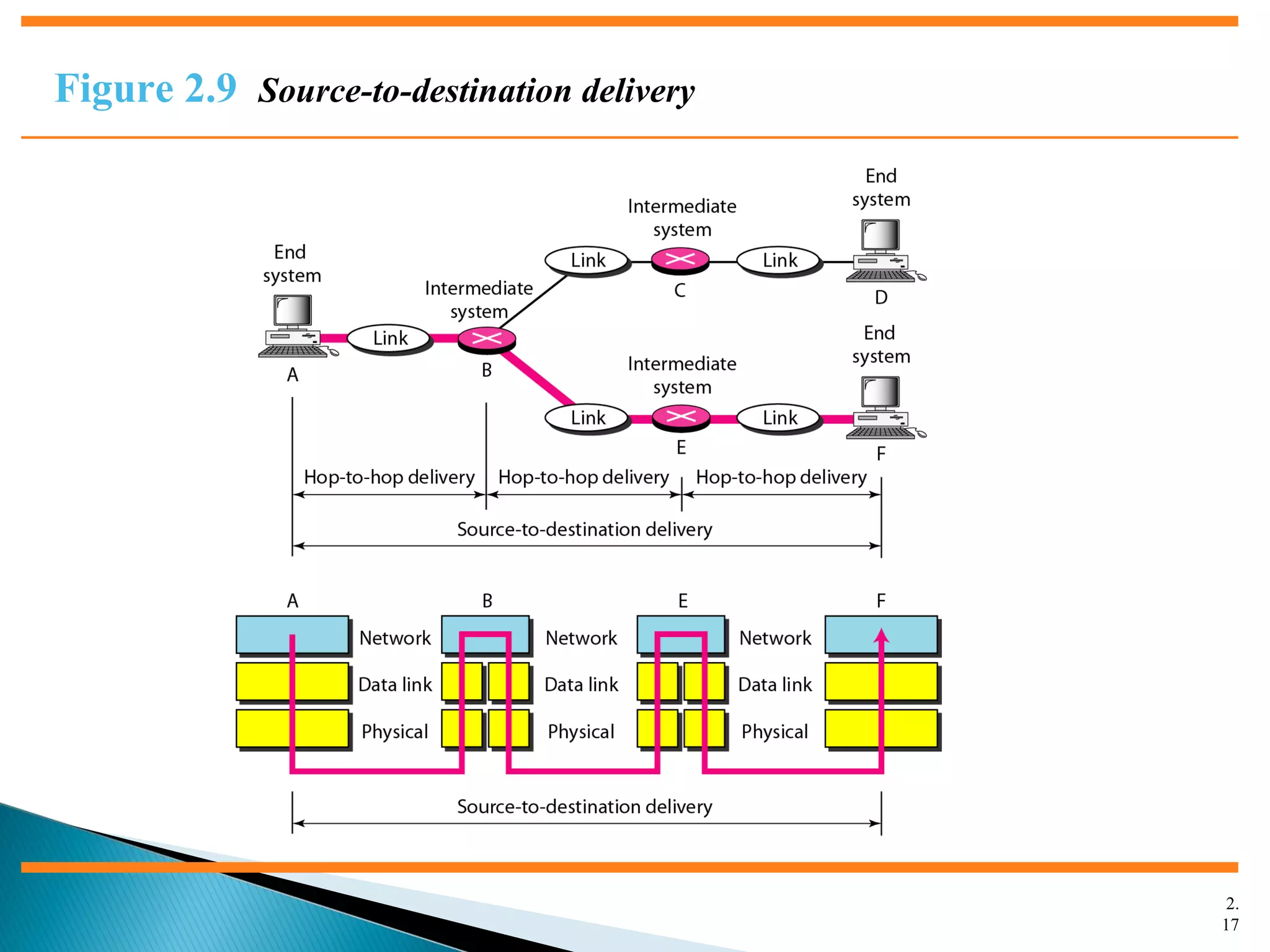
Figure 2.9 Source-to-destination delivery
2.
18
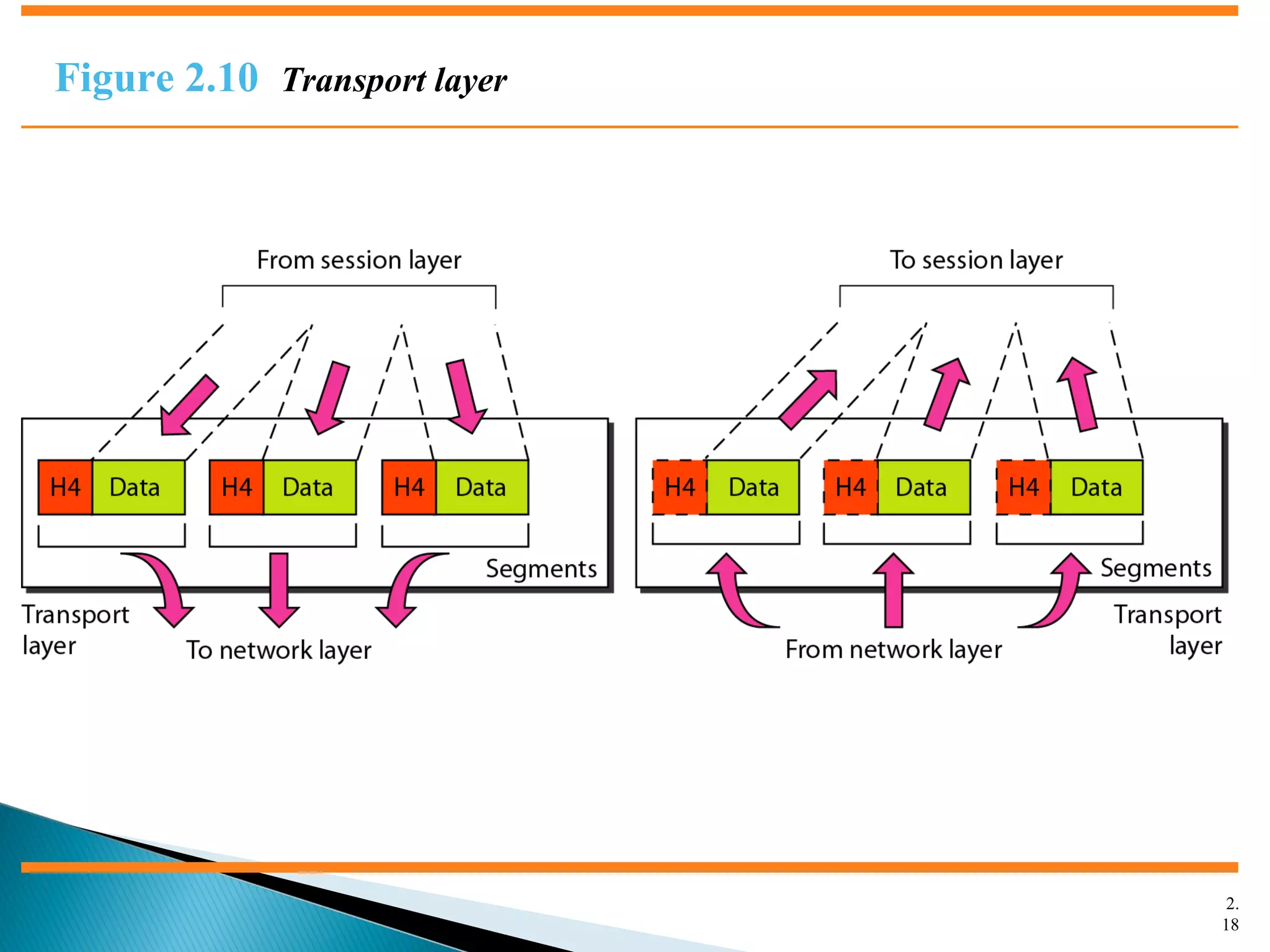
Figure 2.10 Transport layer
2.
19
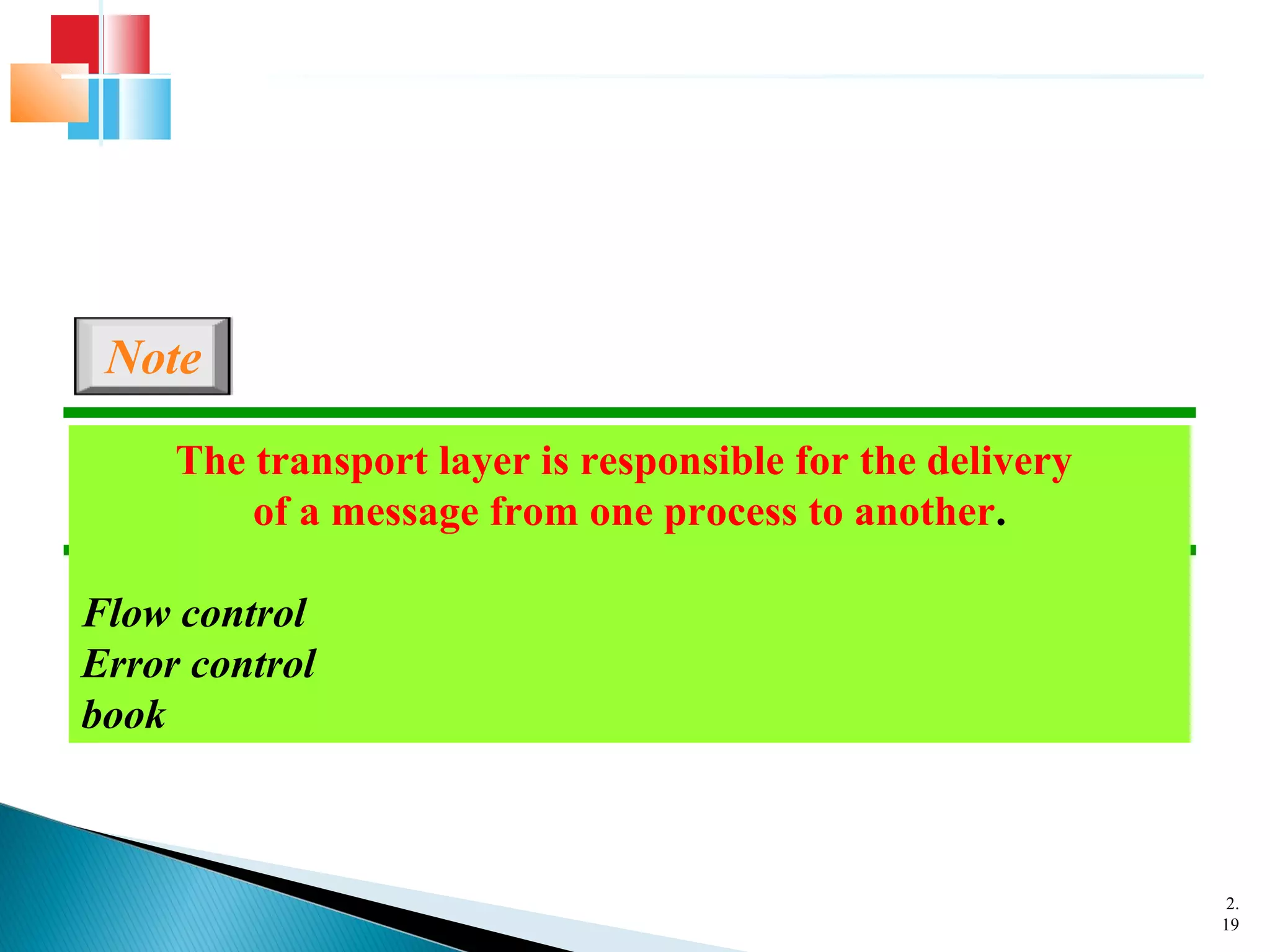
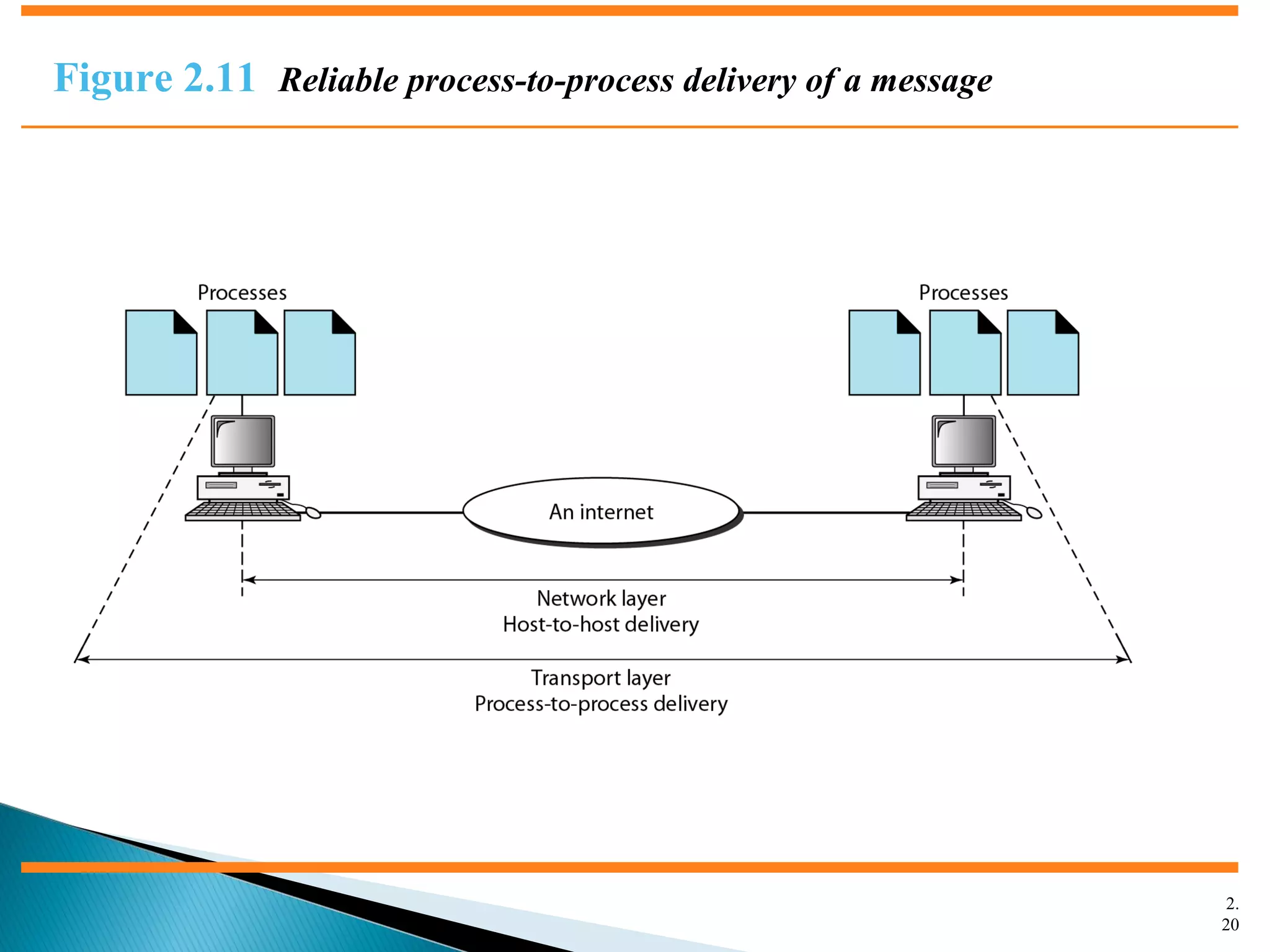
The transport layer is responsible for the delivery
of a message from one process to another.
Flow control
Error control
book
Note
2.
20
Figure 2.11 Reliable process-to-process delivery of a message
2.
21
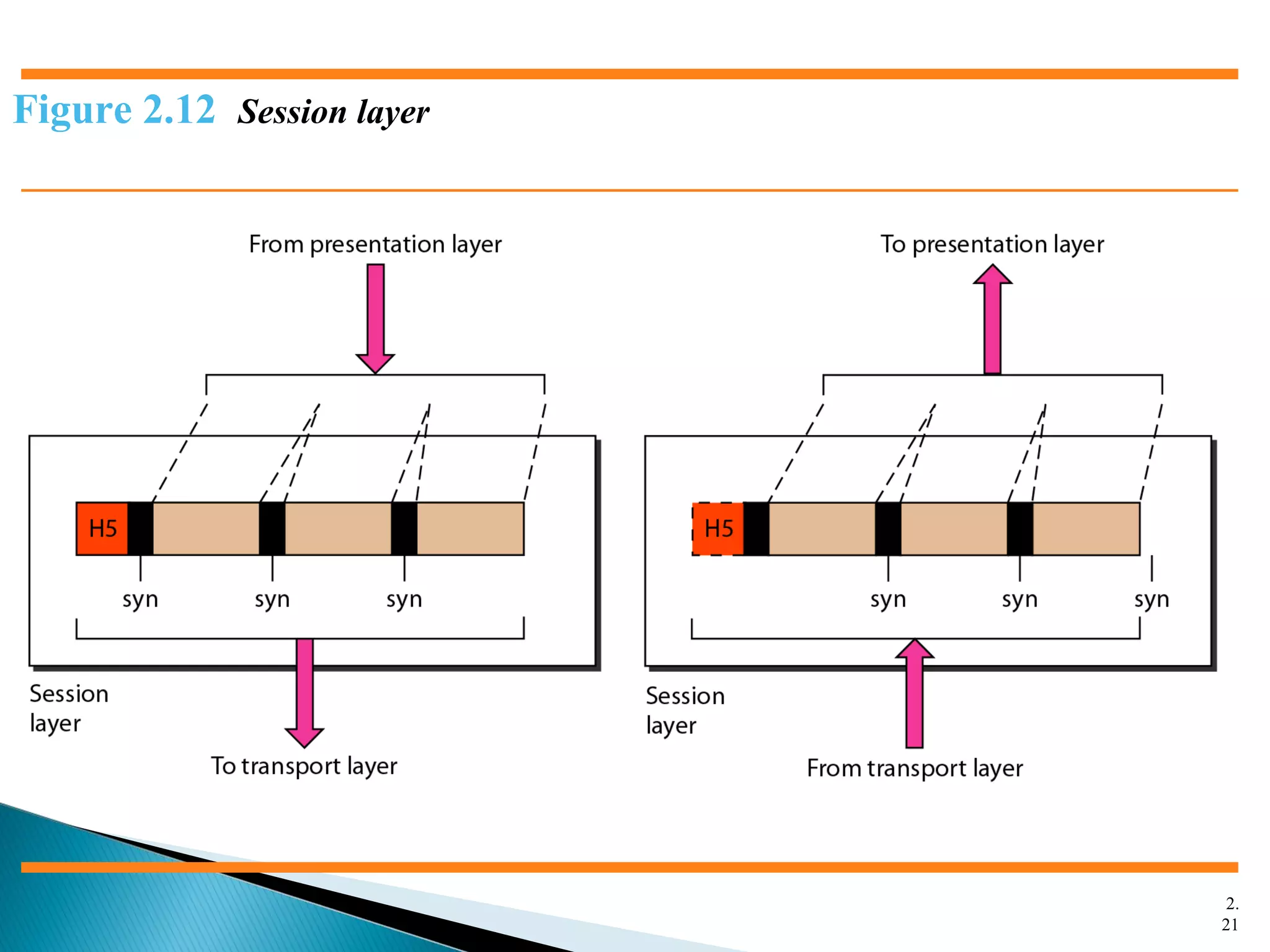
Figure 2.12 Session layer
2.
22
The session layer is responsible for dialog
control and synchronization.
Dialog control= It to allows the communication between two
processes
Note
2.
23
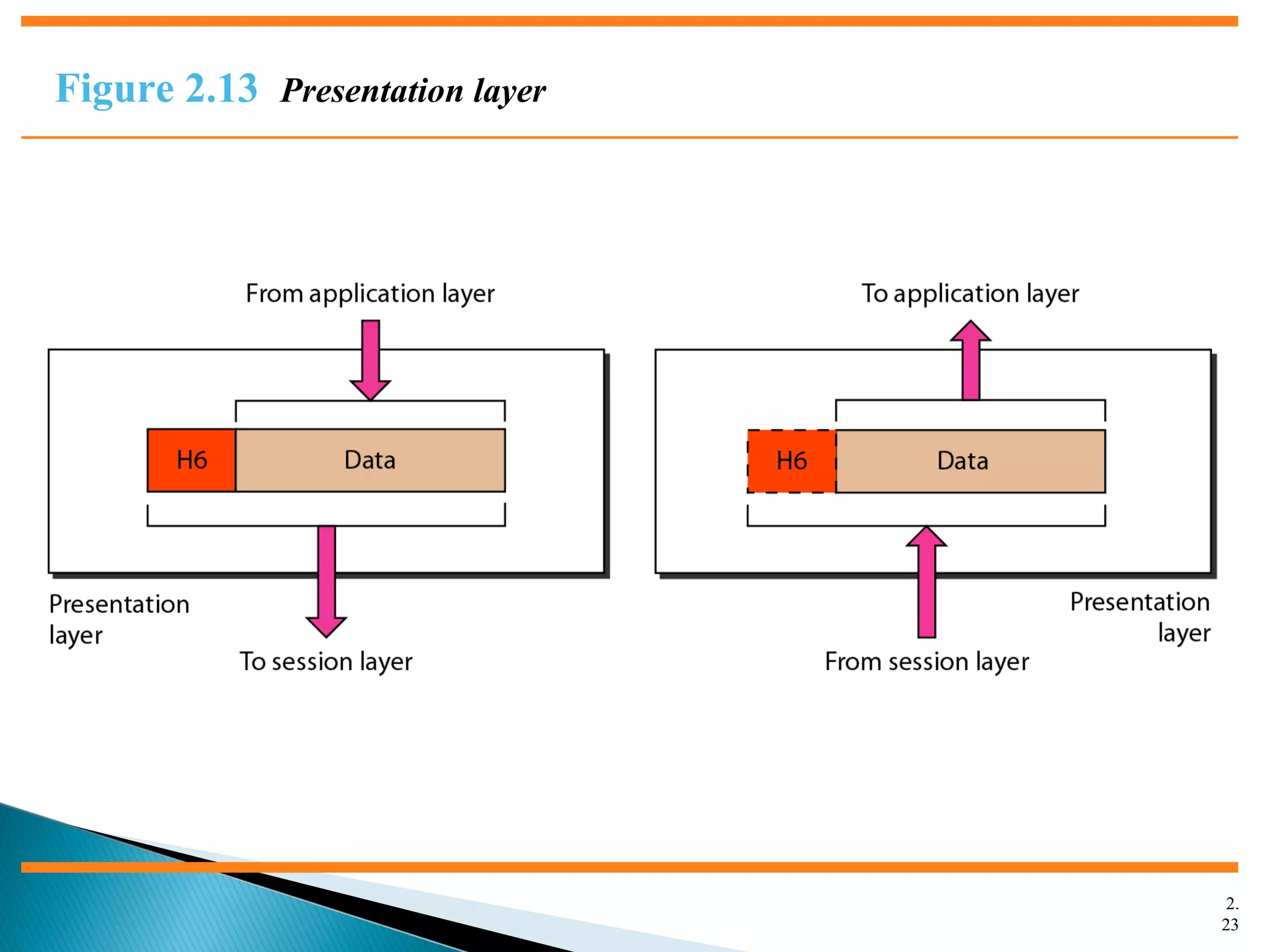
Figure 2.13 Presentation layer
2.
24
The presentation layer is responsible for translation,
encryption and compress data.
Note
2.
25
Translation . The processes (running programs) in two
systems are usually exchanging information in the form of
character strings, numbers, and so on. Because different
computers use different encoding systems.
Encryption. To carry sensitive information a system must be
able to assure privacy.
Compression. Data compression reduces the number of bits
contained in the information. such as text, audio, and video.
2.
26
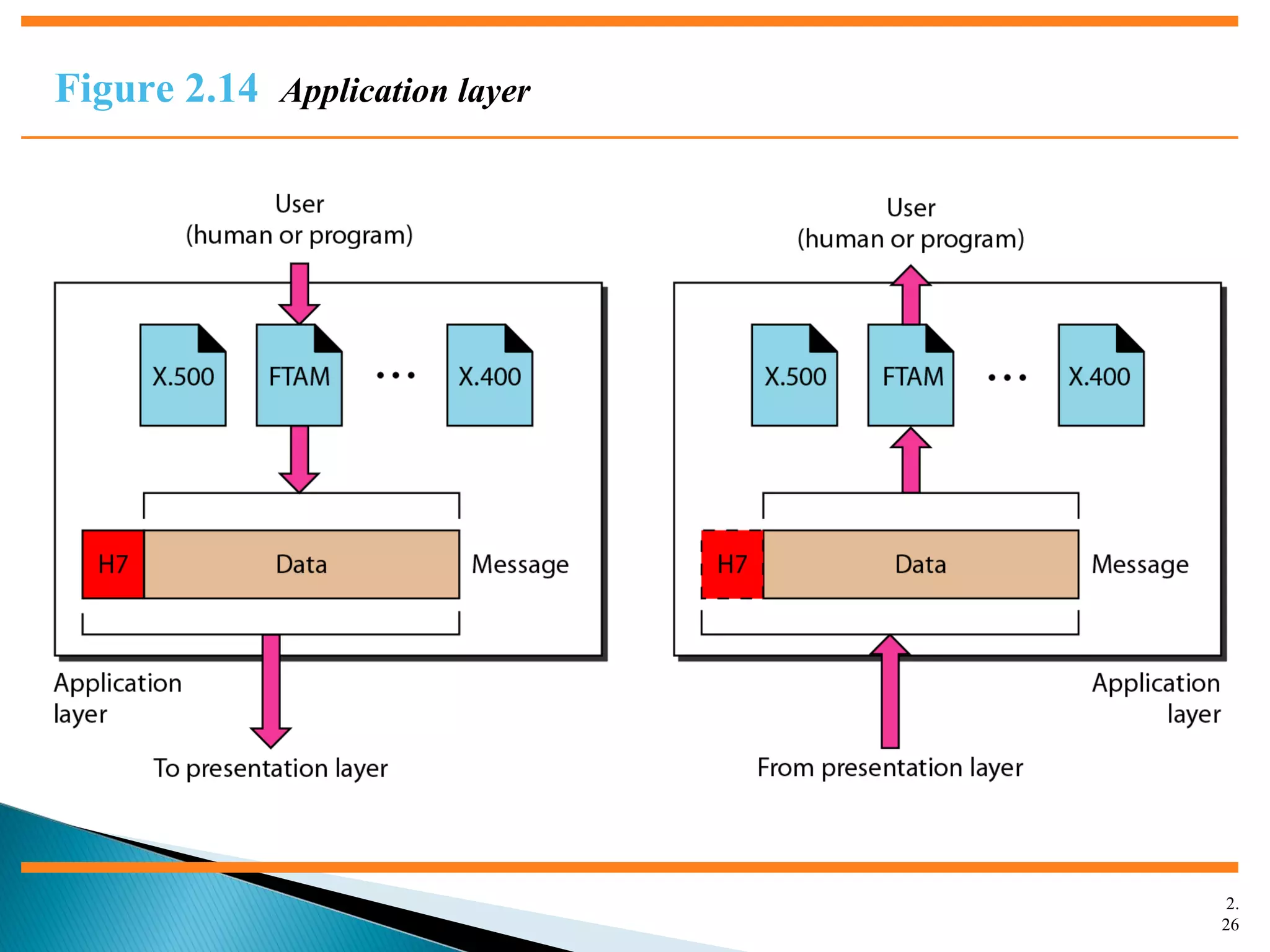
Figure 2.14 Application layer
2.
27
The application layer is responsible for
providing services to the user.
Note
2.
28
Figure 2.15 Summary of layers
2.
29
2.
30
2.
31
2-4 TCP/IP PROTOCOL SUITE2-4 TCP/IP PROTOCOL SUITE
The layers in theThe layers in the TCP/IP protocol suiteTCP/IP protocol suite do not exactlydo not exactly
match those in the OSI model. The original TCP/IPmatch those in the OSI model. The original TCP/IP
protocol suite was defined as having four layers:protocol suite was defined as having four layers: host-to-host-to-
networknetwork,, internetinternet,, transporttransport, and, and applicationapplication. However,. However,
when TCP/IP is compared to OSI, we can say that thewhen TCP/IP is compared to OSI, we can say that the
TCP/IP protocol suite is made of five layers:TCP/IP protocol suite is made of five layers: physicalphysical,,
data linkdata link,, networknetwork,, transporttransport, and, and applicationapplication..
Physical and Data Link Layers
Network Layer
Transport Layer
Application Layer
Topics discussed in this section:Topics discussed in this section:
2.
32
Figure 2.16 TCP/IP and OSI model
2.
33
2-5 ADDRESSING2-5 ADDRESSING
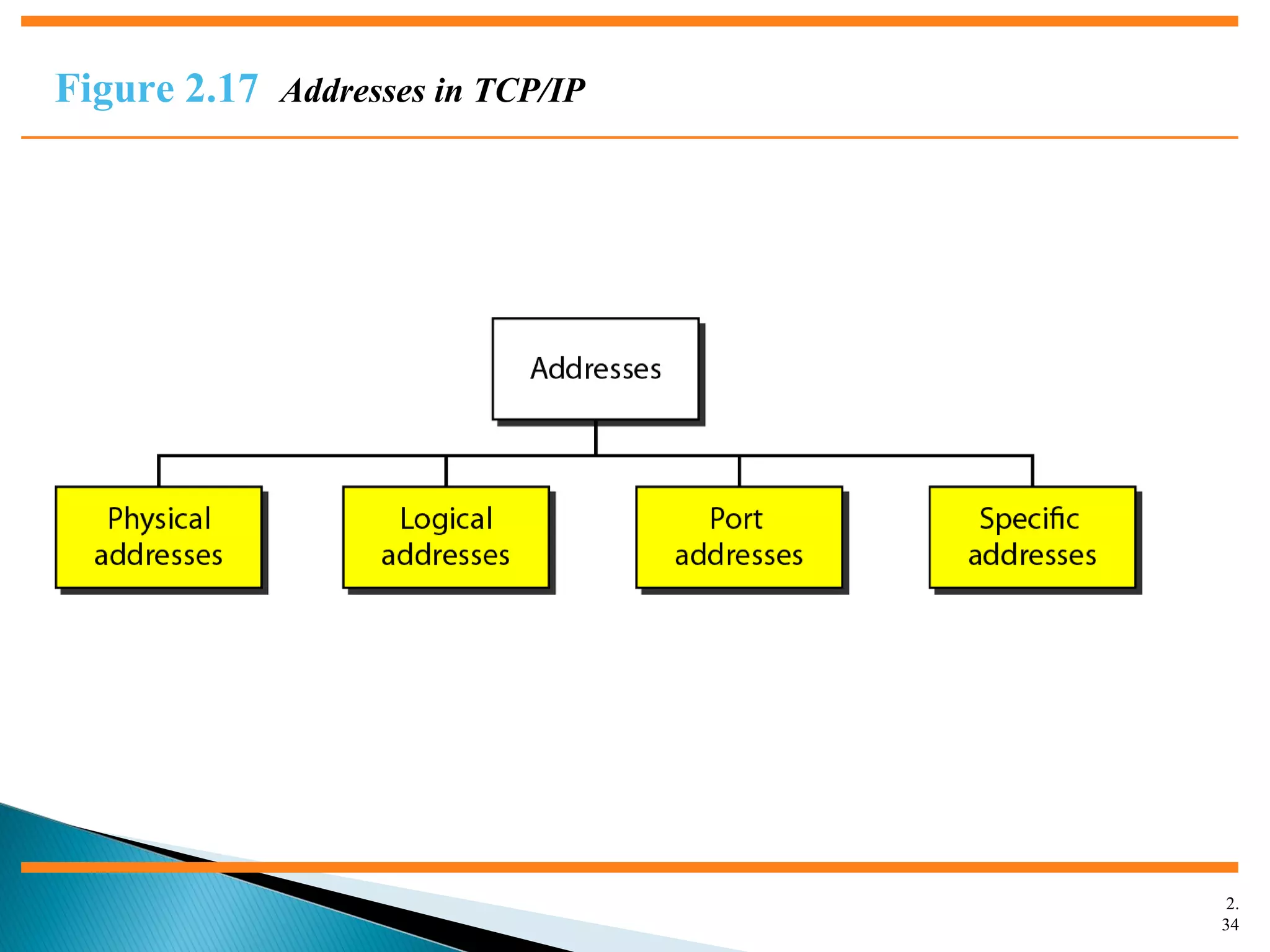
Four levels of addresses are used in an internet employingFour levels of addresses are used in an internet employing
the TCP/IP protocols:the TCP/IP protocols: physicalphysical,, logicallogical,, portport, and, and specificspecific..
Physical Addresses
Logical Addresses
Port Addresses
Specific Addresses
Topics discussed in this section:Topics discussed in this section:
2.
34
Figure 2.17 Addresses in TCP/IP
2.
35
Figure 2.18 Relationship of layers and addresses in TCP/IP
2.
36
In Figure 2.19 a node with physical address 10 sends a
frame to a node with physical address 87. The two nodes
are connected by a link (bus topology LAN). As the
figure shows, the computer with physical address 10 is
the sender, and the computer with physical address 87 is
the receiver.
Example 2.1
2.
37
Figure 2.19 Physical addresses
2.
38
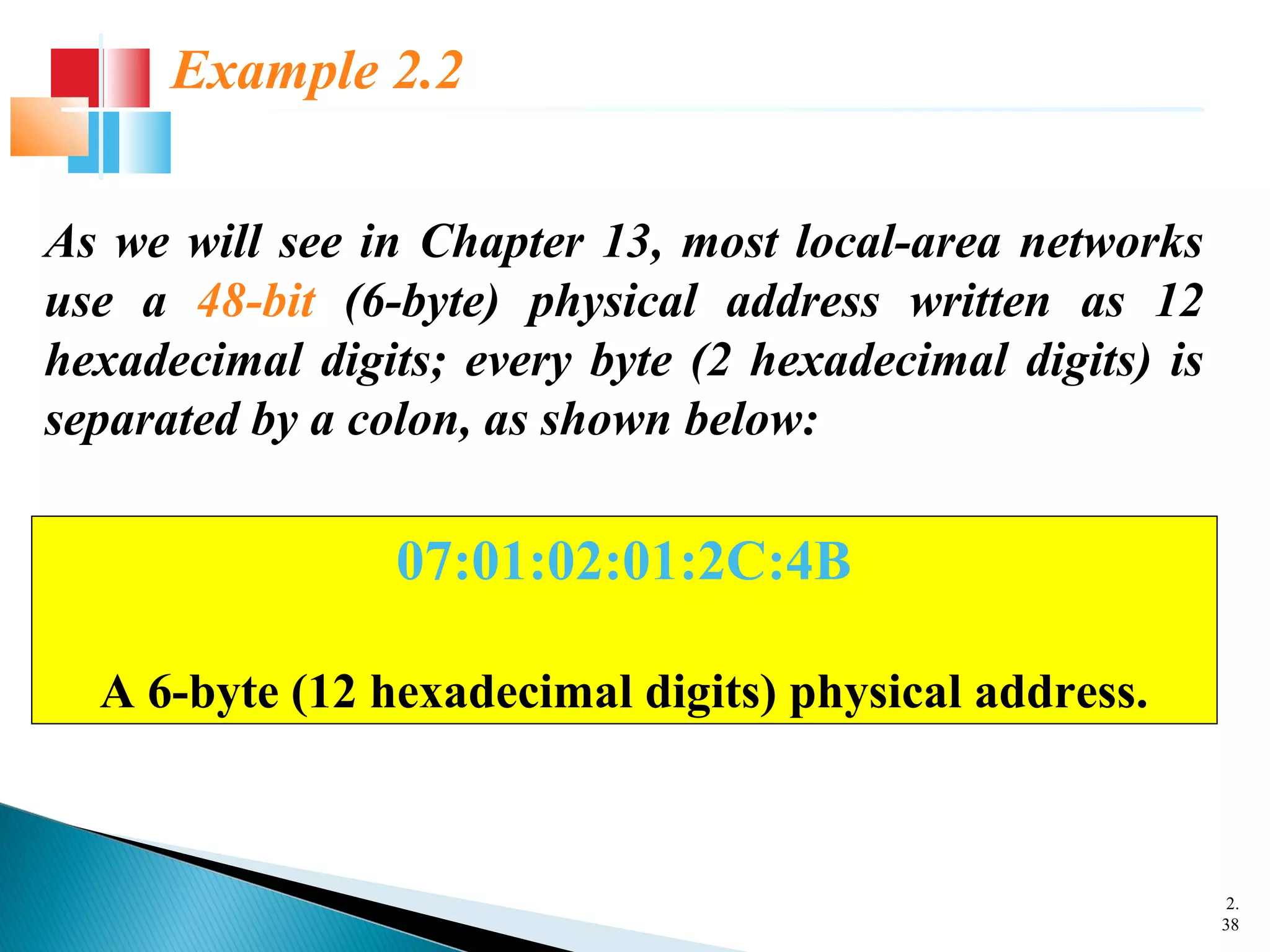
As we will see in Chapter 13, most local-area networks
use a 48-bit (6-byte) physical address written as 12
hexadecimal digits; every byte (2 hexadecimal digits) is
separated by a colon, as shown below:
Example 2.2
07:01:02:01:2C:4B
A 6-byte (12 hexadecimal digits) physical address.
2.
39
Figure 2.20 shows a part of an internet with two routers
connecting three LANs. Each device (computer or
router) has a pair of addresses (logical and physical) for
each connection. In this case, each computer is
connected to only one link and therefore has only one
pair of addresses. Each router, however, is connected to
three networks (only two are shown in the figure). So
each router has three pairs of addresses, one for each
connection.
Example 2.3
2.
40
Figure 2.21 shows two computers communicating via
the Internet. The sending computer is running three
processes at this time with port addresses a, b, and c. The
receiving computer is running two processes at this time
with port addresses j and k. Process a in the sending
computer needs to communicate with process j in the
receiving computer. Note that although physical
addresses change from hop to hop, logical and port
addresses remain the same from the source to
destination.
Example 2.4
2.
41
The physical addresses will change from hop to hop,
but the logical addresses usually remain the same.
Note
2.
42
Example 2.5
As we will see in Chapter 23, a port address is a 16-bit
address represented by one decimal number as shown.
753
A 16-bit port address represented
as one single number.
2.
43
The physical addresses change from hop to hop,
but the logical and port addresses usually remain the same.
Note

Osi model34

  • 1.
    Data communication andNetworks 2.1 Lecture -3 Network Models Copyright © The McGraw-Hill Companies, Inc. Permission required for reproduction or display.
  • 2.
    2.2 2-1 LAYERED TASKS2-1LAYERED TASKS We use the concept ofWe use the concept of layerslayers in our daily life. As anin our daily life. As an example, let us consider two friends who communicateexample, let us consider two friends who communicate through postal mail. The process of sending a letter to athrough postal mail. The process of sending a letter to a friend would be complex if there were no servicesfriend would be complex if there were no services available from the post office.available from the post office. Sender, Receiver, and Carrier Hierarchy Topics discussed in this section:Topics discussed in this section:
  • 3.
    2.3 Figure 2.1 Tasksinvolved in sending a letter
  • 4.
    2.4 2-2 THE OSIMODEL2-2 THE OSI MODEL Established in 1947, the International StandardsEstablished in 1947, the International Standards Organization (Organization (ISOISO) is a multinational body dedicated to) is a multinational body dedicated to worldwide agreement on international standards. An ISOworldwide agreement on international standards. An ISO standard that covers all aspects of networkstandard that covers all aspects of network communications is the Open Systems Interconnectioncommunications is the Open Systems Interconnection ((OSIOSI) model. It was first introduced in the late 1970s.) model. It was first introduced in the late 1970s. Layered Architecture Peer-to-Peer Processes Encapsulation Topics discussed in this section:Topics discussed in this section:
  • 5.
    2.5 ISO is theorganization. OSI is the model. Note
  • 6.
    2.6 Figure 2.2 Sevenlayers of the OSI model
  • 7.
    2.7 Figure 2.3 Theinteraction between layers in the OSI model
  • 8.
    2.8 Figure 2.4 Anexchange using the OSI model
  • 9.
    2.9 2-3 LAYERS INTHE OSI MODEL2-3 LAYERS IN THE OSI MODEL In this section we briefly describe the functions of eachIn this section we briefly describe the functions of each layer in the OSI model.layer in the OSI model. Physical Layer Data Link Layer Network Layer Transport Layer Session Layer Presentation Layer Application Layer Topics discussed in this section:Topics discussed in this section:
  • 10.
  • 11.
    2. 11 The physical layeris responsible for movements of individual bits from one hop (node) to the next. Representation of bits. Represent by (0 s&1 s)  Data rate :the number of bits sent each second . Note
  • 12.
  • 13.
    2. 13 The data linklayer is responsible for moving frames from one hop (node) to the next. Framing: divides the stream of bits into manageable data called frames. Note
  • 14.
  • 15.
  • 16.
    2. 16 The network layeris responsible to move packets from source to destination to provide networking Note
  • 17.
  • 18.
  • 19.
    2. 19 The transport layeris responsible for the delivery of a message from one process to another. Flow control Error control book Note
  • 20.
    2. 20 Figure 2.11 Reliableprocess-to-process delivery of a message
  • 21.
  • 22.
    2. 22 The session layeris responsible for dialog control and synchronization. Dialog control= It to allows the communication between two processes Note
  • 23.
  • 24.
    2. 24 The presentation layeris responsible for translation, encryption and compress data. Note
  • 25.
    2. 25 Translation . Theprocesses (running programs) in two systems are usually exchanging information in the form of character strings, numbers, and so on. Because different computers use different encoding systems. Encryption. To carry sensitive information a system must be able to assure privacy. Compression. Data compression reduces the number of bits contained in the information. such as text, audio, and video.
  • 26.
  • 27.
    2. 27 The application layeris responsible for providing services to the user. Note
  • 28.
  • 29.
  • 30.
  • 31.
    2. 31 2-4 TCP/IP PROTOCOLSUITE2-4 TCP/IP PROTOCOL SUITE The layers in theThe layers in the TCP/IP protocol suiteTCP/IP protocol suite do not exactlydo not exactly match those in the OSI model. The original TCP/IPmatch those in the OSI model. The original TCP/IP protocol suite was defined as having four layers:protocol suite was defined as having four layers: host-to-host-to- networknetwork,, internetinternet,, transporttransport, and, and applicationapplication. However,. However, when TCP/IP is compared to OSI, we can say that thewhen TCP/IP is compared to OSI, we can say that the TCP/IP protocol suite is made of five layers:TCP/IP protocol suite is made of five layers: physicalphysical,, data linkdata link,, networknetwork,, transporttransport, and, and applicationapplication.. Physical and Data Link Layers Network Layer Transport Layer Application Layer Topics discussed in this section:Topics discussed in this section:
  • 32.
  • 33.
    2. 33 2-5 ADDRESSING2-5 ADDRESSING Fourlevels of addresses are used in an internet employingFour levels of addresses are used in an internet employing the TCP/IP protocols:the TCP/IP protocols: physicalphysical,, logicallogical,, portport, and, and specificspecific.. Physical Addresses Logical Addresses Port Addresses Specific Addresses Topics discussed in this section:Topics discussed in this section:
  • 34.
  • 35.
    2. 35 Figure 2.18 Relationshipof layers and addresses in TCP/IP
  • 36.
    2. 36 In Figure 2.19a node with physical address 10 sends a frame to a node with physical address 87. The two nodes are connected by a link (bus topology LAN). As the figure shows, the computer with physical address 10 is the sender, and the computer with physical address 87 is the receiver. Example 2.1
  • 37.
  • 38.
    2. 38 As we willsee in Chapter 13, most local-area networks use a 48-bit (6-byte) physical address written as 12 hexadecimal digits; every byte (2 hexadecimal digits) is separated by a colon, as shown below: Example 2.2 07:01:02:01:2C:4B A 6-byte (12 hexadecimal digits) physical address.
  • 39.
    2. 39 Figure 2.20 showsa part of an internet with two routers connecting three LANs. Each device (computer or router) has a pair of addresses (logical and physical) for each connection. In this case, each computer is connected to only one link and therefore has only one pair of addresses. Each router, however, is connected to three networks (only two are shown in the figure). So each router has three pairs of addresses, one for each connection. Example 2.3
  • 40.
    2. 40 Figure 2.21 showstwo computers communicating via the Internet. The sending computer is running three processes at this time with port addresses a, b, and c. The receiving computer is running two processes at this time with port addresses j and k. Process a in the sending computer needs to communicate with process j in the receiving computer. Note that although physical addresses change from hop to hop, logical and port addresses remain the same from the source to destination. Example 2.4
  • 41.
    2. 41 The physical addresseswill change from hop to hop, but the logical addresses usually remain the same. Note
  • 42.
    2. 42 Example 2.5 As wewill see in Chapter 23, a port address is a 16-bit address represented by one decimal number as shown. 753 A 16-bit port address represented as one single number.
  • 43.
    2. 43 The physical addresseschange from hop to hop, but the logical and port addresses usually remain the same. Note