Chapter 15
Changing Obesity Policies and
Behavioral Risk Factors Through
Social Marketing: Case Study of the
Chicago 5-4-3-2-1 Go! Program
Learning Objectives
• Understand the relationship between social
marketing and ecological approaches to health.
• Understand how social marketing has been
applied in community-based settings to
prevent and control childhood obesity.
Learning Objectives
• Describe the evidence base for social
marketing in changing childhood obesity
community level policies and reducing
behavioral risk factors
• Apply social marketing strategies on an
introductory level to promote community-level
policy change
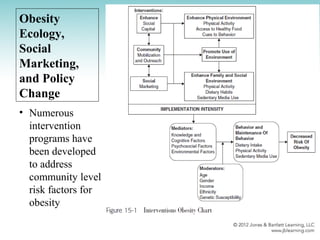
Obesity
Ecology,
Social
Marketing,
and Policy
Change
• Numerous
intervention
programs have
been developed
to address
community level
risk factors for
obesity
Obesity Ecology, Social Marketing,
and Policy Change
• The notion of influencing upstream environmental
factors and intervention strategies such as policy
change, as well as downstream individual behavior, is
now prominent in public health.
• Smoking intervention programs may provide a model
for future obesity prevention social marketing to
affect policy change
• There is now considerable agreement that escalating
rates of obesity can be tied to characteristics of the
environments in which people live
Obesity Ecology, Social Marketing,
and Policy Change
• There is now considerable agreement that escalating
rates of obesity can be tied to characteristics of the
environments in which people live
• Reducing environmental barriers can encourage
physical activity
• Many social marketing efforts have targeted parents
in order to encourage them to change the home health
environment and talk to their children about health
behaviors (5-4-3-2-1 Go!)
Obesity Ecology, Social Marketing,
and Policy Change
• Social marketing goes beyond individual-
focused health communication and uses
multiple interventions at the various ecological
levels
– Family
– Community
– Policy and Society
5-4-3-2-1 Go! Initiative
• Raise awareness of the local opportunities and
community-based services available to
promote healthy lifestyles
• Drive intent to participate in activities that
promote healthy lifestyles
• Increase year-round involvement in activities
that promote healthy lifestyles
5-4-3-2-1 Go! Initiative
• Raise awareness of Chicago as a city that is
tackling the obesity epidemic
• Raise awareness of CLOCC’s work among
corporations, community groups, and
grassroots organizations (CLOCC partners and
nonpartners) to engage them in program
activities and initiatives
5-4-3-2-1 Go! Initiative
• The 5-4-3-2-1 Go! brand includes key messages
about daily nutrition and physical activity
• It delivers its message in public service
announcements, in games taught by high school
volunteers to thousands of grade school children, in
trainings held for YMCA camp counselors and other
community child care workers, in clinical pediatrics
settings for resident physician training and goal-
setting by patient families, and in community events
5-4-3-2-1 Go! Initiative
• Important lessons can be learned from 5-4-3-2-
1 Go! that should be considered when
developing public health education campaigns
focused on healthy eating and physical activity
– Source credibility and message receptivity
– Culturally relevant health information sources
– Multipronged outreach strategies
– Community partners and “influentials”
Summary
• There are many opportunities to prevent
childhood obesity at several levels
– At the individual level, promotion and product
strategies
– At the family level, programs can reduce obesity
risk factors by changing parental behavior
– At the community level, social marketing is
effective at promoting nutrition and physical
activity among parents and children

Ch015

  • 2.
    Chapter 15 Changing ObesityPolicies and Behavioral Risk Factors Through Social Marketing: Case Study of the Chicago 5-4-3-2-1 Go! Program
  • 3.
    Learning Objectives • Understandthe relationship between social marketing and ecological approaches to health. • Understand how social marketing has been applied in community-based settings to prevent and control childhood obesity.
  • 4.
    Learning Objectives • Describethe evidence base for social marketing in changing childhood obesity community level policies and reducing behavioral risk factors • Apply social marketing strategies on an introductory level to promote community-level policy change
  • 5.
    Obesity Ecology, Social Marketing, and Policy Change • Numerous intervention programshave been developed to address community level risk factors for obesity
  • 6.
    Obesity Ecology, SocialMarketing, and Policy Change • The notion of influencing upstream environmental factors and intervention strategies such as policy change, as well as downstream individual behavior, is now prominent in public health. • Smoking intervention programs may provide a model for future obesity prevention social marketing to affect policy change • There is now considerable agreement that escalating rates of obesity can be tied to characteristics of the environments in which people live
  • 7.
    Obesity Ecology, SocialMarketing, and Policy Change • There is now considerable agreement that escalating rates of obesity can be tied to characteristics of the environments in which people live • Reducing environmental barriers can encourage physical activity • Many social marketing efforts have targeted parents in order to encourage them to change the home health environment and talk to their children about health behaviors (5-4-3-2-1 Go!)
  • 8.
    Obesity Ecology, SocialMarketing, and Policy Change • Social marketing goes beyond individual- focused health communication and uses multiple interventions at the various ecological levels – Family – Community – Policy and Society
  • 9.
    5-4-3-2-1 Go! Initiative •Raise awareness of the local opportunities and community-based services available to promote healthy lifestyles • Drive intent to participate in activities that promote healthy lifestyles • Increase year-round involvement in activities that promote healthy lifestyles
  • 10.
    5-4-3-2-1 Go! Initiative •Raise awareness of Chicago as a city that is tackling the obesity epidemic • Raise awareness of CLOCC’s work among corporations, community groups, and grassroots organizations (CLOCC partners and nonpartners) to engage them in program activities and initiatives
  • 11.
    5-4-3-2-1 Go! Initiative •The 5-4-3-2-1 Go! brand includes key messages about daily nutrition and physical activity • It delivers its message in public service announcements, in games taught by high school volunteers to thousands of grade school children, in trainings held for YMCA camp counselors and other community child care workers, in clinical pediatrics settings for resident physician training and goal- setting by patient families, and in community events
  • 12.
    5-4-3-2-1 Go! Initiative •Important lessons can be learned from 5-4-3-2- 1 Go! that should be considered when developing public health education campaigns focused on healthy eating and physical activity – Source credibility and message receptivity – Culturally relevant health information sources – Multipronged outreach strategies – Community partners and “influentials”
  • 13.
    Summary • There aremany opportunities to prevent childhood obesity at several levels – At the individual level, promotion and product strategies – At the family level, programs can reduce obesity risk factors by changing parental behavior – At the community level, social marketing is effective at promoting nutrition and physical activity among parents and children