Chapter 1 Strategic Implications of a Dynamic HRM Environment Fundamentals of Human Resource Management Eighth Edition DeCenzo and Robbins
Introduction   The World of Work - continues to change, but at an even more rapid pace.  HR must understand the implications of: globalization technology changes workforce diversity changing skill requirements continuous improvement initiatives the contingent work force decentralized work sites and employee involvement
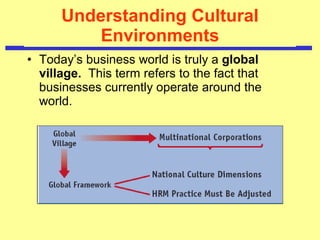
Understanding Cultural Environments Today’s business world is truly a  global village.  This term refers to the fact that businesses currently operate around the world.
Understanding Cultural Environments HRM must ensure that employees can operate in the appropriate language  communications are understood by a multilingual work force Ensure that workers can operate in cultures that differ on variables such as status differentiation societal uncertainty assertiveness individualism HRM also must help multicultural groups work together.
Understanding Cultural Environments GLOBE Dimensions: Assertiveness Future Orientation Gender Differentiation Uncertainty Avoidance Power Distance Individualism/collectivism In-group collectivism Performance orientation Humane orientation
Understanding Cultural Environments Cultural Implications for HRM Not all HRM theories and practices are universally applicable. HRM must understand varying cultural values.
The Changing World of Technology Has altered the way people work.  Has changed the way information is created, stored, used, and shared. The move from agriculture to industrialization created a new group of workers – the blue-collar industrial worker. Since WWII, the trend has been a reduction in manufacturing work and an increase in service jobs.
The Changing World of Technology Knowledge Worker  -  individuals whose jobs are designed around the acquisition and application of information.   Why the emphasis on technology: makes organizations more productive helps them create and maintain a competitive advantage provides better, more useful information
The Changing World of Technology How Technology Affects HRM Practices   Recruiting Employee Selection Training and Development Ethics and Employee Rights Motivating Knowledge Workers Paying Employees Market Value Communication Decentralized Work Sites Skill Levels Legal Concerns
Workforce Diversity The challenge is to make organizations more accommodating to diverse groups of people.
Workforce Diversity The Workforce Today  minorities and women have become the fastest growing segments the numbers of immigrant workers and older workers are increasing
Workforce Diversity How Diversity Affects HRM   Need to attract and maintain a diversified work force that is reflective of the diversity in the general population.  Need to foster increased sensitivity to group differences.  Must deal with the different Values Needs Interests Expectations of employees
Workforce Diversity What Is a Work/Life Balance ? A balance between personal life and work Causes of the blur between work and life The creation of global organizations means the world never sleeps. Communication technologies allow employees to work at home. Organizations are asking employees to put in longer hours. Fewer families have a single breadwinner.
Labor Supply Do We Have a Shortage of Skilled Labor?   The already high participation rate of women in the workforce, and early retirements will lead to a significantly smaller future labor pool from which employers can hire.
Labor Supply Why Do Organizations Lay Off During Shortages?   Downsizing  is part of a larger goal of balancing staff to meet changing needs.  Organizations want more flexibility to better respond to change.  This is often referred to as  rightsizing , linking employee needs to organizational strategy.
Labor Supply How Do Organizations Balance Labor Supply?   Organizations are increasingly using  contingent workers  to respond to fluctuating needs for employees.  Contingent workers include Part-time workers Temporary workers Contract workers
Labor Supply
Labor Supply Issues Contingent Workers Create for HRM   How to attract quality temporaries   How to motivate employees who are receiving less pay and benefits   How to have them available when needed   How to quickly adapt them to the organization   How to deal with potential conflicts between core and contingent workers
Continuous Improvement Programs Continuous improvement  - making constant efforts to provide better products and service to customers External Internal Quality management concepts have existed for over 50 years and include the pioneering work of W. Edwards Deming.
Continuous Improvement Programs Key components of  continuous improvement  are : Focus on the customer   Concern for continuous improvement   Improvement in the quality of everything   Accurate measurement Empowerment of employees
Continuous Improvement Programs Work Process Engineering  involves radical, quantum changes to entire work processes.   How HRM Assists in Work Process Engineering   Helps employees deal with the emotional aspects of conflict and change Provides skills training Adapts HR systems, such as compensation, benefits, and performance standards.
Employee Involvement Delegation  – having the authority to make decisions in one’s job Work teams  – workers of various specializations who work together in an organization  HRM must provide training to help empower employees in their new roles.  Involvement programs can achieve: greater productivity increased employee loyalty and commitment
A Look at Ethics Code of ethics  - a formal document that states an organization’s primary values and the ethical rules it expects organizational members to follow.

Ch01

  • 1.
    Chapter 1 StrategicImplications of a Dynamic HRM Environment Fundamentals of Human Resource Management Eighth Edition DeCenzo and Robbins
  • 2.
    Introduction The World of Work - continues to change, but at an even more rapid pace. HR must understand the implications of: globalization technology changes workforce diversity changing skill requirements continuous improvement initiatives the contingent work force decentralized work sites and employee involvement
  • 3.
    Understanding Cultural EnvironmentsToday’s business world is truly a global village. This term refers to the fact that businesses currently operate around the world.
  • 4.
    Understanding Cultural EnvironmentsHRM must ensure that employees can operate in the appropriate language communications are understood by a multilingual work force Ensure that workers can operate in cultures that differ on variables such as status differentiation societal uncertainty assertiveness individualism HRM also must help multicultural groups work together.
  • 5.
    Understanding Cultural EnvironmentsGLOBE Dimensions: Assertiveness Future Orientation Gender Differentiation Uncertainty Avoidance Power Distance Individualism/collectivism In-group collectivism Performance orientation Humane orientation
  • 6.
    Understanding Cultural EnvironmentsCultural Implications for HRM Not all HRM theories and practices are universally applicable. HRM must understand varying cultural values.
  • 7.
    The Changing Worldof Technology Has altered the way people work. Has changed the way information is created, stored, used, and shared. The move from agriculture to industrialization created a new group of workers – the blue-collar industrial worker. Since WWII, the trend has been a reduction in manufacturing work and an increase in service jobs.
  • 8.
    The Changing Worldof Technology Knowledge Worker - individuals whose jobs are designed around the acquisition and application of information. Why the emphasis on technology: makes organizations more productive helps them create and maintain a competitive advantage provides better, more useful information
  • 9.
    The Changing Worldof Technology How Technology Affects HRM Practices Recruiting Employee Selection Training and Development Ethics and Employee Rights Motivating Knowledge Workers Paying Employees Market Value Communication Decentralized Work Sites Skill Levels Legal Concerns
  • 10.
    Workforce Diversity Thechallenge is to make organizations more accommodating to diverse groups of people.
  • 11.
    Workforce Diversity TheWorkforce Today minorities and women have become the fastest growing segments the numbers of immigrant workers and older workers are increasing
  • 12.
    Workforce Diversity HowDiversity Affects HRM Need to attract and maintain a diversified work force that is reflective of the diversity in the general population. Need to foster increased sensitivity to group differences. Must deal with the different Values Needs Interests Expectations of employees
  • 13.
    Workforce Diversity WhatIs a Work/Life Balance ? A balance between personal life and work Causes of the blur between work and life The creation of global organizations means the world never sleeps. Communication technologies allow employees to work at home. Organizations are asking employees to put in longer hours. Fewer families have a single breadwinner.
  • 14.
    Labor Supply DoWe Have a Shortage of Skilled Labor? The already high participation rate of women in the workforce, and early retirements will lead to a significantly smaller future labor pool from which employers can hire.
  • 15.
    Labor Supply WhyDo Organizations Lay Off During Shortages? Downsizing is part of a larger goal of balancing staff to meet changing needs. Organizations want more flexibility to better respond to change. This is often referred to as rightsizing , linking employee needs to organizational strategy.
  • 16.
    Labor Supply HowDo Organizations Balance Labor Supply? Organizations are increasingly using contingent workers to respond to fluctuating needs for employees. Contingent workers include Part-time workers Temporary workers Contract workers
  • 17.
  • 18.
    Labor Supply IssuesContingent Workers Create for HRM How to attract quality temporaries How to motivate employees who are receiving less pay and benefits How to have them available when needed How to quickly adapt them to the organization How to deal with potential conflicts between core and contingent workers
  • 19.
    Continuous Improvement ProgramsContinuous improvement - making constant efforts to provide better products and service to customers External Internal Quality management concepts have existed for over 50 years and include the pioneering work of W. Edwards Deming.
  • 20.
    Continuous Improvement ProgramsKey components of continuous improvement are : Focus on the customer Concern for continuous improvement Improvement in the quality of everything Accurate measurement Empowerment of employees
  • 21.
    Continuous Improvement ProgramsWork Process Engineering involves radical, quantum changes to entire work processes. How HRM Assists in Work Process Engineering Helps employees deal with the emotional aspects of conflict and change Provides skills training Adapts HR systems, such as compensation, benefits, and performance standards.
  • 22.
    Employee Involvement Delegation – having the authority to make decisions in one’s job Work teams – workers of various specializations who work together in an organization HRM must provide training to help empower employees in their new roles. Involvement programs can achieve: greater productivity increased employee loyalty and commitment
  • 23.
    A Look atEthics Code of ethics - a formal document that states an organization’s primary values and the ethical rules it expects organizational members to follow.