External Assessment
Methods
Submitted to: Ms. Zeenat Shahana
Lecturer
Department of HRM
Premier University
Name ID
Sartaj Noor 1403010107855
External Assessment
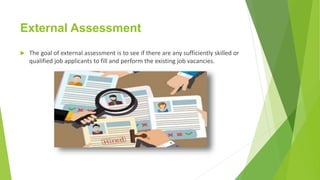
 The goal of external assessment is to see if there are any sufficiently skilled or
qualified job applicants to fill and perform the existing job vacancies.
A wide variety of external assessment methods exist
including:
1. Screening Assessment Methods
2. Evaluative Assessment Methods
3. Contingent Assessment Methods
Screening Assessment Methods
These are used to narrow a pool of job applicants down to
a smaller group of job candidates. These include:
a) Resumes and cover letters
b) Job applications
c) Weighted application blanks
d) Bio data
 Resumes and cover letters
 Applicants volunteer information about themselves and their
interest in the position in a cover letter, and provide a resume
summarizing relevant education, work and nonwork experiences.
 It is important to confirm the accuracy of any resume
information as it will be used to make hiring decisions. Many
firms now use automated resume scanning and screening
software.
 Job applications
 These are forms that require applicants to provide written
information about their skills and education, job experiences and
other job relevant information.
 They help to ensure that consistent information is collected.
 To standardize the information collected, some organizations are
now using online applications which are fast and cost- efficient.
 Weighted application blanks
 It is a job application on which different information receives
different weights, i.e. weighted values are assigned to each
relevant question.
 A weighted scoring system or key is used to evaluate the answers
of applicants.
 It is well received by applicants, relatively inexpensive and easy
to use.
 Bio data
 It consists information about candidates’ interests, work
experiences, training and education.
 It is collected via questionnaires that allow people to describe
more personal aspects about themselves.
 For ethical and legal reasons, bio data items should not be
intrusive or make the respondent uncomfortable, i.e. it should
not inquire about activities or events over which the individual
has no control.
sassDifference between job application, weighted
application blank and bio- data
 Job applications are the forms job applicants complete to
provide information about themselves
 Weighted application blanks look like regular job application
forms but the applicants’ responses are scored and combined to
determine the individual’s fit with the job and organization
 When items on a job application are evaluated to predict job
success, these items become bio-data.
Evaluative Assessment Methods
These are used to evaluate the pool of job candidates to
determine who will be hired. These include:
a) Cognitive and non- cognitive ability tests
b) Integrity tests
c) Polygraph tests
d) Interviews
 Cognitive and non-cognitive ability tests
 Cognitive ability tests are computerized
or paper- and- pencil tests that assess a
person’s general mental abilities
including verbal and mathematical
reasoning, logic and perceptual abilities.
 These are used for jobs that require
innovation and continual training.
 Non-cognitive ability tests include:
a) Psychomotor tests that assess the capacity of
a person to control objects (arm- hand
steadiness)
b) Sensory tests that assess visual, auditory and
speech perception (ability to discriminate
colors)
c) Physical ability tests that assess a physical
abilities (strength/flexibility)
For example, firefighters must be able to carry
heavy hoses up stairs.
 Applicants often dislike these tests
because they do not seem job related.
• They are highly valid, well received by
applicants and easy to use.
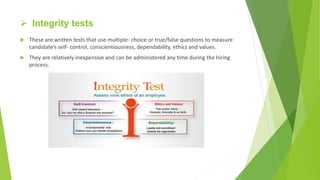
 Integrity tests
 These are written tests that use multiple- choice or true/false questions to measure
candidate’s self- control, conscientiousness, dependability, ethics and values.
 They are relatively inexpensive and can be administered any time during the hiring
process.
 Polygraph tests
 It measures and records physiological factors which are thought to be indicators of
anxiety, including a candidate’s blood pressure, respiration and pulse while s/he
answers a series of questions.
 Polygraphs are thought to assess lying and honesty because anxiety often
accompanies the telling of lies.
 Interviews
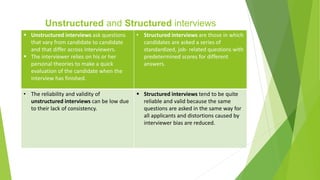
Unstructured and Structured interviews
 Unstructured interviews ask questions
that vary from candidate to candidate
and that differ across interviewers.
 The interviewer relies on his or her
personal theories to make a quick
evaluation of the candidate when the
interview has finished.
• Structured interviews are those in which
candidates are asked a series of
standardized, job- related questions with
predetermined scores for different
answers.
• The reliability and validity of
unstructured interviews can be low due
to their lack of consistency.
 Structured interviews tend to be quite
reliable and valid because the same
questions are asked in the same way for
all applicants and distortions caused by
interviewer bias are reduced.
Behavioral and situational interviews
The choice of behavioral or situational interview depends on the prior work experience of
candidates.
 Behavioral interviews are useful to evaluate candidates who have employment
experience.
 Situational interviews are useful to evaluate candidates with limited work experience.
Behavioral interviews are those that
use information about what the
applicants have done in the past to
predict their future behaviors.
Situational interviews involves asking
candidates how they might react to
hypothetical situations.
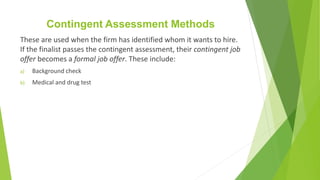
Contingent Assessment Methods
These are used when the firm has identified whom it wants to hire.
If the finalist passes the contingent assessment, their contingent job
offer becomes a formal job offer. These include:
a) Background check
b) Medical and drug test
 Background check
 It assesses factors such as a candidate’s personal and credit information,
character, lifestyle, criminal history and general reputation.
 It is used in many industries, including financial services, health care, childcare
and eldercare.
 Employers must tell candidates that background checks will be conducted and
the candidates must first give their written consent.
 Medical and drug test
It can give the following information:
 Whether the applicant is medically fit for the specific job or not;
 Whether the applicant has any psychological problem likely to interfere with
work efficiency; and
 Whether the applicant suffers from any physical disability which should be
healed before he can work satisfactorily.
External assessment methods

External assessment methods

  • 1.
    External Assessment Methods Submitted to:Ms. Zeenat Shahana Lecturer Department of HRM Premier University
  • 2.
    Name ID Sartaj Noor1403010107855
  • 3.
    External Assessment  Thegoal of external assessment is to see if there are any sufficiently skilled or qualified job applicants to fill and perform the existing job vacancies.
  • 4.
    A wide varietyof external assessment methods exist including: 1. Screening Assessment Methods 2. Evaluative Assessment Methods 3. Contingent Assessment Methods
  • 5.
    Screening Assessment Methods Theseare used to narrow a pool of job applicants down to a smaller group of job candidates. These include: a) Resumes and cover letters b) Job applications c) Weighted application blanks d) Bio data
  • 6.
     Resumes andcover letters  Applicants volunteer information about themselves and their interest in the position in a cover letter, and provide a resume summarizing relevant education, work and nonwork experiences.  It is important to confirm the accuracy of any resume information as it will be used to make hiring decisions. Many firms now use automated resume scanning and screening software.
  • 7.
     Job applications These are forms that require applicants to provide written information about their skills and education, job experiences and other job relevant information.  They help to ensure that consistent information is collected.  To standardize the information collected, some organizations are now using online applications which are fast and cost- efficient.
  • 8.
     Weighted applicationblanks  It is a job application on which different information receives different weights, i.e. weighted values are assigned to each relevant question.  A weighted scoring system or key is used to evaluate the answers of applicants.  It is well received by applicants, relatively inexpensive and easy to use.
  • 9.
     Bio data It consists information about candidates’ interests, work experiences, training and education.  It is collected via questionnaires that allow people to describe more personal aspects about themselves.  For ethical and legal reasons, bio data items should not be intrusive or make the respondent uncomfortable, i.e. it should not inquire about activities or events over which the individual has no control.
  • 10.
    sassDifference between jobapplication, weighted application blank and bio- data  Job applications are the forms job applicants complete to provide information about themselves  Weighted application blanks look like regular job application forms but the applicants’ responses are scored and combined to determine the individual’s fit with the job and organization  When items on a job application are evaluated to predict job success, these items become bio-data.
  • 11.
    Evaluative Assessment Methods Theseare used to evaluate the pool of job candidates to determine who will be hired. These include: a) Cognitive and non- cognitive ability tests b) Integrity tests c) Polygraph tests d) Interviews
  • 12.
     Cognitive andnon-cognitive ability tests  Cognitive ability tests are computerized or paper- and- pencil tests that assess a person’s general mental abilities including verbal and mathematical reasoning, logic and perceptual abilities.  These are used for jobs that require innovation and continual training.  Non-cognitive ability tests include: a) Psychomotor tests that assess the capacity of a person to control objects (arm- hand steadiness) b) Sensory tests that assess visual, auditory and speech perception (ability to discriminate colors) c) Physical ability tests that assess a physical abilities (strength/flexibility) For example, firefighters must be able to carry heavy hoses up stairs.  Applicants often dislike these tests because they do not seem job related. • They are highly valid, well received by applicants and easy to use.
  • 13.
     Integrity tests These are written tests that use multiple- choice or true/false questions to measure candidate’s self- control, conscientiousness, dependability, ethics and values.  They are relatively inexpensive and can be administered any time during the hiring process.
  • 14.
     Polygraph tests It measures and records physiological factors which are thought to be indicators of anxiety, including a candidate’s blood pressure, respiration and pulse while s/he answers a series of questions.  Polygraphs are thought to assess lying and honesty because anxiety often accompanies the telling of lies.
  • 15.
  • 16.
    Unstructured and Structuredinterviews  Unstructured interviews ask questions that vary from candidate to candidate and that differ across interviewers.  The interviewer relies on his or her personal theories to make a quick evaluation of the candidate when the interview has finished. • Structured interviews are those in which candidates are asked a series of standardized, job- related questions with predetermined scores for different answers. • The reliability and validity of unstructured interviews can be low due to their lack of consistency.  Structured interviews tend to be quite reliable and valid because the same questions are asked in the same way for all applicants and distortions caused by interviewer bias are reduced.
  • 17.
    Behavioral and situationalinterviews The choice of behavioral or situational interview depends on the prior work experience of candidates.  Behavioral interviews are useful to evaluate candidates who have employment experience.  Situational interviews are useful to evaluate candidates with limited work experience. Behavioral interviews are those that use information about what the applicants have done in the past to predict their future behaviors. Situational interviews involves asking candidates how they might react to hypothetical situations.
  • 18.
    Contingent Assessment Methods Theseare used when the firm has identified whom it wants to hire. If the finalist passes the contingent assessment, their contingent job offer becomes a formal job offer. These include: a) Background check b) Medical and drug test
  • 19.
     Background check It assesses factors such as a candidate’s personal and credit information, character, lifestyle, criminal history and general reputation.  It is used in many industries, including financial services, health care, childcare and eldercare.  Employers must tell candidates that background checks will be conducted and the candidates must first give their written consent.
  • 20.
     Medical anddrug test It can give the following information:  Whether the applicant is medically fit for the specific job or not;  Whether the applicant has any psychological problem likely to interfere with work efficiency; and  Whether the applicant suffers from any physical disability which should be healed before he can work satisfactorily.