www.thehrdirector.com 100% no paid for editorial
RECRUITMENT Deficiencies in
science and engineering is choking
the UK economy. STEM careers
must be more positively promoted
STRATEGICWORKFORCEMANAGEMENT
Hierarchical structures inherited
from the industrial age are entirely
inappropriate today
PENSIONPLANNING Highest
percentage of opt out rates in
auto-enrolment are 22-30 year olds.
Engaging the young is failing
THOUGHTLEADERSHIP Buyer beware?
Most thought leaders are not
attempting to sell snake oil, they
believe themselves to be right
ALSO FEATURED IN THIS ISSUE
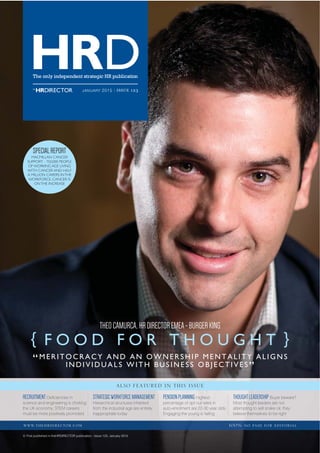
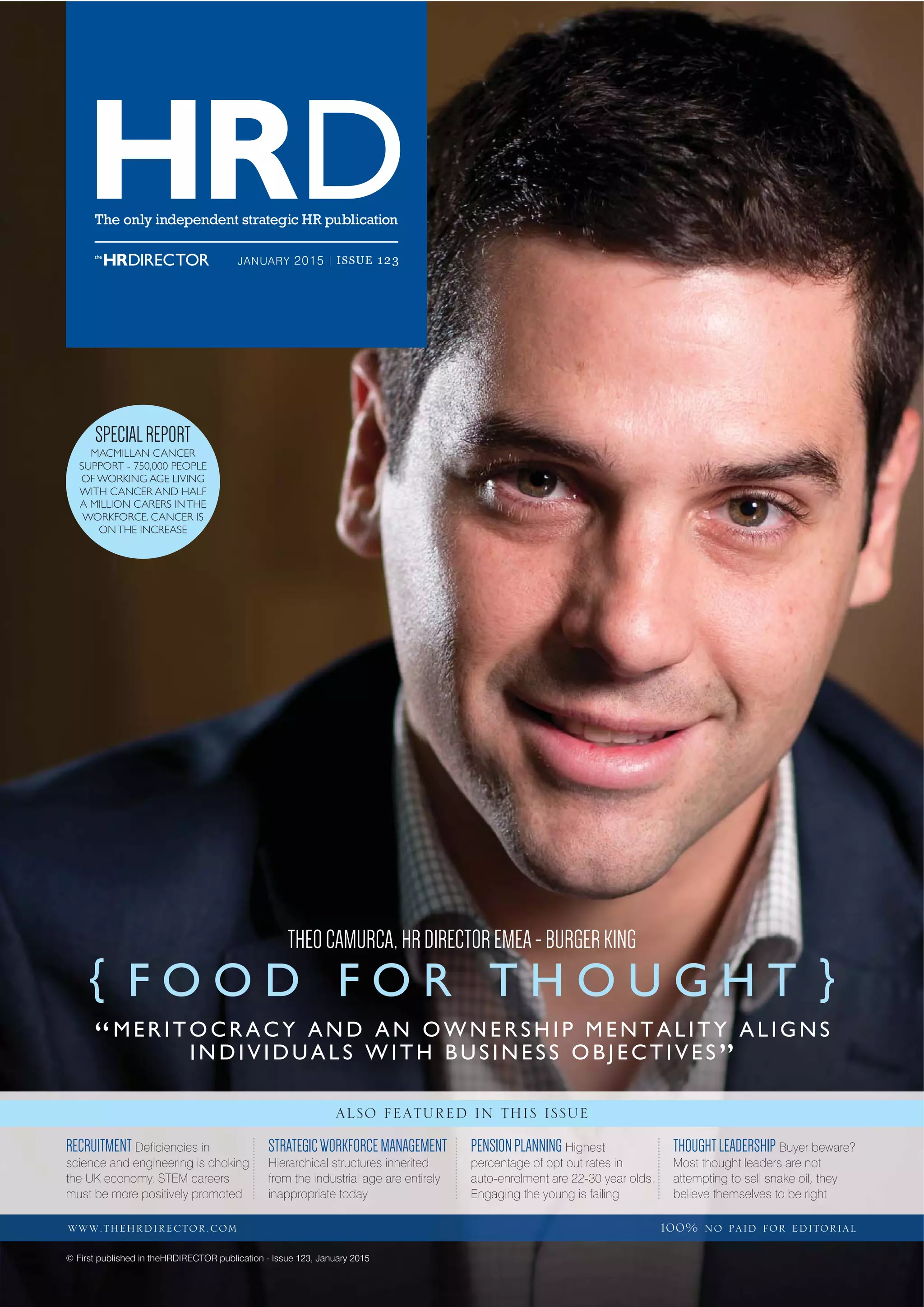
THEOCAMURCA,HRDIRECTOREMEA-BURGERKING
{ F O O D F O R T H O U G H T }
“MERITOC R AC Y AND AN OWNERSHIP MENTALITY ALIGN S
IND I V I D U ALS W ITH BUSINESS OBJECTIVES ”
HRDthe
HRDIRECTOR
The only independent strategic HR publication
JANUARY 2015 I ISSUE 123
SPECIALREPORT
MACMILLAN CANCER
SUPPORT - 750,000 PEOPLE
OF WORKING AGE LIVING
WITH CANCER AND HALF
A MILLION CARERS INTHE
WORKFORCE. CANCER IS
ONTHE INCREASE
© First published in theHRDIRECTOR publication - Issue 123, January 2015
28 thehrdirector JANUARY 2015
feature STRATEGIC WORKFORCE MANAGEMENT
What we do know is that those trends, among
others, are transforming how firms organise
themselves, and the dynamics of the
employment market. In short; how, where and
when people work. However, in many
organisations, the HR department is not
evolving at the same pace. There is a huge
opportunity ahead for HR professionals. But you
better start swimmin’, or you’ll sink like a stone.
A recent survey by McKinsey found that nine
out of ten executives ranked organisational
agility both as critical to business success and
as growing in importance over time. The
message is clear: to survive in an environment
where technologies, knowledge and business
models become obsolete in the blink of an eye,
organisations need to be agile. They must be
capable of integrating, building and
reconfiguring competences to adapt to rapidly
changing environments. The evolution of data
processing and communication technologies
is dramatically reducing transaction costs.
As a result, organisations can now get things
done by being more innovative, more dynamic
and more agile. As Clay Shirky says, “most of
the barriers to group action have collapsed,
and without those barriers, we are now free to
explore new ways of gathering together and
getting things done.”
However, many organisations stick blindly
to rigid workflows and hierarchical structures
inherited from the industrial age, designed to
maximise efficiency or quality in relatively stable
environments. In turbulent times, you need to
be more agile. Fortunately, many organisations
understand that there are alternative models,
more suitable for complex, volatile and
uncertain situations. For example, some
organisations flatten their hierarchies to bring
the voice of customers closer to their
executives, empower their employees to take
more decisions and allow employees the
chance of customising their work through job
crafting programmes. Others introduce social
networking platforms to promote collaboration
and a culture of transparency. Some make their
organisations more open to their environment,
crowd-source some of their business processes,
or increase the proportion of external talent they
work with; tapping into online workplaces to hire
and work with the best freelance professionals
the world has to offer. And a few organise their
teams in co-working spaces where they can
breathe fresh air, see the world with new eyes
and be disruptive.
Of course, not all organisations are equally
successful in these initiatives. Inertia is
common in larger, older and more hierarchical
organisations. Sometimes the blockers derive
from the individual interests of leaders not
Bob Dylan once famously urged: “keep your eyes wide, the chance
won’t come again”. Admittedly, his fifty-year-old protest song wasn’t
written specifically for HR professionals, but the sentiment is still sound.
It’s time to “admit that the waters around you have grown”. Nobody seems
to know for sure where phenomena like the digital revolution, an ageing
population, globalisation and the shift in society’s values will lead us.
STRATEGIC
WORKFORCE
PLANNING
your old road
is rapidly agein’
ARTICLE BY SANTIAGO GARCIA, MANAGING DIRECTOR - IOPENER INSTITUTE
JANUARY 2015 thehrdirector 29
www.thehrdirector.com
ORGANISATIONS
STICK BLINDLY
TO RIGID
WORKFLOWS AND
HIERARCHICAL
STRUCTURES
INHERITED FROM
THE INDUSTRIAL
AGE, DESIGNED
TO MAXIMISE
EFFICIENCY IN
RELATIVELY
STABLE
ENVIRONMENTS.
IN TURBULENT
TIMES, YOU NEED
TO BE MORE
AGILE
willing to stray from their comfort zones, and
sometimes from compensation structures that are
often designed to reward short-term achievements
rather than the development of organisational agility.
Some organisational setups and people management
practices are the result of isomorphic forces such as
trotting out standard responses in an uncertain
environment because there’s no clear best option,
conformity leading to professionalisation, or the
imitation of what managers consider best practices -
best practices that don’t exist in a volatile, uncertain,
complex and ambiguous environment. But for a world
in permanent beta, a good solution for one
organisation may not work when implemented in
a different organisational context. It could even have
a detrimental effect. Many managers become
prisoners of cognitive frames of their own building.
These have been developed throughout their
professional lives as a result of the education they
have received, the behaviours they have copied and
the solutions that may have worked for them in the
past. But it is madness to believe that applying these
cognitive frames in a radically different context will
achieve the same results.
The world has changed and today’s leaders
need to balance apparently contradictory priorities
such as control and agility, efficiency and flexibility,
security and resilience. We are heading towards
a future where leaders cannot have answers to all the
problems. Nor can they have everything under
control. We face a future where organisations cannot
be managed as machines, but as complex adaptive
systems whose behaviour cannot be explained as the
sum of the behaviours of their components, and
where cause and effect relationships are not
commonplace. This brave new world of work is made
up of complex roles where the difference between the
contribution of a top performer and the contribution
of the average employee is much wider than for the
simpler roles of the past. A world in which
organisations and countries are fighting a global war
for the best talent. Talent which is less dependent on
organisations for employment, is looking for
meaningful jobs and has ready information about
what working for a specific organisation is like. We
are in the era of the "Knowmads", a term coined by
John Moravec to refer to a new class of knowledge
professionals who, thanks to technology, can work
with anybody, anytime, anywhere.
It is also a world in which organisations require
employees to have more than just technical expertise,
loyalty and obedience. As Gary Hamel, founder of
Strategos once said: “In a world where customers
wake up every morning asking, ‘What’s new, what’s
different, and what’s amazing?’ success depends on
a company’s ability to unleash the initiative,
imagination, and passion of employees at all levels”.
And since most people act under the influence of
their emotions, it is a world in which organisations
need to pay more attention to another important
element: employees’ “psychological capital” - how
happy people are at work. We have to remember that
FOR FURTHER INFO
www.iopenerinstitute.com
people are not like technologies, processes,
or business strategies that become obsolete at an
accelerated pace and can be easily copied. An
organisation’s human, social, and psychological
capitals form a highly complex social system
developed over time. This is difficult for competitors
to observe, analyse, understand and imitate.
Everything suggests that we are moving towards
a future where people - and people management -
may become the ultimate source of competitiveness
for more organisations.
This situation offers HR professionals the
opportunity to contribute to the competitiveness of
their organisations. And therefore truly be “strategic”.
Their privileged perspective means they can leverage
to help their organisations gain self-awareness,
question their past patterns of behaviour and develop
a suite of human competencies that sets the
organisation apart from its competitors. For instance,
the HR department can enhance the potential for
innovation within an organisation by implementing
diversity programmes, fostering a change in attitudes
towards failure or mobilising the talent of a greater
number of people through collaborative work and
knowledge management initiatives.
In terms of adaptability, HR can of course
facilitate the assimilation of new technologies and
other changes. But beyond that, the HR department
may stop being the voice of Orthodoxy and start
being a function that enables the organisation to be a
little less structured, hierarchical and rigid-minded.
For example, let HR be the voice that challenges
decisions that benefit the efficiency of the
organisation at the expense of its resilience; or
question exaggerated investments in risk prevention
that in the long run leave people underprepared to
deal with adverse situations. HR professionals can
also help the leaders of an organisation abandon the
culture of control and distrust on which the
governance structures of many organisations are still
based, embracing a vision of the organisation as a
community of people. A community whose leaders,
rather than being controllers and decision makers,
act as architects and catalysers of relational contexts
in which people come and go and work
autonomously.
And last but not least, HR can contribute in ways
that transcend the boundaries of the organisation:
playing an active role in the regeneration of moral
values within their organisations; recovering a climate
of trust that, in many cases, has been lost, and
helping people to develop their employability in
a context of longer professional lives, but in which
organisations die younger.

Your old road is rapidly agein'

  • 1.
    www.thehrdirector.com 100% nopaid for editorial RECRUITMENT Deficiencies in science and engineering is choking the UK economy. STEM careers must be more positively promoted STRATEGICWORKFORCEMANAGEMENT Hierarchical structures inherited from the industrial age are entirely inappropriate today PENSIONPLANNING Highest percentage of opt out rates in auto-enrolment are 22-30 year olds. Engaging the young is failing THOUGHTLEADERSHIP Buyer beware? Most thought leaders are not attempting to sell snake oil, they believe themselves to be right ALSO FEATURED IN THIS ISSUE THEOCAMURCA,HRDIRECTOREMEA-BURGERKING { F O O D F O R T H O U G H T } “MERITOC R AC Y AND AN OWNERSHIP MENTALITY ALIGN S IND I V I D U ALS W ITH BUSINESS OBJECTIVES ” HRDthe HRDIRECTOR The only independent strategic HR publication JANUARY 2015 I ISSUE 123 SPECIALREPORT MACMILLAN CANCER SUPPORT - 750,000 PEOPLE OF WORKING AGE LIVING WITH CANCER AND HALF A MILLION CARERS INTHE WORKFORCE. CANCER IS ONTHE INCREASE © First published in theHRDIRECTOR publication - Issue 123, January 2015
  • 2.
    28 thehrdirector JANUARY2015 feature STRATEGIC WORKFORCE MANAGEMENT What we do know is that those trends, among others, are transforming how firms organise themselves, and the dynamics of the employment market. In short; how, where and when people work. However, in many organisations, the HR department is not evolving at the same pace. There is a huge opportunity ahead for HR professionals. But you better start swimmin’, or you’ll sink like a stone. A recent survey by McKinsey found that nine out of ten executives ranked organisational agility both as critical to business success and as growing in importance over time. The message is clear: to survive in an environment where technologies, knowledge and business models become obsolete in the blink of an eye, organisations need to be agile. They must be capable of integrating, building and reconfiguring competences to adapt to rapidly changing environments. The evolution of data processing and communication technologies is dramatically reducing transaction costs. As a result, organisations can now get things done by being more innovative, more dynamic and more agile. As Clay Shirky says, “most of the barriers to group action have collapsed, and without those barriers, we are now free to explore new ways of gathering together and getting things done.” However, many organisations stick blindly to rigid workflows and hierarchical structures inherited from the industrial age, designed to maximise efficiency or quality in relatively stable environments. In turbulent times, you need to be more agile. Fortunately, many organisations understand that there are alternative models, more suitable for complex, volatile and uncertain situations. For example, some organisations flatten their hierarchies to bring the voice of customers closer to their executives, empower their employees to take more decisions and allow employees the chance of customising their work through job crafting programmes. Others introduce social networking platforms to promote collaboration and a culture of transparency. Some make their organisations more open to their environment, crowd-source some of their business processes, or increase the proportion of external talent they work with; tapping into online workplaces to hire and work with the best freelance professionals the world has to offer. And a few organise their teams in co-working spaces where they can breathe fresh air, see the world with new eyes and be disruptive. Of course, not all organisations are equally successful in these initiatives. Inertia is common in larger, older and more hierarchical organisations. Sometimes the blockers derive from the individual interests of leaders not Bob Dylan once famously urged: “keep your eyes wide, the chance won’t come again”. Admittedly, his fifty-year-old protest song wasn’t written specifically for HR professionals, but the sentiment is still sound. It’s time to “admit that the waters around you have grown”. Nobody seems to know for sure where phenomena like the digital revolution, an ageing population, globalisation and the shift in society’s values will lead us. STRATEGIC WORKFORCE PLANNING your old road is rapidly agein’ ARTICLE BY SANTIAGO GARCIA, MANAGING DIRECTOR - IOPENER INSTITUTE
  • 3.
    JANUARY 2015 thehrdirector29 www.thehrdirector.com ORGANISATIONS STICK BLINDLY TO RIGID WORKFLOWS AND HIERARCHICAL STRUCTURES INHERITED FROM THE INDUSTRIAL AGE, DESIGNED TO MAXIMISE EFFICIENCY IN RELATIVELY STABLE ENVIRONMENTS. IN TURBULENT TIMES, YOU NEED TO BE MORE AGILE willing to stray from their comfort zones, and sometimes from compensation structures that are often designed to reward short-term achievements rather than the development of organisational agility. Some organisational setups and people management practices are the result of isomorphic forces such as trotting out standard responses in an uncertain environment because there’s no clear best option, conformity leading to professionalisation, or the imitation of what managers consider best practices - best practices that don’t exist in a volatile, uncertain, complex and ambiguous environment. But for a world in permanent beta, a good solution for one organisation may not work when implemented in a different organisational context. It could even have a detrimental effect. Many managers become prisoners of cognitive frames of their own building. These have been developed throughout their professional lives as a result of the education they have received, the behaviours they have copied and the solutions that may have worked for them in the past. But it is madness to believe that applying these cognitive frames in a radically different context will achieve the same results. The world has changed and today’s leaders need to balance apparently contradictory priorities such as control and agility, efficiency and flexibility, security and resilience. We are heading towards a future where leaders cannot have answers to all the problems. Nor can they have everything under control. We face a future where organisations cannot be managed as machines, but as complex adaptive systems whose behaviour cannot be explained as the sum of the behaviours of their components, and where cause and effect relationships are not commonplace. This brave new world of work is made up of complex roles where the difference between the contribution of a top performer and the contribution of the average employee is much wider than for the simpler roles of the past. A world in which organisations and countries are fighting a global war for the best talent. Talent which is less dependent on organisations for employment, is looking for meaningful jobs and has ready information about what working for a specific organisation is like. We are in the era of the "Knowmads", a term coined by John Moravec to refer to a new class of knowledge professionals who, thanks to technology, can work with anybody, anytime, anywhere. It is also a world in which organisations require employees to have more than just technical expertise, loyalty and obedience. As Gary Hamel, founder of Strategos once said: “In a world where customers wake up every morning asking, ‘What’s new, what’s different, and what’s amazing?’ success depends on a company’s ability to unleash the initiative, imagination, and passion of employees at all levels”. And since most people act under the influence of their emotions, it is a world in which organisations need to pay more attention to another important element: employees’ “psychological capital” - how happy people are at work. We have to remember that FOR FURTHER INFO www.iopenerinstitute.com people are not like technologies, processes, or business strategies that become obsolete at an accelerated pace and can be easily copied. An organisation’s human, social, and psychological capitals form a highly complex social system developed over time. This is difficult for competitors to observe, analyse, understand and imitate. Everything suggests that we are moving towards a future where people - and people management - may become the ultimate source of competitiveness for more organisations. This situation offers HR professionals the opportunity to contribute to the competitiveness of their organisations. And therefore truly be “strategic”. Their privileged perspective means they can leverage to help their organisations gain self-awareness, question their past patterns of behaviour and develop a suite of human competencies that sets the organisation apart from its competitors. For instance, the HR department can enhance the potential for innovation within an organisation by implementing diversity programmes, fostering a change in attitudes towards failure or mobilising the talent of a greater number of people through collaborative work and knowledge management initiatives. In terms of adaptability, HR can of course facilitate the assimilation of new technologies and other changes. But beyond that, the HR department may stop being the voice of Orthodoxy and start being a function that enables the organisation to be a little less structured, hierarchical and rigid-minded. For example, let HR be the voice that challenges decisions that benefit the efficiency of the organisation at the expense of its resilience; or question exaggerated investments in risk prevention that in the long run leave people underprepared to deal with adverse situations. HR professionals can also help the leaders of an organisation abandon the culture of control and distrust on which the governance structures of many organisations are still based, embracing a vision of the organisation as a community of people. A community whose leaders, rather than being controllers and decision makers, act as architects and catalysers of relational contexts in which people come and go and work autonomously. And last but not least, HR can contribute in ways that transcend the boundaries of the organisation: playing an active role in the regeneration of moral values within their organisations; recovering a climate of trust that, in many cases, has been lost, and helping people to develop their employability in a context of longer professional lives, but in which organisations die younger.