Project Management and
     Organizational Change Management

       Creating a Transformation Ready
                 Organization

               PMI Global Congress, Vancouver - LDR14


Susan Boyd
PM Solutions

                                   ―PMI‖ is a registered trade and service mark of the Project Management Institute, Inc.
                                   ©2012 Permission is granted to PMI for PMI® Marketplace use only.
How can you help your organization
prepare for changes that will inevitably
                come?


                     ―PMI‖ is a registered trade and service mark of the Project Management Institute, Inc.
                     ©2012 Permission is granted to PMI for PMI® Marketplace use only.
Agenda

• Today’s Environment
• Goal with Example
• Step 1: Assessing your Readiness for Change
• Step 2: The People
• Step 3: Program Management Best Practices
• The Role of the EPMO
• 10 Common Leadership Mistakes
• Conclusion


                              ―PMI‖ is a registered trade and service mark of the Project Management Institute, Inc.
                              ©2012 Permission is granted to PMI for PMI® Marketplace use only.
Today’s environment

• The world is changing at an incredible pace, the
  economy is unpredictable
• Mergers and Acquisitions happening at light speed
• Restructurings are a common occurrence
• Shifts in business strategy
• Internet is transforming how, where and when people and
  organizations buy as well as who they buy from

Industries are being re-defined and companies continue to
                   re-invent themselves.


                               ―PMI‖ is a registered trade and service mark of the Project Management Institute, Inc.
                               ©2012 Permission is granted to PMI for PMI® Marketplace use only.
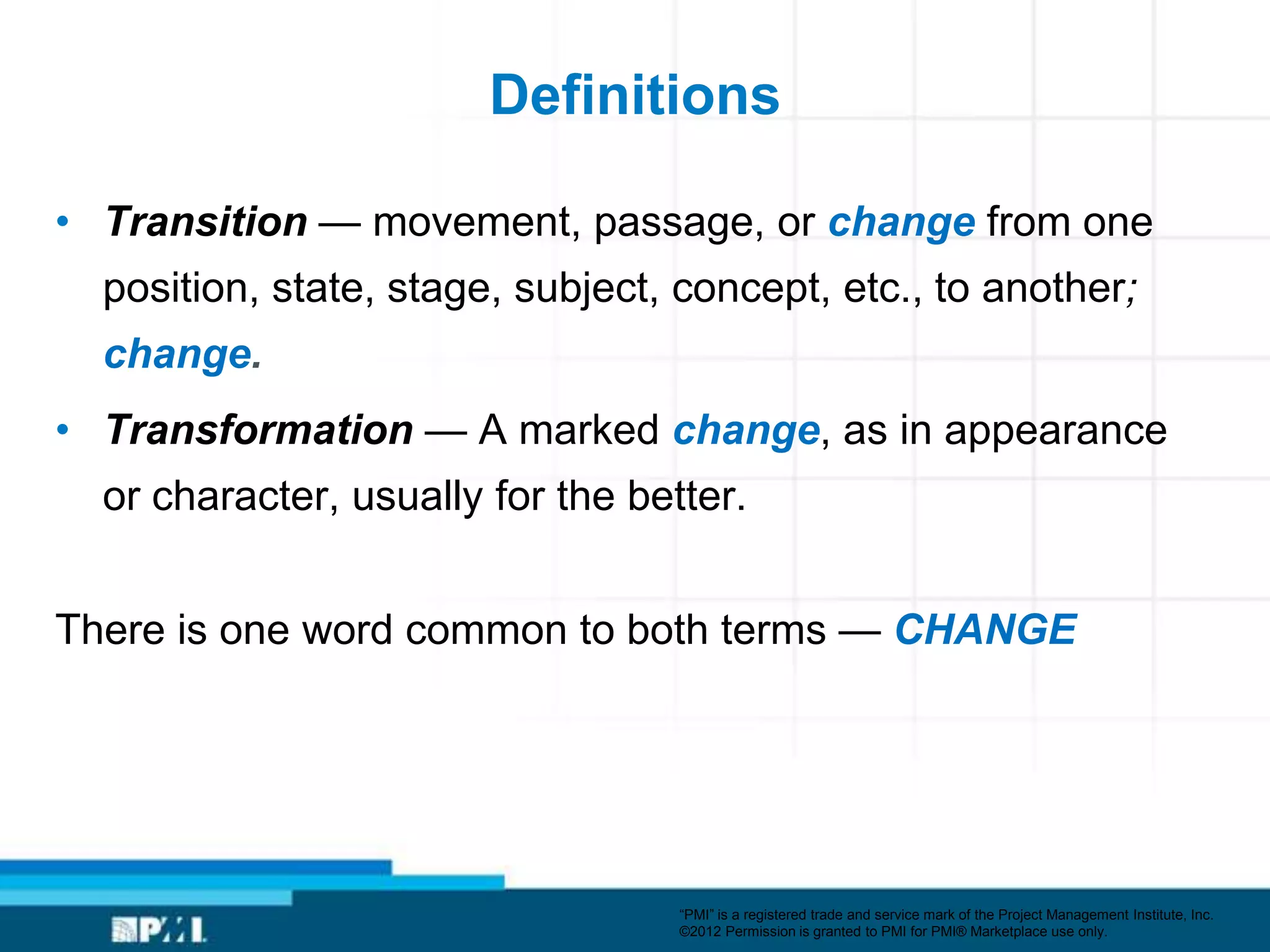
Definitions

• Transition — movement, passage, or change from one
  position, state, stage, subject, concept, etc., to another;
  change.
• Transformation — A marked change, as in appearance
  or character, usually for the better.


There is one word common to both terms — CHANGE


                                   ―PMI‖ is a registered trade and service mark of the Project Management Institute, Inc.
                                   ©2012 Permission is granted to PMI for PMI® Marketplace use only.
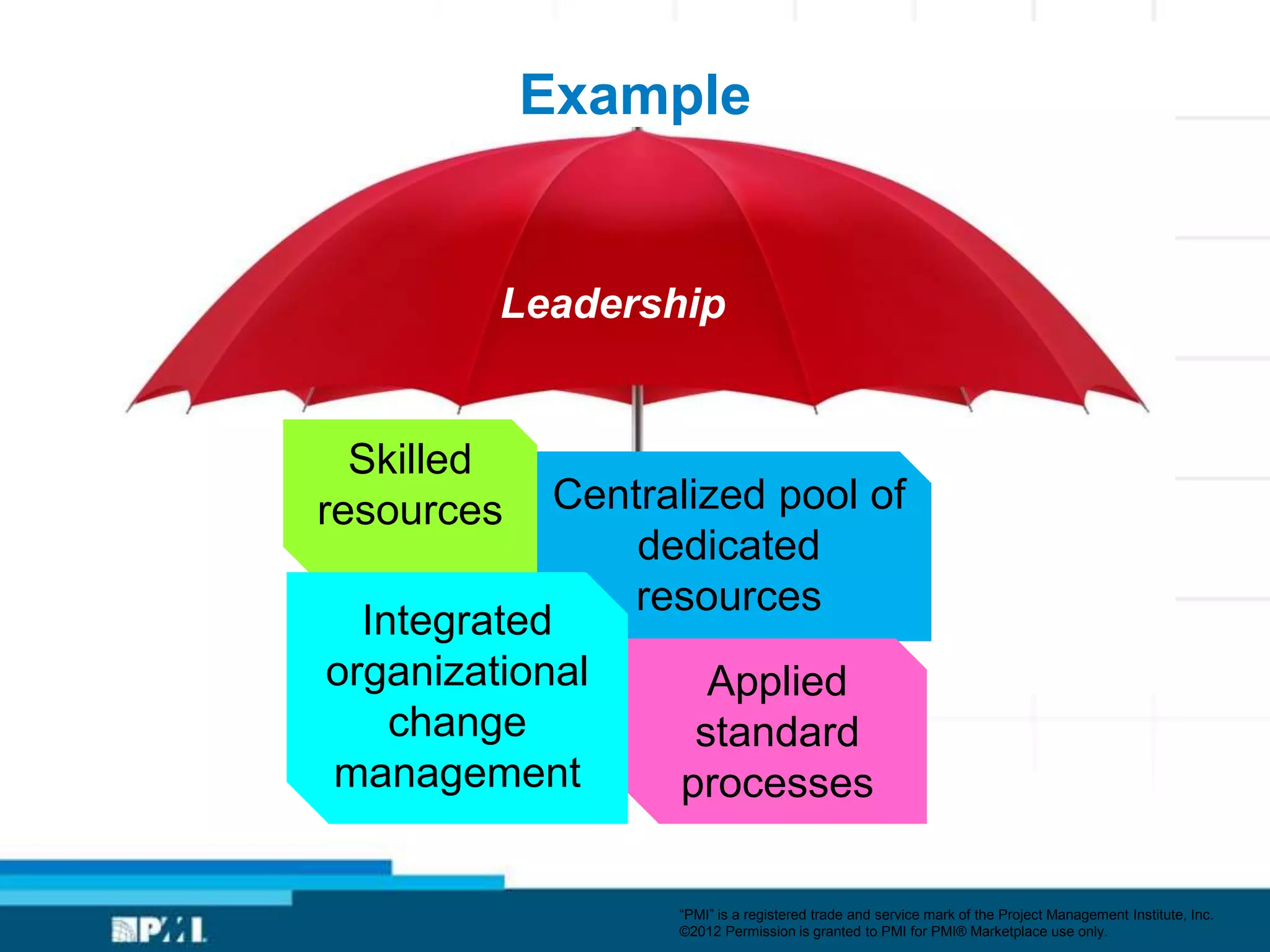
Example


         Leadership


  Skilled
resources   Centralized pool of
                dedicated
                resources
  Integrated
organizational       Applied
    change          standard
management        processes

                  ―PMI‖ is a registered trade and service mark of the Project Management Institute, Inc.
                  ©2012 Permission is granted to PMI for PMI® Marketplace use only.
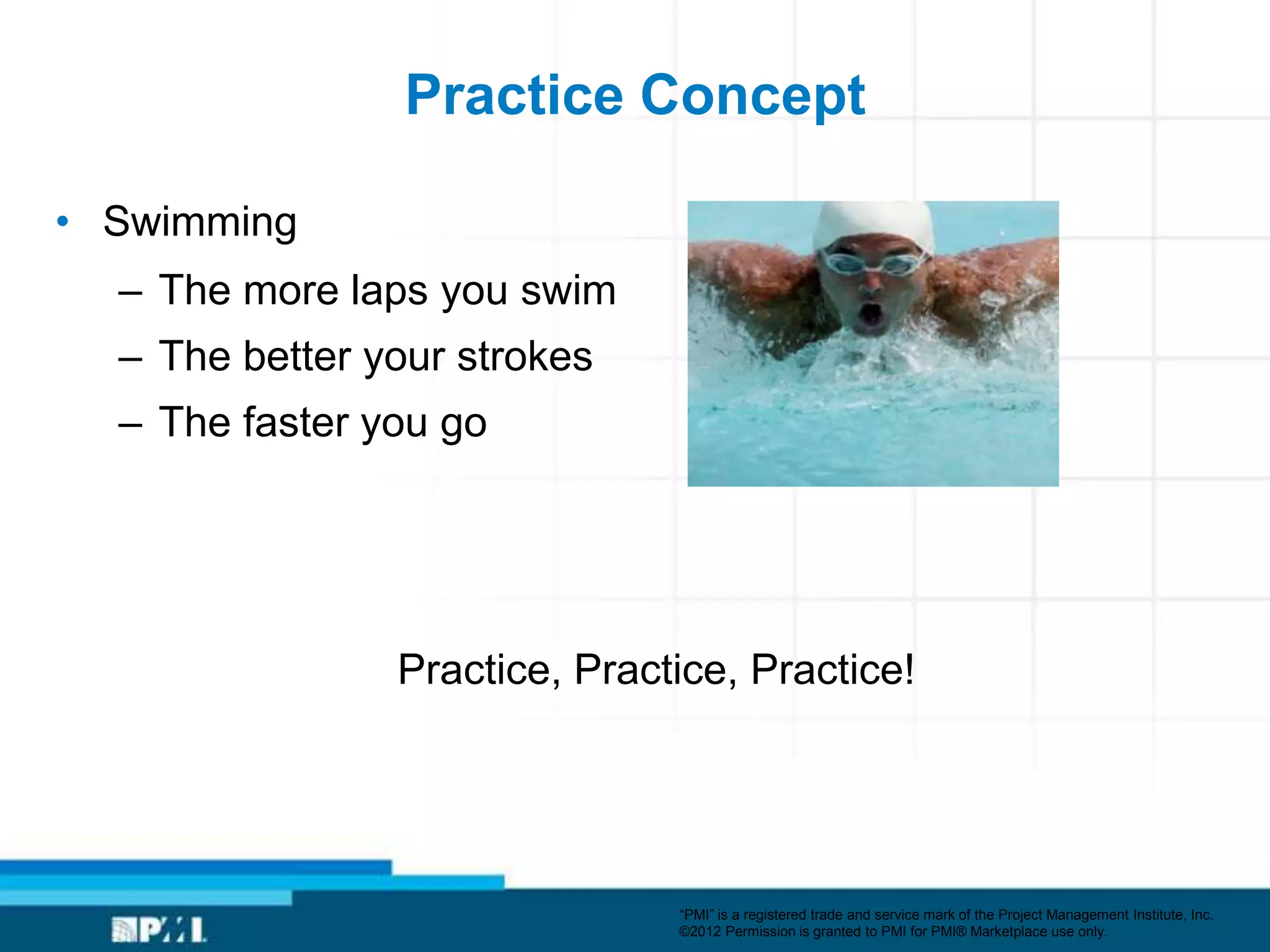
Practice Concept

• Swimming
  – The more laps you swim
  – The better your strokes
  – The faster you go


                Practice, Practice, Practice!


                               ―PMI‖ is a registered trade and service mark of the Project Management Institute, Inc.
                               ©2012 Permission is granted to PMI for PMI® Marketplace use only.
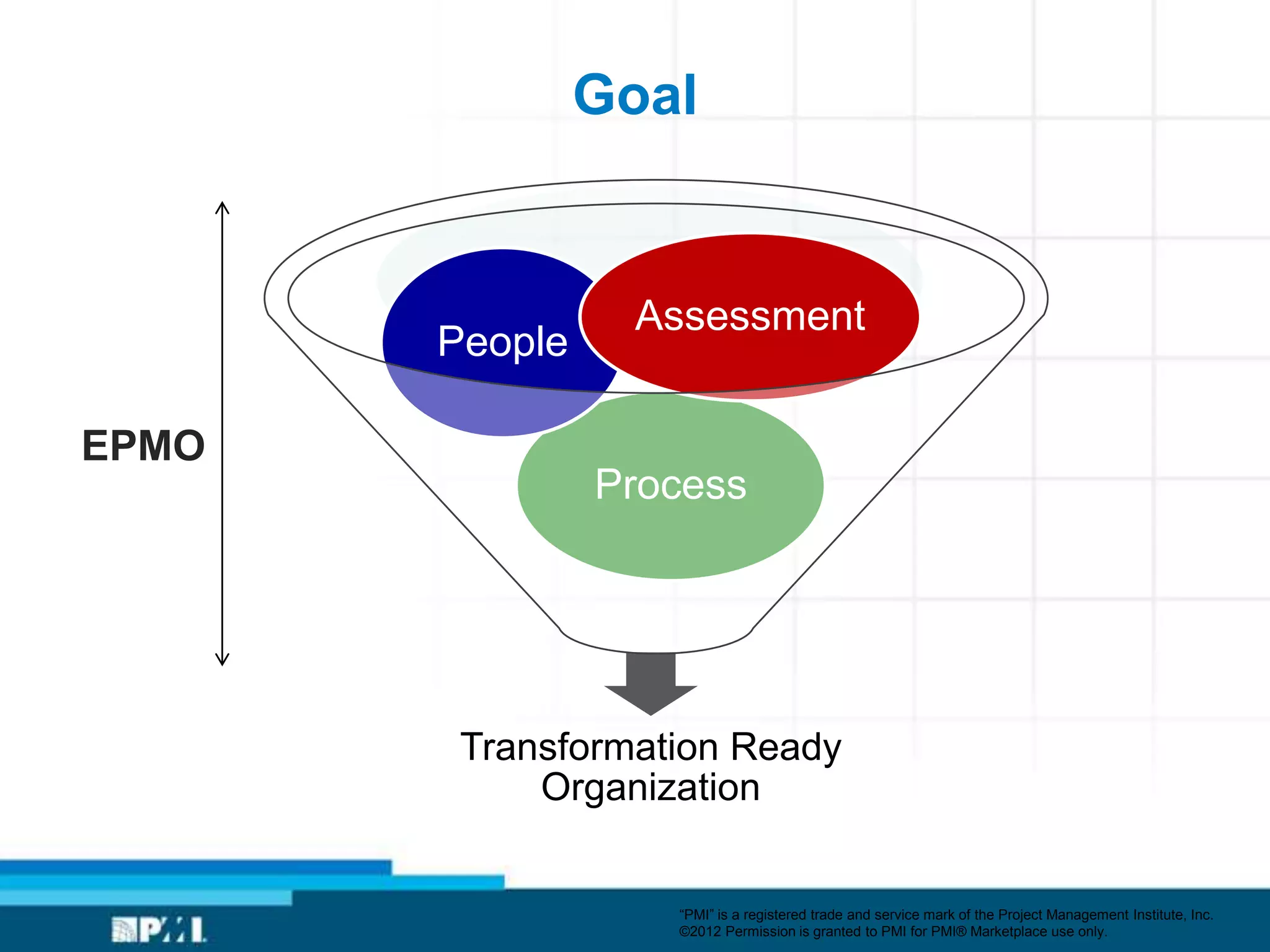
Goal


                 Assessment
       People

EPMO
                Process


        Transformation Ready
            Organization


                   ―PMI‖ is a registered trade and service mark of the Project Management Institute, Inc.
                   ©2012 Permission is granted to PMI for PMI® Marketplace use only.
Step 1: Assessing your Readiness for Change
Step 2: The People
Step 3: Program Management Best Practices


                      ―PMI‖ is a registered trade and service mark of the Project Management Institute, Inc.
                      ©2012 Permission is granted to PMI for PMI® Marketplace use only.
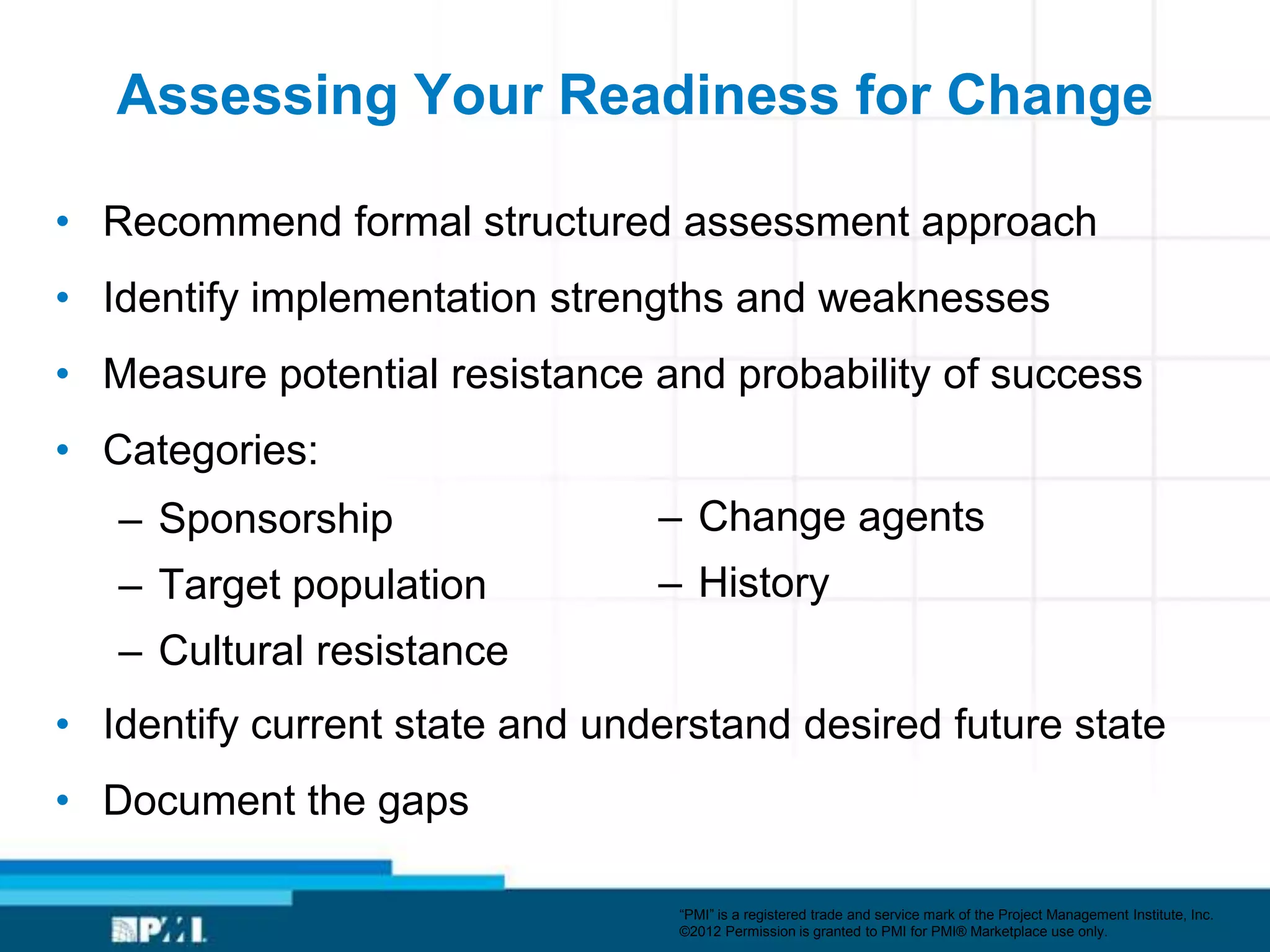
Assessing Your Readiness for Change

• Recommend formal structured assessment approach
• Identify implementation strengths and weaknesses
• Measure potential resistance and probability of success
• Categories:
   – Sponsorship                – Change agents
   – Target population          – History
   – Cultural resistance
• Identify current state and understand desired future state
• Document the gaps

                                 ―PMI‖ is a registered trade and service mark of the Project Management Institute, Inc.
                                 ©2012 Permission is granted to PMI for PMI® Marketplace use only.
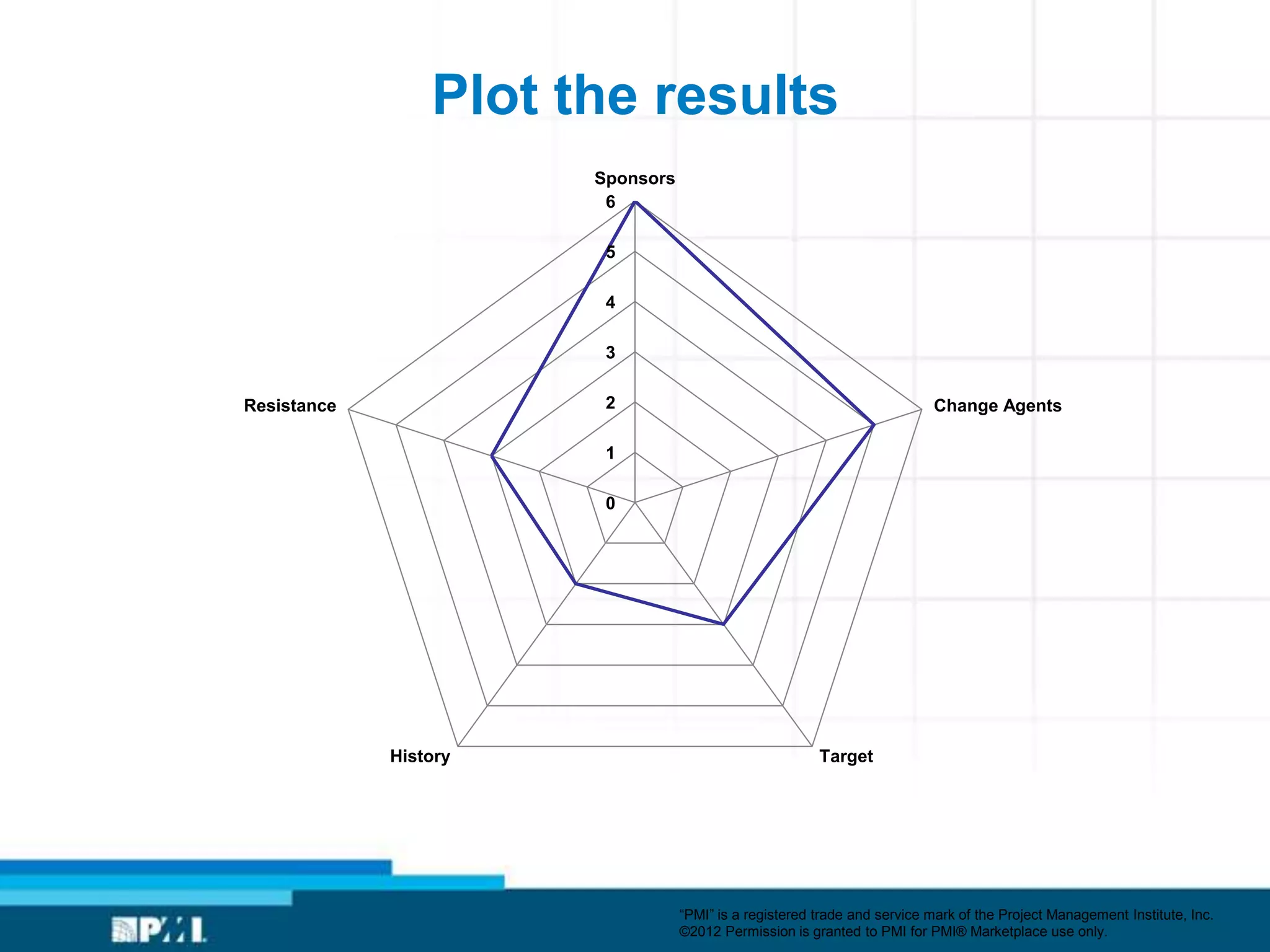
Plot the results
                       Sponsors
                        6

                        5

                        4

                        3


Resistance              2                                                 Change Agents

                        1

                        0


             History                                    Target


                                  ―PMI‖ is a registered trade and service mark of the Project Management Institute, Inc.
                                  ©2012 Permission is granted to PMI for PMI® Marketplace use only.
Step 1: Assessing your Readiness for Change
Step 2: The People
Step 3: Program Management Best Practices


                      ―PMI‖ is a registered trade and service mark of the Project Management Institute, Inc.
                      ©2012 Permission is granted to PMI for PMI® Marketplace use only.
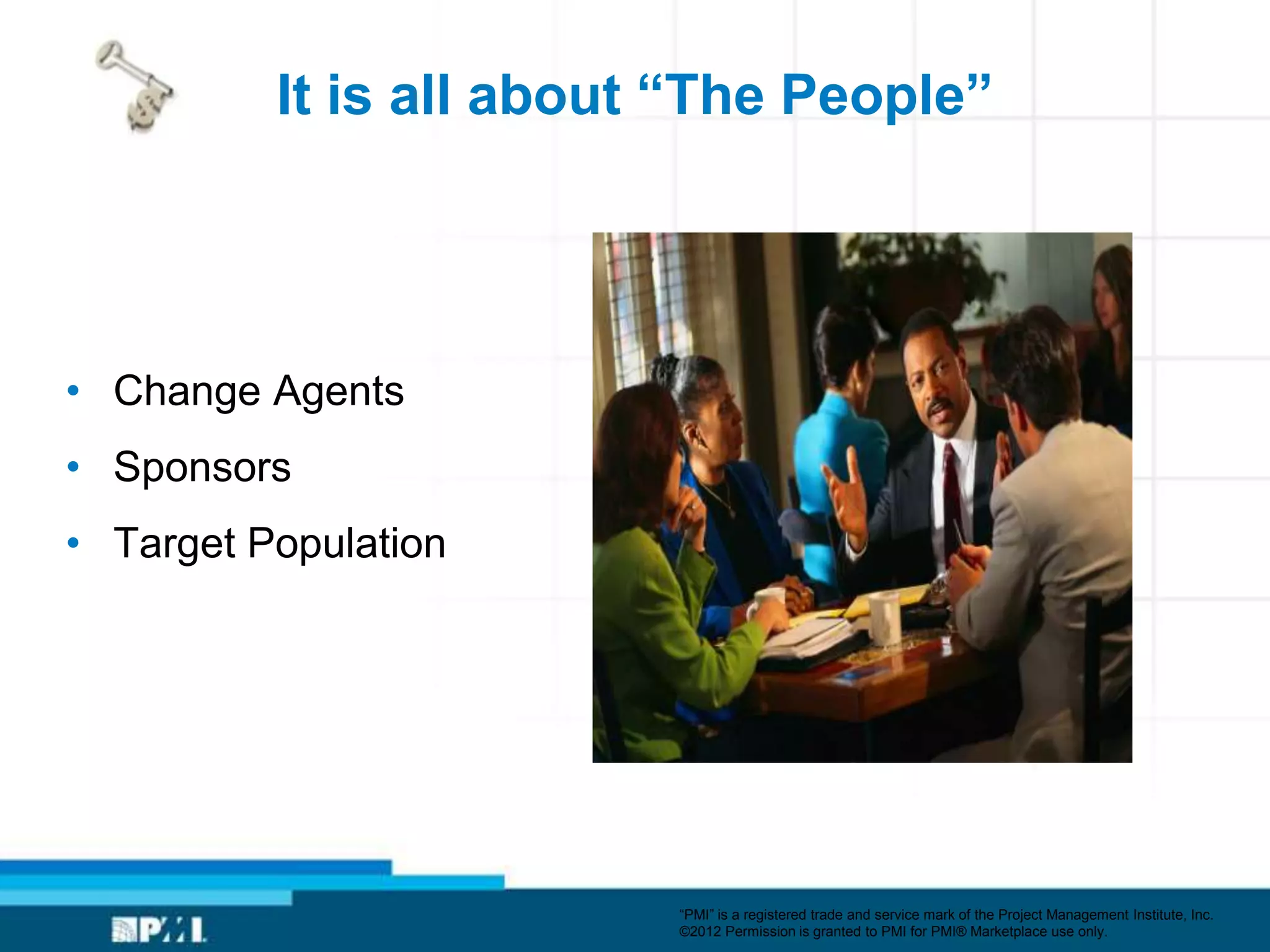
It is all about “The People”


• Change Agents
• Sponsors
• Target Population


                         ―PMI‖ is a registered trade and service mark of the Project Management Institute, Inc.
                         ©2012 Permission is granted to PMI for PMI® Marketplace use only.
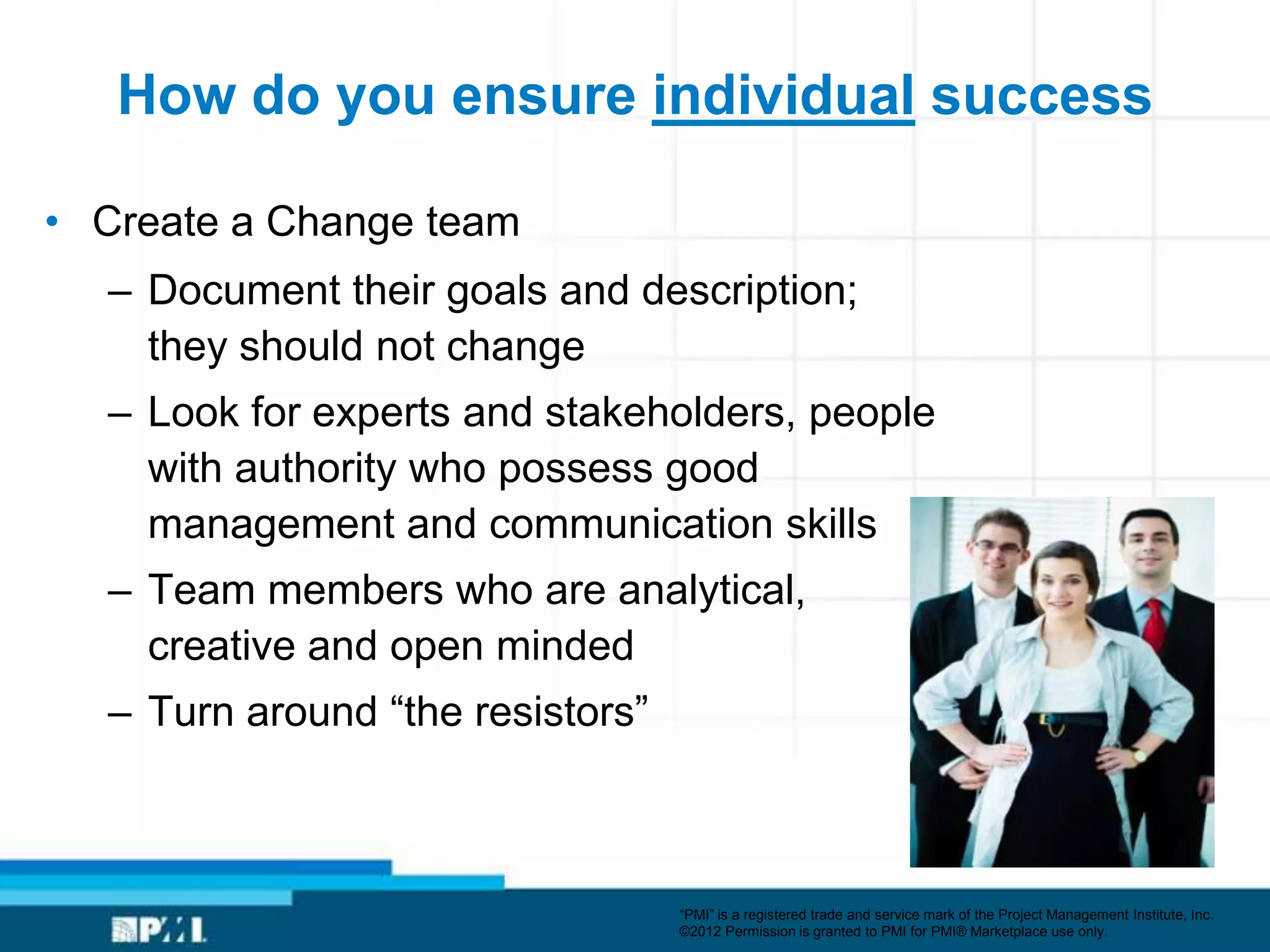
How do you ensure individual success

• Create a Change team
  – Document their goals and description;
    they should not change
  – Look for experts and stakeholders, people
    with authority who possess good
    management and communication skills
  – Team members who are analytical,
    creative and open minded
  – Turn around ―the resistors‖


                                  ―PMI‖ is a registered trade and service mark of the Project Management Institute, Inc.
                                  ©2012 Permission is granted to PMI for PMI® Marketplace use only.
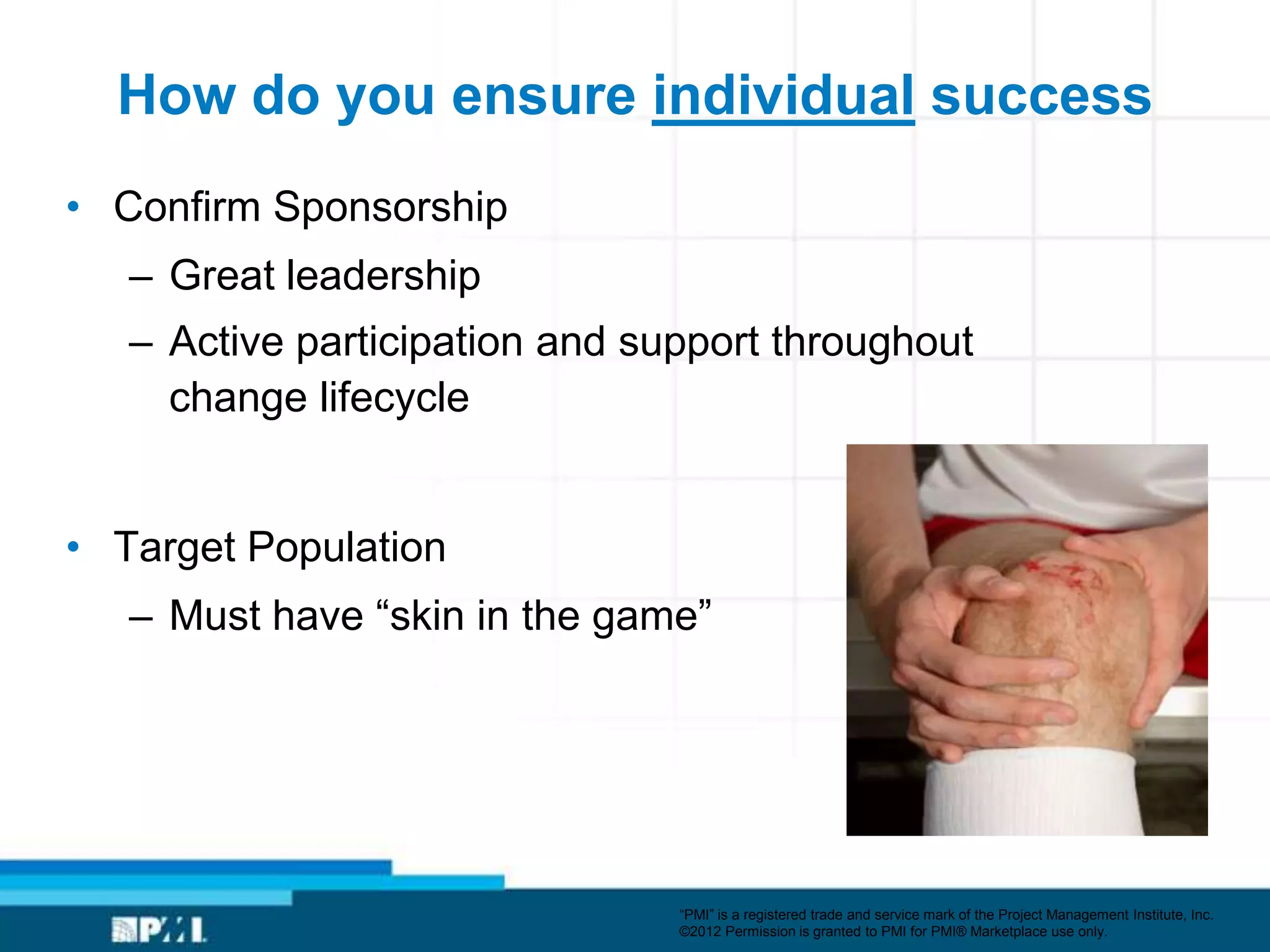
How do you ensure individual success
• Confirm Sponsorship
   – Great leadership
   – Active participation and support throughout
     change lifecycle


• Target Population
   – Must have ―skin in the game‖


                                ―PMI‖ is a registered trade and service mark of the Project Management Institute, Inc.
                                ©2012 Permission is granted to PMI for PMI® Marketplace use only.
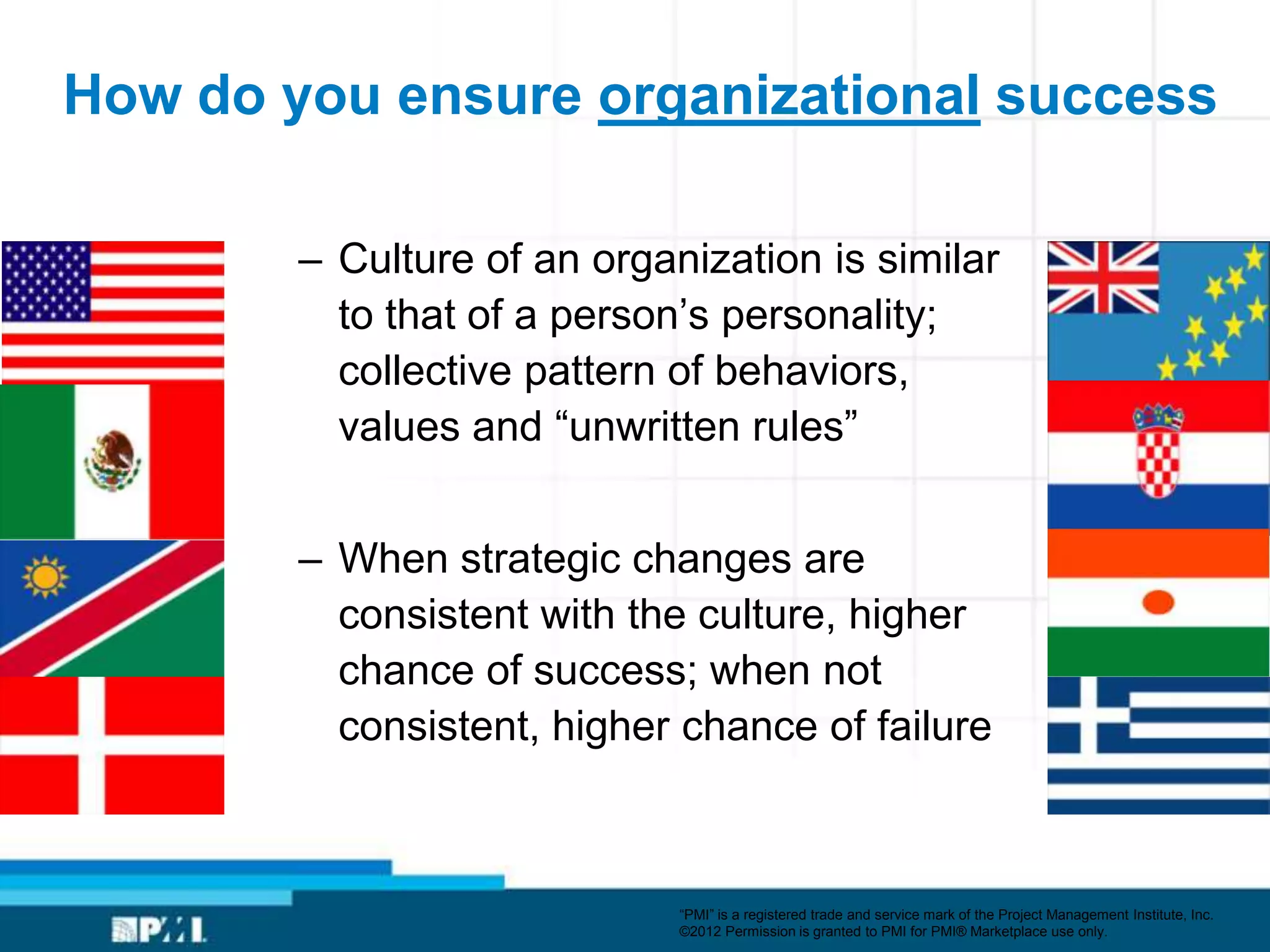
How do you ensure organizational success

        – Culture of an organization is similar
          to that of a person’s personality;
          collective pattern of behaviors,
          values and ―unwritten rules‖


        – When strategic changes are
          consistent with the culture, higher
          chance of success; when not
          consistent, higher chance of failure


                             ―PMI‖ is a registered trade and service mark of the Project Management Institute, Inc.
                             ©2012 Permission is granted to PMI for PMI® Marketplace use only.
Step 1: Assessing your Readiness for Change
Step 2: The People
Step 3: Program Management Best Practices


                      ―PMI‖ is a registered trade and service mark of the Project Management Institute, Inc.
                      ©2012 Permission is granted to PMI for PMI® Marketplace use only.
Key Program Management Best Practices


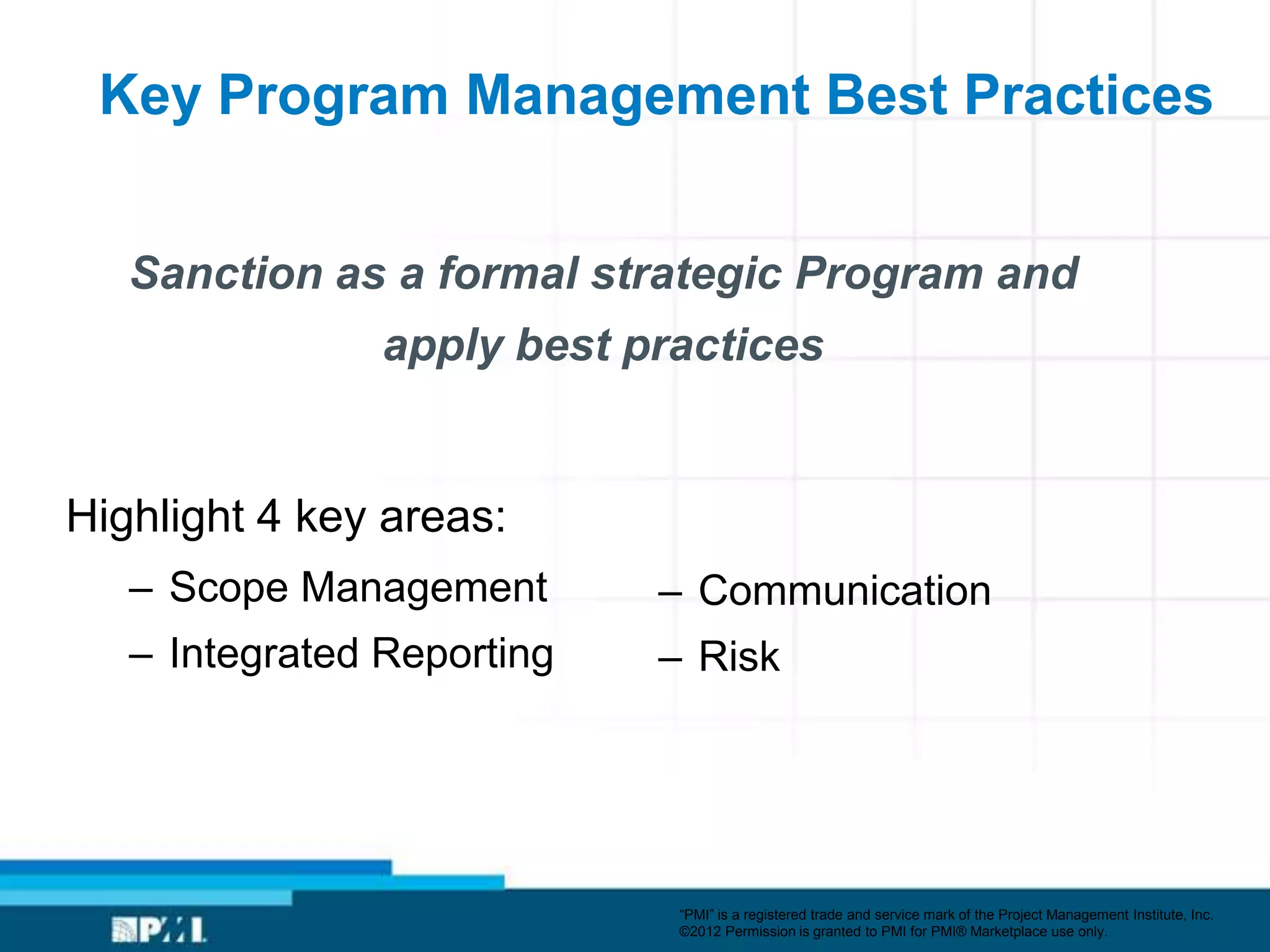
   Sanction as a formal strategic Program and
                apply best practices


Highlight 4 key areas:
   – Scope Management       – Communication
   – Integrated Reporting   – Risk


                             ―PMI‖ is a registered trade and service mark of the Project Management Institute, Inc.
                             ©2012 Permission is granted to PMI for PMI® Marketplace use only.
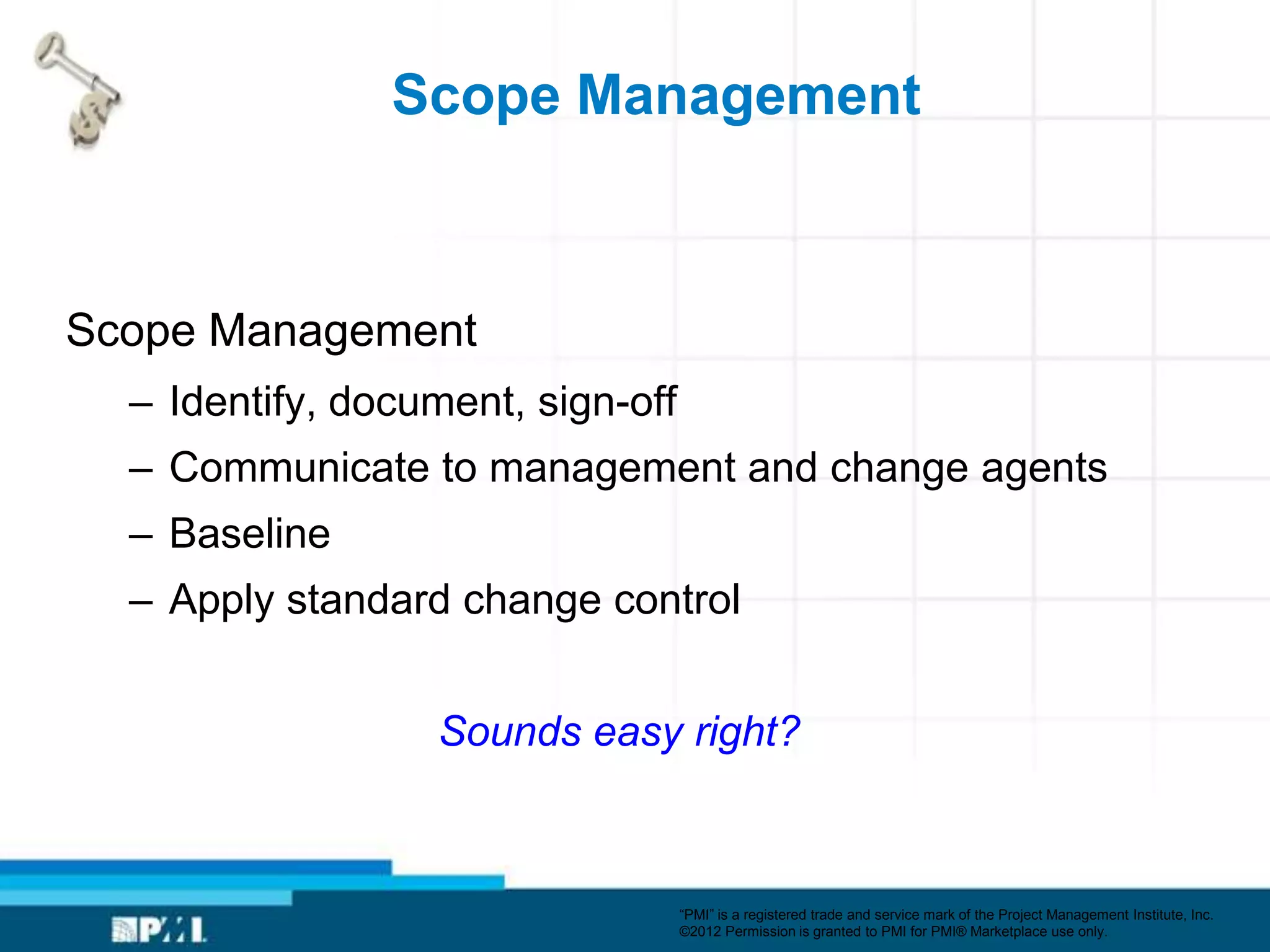
Scope Management


Scope Management
  – Identify, document, sign-off
  – Communicate to management and change agents
  – Baseline
  – Apply standard change control


                  Sounds easy right?


                                   ―PMI‖ is a registered trade and service mark of the Project Management Institute, Inc.
                                   ©2012 Permission is granted to PMI for PMI® Marketplace use only.
Communication Plan


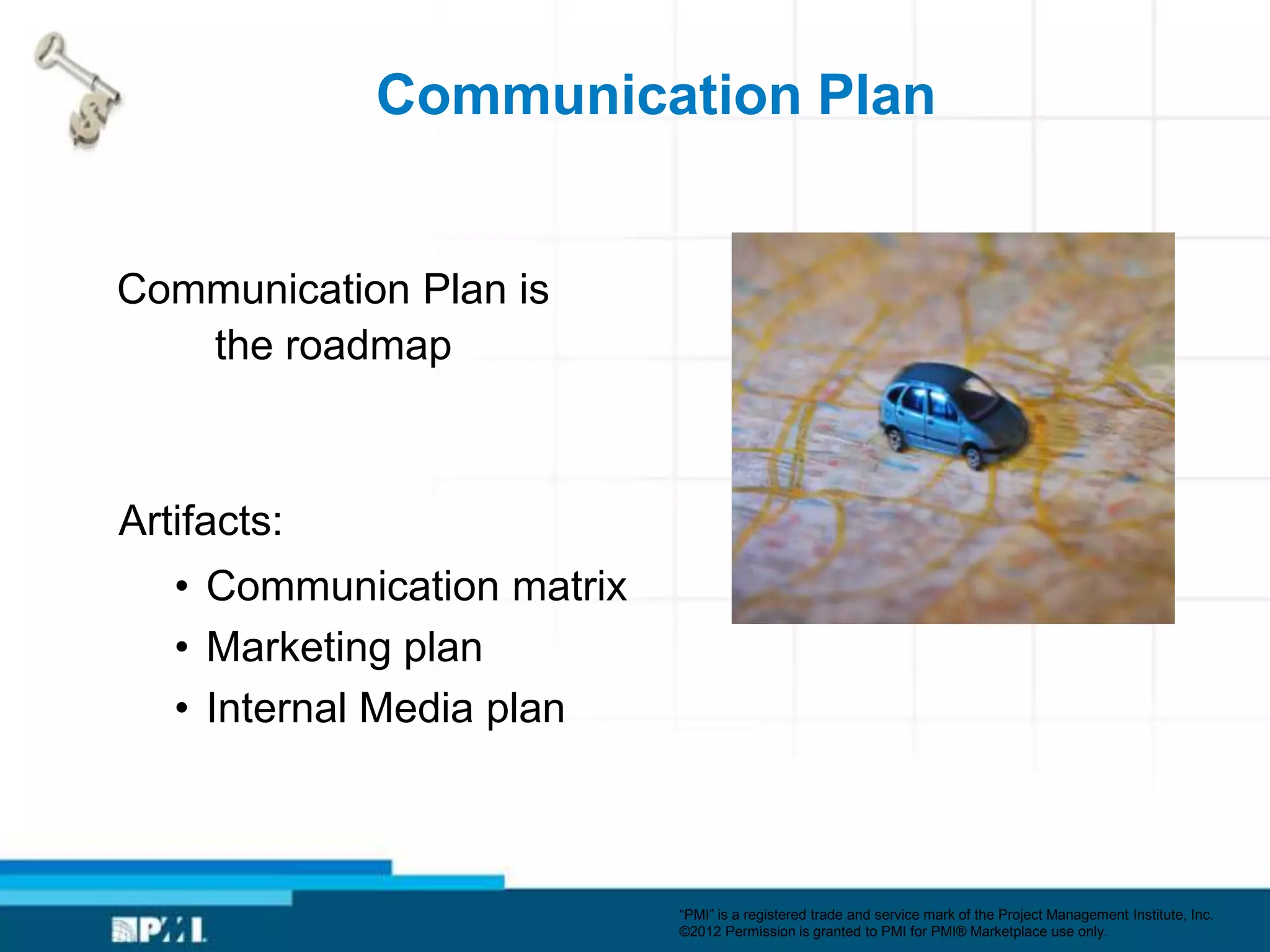
Communication Plan is
   the roadmap


Artifacts:
   • Communication matrix
   • Marketing plan
   • Internal Media plan


                            ―PMI‖ is a registered trade and service mark of the Project Management Institute, Inc.
                            ©2012 Permission is granted to PMI for PMI® Marketplace use only.
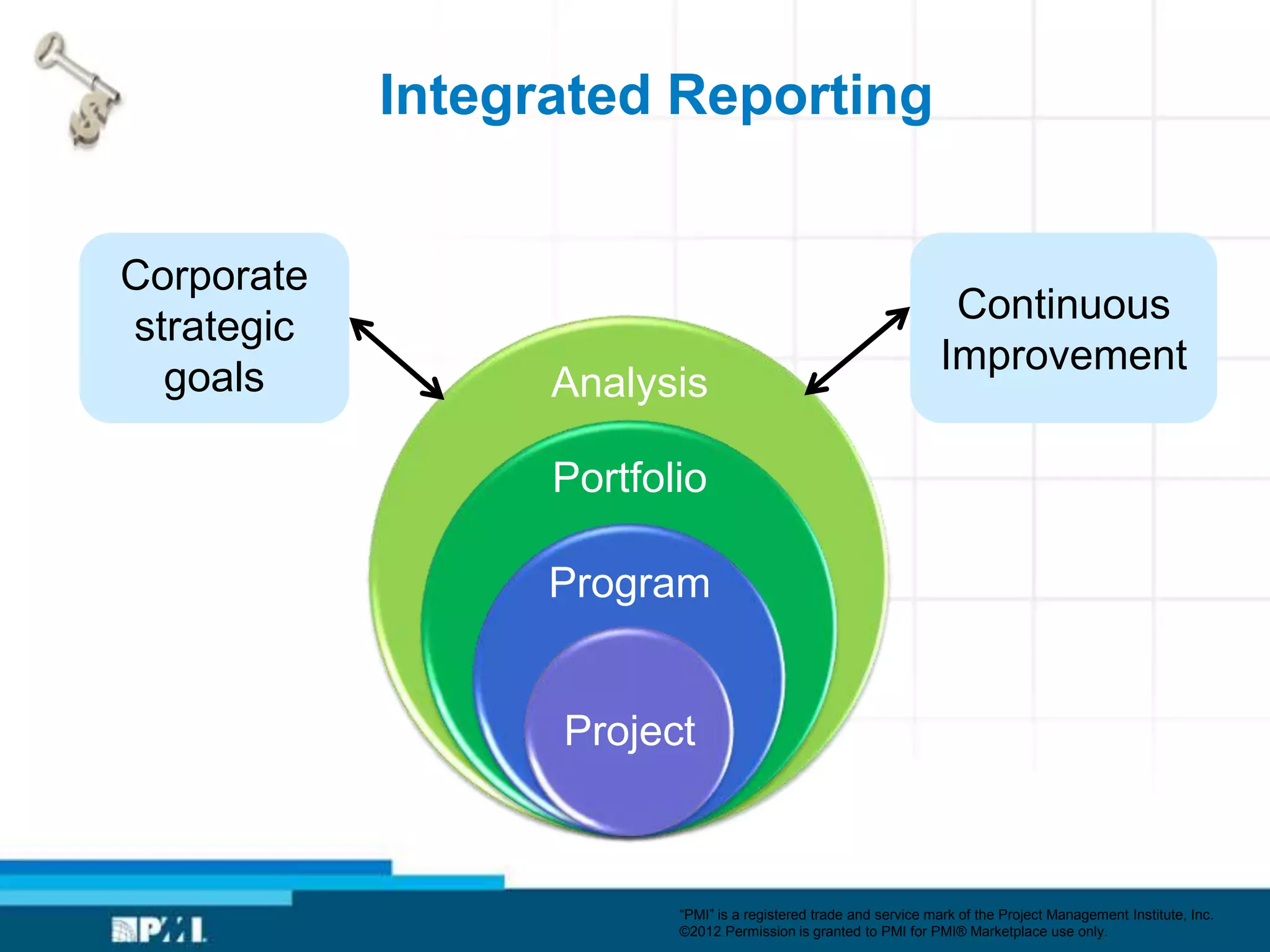
Integrated Reporting


Corporate
                                                                   Continuous
strategic
                                                                  Improvement
  goals           Analysis

                  Portfolio

                  Program


                  Project


                         ―PMI‖ is a registered trade and service mark of the Project Management Institute, Inc.
                         ©2012 Permission is granted to PMI for PMI® Marketplace use only.
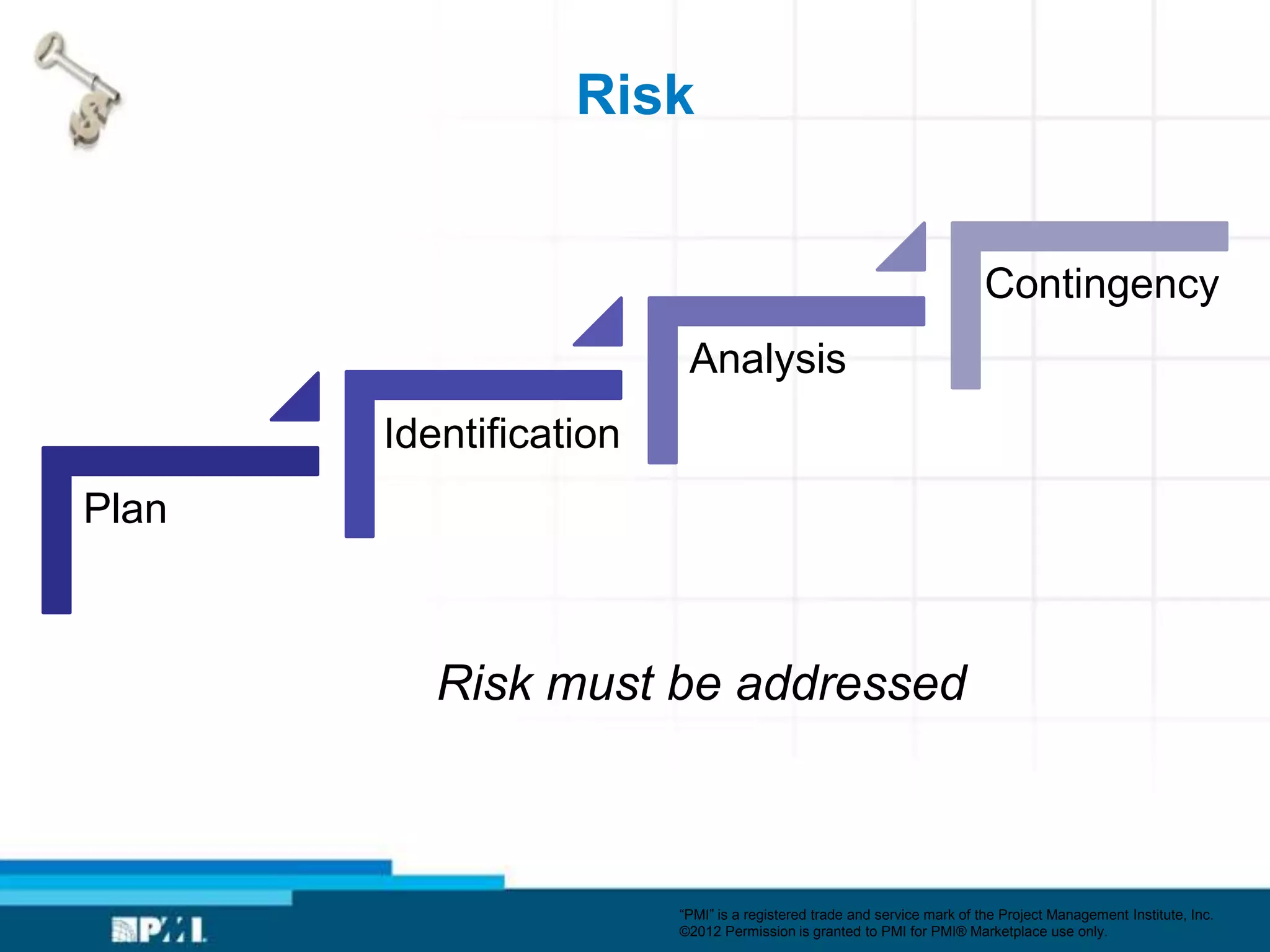
Risk


                                                                         Contingency
                         Analysis
       Identification
Plan


          Risk must be addressed


                        ―PMI‖ is a registered trade and service mark of the Project Management Institute, Inc.
                        ©2012 Permission is granted to PMI for PMI® Marketplace use only.
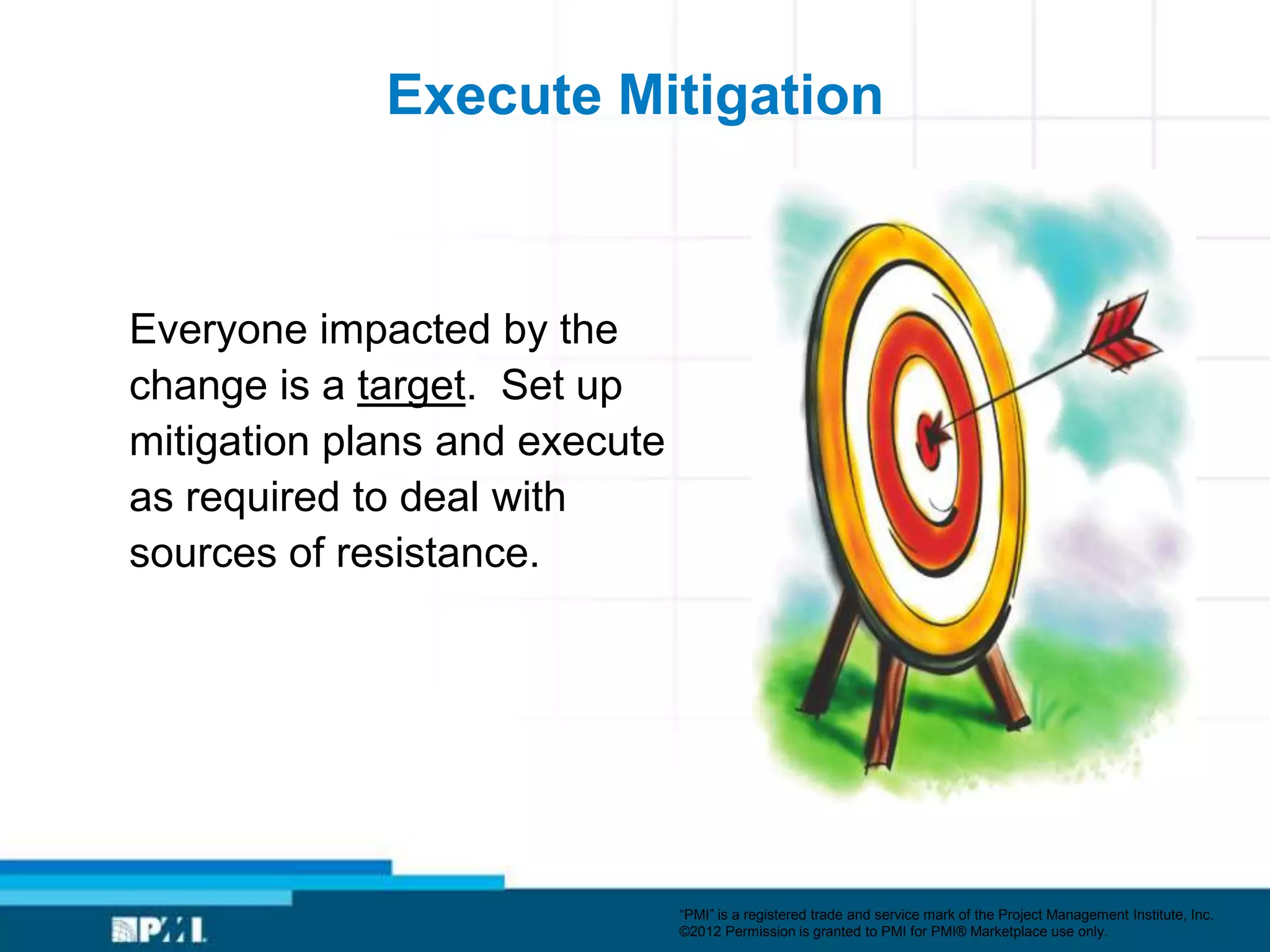
Execute Mitigation


Everyone impacted by the
change is a target. Set up
mitigation plans and execute
as required to deal with
sources of resistance.


                               ―PMI‖ is a registered trade and service mark of the Project Management Institute, Inc.
                               ©2012 Permission is granted to PMI for PMI® Marketplace use only.
Why utilize the EPMO?


             ―PMI‖ is a registered trade and service mark of the Project Management Institute, Inc.
             ©2012 Permission is granted to PMI for PMI® Marketplace use only.
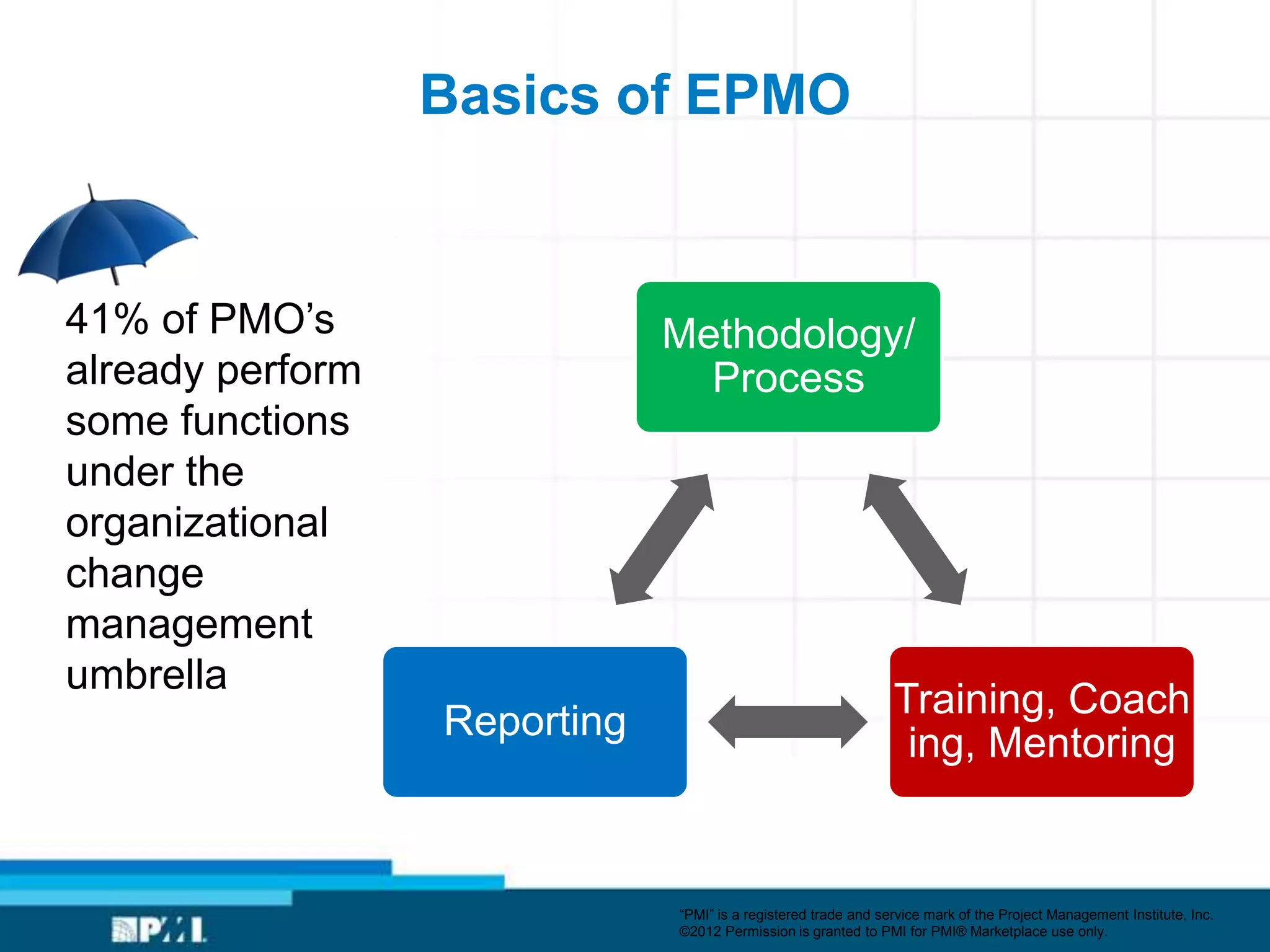
Basics of EPMO


41% of PMO’s                  Methodology/
already perform                 Process
some functions
under the
organizational
change
management
umbrella
                                                                Training, Coach
                  Reporting
                                                                 ing, Mentoring


                              ―PMI‖ is a registered trade and service mark of the Project Management Institute, Inc.
                              ©2012 Permission is granted to PMI for PMI® Marketplace use only.
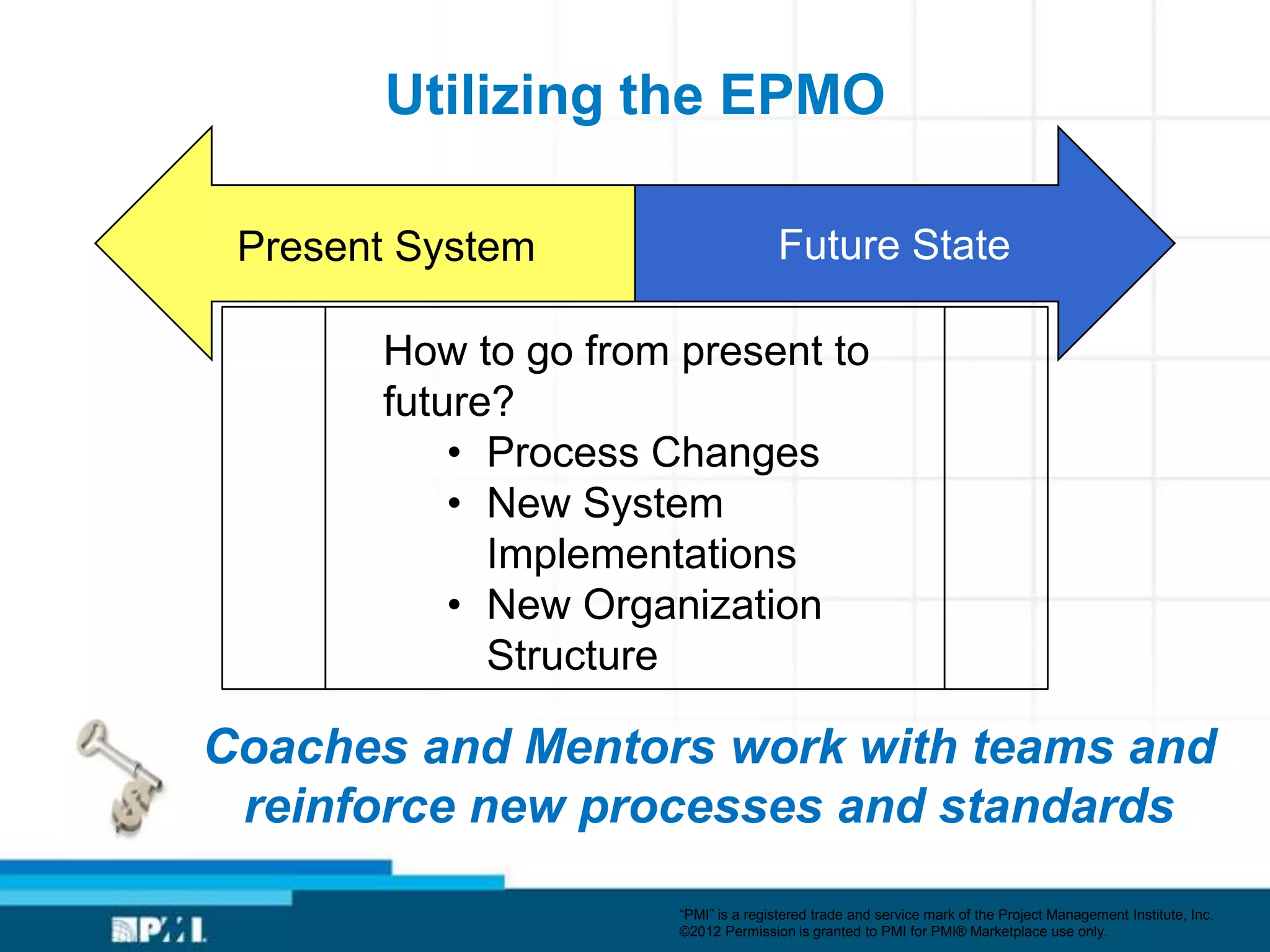
Utilizing the EPMO

 Present System                      Future State

       How to go from present to
       future?
           • Process Changes
           • New System
             Implementations
           • New Organization
             Structure

Coaches and Mentors work with teams and
 reinforce new processes and standards
                      ―PMI‖ is a registered trade and service mark of the Project Management Institute, Inc.
                      ©2012 Permission is granted to PMI for PMI® Marketplace use only.
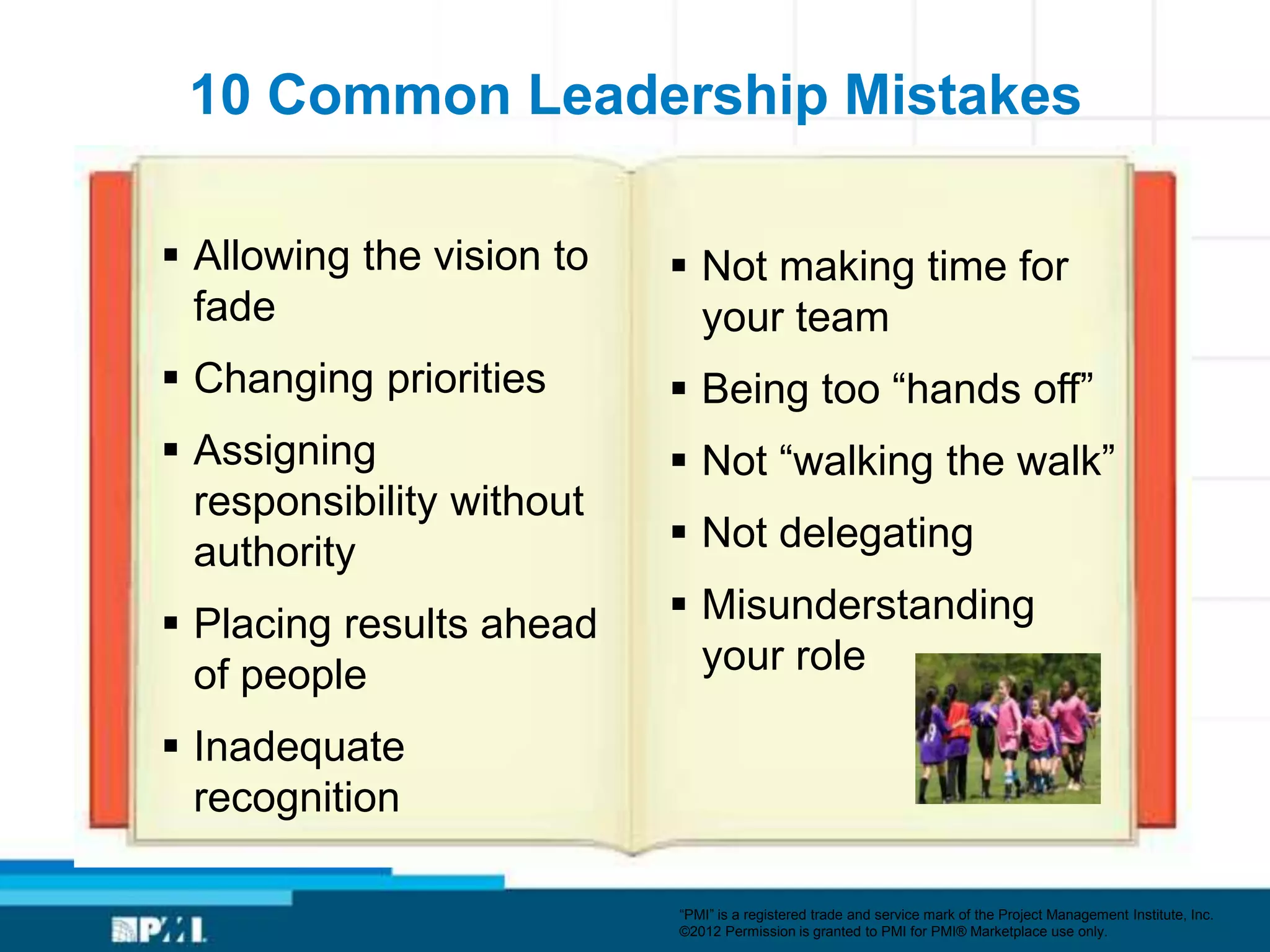
10 Common Leadership Mistakes

 Allowing the vision to    Not making time for
  fade                       your team
 Changing priorities       Being too ―hands off‖
 Assigning                 Not ―walking the walk‖
  responsibility without
  authority                 Not delegating

 Placing results ahead     Misunderstanding
  of people                  your role

 Inadequate
  recognition

                           ―PMI‖ is a registered trade and service mark of the Project Management Institute, Inc.
                           ©2012 Permission is granted to PMI for PMI® Marketplace use only.
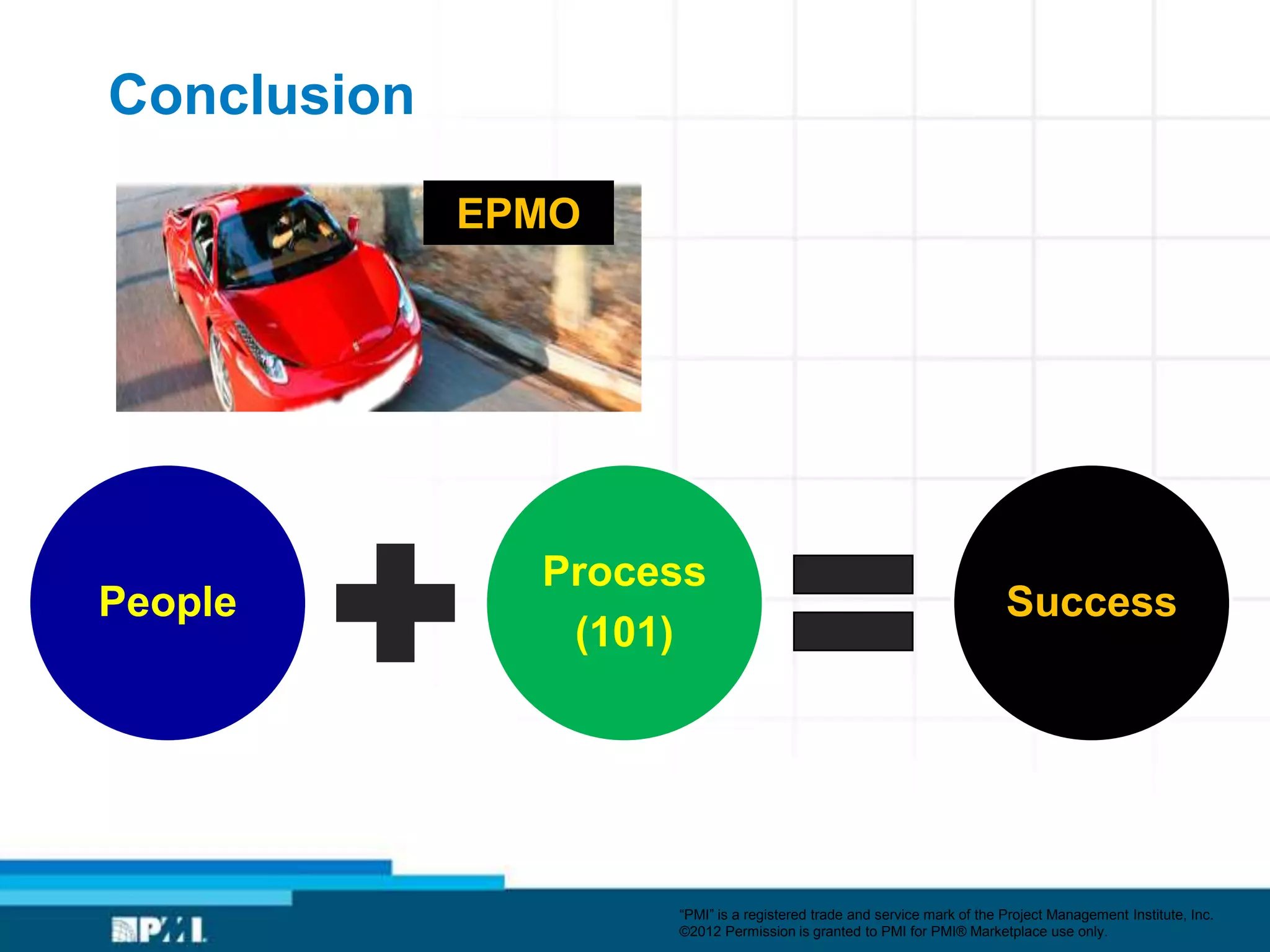
Conclusion

             EPMO


               Process
People                                                                  Success
                (101)


                    ―PMI‖ is a registered trade and service mark of the Project Management Institute, Inc.
                    ©2012 Permission is granted to PMI for PMI® Marketplace use only.
Questions?


      ―PMI‖ is a registered trade and service mark of the Project Management Institute, Inc.
      ©2012 Permission is granted to PMI for PMI® Marketplace use only.
Contact Information

Susan Boyd
njsboyd@gmail.com
703-965-3454


               Session LDR14


                       ―PMI‖ is a registered trade and service mark of the Project Management Institute, Inc.
                       ©2012 Permission is granted to PMI for PMI® Marketplace use only.

Project management and organizational change management

  • 1.
    Project Management and Organizational Change Management Creating a Transformation Ready Organization PMI Global Congress, Vancouver - LDR14 Susan Boyd PM Solutions ―PMI‖ is a registered trade and service mark of the Project Management Institute, Inc. ©2012 Permission is granted to PMI for PMI® Marketplace use only.
  • 2.
    How can youhelp your organization prepare for changes that will inevitably come? ―PMI‖ is a registered trade and service mark of the Project Management Institute, Inc. ©2012 Permission is granted to PMI for PMI® Marketplace use only.
  • 3.
    Agenda • Today’s Environment •Goal with Example • Step 1: Assessing your Readiness for Change • Step 2: The People • Step 3: Program Management Best Practices • The Role of the EPMO • 10 Common Leadership Mistakes • Conclusion ―PMI‖ is a registered trade and service mark of the Project Management Institute, Inc. ©2012 Permission is granted to PMI for PMI® Marketplace use only.
  • 4.
    Today’s environment • Theworld is changing at an incredible pace, the economy is unpredictable • Mergers and Acquisitions happening at light speed • Restructurings are a common occurrence • Shifts in business strategy • Internet is transforming how, where and when people and organizations buy as well as who they buy from Industries are being re-defined and companies continue to re-invent themselves. ―PMI‖ is a registered trade and service mark of the Project Management Institute, Inc. ©2012 Permission is granted to PMI for PMI® Marketplace use only.
  • 5.
    Definitions • Transition —movement, passage, or change from one position, state, stage, subject, concept, etc., to another; change. • Transformation — A marked change, as in appearance or character, usually for the better. There is one word common to both terms — CHANGE ―PMI‖ is a registered trade and service mark of the Project Management Institute, Inc. ©2012 Permission is granted to PMI for PMI® Marketplace use only.
  • 6.
    Example Leadership Skilled resources Centralized pool of dedicated resources Integrated organizational Applied change standard management processes ―PMI‖ is a registered trade and service mark of the Project Management Institute, Inc. ©2012 Permission is granted to PMI for PMI® Marketplace use only.
  • 7.
    Practice Concept • Swimming – The more laps you swim – The better your strokes – The faster you go Practice, Practice, Practice! ―PMI‖ is a registered trade and service mark of the Project Management Institute, Inc. ©2012 Permission is granted to PMI for PMI® Marketplace use only.
  • 8.
    Goal Assessment People EPMO Process Transformation Ready Organization ―PMI‖ is a registered trade and service mark of the Project Management Institute, Inc. ©2012 Permission is granted to PMI for PMI® Marketplace use only.
  • 9.
    Step 1: Assessingyour Readiness for Change Step 2: The People Step 3: Program Management Best Practices ―PMI‖ is a registered trade and service mark of the Project Management Institute, Inc. ©2012 Permission is granted to PMI for PMI® Marketplace use only.
  • 10.
    Assessing Your Readinessfor Change • Recommend formal structured assessment approach • Identify implementation strengths and weaknesses • Measure potential resistance and probability of success • Categories: – Sponsorship – Change agents – Target population – History – Cultural resistance • Identify current state and understand desired future state • Document the gaps ―PMI‖ is a registered trade and service mark of the Project Management Institute, Inc. ©2012 Permission is granted to PMI for PMI® Marketplace use only.
  • 11.
    Plot the results Sponsors 6 5 4 3 Resistance 2 Change Agents 1 0 History Target ―PMI‖ is a registered trade and service mark of the Project Management Institute, Inc. ©2012 Permission is granted to PMI for PMI® Marketplace use only.
  • 12.
    Step 1: Assessingyour Readiness for Change Step 2: The People Step 3: Program Management Best Practices ―PMI‖ is a registered trade and service mark of the Project Management Institute, Inc. ©2012 Permission is granted to PMI for PMI® Marketplace use only.
  • 13.
    It is allabout “The People” • Change Agents • Sponsors • Target Population ―PMI‖ is a registered trade and service mark of the Project Management Institute, Inc. ©2012 Permission is granted to PMI for PMI® Marketplace use only.
  • 14.
    How do youensure individual success • Create a Change team – Document their goals and description; they should not change – Look for experts and stakeholders, people with authority who possess good management and communication skills – Team members who are analytical, creative and open minded – Turn around ―the resistors‖ ―PMI‖ is a registered trade and service mark of the Project Management Institute, Inc. ©2012 Permission is granted to PMI for PMI® Marketplace use only.
  • 15.
    How do youensure individual success • Confirm Sponsorship – Great leadership – Active participation and support throughout change lifecycle • Target Population – Must have ―skin in the game‖ ―PMI‖ is a registered trade and service mark of the Project Management Institute, Inc. ©2012 Permission is granted to PMI for PMI® Marketplace use only.
  • 16.
    How do youensure organizational success – Culture of an organization is similar to that of a person’s personality; collective pattern of behaviors, values and ―unwritten rules‖ – When strategic changes are consistent with the culture, higher chance of success; when not consistent, higher chance of failure ―PMI‖ is a registered trade and service mark of the Project Management Institute, Inc. ©2012 Permission is granted to PMI for PMI® Marketplace use only.
  • 17.
    Step 1: Assessingyour Readiness for Change Step 2: The People Step 3: Program Management Best Practices ―PMI‖ is a registered trade and service mark of the Project Management Institute, Inc. ©2012 Permission is granted to PMI for PMI® Marketplace use only.
  • 18.
    Key Program ManagementBest Practices Sanction as a formal strategic Program and apply best practices Highlight 4 key areas: – Scope Management – Communication – Integrated Reporting – Risk ―PMI‖ is a registered trade and service mark of the Project Management Institute, Inc. ©2012 Permission is granted to PMI for PMI® Marketplace use only.
  • 19.
    Scope Management Scope Management – Identify, document, sign-off – Communicate to management and change agents – Baseline – Apply standard change control Sounds easy right? ―PMI‖ is a registered trade and service mark of the Project Management Institute, Inc. ©2012 Permission is granted to PMI for PMI® Marketplace use only.
  • 20.
    Communication Plan Communication Planis the roadmap Artifacts: • Communication matrix • Marketing plan • Internal Media plan ―PMI‖ is a registered trade and service mark of the Project Management Institute, Inc. ©2012 Permission is granted to PMI for PMI® Marketplace use only.
  • 21.
    Integrated Reporting Corporate Continuous strategic Improvement goals Analysis Portfolio Program Project ―PMI‖ is a registered trade and service mark of the Project Management Institute, Inc. ©2012 Permission is granted to PMI for PMI® Marketplace use only.
  • 22.
    Risk Contingency Analysis Identification Plan Risk must be addressed ―PMI‖ is a registered trade and service mark of the Project Management Institute, Inc. ©2012 Permission is granted to PMI for PMI® Marketplace use only.
  • 23.
    Execute Mitigation Everyone impactedby the change is a target. Set up mitigation plans and execute as required to deal with sources of resistance. ―PMI‖ is a registered trade and service mark of the Project Management Institute, Inc. ©2012 Permission is granted to PMI for PMI® Marketplace use only.
  • 24.
    Why utilize theEPMO? ―PMI‖ is a registered trade and service mark of the Project Management Institute, Inc. ©2012 Permission is granted to PMI for PMI® Marketplace use only.
  • 25.
    Basics of EPMO 41%of PMO’s Methodology/ already perform Process some functions under the organizational change management umbrella Training, Coach Reporting ing, Mentoring ―PMI‖ is a registered trade and service mark of the Project Management Institute, Inc. ©2012 Permission is granted to PMI for PMI® Marketplace use only.
  • 26.
    Utilizing the EPMO Present System Future State How to go from present to future? • Process Changes • New System Implementations • New Organization Structure Coaches and Mentors work with teams and reinforce new processes and standards ―PMI‖ is a registered trade and service mark of the Project Management Institute, Inc. ©2012 Permission is granted to PMI for PMI® Marketplace use only.
  • 27.
    10 Common LeadershipMistakes  Allowing the vision to  Not making time for fade your team  Changing priorities  Being too ―hands off‖  Assigning  Not ―walking the walk‖ responsibility without authority  Not delegating  Placing results ahead  Misunderstanding of people your role  Inadequate recognition ―PMI‖ is a registered trade and service mark of the Project Management Institute, Inc. ©2012 Permission is granted to PMI for PMI® Marketplace use only.
  • 28.
    Conclusion EPMO Process People Success (101) ―PMI‖ is a registered trade and service mark of the Project Management Institute, Inc. ©2012 Permission is granted to PMI for PMI® Marketplace use only.
  • 29.
    Questions? ―PMI‖ is a registered trade and service mark of the Project Management Institute, Inc. ©2012 Permission is granted to PMI for PMI® Marketplace use only.
  • 30.
    Contact Information Susan Boyd njsboyd@gmail.com 703-965-3454 Session LDR14 ―PMI‖ is a registered trade and service mark of the Project Management Institute, Inc. ©2012 Permission is granted to PMI for PMI® Marketplace use only.

Editor's Notes

  • #3 I speak with many companies from various industries on a daily basis. And while each has unique challenges, inevitably the words transition and/or transformation are used to describe their environment. And that should come as no surprise since change IS the status quo. So the real question isn’t what change is next, but rather, how can you help your organization prepare for whatever changes that will inevitably come?
  • #6 Earlier in my career working for an IT outsource provider, the PMO was retitled to Transition and Transformation (T&T). The team was made up of project and program managers who were responsible for transitioning new customers into the environment, expanding services of current clients and large internally focused strategic programs. Having a department solely focused on “change” with a centralized pool of key project/program managers with consistently applied processes worked very well. Why was this model successful?Use transition, transformation and change as synonyms.
  • #14 Transformation is all about the people. It takes people to initiate and execute. On the other end, it is people who will be impacted. Since people are an integral part of whether or not this change is successful, let’s take a look at what we can do to gain buy-in. Sponsors are simply the executives who fund and lead the change. The change agents are normally the PMO and program managers who are performing the activities to implement the change and who are key to ensuring that effective communication occurs throughout. Change agents make it happen. The target population is the group affected by the change and usually exhibit fear; after all, they don’t know how they personally will be affected.
  • #20 The way to plan and execute successfully is by applying a cohesive project management approach to your transformation goal. It must become a program (sticking with program vs. project since, for sake of this paper, a transformation implies a large multi-faceted initiative requiring multiple projects that are inter-related). Once it is identified and sanctioned as a program, common project management best practices must be applied. There are standard phases for the lifecycle and activities within each phase. Picking up from the previous paragraph, once gaps are identified, it is imperative to identify activities and build a work plan/schedule to manage the program. There are four general areas I would like to highlight due to their correlation with achieving success — scope managementcommunications planintegrated reportingrisk.
  • #21 Don’t take the internal media plan for granted. It is best to think outside of the box to reach the largest audience — utilize an internal website, send out broadcasts, create a newsletter, provide targeted email updates, and/or hold town hall meetings or brown bag lunch sessions that are more intimate and allow people to ask questions in a smaller environment. You can also have material created to increase awareness — develop posters to hang around the office, have coffee cups made, distribute company shirts, and even run contests. This creates excitement and awareness and resources feel a part of the transformation rather than something being done to them.