

PROCESSASSESSMENT,PATTERNS&
DFD forOrderProcessingSystem
Presented by :
GaneshVadulekar
Overview
 What is Process ???
 Process Assessment
 Aim of ProcessAssessment
 DifferentApproaches ofAssessment
 Process Patterns
 Types Of Process Pattern
 Data Flow Diagram
 Creating DFD for Order Processing System
What is Process ?
 In computing, a process is an of
a computer program that is being executed. It
contains the program code and its current
activity.
 The existence of software process does not
guarantee the timely delivery of the software
and its ability to meet the user's expectations.
What is ProcessAssessment ???
 Software process assessment examines
whether the software processes are effective
and efficient in accomplishing the goals.
 Process assessment is useful to the
organization as it helps in improving the
existing processes.
 In addition, it determines the strengths,
weaknesses and the risks involved in the
processes.
Aim of ProcessAssessment
 The aim of process assessment is to
identify the areas for improvement and
suggest a plan for making that improvement.
 Obtaining guidance for improving software
development and test processes
 Obtaining an independent and unbiased
review of the process
 Obtaining a baseline for improving quality and
productivity of processes.
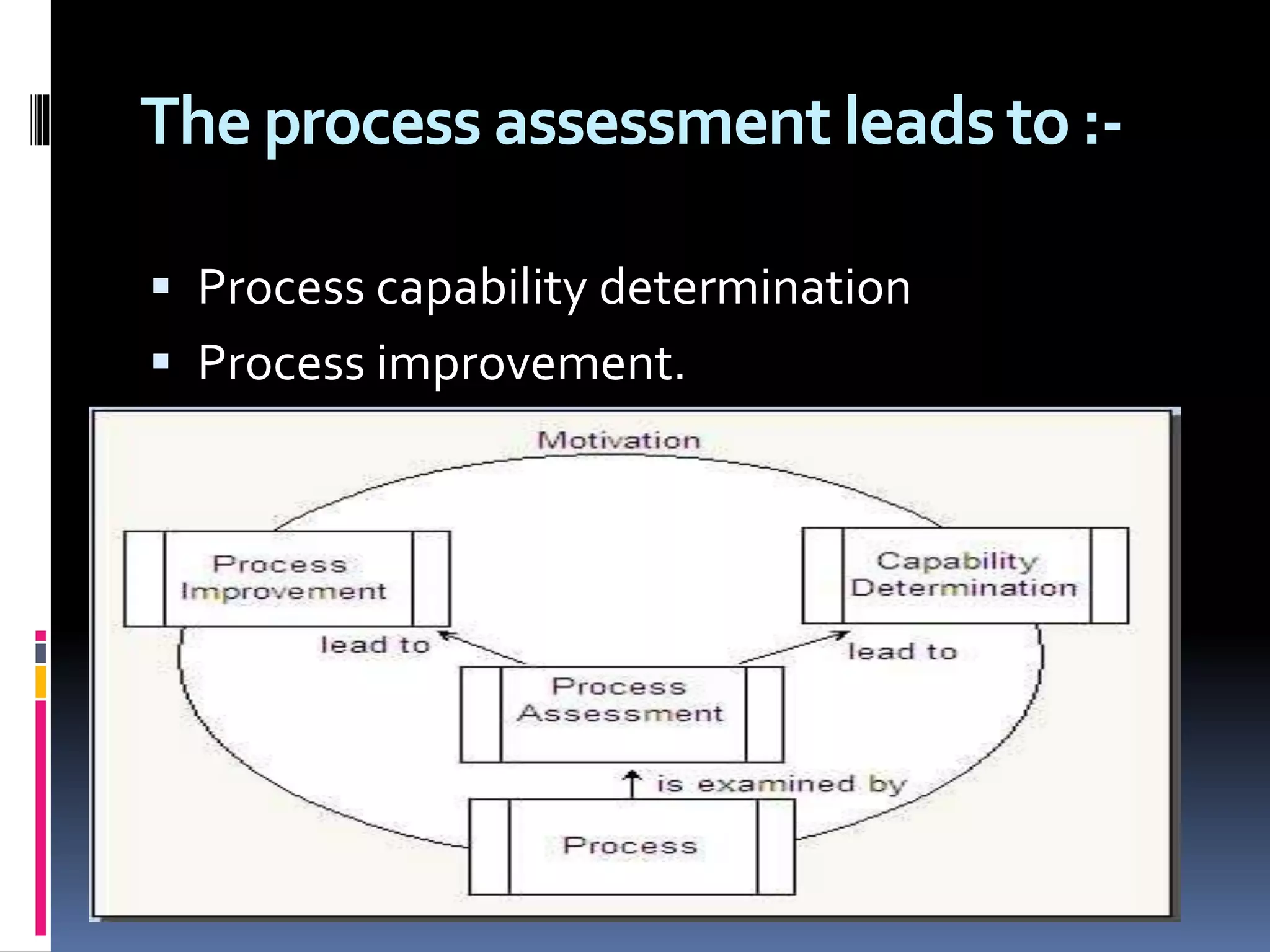
The process assessment leads to :-
 Process capability determination
 Process improvement.
The Processcapabilitydetermination
• It is an organized assessment, which
analyzes the software processes in an
organization . It also identifies risk involved
in it.
• In addition, process capability
determination identifies the capabilities of
a process and the risks involved in it.
The Process improvement
 The process improvement identifies the
changes to be made in the software
processes.The software capability
determination motivates the organization
to perform software process
improvement.
Different Approaches for Assessment
 SPICE (ISO/IEC15504)
 ISO 9001:2000
 Standard CMMI assessment method for
process improvement
 CMM-based appraisal for internal process
improvement
Software Process Improvement and
Capability Determination
 Software Process Improvement and
Capability Determination (SPICE), is a set
of technical standards documents for the
computer software development process
and related business management
functions.
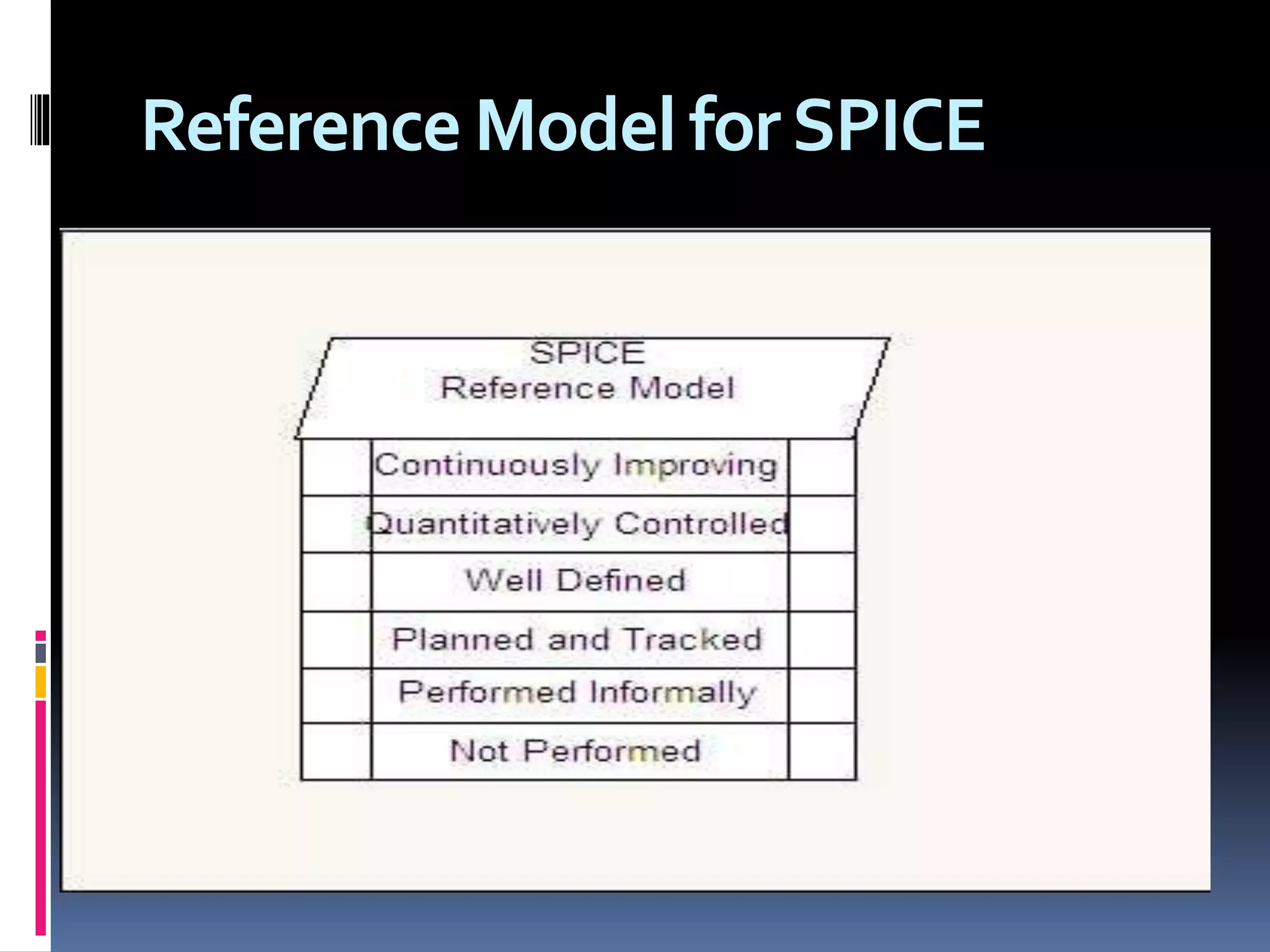
It is applicable for all processes and
comprises following six levels.
1. Not performed: At this level, the processes are
unable to accomplish the required outcomes.
2.Performed informally: At this level, the
implemented process accomplishes the defined
outcomes.
3.Planned and tracked: At this level, the defined
process delivers products according to quality
requirements within a specified time.
4.Well-defined: At this level, the processes
based on software engineering principles
which are capable of achieving defined
outcomes are used.
5.Quantitatively controlled: At this level, the
performance measures, prediction capability
and objective management are evaluated
quantitatively.
6.Continuously improved: At this level, the
existing processes adapt to meet future
business goals.
Reference Model forSPICE
ISO 9001:2000
 ISO (International Organization for
Standardization) established a standard
known as ISO 9001:2000 to determine the
requirements of quality management
systems.
 It is Activity which satisfies the quality related
expectations of customers.
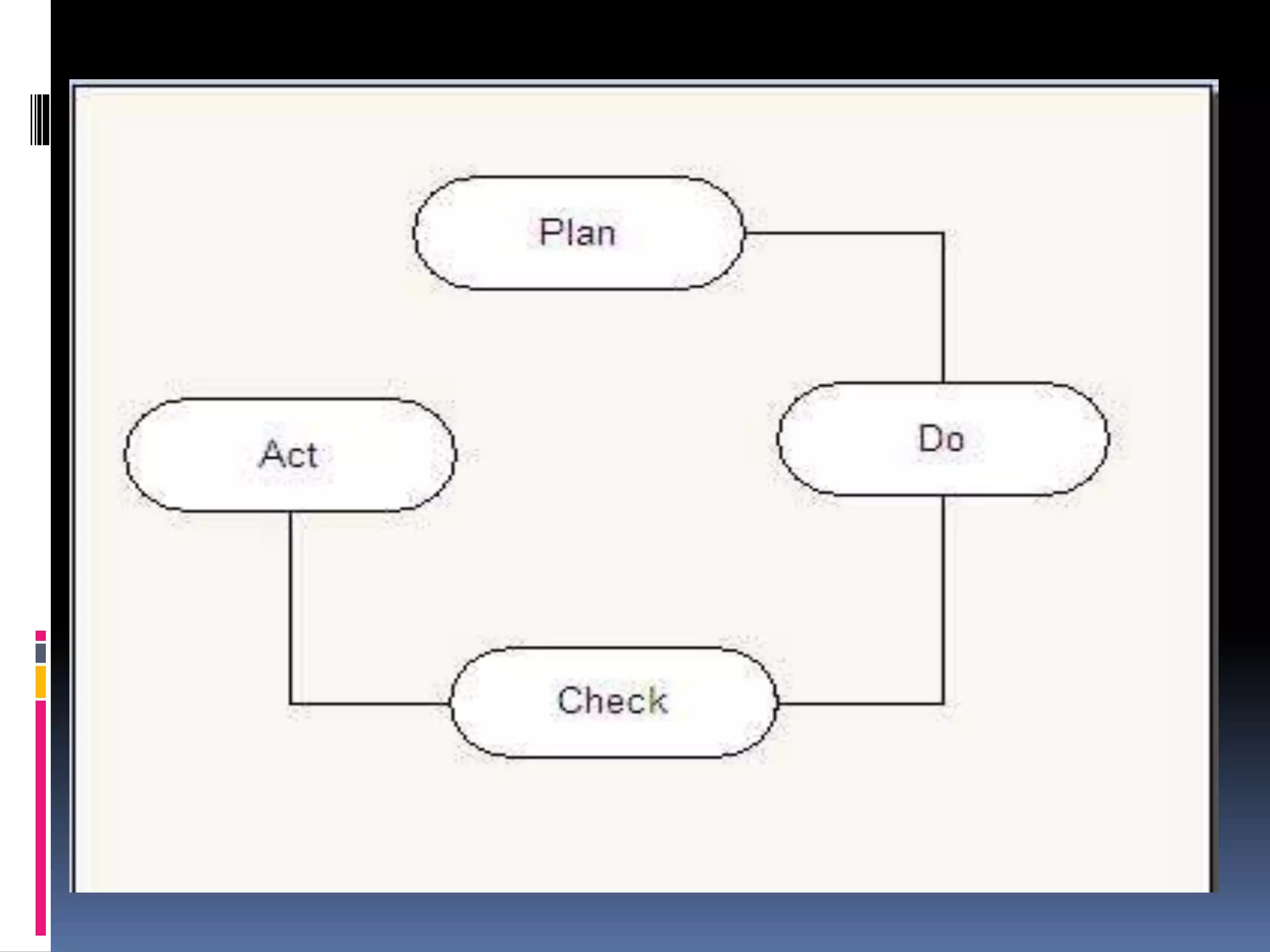
This standard follows a plan-do-check-act
(PDCA) cycle, which includes a set of
activities that are listed below.
 Plan: Determines the processes and resources
which are required to develop a quality product
according to the user's satisfaction.
 Do: Performs activities according to the plan to
create the desired product.
 Check: It Monitors the processes and
takes corrective actions to improve
them.
 Act: Initiates activities which
constantly improve processes in the
organization.
 Check: Measures whether the
activities for establishing quality
management according to the
requirements are accomplished.
 Act: Initiates activities which
constantly improve processes in the
organization.
 Check: Measures whether the
activities for establishing quality
management according to the
requirements are accomplished.
 Act: Initiates activities which
constantly improve processes in the
organization.
StandardCMMI assessment method
for process improvement
 SCAMPI is used for process improvement by
gaining insight into the process capability in
the organization.
 The major advantage of SCAMPI is that it
supports process improvement and
establishes a consensus within the
organization.
The objectives of SCAMPI are listed
below.
 To identify strengths and weaknesses of
existing processes in the organization.
 To specify an integrated appraisal method
for internal process improvement.
 To act as a motivation for initiating and
focusing on software process
improvement.
CMM-basedappraisalfor internal
processimprovement
 CBA-IPI tool is used in an organization to gain
insight into the software development
capability.
 For this, the strengths and weaknesses of the
existing process are identified in order to
prioritize software improvement plans.
 They focus on software improvements, which
are beneficial to the organization.
Toachievethis,theassessmentteam
performsthefollowingfunctions
 Provides data as a baseline to the
organization in order to check its software
capability
 Identifies issues that have an impact on the
process improvement
 Provides sufficiently complete findings to the
organization.
Process Pattern
 Process patterns can be defined as the set of
activities, actions, work tasks or work
products and similar related behaviour
followed in a software development life cycle.
 Process Patterns can be best seen in software
design cycle which involves the common
Stages of development.
 Process patterns can be more easily
understood by dividing it into terms
 Process which means the steps followed
to achieve a task.
 Patterns which means the recurrence of
same basic features during the lifecycle
of a process.
Types of Process Pattern
 Task Pattern :- This type of process pattern
depicts the detailed steps to perform a
specific task, such as theTechnical Review
and Reuse First process patterns.
 Stage Pattern :- This type of process pattern
depicts the steps, which are often performed
iteratively, of a single project stage.
 Phase Pattern :- This type of process pattern
depicts the interactions between the stage
process patterns for a single project phase,
such as the Initiate and Delivery phases.
Data Flow Diagram
 A data flow diagram (DFD) is a graphical
representation of the "flow" of data through
an information system, modelling
its process aspects.
 A DFD shows what kind of information will be
input to and output from the system, where
the data will come from and go to, and where
the data will be stored.
Creating Data Flow Diagrams
1. Create a list of activities
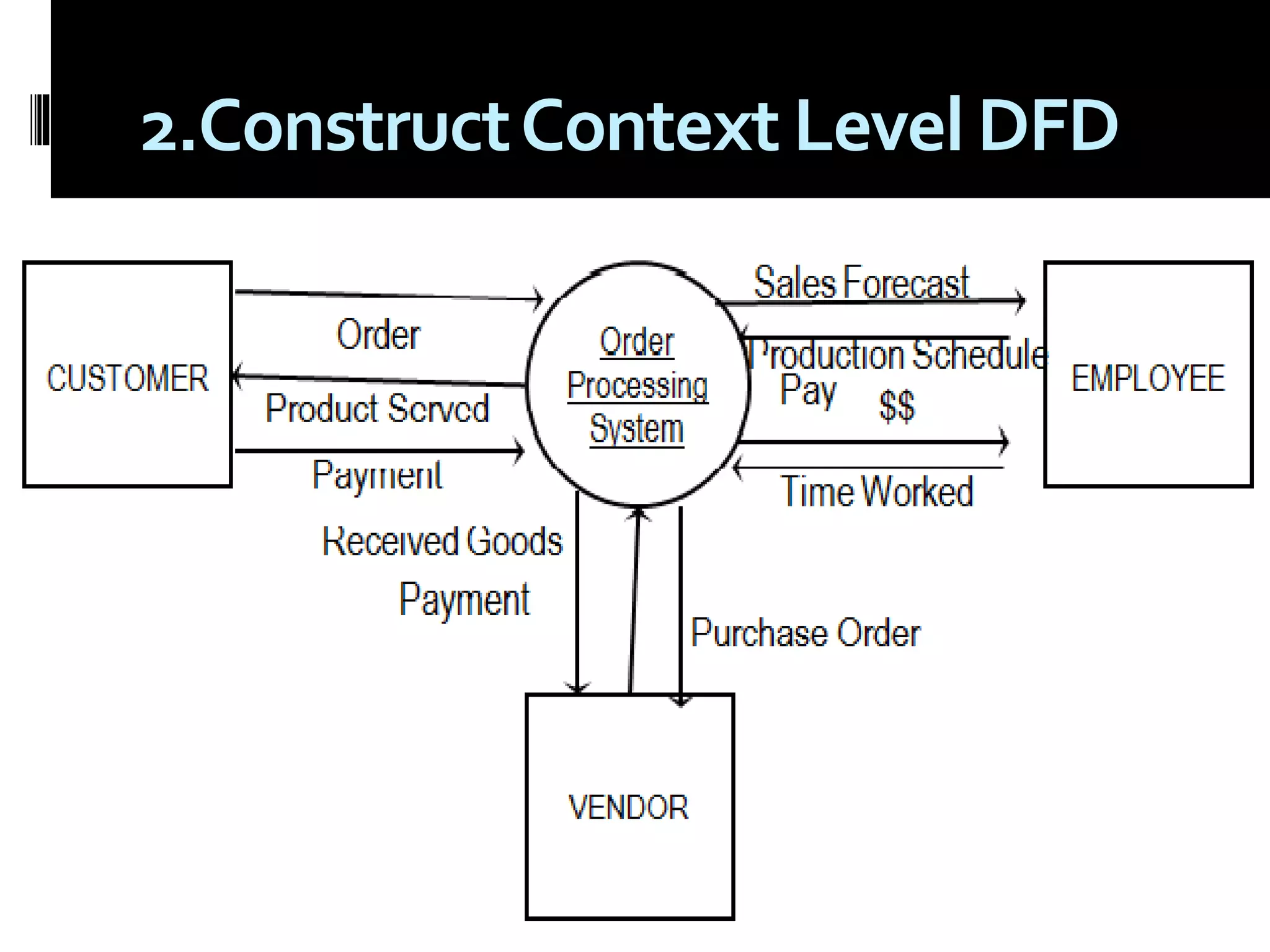
2. Construct Context Level DFD
(identifies external entities and processes)
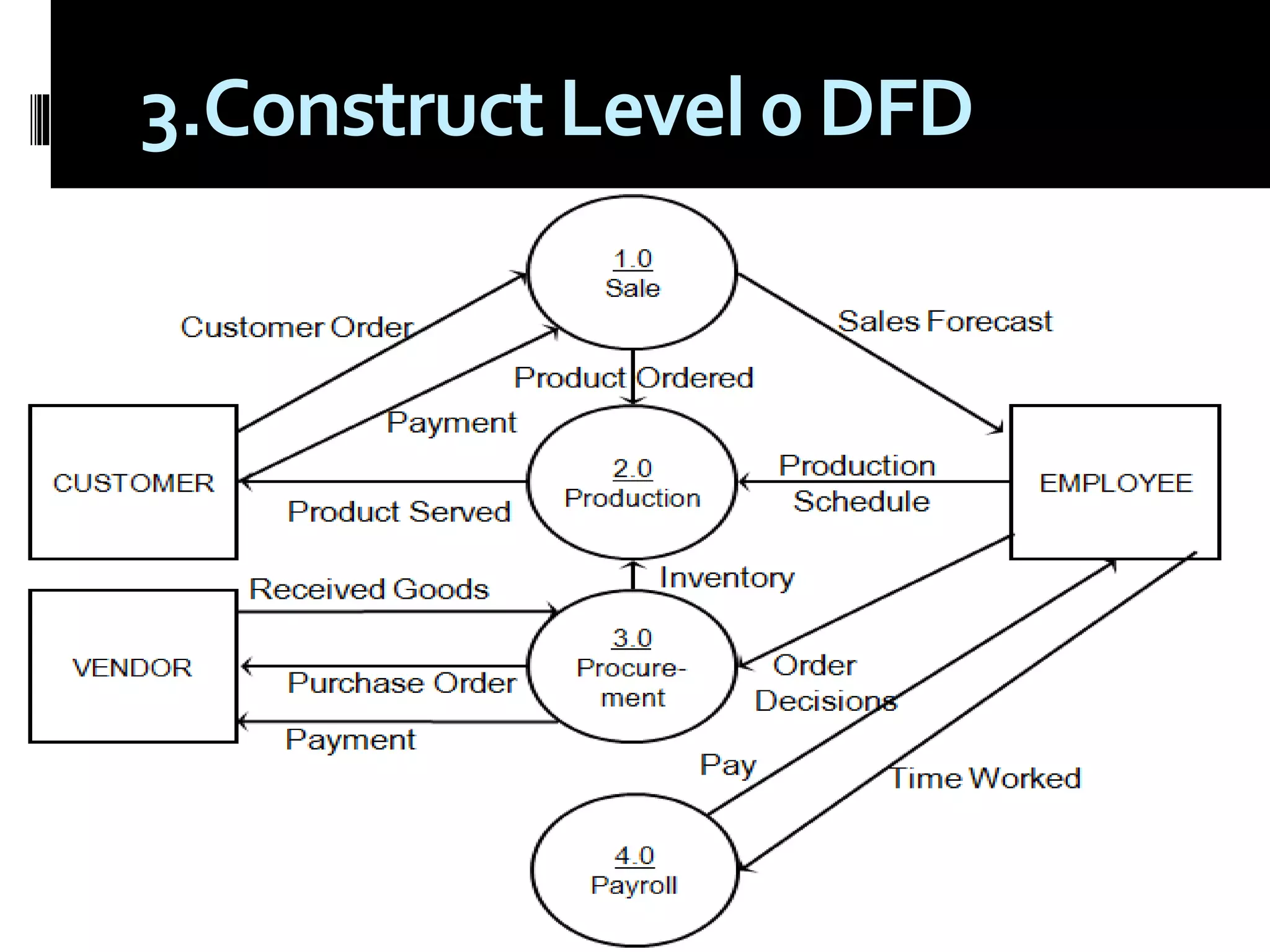
3. Construct Level 0 DFD
(identifies manageable sub process )
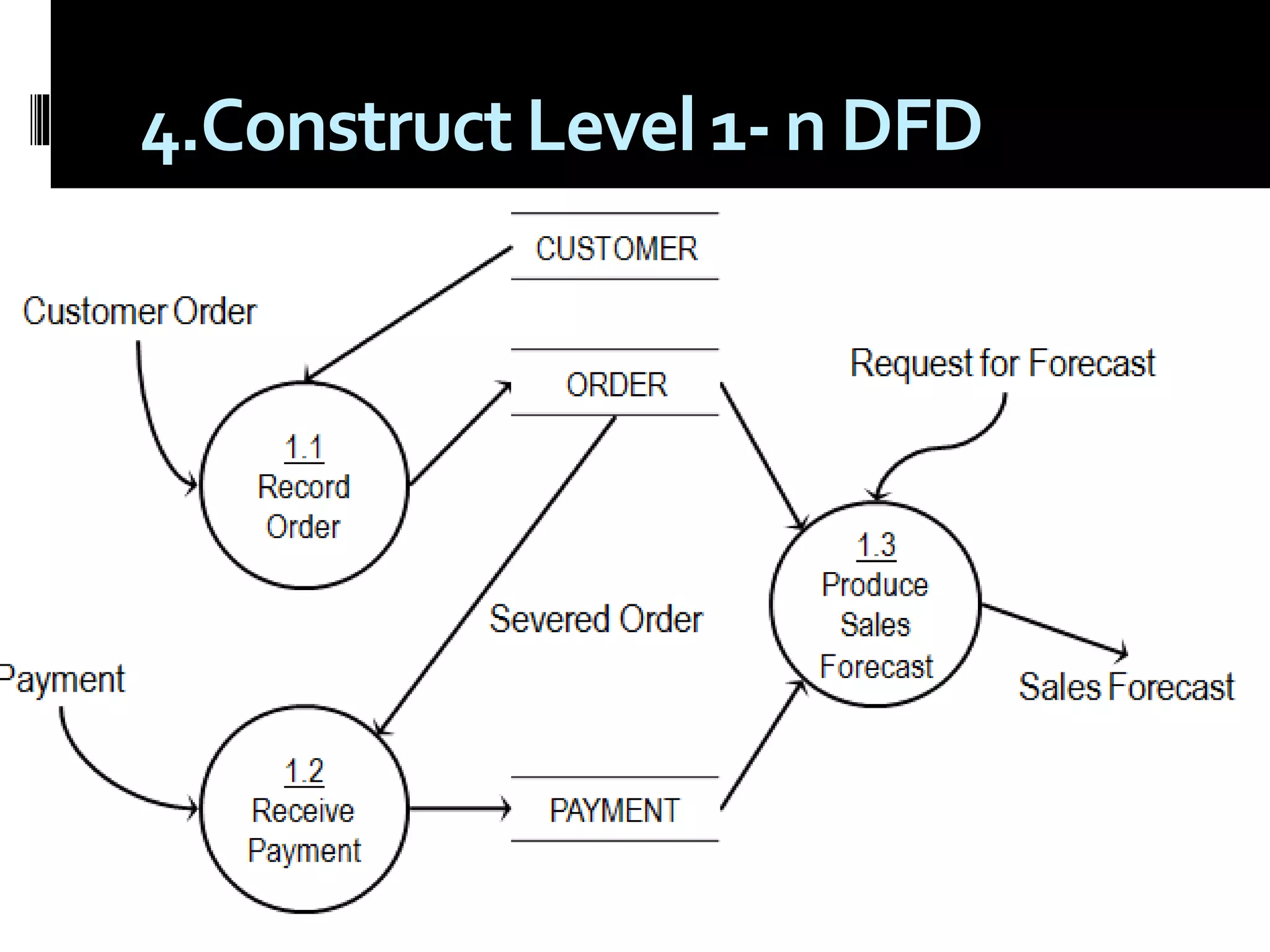
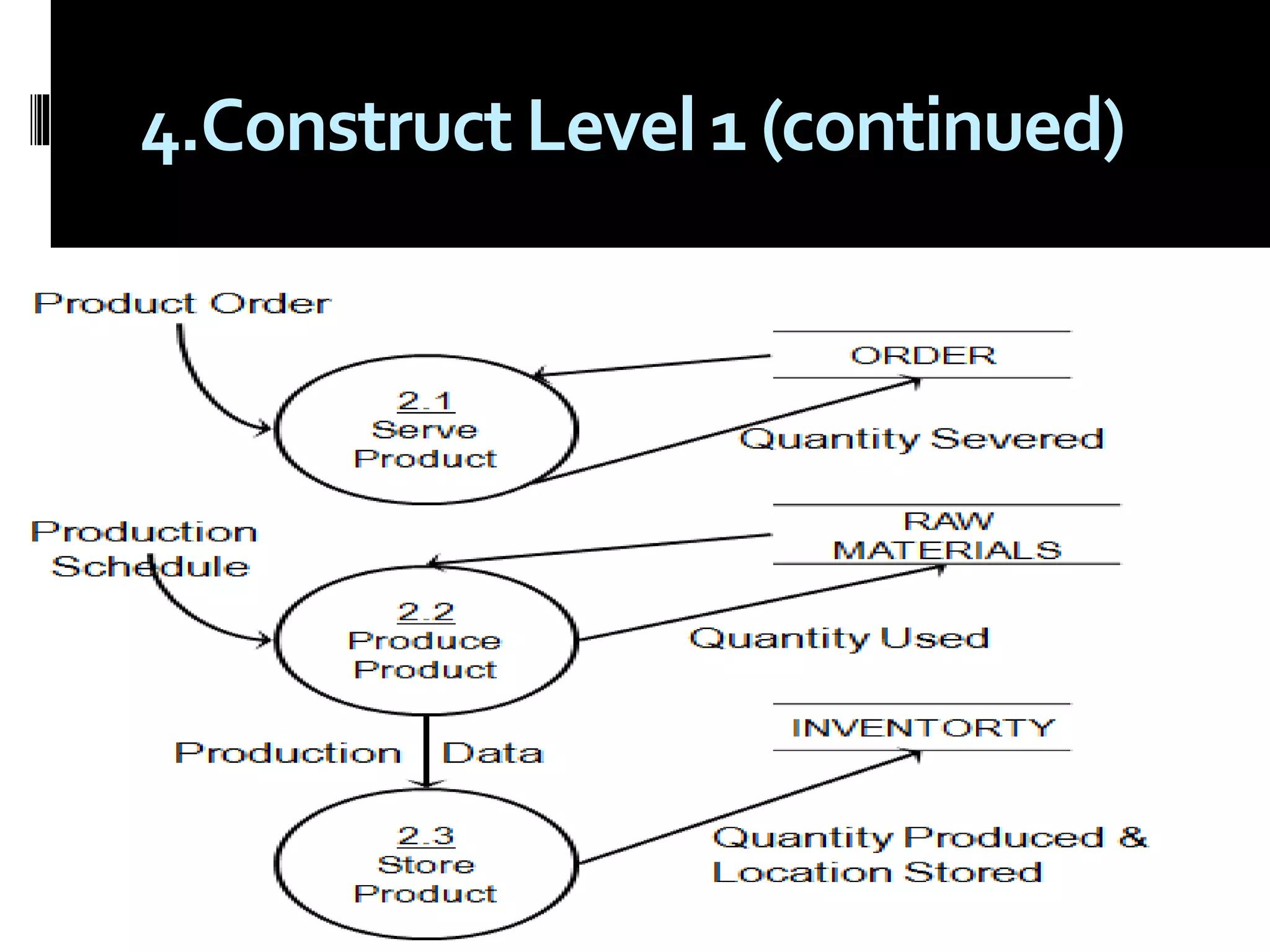
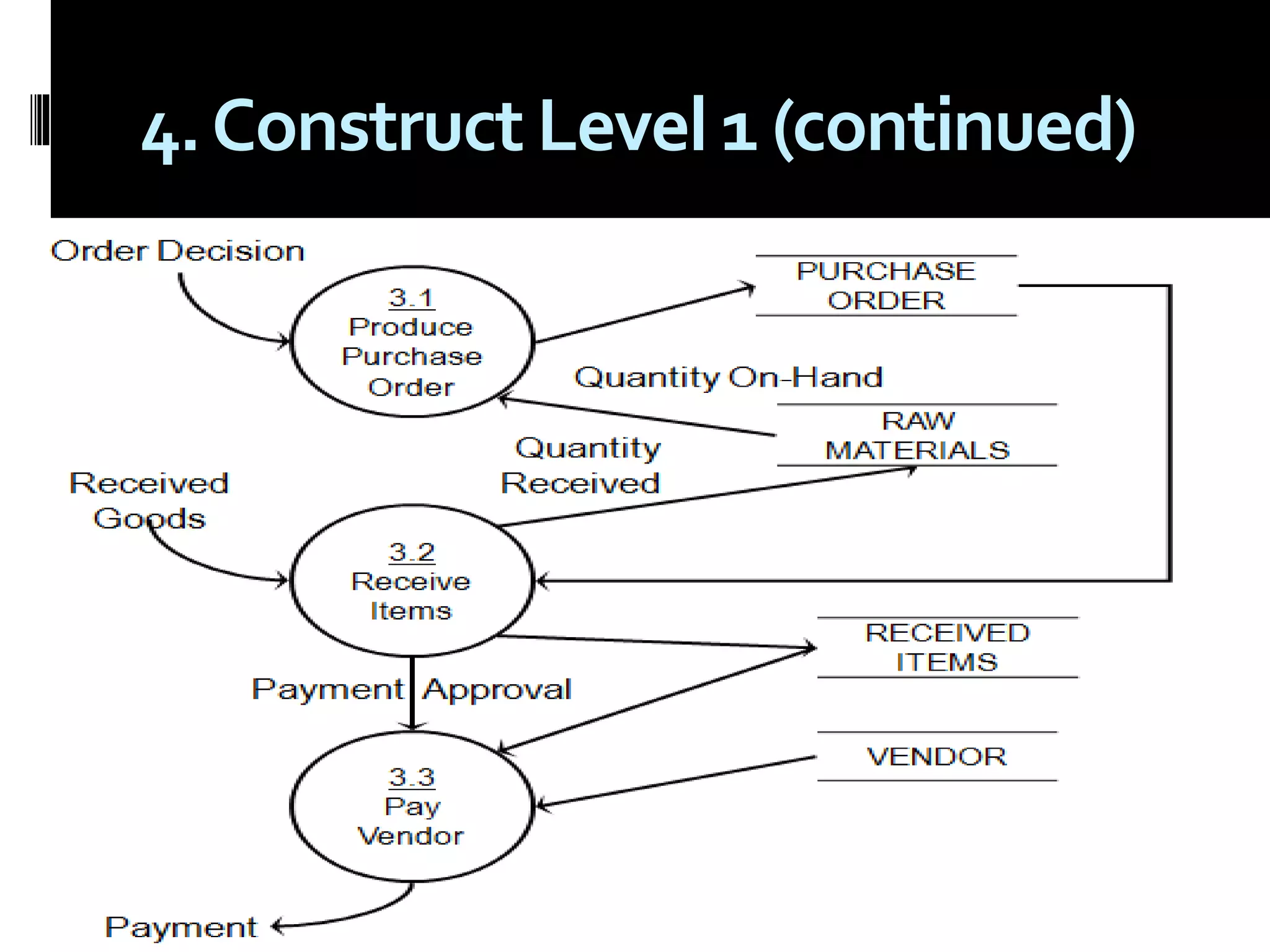
4. Construct Level 1- n DFD
(identifies actual data flows and data stores )
5. Check against rules of DFD
Creating Data Flow Diagrams
Order ProcessingSystem Example
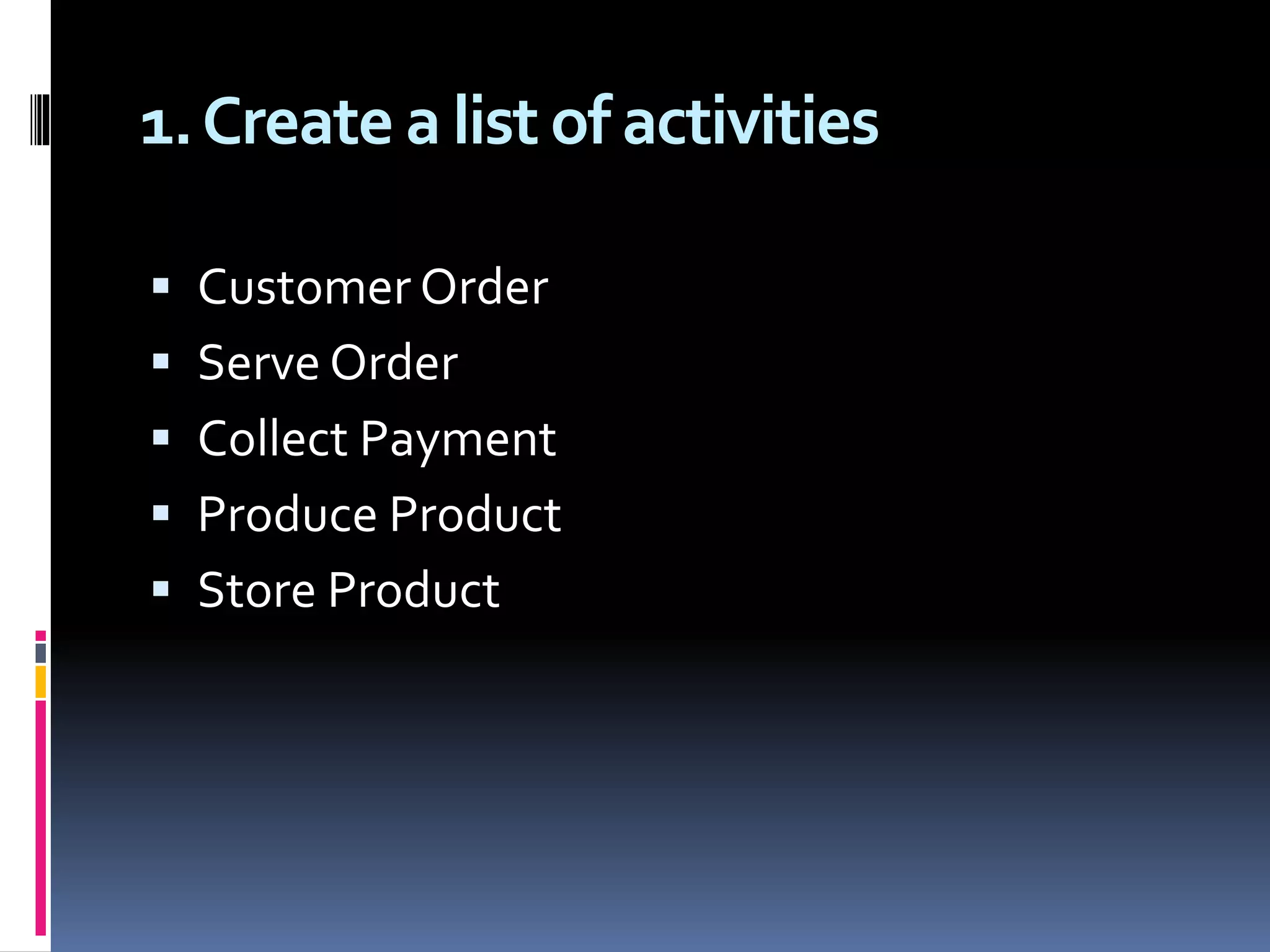
1.Create a list of activities
 Customer Order
 Serve Order
 Collect Payment
 Produce Product
 Store Product
2.ConstructContext Level DFD
3.Construct Level 0 DFD
4.Construct Level 1- n DFD
4.Construct Level 1 (continued)
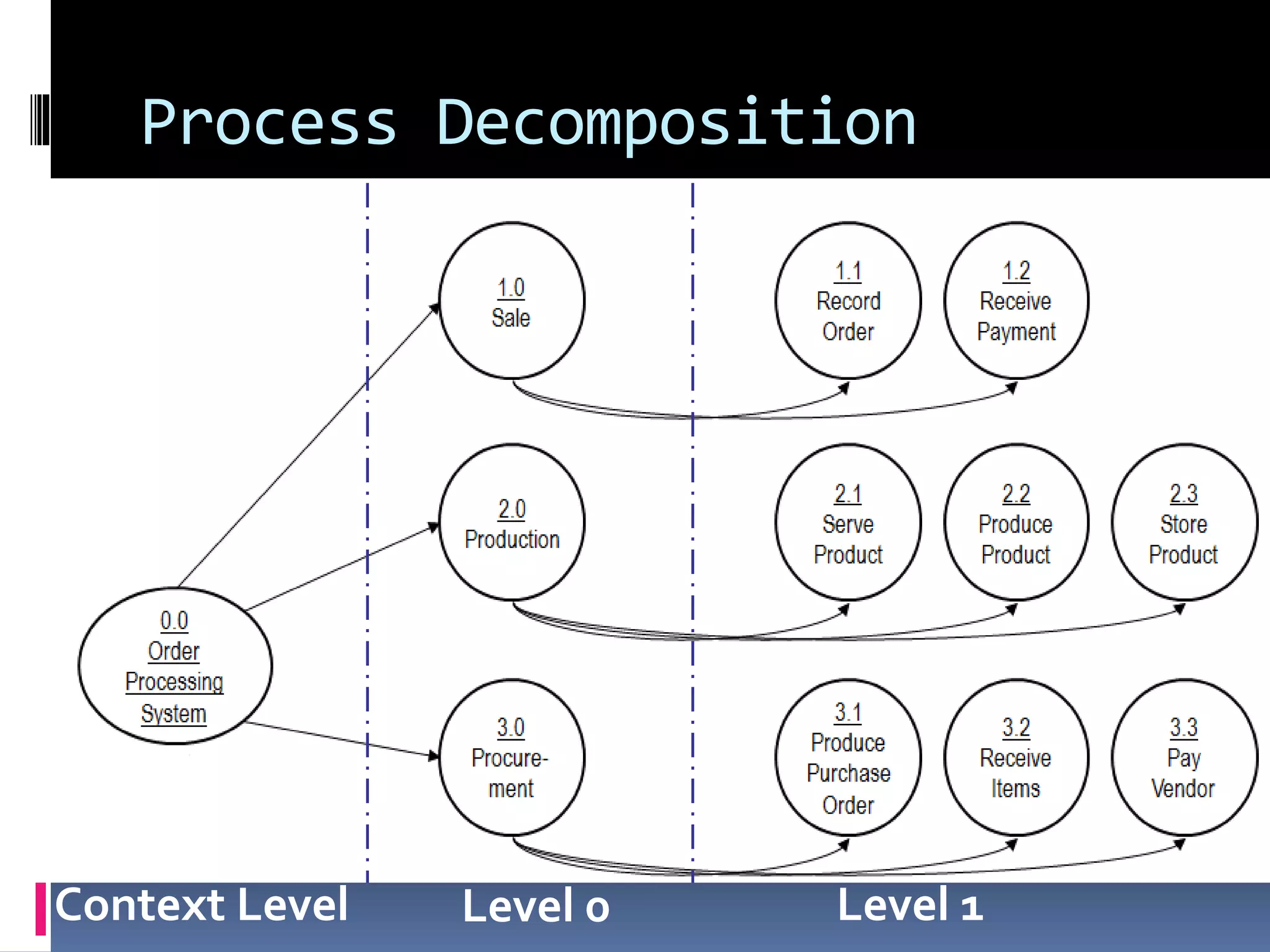
Process Decomposition
Context Level Level 0 Level 1
Summary
 Concept of Process Assessment
 DifferentTypes of Approaches of Process
Assessment
 Concept of Process Pattern
 Types Of Patterns
 Creating Data Flow Diagram
 DFD for Order Processing System
THANK YOU

Process assessment, pattern & dfd final(no change)

  • 1.
  • 2.
    Overview  What isProcess ???  Process Assessment  Aim of ProcessAssessment  DifferentApproaches ofAssessment  Process Patterns  Types Of Process Pattern  Data Flow Diagram  Creating DFD for Order Processing System
  • 3.
    What is Process?  In computing, a process is an of a computer program that is being executed. It contains the program code and its current activity.  The existence of software process does not guarantee the timely delivery of the software and its ability to meet the user's expectations.
  • 4.
    What is ProcessAssessment???  Software process assessment examines whether the software processes are effective and efficient in accomplishing the goals.  Process assessment is useful to the organization as it helps in improving the existing processes.  In addition, it determines the strengths, weaknesses and the risks involved in the processes.
  • 5.
    Aim of ProcessAssessment The aim of process assessment is to identify the areas for improvement and suggest a plan for making that improvement.  Obtaining guidance for improving software development and test processes  Obtaining an independent and unbiased review of the process  Obtaining a baseline for improving quality and productivity of processes.
  • 6.
    The process assessmentleads to :-  Process capability determination  Process improvement.
  • 7.
    The Processcapabilitydetermination • Itis an organized assessment, which analyzes the software processes in an organization . It also identifies risk involved in it. • In addition, process capability determination identifies the capabilities of a process and the risks involved in it.
  • 8.
    The Process improvement The process improvement identifies the changes to be made in the software processes.The software capability determination motivates the organization to perform software process improvement.
  • 9.
    Different Approaches forAssessment  SPICE (ISO/IEC15504)  ISO 9001:2000  Standard CMMI assessment method for process improvement  CMM-based appraisal for internal process improvement
  • 10.
    Software Process Improvementand Capability Determination  Software Process Improvement and Capability Determination (SPICE), is a set of technical standards documents for the computer software development process and related business management functions.
  • 11.
    It is applicablefor all processes and comprises following six levels. 1. Not performed: At this level, the processes are unable to accomplish the required outcomes. 2.Performed informally: At this level, the implemented process accomplishes the defined outcomes. 3.Planned and tracked: At this level, the defined process delivers products according to quality requirements within a specified time.
  • 12.
    4.Well-defined: At thislevel, the processes based on software engineering principles which are capable of achieving defined outcomes are used. 5.Quantitatively controlled: At this level, the performance measures, prediction capability and objective management are evaluated quantitatively. 6.Continuously improved: At this level, the existing processes adapt to meet future business goals.
  • 13.
  • 14.
    ISO 9001:2000  ISO(International Organization for Standardization) established a standard known as ISO 9001:2000 to determine the requirements of quality management systems.  It is Activity which satisfies the quality related expectations of customers.
  • 15.
    This standard followsa plan-do-check-act (PDCA) cycle, which includes a set of activities that are listed below.  Plan: Determines the processes and resources which are required to develop a quality product according to the user's satisfaction.  Do: Performs activities according to the plan to create the desired product.
  • 16.
     Check: ItMonitors the processes and takes corrective actions to improve them.  Act: Initiates activities which constantly improve processes in the organization.
  • 17.
     Check: Measureswhether the activities for establishing quality management according to the requirements are accomplished.  Act: Initiates activities which constantly improve processes in the organization.
  • 18.
     Check: Measureswhether the activities for establishing quality management according to the requirements are accomplished.  Act: Initiates activities which constantly improve processes in the organization.
  • 20.
    StandardCMMI assessment method forprocess improvement  SCAMPI is used for process improvement by gaining insight into the process capability in the organization.  The major advantage of SCAMPI is that it supports process improvement and establishes a consensus within the organization.
  • 21.
    The objectives ofSCAMPI are listed below.  To identify strengths and weaknesses of existing processes in the organization.  To specify an integrated appraisal method for internal process improvement.  To act as a motivation for initiating and focusing on software process improvement.
  • 22.
    CMM-basedappraisalfor internal processimprovement  CBA-IPItool is used in an organization to gain insight into the software development capability.  For this, the strengths and weaknesses of the existing process are identified in order to prioritize software improvement plans.  They focus on software improvements, which are beneficial to the organization.
  • 23.
    Toachievethis,theassessmentteam performsthefollowingfunctions  Provides dataas a baseline to the organization in order to check its software capability  Identifies issues that have an impact on the process improvement  Provides sufficiently complete findings to the organization.
  • 24.
    Process Pattern  Processpatterns can be defined as the set of activities, actions, work tasks or work products and similar related behaviour followed in a software development life cycle.  Process Patterns can be best seen in software design cycle which involves the common Stages of development.
  • 25.
     Process patternscan be more easily understood by dividing it into terms  Process which means the steps followed to achieve a task.  Patterns which means the recurrence of same basic features during the lifecycle of a process.
  • 26.
    Types of ProcessPattern  Task Pattern :- This type of process pattern depicts the detailed steps to perform a specific task, such as theTechnical Review and Reuse First process patterns.  Stage Pattern :- This type of process pattern depicts the steps, which are often performed iteratively, of a single project stage.
  • 27.
     Phase Pattern:- This type of process pattern depicts the interactions between the stage process patterns for a single project phase, such as the Initiate and Delivery phases.
  • 28.
    Data Flow Diagram A data flow diagram (DFD) is a graphical representation of the "flow" of data through an information system, modelling its process aspects.  A DFD shows what kind of information will be input to and output from the system, where the data will come from and go to, and where the data will be stored.
  • 29.
    Creating Data FlowDiagrams 1. Create a list of activities 2. Construct Context Level DFD (identifies external entities and processes) 3. Construct Level 0 DFD (identifies manageable sub process ) 4. Construct Level 1- n DFD (identifies actual data flows and data stores ) 5. Check against rules of DFD
  • 30.
    Creating Data FlowDiagrams Order ProcessingSystem Example
  • 31.
    1.Create a listof activities  Customer Order  Serve Order  Collect Payment  Produce Product  Store Product
  • 32.
  • 33.
  • 34.
  • 35.
  • 36.
  • 37.
  • 38.
    Summary  Concept ofProcess Assessment  DifferentTypes of Approaches of Process Assessment  Concept of Process Pattern  Types Of Patterns  Creating Data Flow Diagram  DFD for Order Processing System
  • 40.