STORAGE
DEVICES
Prepare by: M.Robeel
Storage Devices
3/9/2020Gulab Devi Educational Complex Lahore
2
Storage Devices
 Primary Memory
 Secondary Memory
 Floppy disks
 Hard disks
 Smart cards
 Flash memory
 Online secondary storage
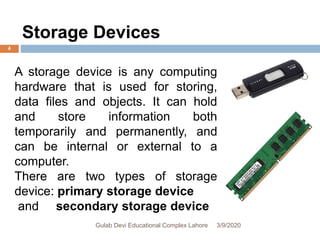
A storage device is any computing
hardware that is used for storing,
data files and objects. It can hold
and store information both
temporarily and permanently, and
can be internal or external to a
computer.
There are two types of storage
device: primary storage device
and secondary storage device
Storage Devices
3/9/2020Gulab Devi Educational Complex Lahore
4
Storage Devices
Primary Memory
3/9/2020Gulab Devi Educational Complex Lahore
5
• Primary memory holds only those data and
instructions on which the computer is currently
working.
• It has a limited capacity and data is lost when power
is switched off. It is generally made up of
semiconductor device.
• These memories are not as fast as registers. The
data and instruction required to be processed
resides in the main memory. It is divided into two
subcategories RAM and ROM
Primary memory
3/9/2020Gulab Devi Educational Complex Lahore
6
• These are semiconductor memories.
• It is known as the main memory.
• Usually volatile memory.
• Data is lost in case power is switched off.
• It is the working memory of the computer.
• Faster than secondary memories.
• A computer cannot run without the primary
memory.
Characteristics of Primary Memory
3/9/2020Gulab Devi Educational Complex Lahore
7
RAM:
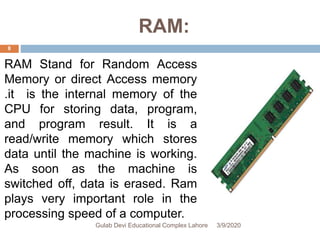
RAM Stand for Random Access
Memory or direct Access memory
.it is the internal memory of the
CPU for storing data, program,
and program result. It is a
read/write memory which stores
data until the machine is working.
As soon as the machine is
switched off, data is erased. Ram
plays very important role in the
processing speed of a computer.
3/9/2020Gulab Devi Educational Complex Lahore
8
Storage Devices
Static RAM
3/9/2020Gulab Devi Educational Complex Lahore
9
Static RAM (SRAM)
The word static indicates that the memory retains
its contents as long as power is being supplied.
However, data is lost when the power gets down
due to volatile nature.
Characteristic of Static RAM
• Long life
• No need to refresh
• Faster
• Used as cache memory
• Large size
• Expensive
• High power consumption
3/9/2020Gulab Devi Educational Complex Lahore
10
Storage Devices
Dynamic RAM
3/9/2020Gulab Devi Educational Complex Lahore
11
DRAM stand for Dynamic Random Access memory. It
is used in most of the computers. It is the least
expensive kind of Ram.. That is why it is slow.
Characteristics of Dynamic RAM
• Short data lifetime
• Needs to be refreshed continuously
• Slower as compared to SRAM
• Used as RAM
• Smaller in size
• Less expensive
• Less power consumption
Dynamic RAM (DRAM)
3/9/2020Gulab Devi Educational Complex Lahore
12
Storage Devices
SDRAM
(synchronous
dynamic RAM)
3/9/2020Gulab Devi Educational Complex Lahore
13
SDRAM (synchronous
dynamic
RAM)
 This Type of RAM is SDRAM (synchronous
dynamic RAM), which is synchronized by the
system clock and is much faster than DRAM.
Often in computer ads the speed of SDRAM is
expressed in megahertz.
3/9/2020Gulab Devi Educational Complex Lahore
14
Storage Devices
DDR-SDRAM (double-data rate
Synchronous dynamic RAM)
3/9/2020Gulab Devi Educational Complex Lahore
15
DDR-SDRAM (double-data
rate
synchronous dynamic RAM)
 DDR-SDRAM: This type, DDR-SDRAM (double-data
rate synchronous dynamic RAM), is the current
standard of RAM chip in PCs used at home; the
speed is measured in megahertz. An even faster
version is DDR2 SDRAM, the most recent entry,
which is found on gaming machines and multimedia
machines, where speed is needed.
3/9/2020Gulab Devi Educational Complex Lahore
16
Storage Devices
Read Only Memory
3/9/2020Gulab Devi Educational Complex Lahore
17
Read Only Memory
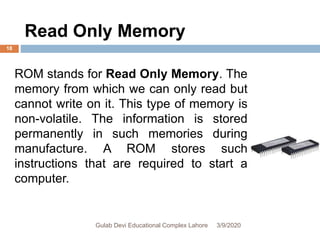
ROM stands for Read Only Memory. The
memory from which we can only read but
cannot write on it. This type of memory is
non-volatile. The information is stored
permanently in such memories during
manufacture. A ROM stores such
instructions that are required to start a
computer.
3/9/2020Gulab Devi Educational Complex Lahore
18
The advantages of ROM are as follows −
• Non-volatile in nature
• Cannot be accidentally changed
• Cheaper than RAMs
• Easy to test
• More Reliable than RAMs
• Static and do not require refreshing
• Contents are always known and can be
verified
Advantages of ROM
3/9/2020Gulab Devi Educational Complex Lahore
19
Storage Devices
Secondary Memory
3/9/2020Gulab Devi Educational Complex Lahore
20
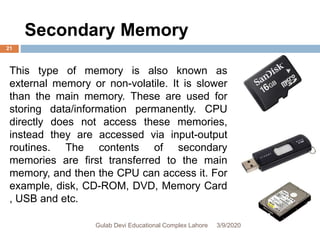
This type of memory is also known as
external memory or non-volatile. It is slower
than the main memory. These are used for
storing data/information permanently. CPU
directly does not access these memories,
instead they are accessed via input-output
routines. The contents of secondary
memories are first transferred to the main
memory, and then the CPU can access it. For
example, disk, CD-ROM, DVD, Memory Card
, USB and etc.
Secondary Memory
3/9/2020Gulab Devi Educational Complex Lahore
21
• These are magnetic and optical memories.
• It is known as the backup memory.
• It is a non-volatile memory.
• Data is permanently stored even if power is
switched off.
• It is used for storage of data in a computer.
• Slower than primary memories.
Characteristics of Secondary Memory
3/9/2020Gulab Devi Educational Complex Lahore
22
Hard Disk Drive
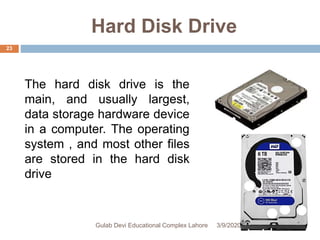
The hard disk drive is the
main, and usually largest,
data storage hardware device
in a computer. The operating
system , and most other files
are stored in the hard disk
drive
3/9/2020Gulab Devi Educational Complex Lahore
23
Online storage
 Online storage services, allow you to use the internet
to back up your data. Some services are free; others
charge a small fee. Examples are Google Drive,
Dropbox, Mega , one Drive , etc offers free online
storage.
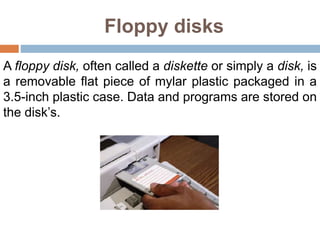
Floppy disks
A floppy disk, often called a diskette or simply a disk, is
a removable flat piece of mylar plastic packaged in a
3.5-inch plastic case. Data and programs are stored on
the disk’s.
Storage Devices
Cache Memory
3/9/2020Gulab Devi Educational Complex Lahore
26
Cache Memory
• Cache memory is a very small and very fast
memory. It is designed to speed up the transfer of
data and instructions. It is located inside or close to
the CPU chip.it is faster than RAM. The data and
instructions that are most recently or most
frequently used by CPU are stored in cache.
• The data and instructions are retrieved from RAM
when CPU uses them for the first time.
• A copy of that data is stored in cache. The next time
the CPU needs that data . It first looks in cache .if
the required data is found there .it is retrieved from
cache memory instead of main memory. It speed up
3/9/2020Gulab Devi Educational Complex Lahore
27
 A computer can have several different levels of
cache memory. All level of cache memory are faster
than RAM. Different level of cache memory
 Level 1 cache :
It is built directly into the processor chip.it has small
capacity from 8KB to 128 KB.
Level 2 cache:
It is slower than L1 cache. It storage capacity is more
64KB to 16 MB.
Level 3 cache: 3/9/2020Gulab Devi Educational Complex Lahore
28
Cache Memory
Virtual Memory
virtual memory
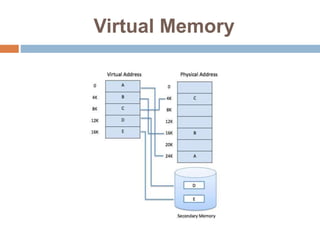
 A computer can address more memory than
the amount physically installed on the system.
This extra memory is actually called virtual
memory and it is a section of a hard disk
that's set up to emulate the computer's RAM.
 Virtual memory serves two purposes. First, it
allows us to extend the use of physical
memory by using disk. Second, it allows us to
have memory protection, because each virtual
address is translated to a physical address.
Virtual Memory
Self Study
3/9/2020Gulab Devi Educational Complex Lahore
32
CD
Usb
Dvd
Magnetic Disk
Memory Card
3/9/2020Gulab Devi Educational Complex Lahore
33
MEASURING
CAPACITY
3/9/2020Gulab Devi Educational Complex Lahore
34
MEASURING CAPACITY
 How many representations of 0s and 1s can be
held in a computer or a storage device such as a
hard disk? Capacity is denoted by bits and bytes
and multiples there of:
 Bit: In the binary system, each 0 or 1 is called a
bit, which is short for “binary digit.”
 Byte: To represent letters, numbers, or special
characters (such as ! or *), bits are combined into
groups. A group of 8 bits is called a byte, and a
byte represents one character ,digit , or other
value.
MEASURING CAPACITY
 Kilobyte: A kilobyte (K, KB) is about 1,000 bytes.
(Actually, it’s precisely 1,024 bytes,
 Megabyte: A megabyte (M, MB) is about 1 million
bytes (1,048,576 bytes).24 bytes,
 Gigabyte: A gigabyte (G, GB) is about 1 billion
bytes (1,073,741,824 bytes).
3/9/2020Gulab Devi Educational Complex Lahore
37

Ch # 06 storage devices

  • 1.
  • 2.
    Storage Devices 3/9/2020Gulab DeviEducational Complex Lahore 2
  • 3.
    Storage Devices  PrimaryMemory  Secondary Memory  Floppy disks  Hard disks  Smart cards  Flash memory  Online secondary storage
  • 4.
    A storage deviceis any computing hardware that is used for storing, data files and objects. It can hold and store information both temporarily and permanently, and can be internal or external to a computer. There are two types of storage device: primary storage device and secondary storage device Storage Devices 3/9/2020Gulab Devi Educational Complex Lahore 4
  • 5.
    Storage Devices Primary Memory 3/9/2020GulabDevi Educational Complex Lahore 5
  • 6.
    • Primary memoryholds only those data and instructions on which the computer is currently working. • It has a limited capacity and data is lost when power is switched off. It is generally made up of semiconductor device. • These memories are not as fast as registers. The data and instruction required to be processed resides in the main memory. It is divided into two subcategories RAM and ROM Primary memory 3/9/2020Gulab Devi Educational Complex Lahore 6
  • 7.
    • These aresemiconductor memories. • It is known as the main memory. • Usually volatile memory. • Data is lost in case power is switched off. • It is the working memory of the computer. • Faster than secondary memories. • A computer cannot run without the primary memory. Characteristics of Primary Memory 3/9/2020Gulab Devi Educational Complex Lahore 7
  • 8.
    RAM: RAM Stand forRandom Access Memory or direct Access memory .it is the internal memory of the CPU for storing data, program, and program result. It is a read/write memory which stores data until the machine is working. As soon as the machine is switched off, data is erased. Ram plays very important role in the processing speed of a computer. 3/9/2020Gulab Devi Educational Complex Lahore 8
  • 9.
    Storage Devices Static RAM 3/9/2020GulabDevi Educational Complex Lahore 9
  • 10.
    Static RAM (SRAM) Theword static indicates that the memory retains its contents as long as power is being supplied. However, data is lost when the power gets down due to volatile nature. Characteristic of Static RAM • Long life • No need to refresh • Faster • Used as cache memory • Large size • Expensive • High power consumption 3/9/2020Gulab Devi Educational Complex Lahore 10
  • 11.
    Storage Devices Dynamic RAM 3/9/2020GulabDevi Educational Complex Lahore 11
  • 12.
    DRAM stand forDynamic Random Access memory. It is used in most of the computers. It is the least expensive kind of Ram.. That is why it is slow. Characteristics of Dynamic RAM • Short data lifetime • Needs to be refreshed continuously • Slower as compared to SRAM • Used as RAM • Smaller in size • Less expensive • Less power consumption Dynamic RAM (DRAM) 3/9/2020Gulab Devi Educational Complex Lahore 12
  • 13.
  • 14.
    SDRAM (synchronous dynamic RAM)  ThisType of RAM is SDRAM (synchronous dynamic RAM), which is synchronized by the system clock and is much faster than DRAM. Often in computer ads the speed of SDRAM is expressed in megahertz. 3/9/2020Gulab Devi Educational Complex Lahore 14
  • 15.
    Storage Devices DDR-SDRAM (double-datarate Synchronous dynamic RAM) 3/9/2020Gulab Devi Educational Complex Lahore 15
  • 16.
    DDR-SDRAM (double-data rate synchronous dynamicRAM)  DDR-SDRAM: This type, DDR-SDRAM (double-data rate synchronous dynamic RAM), is the current standard of RAM chip in PCs used at home; the speed is measured in megahertz. An even faster version is DDR2 SDRAM, the most recent entry, which is found on gaming machines and multimedia machines, where speed is needed. 3/9/2020Gulab Devi Educational Complex Lahore 16
  • 17.
    Storage Devices Read OnlyMemory 3/9/2020Gulab Devi Educational Complex Lahore 17
  • 18.
    Read Only Memory ROMstands for Read Only Memory. The memory from which we can only read but cannot write on it. This type of memory is non-volatile. The information is stored permanently in such memories during manufacture. A ROM stores such instructions that are required to start a computer. 3/9/2020Gulab Devi Educational Complex Lahore 18
  • 19.
    The advantages ofROM are as follows − • Non-volatile in nature • Cannot be accidentally changed • Cheaper than RAMs • Easy to test • More Reliable than RAMs • Static and do not require refreshing • Contents are always known and can be verified Advantages of ROM 3/9/2020Gulab Devi Educational Complex Lahore 19
  • 20.
    Storage Devices Secondary Memory 3/9/2020GulabDevi Educational Complex Lahore 20
  • 21.
    This type ofmemory is also known as external memory or non-volatile. It is slower than the main memory. These are used for storing data/information permanently. CPU directly does not access these memories, instead they are accessed via input-output routines. The contents of secondary memories are first transferred to the main memory, and then the CPU can access it. For example, disk, CD-ROM, DVD, Memory Card , USB and etc. Secondary Memory 3/9/2020Gulab Devi Educational Complex Lahore 21
  • 22.
    • These aremagnetic and optical memories. • It is known as the backup memory. • It is a non-volatile memory. • Data is permanently stored even if power is switched off. • It is used for storage of data in a computer. • Slower than primary memories. Characteristics of Secondary Memory 3/9/2020Gulab Devi Educational Complex Lahore 22
  • 23.
    Hard Disk Drive Thehard disk drive is the main, and usually largest, data storage hardware device in a computer. The operating system , and most other files are stored in the hard disk drive 3/9/2020Gulab Devi Educational Complex Lahore 23
  • 24.
    Online storage  Onlinestorage services, allow you to use the internet to back up your data. Some services are free; others charge a small fee. Examples are Google Drive, Dropbox, Mega , one Drive , etc offers free online storage.
  • 25.
    Floppy disks A floppydisk, often called a diskette or simply a disk, is a removable flat piece of mylar plastic packaged in a 3.5-inch plastic case. Data and programs are stored on the disk’s.
  • 26.
    Storage Devices Cache Memory 3/9/2020GulabDevi Educational Complex Lahore 26
  • 27.
    Cache Memory • Cachememory is a very small and very fast memory. It is designed to speed up the transfer of data and instructions. It is located inside or close to the CPU chip.it is faster than RAM. The data and instructions that are most recently or most frequently used by CPU are stored in cache. • The data and instructions are retrieved from RAM when CPU uses them for the first time. • A copy of that data is stored in cache. The next time the CPU needs that data . It first looks in cache .if the required data is found there .it is retrieved from cache memory instead of main memory. It speed up 3/9/2020Gulab Devi Educational Complex Lahore 27
  • 28.
     A computercan have several different levels of cache memory. All level of cache memory are faster than RAM. Different level of cache memory  Level 1 cache : It is built directly into the processor chip.it has small capacity from 8KB to 128 KB. Level 2 cache: It is slower than L1 cache. It storage capacity is more 64KB to 16 MB. Level 3 cache: 3/9/2020Gulab Devi Educational Complex Lahore 28 Cache Memory
  • 29.
  • 30.
    virtual memory  Acomputer can address more memory than the amount physically installed on the system. This extra memory is actually called virtual memory and it is a section of a hard disk that's set up to emulate the computer's RAM.  Virtual memory serves two purposes. First, it allows us to extend the use of physical memory by using disk. Second, it allows us to have memory protection, because each virtual address is translated to a physical address.
  • 31.
  • 32.
    Self Study 3/9/2020Gulab DeviEducational Complex Lahore 32
  • 33.
    CD Usb Dvd Magnetic Disk Memory Card 3/9/2020GulabDevi Educational Complex Lahore 33
  • 34.
  • 35.
    MEASURING CAPACITY  Howmany representations of 0s and 1s can be held in a computer or a storage device such as a hard disk? Capacity is denoted by bits and bytes and multiples there of:  Bit: In the binary system, each 0 or 1 is called a bit, which is short for “binary digit.”  Byte: To represent letters, numbers, or special characters (such as ! or *), bits are combined into groups. A group of 8 bits is called a byte, and a byte represents one character ,digit , or other value.
  • 36.
    MEASURING CAPACITY  Kilobyte:A kilobyte (K, KB) is about 1,000 bytes. (Actually, it’s precisely 1,024 bytes,  Megabyte: A megabyte (M, MB) is about 1 million bytes (1,048,576 bytes).24 bytes,  Gigabyte: A gigabyte (G, GB) is about 1 billion bytes (1,073,741,824 bytes).
  • 37.