MEMORY
Asma Khan
Did you know…
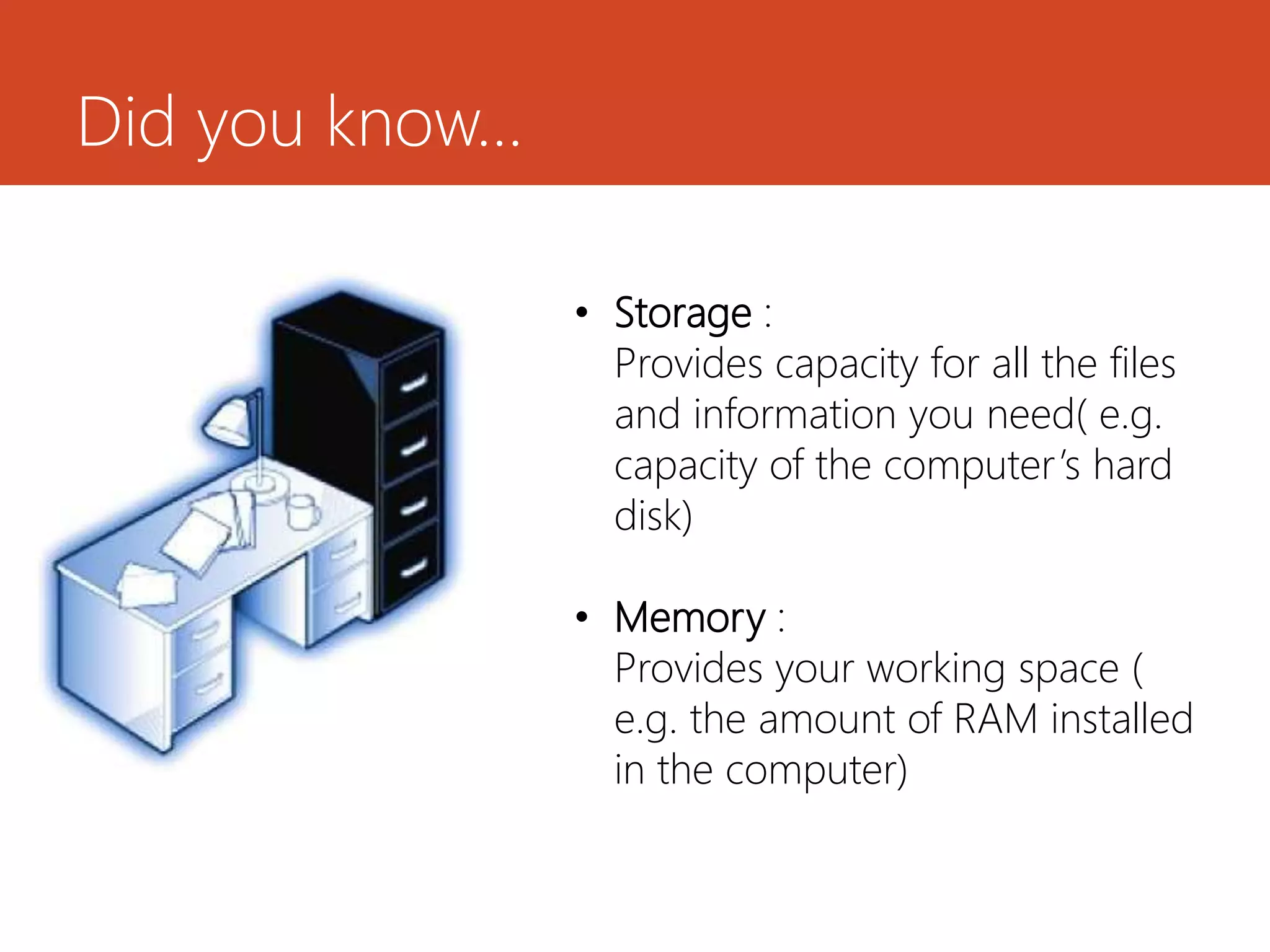
• Storage :
Provides capacity for all the files
and information you need( e.g.
capacity of the computer’s hard
disk)
• Memory :
Provides your working space (
e.g. the amount of RAM installed
in the computer)
Overview
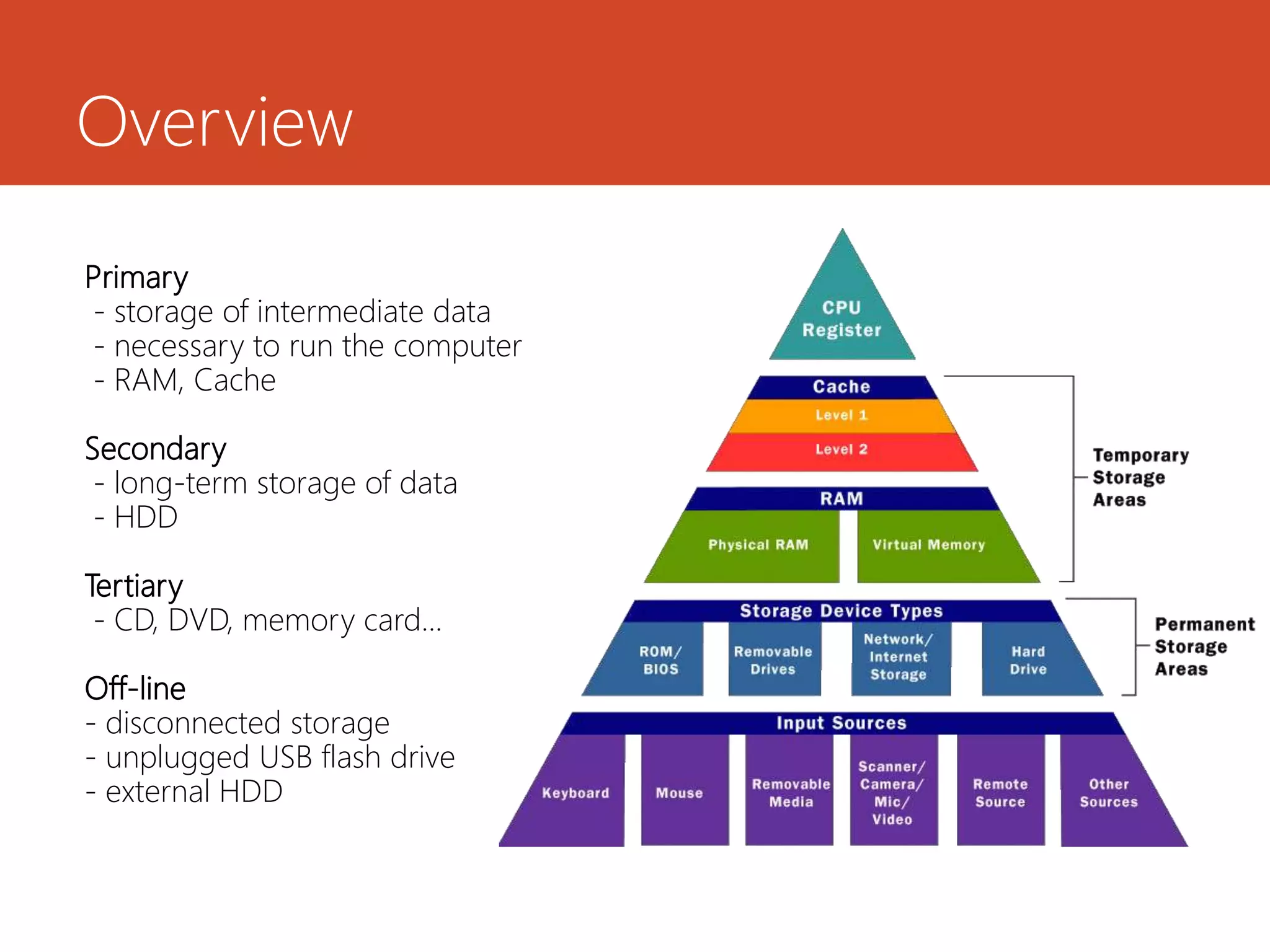
Primary
- storage of intermediate data
- necessary to run the computer
- RAM, Cache
Secondary
- long-term storage of data
- HDD
Tertiary
- CD, DVD, memory card...
Off-line
- disconnected storage
- unplugged USB flash drive
- external HDD
Memory
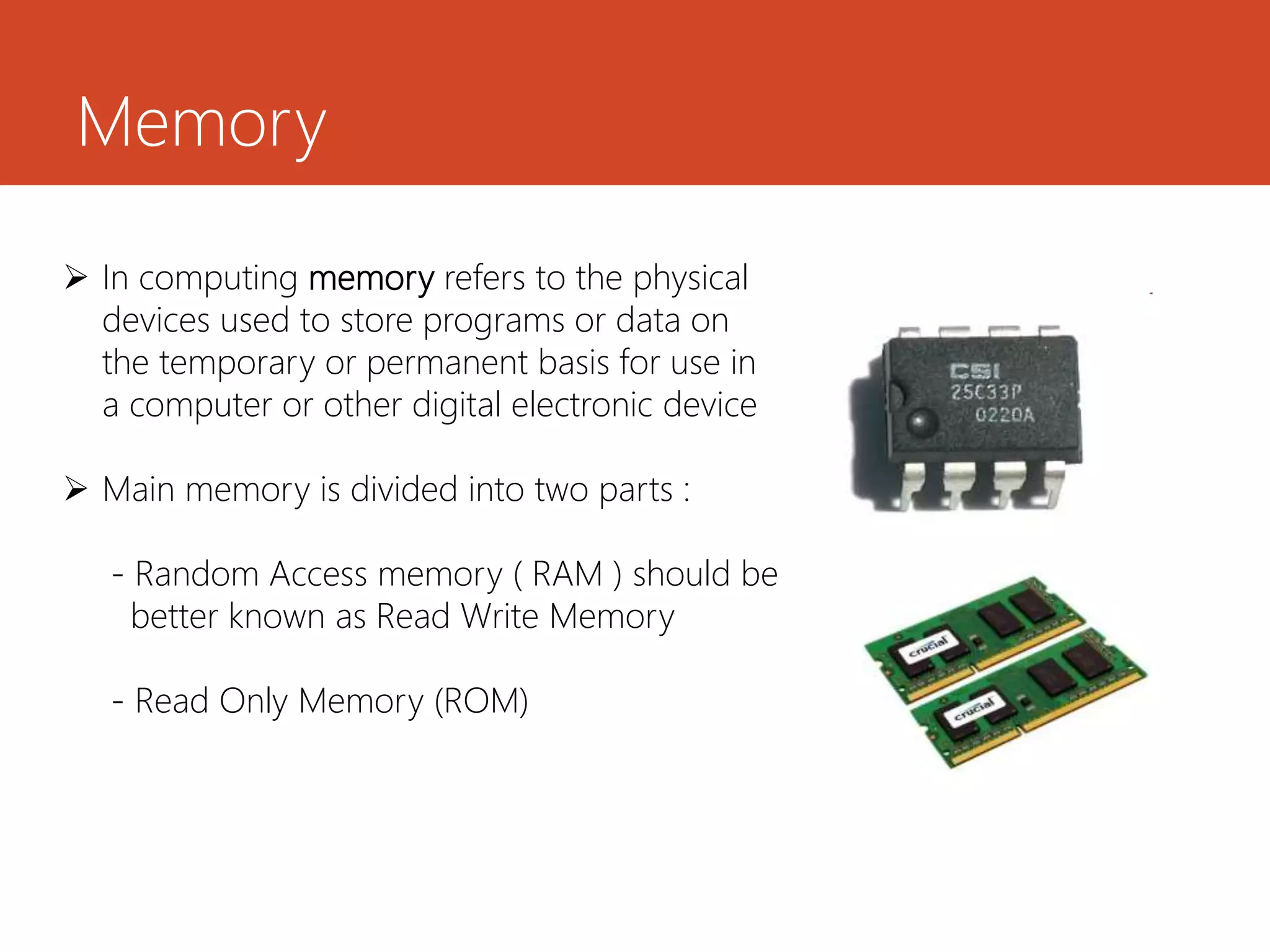
 In computing memory refers to the physical
devices used to store programs or data on
the temporary or permanent basis for use in
a computer or other digital electronic device
 Main memory is divided into two parts :
- Random Access memory ( RAM ) should be
better known as Read Write Memory
- Read Only Memory (ROM)
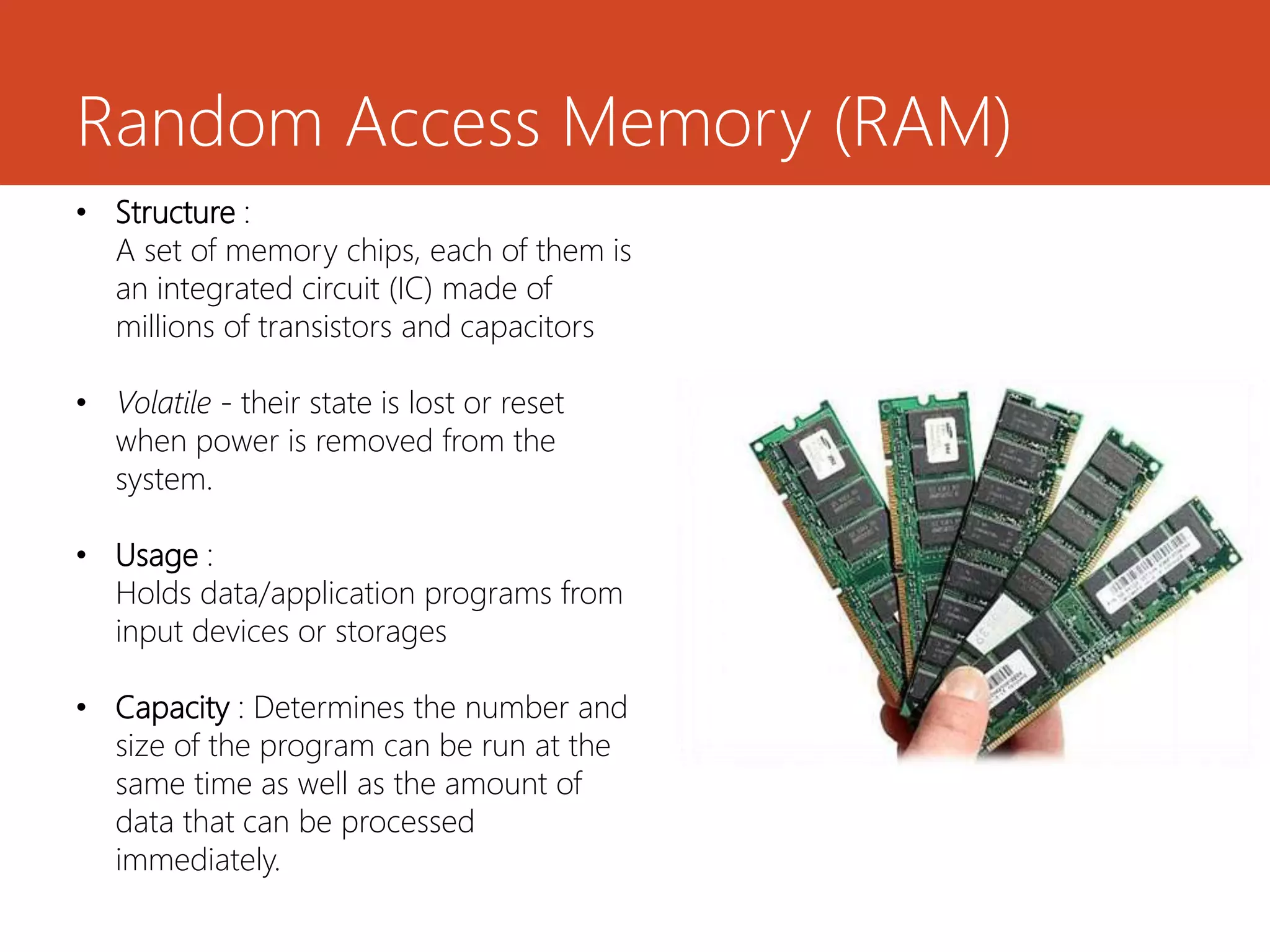
Random Access Memory (RAM)
• Structure :
A set of memory chips, each of them is
an integrated circuit (IC) made of
millions of transistors and capacitors
• Volatile - their state is lost or reset
when power is removed from the
system.
• Usage :
Holds data/application programs from
input devices or storages
• Capacity : Determines the number and
size of the program can be run at the
same time as well as the amount of
data that can be processed
immediately.
Types of RAM
Static Random Access Memory
(SRAM)
• Semi conductor memory
• Use flip-flop to store each bit of
memory so does not need to be
periodically refreshed
• Faster and consumes low power
• Expensive and have complex
structure (6 transistors) so not use in
high capacity applications
Dynamic Random Access Memory
(DRAM)
• Store each bit of memory in
capacitor in an integrated circuit
• Real capacitors leak charge so
capacitors need to be refreshed
periodically
• Simple structure ( 1 transistor and 1
capacitor per bit) so it has very high
density
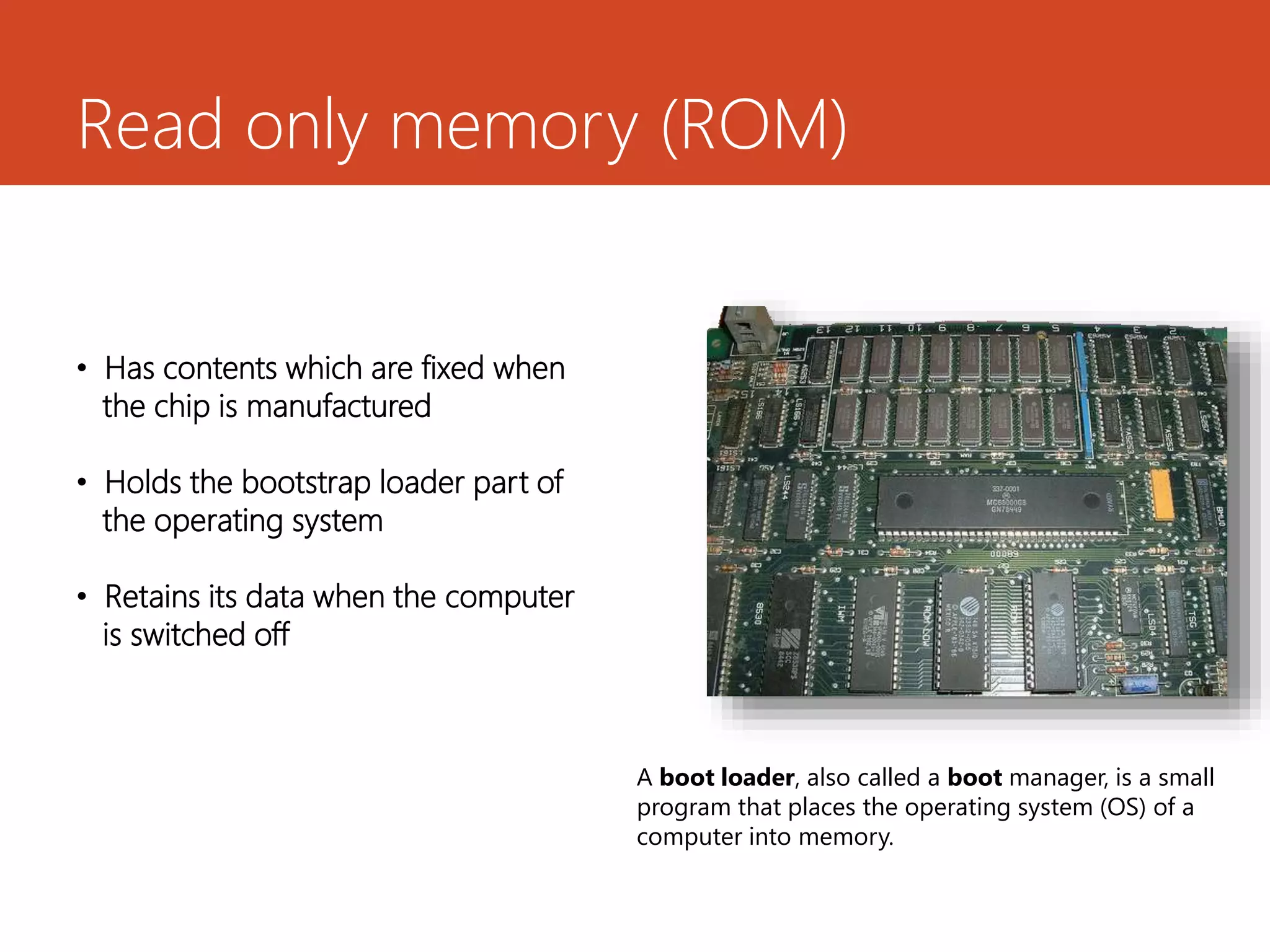
Read only memory (ROM)
• Has contents which are fixed when
the chip is manufactured
• Holds the bootstrap loader part of
the operating system
• Retains its data when the computer
is switched off
A boot loader, also called a boot manager, is a small
program that places the operating system (OS) of a
computer into memory.
Types of ROM
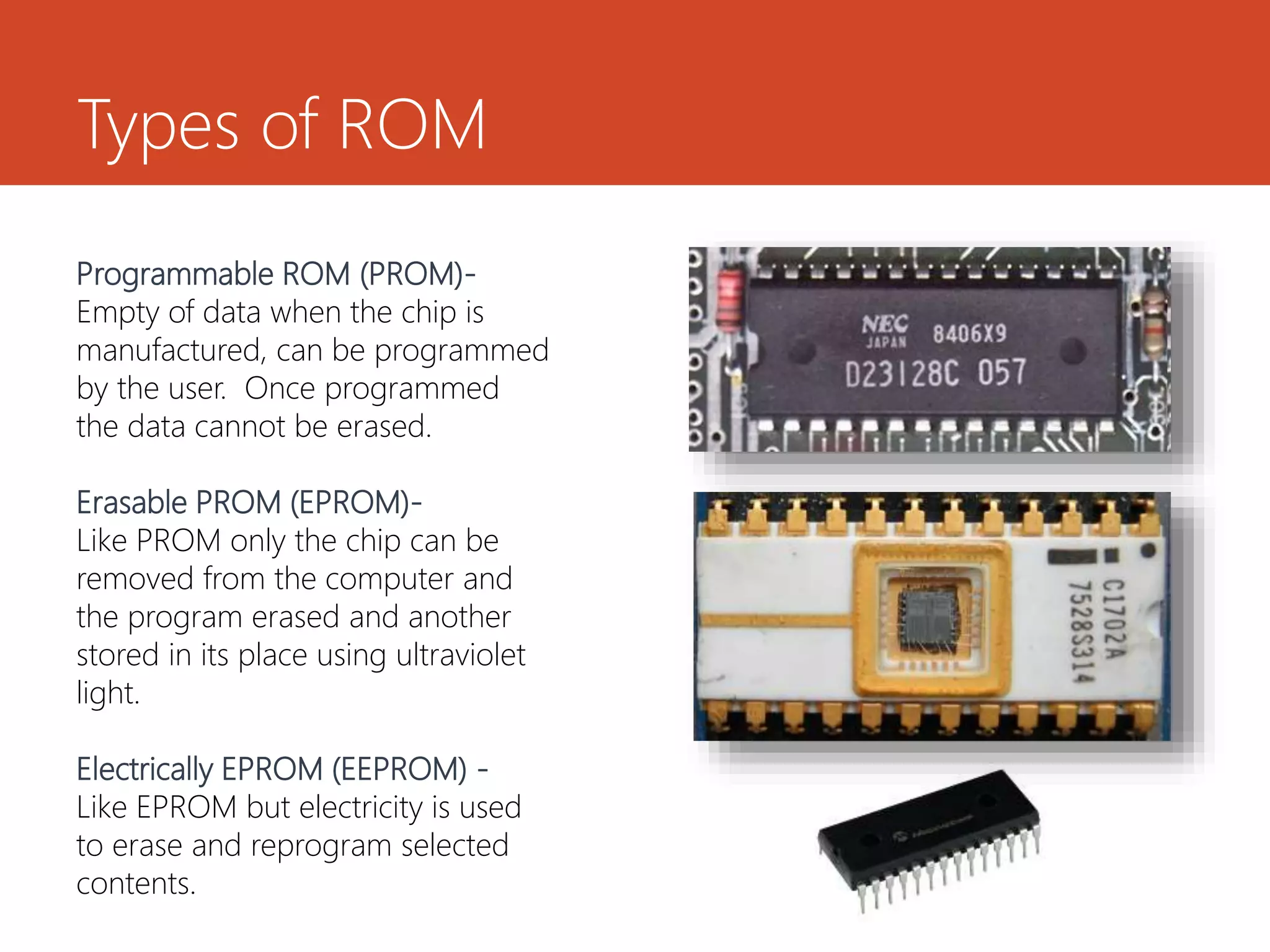
Programmable ROM (PROM)-
Empty of data when the chip is
manufactured, can be programmed
by the user. Once programmed
the data cannot be erased.
Erasable PROM (EPROM)-
Like PROM only the chip can be
removed from the computer and
the program erased and another
stored in its place using ultraviolet
light.
Electrically EPROM (EEPROM) -
Like EPROM but electricity is used
to erase and reprogram selected
contents.
CACHE MEMORY
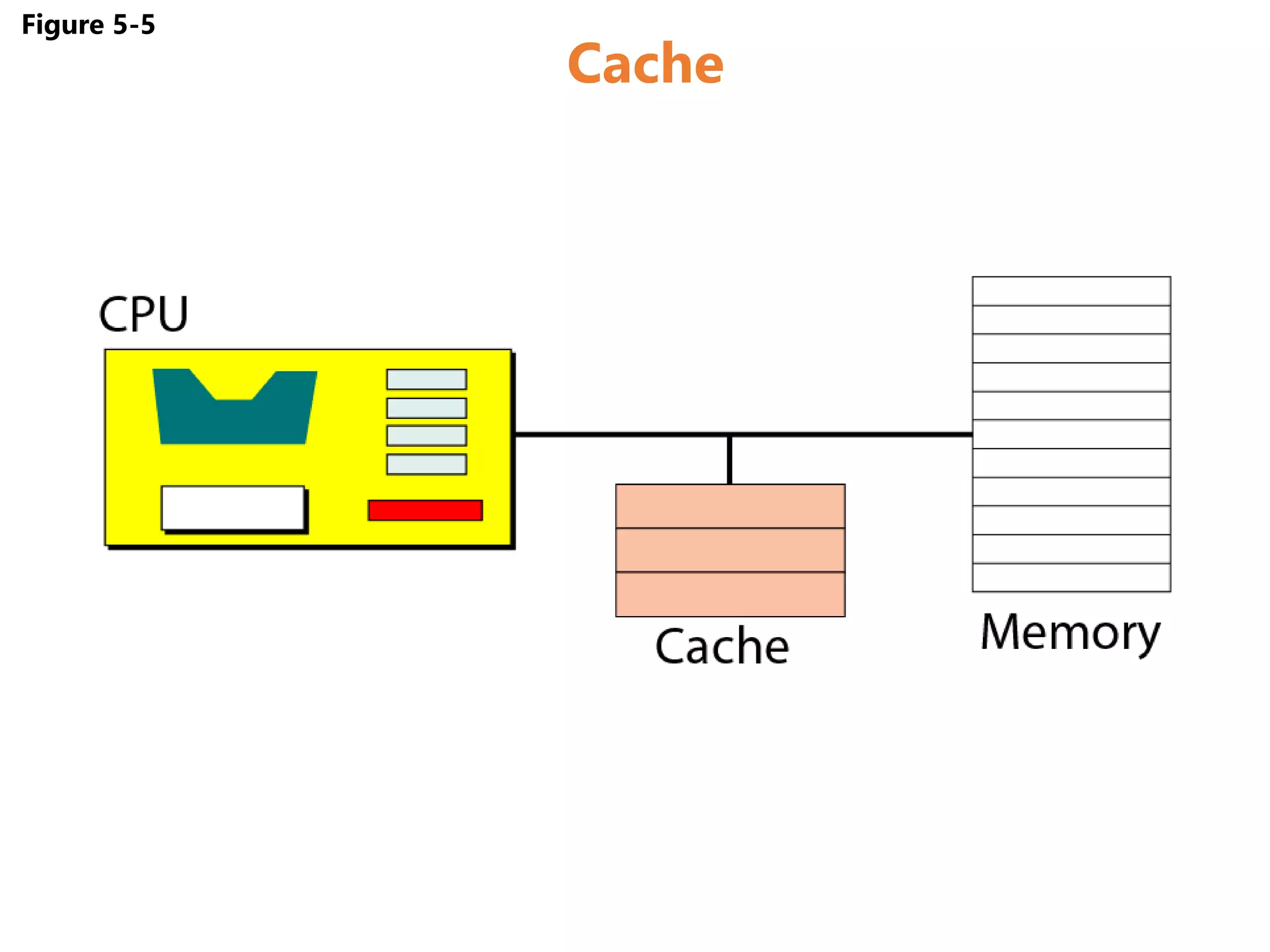
Cache memory, also called CPU memory, is random
access memory(RAM) that a computer microprocessor
can access more quickly than it can access regular RAM.
This memory is typically integrated directly with
the CPU chip or placed on a separate chip that has a
separate bus interconnect with the CPU.
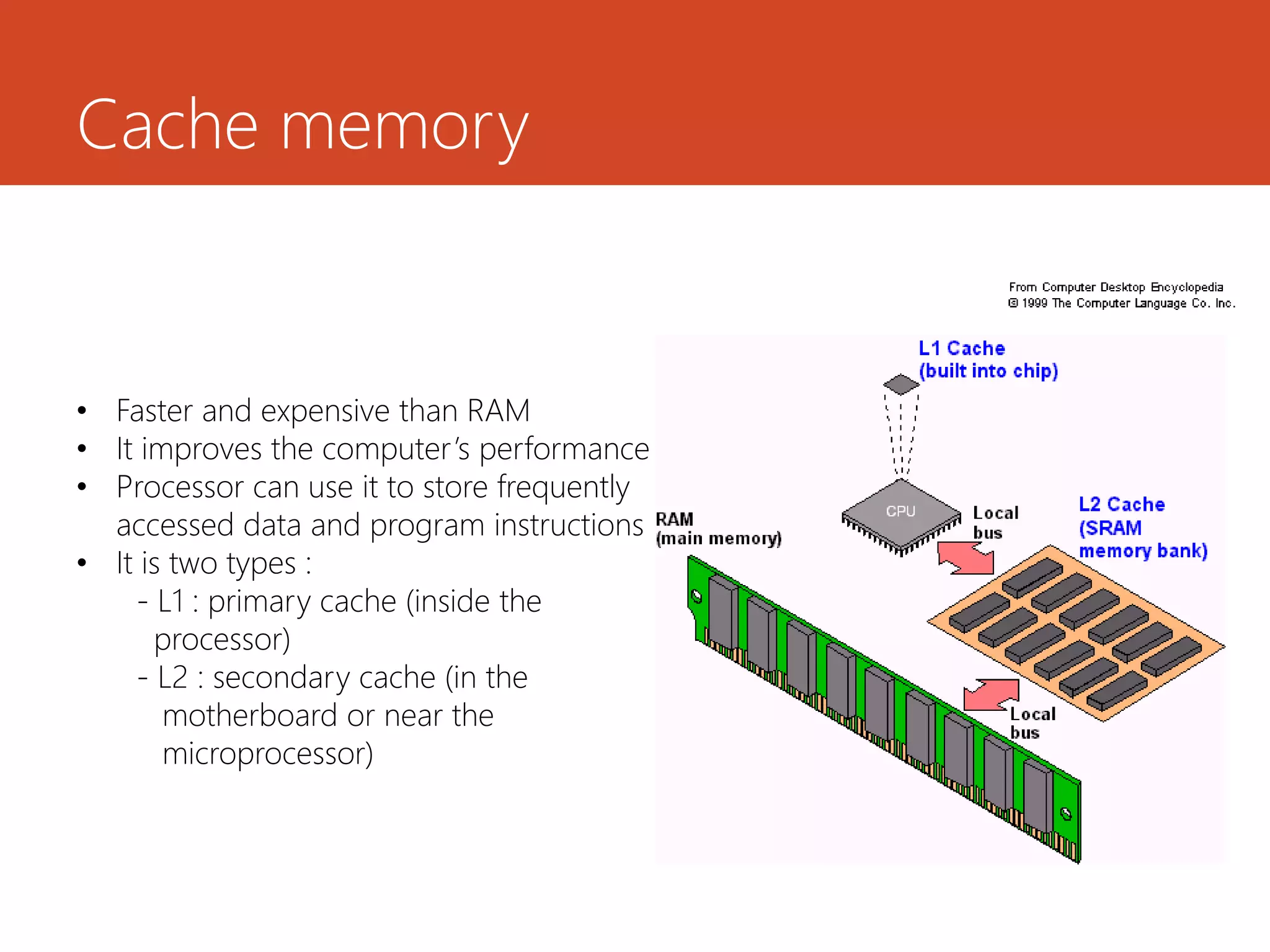
Cache memory
• Faster and expensive than RAM
• It improves the computer’s performance
• Processor can use it to store frequently
accessed data and program instructions
• It is two types :
- L1 : primary cache (inside the
processor)
- L2 : secondary cache (in the
motherboard or near the
microprocessor)
Figure 5-5
Cache
STORAGE
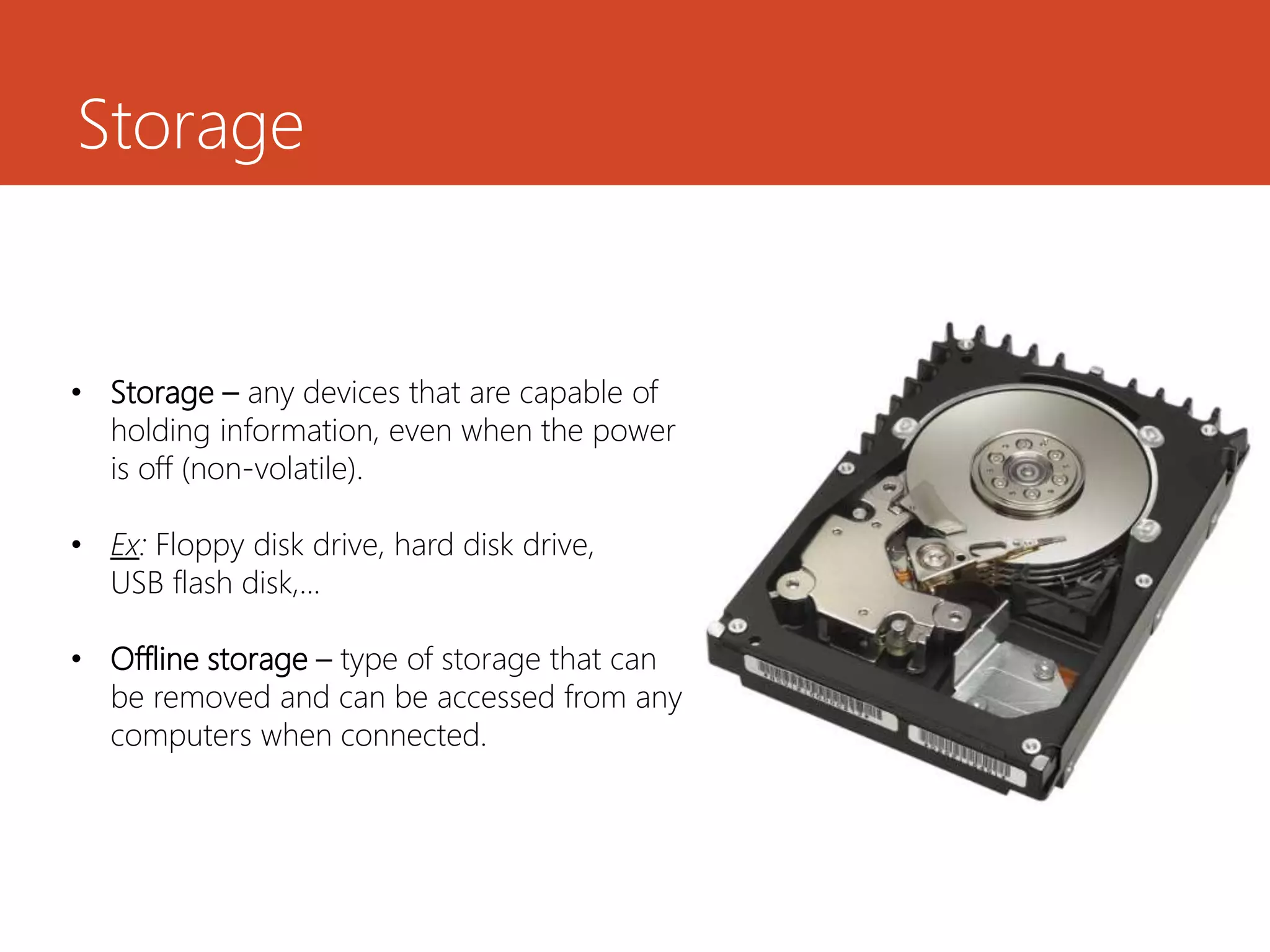
Storage
• Storage – any devices that are capable of
holding information, even when the power
is off (non-volatile).
• Ex: Floppy disk drive, hard disk drive,
USB flash disk,...
• Offline storage – type of storage that can
be removed and can be accessed from any
computers when connected.
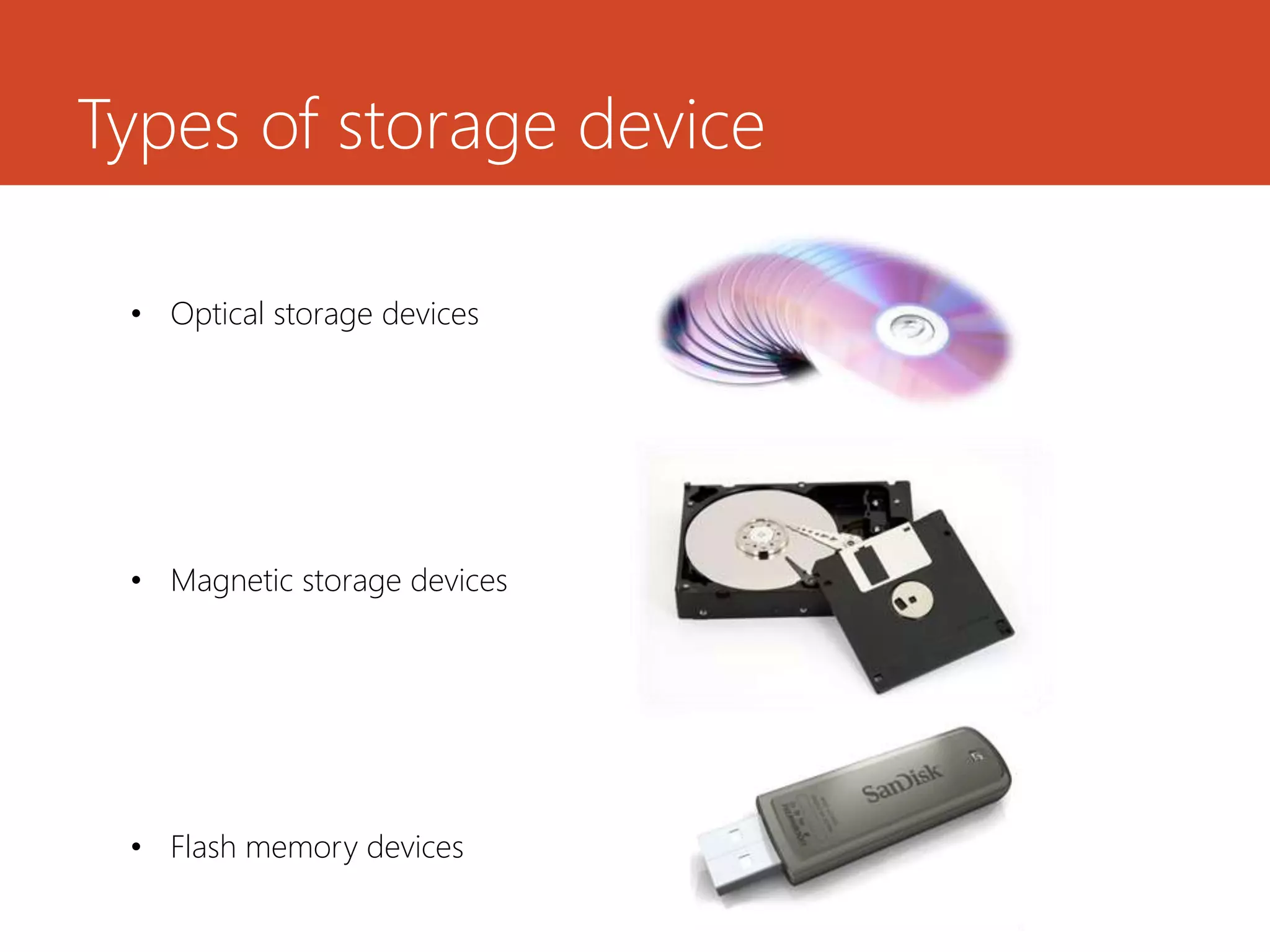
Types of storage device
• Optical storage devices
• Magnetic storage devices
• Flash memory devices
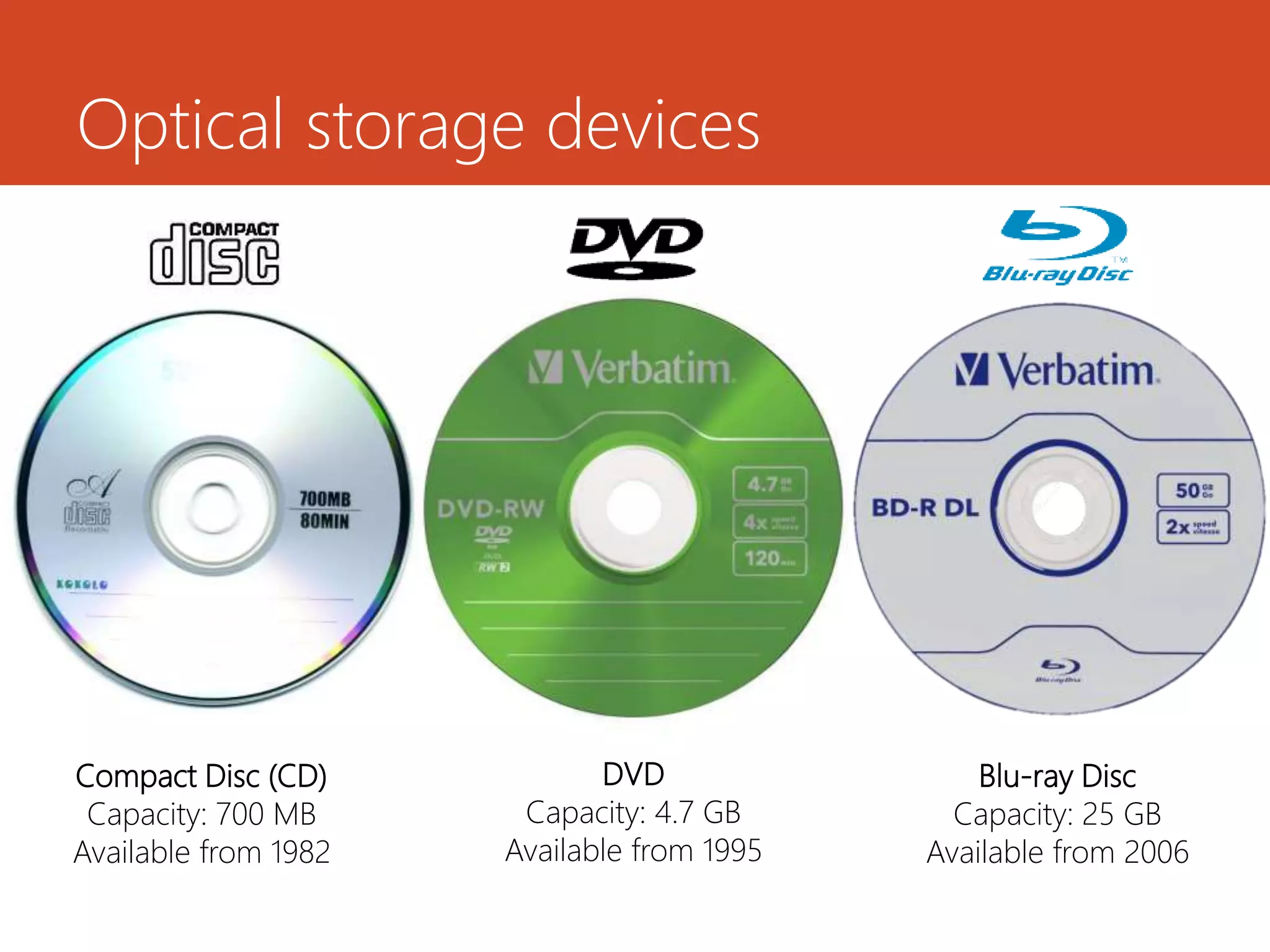
Optical storage devices
Compact Disc (CD)
Capacity: 700 MB
Available from 1982
Blu-ray Disc
Capacity: 25 GB
Available from 2006
DVD
Capacity: 4.7 GB
Available from 1995
Optical storage devices
Advantages:
 Small and portable
 Cheap to produce
 Large market of music, movies and games
 Most desktop computers or laptops are equipped with
CD/DVD/Blu-ray drive
Disadvantages:
x Fragile, easy to get scratched
x Slower data transferring rate
x Required specified drives to write data to the discs
x Limited number of writes
Magnetic storage devices
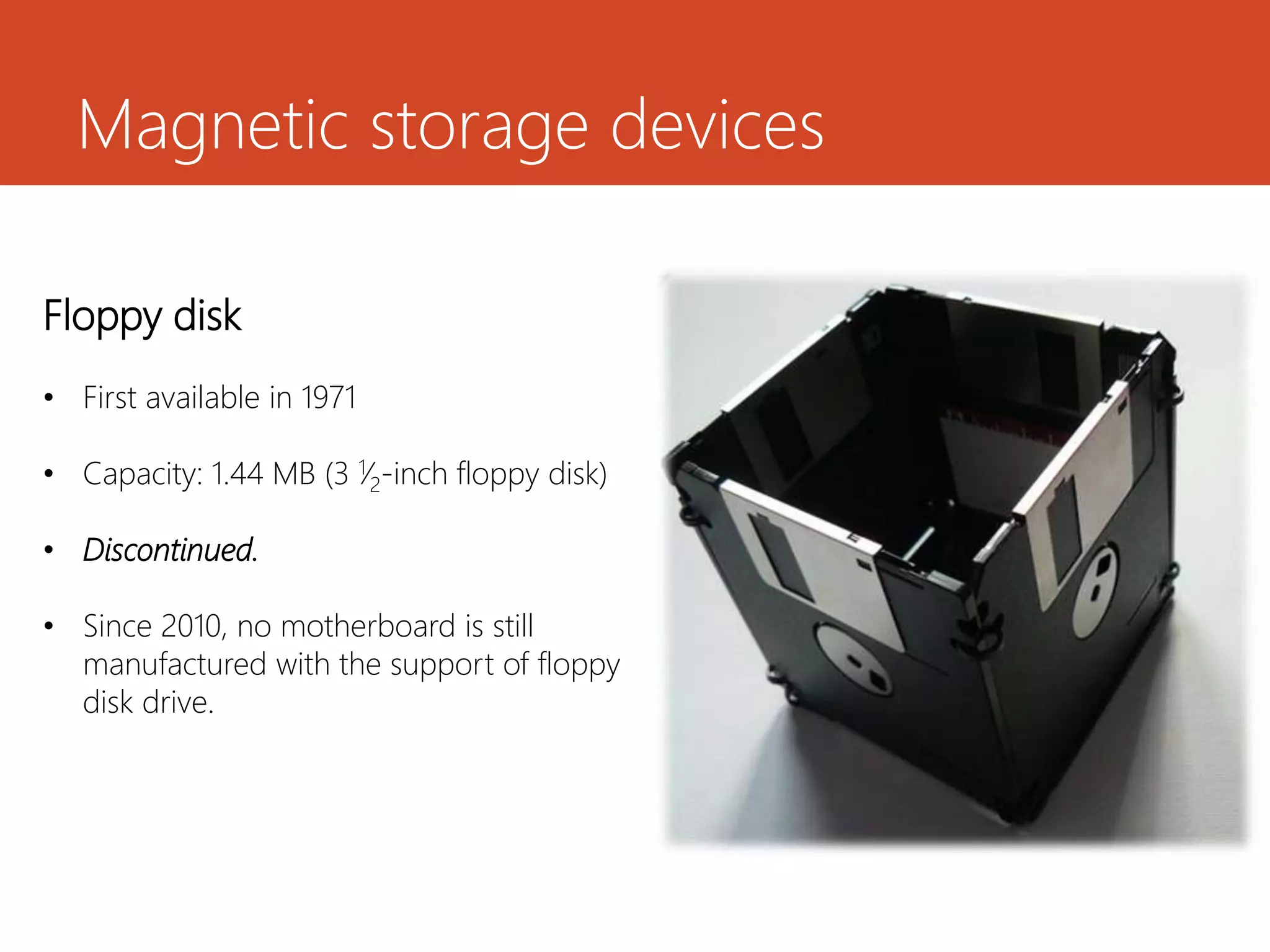
Floppy disk
• First available in 1971
• Capacity: 1.44 MB (3 1⁄2-inch floppy disk)
• Discontinued.
• Since 2010, no motherboard is still
manufactured with the support of floppy
disk drive.
Magnetic storage devices
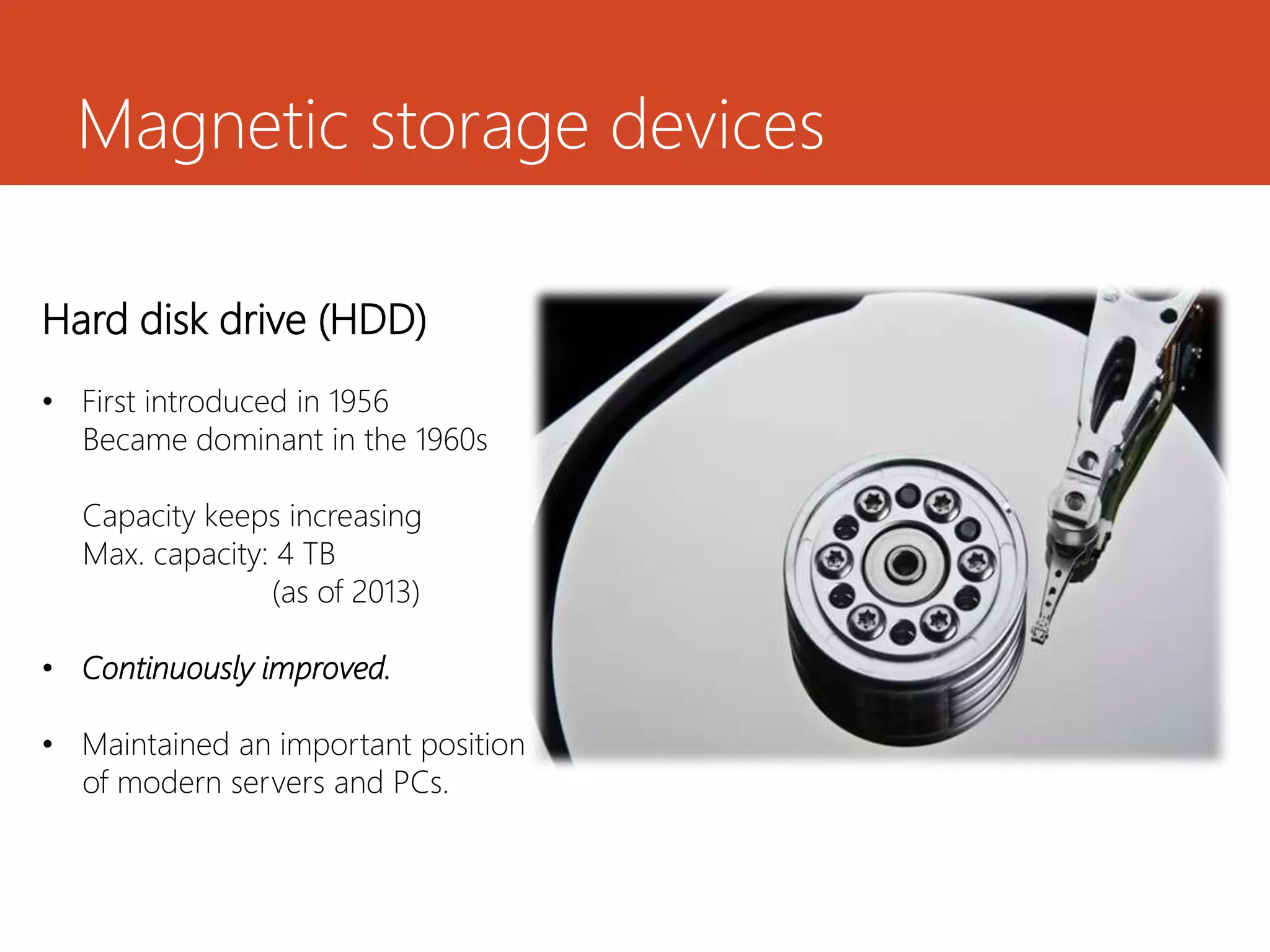
Hard disk drive (HDD)
• First introduced in 1956
Became dominant in the 1960s
Capacity keeps increasing
Max. capacity: 4 TB
(as of 2013)
• Continuously improved.
• Maintained an important position
of modern servers and PCs.
Magnetic storage devices
Advantages (HDD):
 Large and increasing capacity
 High transferring speed
 No data loss when power is off (non-volatile)
 Cheap price compared to other storage media (cost per MB)
Disadvantages (HDD):
x Possible damages and data loss due to ‘head’ crash
x Because of working on mechanism basis, it will be eventually
broken
x In case of internal hard drive, it is not easy to be transferred
to another computer
x High power consumption
Flash memory devices
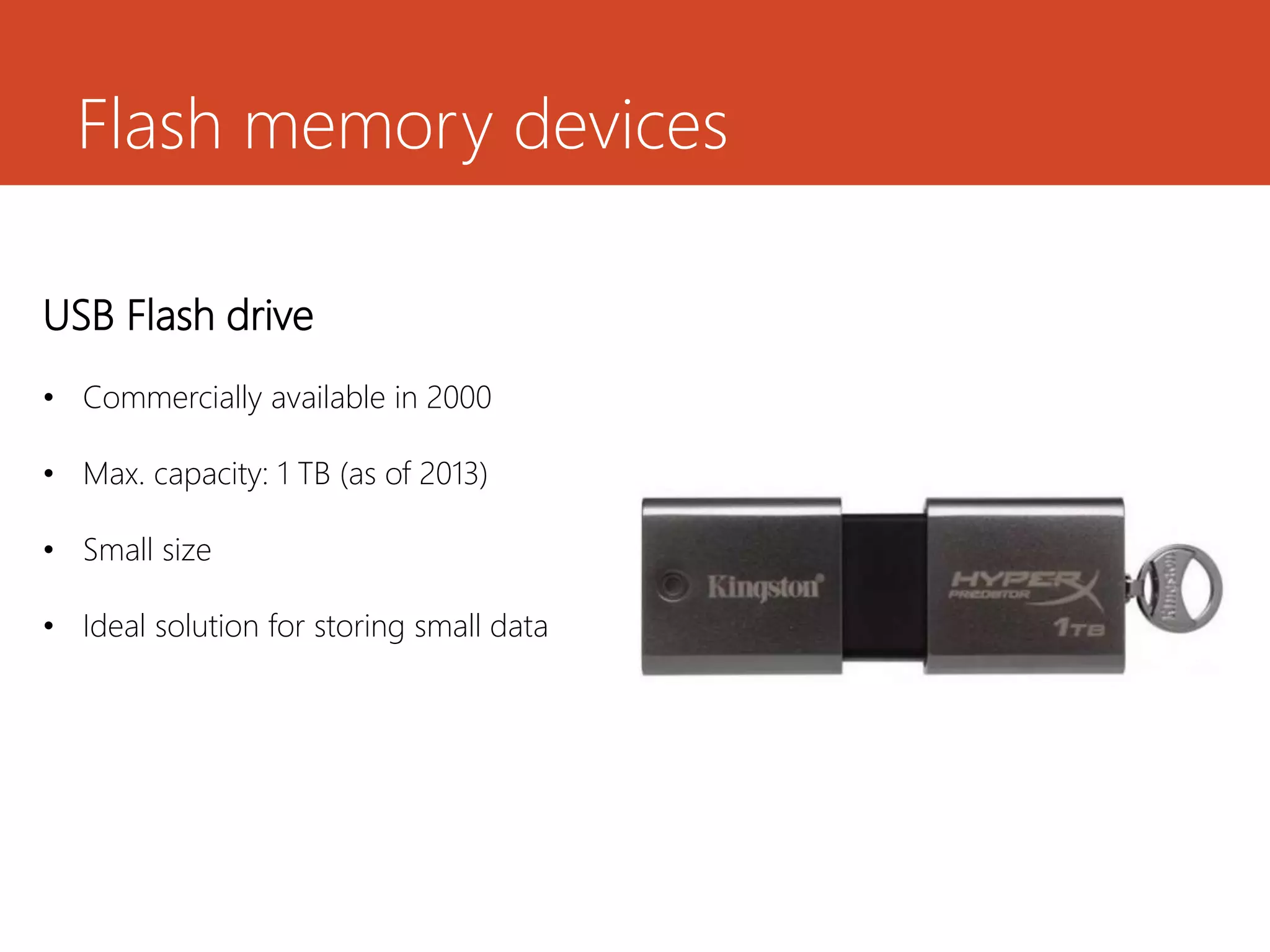
USB Flash drive
• Commercially available in 2000
• Max. capacity: 1 TB (as of 2013)
• Small size
• Ideal solution for storing small data
Flash memory devices
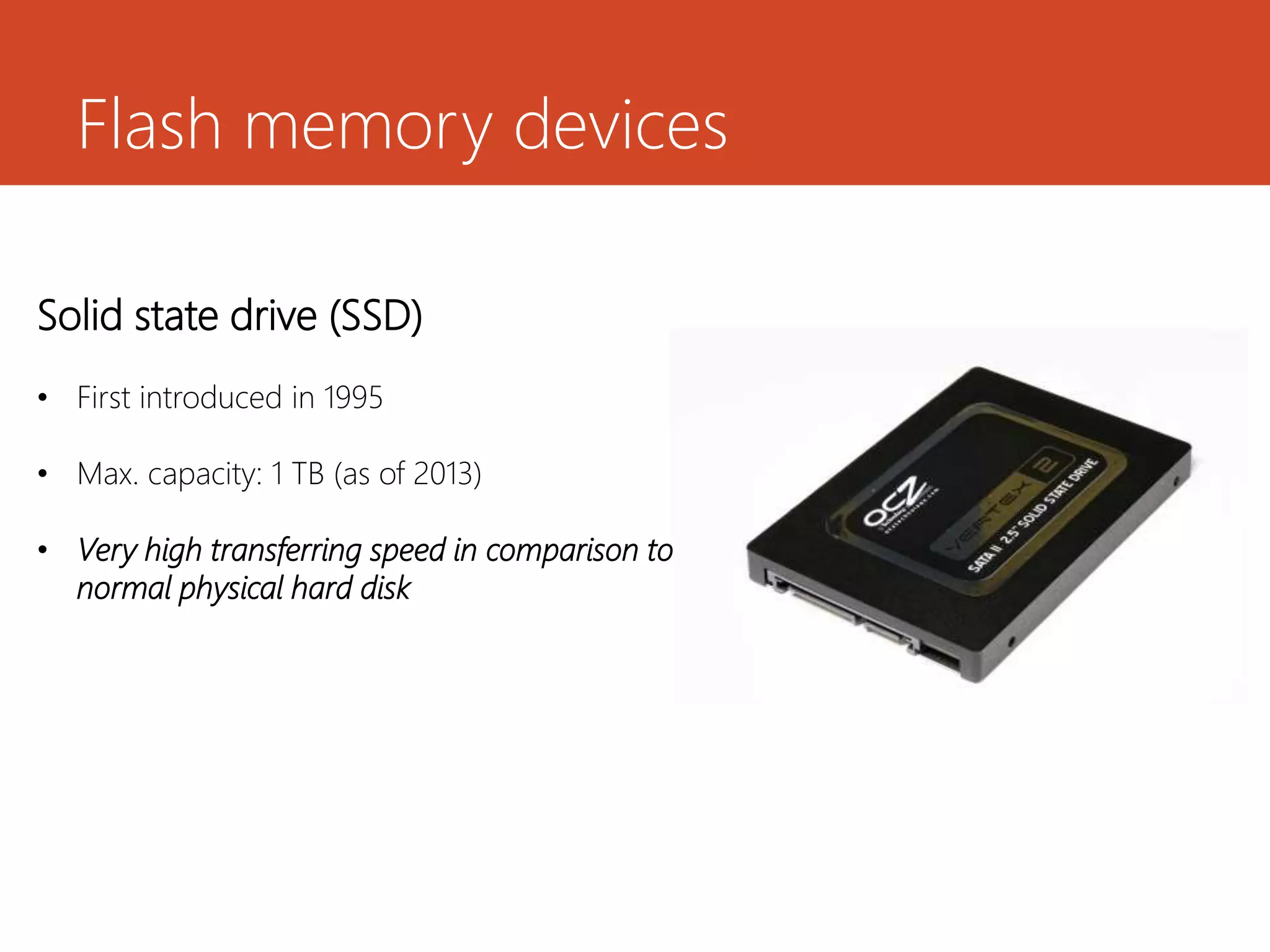
Solid state drive (SSD)
• First introduced in 1995
• Max. capacity: 1 TB (as of 2013)
• Very high transferring speed in comparison to
normal physical hard disk
Flash memory devices
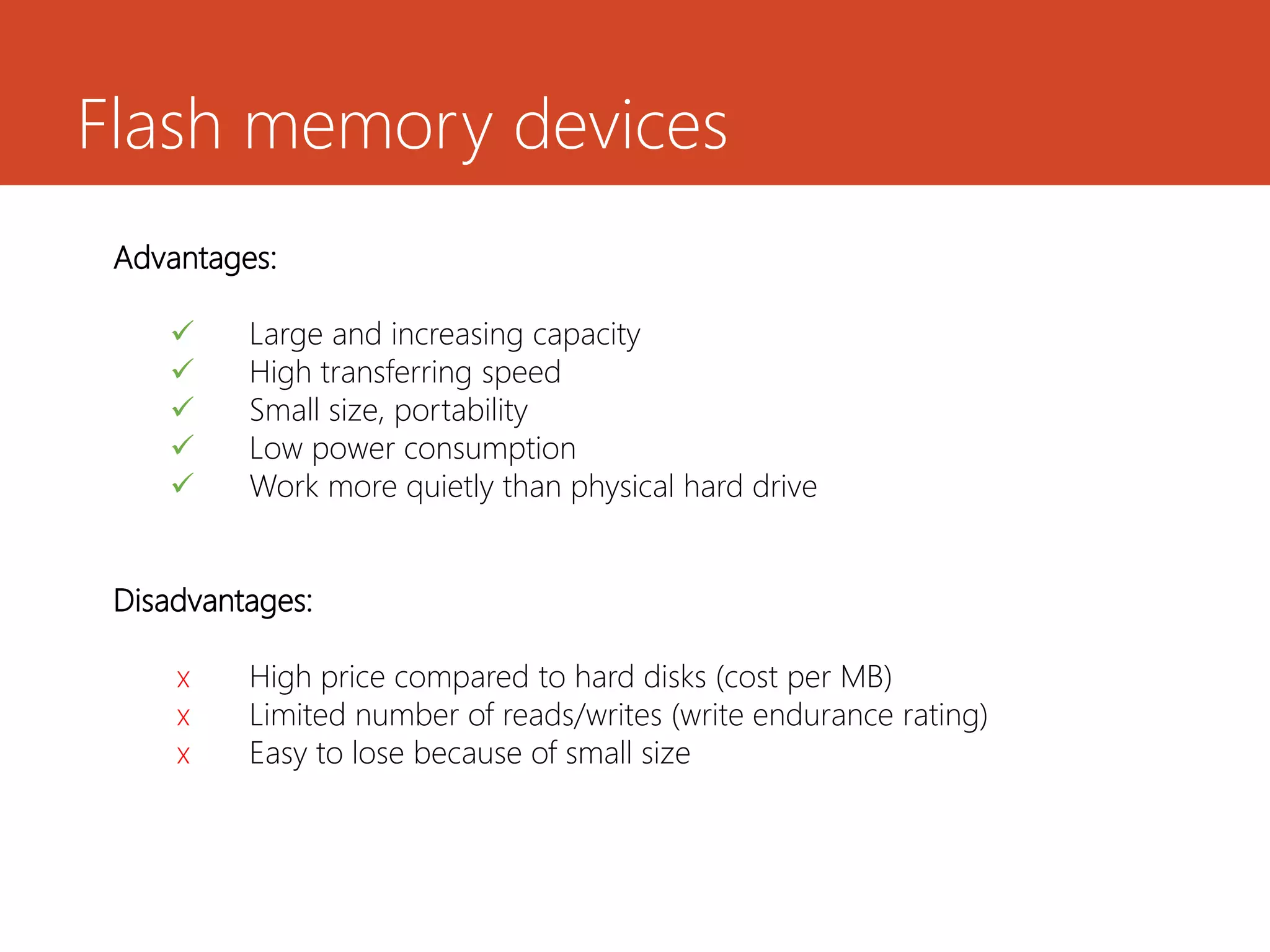
Advantages:
 Large and increasing capacity
 High transferring speed
 Small size, portability
 Low power consumption
 Work more quietly than physical hard drive
Disadvantages:
x High price compared to hard disks (cost per MB)
x Limited number of reads/writes (write endurance rating)
x Easy to lose because of small size
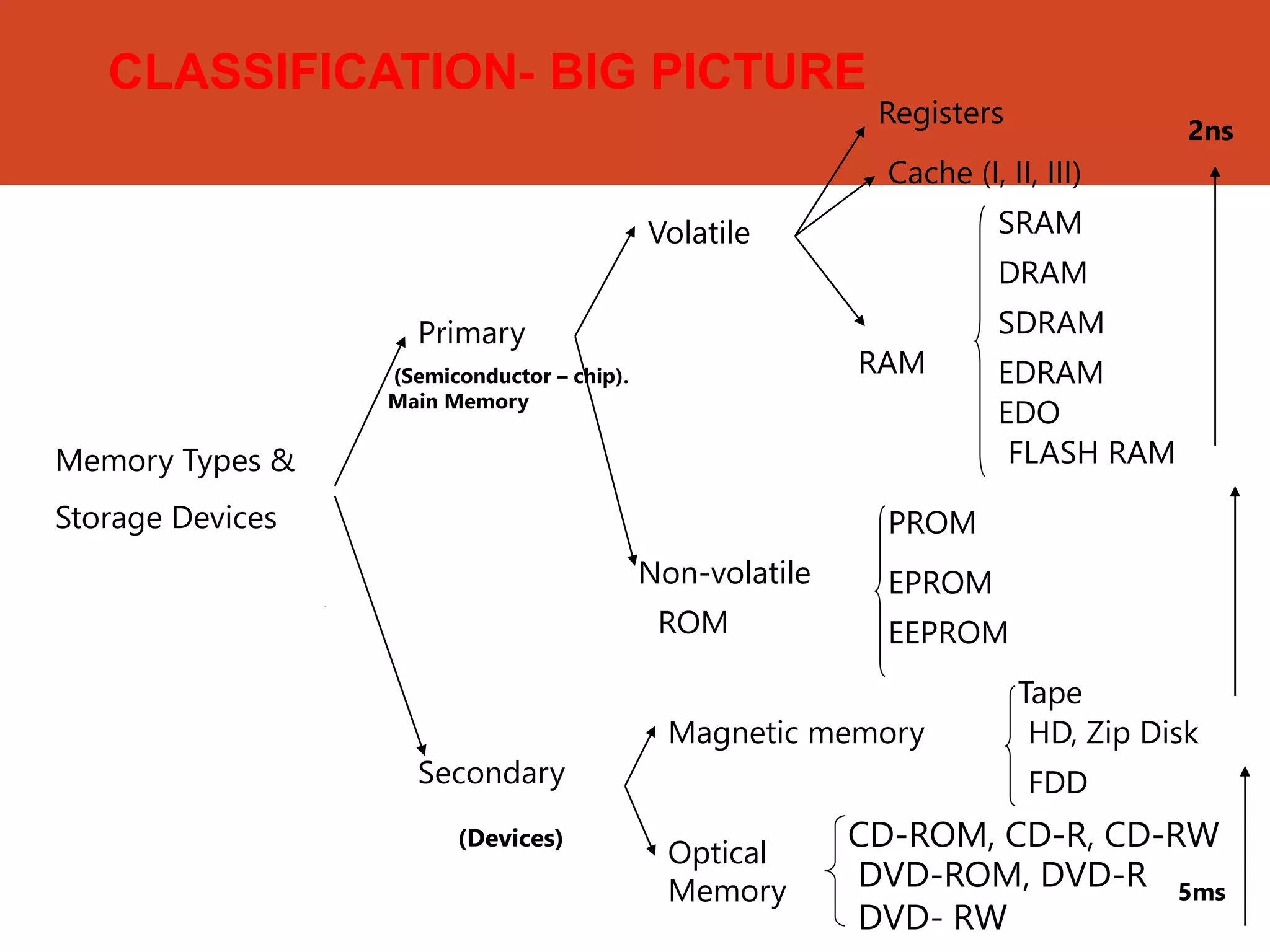
CLASSIFICATION- BIG PICTURE
Primary
Secondary
Volatile
Registers
Cache (I, II, III)
RAM
SRAM
DRAM
SDRAM
EDRAM
EDO
FLASH RAM
Non-volatile
ROM
PROM
EPROM
EEPROM
Magnetic memory
Tape
HD, Zip Disk
FDD
Optical
Memory
CD-ROM, CD-R, CD-RW
DVD-ROM, DVD-R
DVD- RW
(Semiconductor – chip).
Main Memory
(Devices)
2ns
5ms
Memory Types &
Storage Devices
Thank you
You didn’t hear that?
Memory

Memory

  • 1.
  • 2.
    Did you know… •Storage : Provides capacity for all the files and information you need( e.g. capacity of the computer’s hard disk) • Memory : Provides your working space ( e.g. the amount of RAM installed in the computer)
  • 3.
    Overview Primary - storage ofintermediate data - necessary to run the computer - RAM, Cache Secondary - long-term storage of data - HDD Tertiary - CD, DVD, memory card... Off-line - disconnected storage - unplugged USB flash drive - external HDD
  • 4.
    Memory  In computingmemory refers to the physical devices used to store programs or data on the temporary or permanent basis for use in a computer or other digital electronic device  Main memory is divided into two parts : - Random Access memory ( RAM ) should be better known as Read Write Memory - Read Only Memory (ROM)
  • 5.
    Random Access Memory(RAM) • Structure : A set of memory chips, each of them is an integrated circuit (IC) made of millions of transistors and capacitors • Volatile - their state is lost or reset when power is removed from the system. • Usage : Holds data/application programs from input devices or storages • Capacity : Determines the number and size of the program can be run at the same time as well as the amount of data that can be processed immediately.
  • 6.
    Types of RAM StaticRandom Access Memory (SRAM) • Semi conductor memory • Use flip-flop to store each bit of memory so does not need to be periodically refreshed • Faster and consumes low power • Expensive and have complex structure (6 transistors) so not use in high capacity applications Dynamic Random Access Memory (DRAM) • Store each bit of memory in capacitor in an integrated circuit • Real capacitors leak charge so capacitors need to be refreshed periodically • Simple structure ( 1 transistor and 1 capacitor per bit) so it has very high density
  • 7.
    Read only memory(ROM) • Has contents which are fixed when the chip is manufactured • Holds the bootstrap loader part of the operating system • Retains its data when the computer is switched off A boot loader, also called a boot manager, is a small program that places the operating system (OS) of a computer into memory.
  • 8.
    Types of ROM ProgrammableROM (PROM)- Empty of data when the chip is manufactured, can be programmed by the user. Once programmed the data cannot be erased. Erasable PROM (EPROM)- Like PROM only the chip can be removed from the computer and the program erased and another stored in its place using ultraviolet light. Electrically EPROM (EEPROM) - Like EPROM but electricity is used to erase and reprogram selected contents.
  • 9.
    CACHE MEMORY Cache memory,also called CPU memory, is random access memory(RAM) that a computer microprocessor can access more quickly than it can access regular RAM. This memory is typically integrated directly with the CPU chip or placed on a separate chip that has a separate bus interconnect with the CPU.
  • 10.
    Cache memory • Fasterand expensive than RAM • It improves the computer’s performance • Processor can use it to store frequently accessed data and program instructions • It is two types : - L1 : primary cache (inside the processor) - L2 : secondary cache (in the motherboard or near the microprocessor)
  • 11.
  • 12.
  • 13.
    Storage • Storage –any devices that are capable of holding information, even when the power is off (non-volatile). • Ex: Floppy disk drive, hard disk drive, USB flash disk,... • Offline storage – type of storage that can be removed and can be accessed from any computers when connected.
  • 14.
    Types of storagedevice • Optical storage devices • Magnetic storage devices • Flash memory devices
  • 15.
    Optical storage devices CompactDisc (CD) Capacity: 700 MB Available from 1982 Blu-ray Disc Capacity: 25 GB Available from 2006 DVD Capacity: 4.7 GB Available from 1995
  • 16.
    Optical storage devices Advantages: Small and portable  Cheap to produce  Large market of music, movies and games  Most desktop computers or laptops are equipped with CD/DVD/Blu-ray drive Disadvantages: x Fragile, easy to get scratched x Slower data transferring rate x Required specified drives to write data to the discs x Limited number of writes
  • 17.
    Magnetic storage devices Floppydisk • First available in 1971 • Capacity: 1.44 MB (3 1⁄2-inch floppy disk) • Discontinued. • Since 2010, no motherboard is still manufactured with the support of floppy disk drive.
  • 18.
    Magnetic storage devices Harddisk drive (HDD) • First introduced in 1956 Became dominant in the 1960s Capacity keeps increasing Max. capacity: 4 TB (as of 2013) • Continuously improved. • Maintained an important position of modern servers and PCs.
  • 19.
    Magnetic storage devices Advantages(HDD):  Large and increasing capacity  High transferring speed  No data loss when power is off (non-volatile)  Cheap price compared to other storage media (cost per MB) Disadvantages (HDD): x Possible damages and data loss due to ‘head’ crash x Because of working on mechanism basis, it will be eventually broken x In case of internal hard drive, it is not easy to be transferred to another computer x High power consumption
  • 20.
    Flash memory devices USBFlash drive • Commercially available in 2000 • Max. capacity: 1 TB (as of 2013) • Small size • Ideal solution for storing small data
  • 21.
    Flash memory devices Solidstate drive (SSD) • First introduced in 1995 • Max. capacity: 1 TB (as of 2013) • Very high transferring speed in comparison to normal physical hard disk
  • 22.
    Flash memory devices Advantages: Large and increasing capacity  High transferring speed  Small size, portability  Low power consumption  Work more quietly than physical hard drive Disadvantages: x High price compared to hard disks (cost per MB) x Limited number of reads/writes (write endurance rating) x Easy to lose because of small size
  • 24.
    CLASSIFICATION- BIG PICTURE Primary Secondary Volatile Registers Cache(I, II, III) RAM SRAM DRAM SDRAM EDRAM EDO FLASH RAM Non-volatile ROM PROM EPROM EEPROM Magnetic memory Tape HD, Zip Disk FDD Optical Memory CD-ROM, CD-R, CD-RW DVD-ROM, DVD-R DVD- RW (Semiconductor – chip). Main Memory (Devices) 2ns 5ms Memory Types & Storage Devices
  • 25.