CGMP
CURRENT GOOD MANUFACTURING
PRACTICES
CGMP - Definition:
“Good Manufacturing Practice is a part of Quality Assurance which
ensures that medicinal products are consistently produced and
controlled to the quality standards appropriate to their intended use
and as required by the marketing authorisation or product
specification”.
Good Manufacturing Practice is concerned more with both
production and quality control.
What is the role of QA in CGMP
• Verify the qualification & calibration status of relevant equipment, Instruments and utilities, e.g. HVAC, Water
systems, Fermenters, Compressions machines, HPLC Systems etc.
• Approve the Manufacturing instructions, SOP’s, STP’s, Protocols.
• Approving the Process, methods, cleaning validation reports.
• GDP Verification e.g. Data integrity, Online documentation.
• Training verification.
• QMS Verification e.g. Breakdowns, incidents, investigation, CAPA, Change controls
and LIR – lab investigation reports e.g. OOS, OOL, OOT etc.
• Sampling verifications e.g. In process, CV, PV, Stability etc.
• Analytical reports verification e.g. API & Excipients, SFG, FG, PPM, SPM.
• BMR, BPR and document’s issuance and review.
• Self inspection.
cGMP Thumb rules
1. Write step by step operating procedure and work instructions.
2. Carefully follow written procedures and instructions.
3. Promptly and accurately record the document work for compliance and traceability.
4. Validating work ensures that the system is doing what it is designed to do.
5. Develop a good design for the facility and equipment from the beginning.
6. Properly maintain the facility, equipment and utilities etc.
7. Clearly define, develop and demonstrate job competence.
8. Protect drug products from contamination and cross contamination by practicing good hygiene.
9. Design quality in the product manufacturing.
10. Conducting sudden and pre planned periodic audits.
1. Write step by step operating procedure and work instructions.
‘Procedures should be clearly defined and should be concise and logical’ like in below
 Batch records
 Operating Instructions,
 Operating Procedures,
 Method of analysis
 Records.
2. Carefully follow written procedures and instructions.
 Should be placed and made available in working area like Manufacturing instructions, SOP’s, STP’s, Protocols.
 Train the persons e.g. On Job trainings, classroom trainings.
 Define the Roles and responsibilities .
 Don’t use shortcut’s (may save time or make the task easier, but you should never deviate from a written procedure).
 Each step in a procedure has been included for a purpose, so do not deviate from any written instructions.
“Companies are looking for people who know how to the do the job right first time, every time”
3.Promptly and accurately record the document work for compliance and traceability
GDP – Good Document Practices.
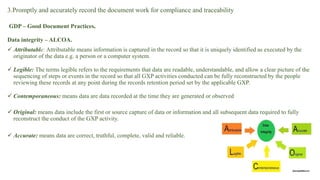
Data integrity – ALCOA.
 Attributable: Attributable means information is captured in the record so that it is uniquely identified as executed by the
originator of the data e.g. a person or a computer system.
 Legible: The terms legible refers to the requirements that data are readable, understandable, and allow a clear picture of the
sequencing of steps or events in the record so that all GXP activities conducted can be fully reconstructed by the people
reviewing these records at any point during the records retention period set by the applicable GXP.
 Contemporaneous: means data are data recorded at the time they are generated or observed
 Original: means data include the first or source capture of data or information and all subsequent data required to fully
reconstruct the conduct of the GXP activity.
 Accurate: means data are correct, truthful, complete, valid and reliable.
4.Validating work ensures that the system is doing what it is designed to do.
"Establishing documented evidence that provides a high degree of assurance that a specific process will consistently produce a
product meeting its pre-determined specifications and quality attributes."
Validation usually involves:
 Installation Qualification - which is testing to verify that the equipment is installed correctly.
 Operational Qualification - which is testing to verify that the equipment operates correctly.
 Performance Qualification - which is testing to verify that product can be consistently be produced to specification.
• A protocol describing each test and the acceptance criteria should be prepared, and once the testing is complete, a report
written.
• It’s a GMP requirement to prove control of the critical aspects of certain operations. New facilities and equipment, as well as
significant changes to existing systems, require validation.
5.Develop a good design for the facility and the equipment from the beginning.
Facility layout:
• Design & construction of the facilities and equipment should be inlign and finally complain with cGMP principle and drive through product
quality characteristics , these are important to comply with GMP principles.
Environment
 It’s important to control the air, water, lighting, ventilation, temperature, and humidity within a plant so that it does not impact product
quality. You should design facilities to reduce the risk of contamination and cross contamination from the environment.
 lighting, temperature, humidity and ventilation are appropriate.
 Interior surfaces (walls, floors and ceilings) should be smooth, free from cracks and do not shed particulate matter.
 Interior surfaces should be easy to clean.
 Pipe work, light fittings, and ventilation points should be designed be easily accessible to clean and perform maintenance activities.
 Drains are sized adequately and should be designed in a such a way to avoid the backflow of waste into the facility, e.g., having NRV
valves.
Equipment
 Design, location, and maintain of equipment should meet the intended use and easily accessible for maintenance activity.
 Designed and installed in an area where it can be easily cleaned like having all the necessary qualified utilities with desired set points.
 Equipment should be non reactive to the process, utilities, good drainability, avoid having dead legs.
 Calibratable at defined frequency and at all feasible points ( like 3point calibration).
 Label the equipment's all the time with current status.
6.Properly maintain the facility and the equipment.
“Walk around your plant and check the hygiene’s and stickers like (calibration, cleaning, sterilization, and preventive
maintenance) you can see. If they are out of date then your maintenance process is not being controlled properly”.
 It’s important to have a maintenance schedule for facilities and equipment. Regular equipment maintenance prevents
equipment breakdowns, which can be costly. It also reduces the risk of product contamination and maintains the ‘validated
state’ of the facility or equipment. Sometimes an unexpected event may affect the facility or equipment and under such
circumstances, you need to carry out repairs immediately.
Maintenance Records
 GMP requires you to keep accurate records relating to maintenance activities. Use equipment logs to record information such
as:
 When the equipment was last used.
 What is was used for.
 When it was cleaned including the time along with the date.
 When it was last inspected or rectified.
 When it was last calibrated.
7.Clearly define, develop and demonstrate job competence.
 Employees must demonstrate their job competence every day by producing quality products in a safe and efficient manner.
people should know how to do the job right first time & every time.
 Annual performance reviews are also a great way to formally discuss an employee’s development and performance. It’s a
great way to review what the employee has achieved and to identify any gaps or areas for further development.
Key Performance Indicators:
 Work plans
 Roles and responsibilities.
 Training.
8.Protect drug products against contamination by practicing good hygiene.
The fight against contamination is a constant battle and is one that requires the attention of every single employee, every day.
Practices in mind:
 Always practice good personal hygiene by washing your hands and wearing the required protective garments.
 Inform your supervisor if you are ill; you may not be allowed to enter the manufacturing area until you are well again.
 Minimise contact with product or product contact surfaces and equipment.
 NEVER eat, drink, smoke or chew in manufacturing areas.
 Always follow cleaning and sanitation procedures.
 Report any condition that may cause product contamination.
 Remove trash and waste materials, and store (or) discard
appropriately.
“These practices are nothing more than common sense and are
your best defence to reduce the risk of product contamination”.
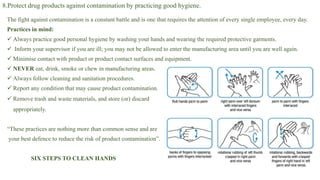
SIX STEPS TO CLEAN HANDS
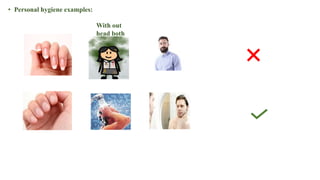
• Personal hygiene examples:
With out
head both
9.Design quality in the product manufacturing
By working the in food, drug, and medical device industry you know that the health and safety of the customer depends on the
quality of the product. The QC department can only inspect for presence of quality based on the mere sample,
“ So it’s critical that you build the quality within the product and throughout product life cycle”.
Critical areas:
Controlling Components: Check all materials and components when they enter the plant to ensure they meet the defined
specifications. Identify components and store them in a quarantine area for sampling and testing. All materials and components
must be approved prior to release for manufacturing, or if rejected, they must be identified and stored in a secure area to prevent
accidental use.
Controlling the Manufacturing Process: Establish records and procedures to ensure that employees perform the same job
every time.
 A master record that outlines the specifications and manufacturing procedures.
 Individual batch or history records to document conformance to the master record.
 Written schedules and procedures for cleaning and maintaining the equipment and areas.
Packaging and Labelling Controls: Packaging and labelling are areas where mix-ups and errors occur. To enable traceability,
assign a batch or lot number to each product. Inspect packaging and labelling areas to ensure that it contains no material from a
previous batch. Follow all procedures and carefully document your work.
Holding and Distribution Controls: The company must have controls against contamination, mix-up, and errors. Provide
separate areas for quarantine, material and personnel movement and finished product testing (QC). Prepare procedures for
handling and storage of products and distribution records to help trace shipments.
10. Conducting planned and periodic audits
• Audits must be conducted to assess whether you are following the GMP rules.
• Conduct In-house audits, or self-inspections, to ensure GMP compliance.
• A ‘Self Audit Checklist’ is provided below. It’s a good practice to undertake a self-audit a two times a year and to target
different manufacturing areas and departments each time.
• Corrective Action Preventative Action (CAPA) system to manage and fix anything found during an audit.
Inspection or audit check list but not limited to below:
 Visual GMP.
 Cleanliness & hygienic maintenance of facility, equipment and personnel.
 Training and education.
 Housekeeping.
 Good documentation practices(online), GLP.
 Preventive maintenance, calibration schedules.
 VMP – Meeting VMP requirements.
 HSE – Health, Safety, Ergonomics.
Video demonstration of Gowning procedure
Reference:
• 21 CFR part210(definition) & part211(basic).
• ICH – Q7.

cGMP / Sai sasidhar.ch

  • 1.
  • 2.
    CGMP - Definition: “GoodManufacturing Practice is a part of Quality Assurance which ensures that medicinal products are consistently produced and controlled to the quality standards appropriate to their intended use and as required by the marketing authorisation or product specification”. Good Manufacturing Practice is concerned more with both production and quality control.
  • 3.
    What is therole of QA in CGMP • Verify the qualification & calibration status of relevant equipment, Instruments and utilities, e.g. HVAC, Water systems, Fermenters, Compressions machines, HPLC Systems etc. • Approve the Manufacturing instructions, SOP’s, STP’s, Protocols. • Approving the Process, methods, cleaning validation reports. • GDP Verification e.g. Data integrity, Online documentation. • Training verification. • QMS Verification e.g. Breakdowns, incidents, investigation, CAPA, Change controls and LIR – lab investigation reports e.g. OOS, OOL, OOT etc. • Sampling verifications e.g. In process, CV, PV, Stability etc. • Analytical reports verification e.g. API & Excipients, SFG, FG, PPM, SPM. • BMR, BPR and document’s issuance and review. • Self inspection.
  • 4.
    cGMP Thumb rules 1.Write step by step operating procedure and work instructions. 2. Carefully follow written procedures and instructions. 3. Promptly and accurately record the document work for compliance and traceability. 4. Validating work ensures that the system is doing what it is designed to do. 5. Develop a good design for the facility and equipment from the beginning. 6. Properly maintain the facility, equipment and utilities etc. 7. Clearly define, develop and demonstrate job competence. 8. Protect drug products from contamination and cross contamination by practicing good hygiene. 9. Design quality in the product manufacturing. 10. Conducting sudden and pre planned periodic audits.
  • 5.
    1. Write stepby step operating procedure and work instructions. ‘Procedures should be clearly defined and should be concise and logical’ like in below  Batch records  Operating Instructions,  Operating Procedures,  Method of analysis  Records.
  • 6.
    2. Carefully followwritten procedures and instructions.  Should be placed and made available in working area like Manufacturing instructions, SOP’s, STP’s, Protocols.  Train the persons e.g. On Job trainings, classroom trainings.  Define the Roles and responsibilities .  Don’t use shortcut’s (may save time or make the task easier, but you should never deviate from a written procedure).  Each step in a procedure has been included for a purpose, so do not deviate from any written instructions. “Companies are looking for people who know how to the do the job right first time, every time”
  • 7.
    3.Promptly and accuratelyrecord the document work for compliance and traceability GDP – Good Document Practices. Data integrity – ALCOA.  Attributable: Attributable means information is captured in the record so that it is uniquely identified as executed by the originator of the data e.g. a person or a computer system.  Legible: The terms legible refers to the requirements that data are readable, understandable, and allow a clear picture of the sequencing of steps or events in the record so that all GXP activities conducted can be fully reconstructed by the people reviewing these records at any point during the records retention period set by the applicable GXP.  Contemporaneous: means data are data recorded at the time they are generated or observed  Original: means data include the first or source capture of data or information and all subsequent data required to fully reconstruct the conduct of the GXP activity.  Accurate: means data are correct, truthful, complete, valid and reliable.
  • 8.
    4.Validating work ensuresthat the system is doing what it is designed to do. "Establishing documented evidence that provides a high degree of assurance that a specific process will consistently produce a product meeting its pre-determined specifications and quality attributes." Validation usually involves:  Installation Qualification - which is testing to verify that the equipment is installed correctly.  Operational Qualification - which is testing to verify that the equipment operates correctly.  Performance Qualification - which is testing to verify that product can be consistently be produced to specification. • A protocol describing each test and the acceptance criteria should be prepared, and once the testing is complete, a report written. • It’s a GMP requirement to prove control of the critical aspects of certain operations. New facilities and equipment, as well as significant changes to existing systems, require validation.
  • 9.
    5.Develop a gooddesign for the facility and the equipment from the beginning. Facility layout: • Design & construction of the facilities and equipment should be inlign and finally complain with cGMP principle and drive through product quality characteristics , these are important to comply with GMP principles. Environment  It’s important to control the air, water, lighting, ventilation, temperature, and humidity within a plant so that it does not impact product quality. You should design facilities to reduce the risk of contamination and cross contamination from the environment.  lighting, temperature, humidity and ventilation are appropriate.  Interior surfaces (walls, floors and ceilings) should be smooth, free from cracks and do not shed particulate matter.  Interior surfaces should be easy to clean.  Pipe work, light fittings, and ventilation points should be designed be easily accessible to clean and perform maintenance activities.  Drains are sized adequately and should be designed in a such a way to avoid the backflow of waste into the facility, e.g., having NRV valves. Equipment  Design, location, and maintain of equipment should meet the intended use and easily accessible for maintenance activity.  Designed and installed in an area where it can be easily cleaned like having all the necessary qualified utilities with desired set points.  Equipment should be non reactive to the process, utilities, good drainability, avoid having dead legs.  Calibratable at defined frequency and at all feasible points ( like 3point calibration).  Label the equipment's all the time with current status.
  • 10.
    6.Properly maintain thefacility and the equipment. “Walk around your plant and check the hygiene’s and stickers like (calibration, cleaning, sterilization, and preventive maintenance) you can see. If they are out of date then your maintenance process is not being controlled properly”.  It’s important to have a maintenance schedule for facilities and equipment. Regular equipment maintenance prevents equipment breakdowns, which can be costly. It also reduces the risk of product contamination and maintains the ‘validated state’ of the facility or equipment. Sometimes an unexpected event may affect the facility or equipment and under such circumstances, you need to carry out repairs immediately. Maintenance Records  GMP requires you to keep accurate records relating to maintenance activities. Use equipment logs to record information such as:  When the equipment was last used.  What is was used for.  When it was cleaned including the time along with the date.  When it was last inspected or rectified.  When it was last calibrated.
  • 11.
    7.Clearly define, developand demonstrate job competence.  Employees must demonstrate their job competence every day by producing quality products in a safe and efficient manner. people should know how to do the job right first time & every time.  Annual performance reviews are also a great way to formally discuss an employee’s development and performance. It’s a great way to review what the employee has achieved and to identify any gaps or areas for further development. Key Performance Indicators:  Work plans  Roles and responsibilities.  Training.
  • 12.
    8.Protect drug productsagainst contamination by practicing good hygiene. The fight against contamination is a constant battle and is one that requires the attention of every single employee, every day. Practices in mind:  Always practice good personal hygiene by washing your hands and wearing the required protective garments.  Inform your supervisor if you are ill; you may not be allowed to enter the manufacturing area until you are well again.  Minimise contact with product or product contact surfaces and equipment.  NEVER eat, drink, smoke or chew in manufacturing areas.  Always follow cleaning and sanitation procedures.  Report any condition that may cause product contamination.  Remove trash and waste materials, and store (or) discard appropriately. “These practices are nothing more than common sense and are your best defence to reduce the risk of product contamination”. SIX STEPS TO CLEAN HANDS
  • 13.
    • Personal hygieneexamples: With out head both
  • 14.
    9.Design quality inthe product manufacturing By working the in food, drug, and medical device industry you know that the health and safety of the customer depends on the quality of the product. The QC department can only inspect for presence of quality based on the mere sample, “ So it’s critical that you build the quality within the product and throughout product life cycle”. Critical areas: Controlling Components: Check all materials and components when they enter the plant to ensure they meet the defined specifications. Identify components and store them in a quarantine area for sampling and testing. All materials and components must be approved prior to release for manufacturing, or if rejected, they must be identified and stored in a secure area to prevent accidental use. Controlling the Manufacturing Process: Establish records and procedures to ensure that employees perform the same job every time.  A master record that outlines the specifications and manufacturing procedures.  Individual batch or history records to document conformance to the master record.  Written schedules and procedures for cleaning and maintaining the equipment and areas. Packaging and Labelling Controls: Packaging and labelling are areas where mix-ups and errors occur. To enable traceability, assign a batch or lot number to each product. Inspect packaging and labelling areas to ensure that it contains no material from a previous batch. Follow all procedures and carefully document your work. Holding and Distribution Controls: The company must have controls against contamination, mix-up, and errors. Provide separate areas for quarantine, material and personnel movement and finished product testing (QC). Prepare procedures for handling and storage of products and distribution records to help trace shipments.
  • 15.
    10. Conducting plannedand periodic audits • Audits must be conducted to assess whether you are following the GMP rules. • Conduct In-house audits, or self-inspections, to ensure GMP compliance. • A ‘Self Audit Checklist’ is provided below. It’s a good practice to undertake a self-audit a two times a year and to target different manufacturing areas and departments each time. • Corrective Action Preventative Action (CAPA) system to manage and fix anything found during an audit. Inspection or audit check list but not limited to below:  Visual GMP.  Cleanliness & hygienic maintenance of facility, equipment and personnel.  Training and education.  Housekeeping.  Good documentation practices(online), GLP.  Preventive maintenance, calibration schedules.  VMP – Meeting VMP requirements.  HSE – Health, Safety, Ergonomics.
  • 16.
    Video demonstration ofGowning procedure
  • 17.
    Reference: • 21 CFRpart210(definition) & part211(basic). • ICH – Q7.