

AApppprrooaacchheess ffoorr 
CCoommmmeerrcciiaalliizzaattiioonn ooff PPoosstt 
HHaarrvveesstt TTeecchhnnoollooggiieess 
DDrr.. RR..TT.. PPaattiill 
FFoorrmmeerr DDiirreeccttoorr,, CCIIPPHHEETT,, LLuuddhhiiaannaa 
CChhaaiirrmmaann && EEDD,, BBeenneevvoollee ffoorr PPHHTT,, 
BBhhooppaall
Agri businesses 
• Most of the rural-agribusinesses are 
small businesses. 
• The small business is business that is 
independently operated, is not 
dominant in its field. 
• Ninety percent of the nation’s new jobs 
in the private sector are in small 
businesses.
Uniqueness 
• Low risk 
• All time demand 
• Cost addition to highest extent 
• Low skill 
• Highly hygeinic 
• Highest sanitary standards 
• Great demand for health benefits
Entrepreneurship 
• In the context of employment generation, the 
three terms i.e. entrepreneurship, self-employment 
and income generation are often 
used interchangeably. 
• The functions of entrepreneurs suggest that all 
entrepreneurs are self-employed and income 
generating persons. But all self employed and 
income generating persons may not 
necessarily be entrepreneurs. 
• The three, however, can be viewed as initial 
middle and terminal stages in entrepreneurship 
growth process.
Characteristics of Entrepreneur 
Drive and Energy 
Tremendous amount of personal energy and drive. 
Self confidence 
The successful entrepreneur has a high level of 
self confidence. 
Long term involvement 
He is a creator and builder of the business against 
promoter or fast buck artist. 
Money as a Measure 
The money is a way of measuring performance 
and not an end in itself.
Characteristics of Entrepreneur 
Persistent Problem Solving 
He possesses intense level of determination 
and desire to overcome hurdles to solve a 
problem and complete the job. 
Goal setting 
He is very goal oriented, has an ability and 
commitment to set clear, realistic and 
attainable goals. 
Moderate risk taking 
Risk planner, takes moderate and 
calculated risk.
Characteristics of Entrepreneur 
Dealing with failure 
Entrepreneurs are not afraid of failure. 
Use of Feedback 
Demonstrate a capacity to seek and use feed 
back on their performance in order to take 
action and to improve. 
Taking initiative and seeking personal 
responsibility 
Independent and highly self-reliant innovators. 
They like to take the initiative to solve a 
problem of filling a vacuum where no 
leadership exists.
Characteristics of Entrepreneur 
• Use of resources 
Successful entrepreneur knows when and how 
to seek outside as well as inside help in 
building their company. 
• Competing against self imposed 
standards 
Continuously engages in competition with 
himself to beat their last best performance 
• Internal locus of control 
The entrepreneur does not believe that success 
or failure of a new business venture depends 
upon luck or other external, personal
Characteristics of Entrepreneur 
• Tolerance to ambiguity and uncertainty 
Entrepreneurs have special tolerance for 
ambiguous situations making decisions under 
conditions of uncertainty. In contrast to the 
professional manager, entrepreneurs are able 
to live with modest levels of uncertainty 
concerning job and career decisions and 
security and permanency are considerably 
lower on entrepreneurial hierarchy of 
preferences compared to his managerial 
counterpart.
Entrepreneurship 
Development Stages 
•Trade Acquaintance 
•Skill Acquisition 
•Management Practices 
•Quality Control 
•Process Understanding
Project Selection 
• Availability of market 
• Availability of raw materials 
• Availability of technology 
• Availability of skills 
• Government priority 
• Strategic fit 
• Ease of implementation 
• Risk of exposure 
• Profitability 
– Cost/benefit 
– Critical success factor
Market Survey 
A market survey may have following 
objectives: 
• Present reliable, accurate and objective 
picture of conditions prevailing in the 
market. 
• Forecasting market trends. 
• Reactions to the products 
• Establish the salability and marketability 
of the products.
Market Survey 
The objective of the market survey should be answer the 
following questions: 
• Size of the market? 
• Who are the customers? 
• What is the demand of the product and how it is being 
fulfilled? 
• What are the factors limiting the size of the market? 
• What is the pattern of demand? 
• What are the prospects of the demand being increased or 
decreased in future? 
• How much market share would you like to posses in terms of 
volume and value? 
• What are the buying habits and motives of the buyer? 
• What aspects of the products will appeal to the customer 
(Unique selling feature or unique selling proposition? 
• What are the competitors? 
• What are the past and futures trends?
Small business management 
A Practical element -knowing your business 
B Managerial element 
Planning – Setting objectives, Outlining procedures, 
Assigning responsibilities 
Organizing- 
• arrange and assign work amongst the people 
• Dividing work so that it can be logically and comfortably 
performed by individuals 
Leading -Motivate- Do as I do and not Do as I say 
Coordinating- 
• Integrate activities & avoid overlap of duties 
Controlling the activities – 
• See that every thing occurs as per plan 
• Check actual results against desired results and make 
changes in work orders, methods or materials.
Why agribusiness fail ? 
Management 
People do not plan to fail, they only fail to plan. If the business will not 
work “on paper”, in the real world; even if the business works on 
paper, there is still no guarantee it will succeed. 
Avoid the following pitfalls as you plan and manage your business: 
• Plunging in without first testing the waters on a small scale 
• Buying too much on credit 
• Misunderstanding how much time it will take to build a market 
• Going into business with little or no experience 
• Attempting to do too much business with too little capital 
• Not understanding business cycles 
• Lack of an effective marketing program 
• Spending too much time/money on nonproductive activities 
• Unnecessary capital investments made to minimize income taxes 
• Under pricing or overpricing goods or services 
• Extending credit too freely 
• Extending credit too rapidly
Why agribusiness fail ? 
Strength of a business is in its people. 
undependable and unqualified employees 
can quickly destroy your business. 
Do not attempt to support too many people 
from the business like your children into 
the business or helping failures. 
Do not mistake the freedom of having your 
own business for the liberty to work only 
as you wish.
Why agribusiness fail ? 
Financial resources-Avoid the following as you manage your 
financial resources. 
• Starting with too little capital 
• Starting with too much capital and being careless in its use. 
• Borrowing money without planning just how and when to pay 
it back 
• Failing to keep complete, accurate records, which causes you 
to drift into trouble without realizing it 
• Carrying out habits of personal extravagance into the 
business 
• Forgetting about taxes, insurance and other costs of doing 
business 
• Over dependence on collateral 
• Improper loan structuring due to an improper match of loan 
repayment period and loan repayment ability 
• Failure to control living expenses because of withdrawing 
more from the business than the business actually earns
Words of Advise 
Failure is always a possibility. 
However, if we become afraid 
to fail we will not even try. Plan, 
study and research every 
possible angle-then give it your 
best.
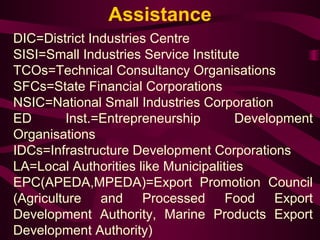
Assistance 
DIC=District Industries Centre 
SISI=Small Industries Service Institute 
TCOs=Technical Consultancy Organisations 
SFCs=State Financial Corporations 
NSIC=National Small Industries Corporation 
ED Inst.=Entrepreneurship Development 
Organisations 
IDCs=Infrastructure Development Corporations 
LA=Local Authorities like Municipalities 
EPC(APEDA,MPEDA)=Export Promotion Council 
(Agriculture and Processed Food Export 
Development Authority, Marine Products Export 
Development Authority)
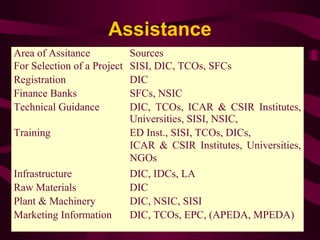
Assistance 
Area of Assitance Sources 
For Selection of a Project SISI, DIC, TCOs, SFCs 
Registration DIC 
Finance Banks SFCs, NSIC 
Technical Guidance DIC, TCOs, ICAR & CSIR Institutes, 
Universities, SISI, NSIC, 
Training ED Inst., SISI, TCOs, DICs, 
ICAR & CSIR Institutes, Universities, 
NGOs 
Infrastructure DIC, IDCs, LA 
Raw Materials DIC 
Plant & Machinery DIC, NSIC, SISI 
Marketing Information DIC, TCOs, EPC, (APEDA, MPEDA)
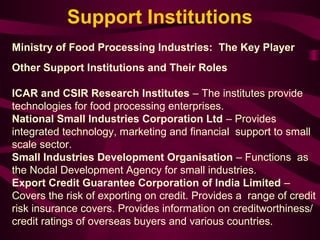
Support Institutions 
Ministry of Food Processing Industries: The Key Player 
Other Support Institutions and Their Roles 
ICAR and CSIR Research Institutes – The institutes provide 
technologies for food processing enterprises. 
National Small Industries Corporation Ltd – Provides 
integrated technology, marketing and financial support to small 
scale sector. 
Small Industries Development Organisation – Functions as 
the Nodal Development Agency for small industries. 
Export Credit Guarantee Corporation of India Limited – 
Covers the risk of exporting on credit. Provides a range of credit 
risk insurance covers. Provides information on creditworthiness/ 
credit ratings of overseas buyers and various countries.
Thanks !!!!

Approaches for Commercialization of Post Harvest Technologies

  • 1.
    AApppprrooaacchheess ffoorr CCoommmmeerrcciiaalliizzaattiioonnooff PPoosstt HHaarrvveesstt TTeecchhnnoollooggiieess DDrr.. RR..TT.. PPaattiill FFoorrmmeerr DDiirreeccttoorr,, CCIIPPHHEETT,, LLuuddhhiiaannaa CChhaaiirrmmaann && EEDD,, BBeenneevvoollee ffoorr PPHHTT,, BBhhooppaall
  • 2.
    Agri businesses •Most of the rural-agribusinesses are small businesses. • The small business is business that is independently operated, is not dominant in its field. • Ninety percent of the nation’s new jobs in the private sector are in small businesses.
  • 3.
    Uniqueness • Lowrisk • All time demand • Cost addition to highest extent • Low skill • Highly hygeinic • Highest sanitary standards • Great demand for health benefits
  • 4.
    Entrepreneurship • Inthe context of employment generation, the three terms i.e. entrepreneurship, self-employment and income generation are often used interchangeably. • The functions of entrepreneurs suggest that all entrepreneurs are self-employed and income generating persons. But all self employed and income generating persons may not necessarily be entrepreneurs. • The three, however, can be viewed as initial middle and terminal stages in entrepreneurship growth process.
  • 5.
    Characteristics of Entrepreneur Drive and Energy Tremendous amount of personal energy and drive. Self confidence The successful entrepreneur has a high level of self confidence. Long term involvement He is a creator and builder of the business against promoter or fast buck artist. Money as a Measure The money is a way of measuring performance and not an end in itself.
  • 6.
    Characteristics of Entrepreneur Persistent Problem Solving He possesses intense level of determination and desire to overcome hurdles to solve a problem and complete the job. Goal setting He is very goal oriented, has an ability and commitment to set clear, realistic and attainable goals. Moderate risk taking Risk planner, takes moderate and calculated risk.
  • 7.
    Characteristics of Entrepreneur Dealing with failure Entrepreneurs are not afraid of failure. Use of Feedback Demonstrate a capacity to seek and use feed back on their performance in order to take action and to improve. Taking initiative and seeking personal responsibility Independent and highly self-reliant innovators. They like to take the initiative to solve a problem of filling a vacuum where no leadership exists.
  • 8.
    Characteristics of Entrepreneur • Use of resources Successful entrepreneur knows when and how to seek outside as well as inside help in building their company. • Competing against self imposed standards Continuously engages in competition with himself to beat their last best performance • Internal locus of control The entrepreneur does not believe that success or failure of a new business venture depends upon luck or other external, personal
  • 9.
    Characteristics of Entrepreneur • Tolerance to ambiguity and uncertainty Entrepreneurs have special tolerance for ambiguous situations making decisions under conditions of uncertainty. In contrast to the professional manager, entrepreneurs are able to live with modest levels of uncertainty concerning job and career decisions and security and permanency are considerably lower on entrepreneurial hierarchy of preferences compared to his managerial counterpart.
  • 10.
    Entrepreneurship Development Stages •Trade Acquaintance •Skill Acquisition •Management Practices •Quality Control •Process Understanding
  • 11.
    Project Selection •Availability of market • Availability of raw materials • Availability of technology • Availability of skills • Government priority • Strategic fit • Ease of implementation • Risk of exposure • Profitability – Cost/benefit – Critical success factor
  • 12.
    Market Survey Amarket survey may have following objectives: • Present reliable, accurate and objective picture of conditions prevailing in the market. • Forecasting market trends. • Reactions to the products • Establish the salability and marketability of the products.
  • 13.
    Market Survey Theobjective of the market survey should be answer the following questions: • Size of the market? • Who are the customers? • What is the demand of the product and how it is being fulfilled? • What are the factors limiting the size of the market? • What is the pattern of demand? • What are the prospects of the demand being increased or decreased in future? • How much market share would you like to posses in terms of volume and value? • What are the buying habits and motives of the buyer? • What aspects of the products will appeal to the customer (Unique selling feature or unique selling proposition? • What are the competitors? • What are the past and futures trends?
  • 14.
    Small business management A Practical element -knowing your business B Managerial element Planning – Setting objectives, Outlining procedures, Assigning responsibilities Organizing- • arrange and assign work amongst the people • Dividing work so that it can be logically and comfortably performed by individuals Leading -Motivate- Do as I do and not Do as I say Coordinating- • Integrate activities & avoid overlap of duties Controlling the activities – • See that every thing occurs as per plan • Check actual results against desired results and make changes in work orders, methods or materials.
  • 15.
    Why agribusiness fail? Management People do not plan to fail, they only fail to plan. If the business will not work “on paper”, in the real world; even if the business works on paper, there is still no guarantee it will succeed. Avoid the following pitfalls as you plan and manage your business: • Plunging in without first testing the waters on a small scale • Buying too much on credit • Misunderstanding how much time it will take to build a market • Going into business with little or no experience • Attempting to do too much business with too little capital • Not understanding business cycles • Lack of an effective marketing program • Spending too much time/money on nonproductive activities • Unnecessary capital investments made to minimize income taxes • Under pricing or overpricing goods or services • Extending credit too freely • Extending credit too rapidly
  • 16.
    Why agribusiness fail? Strength of a business is in its people. undependable and unqualified employees can quickly destroy your business. Do not attempt to support too many people from the business like your children into the business or helping failures. Do not mistake the freedom of having your own business for the liberty to work only as you wish.
  • 17.
    Why agribusiness fail? Financial resources-Avoid the following as you manage your financial resources. • Starting with too little capital • Starting with too much capital and being careless in its use. • Borrowing money without planning just how and when to pay it back • Failing to keep complete, accurate records, which causes you to drift into trouble without realizing it • Carrying out habits of personal extravagance into the business • Forgetting about taxes, insurance and other costs of doing business • Over dependence on collateral • Improper loan structuring due to an improper match of loan repayment period and loan repayment ability • Failure to control living expenses because of withdrawing more from the business than the business actually earns
  • 18.
    Words of Advise Failure is always a possibility. However, if we become afraid to fail we will not even try. Plan, study and research every possible angle-then give it your best.
  • 19.
    Assistance DIC=District IndustriesCentre SISI=Small Industries Service Institute TCOs=Technical Consultancy Organisations SFCs=State Financial Corporations NSIC=National Small Industries Corporation ED Inst.=Entrepreneurship Development Organisations IDCs=Infrastructure Development Corporations LA=Local Authorities like Municipalities EPC(APEDA,MPEDA)=Export Promotion Council (Agriculture and Processed Food Export Development Authority, Marine Products Export Development Authority)
  • 20.
    Assistance Area ofAssitance Sources For Selection of a Project SISI, DIC, TCOs, SFCs Registration DIC Finance Banks SFCs, NSIC Technical Guidance DIC, TCOs, ICAR & CSIR Institutes, Universities, SISI, NSIC, Training ED Inst., SISI, TCOs, DICs, ICAR & CSIR Institutes, Universities, NGOs Infrastructure DIC, IDCs, LA Raw Materials DIC Plant & Machinery DIC, NSIC, SISI Marketing Information DIC, TCOs, EPC, (APEDA, MPEDA)
  • 21.
    Support Institutions Ministryof Food Processing Industries: The Key Player Other Support Institutions and Their Roles ICAR and CSIR Research Institutes – The institutes provide technologies for food processing enterprises. National Small Industries Corporation Ltd – Provides integrated technology, marketing and financial support to small scale sector. Small Industries Development Organisation – Functions as the Nodal Development Agency for small industries. Export Credit Guarantee Corporation of India Limited – Covers the risk of exporting on credit. Provides a range of credit risk insurance covers. Provides information on creditworthiness/ credit ratings of overseas buyers and various countries.
  • 22.