Welcome to Classroom Formative Assessment for Coaches and Administrators
TargetWe will be able to describe the very big picture for the district and for their school: how classroom formative assessment connects with everything we do, including but not limited to:The 27J Instructional ModelPLCsPSTsProfessional developmentStaff meetingsSIPPBSProfessional growth plansTeacher evaluationGrading and reportingWe will start thinking about change in the district and in schools, and explore constructs that may help us with planning and execution.
The indispensable conditions for improvement are that the student comes to hold a concept of quality roughly similar to that held by the teacher, is able to monitor continuously the quality of what is being produced during the act of production itself, and has a repertoire of alternative moves or strategies from which to draw at any given point.Sadler, 1989
Our StoryWhere are you now?Where do you want to be?How do you close the gap?
Connecting Classroom Formative AssessmentIn school groups, draw a web showing the connection of classroom formative assessment to what is going on in your school.
ReflectionIndividually, write about the what you have been thinking about so far.  (Sentence stems are available in your packet.)
Think about Change
The confusion created by the inevitable discrepancies in meaning that occur in any organization might seem like a problem.  In fact, it can be a rich source of new knowledge—if a company knows how to manage it.  The key to doing so is continuously challenging employees to reexamine what they take for granted.  Such reflection is always necessary in the knowledge-creating company, but it is especially essential during times of crisis or breakdown, when a company’s traditional categories of knowledge no longer work.Nonaka, 2007
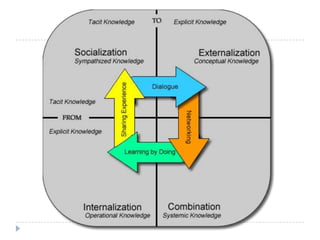
Tacit KnowledgeIndividually, list the tacit knowledge that exists among you and your colleagues and that has an influence on your situation.In your group, discuss the implications of this tacit knowledge, positive and negative.What will you do to get yourself and your colleagues on the knowledge spiral?
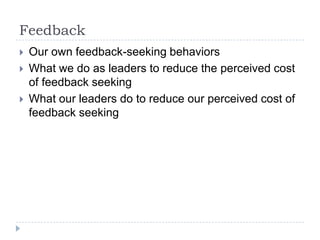
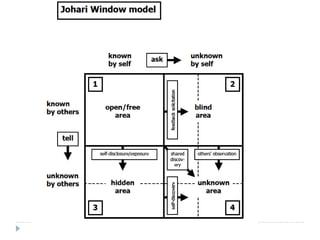
FeedbackOur own feedback-seeking behaviorsWhat we do as leaders to reduce the perceived cost of feedback seekingWhat our leaders do to reduce our perceived cost of feedback seeking
ConfidenceRead the excerpt from Rosabeth Moss Kanter’s book, ConfidenceUse your own experiences to respond to the prompts about winning and losing streaks, then add with other people’s stories
It was when you found out you could make mistakes that you knew you were onto something.

CFA for Coaches and Administrators Day One PowerPoint

  • 1.
    Welcome to ClassroomFormative Assessment for Coaches and Administrators
  • 2.
    TargetWe will beable to describe the very big picture for the district and for their school: how classroom formative assessment connects with everything we do, including but not limited to:The 27J Instructional ModelPLCsPSTsProfessional developmentStaff meetingsSIPPBSProfessional growth plansTeacher evaluationGrading and reportingWe will start thinking about change in the district and in schools, and explore constructs that may help us with planning and execution.
  • 4.
    The indispensable conditionsfor improvement are that the student comes to hold a concept of quality roughly similar to that held by the teacher, is able to monitor continuously the quality of what is being produced during the act of production itself, and has a repertoire of alternative moves or strategies from which to draw at any given point.Sadler, 1989
  • 5.
    Our StoryWhere areyou now?Where do you want to be?How do you close the gap?
  • 6.
    Connecting Classroom FormativeAssessmentIn school groups, draw a web showing the connection of classroom formative assessment to what is going on in your school.
  • 7.
    ReflectionIndividually, write aboutthe what you have been thinking about so far. (Sentence stems are available in your packet.)
  • 8.
  • 10.
    The confusion createdby the inevitable discrepancies in meaning that occur in any organization might seem like a problem. In fact, it can be a rich source of new knowledge—if a company knows how to manage it. The key to doing so is continuously challenging employees to reexamine what they take for granted. Such reflection is always necessary in the knowledge-creating company, but it is especially essential during times of crisis or breakdown, when a company’s traditional categories of knowledge no longer work.Nonaka, 2007
  • 11.
    Tacit KnowledgeIndividually, listthe tacit knowledge that exists among you and your colleagues and that has an influence on your situation.In your group, discuss the implications of this tacit knowledge, positive and negative.What will you do to get yourself and your colleagues on the knowledge spiral?
  • 12.
    FeedbackOur own feedback-seekingbehaviorsWhat we do as leaders to reduce the perceived cost of feedback seekingWhat our leaders do to reduce our perceived cost of feedback seeking
  • 14.
    ConfidenceRead the excerptfrom Rosabeth Moss Kanter’s book, ConfidenceUse your own experiences to respond to the prompts about winning and losing streaks, then add with other people’s stories
  • 15.
    It was whenyou found out you could make mistakes that you knew you were onto something.