Food Policy for the 21st century:  can we grow enough,  sustainably and healthily? Tim Lang Centre for Food Policy, City University, London  [email_address] CLM lecture, De Rode Hoed debating centre, Keizersgracht 102,   Amsterdam,  October 29 2009
I give my answer first! Yes … … probably… … but  only  if there is big change… … on many fronts… … by everyone… … government, supply chain…consumers … all at once … very fast!
So the big questions are: Q 1. Do we change fast enough now?  Answer: No, not fast or deep enough yet Q2. If not, will we be forced to change? Answer: probably - by shocks such as war or water Q3. How could we get change quicker and more deeply? Answer: with difficulty but we must try Q4. Is there any hope? Answer: yes, there are signs of movement but we need to work very hard!
Summary Current food system is in trouble: neo-Malthusian questions return Sustainable diet = key to linking health, environment and social needs into culture Debate and actions are emerging A complex issue: all about values C21st challenges: Time? Limits? Ideology (eg choice)?
1. What’s the problem?
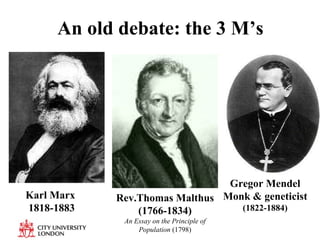
Rev.Thomas Malthus (1766-1834) An Essay on the Principle of Population  (1798) Karl Marx  1818-1883 Gregor Mendel Monk & geneticist (1822-1884) An old debate: the 3 M’s
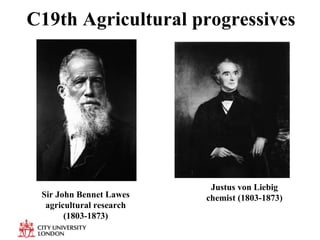
C19th Agricultural progressives Sir John Bennet Lawes agricultural research (1803-1873) Justus von Liebig chemist (1803-1873)
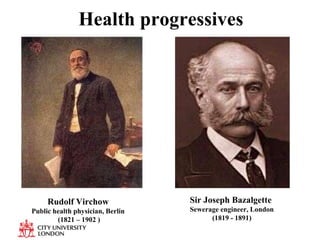
Health progressives Rudolf Virchow Public health physician, Berlin (1821 – 1902   ) Sir Joseph Bazalgette  Sewerage engineer, London (1819 - 1891)
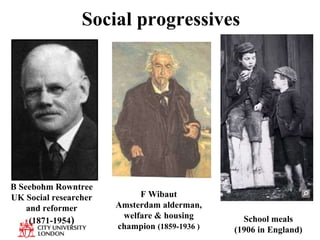
Social progressives B Seebohm Rowntree UK Social researcher and reformer (1871-1954 ) F Wibaut Amsterdam alderman, welfare & housing champion  ( 1859-1936   ) School meals (1906 in England)
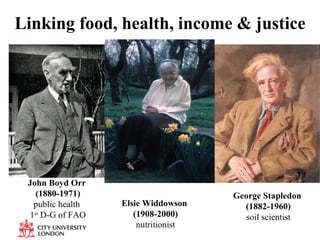
Linking food, health, income & justice John Boyd Orr  (1880-1971) public health  1 st  D-G of FAO George Stapledon  (1882-1960) soil scientist Elsie Widdowson  (1908-2000) nutritionist
They seized their moment and applied their integrated vision World War 2 NL famine (1944-45) Wave of initiatives UN institutions eg FAO created 1946 Common Market 1957 Treaty of Rome    CAP Food as a litmus test for progress taming the state Transcending corporate / economic uncertainties
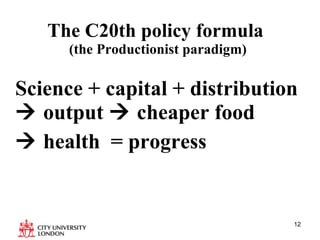
The C20th policy formula  (the Productionist paradigm) Science + capital + distribution    output    cheaper food     health  = progress
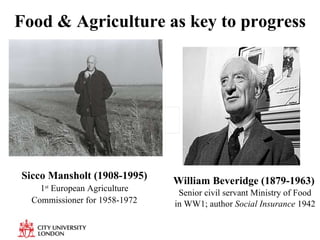
Food & Agriculture as key to progress William Beveridge (1879-1963)   Senior civil servant Ministry of Food in WW1; author  Social Insurance  1942 Sicco Mansholt (1908-1995) 1 st  European Agriculture Commissioner for 1958-1972
The model faces challenges Reliance on oil (hence 1970s crisis) It was altered in the 1970s by neo-liberalism Market-led  No overall vision  It is now meeting other environmental limits Water, population, eco-systems, land, fertilisers (Atlas) Capital - now supporting bankers not green vision Social resistance – consumers locked into consumerism?
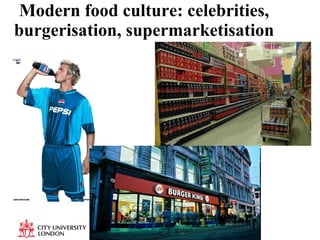
Modern food culture: celebrities, burgerisation, supermarketisation
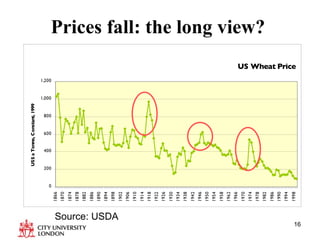
Prices fall: the long view?  Source: USDA
source:  http://www.fao.org/worldfoodsituation/en/  (accessed June 26 2009] Prices…up and down … …and rising again? 2005-09
2. The C21 st  challenge is to deliver a sustainable food system
New policy based on  New (& Old) Fundamentals Climate change Fuel / oil / energy Water Biodiversity  Soil  Land use Labour Population (9bn 2050) Urbanisation Affluence (BRICs +) Nutrition transition Inequality  Healthcare costs
The C21st challenge: how to inject Omni-Standards into business and supply chains? Quality : Fresh (?) Localness (?) Seasonality Social values : Animal welfare Working conditions Equality Cost internalisation  Environmental : Climate change  Water Land use Biodiversity  Health : Safety Nutrition Access / affordability
3. Responses are emerging  (but are they fast enough?)
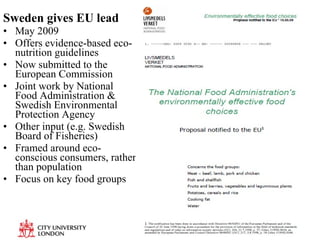
Sweden gives EU lead May 2009  Offers evidence-based eco-nutrition guidelines Now submitted to the European Commission  Joint work by National Food Administration & Swedish Environmental Protection Agency Other input (e.g. Swedish Board of Fisheries) Framed around eco-conscious consumers, rather than population Focus on key food groups
NL Ministry of Agriculture, Nature & Food Quality June 2008 Policy Document on Sustainable Food: towards sustainable production and consumption of food   http:// www.minlnv.nl/portal/page?_pageid =116,1640321&_dad= portal&_schema = PORTAL&p_file_id =39545   Objectives Stimulating sustainable innovations in the Dutch agrifood complex Enable and entice Dutch consumers to buy sustainable (and healthy) food Influencing the international agenda Approach:  voluntarism, information, innovation (GMOs), productivity, etc
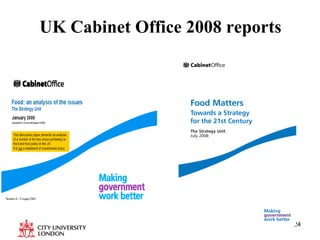
UK Cabinet Office 2008 reports
UK : internal government action Scotland Recipe for Success – Scotland’s National Food and Drink Policy  (2009) England Council of Food Policy Advisors Integrated Advice Scheme Healthy Food Mark (DH, FSA, Defra) Sustainable Development Commission Sustainable Diets report for Defra (Nov 09)
Company actions 2008 Tesco gives £25m to University of Manchester Sustainable Consumption Institute 2007 IGD  Food Industry Sustainability Strategy Champions Group focus on low carbon + ethics Focus on waste (jointly with Govt funded WRAP)  www.wrap.org.uk     resource efficiency Ideology: Self interest, cost-cutting, long-termism,  Split focus on consumers: choice vs choice-edit?
Consumer actions: various strategies Big bang: Total change – eg meat only 1 x per week Gradualism - ease consumers into change From light bulbs to food? Hierarchy of impact SDC paper (forthcoming) Do nothing Let consumers decide
4. Barriers and problems
All these demands at time of  complex policy architecture multi-level:  local, sub-national, national, regional, global multi-agency  public, private & civil society rapid concentration of power over supply chains intra and inter-national Complex influences:  laws, regulations, standards    twitter /media/hype
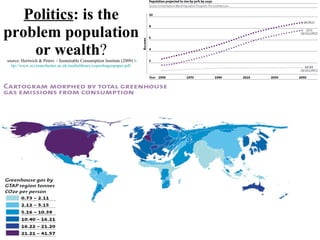
Politics : is the problem population or wealth ?  source: Hertwich & Peters  / Sustainable Consumption Institute (2009)  h ttp://www.sci.manchester.ac.uk/medialibrary/copenhagenpaper.pdf
Complex  ideological  challenge Prices and cheapness Choice vs choice-editing How can consumers choose if advice is incoherent, eg fish – to eat it or not? Companies are more used to integrated thinking than Governments Food culture is fragmented: meat & dairy on feast days not everyday de-skilled consumers for low carbon living
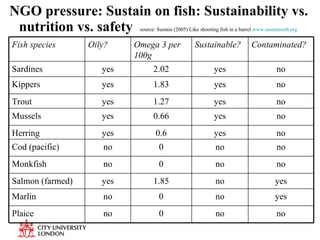
NGO pressure: Sustain on fish: Sustainability vs. nutrition vs. safety   source: Sustain (2005)  Like shooting fish in a barrel   www.sustainweb.org   no no 0 no Plaice  yes no 0 no Marlin yes no 1.85 yes Salmon (farmed) no no 0 no Monkfish  no no 0 no Cod (pacific) no yes 0.6 yes Herring no yes 0.66 yes Mussels no yes 1.27 yes Trout no yes 1.83 yes Kippers no yes 2.02 yes Sardines Contaminated? Sustainable? Omega 3 per 100g Oily? Fish species
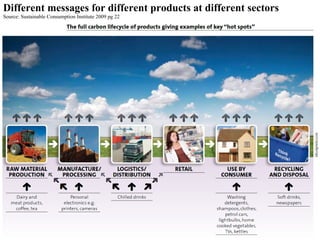
Different messages for different products at different sectors Source: Sustainable Consumption Institute 2009 pg 22
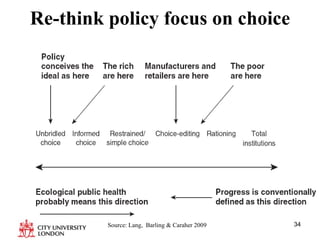
Re-think policy focus on choice Source: Lang,  Barling & Caraher 2009
5. Looking ahead
1. Consumers change We must change  what we eat &  how it is  produced No romance about turning clocks back Need for new cultural norms / ‘rules’ No clarity in everyday culture yet Period of social experimentation to watch:  Fife Diet (Vancouver)  http://fifediet.co.uk/   New consumer co-operatives eg Growing Communities Hackney  http://www.growingcommunities.org/   Most consumers want choices taken upstream and to be given feasible alternatives (SCI report 2009)
2. Sharing lessons Regions : Toscana, Wales, Scotland, Cuba Cities : London (2012), Toronto, Belo Horizonte, Amsterdam, Roma Food Policy Councils : 100 in USA, Toronto Markets  rebuilt: Barcelona, Borough (London) Transition towns : Europe Urban agriculture : Africa, Asia Projects:  Incredible Edible Todmorden (Lancs UK)
3. Support / invigorate pursuit of new business model  Less focus on price….more on quality and means Industry creating its own standards  GlobalGAP, GFSI, SAI, etc G30 top TNCs initiative October 16 2009  Coca-Cola, Tesco, Unilever, News International  Some remarkable initiatives: Marks & Spencer Plan A Reduced GHG dairy initiatives eg WalMart-Asda; J Sainsbury Re-emergence of co-operation as framework: TNCs G30    box schemes / CSA    reinvention of Co-ops?
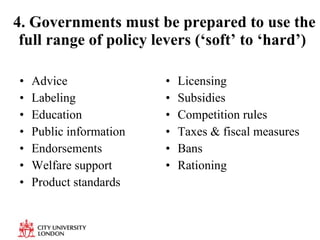
4. Governments must be prepared to use the full range of policy levers (‘soft’ to ‘hard’)   Advice Labeling Education Public information Endorsements  Welfare support Product standards Licensing Subsidies Competition rules Taxes & fiscal measures Bans Rationing
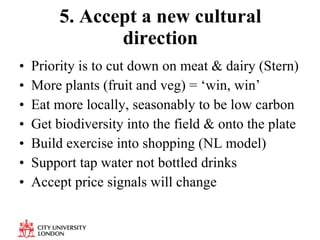
5. Accept a new cultural direction Priority is to cut down on meat & dairy (Stern) More plants (fruit and veg) = ‘win, win’ Eat more locally, seasonably to be low carbon Get biodiversity into the field & onto the plate Build exercise into shopping (NL model) Support tap water not bottled drinks Accept price signals will change
Thanks

Tim Lang, Rode Hoed, October 2009

  • 1.
    Food Policy forthe 21st century: can we grow enough, sustainably and healthily? Tim Lang Centre for Food Policy, City University, London [email_address] CLM lecture, De Rode Hoed debating centre, Keizersgracht 102, Amsterdam, October 29 2009
  • 2.
    I give myanswer first! Yes … … probably… … but only if there is big change… … on many fronts… … by everyone… … government, supply chain…consumers … all at once … very fast!
  • 3.
    So the bigquestions are: Q 1. Do we change fast enough now? Answer: No, not fast or deep enough yet Q2. If not, will we be forced to change? Answer: probably - by shocks such as war or water Q3. How could we get change quicker and more deeply? Answer: with difficulty but we must try Q4. Is there any hope? Answer: yes, there are signs of movement but we need to work very hard!
  • 4.
    Summary Current foodsystem is in trouble: neo-Malthusian questions return Sustainable diet = key to linking health, environment and social needs into culture Debate and actions are emerging A complex issue: all about values C21st challenges: Time? Limits? Ideology (eg choice)?
  • 5.
  • 6.
    Rev.Thomas Malthus (1766-1834)An Essay on the Principle of Population (1798) Karl Marx 1818-1883 Gregor Mendel Monk & geneticist (1822-1884) An old debate: the 3 M’s
  • 7.
    C19th Agricultural progressivesSir John Bennet Lawes agricultural research (1803-1873) Justus von Liebig chemist (1803-1873)
  • 8.
    Health progressives RudolfVirchow Public health physician, Berlin (1821 – 1902 ) Sir Joseph Bazalgette Sewerage engineer, London (1819 - 1891)
  • 9.
    Social progressives BSeebohm Rowntree UK Social researcher and reformer (1871-1954 ) F Wibaut Amsterdam alderman, welfare & housing champion ( 1859-1936 ) School meals (1906 in England)
  • 10.
    Linking food, health,income & justice John Boyd Orr (1880-1971) public health 1 st D-G of FAO George Stapledon (1882-1960) soil scientist Elsie Widdowson (1908-2000) nutritionist
  • 11.
    They seized theirmoment and applied their integrated vision World War 2 NL famine (1944-45) Wave of initiatives UN institutions eg FAO created 1946 Common Market 1957 Treaty of Rome  CAP Food as a litmus test for progress taming the state Transcending corporate / economic uncertainties
  • 12.
    The C20th policyformula (the Productionist paradigm) Science + capital + distribution  output  cheaper food  health = progress
  • 13.
    Food & Agricultureas key to progress William Beveridge (1879-1963) Senior civil servant Ministry of Food in WW1; author Social Insurance 1942 Sicco Mansholt (1908-1995) 1 st European Agriculture Commissioner for 1958-1972
  • 14.
    The model faceschallenges Reliance on oil (hence 1970s crisis) It was altered in the 1970s by neo-liberalism Market-led No overall vision It is now meeting other environmental limits Water, population, eco-systems, land, fertilisers (Atlas) Capital - now supporting bankers not green vision Social resistance – consumers locked into consumerism?
  • 15.
    Modern food culture:celebrities, burgerisation, supermarketisation
  • 16.
    Prices fall: thelong view? Source: USDA
  • 17.
    source: http://www.fao.org/worldfoodsituation/en/ (accessed June 26 2009] Prices…up and down … …and rising again? 2005-09
  • 18.
    2. The C21st challenge is to deliver a sustainable food system
  • 19.
    New policy basedon New (& Old) Fundamentals Climate change Fuel / oil / energy Water Biodiversity Soil Land use Labour Population (9bn 2050) Urbanisation Affluence (BRICs +) Nutrition transition Inequality Healthcare costs
  • 20.
    The C21st challenge:how to inject Omni-Standards into business and supply chains? Quality : Fresh (?) Localness (?) Seasonality Social values : Animal welfare Working conditions Equality Cost internalisation Environmental : Climate change Water Land use Biodiversity Health : Safety Nutrition Access / affordability
  • 21.
    3. Responses areemerging (but are they fast enough?)
  • 22.
    Sweden gives EUlead May 2009 Offers evidence-based eco-nutrition guidelines Now submitted to the European Commission Joint work by National Food Administration & Swedish Environmental Protection Agency Other input (e.g. Swedish Board of Fisheries) Framed around eco-conscious consumers, rather than population Focus on key food groups
  • 23.
    NL Ministry ofAgriculture, Nature & Food Quality June 2008 Policy Document on Sustainable Food: towards sustainable production and consumption of food http:// www.minlnv.nl/portal/page?_pageid =116,1640321&_dad= portal&_schema = PORTAL&p_file_id =39545 Objectives Stimulating sustainable innovations in the Dutch agrifood complex Enable and entice Dutch consumers to buy sustainable (and healthy) food Influencing the international agenda Approach: voluntarism, information, innovation (GMOs), productivity, etc
  • 24.
    UK Cabinet Office2008 reports
  • 25.
    UK : internalgovernment action Scotland Recipe for Success – Scotland’s National Food and Drink Policy (2009) England Council of Food Policy Advisors Integrated Advice Scheme Healthy Food Mark (DH, FSA, Defra) Sustainable Development Commission Sustainable Diets report for Defra (Nov 09)
  • 26.
    Company actions 2008Tesco gives £25m to University of Manchester Sustainable Consumption Institute 2007 IGD Food Industry Sustainability Strategy Champions Group focus on low carbon + ethics Focus on waste (jointly with Govt funded WRAP) www.wrap.org.uk  resource efficiency Ideology: Self interest, cost-cutting, long-termism, Split focus on consumers: choice vs choice-edit?
  • 27.
    Consumer actions: variousstrategies Big bang: Total change – eg meat only 1 x per week Gradualism - ease consumers into change From light bulbs to food? Hierarchy of impact SDC paper (forthcoming) Do nothing Let consumers decide
  • 28.
  • 29.
    All these demandsat time of complex policy architecture multi-level: local, sub-national, national, regional, global multi-agency public, private & civil society rapid concentration of power over supply chains intra and inter-national Complex influences: laws, regulations, standards  twitter /media/hype
  • 30.
    Politics : isthe problem population or wealth ? source: Hertwich & Peters / Sustainable Consumption Institute (2009) h ttp://www.sci.manchester.ac.uk/medialibrary/copenhagenpaper.pdf
  • 31.
    Complex ideological challenge Prices and cheapness Choice vs choice-editing How can consumers choose if advice is incoherent, eg fish – to eat it or not? Companies are more used to integrated thinking than Governments Food culture is fragmented: meat & dairy on feast days not everyday de-skilled consumers for low carbon living
  • 32.
    NGO pressure: Sustainon fish: Sustainability vs. nutrition vs. safety source: Sustain (2005) Like shooting fish in a barrel www.sustainweb.org no no 0 no Plaice yes no 0 no Marlin yes no 1.85 yes Salmon (farmed) no no 0 no Monkfish no no 0 no Cod (pacific) no yes 0.6 yes Herring no yes 0.66 yes Mussels no yes 1.27 yes Trout no yes 1.83 yes Kippers no yes 2.02 yes Sardines Contaminated? Sustainable? Omega 3 per 100g Oily? Fish species
  • 33.
    Different messages fordifferent products at different sectors Source: Sustainable Consumption Institute 2009 pg 22
  • 34.
    Re-think policy focuson choice Source: Lang, Barling & Caraher 2009
  • 35.
  • 36.
    1. Consumers changeWe must change what we eat & how it is produced No romance about turning clocks back Need for new cultural norms / ‘rules’ No clarity in everyday culture yet Period of social experimentation to watch: Fife Diet (Vancouver) http://fifediet.co.uk/ New consumer co-operatives eg Growing Communities Hackney http://www.growingcommunities.org/ Most consumers want choices taken upstream and to be given feasible alternatives (SCI report 2009)
  • 37.
    2. Sharing lessonsRegions : Toscana, Wales, Scotland, Cuba Cities : London (2012), Toronto, Belo Horizonte, Amsterdam, Roma Food Policy Councils : 100 in USA, Toronto Markets rebuilt: Barcelona, Borough (London) Transition towns : Europe Urban agriculture : Africa, Asia Projects: Incredible Edible Todmorden (Lancs UK)
  • 38.
    3. Support /invigorate pursuit of new business model Less focus on price….more on quality and means Industry creating its own standards GlobalGAP, GFSI, SAI, etc G30 top TNCs initiative October 16 2009 Coca-Cola, Tesco, Unilever, News International Some remarkable initiatives: Marks & Spencer Plan A Reduced GHG dairy initiatives eg WalMart-Asda; J Sainsbury Re-emergence of co-operation as framework: TNCs G30  box schemes / CSA  reinvention of Co-ops?
  • 39.
    4. Governments mustbe prepared to use the full range of policy levers (‘soft’ to ‘hard’) Advice Labeling Education Public information Endorsements Welfare support Product standards Licensing Subsidies Competition rules Taxes & fiscal measures Bans Rationing
  • 40.
    5. Accept anew cultural direction Priority is to cut down on meat & dairy (Stern) More plants (fruit and veg) = ‘win, win’ Eat more locally, seasonably to be low carbon Get biodiversity into the field & onto the plate Build exercise into shopping (NL model) Support tap water not bottled drinks Accept price signals will change
  • 41.