Learning mathematical proof
lesson learned from research
&
principles of design of a learning environment
Nicolas.Balacheff@imag.fr

© N. Balacheff Oct. 2005
A controversial question...

What is a mathematical proof ?

© N. Balacheff Oct. 2005
The rôle of mathematical proof
in the practice of mathematicians

© N. Balacheff Oct. 2005

Internal needs
Social communication
The rôle of mathematical proof
in the practice of mathematicians

mathematical
rationalism

© N. Balacheff Oct. 2005

Versus

Internal needs
Social communication
non mathematical
rationalism
The rôle of mathematical proof
in the practice of mathematicians

mathematical
rationalism

Rigour

© N. Balacheff Oct. 2005

Versus

Versus

Internal needs
Social communication
non mathematical
rationalism

Efficiency
The rôle of mathematical proof
in the practice of mathematicians

mathematical
rationalism

Versus

Internal needs
Social communication
non mathematical
rationalism

The specific economy
of the practice of mathematics
Rigour

© N. Balacheff Oct. 2005

Versus

Efficiency
Argumentation
vs
Mathematical proof
Argumentation
content count
epistemic value
Mathematical proof
operational value count
structural value
© N. Balacheff Oct. 2005
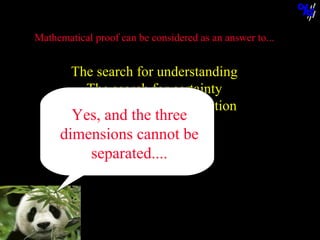
Mathematical proof can be considered as an answer to...

The search for certainty
The need for communication
The search for understanding

© N. Balacheff Oct. 2005
Mathematical proof can be considered as an answer to...

The search for understanding
The search for certainty
The need for communication

Yes, and the three
dimensions cannot be
separated....

© N. Balacheff Oct. 2005
Learning mathematical proof,
which genesis ?

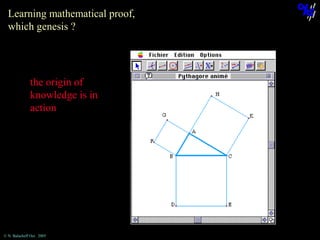
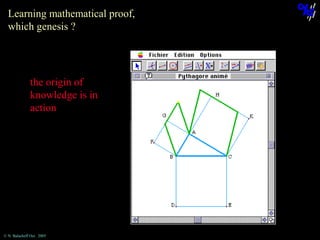
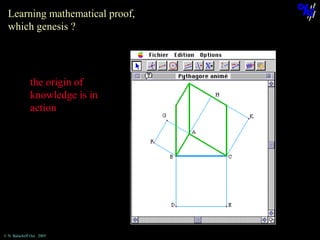
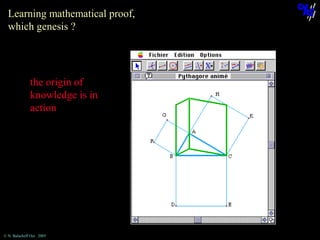
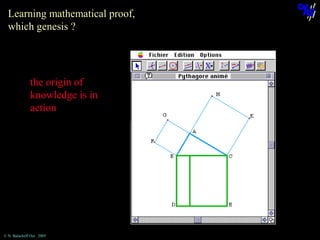
the origin of knowledge is in action
but the achievement of

Mathematical proof is in language

© N. Balacheff Oct. 2005
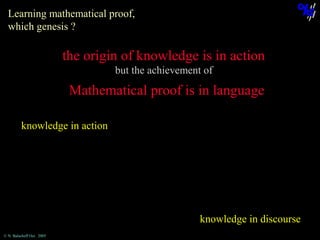
Learning mathematical proof,
which genesis ?

the origin of knowledge is in action
but the achievement of

Mathematical proof is in language
knowledge in action

knowledge in discourse
© N. Balacheff Oct. 2005
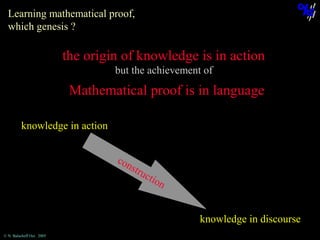
Learning mathematical proof,
which genesis ?

the origin of knowledge is in action
but the achievement of

Mathematical proof is in language
knowledge in action
con
str
uct
ion

knowledge in discourse
© N. Balacheff Oct. 2005
Learning mathematical proof,
which genesis ?

the origin of
knowledge is in
action

© N. Balacheff Oct. 2005
Learning mathematical proof,
which genesis ?

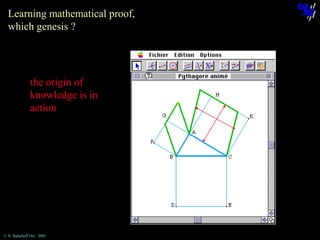
the origin of
knowledge is in
action

© N. Balacheff Oct. 2005
Learning mathematical proof,
which genesis ?

the origin of
knowledge is in
action

© N. Balacheff Oct. 2005
Learning mathematical proof,
which genesis ?

the origin of
knowledge is in
action

© N. Balacheff Oct. 2005
Learning mathematical proof,
which genesis ?

the origin of
knowledge is in
action

© N. Balacheff Oct. 2005
Learning mathematical proof,
which genesis ?

the origin of
knowledge is in
action

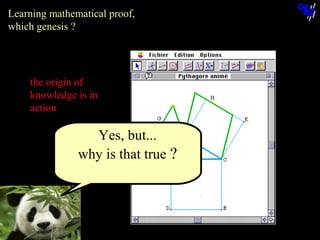
Yes, but...
why is that true ?

© N. Balacheff Oct. 2005
Learning mathematical proof,
which genesis ?

the origin of
knowledge is in
action

© N. Balacheff Oct. 2005
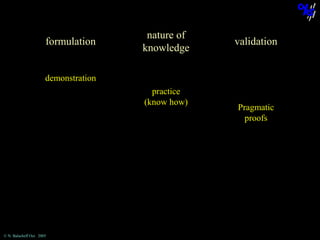
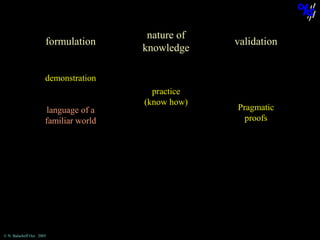
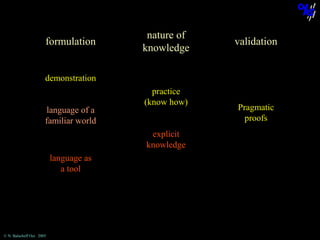
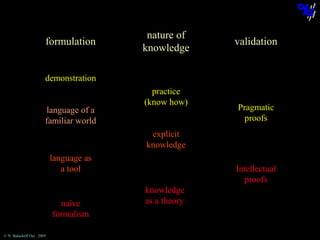
formulation

© N. Balacheff Oct. 2005

nature of
knowledge

validation
formulation

nature of
knowledge

validation

demonstration
practice
(know how)

© N. Balacheff Oct. 2005

Pragmatic
proofs
formulation

nature of
knowledge

validation

demonstration
language of a
familiar world

© N. Balacheff Oct. 2005

practice
(know how)

Pragmatic
proofs
formulation

nature of
knowledge

validation

demonstration
language of a
familiar world

practice
(know how)
explicit
knowledge

language as
a tool

© N. Balacheff Oct. 2005

Pragmatic
proofs
formulation

nature of
knowledge

validation

demonstration
language of a
familiar world

practice
(know how)

Pragmatic
proofs

explicit
knowledge
language as
a tool

naïve
formalism
© N. Balacheff Oct. 2005

Intellectual
proofs
knowledge
as a theory
formulation

nature of
knowledge

validation

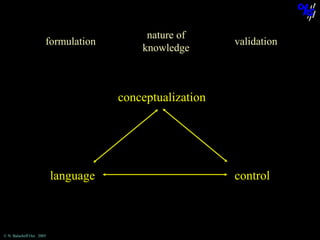
conceptualization

language

© N. Balacheff Oct. 2005

control
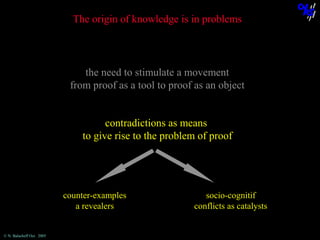
The origin of knowledge is in problems
in the case of proof, mathematical problem-solving is not enough

the need to stimulate a movement
from proof as a tool to proof as an object
contradictions as means
to give rise to the problem of proof

counter-examples
a revealers

© N. Balacheff Oct. 2005

socio-cognitif
conflicts as catalysts
The origin of knowledge is in problems
in the case of proof, mathematical problem-solving is not enough

the need to stimulate a movement
from proof as a tool to proof as an object

counter-examples
a contradictions as means
to give rise to the problem of proof
revealers

counter-examples
a revealers

© N. Balacheff Oct. 2005

socio-cognitif
conflicts as catalysts
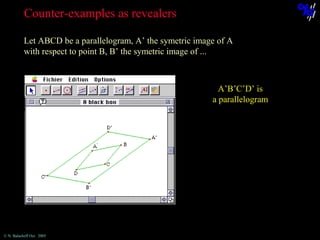
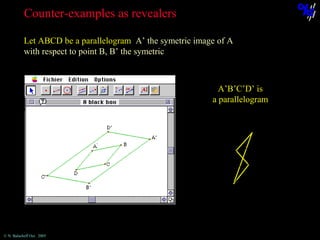
Counter-examples as revealers
Let ABCD be a parallelogram, A’ the symetric image of A
with respect to point B, B’ the symetric image of ...

A’B’C’D’ is
a parallelogram

© N. Balacheff Oct. 2005
Counter-examples as revealers
Let ABCD be a parallelogram, A’ the symetric image of A
with respect to point B, B’ the symetric image of ...

A’B’C’D’ is
a parallelogram

SAS

© N. Balacheff Oct. 2005
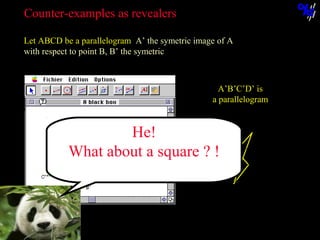
Counter-examples as revealers
Let ABCD be a parallelogram, A’ the symetric image of A
with respect to point B, B’ the symetric image of ...

A’B’C’D’ is
a parallelogram

He!
What about a square ? !
SAS

© N. Balacheff Oct. 2005
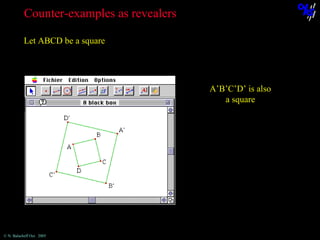
Counter-examples as revealers
Let ABCD be a square...

A’B’C’D’ is also
a square

© N. Balacheff Oct. 2005
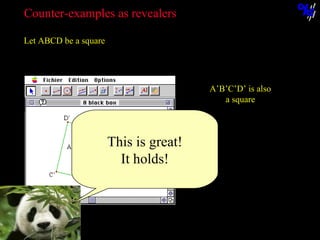
Counter-examples as revealers
Let ABCD be a square...

A’B’C’D’ is also
a square

This is great!
It holds!

© N. Balacheff Oct. 2005
Counter-examples as revealers
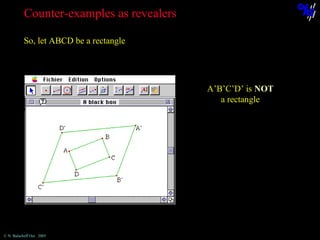
So, let ABCD be a rectangle...

A’B’C’D’ is NOT
a rectangle

© N. Balacheff Oct. 2005
Counter-examples as revealers
So, let ABCD be a rectangle...

A’B’C’D’ is NOT
a rectangle

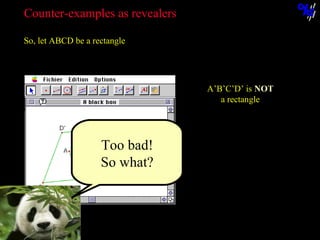
Too bad!
So what?

© N. Balacheff Oct. 2005
How to deal with a counter-example?
The mathematics classroom tends to be a
manichean world:
to be or not to be true is the only question
Whereas an example proves mathematically
nothing, a counter-example just destroyes every
effort...
Could we revisit the old classical position?
© N. Balacheff Oct. 2005
Proof
Conjecture

© N. Balacheff Oct. 2005
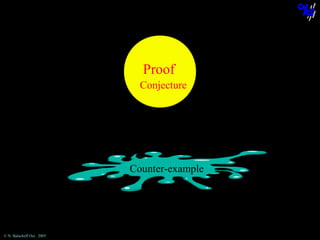
Proof
Conjecture

Counter-example

© N. Balacheff Oct. 2005
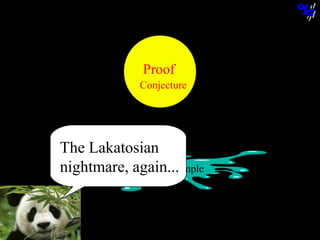
Proof
Conjecture

The Lakatosian
nightmare, Counter-example
again...

© N. Balacheff Oct. 2005
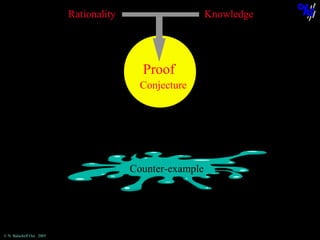
Rationality

Knowledge

Proof
Conjecture

Counter-example

© N. Balacheff Oct. 2005
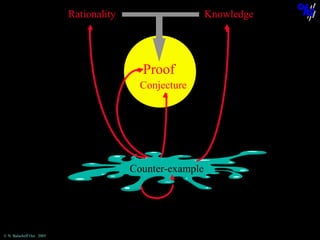
Rationality

Knowledge

Proof
Conjecture

Counter-example

© N. Balacheff Oct. 2005
Where are we?
A constructivist approach is possible, but a problématique
of proof must not be separated from knowledge construction
Regulation of cognitive processes
related to proving in mathematics,
treatment of refutations

© N. Balacheff Oct. 2005
Where are we?
A constructivist approach is possible, but a problématique
of proof must not be separated from knowledge construction
Regulation of cognitive processes
related to proving in mathematics,
treatment of refutations

Specific situations are needed in order to elicit
the meaning of mathematical proofs
The rôle of the teacher, negociation
not on the objects but on the means

© N. Balacheff Oct. 2005
Where are we?
A constructivist approach is possible, but a problématique
of proof must not be separated from knowledge construction
Regulation of cognitive processes
related to proving in mathematics,
treatment of refutations

Specific situations are needed in order to elicit
the meaning of mathematical proofs
The rôle of the teacher, negociation
not on the objects but on the means

Mathematics needs a specific milieu which feedback
can reflect the specificities of its objects
Computer-based microworlds
could offer a virtual reality to
mathematical abstractions
© N. Balacheff Oct. 2005
Where are we?
A constructivist approach is possible, but a problématique
of proof must not be separated from knowledge construction
Computer-based

microworlds
could offer a
virtual reality to
Specific situations are needed in order to elicit
the meaning of mathematical proofs
mathematical
The rôle of the teacher, negociation
abstractions on the means
not on the objects but
Regulation of cognitive processes
related to proving in mathematics,
treatment of refutations

Mathematics needs a specific milieu which feedback
can reflect the specificities of its objects
Computer-based microworlds
could offer a virtual reality to
mathematical abstractions
© N. Balacheff Oct. 2005
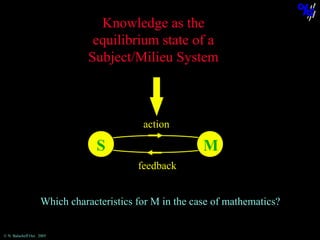
Knowledge as the
equilibrium state of a
Subject/Milieu System

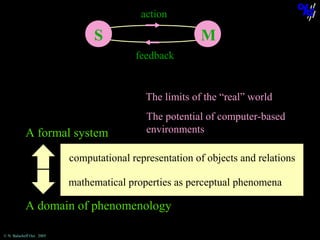
action

S

M
feedback

Which characteristics for M in the case of mathematics?
© N. Balacheff Oct. 2005
action

S

M
feedback

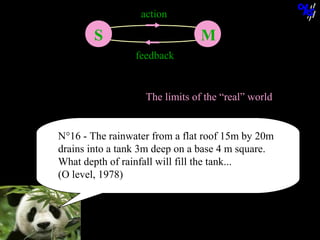
The limits of the “real” world

© N. Balacheff Oct. 2005
action

S

M
feedback

The limits of the “real” world

N°16 - The rainwater from a flat roof 15m by 20m
drains into a tank 3m deep on a base 4 m square.
What depth of rainfall will fill the tank...
(O level, 1978)

© N. Balacheff Oct. 2005
action

S

M
feedback

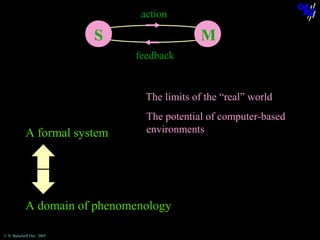
The limits of the “real” world

A formal system

The potential of computer-based
environments

A domain of phenomenology
© N. Balacheff Oct. 2005
action

S

M
feedback

The limits of the “real” world

A formal system

The potential of computer-based
environments

computational representation of objects and relations
mathematical properties as perceptual phenomena

A domain of phenomenology
© N. Balacheff Oct. 2005
action

S

M
feedback

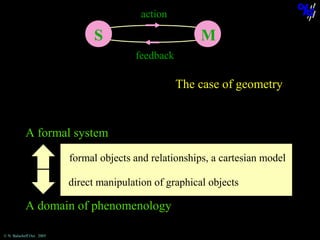
The case of geometry

A formal system
formal objects and relationships, a cartesian model
direct manipulation of graphical objects

A domain of phenomenology
© N. Balacheff Oct. 2005
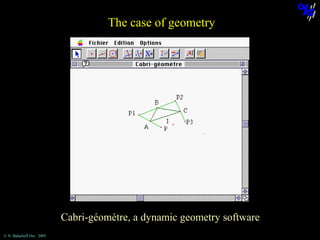
The case of geometry

Cabri-géomètre, a dynamic geometry software
© N. Balacheff Oct. 2005
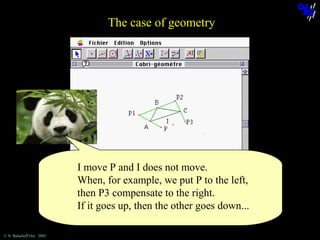
The case of geometry

Construct the symmetrical point P1 of P about A,
then the symmetrical point P2 of P1 about B, etc.
Then, construct the point I, the midpoint of [PP3].
What can be said about the point I when P is moved?
Cabri-géomètre, a dynamic geometry software
© N. Balacheff Oct. 2005
The case of geometry

I move P and I does not move.
When, for example, we put P to the left,
then P3 compensate to the right.
If it goes up, then the other goes down...
Cabri-géomètre, a dynamic geometry software
© N. Balacheff Oct. 2005
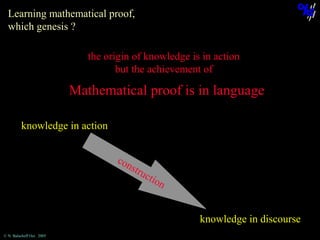
Learning mathematical proof,
which genesis ?
the origin of knowledge is in action
but the achievement of

Mathematical proof is in language
knowledge in action
con
str
uct
ion

knowledge in discourse
© N. Balacheff Oct. 2005
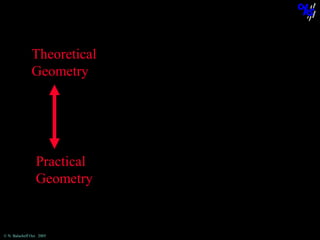
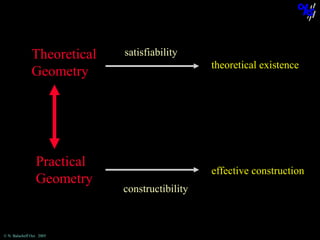
Theoretical
Geometry

Practical
Geometry

© N. Balacheff Oct. 2005
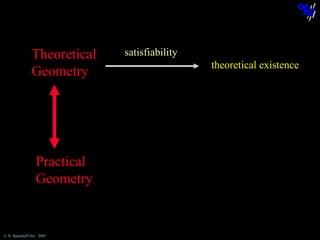
Theoretical
Geometry

satisfiability
theoretical existence
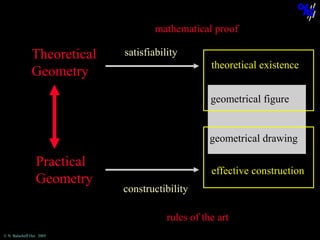
geometrical figure

Practical
Geometry

© N. Balacheff Oct. 2005
Theoretical
Geometry

satisfiability
theoretical existence
geometrical figure

geometrical drawing

Practical
Geometry

© N. Balacheff Oct. 2005

effective construction
constructibility
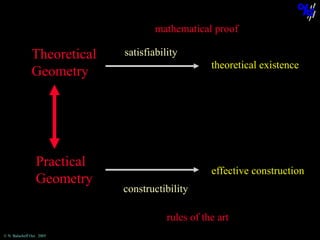
mathematical proof

Theoretical
Geometry

satisfiability
theoretical existence
geometrical figure

geometrical drawing

Practical
Geometry

effective construction
constructibility
rules of the art

© N. Balacheff Oct. 2005
mathematical proof

Theoretical
Geometry

satisfiability
theoretical existence
geometrical figure

geometrical drawing

Practical
Geometry

effective construction
constructibility
rules of the art

© N. Balacheff Oct. 2005
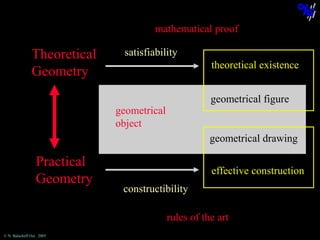
mathematical proof

Theoretical
Geometry

satisfiability
theoretical existence
geometrical figure

geometrical
object

geometrical drawing

Practical
Geometry

effective construction
constructibility
rules of the art

© N. Balacheff Oct. 2005
The end?

© N. Balacheff Oct. 2005
Learning mathematical proof,
which genesis ?
the origin of knowledge is in action
but the achievement of

Mathematical proof is in language
From action...
in a mathematical microworld
... to formulation
for a rational agent, understanding the constraints
of the mathematical discourse

V. Luengo 1997
© N. Balacheff Oct. 2005
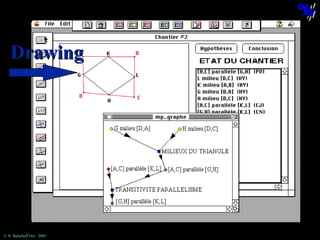
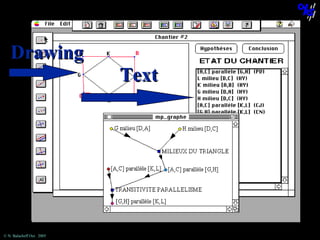
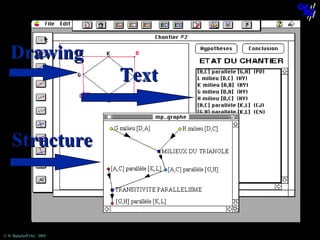
Drawing

© N. Balacheff Oct. 2005
Drawing

© N. Balacheff Oct. 2005

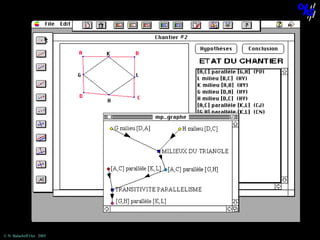
Text
Drawing

Structure

© N. Balacheff Oct. 2005

Text
© N. Balacheff Oct. 2005
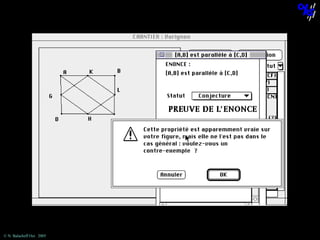
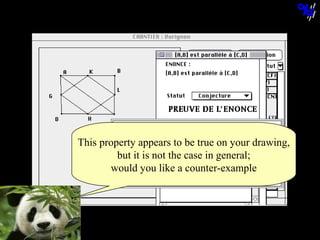
This property appears to be true on your drawing,
but it is not the case in general;
would you like a counter-example

© N. Balacheff Oct. 2005
The statement “[AC] is parallel to [KL]”
cannot be obtained using this theorem.

© N. Balacheff Oct. 2005
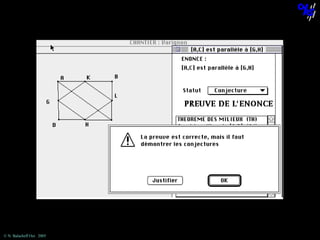
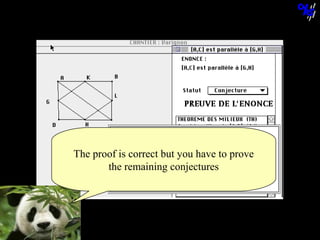
The proof is correct but you have to prove
the remaining conjectures

© N. Balacheff Oct. 2005
The (very) end!

© N. Balacheff Oct. 2005

Learning mathematical proof, lessons learned and outlines of a learning environment

Editor's Notes

  • #2 -         (1) The question of understanding what convinces students when they think that they have a valid solution to a mathematical problem, and how they treat the refutation they may encounter. In other words: what is the nature of student rationality when they are engaged in a mathematical activity.-         (2) The question of specifying the characteristics of teaching situations which could ensure a relevant meaning to the learning of mathematical proof, taking into account students conceptions; that is an evolution of their initial rationality towards an acceptable rationality from a mathematical point of view.The theoretical framework for the study of these questions is built upon constructivism, taking in particular into account the contribution of the psychologist G鲡rd Vergnaud, and the theory of didactical situations designed by Guy Brousseau and the Lakatos epistemology of proof. The experimental part of this work has been carried out with students and classes for the eighth and ninth grade.I have obtained two types of results. First, results on the characterization of different types of proofs in the genesis of the learning of mathematical proof, second the demonstration of the complexity of the treatment of a counter-example by the students.I propose to focus the brow bag conversation on these results, and the way I used them for further research on bridging knowing and proving, and on the design a learning environment.