CAESAREAN
SECTION
BY:
MRS. DEEPTI KUKRETI
PG NURSING TUTOR
OBSTETRICS & GYNAECOLOGY
INTRODUCTION
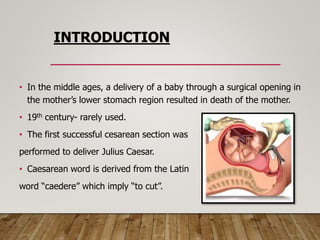
• In the middle ages, a delivery of a baby through a surgical opening in
the mother’s lower stomach region resulted in death of the mother.
• 19th century- rarely used.
• The first successful cesarean section was
performed to deliver Julius Caesar.
• Caesarean word is derived from the Latin
word “caedere” which imply “to cut”.
DEFINITION
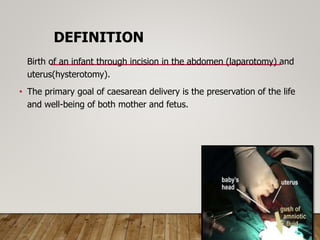
Birth of an infant through incision in the abdomen (laparotomy) and
uterus(hysterotomy).
• The primary goal of caesarean delivery is the preservation of the life
and well-being of both mother and fetus.
INDICATIONS
• Absolute
• Relative
• Common
Absolute indications:
• Central placenta praevia
• Contracted pelvis or cephalopelvic disproportion
• Pelvic mass causing obstruction (cervical or broad
ligament fibroid)
• Carcinoma cervix
• Vaginal obstruction (atresia, stenosis)
Relative indications:
• Cephalo-pelvic disproportion
• Previous caesarean delivery
• Non reassuring FHR (fetal distress)
• Dystocia [due to (three Ps) relatively large fetus
(passenger), small pelvis (passage) / or inefficient
uterine contractions (power)]
• Ante partum hemorrhage (APH)
• Malpresentations
• Failed surgical induction of labor
• Failure to progress in labor.
Common indications:
• Primigravida: Cephalopelvic disproportion (CPD)
• Fetal distress (non-reassuring fetal FHR)
• Dystocia (three Ps)
• Multigravida
• Previous caesarean delivery (28%)
• Ante partum hemorrhage
• Malpresentation (Breech)
TIME OF OPERATION
EMERGENCY
When the operation is
performed due to
unforeseen or acute
obstetric emergencies. An
arbitrary time limit of 30
minutes is thought to be
reasonable from the time
of decision to the start of
the procedure.
ELECTIVE
When the operation is
done at pre-arranged
time during pregnancy to
ensure the best quality of
obstetrics, anesthesia,
neonatal resuscitation
and nursing services.
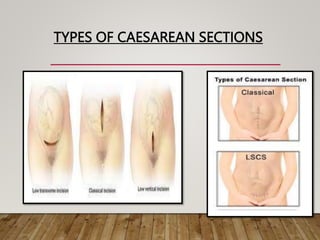
TYPES OF CAESAREAN SECTIONS
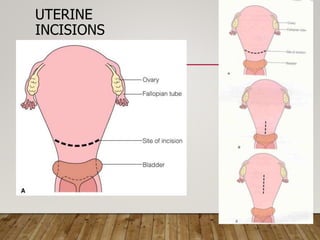
UTERINE
INCISIONS
1. The lower uterine segment section:
• It is the a procedure most commonly used today; it involves a
transverse cut just above the edge of the bladder and results in
less blood loss and is easier to repair. The skin incision is made
horizontally, suprapubic called a pfannenstiel incision or the
"bikinicut” and incision is made in the lower segment of the
uterus after about 32 weeks of gestation and is less muscular
than the upper segment of the uterus. Since skin incision is low
it is latter hidden by pubic hair.
Advantage-
• This heals more rapidly and successfully. Blood loss is minimal,
few post delivery complications occur.
• The incision is easy to repair. Less chance of rupture from the
uterine scar in future pregnancies.
2. The classical or upper segment caesarean
section:
• A midline longitudinal (vertical) incision which allows
a larger space to deliver the baby. However, it is
rarely performed today as it is more prone to
complications. Its indication in present day are-
Indication-
• preferred when there are abdominal adhesions from
previous surgery
• when the fetus is in a transverse lie
• In an emergency delivery
IMPACT ON WOMEN’S HEALTH
• Postpartum hemorrhage
• Post operative adhesions
• Surgical & traumatic complications
• Fever, Wound Infection & thrombo embolic events
• Maternal mortality
• Post spinal headaches
IMPACT ON NEONATES
• Breastfeeding, bonding & attachment issues
• Respiratory effects
• Fetal injuries
COMPLICATIONS
• INTRAOPERATIVE COMPLICATIONS:
• Extension of uterine incision
• Uterine lacerations
• Bladder injury
• Ureteral injury
• Gastrointestinal tract injury
• Uterine atony and primary postpartum hemorrhage
• Morbid adherent placenta (placenta accreta)
POSTOPERATIVE COMPLICATIONS:
MATERNAL COMPLICATIONS:
a. IMMEDIATE
• Postpartum hemorrhage
• Shock
• Anesthetic hazards
• Infections
• Intestinal obstruction
• Thrombo embolic disorders
• Wound complications
b. REMOTE
• Gynecological: Menstrual excess or irregularities, chronic pelvic pain
or backache
• General Surgical: Incisional hernia, Intestinal obstruction due to
adhesions and bands
• Future Pregnancy: There is risk of scar rupture Infections
POSTOPERATIVE NURSING CARE
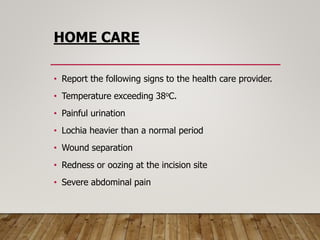
HOME CARE
• Report the following signs to the health care provider.
• Temperature exceeding 38oC.
• Painful urination
• Lochia heavier than a normal period
• Wound separation
• Redness or oozing at the incision site
• Severe abdominal pain
THANK YOU

CESAREAN SECTION.pptx

  • 1.
    CAESAREAN SECTION BY: MRS. DEEPTI KUKRETI PGNURSING TUTOR OBSTETRICS & GYNAECOLOGY
  • 2.
    INTRODUCTION • In themiddle ages, a delivery of a baby through a surgical opening in the mother’s lower stomach region resulted in death of the mother. • 19th century- rarely used. • The first successful cesarean section was performed to deliver Julius Caesar. • Caesarean word is derived from the Latin word “caedere” which imply “to cut”.
  • 3.
    DEFINITION Birth of aninfant through incision in the abdomen (laparotomy) and uterus(hysterotomy). • The primary goal of caesarean delivery is the preservation of the life and well-being of both mother and fetus.
  • 4.
  • 5.
    Absolute indications: • Centralplacenta praevia • Contracted pelvis or cephalopelvic disproportion • Pelvic mass causing obstruction (cervical or broad ligament fibroid) • Carcinoma cervix • Vaginal obstruction (atresia, stenosis)
  • 6.
    Relative indications: • Cephalo-pelvicdisproportion • Previous caesarean delivery • Non reassuring FHR (fetal distress) • Dystocia [due to (three Ps) relatively large fetus (passenger), small pelvis (passage) / or inefficient uterine contractions (power)] • Ante partum hemorrhage (APH) • Malpresentations • Failed surgical induction of labor • Failure to progress in labor.
  • 7.
    Common indications: • Primigravida:Cephalopelvic disproportion (CPD) • Fetal distress (non-reassuring fetal FHR) • Dystocia (three Ps) • Multigravida • Previous caesarean delivery (28%) • Ante partum hemorrhage • Malpresentation (Breech)
  • 8.
    TIME OF OPERATION EMERGENCY Whenthe operation is performed due to unforeseen or acute obstetric emergencies. An arbitrary time limit of 30 minutes is thought to be reasonable from the time of decision to the start of the procedure. ELECTIVE When the operation is done at pre-arranged time during pregnancy to ensure the best quality of obstetrics, anesthesia, neonatal resuscitation and nursing services.
  • 9.
  • 10.
  • 11.
    1. The loweruterine segment section: • It is the a procedure most commonly used today; it involves a transverse cut just above the edge of the bladder and results in less blood loss and is easier to repair. The skin incision is made horizontally, suprapubic called a pfannenstiel incision or the "bikinicut” and incision is made in the lower segment of the uterus after about 32 weeks of gestation and is less muscular than the upper segment of the uterus. Since skin incision is low it is latter hidden by pubic hair. Advantage- • This heals more rapidly and successfully. Blood loss is minimal, few post delivery complications occur. • The incision is easy to repair. Less chance of rupture from the uterine scar in future pregnancies.
  • 12.
    2. The classicalor upper segment caesarean section: • A midline longitudinal (vertical) incision which allows a larger space to deliver the baby. However, it is rarely performed today as it is more prone to complications. Its indication in present day are- Indication- • preferred when there are abdominal adhesions from previous surgery • when the fetus is in a transverse lie • In an emergency delivery
  • 13.
    IMPACT ON WOMEN’SHEALTH • Postpartum hemorrhage • Post operative adhesions • Surgical & traumatic complications • Fever, Wound Infection & thrombo embolic events • Maternal mortality • Post spinal headaches
  • 14.
    IMPACT ON NEONATES •Breastfeeding, bonding & attachment issues • Respiratory effects • Fetal injuries
  • 15.
    COMPLICATIONS • INTRAOPERATIVE COMPLICATIONS: •Extension of uterine incision • Uterine lacerations • Bladder injury • Ureteral injury • Gastrointestinal tract injury • Uterine atony and primary postpartum hemorrhage • Morbid adherent placenta (placenta accreta)
  • 16.
    POSTOPERATIVE COMPLICATIONS: MATERNAL COMPLICATIONS: a.IMMEDIATE • Postpartum hemorrhage • Shock • Anesthetic hazards • Infections • Intestinal obstruction • Thrombo embolic disorders • Wound complications
  • 17.
    b. REMOTE • Gynecological:Menstrual excess or irregularities, chronic pelvic pain or backache • General Surgical: Incisional hernia, Intestinal obstruction due to adhesions and bands • Future Pregnancy: There is risk of scar rupture Infections
  • 18.
  • 19.
    HOME CARE • Reportthe following signs to the health care provider. • Temperature exceeding 38oC. • Painful urination • Lochia heavier than a normal period • Wound separation • Redness or oozing at the incision site • Severe abdominal pain
  • 20.