Thoracic Outlet Syndrome
Dr. Sanjana Kamath M.
Thoracic outlet syndrome
• Term coined by Rob and Standover
• Refers to compression of the subclavian vessels and brachial plexus at
the superior aperture of the chest
• Scalenus anticus, costoclavicular, hyperabduction, cervical rib, and
first thoracic rib syndromes
• Most compressive factors operate against the first rib
Basic etiology
• Symptoms and presentations  related to which structure or structures
are affected  subclavian vein, subclavian artery or brachial plexus
• Neurovascular compression can occur  between the anterior and
middle scalene muscles while passing over the first rib  in the space
between the clavicle and 1st rib, or in the subcoracoid tunnel at the
insertion of the pectoralis minor muscle
Historical aspects
Until 1927 Cervical rib was commonly thought to be the cause of symptoms
Galen and Vesalius 1st described the presence of a cervical rib
1742 Hunauld 1st to describe the importance of
the cervical rib in causing symptoms
1818 Cooper Treated symptoms of cervical rib with some success
1861 Coote Performed the 1st cervical rib removal
1927 Adson and Coffey Suggested the role of the scalenus anticus muscle in cervical rib
syndrome
• Naffziger & Grant
• Ochsner & Associates
Popularized sectioning of the scalenus anticus muscle
• Falconer & Weddell
• Brintall & colleagues
Incriminated the costoclavicular membrane in the production of
neurovascular symptoms
1945 • Wright Described the hyperabduction syndrome with compression in the
costoclavicular area by the tendon of the pectoralis minor
Historical aspects
Rosati & Lord Claviculectomy to anterior exploration, scalenotomy, cervical rib
resection, and sectioning of the pectoralis minor and subclavian
muscles and of the costoclavicular membrane
1903 Bramwell Recognized the role of the 1st rib in causing symptoms of
neurovascular compression
1910 Murphy Initial resection of the 1st rib  supraclavicular approach
• Brickner
• Brickner and Milch
• Telford & coworkers
Suggested that the 1st rib was the culprit
Clagett Emphasized the 1st rib and its resection through the posterior
thoracoplasty approach to relieve neurovascular compression
1962 Falconer & Li Anterior approach for 1st rib resection
1966 Roos Transaxillary approach for 1st rib resection and extirpation
Caldwell & colleagues Introduced the method of measuring motor conduction velocities
across the thoracic outlet in diagnosing TOS
Urschel & Razzuk Popularized reoperation for recurrent TOS
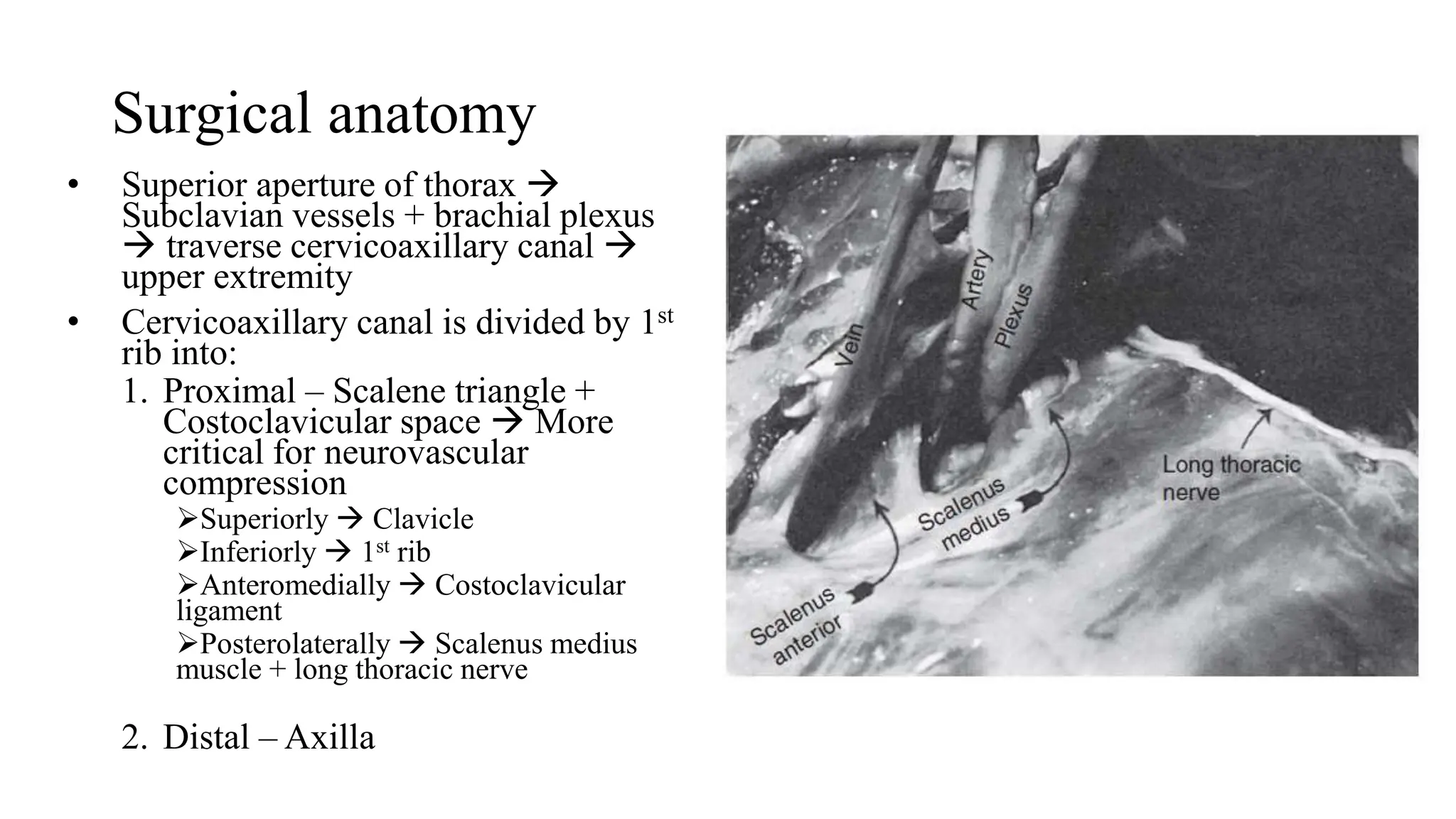
Surgical anatomy
• Superior aperture of thorax 
Subclavian vessels + brachial plexus
 traverse cervicoaxillary canal 
upper extremity
• Cervicoaxillary canal is divided by 1st
rib into:
1. Proximal – Scalene triangle +
Costoclavicular space  More
critical for neurovascular
compression
Superiorly  Clavicle
Inferiorly  1st rib
Anteromedially  Costoclavicular
ligament
Posterolaterally  Scalenus medius
muscle + long thoracic nerve
2. Distal – Axilla
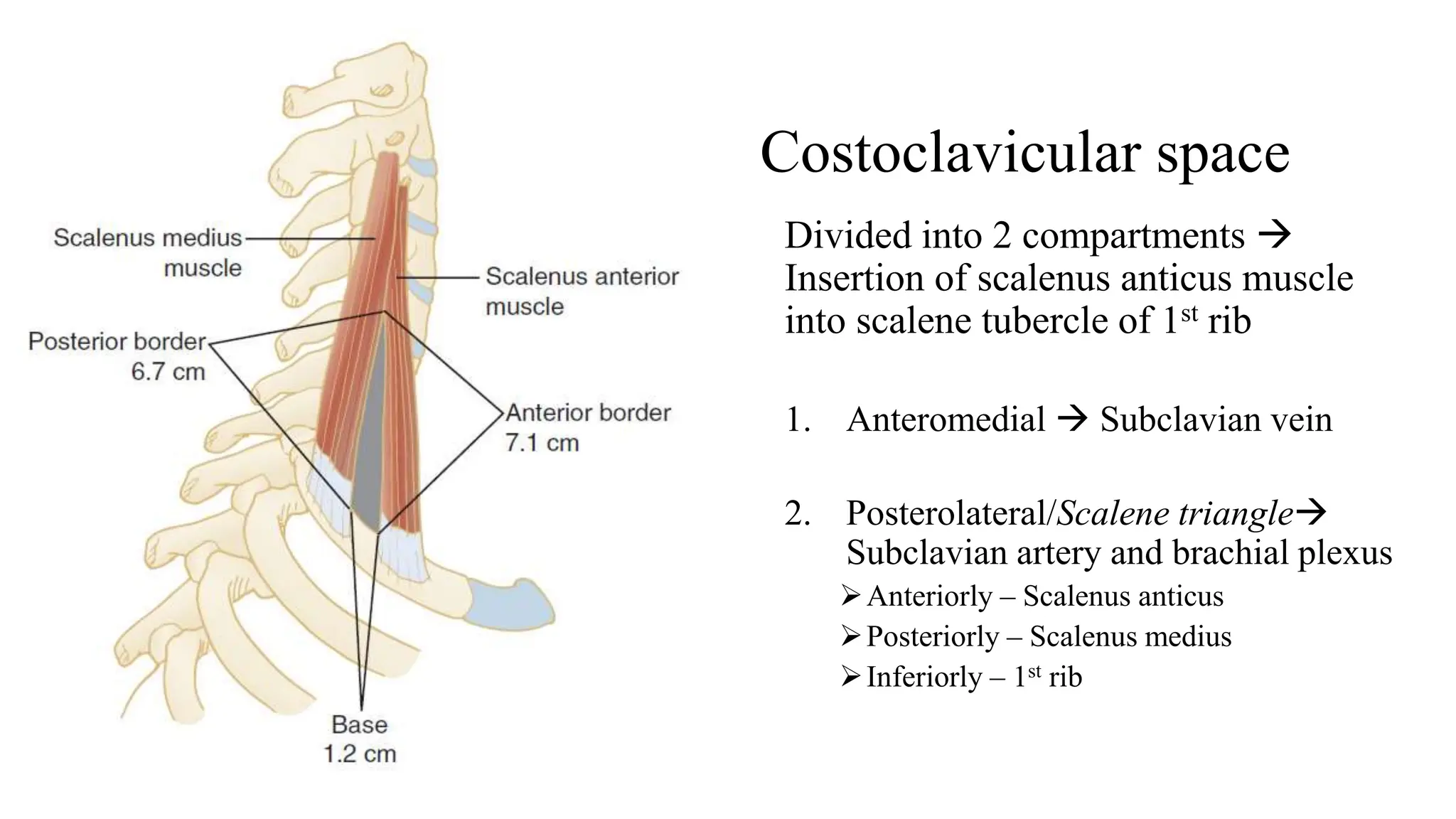
Costoclavicular space
Divided into 2 compartments 
Insertion of scalenus anticus muscle
into scalene tubercle of 1st rib
1. Anteromedial  Subclavian vein
2. Posterolateral/Scalene triangle
Subclavian artery and brachial plexus
Anteriorly – Scalenus anticus
Posteriorly – Scalenus medius
Inferiorly – 1st rib
Functional anatomy
• Cervicoaxillary canal, especially its proximal segment –
costoclavicular area  ample space
Narrows during abduction of arm  Clavicle rotates backward towards 1st rib
and insertion of scalenus anticus
• Hyperabduction  Neurovascular bundle is pulled around the
pectoralis minor tendon, coracoid process and head of humerus
Coracoid process tilts downwards and exaggerates tension on bundle
• Sternoclavicular joint – forms 15°-20°
Smaller angle on descent of outer end of clavicle  drooping of shoulders
• During inspiration, scalenus anticus raises 1st rib and narrows
costoclavicular space
Abnormal lift noted in severe emphysema/excessive muscular development
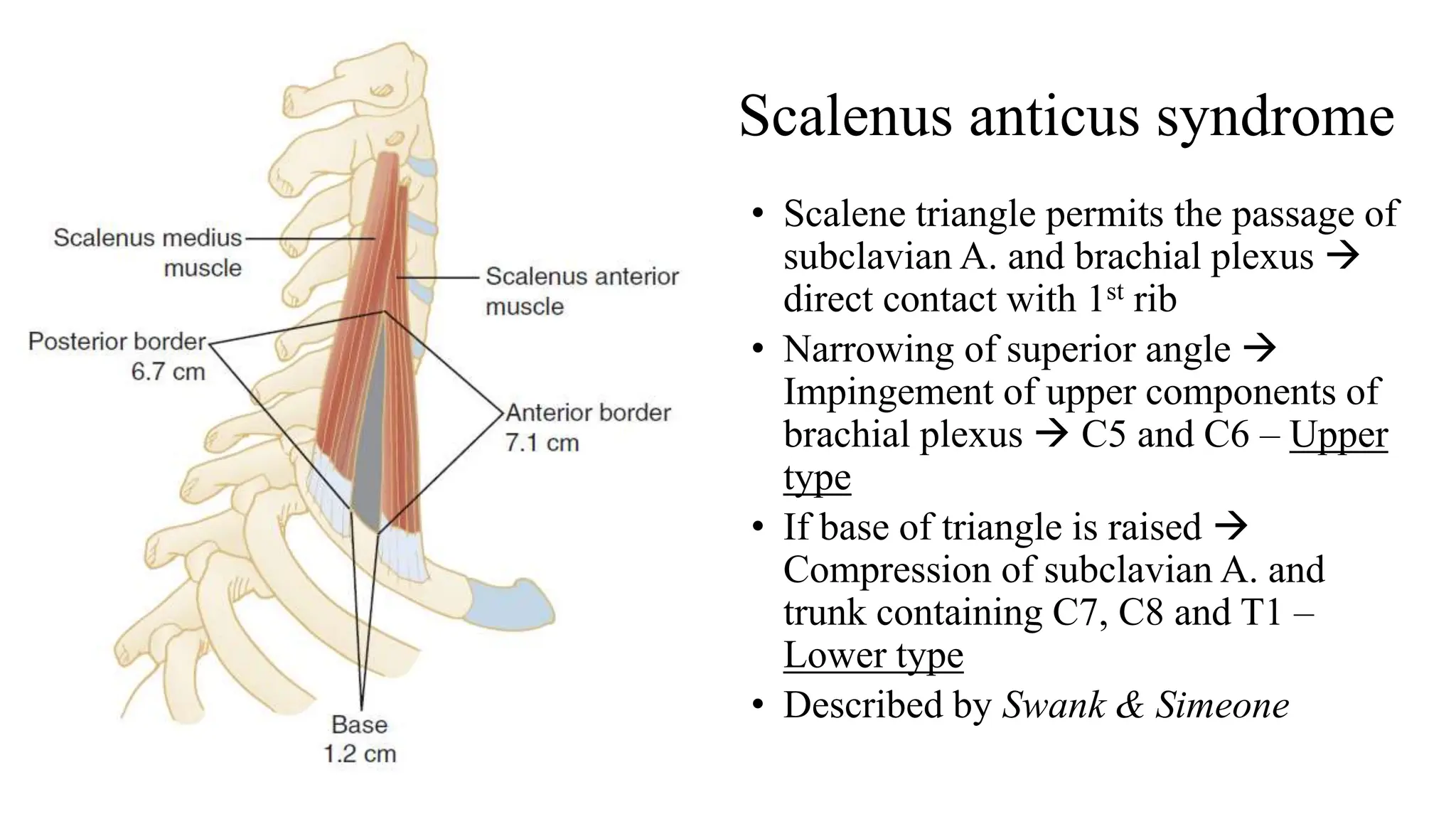
• Scalene triangle permits the passage of
subclavian A. and brachial plexus 
direct contact with 1st rib
• Narrowing of superior angle 
Impingement of upper components of
brachial plexus  C5 and C6 – Upper
type
• If base of triangle is raised 
Compression of subclavian A. and
trunk containing C7, C8 and T1 –
Lower type
• Described by Swank & Simeone
Scalenus anticus syndrome
Compression factors
• Basically – deranged anatomy
• With the contribution of congenital, traumatic, atherosclerotic factors
• Bony abnormalities – ~30% – Cervical rib, bifid 1st rib, fusion of 1st
and 2nd ribs, clavicular deformities, previous thoracoplasties
• Plain CXR-PA view, or specialised vies of lower cervical spine
Symptoms and signs – Neurogenic
• Neurogenic manifestations > Vascular BUT objective physical
findings – vascular > neural compression
• ~95%  Pain and paresthesias  Strenous physical exercise or
sustained physical effort with arm in abduction and neck in
hyperextension
Pain – insidious onset – neck, shoulder, arm and hand
• ~10%  Atrophy of hypothenar and interosseus muscles – ulnar type
(claw hand)
• Medial aspects of arm and hand, 5th finger, lateral aspects of 4th finger
Symptoms and signs – Neurogenic
• Upper type – C5 and C6 – Pain in deltoid area and lateral aspects of
arm – exclude herniated cervical disc
• Entrapment of C7 and C8 – contribute to median nerve – index finger
and middle finger
• C5-T1 – cervical rib
Pseudoangina
• Atypical pain involving anterior chest wall or parascapular area
• Simulates angina pectoris
• Normal CAG + Ulnar nerve conduction velocities (UNCV) <48m/sec
• Initially absent/minimal shoulder, arm and hand symptoms
• Cardiac cripples or develop severe psychological depression
Symptoms and signs – vascular  Arterial
• Coldness, weakness, easy fatigability of arm and hand, diffuse pain
• ~7.5% TOS  Raynaud phenomenon
Unilateral and precipitated by hyperabduction of arm, turning of head or
carrying heavy objects
Sudden onset of cold  blanching  cyanosis  persistent rubor
• Precursors for permanent arterial thrombosis
• Arterial occlusion – subclavian A.  ulceration/gangrene
• Palpation of parascapular area – prominent pulsation  post-stenotic
dilation/aneurysm of subclavian A.
• Clinical evaluation – physical finding of loss or ↓ of radial pulse and
reproduction of symptoms – elicited by classic maneuvers
Symptoms and signs – vascular  Venous
• Effort thrombosis or Paget-Schroetter syndrome
• Edema, discoloration of arm, distension of superficial veins of limb and
shoulder, some degree of aches and pains
• Walking or sustained efforts with arm in abduction
• Sudden backward and downward bracing of shoulder or heavy lifting or
strenuous physical activity involving arm  constricts vein  initiates
venospasm  with/without subsequent thrombosis
• If definite venous thrombosis – tenderness over axillary vein – cord-like
feel of vein
• Acute symptoms subside with collateral circulation – recur when inadequate
collateral circulation
Radiography • X-ray chest and cervical spine
• Bony abnormalities – cervical
ribs and degenerative changes
• Osteophytic changes and
intervertebral space narrowing 
Cervical CT – rule out bony
encroachment and narrowing of
spinal canal and intervertebral
foramina
NCV and electromyography
• Used in differential diagnosis of the causes of arm pain, tingling, and
numbness with or without motor weakness of the hand
• Symptoms can result from compression at various sites 
At the spine
At the thoracic outlet
Around the elbow – where it causes tardy ulnar nerve palsy
Flexor aspects of the wrist – where it produces carpal tunnel
syndrome
Krusen-Caldwell technique
• The patient is placed on the examination table with the arm fully extended at the
elbow and in ~20° of abduction at the shoulder
• 350V electrical stimulus for 0.2msec (0.5msec in muscular individuals)
• Normal values of UNCVs
>72 m/sec across the outlet
>55 m/sec around the elbow
> 59 m/sec in the forearm
Wrist delay is 2.5-3.5 msec
• ↓velocity in a segment or ↑delay at the wrist  indicates compression, injury,
neuropathy, or neurologic disorders
↓velocity across the outlet is consistent with TOS
↓velocity around the elbow signifies ulnar nerve entrapment or neuropathy.
↑delay at the wrist is encountered in carpal tunnel syndrome
Grading of compression
• Clinical picture of TOS – correlates fairly well with the conduction
velocity across the outlet
• <70 m/sec indicates neurovascular compression
• The severity of compression is graded according to ↓velocity across
the thoracic outlet
Slight – 66 to 69 m/sec
Mild – 60 to 65 m/sec
Moderate – 55 to 59 m/sec
Severe – <54 m/sec
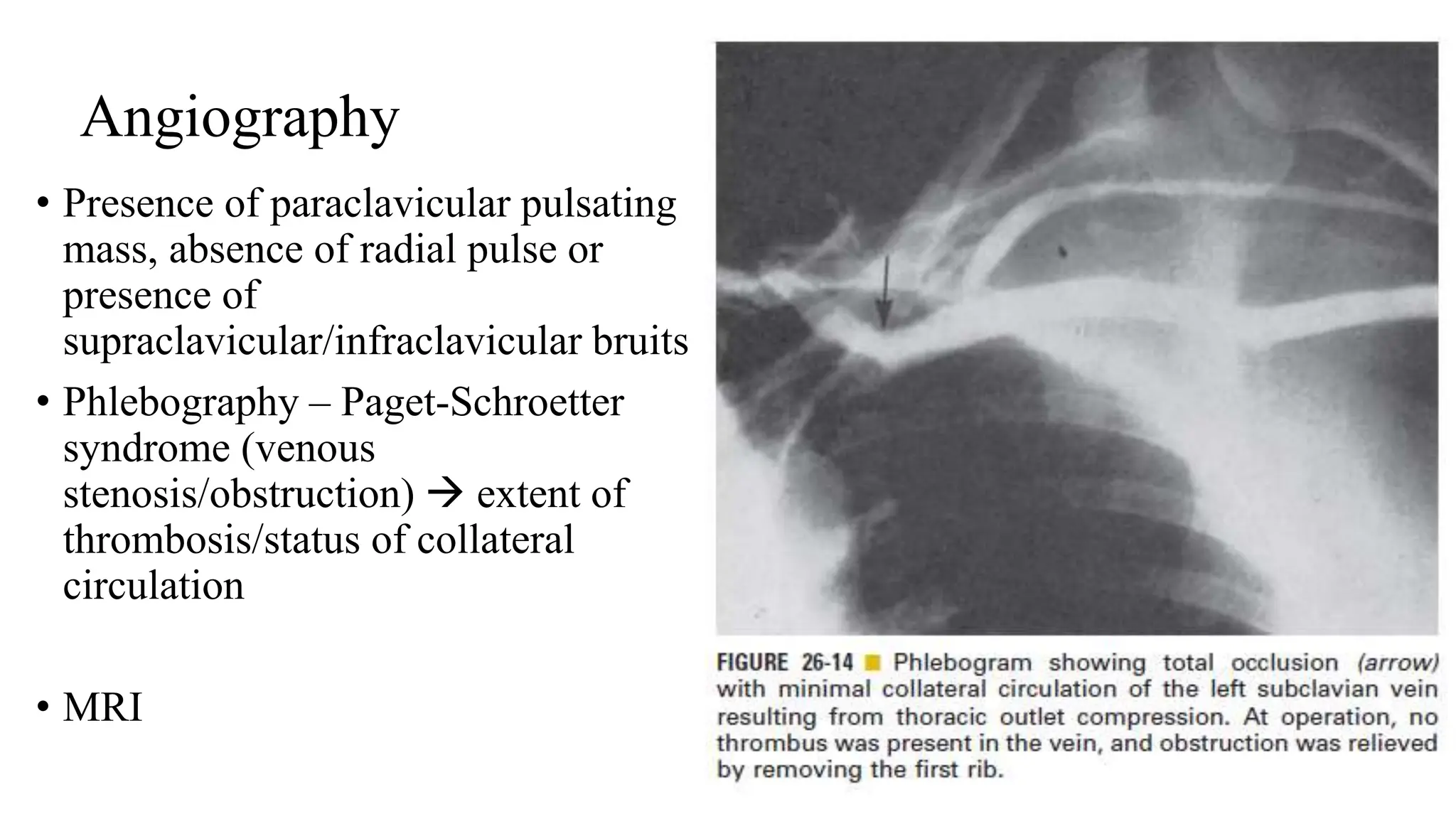
Angiography
• Presence of paraclavicular pulsating
mass, absence of radial pulse or
presence of
supraclavicular/infraclavicular bruits
• Phlebography – Paget-Schroetter
syndrome (venous
stenosis/obstruction)  extent of
thrombosis/status of collateral
circulation
• MRI
Therapy
• Neurogenic TOS  Physiotherapy
• Heat massages, active neck exercises, stretching of scalenus muscles,
strengthening of upper trapezius muscle and posture instruction
• UNCVs of >60m/sec  Improve with conservative Mx
• If <60m/sec  May need additional surgical resection of 1st rib and
correction of other bony abnormalities  relief from symptoms
Surgical resection of 1st rib
• Clagett – High posterior thoracoplasty  Rib resection without major
muscle division
• Falconer & Li – Anterior approach  Rib resection witout need for
retraction of brachial plexus
• Roos (1966) – Transaxillary approach – Expedient  Complete
removal of 1st rib + decompression of C7, C8 and T1 nerve roots and
lower trunks of brachial plexus
Transaxillary resection of 1st rib
VATS for
Transaxillary
resection of 1sy
rib
Effort thrombosis/Paget-Schroetter syndrome
• Axillary-subclavian V. – generally secondary to unusual/excessive use
of arm + presence of >1 compressive TOS elements
• Paget (1875) and Schroetter (1884) described
• Costoclavicular ligament congenitally inserts into 1st rib – much
farther laterally than normal
• Subsequent hypertrophy of scalenus anticus – lateral to the axially-
subclavian V.  external compression of vein
Effort thrombosis/Paget-Schroetter syndrome
• Elevation of arm + anticoagulants
• If symptoms recurred – 1st rib resection (with/without thrombectomy)
+ scalenus anterior resection and removal of any other compressive
element in thoracic outlet
• Urokinase > Streptokinase  Direct action vs. systemic effect
Dorsal sympathectomy
• Primary indications – Hyperhidrosis, Raynaud phenomenon and
Raynaud disease, causalgia, reflex sympathetic dystrophy (RSD) and
vascular insufficiency of upper extremity
• Physiologic effect – release of vasomotor control and hyperactive tone
of arterioles and smaller arteries (muscular element in wall)
• RSD  Pain, neurasthenia and cutaneous atrophy (Sudeck-Leriche) +
posttraumatic limb
• Contraindicated in diabetic neuropathy and vascular vasospastic
syndromes (until after tobacco cessation, starting β-blockers,
peripheral vasodilators and CCBs have failed)
Dorsal sympathectomy
• Standard – removal of sympathetic chain with thoracic ganglia 1, 2
and 3  removal of lower 1/3rd of stellate ganglion with 2nd and 3rd
ganglia and interconnecting sympathetic chain
Standard approach for Raynaud phenomenon, causalgia and RSD
• Standard VATS approach for hyperhidrosis – 1cm incision in axilla or
two 3mm trocars for insufflation and transection of nerve
Dorsal sympathectomy – Complications
• Horner syndrome – Removal of fibres of C7 and C8
• Postsympathectomy neuralgia – Rebound phenomenon  nerve
regeneration or ↑response to catecholamines – Rx with Phenytoin,
Carbamazepine and CCBs
• Recurrent symptoms – Regeneration of nerves or failure to strip
sympathetic nerves from artery and transfer of sympathetic tone
through nerves
Dorsal sympathectomy – Approaches
• Anterior approach – Stellate ganglion lies on transverse process of C6
 Neurosurgeons/vascular surgeons
• Posterior approach – Smithwick, Urschel & Razzuk – for HTN
• Transaxillary transthoracic approach – through 2nd or 3rd interspace
Thoracic outlet syndrome-1.pptx

Thoracic outlet syndrome-1.pptx

  • 1.
  • 2.
    Thoracic outlet syndrome •Term coined by Rob and Standover • Refers to compression of the subclavian vessels and brachial plexus at the superior aperture of the chest • Scalenus anticus, costoclavicular, hyperabduction, cervical rib, and first thoracic rib syndromes • Most compressive factors operate against the first rib
  • 3.
    Basic etiology • Symptomsand presentations  related to which structure or structures are affected  subclavian vein, subclavian artery or brachial plexus • Neurovascular compression can occur  between the anterior and middle scalene muscles while passing over the first rib  in the space between the clavicle and 1st rib, or in the subcoracoid tunnel at the insertion of the pectoralis minor muscle
  • 5.
    Historical aspects Until 1927Cervical rib was commonly thought to be the cause of symptoms Galen and Vesalius 1st described the presence of a cervical rib 1742 Hunauld 1st to describe the importance of the cervical rib in causing symptoms 1818 Cooper Treated symptoms of cervical rib with some success 1861 Coote Performed the 1st cervical rib removal 1927 Adson and Coffey Suggested the role of the scalenus anticus muscle in cervical rib syndrome • Naffziger & Grant • Ochsner & Associates Popularized sectioning of the scalenus anticus muscle • Falconer & Weddell • Brintall & colleagues Incriminated the costoclavicular membrane in the production of neurovascular symptoms 1945 • Wright Described the hyperabduction syndrome with compression in the costoclavicular area by the tendon of the pectoralis minor
  • 6.
    Historical aspects Rosati &Lord Claviculectomy to anterior exploration, scalenotomy, cervical rib resection, and sectioning of the pectoralis minor and subclavian muscles and of the costoclavicular membrane 1903 Bramwell Recognized the role of the 1st rib in causing symptoms of neurovascular compression 1910 Murphy Initial resection of the 1st rib  supraclavicular approach • Brickner • Brickner and Milch • Telford & coworkers Suggested that the 1st rib was the culprit Clagett Emphasized the 1st rib and its resection through the posterior thoracoplasty approach to relieve neurovascular compression 1962 Falconer & Li Anterior approach for 1st rib resection 1966 Roos Transaxillary approach for 1st rib resection and extirpation Caldwell & colleagues Introduced the method of measuring motor conduction velocities across the thoracic outlet in diagnosing TOS Urschel & Razzuk Popularized reoperation for recurrent TOS
  • 7.
    Surgical anatomy • Superioraperture of thorax  Subclavian vessels + brachial plexus  traverse cervicoaxillary canal  upper extremity • Cervicoaxillary canal is divided by 1st rib into: 1. Proximal – Scalene triangle + Costoclavicular space  More critical for neurovascular compression Superiorly  Clavicle Inferiorly  1st rib Anteromedially  Costoclavicular ligament Posterolaterally  Scalenus medius muscle + long thoracic nerve 2. Distal – Axilla
  • 8.
    Costoclavicular space Divided into2 compartments  Insertion of scalenus anticus muscle into scalene tubercle of 1st rib 1. Anteromedial  Subclavian vein 2. Posterolateral/Scalene triangle Subclavian artery and brachial plexus Anteriorly – Scalenus anticus Posteriorly – Scalenus medius Inferiorly – 1st rib
  • 9.
    Functional anatomy • Cervicoaxillarycanal, especially its proximal segment – costoclavicular area  ample space Narrows during abduction of arm  Clavicle rotates backward towards 1st rib and insertion of scalenus anticus • Hyperabduction  Neurovascular bundle is pulled around the pectoralis minor tendon, coracoid process and head of humerus Coracoid process tilts downwards and exaggerates tension on bundle • Sternoclavicular joint – forms 15°-20° Smaller angle on descent of outer end of clavicle  drooping of shoulders • During inspiration, scalenus anticus raises 1st rib and narrows costoclavicular space Abnormal lift noted in severe emphysema/excessive muscular development
  • 10.
    • Scalene trianglepermits the passage of subclavian A. and brachial plexus  direct contact with 1st rib • Narrowing of superior angle  Impingement of upper components of brachial plexus  C5 and C6 – Upper type • If base of triangle is raised  Compression of subclavian A. and trunk containing C7, C8 and T1 – Lower type • Described by Swank & Simeone Scalenus anticus syndrome
  • 11.
    Compression factors • Basically– deranged anatomy • With the contribution of congenital, traumatic, atherosclerotic factors • Bony abnormalities – ~30% – Cervical rib, bifid 1st rib, fusion of 1st and 2nd ribs, clavicular deformities, previous thoracoplasties • Plain CXR-PA view, or specialised vies of lower cervical spine
  • 13.
    Symptoms and signs– Neurogenic • Neurogenic manifestations > Vascular BUT objective physical findings – vascular > neural compression • ~95%  Pain and paresthesias  Strenous physical exercise or sustained physical effort with arm in abduction and neck in hyperextension Pain – insidious onset – neck, shoulder, arm and hand • ~10%  Atrophy of hypothenar and interosseus muscles – ulnar type (claw hand) • Medial aspects of arm and hand, 5th finger, lateral aspects of 4th finger
  • 14.
    Symptoms and signs– Neurogenic • Upper type – C5 and C6 – Pain in deltoid area and lateral aspects of arm – exclude herniated cervical disc • Entrapment of C7 and C8 – contribute to median nerve – index finger and middle finger • C5-T1 – cervical rib
  • 16.
    Pseudoangina • Atypical paininvolving anterior chest wall or parascapular area • Simulates angina pectoris • Normal CAG + Ulnar nerve conduction velocities (UNCV) <48m/sec • Initially absent/minimal shoulder, arm and hand symptoms • Cardiac cripples or develop severe psychological depression
  • 17.
    Symptoms and signs– vascular  Arterial • Coldness, weakness, easy fatigability of arm and hand, diffuse pain • ~7.5% TOS  Raynaud phenomenon Unilateral and precipitated by hyperabduction of arm, turning of head or carrying heavy objects Sudden onset of cold  blanching  cyanosis  persistent rubor • Precursors for permanent arterial thrombosis • Arterial occlusion – subclavian A.  ulceration/gangrene • Palpation of parascapular area – prominent pulsation  post-stenotic dilation/aneurysm of subclavian A. • Clinical evaluation – physical finding of loss or ↓ of radial pulse and reproduction of symptoms – elicited by classic maneuvers
  • 18.
    Symptoms and signs– vascular  Venous • Effort thrombosis or Paget-Schroetter syndrome • Edema, discoloration of arm, distension of superficial veins of limb and shoulder, some degree of aches and pains • Walking or sustained efforts with arm in abduction • Sudden backward and downward bracing of shoulder or heavy lifting or strenuous physical activity involving arm  constricts vein  initiates venospasm  with/without subsequent thrombosis • If definite venous thrombosis – tenderness over axillary vein – cord-like feel of vein • Acute symptoms subside with collateral circulation – recur when inadequate collateral circulation
  • 22.
    Radiography • X-raychest and cervical spine • Bony abnormalities – cervical ribs and degenerative changes • Osteophytic changes and intervertebral space narrowing  Cervical CT – rule out bony encroachment and narrowing of spinal canal and intervertebral foramina
  • 23.
    NCV and electromyography •Used in differential diagnosis of the causes of arm pain, tingling, and numbness with or without motor weakness of the hand • Symptoms can result from compression at various sites  At the spine At the thoracic outlet Around the elbow – where it causes tardy ulnar nerve palsy Flexor aspects of the wrist – where it produces carpal tunnel syndrome
  • 26.
    Krusen-Caldwell technique • Thepatient is placed on the examination table with the arm fully extended at the elbow and in ~20° of abduction at the shoulder • 350V electrical stimulus for 0.2msec (0.5msec in muscular individuals) • Normal values of UNCVs >72 m/sec across the outlet >55 m/sec around the elbow > 59 m/sec in the forearm Wrist delay is 2.5-3.5 msec • ↓velocity in a segment or ↑delay at the wrist  indicates compression, injury, neuropathy, or neurologic disorders ↓velocity across the outlet is consistent with TOS ↓velocity around the elbow signifies ulnar nerve entrapment or neuropathy. ↑delay at the wrist is encountered in carpal tunnel syndrome
  • 27.
    Grading of compression •Clinical picture of TOS – correlates fairly well with the conduction velocity across the outlet • <70 m/sec indicates neurovascular compression • The severity of compression is graded according to ↓velocity across the thoracic outlet Slight – 66 to 69 m/sec Mild – 60 to 65 m/sec Moderate – 55 to 59 m/sec Severe – <54 m/sec
  • 28.
    Angiography • Presence ofparaclavicular pulsating mass, absence of radial pulse or presence of supraclavicular/infraclavicular bruits • Phlebography – Paget-Schroetter syndrome (venous stenosis/obstruction)  extent of thrombosis/status of collateral circulation • MRI
  • 30.
    Therapy • Neurogenic TOS Physiotherapy • Heat massages, active neck exercises, stretching of scalenus muscles, strengthening of upper trapezius muscle and posture instruction • UNCVs of >60m/sec  Improve with conservative Mx • If <60m/sec  May need additional surgical resection of 1st rib and correction of other bony abnormalities  relief from symptoms
  • 31.
    Surgical resection of1st rib • Clagett – High posterior thoracoplasty  Rib resection without major muscle division • Falconer & Li – Anterior approach  Rib resection witout need for retraction of brachial plexus • Roos (1966) – Transaxillary approach – Expedient  Complete removal of 1st rib + decompression of C7, C8 and T1 nerve roots and lower trunks of brachial plexus
  • 32.
  • 34.
  • 35.
    Effort thrombosis/Paget-Schroetter syndrome •Axillary-subclavian V. – generally secondary to unusual/excessive use of arm + presence of >1 compressive TOS elements • Paget (1875) and Schroetter (1884) described • Costoclavicular ligament congenitally inserts into 1st rib – much farther laterally than normal • Subsequent hypertrophy of scalenus anticus – lateral to the axially- subclavian V.  external compression of vein
  • 38.
    Effort thrombosis/Paget-Schroetter syndrome •Elevation of arm + anticoagulants • If symptoms recurred – 1st rib resection (with/without thrombectomy) + scalenus anterior resection and removal of any other compressive element in thoracic outlet • Urokinase > Streptokinase  Direct action vs. systemic effect
  • 39.
    Dorsal sympathectomy • Primaryindications – Hyperhidrosis, Raynaud phenomenon and Raynaud disease, causalgia, reflex sympathetic dystrophy (RSD) and vascular insufficiency of upper extremity • Physiologic effect – release of vasomotor control and hyperactive tone of arterioles and smaller arteries (muscular element in wall) • RSD  Pain, neurasthenia and cutaneous atrophy (Sudeck-Leriche) + posttraumatic limb • Contraindicated in diabetic neuropathy and vascular vasospastic syndromes (until after tobacco cessation, starting β-blockers, peripheral vasodilators and CCBs have failed)
  • 40.
    Dorsal sympathectomy • Standard– removal of sympathetic chain with thoracic ganglia 1, 2 and 3  removal of lower 1/3rd of stellate ganglion with 2nd and 3rd ganglia and interconnecting sympathetic chain Standard approach for Raynaud phenomenon, causalgia and RSD • Standard VATS approach for hyperhidrosis – 1cm incision in axilla or two 3mm trocars for insufflation and transection of nerve
  • 41.
    Dorsal sympathectomy –Complications • Horner syndrome – Removal of fibres of C7 and C8 • Postsympathectomy neuralgia – Rebound phenomenon  nerve regeneration or ↑response to catecholamines – Rx with Phenytoin, Carbamazepine and CCBs • Recurrent symptoms – Regeneration of nerves or failure to strip sympathetic nerves from artery and transfer of sympathetic tone through nerves
  • 42.
    Dorsal sympathectomy –Approaches • Anterior approach – Stellate ganglion lies on transverse process of C6  Neurosurgeons/vascular surgeons • Posterior approach – Smithwick, Urschel & Razzuk – for HTN • Transaxillary transthoracic approach – through 2nd or 3rd interspace