SYMPATHETIC BLOCK FOR HEAD & NECK
AND UPPER EXTREMITIES
ANATOMY, LANDMARK BASED AND USG GUIDED TECHNIQUE
DR. RIYA SHARMA
MODERATOR : DR. POOJA MONGIA
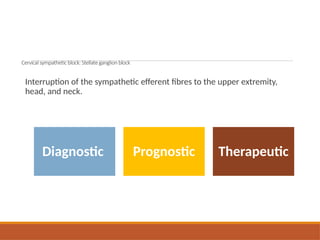
Cervical sympatheticblock:Stellateganglionblock
Interruption of the sympathetic efferent fibres to the upper extremity,
head, and neck.
Diagnostic Prognostic Therapeutic
Cervical sympathetic block
Diagnostic :
◦ To determine if the pain is sympathetically mediated or not.
Prognostic:
◦ To determine if neurolysis or surgical sympathectomy could be beneficial
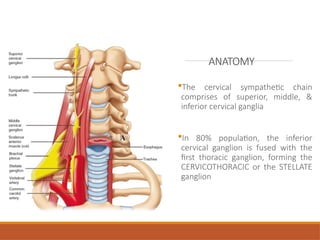
ANATOMY
The cervical sympathetic chain
comprises of superior, middle, &
inferior cervical ganglia
In 80% population, the inferior
cervical ganglion is fused with the
first thoracic ganglion, forming the
CERVICOTHORACIC or the STELLATE
ganglion
ANATOMY
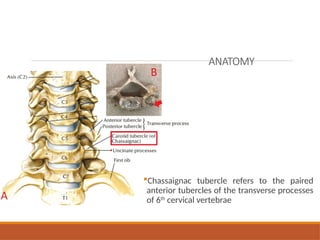
Chassaignac tubercle refers to the paired
anterior tubercles of the transverse processes
of 6th
cervical vertebrae
ANATOMY
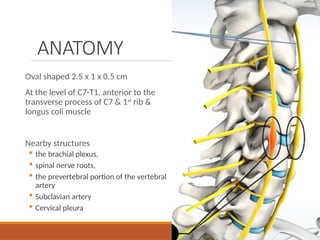
Oval shaped 2.5 x 1 x 0.5 cm
At the level of C7-T1, anterior to the
transverse process of C7 & 1st
rib &
longus coli muscle
Nearby structures
 the brachial plexus,
 spinal nerve roots,
 the prevertebral portion of the vertebral
artery
 Subclavian artery
 Cervical pleura
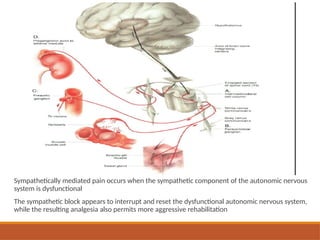
Sympathetically mediated pain occurs when the sympathetic component of the autonomic nervous
system is dysfunctional
The sympathetic block appears to interrupt and reset the dysfunctional autonomic nervous system,
while the resulting analgesia also permits more aggressive rehabilitation
INDICATIONS
Most common indication - sympathetically mediated pain
Less common indications
◦ VT and electrical storm
◦ Hyperhidrosis
◦ Postherpetic neuralgia
◦ Ménière disease
◦ Accidental intra arterial injection of intravenous medications,
◦ Frost bite
◦ Angina pectoris
◦ Hot flashes and
◦ Posttraumatic stress disorders.
◦ Raynauds syndrome
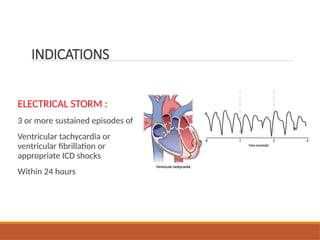
ELECTRICAL STORM :
3 or more sustained episodes of
Ventricular tachycardia or
ventricular fibrillation or
appropriate ICD shocks
Within 24 hours
INDICATIONS
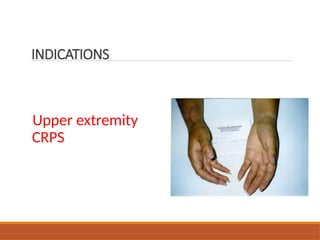
Upper extremity
CRPS
INDICATIONS
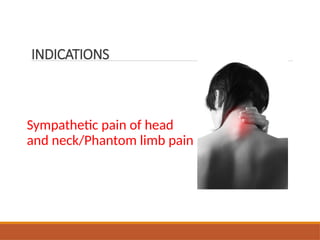
Sympathetic pain of head
and neck/Phantom limb pain
INDICATIONS
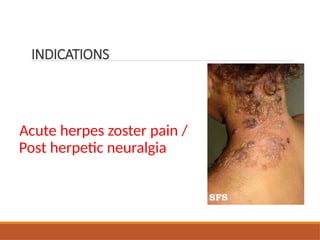
Acute herpes zoster pain /
Post herpetic neuralgia
INDICATIONS
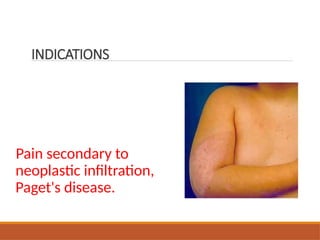
Pain secondary to
neoplastic infiltration,
Paget's disease.
INDICATIONS
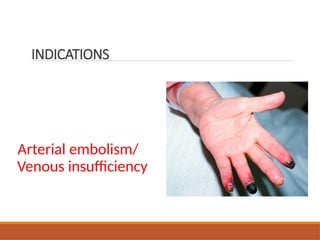
Arterial embolism/
Venous insufficiency
INDICATIONS
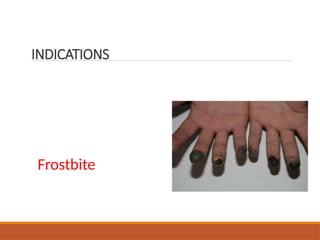
Frostbite
INDICATIONS
CONTRAINDICATIONS
◦ Coagulopathy,
◦ Pneumothorax,
◦ Glaucoma
◦ Atrioventricular block
STELLATE GANGLION BLOCK
TECHNIQUES
Surface
Landmark
Technique
Fluoroscopic
Technique
Ultrasound
guided
CT guided
SURFACE LANDMARK TECHNIQUE
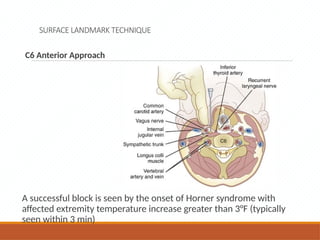
C6 Anterior Approach
A successful block is seen by the onset of Horner syndrome with
affected extremity temperature increase greater than 3°F (typically
seen within 3 min)
SURFACE LANDMARK TECHNIQUE
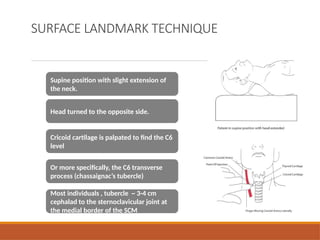
Supine position with slight extension of
the neck.
Head turned to the opposite side.
Cricoid cartilage is palpated to find the C6
level
Or more specifically, the C6 transverse
process (chassaignac’s tubercle)
Most individuals , tubercle ~ 3-4 cm
cephalad to the sternoclavicular joint at
the medial border of the SCM
SURFACE LANDMARK
TECHNIQUE
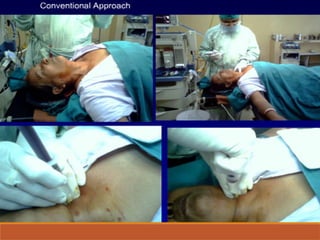
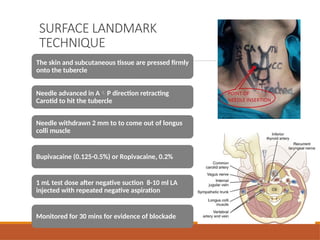
The skin and subcutaneous tissue are pressed firmly
onto the tubercle
Needle advanced in AP direction retracting
Carotid to hit the tubercle
Needle withdrawn 2 mm to to come out of longus
colli muscle
Bupivacaine (0.125-0.5%) or Ropivacaine, 0.2%
1 mL test dose after negative suction 8-10 ml LA
injected with repeated negative aspiration
Monitored for 30 mins for evidence of blockade
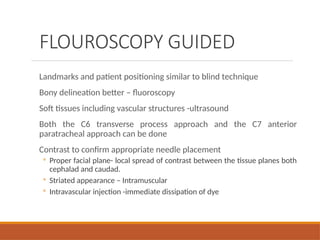
FLOUROSCOPY GUIDED
Landmarks and patient positioning similar to blind technique
Bony delineation better – fluoroscopy
Soft tissues including vascular structures -ultrasound
Both the C6 transverse process approach and the C7 anterior
paratracheal approach can be done
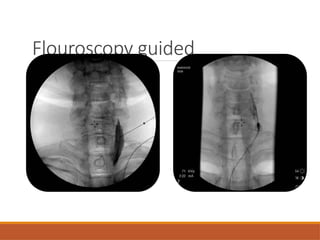
Contrast to confirm appropriate needle placement
◦ Proper facial plane- local spread of contrast between the tissue planes both
cephalad and caudad.
◦ Striated appearance – Intramuscular
◦ Intravascular injection -immediate dissipation of dye
Flouroscopy guided
USG GUIDED
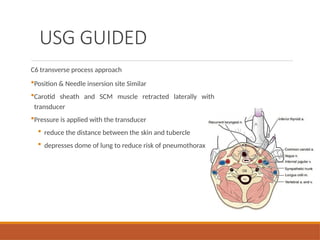
C6 transverse process approach
Position & Needle insersion site Similar
Carotid sheath and SCM muscle retracted laterally with
transducer
Pressure is applied with the transducer
 reduce the distance between the skin and tubercle
 depresses dome of lung to reduce risk of pneumothorax
USG GUIDED
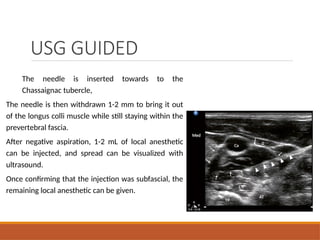
The needle is inserted towards to the
Chassaignac tubercle,
The needle is then withdrawn 1-2 mm to bring it out
of the longus colli muscle while still staying within the
prevertebral fascia.
After negative aspiration, 1-2 mL of local anesthetic
can be injected, and spread can be visualized with
ultrasound.
Once confirming that the injection was subfascial, the
remaining local anesthetic can be given.
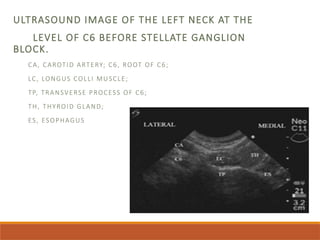
ULTRASOUND IMAGE OF THE LEFT NECK AT THE
LEVEL OF C6 BEFORE STELLATE GANGLION
BLOCK.
CA, CAROTID ARTERY; C6, ROOT OF C6;
LC, LONGUS COLLI MUSCLE;
TP, TRANSVERSE PROCESS OF C6;
TH, THYROID GLAND;
ES, ESOPHAGUS
C7 Anterior Approach
Nearly identical to the C6 approach.
Performed with USG or fluoroscopy - anatomical landmarks are more difficult to identify
because the C7 vertebra has only a vestigial tubercle that is not readily palpable.
Risk of pneumothorax and vertebral artery injury is higher.
Advantages
◦ Needle is closer in proximity to ganglion
◦ A smaller volume of LA agent with more reliable and consistent blockade.
◦ Particularily usefull - failed blockade at the c6 level.
An oblique C7 fluoroscopic approach targeting the junction between the uncinate process
and the vertebral body is described in an effort to decrease those risks.
Lateral approach (USG Guided) also described
CT guided technique
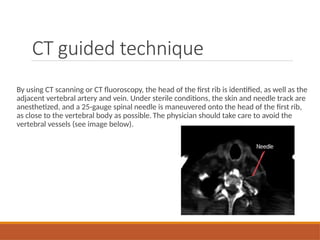
By using CT scanning or CT fluoroscopy, the head of the first rib is identified, as well as the
adjacent vertebral artery and vein. Under sterile conditions, the skin and needle track are
anesthetized, and a 25-gauge spinal needle is maneuvered onto the head of the first rib,
as close to the vertebral body as possible. The physician should take care to avoid the
vertebral vessels (see image below).
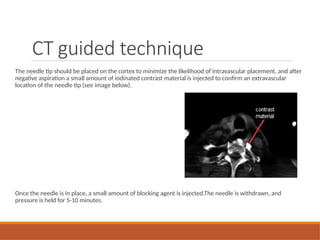
The needle tip should be placed on the cortex to minimize the likelihood of intravascular placement, and after
negative aspiration a small amount of iodinated contrast material is injected to confirm an extravascular
location of the needle tip (see image below).
Once the needle is in place, a small amount of blocking agent is injected.The needle is withdrawn, and
pressure is held for 5-10 minutes.
CT guided technique
Expected result
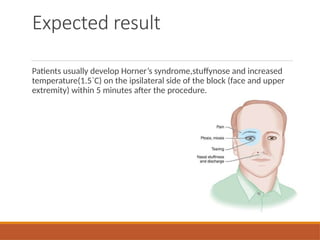
Patients usually develop Horner’s syndrome,stuffynose and increased
temperature(1.5`C) on the ipsilateral side of the block (face and upper
extremity) within 5 minutes after the procedure.
COMPLICATIONS
Misplaced needle
Haematoma from vascular trauma
Carotid trauma
Internal jugular vein trauma
Neural injury (recurrent laryngeal nerve)
Vagus injury
Brachial plexus roots injury
Pulmonary injury
Pneumothorax
Haemothorax
Chylothorax (thoracic duct injury)
Oesophageal perforation
Infection
Soft tissue (abscess)
Neuraxial (meningitis)
Osteitis
Spread of local anaesthetic
Intravascular injection:
Carotid artery
Vertebral artery
Internal jugular vein
Neuraxial/brachial plexus spread:
Epidural block
Intrathecal
Brachial plexus anaesthesia or injury
(intraneural injection)
Local spread:
Horseness (recurrent laryngeal nerve)
Elevated hemidiaphragm (phrenic nerve)
SUMMARY
Stellate ganglion block is useful to denervate sympathetic component involved in upper
limb,head and neck disease conditions.
Careful evaluation of sympathetic involvement in disease process should be done before
deciding to perform block.
Blocking agent type, dose and subsequent blocks should be decided on the basis of
response to primary block.
After even successful stellate ganglion block patient should be monitored for side
effects.
THANK YOU

stellate ganglion block presentation (1).pptx

  • 1.
    SYMPATHETIC BLOCK FORHEAD & NECK AND UPPER EXTREMITIES ANATOMY, LANDMARK BASED AND USG GUIDED TECHNIQUE DR. RIYA SHARMA MODERATOR : DR. POOJA MONGIA
  • 2.
    Cervical sympatheticblock:Stellateganglionblock Interruption ofthe sympathetic efferent fibres to the upper extremity, head, and neck. Diagnostic Prognostic Therapeutic
  • 3.
    Cervical sympathetic block Diagnostic: ◦ To determine if the pain is sympathetically mediated or not. Prognostic: ◦ To determine if neurolysis or surgical sympathectomy could be beneficial
  • 4.
    ANATOMY The cervical sympatheticchain comprises of superior, middle, & inferior cervical ganglia In 80% population, the inferior cervical ganglion is fused with the first thoracic ganglion, forming the CERVICOTHORACIC or the STELLATE ganglion
  • 5.
    ANATOMY Chassaignac tubercle refersto the paired anterior tubercles of the transverse processes of 6th cervical vertebrae
  • 6.
    ANATOMY Oval shaped 2.5x 1 x 0.5 cm At the level of C7-T1, anterior to the transverse process of C7 & 1st rib & longus coli muscle Nearby structures  the brachial plexus,  spinal nerve roots,  the prevertebral portion of the vertebral artery  Subclavian artery  Cervical pleura
  • 7.
    Sympathetically mediated painoccurs when the sympathetic component of the autonomic nervous system is dysfunctional The sympathetic block appears to interrupt and reset the dysfunctional autonomic nervous system, while the resulting analgesia also permits more aggressive rehabilitation
  • 8.
    INDICATIONS Most common indication- sympathetically mediated pain Less common indications ◦ VT and electrical storm ◦ Hyperhidrosis ◦ Postherpetic neuralgia ◦ Ménière disease ◦ Accidental intra arterial injection of intravenous medications, ◦ Frost bite ◦ Angina pectoris ◦ Hot flashes and ◦ Posttraumatic stress disorders. ◦ Raynauds syndrome
  • 9.
    ELECTRICAL STORM : 3or more sustained episodes of Ventricular tachycardia or ventricular fibrillation or appropriate ICD shocks Within 24 hours INDICATIONS
  • 10.
  • 11.
    Sympathetic pain ofhead and neck/Phantom limb pain INDICATIONS
  • 12.
    Acute herpes zosterpain / Post herpetic neuralgia INDICATIONS
  • 13.
    Pain secondary to neoplasticinfiltration, Paget's disease. INDICATIONS
  • 14.
  • 15.
  • 16.
  • 17.
  • 18.
    SURFACE LANDMARK TECHNIQUE C6Anterior Approach A successful block is seen by the onset of Horner syndrome with affected extremity temperature increase greater than 3°F (typically seen within 3 min)
  • 19.
    SURFACE LANDMARK TECHNIQUE Supineposition with slight extension of the neck. Head turned to the opposite side. Cricoid cartilage is palpated to find the C6 level Or more specifically, the C6 transverse process (chassaignac’s tubercle) Most individuals , tubercle ~ 3-4 cm cephalad to the sternoclavicular joint at the medial border of the SCM
  • 21.
    SURFACE LANDMARK TECHNIQUE The skinand subcutaneous tissue are pressed firmly onto the tubercle Needle advanced in AP direction retracting Carotid to hit the tubercle Needle withdrawn 2 mm to to come out of longus colli muscle Bupivacaine (0.125-0.5%) or Ropivacaine, 0.2% 1 mL test dose after negative suction 8-10 ml LA injected with repeated negative aspiration Monitored for 30 mins for evidence of blockade
  • 22.
    FLOUROSCOPY GUIDED Landmarks andpatient positioning similar to blind technique Bony delineation better – fluoroscopy Soft tissues including vascular structures -ultrasound Both the C6 transverse process approach and the C7 anterior paratracheal approach can be done Contrast to confirm appropriate needle placement ◦ Proper facial plane- local spread of contrast between the tissue planes both cephalad and caudad. ◦ Striated appearance – Intramuscular ◦ Intravascular injection -immediate dissipation of dye
  • 23.
  • 24.
    USG GUIDED C6 transverseprocess approach Position & Needle insersion site Similar Carotid sheath and SCM muscle retracted laterally with transducer Pressure is applied with the transducer  reduce the distance between the skin and tubercle  depresses dome of lung to reduce risk of pneumothorax
  • 25.
    USG GUIDED The needleis inserted towards to the Chassaignac tubercle, The needle is then withdrawn 1-2 mm to bring it out of the longus colli muscle while still staying within the prevertebral fascia. After negative aspiration, 1-2 mL of local anesthetic can be injected, and spread can be visualized with ultrasound. Once confirming that the injection was subfascial, the remaining local anesthetic can be given.
  • 26.
    ULTRASOUND IMAGE OFTHE LEFT NECK AT THE LEVEL OF C6 BEFORE STELLATE GANGLION BLOCK. CA, CAROTID ARTERY; C6, ROOT OF C6; LC, LONGUS COLLI MUSCLE; TP, TRANSVERSE PROCESS OF C6; TH, THYROID GLAND; ES, ESOPHAGUS
  • 27.
    C7 Anterior Approach Nearlyidentical to the C6 approach. Performed with USG or fluoroscopy - anatomical landmarks are more difficult to identify because the C7 vertebra has only a vestigial tubercle that is not readily palpable. Risk of pneumothorax and vertebral artery injury is higher. Advantages ◦ Needle is closer in proximity to ganglion ◦ A smaller volume of LA agent with more reliable and consistent blockade. ◦ Particularily usefull - failed blockade at the c6 level. An oblique C7 fluoroscopic approach targeting the junction between the uncinate process and the vertebral body is described in an effort to decrease those risks. Lateral approach (USG Guided) also described
  • 28.
    CT guided technique Byusing CT scanning or CT fluoroscopy, the head of the first rib is identified, as well as the adjacent vertebral artery and vein. Under sterile conditions, the skin and needle track are anesthetized, and a 25-gauge spinal needle is maneuvered onto the head of the first rib, as close to the vertebral body as possible. The physician should take care to avoid the vertebral vessels (see image below).
  • 29.
    The needle tipshould be placed on the cortex to minimize the likelihood of intravascular placement, and after negative aspiration a small amount of iodinated contrast material is injected to confirm an extravascular location of the needle tip (see image below). Once the needle is in place, a small amount of blocking agent is injected.The needle is withdrawn, and pressure is held for 5-10 minutes. CT guided technique
  • 30.
    Expected result Patients usuallydevelop Horner’s syndrome,stuffynose and increased temperature(1.5`C) on the ipsilateral side of the block (face and upper extremity) within 5 minutes after the procedure.
  • 31.
    COMPLICATIONS Misplaced needle Haematoma fromvascular trauma Carotid trauma Internal jugular vein trauma Neural injury (recurrent laryngeal nerve) Vagus injury Brachial plexus roots injury Pulmonary injury Pneumothorax Haemothorax Chylothorax (thoracic duct injury) Oesophageal perforation Infection Soft tissue (abscess) Neuraxial (meningitis) Osteitis Spread of local anaesthetic Intravascular injection: Carotid artery Vertebral artery Internal jugular vein Neuraxial/brachial plexus spread: Epidural block Intrathecal Brachial plexus anaesthesia or injury (intraneural injection) Local spread: Horseness (recurrent laryngeal nerve) Elevated hemidiaphragm (phrenic nerve)
  • 32.
    SUMMARY Stellate ganglion blockis useful to denervate sympathetic component involved in upper limb,head and neck disease conditions. Careful evaluation of sympathetic involvement in disease process should be done before deciding to perform block. Blocking agent type, dose and subsequent blocks should be decided on the basis of response to primary block. After even successful stellate ganglion block patient should be monitored for side effects.
  • 33.

Editor's Notes

  • #4 Chassaignac tubercle refers to the paired anterior tubercles of the transverse processes of 6th cervical vertebrae
  • #5 It separates carotid artery from the vertebral artery Serves as important landmark wrt performing regional anasthesia such as brachial plexus and cervical plexus block & is a firm structure against which carotid massage can be performed
  • #7 The sympathetic nervous system (SNS) directly controls involuntary human homeostatic activities The involuntary system controls numerous body functions such as sweating, the functions of the intestines and internal organs, dilation and contracting of the pupils in the eye, and blood flow through various tissues and has a major role in neuropathic, vascular, and visceral pain
  • #8 3 or more sustained episodes of Ventricular tachycardia or ventricular fibrillation or appropriate ICD shocks Within 24 hours
  • #22 With image guidance: Anterior paratrecheal approach at C6 level Anterior paratrecheal approach at C7 level
  • #25 Ultrasonographic image of the neck at C6 following injection of local anesthetic. The needle was indicated by solid arrows and the local anesthetic was outlined by the line arrows.
  • #28  Computed tomography fluoroscopic image shows the correct placement of a 25-gauge needle on the head of the first rib.
  • #29  Contrast material has been injected to confirm the extravascular location of the needle tip (same patient as in image above).