COCP
Dr.Kavinda Hewawitharana
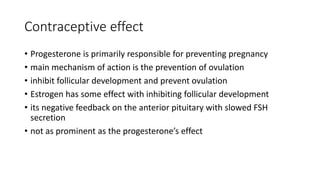
Contraceptive effect
• Progesterone is primarily responsible for preventing pregnancy
• main mechanism of action is the prevention of ovulation
• inhibit follicular development and prevent ovulation
• Estrogen has some effect with inhibiting follicular development
• its negative feedback on the anterior pituitary with slowed FSH
secretion
• not as prominent as the progesterone’s effect
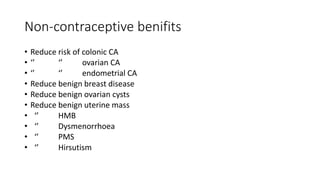
Non-contraceptive benifits
• Reduce risk of colonic CA
• ‘’ ‘’ ovarian CA
• ‘’ ‘’ endometrial CA
• Reduce benign breast disease
• Reduce benign ovarian cysts
• Reduce benign uterine mass
• ‘’ HMB
• ‘’ Dysmenorrhoea
• ‘’ PMS
• ‘’ Hirsutism
Preparations
• usual estrogen component is combined with a different generation of
progestin components with varying degrees of androgenic and
progestogenic potential
• prescribed based on desirable effects and risk of adverse events with
progestin component and dose of estrogen and progestin
component.
• Currently drugs have setup to minimum dose of estrogen with its
maximal effect to avoid side effects
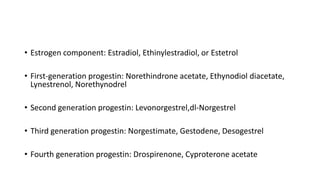
• Estrogen component: Estradiol, Ethinylestradiol, or Estetrol
• First-generation progestin: Norethindrone acetate, Ethynodiol diacetate,
Lynestrenol, Norethynodrel
• Second generation progestin: Levonorgestrel,dl-Norgestrel
• Third generation progestin: Norgestimate, Gestodene, Desogestrel
• Fourth generation progestin: Drospirenone, Cyproterone acetate
Phasic preparations-Monophasic
• Monophasic birth control pills have the same amount of estrogen and
progestin in each active pill
• less likely to cause side effects that could result from fluctuating
hormones
• This is the most common type
Phasic preparations-Biphasic preparations
• Biphasic birth control pills change the level of hormones one time
during the pill pack
• deliver the same amount of estrogen each day, but the level of
progestin is increased about halfway through the pill cycle.
• During the first half of the cycle, the progestin/estrogen ratio is
usually lower.
• During the second half of the cycle, the progestin/estrogen ratio
tends to be higher
Phasic preparations-Triphasic preparations
• contain three different doses of hormones
• hormone combination changes approximately every seven days
throughout the pill pack.
• the amount of estrogen may change as well as the amount of
progestin
• no evidence-based advantage over monophasic pills in relation to
their adverse effect profile or cycle control
Phasic preparations-Quadriphasic OCP
• contains oestradiol valerate and desogestrel
• is formulated with an oestrogen step-down and progestogen step-up
sequence
Why we need phasic pills?
• Lower the total hormone dosage you may receive in each pill pack.
• They are also designed to more naturally mimic your body's
menstrual cycle
• But should not messed up with pills-each dose changed tablet has
different colour and should follow those in a row , otherwise not
effective
Why day 21 or 24 preparations?
• Some COCP has active 21 pills while others have 24
• Why 24?not 21
• reduce the chance of contraceptive failure
• ‘’ ‘’ breakthrough ovulation
• delay or avoid a withdrawal bleeding
• This is most easily achieved with monophasic regimens in which each active pill
contains the same amount of oestrogen and progestogen and the inactive pills
are skipped
• But now there are commercial preparations/formulations for this task with better
progesterone forms
Drospirenone
• 4th genereation progestogen
• Anti-mineralocorticoid activity(3 mg drospirenone has comparable
anti-mineralocorticoid activity as 25 mg dose of spironolactone)
• Anti-androgenic
• no negative metabolic effects on women with PCOS, and some
studies reported favorable metabolic effects
Cyproterone ; how about this?
• has high antiandrogenic activity
• controversy remains regarding whether CPA has a transiently negative
effect on carbohydrate metabolism and lipid profiles
• Unlike drospirenone – no anti-mineralocorticoid effect as former
Comparison of CYP and DPN
• Cyproterone acetate and drospirenone containing OCs have similar
effects regarding carbohydrate/lipid metabolism and oxidative stress
parameters.
• Cyproterone acetate containing OCs seem to be more effective to
treat clinical hirsutism in patients with PCOS after 12 months of
treatment
• Both drugs have adrenal influence which is more prominent with
drospirenone containing OCs.
Which one we select?
• 21 or 24
• Cyp or Dpn
• Monophasic or polyphasic
• Open for discussion………………
COCP.pptx

COCP.pptx

  • 1.
  • 2.
    Contraceptive effect • Progesteroneis primarily responsible for preventing pregnancy • main mechanism of action is the prevention of ovulation • inhibit follicular development and prevent ovulation • Estrogen has some effect with inhibiting follicular development • its negative feedback on the anterior pituitary with slowed FSH secretion • not as prominent as the progesterone’s effect
  • 3.
    Non-contraceptive benifits • Reducerisk of colonic CA • ‘’ ‘’ ovarian CA • ‘’ ‘’ endometrial CA • Reduce benign breast disease • Reduce benign ovarian cysts • Reduce benign uterine mass • ‘’ HMB • ‘’ Dysmenorrhoea • ‘’ PMS • ‘’ Hirsutism
  • 4.
    Preparations • usual estrogencomponent is combined with a different generation of progestin components with varying degrees of androgenic and progestogenic potential • prescribed based on desirable effects and risk of adverse events with progestin component and dose of estrogen and progestin component. • Currently drugs have setup to minimum dose of estrogen with its maximal effect to avoid side effects
  • 5.
    • Estrogen component:Estradiol, Ethinylestradiol, or Estetrol • First-generation progestin: Norethindrone acetate, Ethynodiol diacetate, Lynestrenol, Norethynodrel • Second generation progestin: Levonorgestrel,dl-Norgestrel • Third generation progestin: Norgestimate, Gestodene, Desogestrel • Fourth generation progestin: Drospirenone, Cyproterone acetate
  • 6.
    Phasic preparations-Monophasic • Monophasicbirth control pills have the same amount of estrogen and progestin in each active pill • less likely to cause side effects that could result from fluctuating hormones • This is the most common type
  • 7.
    Phasic preparations-Biphasic preparations •Biphasic birth control pills change the level of hormones one time during the pill pack • deliver the same amount of estrogen each day, but the level of progestin is increased about halfway through the pill cycle. • During the first half of the cycle, the progestin/estrogen ratio is usually lower. • During the second half of the cycle, the progestin/estrogen ratio tends to be higher
  • 8.
    Phasic preparations-Triphasic preparations •contain three different doses of hormones • hormone combination changes approximately every seven days throughout the pill pack. • the amount of estrogen may change as well as the amount of progestin • no evidence-based advantage over monophasic pills in relation to their adverse effect profile or cycle control
  • 9.
    Phasic preparations-Quadriphasic OCP •contains oestradiol valerate and desogestrel • is formulated with an oestrogen step-down and progestogen step-up sequence
  • 10.
    Why we needphasic pills? • Lower the total hormone dosage you may receive in each pill pack. • They are also designed to more naturally mimic your body's menstrual cycle • But should not messed up with pills-each dose changed tablet has different colour and should follow those in a row , otherwise not effective
  • 11.
    Why day 21or 24 preparations? • Some COCP has active 21 pills while others have 24 • Why 24?not 21 • reduce the chance of contraceptive failure • ‘’ ‘’ breakthrough ovulation • delay or avoid a withdrawal bleeding • This is most easily achieved with monophasic regimens in which each active pill contains the same amount of oestrogen and progestogen and the inactive pills are skipped • But now there are commercial preparations/formulations for this task with better progesterone forms
  • 12.
    Drospirenone • 4th genereationprogestogen • Anti-mineralocorticoid activity(3 mg drospirenone has comparable anti-mineralocorticoid activity as 25 mg dose of spironolactone) • Anti-androgenic • no negative metabolic effects on women with PCOS, and some studies reported favorable metabolic effects
  • 13.
    Cyproterone ; howabout this? • has high antiandrogenic activity • controversy remains regarding whether CPA has a transiently negative effect on carbohydrate metabolism and lipid profiles • Unlike drospirenone – no anti-mineralocorticoid effect as former
  • 14.
    Comparison of CYPand DPN • Cyproterone acetate and drospirenone containing OCs have similar effects regarding carbohydrate/lipid metabolism and oxidative stress parameters. • Cyproterone acetate containing OCs seem to be more effective to treat clinical hirsutism in patients with PCOS after 12 months of treatment • Both drugs have adrenal influence which is more prominent with drospirenone containing OCs.
  • 15.
    Which one weselect? • 21 or 24 • Cyp or Dpn • Monophasic or polyphasic • Open for discussion………………