Cerebrovascular
Disease
(Stroke)
By: Nagoor Ghany, Ruzaica
Junior Intern, VMUF
2016
• Most common and devastating disorders of Cerebrovascular Dse:
Stroke
• Stroke: 2nd leading cause of death world wide
• Stroke causes prox. 200,000 death in each year in USA
• Cerebral ischemia: reduction in blood flow that last longer than
several seconds
• If this long for few minutes, it will cause infarct or Death of brain
tissues
• If quickly restored, neurological signs and symptoms resolve back
within 24 hours, it’s Transient Ischemic Attack
• Or if the signs and symptoms last for >24hrs and the infarct is
demonstrated, it’s stroke.
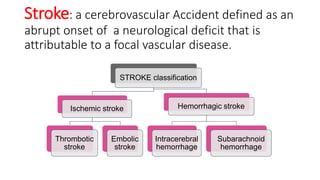
Stroke: a cerebrovascular Accident defined as an
abrupt onset of a neurological deficit that is
attributable to a focal vascular disease.
STROKE classification
Ischemic stroke
Thrombotic
stroke
Embolic
stroke
Hemorrhagic stroke
Intracerebral
hemorrhage
Subarachnoid
hemorrhage
Ischemic Stroke
• Lacunar (small Vessel Dse) 20%
• Perforating Arteries obstruction, microatheromas, microembolis
• Basal ganglia
• Very isolated lesion: pure motor or pure sensory stroke
• Intracranial Atherosclerosis: 50%
• Extracranial Atherosclerosis
• Hemodynamic – more common in the Internal Carotid artery
• Cardioembolism (20%)
• Atrial Fibrillation (most Common)
• Valvular Heart Disease
• Congenital Heart Failure
• Cryptogenic or unknown
• Classically: Hx of TIA
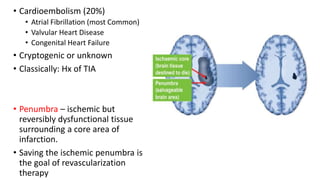
• Penumbra – ischemic but
reversibly dysfunctional tissue
surrounding a core area of
infarction.
• Saving the ischemic penumbra is
the goal of revascularization
therapy
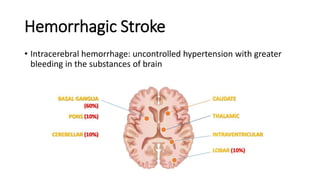
Hemorrhagic Stroke
• Intracerebral hemorrhage: uncontrolled hypertension with greater
bleeding in the substances of brain
• 15% of stroke
• Classic symptoms: sudden
onset of headache, vomiting
and elevated BP
• Focal neurological deficits
progress over minutes
• May present with agitation and
lethargy, then progress to
stupor or coma
Subarachnoid Hemorrhage
• Aneurysm (>40 yrs)
• AV malformation (<40 yrs)
• Greater in between the pia and
arachnoid matters
• Bleeding into the space between the
inner layer and the middle layer of the
tissue covering the brain
• Cause sudden, severe headache, often
followed by a brief episode of
unconsciousness.
Symptoms of Stroke:
• Loss of Sensory and/or motor Function on one side of the body
• Change in vision, gait, or ability to speak or understand
• Sudden severe headache
• Dizziness
• Confusion
• Loss of balance or coordination
• Nausea/vomiting
• Seizure
• Painful stiff neck
Pre Hospital Assesment:
• Rapid identification of potential
Stroke patient
• Pre arrival notification of receiving
facility – early mobilization of stroke
team
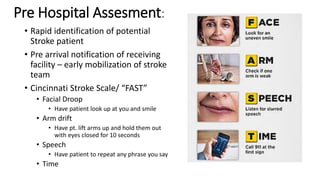
• Cincinnati Stroke Scale/ “FAST”
• Facial Droop
• Have patient look up at you and smile
• Arm drift
• Have pt. lift arms up and hold them out
with eyes closed for 10 seconds
• Speech
• Have patient to repeat any phrase you say
• Time
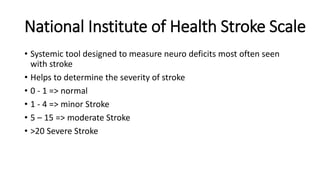
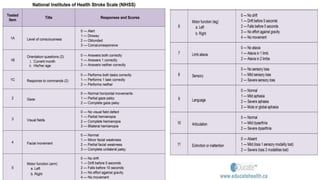
National Institute of Health Stroke Scale
• Systemic tool designed to measure neuro deficits most often seen
with stroke
• Helps to determine the severity of stroke
• 0 - 1 => normal
• 1 - 4 => minor Stroke
• 5 – 15 => moderate Stroke
• >20 Severe Stroke
Stroke Mimickers
• Seizure
• Intracranial Tumor
• Hyponatremia or hypoglycemia
• Migraine
• Metabolic encephalopathy
• Anxiety
• Parkinson’s dse
• Peripheral vertigo
• Bells palsy
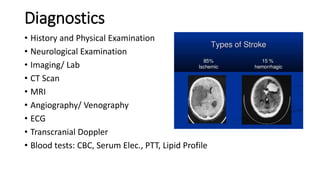
Diagnostics
• History and Physical Examination
• Neurological Examination
• Imaging/ Lab
• CT Scan
• MRI
• Angiography/ Venography
• ECG
• Transcranial Doppler
• Blood tests: CBC, Serum Elec., PTT, Lipid Profile
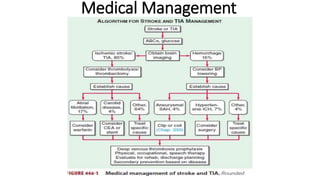
Medical Management
• Ascertain Clinical Diagnosis of TIA/Stroke (Hx and PE are very
important)
• Exclude Common stroke Mimickers
• Provide basic emergent supportive care (ABCs of Resuscitation)
• Monitor neuro VS, BP, MAP, RR, Temperature and Pupils
• Perform Stroke Scales
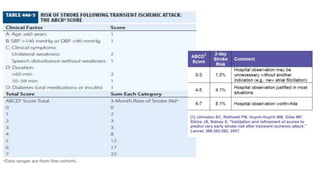
• Perform risk stratification using the ABCD2 scale
• Monitor and Manage BP; treat if MAP >130
• Medications:
• Tissue Plasminogen Activator:
• Dissolve blood clot and restore blood flow
• Antithrombotic Tx
• Platelet inhibitors
• Anticoagulants
• Also, Statins to reduce cholesterol level in blood
• With neuroprotection
Management
• BP management
• Should be kept within higher normal limits
• Blood Glucose Level
• Within physiological level
• Body Temperature
• Antipyretics or Cooling devices
Sever Stroke Considerations
• Ischemic
• BP management
• Recognize sings of increased ICP
• Non cardio embolic: antiplatelet or combination, neurospecialist for posterior circulation
stroke, if cerebellar infarct refer to neurosurgery
• Hemorrhagic:
• Medical Compression: mannitol, furosemide or Hypertonic saline
• Long term strict BP control
• Neurosurgical control
• ICP monitoring
• Goal: reduce mortality
Neuroprotective interventions
5 ‘H’
• Hypotension
• Hypoxemia
• Hypoglycemia
• Hyperglycemia
• Hyperthermia
Prevention
• Diet (low Fat, High Fiber)
• Quit smoking and Alcohol intake
• Control Diabetes
• Maintain healthy weight
• Exercise
Case Scenario
• Patient M is an active woman, 70 years(1) [≈ average human life
expectancy at birth, 2011 estimate] of age, who lost consciousness
and collapsed at home. Her daughter, who was visiting her at the
time, did not witness the collapse but found her mother on the floor,
awake, confused, and slightly short of breath. The daughter estimated
that she called EMS within 5 minutes after the collapse, and EMS
responded within 10 minutes. EMS evaluated Patient M, drew blood
for a glucose level, and determined that she may have had a stroke.
They notified the nearest designated comprehensive stroke center
that they would be arriving with the patient within15 minutes(1).
Patient M's daughter accompanied her.
Further information from daughter
• HPI: 3days PTC patient had sudden onset numbness and tingling in
the right limb, with slight confusion and slurred speech and lasted
only for 5mins. No consultations were made.
• Past medical Hx: Patient M has been treated for hypertension for 10
years with a antihypertensive drug and a diuretic. But pt. is not
compliant with her drugs
• Family Hx: not known family hx for any diseases
• Socio Personal Hx: The patient has never smoked, drinks occasionally,
and is of normal weight.
• ROS: (+) LOC, (+) Shortness of Breath (+) headache (+) dizziness (+)
left arm pain
• BP – 150/95 (1)
• Pain in her left arm
• Slight headache
• With the use of NIHSS, Left hemiparesis(2) and left visual spatial
neglect, left side droop on face
• Lab results: CBC, PTT, serum electrolytes Renal functioning tests and
cardio biomarkers are in normal level
• CT of the Brain: thrombus in a branch of internal carotid Artery with
50% occlusion by atherosclerosis. Infarct on the right hemisphere.
• ABCDD2 scoring: 5
• NIHSS: 12 (given)
• Risk Factors: long hx of hypertension, evidence of TIA (numbness)
• Diagnosis: ISCHEMIC STROKE
Differential Diagnosis:
• Brain Tumor
• r/o by the CT scan of the Brain: no tumors found
• Hypoglycemia or hyponatremia
• r/o by the lab results, Serum Electrolytes and Glucose level was in
physiological range
• Hemorrhagic Stroke
• r/o by the CT Scan of the brain, shows an atherosclerosis with 50% occlusion

Cerebrovascular disease

  • 1.
  • 2.
    • Most commonand devastating disorders of Cerebrovascular Dse: Stroke • Stroke: 2nd leading cause of death world wide • Stroke causes prox. 200,000 death in each year in USA • Cerebral ischemia: reduction in blood flow that last longer than several seconds • If this long for few minutes, it will cause infarct or Death of brain tissues • If quickly restored, neurological signs and symptoms resolve back within 24 hours, it’s Transient Ischemic Attack • Or if the signs and symptoms last for >24hrs and the infarct is demonstrated, it’s stroke.
  • 3.
    Stroke: a cerebrovascularAccident defined as an abrupt onset of a neurological deficit that is attributable to a focal vascular disease. STROKE classification Ischemic stroke Thrombotic stroke Embolic stroke Hemorrhagic stroke Intracerebral hemorrhage Subarachnoid hemorrhage
  • 4.
    Ischemic Stroke • Lacunar(small Vessel Dse) 20% • Perforating Arteries obstruction, microatheromas, microembolis • Basal ganglia • Very isolated lesion: pure motor or pure sensory stroke • Intracranial Atherosclerosis: 50% • Extracranial Atherosclerosis • Hemodynamic – more common in the Internal Carotid artery
  • 5.
    • Cardioembolism (20%) •Atrial Fibrillation (most Common) • Valvular Heart Disease • Congenital Heart Failure • Cryptogenic or unknown • Classically: Hx of TIA • Penumbra – ischemic but reversibly dysfunctional tissue surrounding a core area of infarction. • Saving the ischemic penumbra is the goal of revascularization therapy
  • 7.
    Hemorrhagic Stroke • Intracerebralhemorrhage: uncontrolled hypertension with greater bleeding in the substances of brain
  • 8.
    • 15% ofstroke • Classic symptoms: sudden onset of headache, vomiting and elevated BP • Focal neurological deficits progress over minutes • May present with agitation and lethargy, then progress to stupor or coma
  • 9.
    Subarachnoid Hemorrhage • Aneurysm(>40 yrs) • AV malformation (<40 yrs) • Greater in between the pia and arachnoid matters • Bleeding into the space between the inner layer and the middle layer of the tissue covering the brain • Cause sudden, severe headache, often followed by a brief episode of unconsciousness.
  • 10.
    Symptoms of Stroke: •Loss of Sensory and/or motor Function on one side of the body • Change in vision, gait, or ability to speak or understand • Sudden severe headache • Dizziness • Confusion • Loss of balance or coordination • Nausea/vomiting • Seizure • Painful stiff neck
  • 11.
    Pre Hospital Assesment: •Rapid identification of potential Stroke patient • Pre arrival notification of receiving facility – early mobilization of stroke team • Cincinnati Stroke Scale/ “FAST” • Facial Droop • Have patient look up at you and smile • Arm drift • Have pt. lift arms up and hold them out with eyes closed for 10 seconds • Speech • Have patient to repeat any phrase you say • Time
  • 12.
    National Institute ofHealth Stroke Scale • Systemic tool designed to measure neuro deficits most often seen with stroke • Helps to determine the severity of stroke • 0 - 1 => normal • 1 - 4 => minor Stroke • 5 – 15 => moderate Stroke • >20 Severe Stroke
  • 16.
    Stroke Mimickers • Seizure •Intracranial Tumor • Hyponatremia or hypoglycemia • Migraine • Metabolic encephalopathy • Anxiety • Parkinson’s dse • Peripheral vertigo • Bells palsy
  • 17.
    Diagnostics • History andPhysical Examination • Neurological Examination • Imaging/ Lab • CT Scan • MRI • Angiography/ Venography • ECG • Transcranial Doppler • Blood tests: CBC, Serum Elec., PTT, Lipid Profile
  • 18.
  • 19.
    • Ascertain ClinicalDiagnosis of TIA/Stroke (Hx and PE are very important) • Exclude Common stroke Mimickers • Provide basic emergent supportive care (ABCs of Resuscitation) • Monitor neuro VS, BP, MAP, RR, Temperature and Pupils • Perform Stroke Scales • Perform risk stratification using the ABCD2 scale • Monitor and Manage BP; treat if MAP >130 • Medications: • Tissue Plasminogen Activator: • Dissolve blood clot and restore blood flow • Antithrombotic Tx • Platelet inhibitors • Anticoagulants • Also, Statins to reduce cholesterol level in blood • With neuroprotection
  • 20.
    Management • BP management •Should be kept within higher normal limits • Blood Glucose Level • Within physiological level • Body Temperature • Antipyretics or Cooling devices Sever Stroke Considerations • Ischemic • BP management • Recognize sings of increased ICP • Non cardio embolic: antiplatelet or combination, neurospecialist for posterior circulation stroke, if cerebellar infarct refer to neurosurgery • Hemorrhagic: • Medical Compression: mannitol, furosemide or Hypertonic saline • Long term strict BP control • Neurosurgical control • ICP monitoring • Goal: reduce mortality
  • 21.
    Neuroprotective interventions 5 ‘H’ •Hypotension • Hypoxemia • Hypoglycemia • Hyperglycemia • Hyperthermia Prevention • Diet (low Fat, High Fiber) • Quit smoking and Alcohol intake • Control Diabetes • Maintain healthy weight • Exercise
  • 22.
    Case Scenario • PatientM is an active woman, 70 years(1) [≈ average human life expectancy at birth, 2011 estimate] of age, who lost consciousness and collapsed at home. Her daughter, who was visiting her at the time, did not witness the collapse but found her mother on the floor, awake, confused, and slightly short of breath. The daughter estimated that she called EMS within 5 minutes after the collapse, and EMS responded within 10 minutes. EMS evaluated Patient M, drew blood for a glucose level, and determined that she may have had a stroke. They notified the nearest designated comprehensive stroke center that they would be arriving with the patient within15 minutes(1). Patient M's daughter accompanied her.
  • 23.
    Further information fromdaughter • HPI: 3days PTC patient had sudden onset numbness and tingling in the right limb, with slight confusion and slurred speech and lasted only for 5mins. No consultations were made. • Past medical Hx: Patient M has been treated for hypertension for 10 years with a antihypertensive drug and a diuretic. But pt. is not compliant with her drugs • Family Hx: not known family hx for any diseases • Socio Personal Hx: The patient has never smoked, drinks occasionally, and is of normal weight. • ROS: (+) LOC, (+) Shortness of Breath (+) headache (+) dizziness (+) left arm pain
  • 24.
    • BP –150/95 (1) • Pain in her left arm • Slight headache • With the use of NIHSS, Left hemiparesis(2) and left visual spatial neglect, left side droop on face • Lab results: CBC, PTT, serum electrolytes Renal functioning tests and cardio biomarkers are in normal level • CT of the Brain: thrombus in a branch of internal carotid Artery with 50% occlusion by atherosclerosis. Infarct on the right hemisphere. • ABCDD2 scoring: 5 • NIHSS: 12 (given) • Risk Factors: long hx of hypertension, evidence of TIA (numbness) • Diagnosis: ISCHEMIC STROKE
  • 25.
    Differential Diagnosis: • BrainTumor • r/o by the CT scan of the Brain: no tumors found • Hypoglycemia or hyponatremia • r/o by the lab results, Serum Electrolytes and Glucose level was in physiological range • Hemorrhagic Stroke • r/o by the CT Scan of the brain, shows an atherosclerosis with 50% occlusion